
All Topics  
Traction engine

 
Traction Engine

   Email Print
   Bookmark   Link


Traction engine


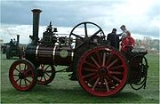
A traction engine is a self-propelled steam engine
Steam engine

File:Steam-powered fire engine.jpgA steam engine is a heat engine that performs mechanical work using steam as its working fluid.Steam engines have a long history, going back at least 2000 years....
 used to move heavy loads on roads, plough ground or to provide power at a chosen location. The name derives from the Latin tractus, meaning 'drawn', since the prime function of any traction engine is to draw a load behind it. They are sometimes called road locomotives to distinguish them from (railway) steam locomotive
Steam locomotive

A steam locomotive is a locomotive powered by steam. The term usually refers to its use on railways, but can also refer to a "road locomotive" such as a traction engine or steamroller....
s – that is, steam engines that run on rails.

Traction engines tend to be large, robust and powerful, but heavy, slow, and have poor manoeuvrability.


Discussion
Ask a question about 'Traction engine'
Start a new discussion about 'Traction engine'
Answer questions from other users
Full Discussion Forum


Recent Posts


Encyclopedia


A traction engine is a self-propelled steam engine
Steam engine

File:Steam-powered fire engine.jpgA steam engine is a heat engine that performs mechanical work using steam as its working fluid.Steam engines have a long history, going back at least 2000 years....
 used to move heavy loads on roads, plough ground or to provide power at a chosen location. The name derives from the Latin tractus, meaning 'drawn', since the prime function of any traction engine is to draw a load behind it. They are sometimes called road locomotives to distinguish them from (railway) steam locomotive
Steam locomotive

A steam locomotive is a locomotive powered by steam. The term usually refers to its use on railways, but can also refer to a "road locomotive" such as a traction engine or steamroller....
s – that is, steam engines that run on rails.

Traction engines tend to be large, robust and powerful, but heavy, slow, and have poor manoeuvrability. Nevertheless, they revolutionized agriculture and road haulage at a time when the only alternative prime mover was the draught horse.

Traction Engine Exedon Lad
They became popular in industrialised countries from around 1850, when the first self-propelled portable steam engines for agricultural use were developed. Production continued well into the early part of the 20th century, when competition from internal combustion engine
Internal combustion engine

The internal combustion engine is an engine in which the combustion of a fuel occurs in a combustion chamber inside and integral to the engine. In an internal combustion engine it is always the expansion of the high temperature and pressure gases that are produced by the combustion which apply force to the movable component of the engine, such as...
 -powered tractors saw them fall out of favour, although some continued in commercial use in the UK into the 1950s and later. All types of traction engines have now been superseded, in commercial use. However, several thousand examples have been preserved worldwide, many in working order. Steam fairs are held throughout the year in the UK, and in other countries, where visitors can experience working traction engines at close hand.

Traction engines were cumbersome and ill-suited to crossing soft or heavy ground so their agricultural use was usually either "in the belt" – powering farm machinery by means of a continuous leather belt driven by the flywheel – or in pairs, dragging an implement on a cable from one side of a field to another. However, where soil conditions permitted, direct hauling of implements ("off the drawbar
Drawbar (haulage)

A drawbar is a solid coupling between a hauling vehicle and its hauled load. Drawbars are in common use with rail transport, road trailers, both large and small, industrial and recreational, and with agricultural equipment....
") was preferred – in the U.S., this led to the divergent development of the steam tractor
Steam tractor

A steam tractor is a vehicle powered by a steam engine which is used for pulling.In North America, the term steam tractor usually refers to a type of agriculture tractor powered by a steam engine, used extensively in the late 1800s and early 1900s....
.

History

Limits of technical knowledge and manufacturing technology meant that practicable road vehicles, powered by steam, did not start to appear until the early years of the 19th century.

The traction engine, in the form recognisable today, developed partly from an experiment in 1859 when Thomas Aveling modified a Clayton & Shuttleworth
Clayton & Shuttleworth

Clayton & Shuttleworth was an engineering company located at Stamp End Works, Lincoln, Lincolnshire, Lincolnshire. The company was established in 1842 when Nathaniel Clayton formed a partnership with his brother-in-law, Joseph Shuttleworth ....
 portable engine
Portable engine

A portable engine is a small steam engine, mounted on wheels or skids, which is used for driving machinery using a belt from its flywheel. It is not self-propelled and is towed to the work site by draft horses or bullocks, or even a traction engine....
, which had to be hauled from job to job by horses, into a self-propelled one. The alteration was made by fitting a long driving chain between the crankshaft and the rear axle.

Other influences were existing vehicles which were the first to be referred to as traction engines such as the Boydell engines manufactured by various companies and those developed for road haulage by Bray. The first half of the 1860s was a period of great experimentation but by the end of the decade the standard form of the traction engine had evolved and would change little over the next sixty years.

Development of traction engines, and indeed all forms of steam road transport, was hampered in the UK by a series of government acts that tried to balance various competing interests, those of other types of vehicles as well as those maintaining the roads. Until the quality of roads improved there was little demand for faster vehicles and engines were geared accordingly to cope with their use on both roads and farm tracks.

Right through to the first decades of the twentieth century, manufacturers continued to seek a solution to realise the economic benefits of direct-pull ploughing, and, particularly in North America
North America

North America is the northern continent of the Americas, situated in the Earth's northern hemisphere and almost totally in the western hemisphere....
, this led to the American development of the steam tractor
Steam tractor

A steam tractor is a vehicle powered by a steam engine which is used for pulling.In North America, the term steam tractor usually refers to a type of agriculture tractor powered by a steam engine, used extensively in the late 1800s and early 1900s....
. British companies such as Mann's and Garrett
Richard Garrett & Sons

Richard Garrett & Sons was a manufacturer of agricultural machinery, steam engines and trolleybuses. Their factory was Leiston Works, in Leiston, Suffolk, United Kingdom....
 developed potentially-viable direct ploughing engines, however market conditions were against them, and they failed to gain widespread popularity. These market conditions arose in the wake of the First World War
World War I

World War I, or the First World War , was a global military conflict which involved the Great powers, organized into two opposing military alliances: the Allies of World War I and the Central Powers....
 when there was a glut of surplus equipment available as a result of British Government policy. Large numbers of Fowler ploughing engines had been constructed in order to increase the land under tillage during the war, and many new light Fordson F tractors had been imported from 1917 onwards.

The last new UK-built traction engines were constructed in the 1930s, although many continued in commercial use for many years, while there remained experienced enginemen available to drive them.

From the 1950s, the 'preservation movement' started to build up as enthusiasts realised that these lumbering beasts were in danger of dying out. Many of the remaining engines were snapped-up by enthusiasts, and restored to working order. Traction engine rallies began, initially as races between engine owners and their charges, later developing into the significant tourist attractions that takes place in many locations each year. It has been estimated that over two thousand traction engines have been preserved.

Operation

See: steam engine
Steam engine

File:Steam-powered fire engine.jpgA steam engine is a heat engine that performs mechanical work using steam as its working fluid.Steam engines have a long history, going back at least 2000 years....
 for a description of how the actual engine worked


Although the first traction engines employed a chain drive, it is more typical for large gears to be used to transfer the drive from the crankshaft to the rear axle.

The machines typically have two large powered wheels at the back and two smaller wheels for steering at the front. However, some traction engines used a four-wheel-drive variation, and some experimented with an early form of caterpillar track
Caterpillar track

File:279-7.jpgContinuous tracks are large tracks used on the so-called caterpillar tanks, engineering vehicle and certain other off-road vehicles....
.

A simple animation showing the steam cycle of a traction engine, the operation of the valve gear and the reversing mechanism, may be found here: .

Types and usage

Traction engines saw commercial use in a variety of roles between the mid-nineteenth and mid-twentieth centuries. Each role required a machine with a different set of characteristics, and the traction engine evolved into a number of different types to suit these different roles.

Agricultural (general purpose) engine

The most common form in the countryside. They were used for hauling and as a stationary power source. Even when farmers did not own such a machine they would rely upon it from time to time. Many farms would use draught horses throughout the year, but during the harvest, threshing contractors would travel from farm to farm hauling the threshing machine
Threshing machine

The thrashing machine, or, in modern spelling, threshing machine , was a machine first invented by Scotland mechanical engineer Andrew Meikle for use in agriculture....
 which would be set up in the field and powered from the engine – a good example of the moveable stationary engine.

U.S. (agricultural) traction engine
Favourable soil conditions meant that U.S. traction engines usually pulled their ploughs behind them, thereby eliminating the complexities of providing a cable drum and extra gearing, hence simplifying maintenance. American traction engines were manufactured in a variety of sizes, with the 6 nhp Russell being the smallest commercially made, and the large engines made by Russell, Case, and Reeves being the largest.

Ploughing engine

Johnfowlertractionengine
A distinct form of traction engine, characterised by the provision of a large diameter winding drum driven by separate gearing from the steam engine. Onto the drum a long length of wire rope was wound, which was used to haul an implement, such as a plough, across a field.

The winding drum was either mounted horizontally (below the boiler), vertically (to one side), or even concentrically, so that it encircled the boiler. The majority were under-slung (horizontal), however, and necessitated the use of an extra-long boiler to allow enough space for the drum to fit between the front and back wheels. These designs were the largest and longest traction engines to be built.

Mostly the ploughing engines worked in pairs, one on each side of the field, with the rope from each machine fastened to the implement to be hauled. The two drivers communicated by signals using the engine whistles.

A variety of implements were constructed for use with ploughing engines. The most common were the balance plough
Plough

The plough is a tool used in farming for initial cultivation of soil in preparation for sowing seed or planting. It has been a basic instrument for most of recorded history, and represents one of the major advances in agriculture....
 and the cultivator
Cultivator

A cultivator is a farming implement for stirring and pulverizing the soil, either before planting or to remove weeds and to aerate and loosen the soil after the crop has begun to grow....
 - ploughing and cultivating being the most physically demanding jobs to do on an arable farm. Other implements could include a mole drainer, used to create an underground drainage channel or pipe, or a dredger bucket for dredging rivers or moats.

The engines were frequently provided with a 'spud tray' on the front axle, to store the 'spuds' which would be fitted to the wheels when travelling across claggy ground.

The man credited with the invention of the ploughing engine, in the mid-nineteenth century, was John Fowler
John Fowler (agricultural engineer)

John Fowler was an English agricultural engineer who was a pioneer in the use of steam engines for ploughing and digging drainage channels. His inventions significantly reduced the cost of ploughing farmland, and also enabled the drainage of previously uncultivated land in many parts of the world....
, an English agricultural engineer and inventor.

Ploughing engines were rare in the U.S.; ploughs were usually hauled directly by an agricultural engine or steam tractor
Steam tractor

A steam tractor is a vehicle powered by a steam engine which is used for pulling.In North America, the term steam tractor usually refers to a type of agriculture tractor powered by a steam engine, used extensively in the late 1800s and early 1900s....
.

Steam tractor (U.S.)

In North America
North America

North America is the northern continent of the Americas, situated in the Earth's northern hemisphere and almost totally in the western hemisphere....
, the term steam tractor usually refers to a type of agricultural
Agriculture

Agriculture refers to the production of food and goods through farming and forestry. Agriculture was the key development that led to the rise of civilization, with the animal husbandry of domestication animals and plants creating food surpluses that enabled the development of more Population density and Social stratification societies....
 tractor
Tractor

File:John Deere 3350 tractor cut.JPGA tractor is a vehicle specifically designed to deliver a high tractive effort at slow speeds, for the purposes of hauling a trailer or machinery used in agriculture or construction....
 powered by a steam engine
Steam engine

File:Steam-powered fire engine.jpgA steam engine is a heat engine that performs mechanical work using steam as its working fluid.Steam engines have a long history, going back at least 2000 years....
, used extensively in the late 1800s and early 1900s.

Steam tractor (UK)

In Great Britain
Great Britain

Great Britain is an island lying to the northwest of Continental Europe. It is the List of islands by area, and the largest in Europe. With a population of 58.9 million people it is List of islands by population....
, the term steam tractor is more usually applied to the smallest models of traction engine – typically those weighing seven tons or less – used for hauling small loads on public roads. Although known as light steam tractors, these engines are generally just smaller versions of the road locomotive
Traction engine

A traction engine is a self-propelled steam engine used to move heavy loads on roads, plough ground or to provide power at a chosen location. The name derives from the Latin tractus, meaning 'drawn', since the prime function of any traction engine is to draw a load behind it....
.

They were popular in the timber trade in the UK, although variations were also designed for general light road haulage and showman's use.

The most popular of these designs was probably the Garrett
Richard Garrett & Sons

Richard Garrett & Sons was a manufacturer of agricultural machinery, steam engines and trolleybuses. Their factory was Leiston Works, in Leiston, Suffolk, United Kingdom....
 4CD, meaning 4 nominal horse power Compound
Compound locomotive

A compound engine unit is a type of steam engine where steam is expanded in two or more phases....
.

Road locomotive

Dsc 0315
Designed for haulage of heavy loads on public highways, it was not uncommon for two or even three to be coupled together to allow heavier loads to be handled.

The characteristic features of these engines are very large rear driving wheels fitted with solid rubber tyres; three-speed gearing (most traction engine types have only two gears); rear suspension; and belly tanks to provide a greater range between the stops needed to replenish water. All these features are to improve the ride and performance of the engine, which used to be used for journeys of hundreds of miles. Most road locomotives are fitted with a winch drum on the back axle. This can be used by removing the driving pins that secure the rear wheels, allowing the drive train to power the winch drum instead of the wheels.

A number of road locomotives are fitted with a crane
Crane (machine)

A crane is a lifting machine equipped with a winder , wire ropes or chains and Sheave that can be used both to lift and lower materials and to move them horizontally....
 boom on the front. The boom pivot is mounted on the front axle assembly, and a small winch
Winch

A winch is a mechanical device that is used to pull in or let out or otherwise adjust the "tension" of a rope or wire rope . In its simplest form it consists of a spool and attached hand crank ....
 is mounted on an extension to the smokebox in front of the chimney; the cable passing over a sheave
Sheave

* Sheave , the wheel of a pulley* Sceafa, a legendary Lombardic king...
 at the top of the boom arm. The winch is powered by bevel gears on a shaft driven directly from the engine, with some form of clutch providing raise/lower control. These road locomotives can be used to load a trailer as well as to haul it to a new location. They are often referred to as 'crane engines'.

A particularly distinctive form of road locomotive was the Showman's engine
Showman's road locomotive

A Showman's road locomotive or showman's engine is a steam engine road-going 'locomotive' designed to provide power and transport for a travelling fair or circus....
. These were operated by travelling showmen both to tow fairground equipment and to power it when set up; either directly or by running a generator. These could be highly decorated and formed part of the spectacle of the fair. Some were fitted with a small crane that could be used when assembling the ride.

Steamroller

Steamrollerfowler
Another distinct form of the steam traction engine, used for road building and flattening ground. Typically designed with a single heavy roller replacing the front wheels and axle, and smooth rear wheels without strakes.

Some traction engines were designed to be convertible: the same basic machine could be fitted with either standard ('treaded' or tyred) road wheels, or else smooth rolls – the changeover between the two being achieved in less than half a day.

Relatives of the traction engine

Foden 5 Ton Steam Lorry Registration Wx 2682
A number of other steam-powered vehicles share design features with the traction engine, usually because the same technology was re-used in a new application.

Portable engine


A portable engine is a type of self-contained steam engine and boiler combination that may be moved from site to site. Although bearing a strong family resemblance, in both appearance and (stationary) operation, the portable engine is not classed as a traction engine as it is not self-propelled. However, it is included in this list because the traction engine is a direct descendant.

Steam wagon

A steam wagon is a steam
Steam

In physical chemistry, and in engineering, steam refers to vaporized water. It is a pure, completely invisible gaseous phase . At standard temperature and pressure, pure steam occupies about 1,600 times the volume of an equal mass of liquid water....
-powered road vehicle for carrying freight. It was the earliest form of lorry
Lorry

Lorry may refer to:Transport:* Lorry or truck, a large motor vehicle* Lorry, called a tippler in the UK, an open Gondola #Lorry with a tipping trough...
 (truck) and came in two basic forms: overtype and undertype – the distinction being the position of the engine
Steam engine

File:Steam-powered fire engine.jpgA steam engine is a heat engine that performs mechanical work using steam as its working fluid.Steam engines have a long history, going back at least 2000 years....
 relative to the boiler
Boiler

A boiler is a closed Pressure vessel in which water or other fluid is heated. The heated or vaporized fluid exits the boiler for use in various processes or heating applications....
. The overtype had a steam engine mounted on top of a fire-tube boiler
Fire-tube boiler

A fire-tube boiler is a type of boiler in which hot gases from a fire pass through one or more tubes running through a sealed container of water....
, in a similar manner to a traction engine. The front of an overtype steam wagon bears a close family resemblance to traction engines, and manufacturers who made both may well have been able to use some common parts.

Steam wagons were the dominant form of powered road traction for commercial haulage in the early part of the twentieth century, although they were a largely British phenomenon, with few manufacturers outside Great Britain. Competition from internal-combustion-powered vehicles and adverse legislation meant that few remained in commercial use beyond the Second World War.

Traction engines as railway locomotives

Several traction engine builders (such as Aveling and Porter
Aveling and Porter

Aveling and Porter was a United Kingdom agricultural engine and steam roller manufacturer. Thomas Aveling and Richard Thomas Porter entered into partnership in 1862, developed a steam engine three years later in 1865 and produced more of the machines than all the other British manufacturers combined....
 and Fowler
John Fowler & Co.

John Fowler & Co Engineers of Leathley Road, Hunslet, Leeds, West Yorkshire, England produced traction engines and Plough implements and equipment, as well as railway equipment....
) built light railway locomotives based on their traction engines. In their crudest form these simply had flanged steel wheels to enable them to run on rails. More sophisticated models had the boiler and engine mounted on a chassis
Chassis

A chassis consists of a Frame that supports an inanimate object, analogous to an animal's skeleton, for example in a motor vehicle or a firearm....
 which carried railway-wagon style axles. The rear axle was driven from the engine by gear or chain-drive. These unusual locomotives were sold to small industries for use in shunting and marshalling duties, although they also found favour with engineering firms engaged in the construction of mainline railways for hauling men, equipment and materials over the partly-constructed line.

Terminology

  • spud or lug – strip of angled metal that could be bolted to the driving wheels to provide greater traction on soft or heavy ground. Spuds were often required on ploughing engines when moving across farmland.


  • strake – name for the diagonal strips cast into or rivetted onto the wheel rims to provide traction on unmade ground (similar to the tread on a pneumatic tyre).


  • Nominal horse power– NHP is the typical way that traction engines are rated. However, it has long been accepted that nominal horse power
    Horsepower

    Horsepower is the name of several non-International System of Units units of power . It was originally defined to allow the output of steam engines to be measured and compared with the power output of draft horses....
     understates the actual power of the engine. There are many ways to estimate the actual horse power but none of them gives an accurate answer, for example, a 4NHP engine is said to be approximately ; however a 4NHP engine can happily pull a laden 8-wheeler lorry while a diesel engine of cannot. Thus, many have resigned themselves that this debate will never be settled and, while NHP gives a very appropriate way of rating traction engine, it may never be converted accurately into diesel HP.


Modern use

Although no longer used commercially, traction engines of all types continue to be maintained and preserved by enthusiastic individuals and are frequently exhibited at agricultural shows in Europe (particularly the UK), Canada and the United States. They are often a main attraction in a live steam
Live steam

Live steam is steam under pressure, obtained by heating water in a boiler. The steam is used to operate stationary or moving equipment.A live steam machine or device is one powered by steam, but the term is usually reserved for those that are replicas, scale models, toys, or otherwise used for Cultural heritage, museum, entertainment, or...
 festival (see List of steam fairs
List of steam fairs

A steam fair is a regular organised gathering of steam engine vehicles and machinery. Typical exhibits include: traction engines, steam rollers, steam wagons, steam cars and portable engines....
)
.

Model traction engines, powered by steam, are manufactured by several companies, notably Mamod
Mamod

The Mamod company is a British toy manufacturer specializing in building live steam models. The company was founded in 1937 in Birmingham in the British midlands by Geoffrey Malins....
 and Wilesco. Larger scale model engines are popular subjects for model engineers to construct, either as a supplied kit of parts, or machined from raw materials.

Traction engines in popular culture

On film
See also: Steam rollers on film
Steamroller

A steamroller is a form of road roller – a type of heavy construction machinery used for levelling surfaces, such as roads or airfields – that is powered by a steam engine....
  • The 1962 film The Iron Maiden featured a showman's engine as the film's star, along with many others, at the annual rally at Woburn Abbey
    Woburn Abbey

    Woburn Abbey, near Woburn, Bedfordshire, Bedfordshire, England, is the seat of the Duke of Bedford and the location of the Woburn Safari Park....
    .


In fiction
See also: Steam rollers in fiction
Steamroller

A steamroller is a form of road roller – a type of heavy construction machinery used for levelling surfaces, such as roads or airfields – that is powered by a steam engine....
  • Trevor the Traction Engine
    Trevor the Traction Engine

    Trevor the Traction Engine is a fictional anthropomorphic character from The Railway Series children's books by the W.V. Awdry, and the spin-off TV Series Thomas the Tank Engine and Friends....
     is one of the non-railway characters featured in The Railway Series
    The Railway Series

    The Railway Series is a set of story books about a fictional railway system located on the fictional Sodor and the locomotive that lived on it....
     of children's books by the Rev. W. Awdry
    W.V. Awdry

    Wilbert Vere Awdry, Order of the British Empire, , better known as the Reverend W. Awdry, was a clergyman, railfan and children's author....
    . Appearing in several of the books, the traction engine was originally 'saved from scrap' by The Vicar of Wellsworth
    Fictional locations in The Railway Series

    There are many fictional locations in The Railway Series of books by W.V. Awdry and his son Christopher Awdry. This is a summary of the locations as they appear in The Railway Series books....
     with the help of Edward the Blue Engine
    Edward the Blue Engine

    Edward the Blue Engine is a fictional anthropomorphic steam locomotive from The Railway Series by W.V. Awdry, and the TV Series Thomas the Tank Engine and Friends....
    . Trevor has also appeared in a number of episodes in the TV spin-off Thomas the Tank Engine and Friends
    Thomas the Tank Engine and Friends

    Thomas and Friends is a United Kingdom children's television series, first broadcast on Central Television in June 1984. Until Season 7, which premiered in 2003, it was named Thomas the Tank Engine and Friends....
    .


  • In the book Gumdrop and The Farmer's Friend, by Val Biro
    Val Biro

    Val Biro , children's author, artist and illustrator, was a native of Hungary now resident in Sussex in England. He received his education in Budapest and London....
    , the vintage motor-car Gumdrop is rescued from a snowy ditch by "The Farmer's Friend", a traction engine belonging to a local farmer. Some months later, the two vehicles are instrumental in thwarting a pair of car thieves.
    The end-papers of the book include a simplified cut-away drawing of the traction engine: a single-cylinder, 6 NHP Fowler
    John Fowler & Co.

    John Fowler & Co Engineers of Leathley Road, Hunslet, Leeds, West Yorkshire, England produced traction engines and Plough implements and equipment, as well as railway equipment....
     light tractor, built in 1903.


On television
  • Fred Dibnah
    Fred Dibnah

    Fred Dibnah Order of the British Empire , born in Bolton, Lancashire, was an English steeplejack, engineer and eccentricity who became a television personality, a cult figure and, latterly, a national institution....
     of Bolton
    Bolton

    Bolton is a large town in Greater Manchester, in the North West England region of England.Situated close to the West Pennine Moors, north west of the city of Manchester, it is the largest and most populous settlement of the Metropolitan Borough of Bolton, the former county borough of Bolton has a population of 139,403, though this figure d...
    , England
    England

    native_name =|conventional_long_name = England|common_name = England|image_flag = Flag of England.svg|image_coat = England COA.svg|symbol_type = Royal Coat of Arms...
     was known as a National Institution for the conservation of old traction engines in Great Britain
    Great Britain

    Great Britain is an island lying to the northwest of Continental Europe. It is the List of islands by area, and the largest in Europe. With a population of 58.9 million people it is List of islands by population....
    . His television series, Fred Dibnah's Made in Britain, shows him touring the United Kingdom
    United Kingdom

    The United Kingdom of Great Britain and Northern Ireland, commonly known as the United Kingdom , the UK or Britain,is a sovereign state located off the northwestern coast of continental Europe....
     in his rebuilt, 10 ton
    Ton

    Units of massThere are several similar units of mass or volume called the ton:Others*The long ton is used for petroleum products such as aviation fuel....
     traction engine.


Manufacturers

Poyle Pump 022
:See List of traction engine manufacturers
List of traction engine manufacturers

Great BritainThere were a large number of manufacturers in Great Britain. Most started life as agricultural engineers, and many exported engines all over the world....


See also

  • Live steam
    Live steam

    Live steam is steam under pressure, obtained by heating water in a boiler. The steam is used to operate stationary or moving equipment.A live steam machine or device is one powered by steam, but the term is usually reserved for those that are replicas, scale models, toys, or otherwise used for Cultural heritage, museum, entertainment, or...
  • Steam tractor
    Steam tractor

    A steam tractor is a vehicle powered by a steam engine which is used for pulling.In North America, the term steam tractor usually refers to a type of agriculture tractor powered by a steam engine, used extensively in the late 1800s and early 1900s....
  • Museum of English Rural Life
    Museum of English Rural Life

    The Museum of English Rural Life was founded by the University of Reading, England, in 1951 to record the changing face of farming and the countryside....
     (MERL) – UK national collection of history of farming
  • List of steam fairs
    List of steam fairs

    A steam fair is a regular organised gathering of steam engine vehicles and machinery. Typical exhibits include: traction engines, steam rollers, steam wagons, steam cars and portable engines....
     – where preserved traction engines may be seen in action


Research

  • (MERL
    Museum of English Rural Life

    The Museum of English Rural Life was founded by the University of Reading, England, in 1951 to record the changing face of farming and the countryside....
    )

  •    Covers mainly-US traction engines and steam tractors, threshing machine
    Threshing machine

    The thrashing machine, or, in modern spelling, threshing machine , was a machine first invented by Scotland mechanical engineer Andrew Meikle for use in agriculture....
    s and steam-powered agricultural machinery.
  • preserved traction engines in the UK, Europe, Australia and New Zealand
  • UK-based preserved traction engines
  • Information regarding UK-based traction engines
  • at the Tractor & Construction Plant Wiki


External links


History

  • Timeline, 1700 - 1914 (MERL
    Museum of English Rural Life

    The Museum of English Rural Life was founded by the University of Reading, England, in 1951 to record the changing face of farming and the countryside....
    )
  • evolution, from earliest experiments to widespread manufacture, plus definitions of the six main types
  • particularly covers the very early years as different techniques were tried
  • (c.1871) report of trial of Fiskens Steam Cultivation Machinery (a windlass ploughing apparatus) -- including description and diagram
  • Timeline including early development history of steam-powered road vehicles (from Hampshire County Council Museum Service)
  • the first gasoline-powered traction engine, and forerunner of the John Deere tractor range
  • (plus lots of history of early Aveling products)
  • charitable society founded in 1937 for education and research into history of traction engines and portable engines


Preservation


Further information

  • also see Nominal Horse Power
    Horsepower

    Horsepower is the name of several non-International System of Units units of power . It was originally defined to allow the output of steam engines to be measured and compared with the power output of draft horses....
  • page at the RitchieWiki equipment and industry wiki