

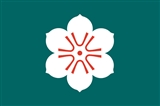
Saga Prefecture

Encyclopedia
is located in the northwest part of the island of Kyūshū
, Japan. It touches both the Sea of Japan
and the Ariake Sea
. The western part of the prefecture
is a region famous for producing ceramics
and porcelain
, particularly the towns of Karatsu
, Imari
, and Arita
. The capital is the city of Saga
.
 In ancient times the area composed by Nagasaki Prefecture
and Saga Prefecture was called Hizen Province
. The current name dates from the Meiji Restoration
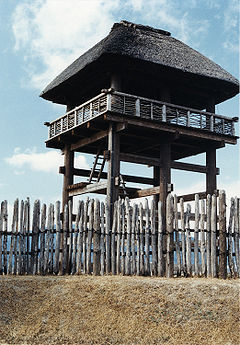
. Rice farming culture has prospered here since ancient times, and vestiges can be seen at the ruins of Nabatake in Karatsu
and the Yoshinogari site
in Yoshinogari
.
to the Muromachi period
it is thought that over 100 feudal clans existed. Also exerting great influence during this time was a samurai clan operating along the Genkai Sea
called the Matsuratō. Upon entering the Sengoku period
, the Ryūzōji clan
expanded their control to include all of Hizen and Chikugo Province
s, and part of Higo
and Chikuzen Province
s. After the death of daimyo
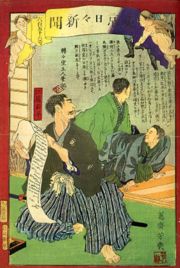
Takanobu Ryūzōji, Naoshige Nabeshima took control of the political situation, and by 1607 all of the Ryūzōji clan's domain was under the control of the Nabeshima clan
.
 In the Edo period
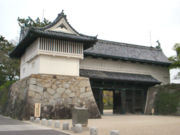
this area was called the Saga Domain
(佐賀藩 Saga-han), and it included three sub-domains: the Hasunoike, Ogi and Kashima Domains. Also within the current borders of Saga Prefecture during this time were the Karatsu Domain
(唐津藩 Karatsu-han) and two territories of the Tsushima-Fuchū Domain (対馬府中藩 Tsushimafuchū-han). Saga Domain and its sub-domains continued to be ruled by the Nabeshima clan, its various illegitimate family lineages and members of the former Ryūzōji clan, and politically the area was relatively stable. However, the cost of defending Nagasaki was increasing and, difficult from the start, the financial situation was worsened by the great Kyōhō
famine and the Siebold Typhoon of 1828. Nevertheless, due to the large area of reclaimed land from the Ariake Sea
arable land was able to increase significantly and by the 1840s the annual koku
of Saga Domain increased to about 670,000, twice that of 200 years before.
Around the middle of the 19th century, Naomasa Nabeshima strove to set right the domain's financial affairs, reduce the number of government officials, and encourage local industry such as Arita porcelain, green tea
, and coal. Also, thanks to the proximity of the international port of Nagasaki, new technologies were introduced from overseas, such as the reverberatory furnace
and models of steam locomotive
s.
After the Boshin war
, many people from Saga Domain assisted in the Meiji Restoration
. In the Meiji era the modernization of coal mines in Kishima
and Higashimatsuura districts
, among others, progressed bolstered by the construction of railroads.
's smallest prefecture
, Saga, is located on the northwest corner of the island, bordered by the Genkai Sea
and the Tsushima Strait
to the north and the Ariake Sea
to the south. Saga's proximity to mainland Asia has made it an important gateway for the transmission of culture and trade throughout Japanese history. Largely rural outside of the two largest cities of Saga
and Karatsu
, agricultural and forested lands comprise over 68% of the total prefectural land area. There are six prefectural parks and one quasi-national park in Saga.
Kyushu
is the third largest island of Japan and most southwesterly of its four main islands. Its alternate ancient names include , , and . The historical regional name is referred to Kyushu and its surrounding islands....
, Japan. It touches both the Sea of Japan
Sea of Japan
The Sea of Japan is a marginal sea of the western Pacific Ocean, between the Asian mainland, the Japanese archipelago and Sakhalin. It is bordered by Japan, North Korea, Russia and South Korea. Like the Mediterranean Sea, it has almost no tides due to its nearly complete enclosure from the Pacific...
and the Ariake Sea
Ariake Sea
The is a body of salt water surrounded by Fukuoka, Saga, Nagasaki, and Kumamoto Prefectures, all of which lie on the island of Kyūshū in Japan. It is the largest bay in Kyūshū. Its deepest point is only about 50 m deep, and extreme tides exceed 4 m. It is used for aquaculture, with nori...
. The western part of the prefecture
Prefectures of Japan
The prefectures of Japan are the country's 47 subnational jurisdictions: one "metropolis" , Tokyo; one "circuit" , Hokkaidō; two urban prefectures , Osaka and Kyoto; and 43 other prefectures . In Japanese, they are commonly referred to as...
is a region famous for producing ceramics
Ceramics (art)
In art history, ceramics and ceramic art mean art objects such as figures, tiles, and tableware made from clay and other raw materials by the process of pottery. Some ceramic products are regarded as fine art, while others are regarded as decorative, industrial or applied art objects, or as...
and porcelain
Porcelain
Porcelain is a ceramic material made by heating raw materials, generally including clay in the form of kaolin, in a kiln to temperatures between and...
, particularly the towns of Karatsu
Karatsu, Saga
is a city located in Saga Prefecture on the island of Kyūshū, Japan. Its name, formed from the Japanese word roots 唐 kara , and 津 tsu , signifies its historical importance as an ancient trading port between Japan with China and Korea...
, Imari
Imari, Saga
is a city located in Saga Prefecture on the island of Kyūshū, Japan. Imari is most notable because of Imari porcelain, which is the European collectors' name for Japanese porcelain wares made in the town of Arita, Saga Prefecture. The porcelain was exported from the port of Imari specifically for...
, and Arita
Arita, Saga
is a town located in Nishimatsuura District, Saga, Japan. It is known for producing Arita porcelain, one of the traditional handicrafts of Japan. It also holds the largest ceramic fair in Western Japan, the Arita Ceramic Fair...
. The capital is the city of Saga
Saga, Saga
is the capital of Saga Prefecture, located on the island of Kyūshū, Japan.Saga was the capital of Saga Domain in the Edo period, and largest city of former Hizen Province....
.
History
Nagasaki Prefecture
is a prefecture of Japan located on the island of Kyūshū. The capital is the city of Nagasaki.- History :Nagasaki Prefecture was created by merging of the western half of the former province of Hizen with the island provinces of Tsushima and Iki...
and Saga Prefecture was called Hizen Province
Hizen Province
was an old province of Japan in the area of Saga and Nagasaki prefectures. It was sometimes called , with Higo Province. Hizen bordered on the provinces of Chikuzen and Chikugo. The province was included in Saikaidō...
. The current name dates from the Meiji Restoration
Meiji Restoration
The , also known as the Meiji Ishin, Revolution, Reform or Renewal, was a chain of events that restored imperial rule to Japan in 1868...
. Rice farming culture has prospered here since ancient times, and vestiges can be seen at the ruins of Nabatake in Karatsu
Karatsu, Saga
is a city located in Saga Prefecture on the island of Kyūshū, Japan. Its name, formed from the Japanese word roots 唐 kara , and 津 tsu , signifies its historical importance as an ancient trading port between Japan with China and Korea...
and the Yoshinogari site
Yoshinogari site
Yoshinogari is the name of a large and complex Yayoi archaeological site in Yoshinogari and Kanzaki in Saga Prefecture, Kyūshū, Japan. According to the Yayoi chronology established by pottery seriations in the 20th century, Yoshinogari dates to between the 3rd century BC and the 3rd century AD...
in Yoshinogari
Yoshinogari, Saga
is a town located in Kanzaki District, Saga Prefecture, Japan. It is the result of a merger between the town of Mitagawa, and the village of Higashisefuri, both from Kanzaki District, on March 1, 2006.-Geography:...
.
Feudal period
From the Kamakura periodKamakura period
The is a period of Japanese history that marks the governance by the Kamakura Shogunate, officially established in 1192 in Kamakura by the first shogun Minamoto no Yoritomo....
to the Muromachi period
Muromachi period
The is a division of Japanese history running from approximately 1336 to 1573. The period marks the governance of the Muromachi or Ashikaga shogunate, which was officially established in 1338 by the first Muromachi shogun, Ashikaga Takauji, two years after the brief Kemmu restoration of imperial...
it is thought that over 100 feudal clans existed. Also exerting great influence during this time was a samurai clan operating along the Genkai Sea
Genkai Sea
The is a body of water that comprises the southwestern tip of the Sea of Japan and borders the northern coasts of Fukuoka and Saga prefectures....
called the Matsuratō. Upon entering the Sengoku period
Sengoku period
The or Warring States period in Japanese history was a time of social upheaval, political intrigue, and nearly constant military conflict that lasted roughly from the middle of the 15th century to the beginning of the 17th century. The name "Sengoku" was adopted by Japanese historians in reference...
, the Ryūzōji clan
Ryuzoji clan
The was a Japanese clan which claimed descent from Fujiwara Hidesato. It came to prominence in the Sengoku period, in the fighting in northern Kyūshū. Their descendants became retainers of the Matsudaira clan of Aizu, and remained there until the Meiji Restoration...
expanded their control to include all of Hizen and Chikugo Province
Chikugo Province
is the name of a former province of Japan in the area that is today the southern part of Fukuoka Prefecture on Kyūshū. It was sometimes called , with Chikuzen Province...
s, and part of Higo
Higo Province
Higo Province was an old province of Japan in the area that is today Kumamoto Prefecture on the island of Kyūshū. It was sometimes called , with Hizen Province. Higo bordered on Chikugo, Bungo, Hyūga, Ōsumi, and Satsuma Provinces....
and Chikuzen Province
Chikuzen Province
was an old province of Japan in the area that is today part of Fukuoka Prefecture in Kyūshū. It was sometimes called , with Chikugo Province. Chikuzen bordered Buzen, Bungo, Chikugo, and Hizen Provinces....
s. After the death of daimyo
Daimyo
is a generic term referring to the powerful territorial lords in pre-modern Japan who ruled most of the country from their vast, hereditary land holdings...
Takanobu Ryūzōji, Naoshige Nabeshima took control of the political situation, and by 1607 all of the Ryūzōji clan's domain was under the control of the Nabeshima clan
Nabeshima clan
The Nabeshima clan was a prominent Japanese samurai clan of Kyūshū which controlled Saga Domain from the late Sengoku period through the Edo period.The Nabeshima clan was a cadet branch of the Shōni clan and was descended from the Fujiwara clan...
.
Edo period
The , or , is a division of Japanese history which was ruled by the shoguns of the Tokugawa family, running from 1603 to 1868. The political entity of this period was the Tokugawa shogunate....
this area was called the Saga Domain
Saga Domain
Saga Domain was a han, or feudal domain, in Tokugawa period Japan. Largely contiguous with Hizen Province on Kyūshū, the domain was governed from Saga Castle in the capital city of Saga by the Nabeshima clan of tozama daimyō...
(佐賀藩 Saga-han), and it included three sub-domains: the Hasunoike, Ogi and Kashima Domains. Also within the current borders of Saga Prefecture during this time were the Karatsu Domain
Karatsu Domain
' was a Japanese domain of the Edo period, located in Hizen Province, in Kyūshū. Its seat of government was in Karatsu Castle, in modern-day Karatsu, Saga.-History:...
(唐津藩 Karatsu-han) and two territories of the Tsushima-Fuchū Domain (対馬府中藩 Tsushimafuchū-han). Saga Domain and its sub-domains continued to be ruled by the Nabeshima clan, its various illegitimate family lineages and members of the former Ryūzōji clan, and politically the area was relatively stable. However, the cost of defending Nagasaki was increasing and, difficult from the start, the financial situation was worsened by the great Kyōhō
Kyoho
was a after Shōtoku and before Gembun. This period spanned the years from July 1716 through April 1736. The reigning emperors were and .-Change of era:...
famine and the Siebold Typhoon of 1828. Nevertheless, due to the large area of reclaimed land from the Ariake Sea
Ariake Sea
The is a body of salt water surrounded by Fukuoka, Saga, Nagasaki, and Kumamoto Prefectures, all of which lie on the island of Kyūshū in Japan. It is the largest bay in Kyūshū. Its deepest point is only about 50 m deep, and extreme tides exceed 4 m. It is used for aquaculture, with nori...
arable land was able to increase significantly and by the 1840s the annual koku
Koku
The is a Japanese unit of volume, equal to ten cubic shaku. In this definition, 3.5937 koku equal one cubic metre, i.e. 1 koku is approximately 278.3 litres. The koku was originally defined as a quantity of rice, historically defined as enough rice to feed one person for one year...
of Saga Domain increased to about 670,000, twice that of 200 years before.
Around the middle of the 19th century, Naomasa Nabeshima strove to set right the domain's financial affairs, reduce the number of government officials, and encourage local industry such as Arita porcelain, green tea
Green tea
Green tea is made solely from the leaves of Camellia sinensis that have undergone minimal oxidation during processing. Green tea originates from China and has become associated with many cultures throughout Asia. It has recently become more widespread in the West, where black tea is traditionally...
, and coal. Also, thanks to the proximity of the international port of Nagasaki, new technologies were introduced from overseas, such as the reverberatory furnace
Reverberatory furnace
A reverberatory furnace is a metallurgical or process furnace that isolates the material being processed from contact with the fuel, but not from contact with combustion gases...
and models of steam locomotive
Steam locomotive
A steam locomotive is a railway locomotive that produces its power through a steam engine. These locomotives are fueled by burning some combustible material, usually coal, wood or oil, to produce steam in a boiler, which drives the steam engine...
s.
After the Boshin war
Boshin War
The was a civil war in Japan, fought from 1868 to 1869 between forces of the ruling Tokugawa shogunate and those seeking to return political power to the imperial court....
, many people from Saga Domain assisted in the Meiji Restoration
Meiji Restoration
The , also known as the Meiji Ishin, Revolution, Reform or Renewal, was a chain of events that restored imperial rule to Japan in 1868...
. In the Meiji era the modernization of coal mines in Kishima
Kishima District, Saga
is a district located in Saga Prefecture, Japan.As of February 1, 2009, the district has an estimated population of 45,085 and a density of 318 persons per km²...
and Higashimatsuura districts
Higashimatsuura District, Saga
is a district located in Saga Prefecture, Japan. At the present it has only one town.As of February 1, 2009, the district has an estimated population of 21,066 and a density of 320 persons per km²...
, among others, progressed bolstered by the construction of railroads.
Timeline
- 6th century BC (end of the Jomon periodJomon periodThe is the time in Japanese prehistory from about 14,000 BC to 300 BC.The term jōmon means "cord-patterned" in Japanese. This refers to the pottery style characteristic of the Jōmon culture, and which has markings made using sticks with cords wrapped around them...
) – Estimated date of the Nabatake ruins in KaratsuKaratsu, Sagais a city located in Saga Prefecture on the island of Kyūshū, Japan. Its name, formed from the Japanese word roots 唐 kara , and 津 tsu , signifies its historical importance as an ancient trading port between Japan with China and Korea... - 1st century BC (middle of the Yayoi periodYayoi periodThe is an Iron Age era in the history of Japan traditionally dated 300 BC to 300 AD. It is named after the neighbourhood of Tokyo where archaeologists first uncovered artifacts and features from that era. Distinguishing characteristics of the Yayoi period include the appearance of new...
) – Villages flourished at what is now the Yoshinogari siteYoshinogari siteYoshinogari is the name of a large and complex Yayoi archaeological site in Yoshinogari and Kanzaki in Saga Prefecture, Kyūshū, Japan. According to the Yayoi chronology established by pottery seriations in the 20th century, Yoshinogari dates to between the 3rd century BC and the 3rd century AD... - 665 – After losing the Battle of BaekgangBattle of BaekgangThe Battle of Baekgang, also known as Battle of Baekgang-gu or by the Japanese name Battle of Hakusukinoe , was a battle between Baekje restoration forces and their ally, Yamato Japan, against the allied forces of Silla and the Tang Dynasty of ancient China...
, Kii Castle (in present day KiyamaKiyama, Sagais a town located in Miyaki District, Saga Prefecture, Japan on the island of Kyūshū. It can be considered part of an economic sphere with nearby cities Tosu in Saga Prefecture and Ogōri and Kurume in Fukuoka Prefecture...
) amassed its defenses to protect Dazaifu. - 733 – Hizen FudokiFudokiare ancient records of the culture and geography of provinces of Japan. They contain agricultural, geographical, historical and mythological records, as well as folklore.Compilation of Fudoki began in 713 and was completed over a 20-year period....
created. - 1274 – Battle of Bun'eiBattle of Bun'eiThe , also known as the First Battle of Hakata Bay was the first attempt by the Yuan Dynasty founded by the Mongols to invade Japan. After conquering the Tsushima Island and Iki, Kublai Khan's fleet moved on to Japan proper, landing at Hakata Bay, a short distance from Kyūshū's administrative...
, the first invasion in the Mongol invasions of JapanMongol invasions of JapanThe ' of 1274 and 1281 were major military efforts undertaken by Kublai Khan to conquer the Japanese islands after the submission of Goryeo to vassaldom. Despite their ultimate failure, the invasion attempts are of macrohistorical importance, because they set a limit on Mongol expansion, and rank... - 1281 – Battle of KōanBattle of KoanThe ', also known as the Second Battle of Hakata Bay, was the second attempt by the Yuan Dynasty founded by the Mongols to invade Japan...
, the second invasion in the Mongol invasions of Japan - 1591 – Construction of Nagoya CastleNagoya, Sagawas the location of a castle in Matsuura District, Hizen Province. Today, the area is part of Chinzei in the city of Karatsu in Saga prefecture.Toyotomi Hideyoshi made Nagoya his base for directing the invasion of Korea.-References:...
. After the Japanese invasions of Korea the castle fell in 1598. - 1602 – Construction of Karatsu CastleKaratsu Castleis a Japanese castle located in Karatsu, Saga Prefecture, Japan. It is a hirayama-jō, a castle built on a plains rather than a hill or mountain. At the end of the Edo period, Karatsu castle was home to the Ogasawara clan, daimyo of Karatsu Domain...
and Saga CastleSaga Castleis a Japanese castle located in Saga City, Saga Prefecture, Japan. It is a hiraijirō, a castle built on a plains rather than a hill or mountain, and is surrounded by a wall rather than being built above a stone base. Saga castle was home to the Nabeshima clan, daimyō of Saga Domain...
. - 1607 – Control of Saga DomainSaga DomainSaga Domain was a han, or feudal domain, in Tokugawa period Japan. Largely contiguous with Hizen Province on Kyūshū, the domain was governed from Saga Castle in the capital city of Saga by the Nabeshima clan of tozama daimyō...
moved from the Ryūzōji clanRyuzoji clanThe was a Japanese clan which claimed descent from Fujiwara Hidesato. It came to prominence in the Sengoku period, in the fighting in northern Kyūshū. Their descendants became retainers of the Matsudaira clan of Aizu, and remained there until the Meiji Restoration...
to the Nabeshima clanNabeshima clanThe Nabeshima clan was a prominent Japanese samurai clan of Kyūshū which controlled Saga Domain from the late Sengoku period through the Edo period.The Nabeshima clan was a cadet branch of the Shōni clan and was descended from the Fujiwara clan...
. - 1771 – NijinomatsubaraNijinomatsubarais a 360 year old pine forest in Karatsu, Saga. It has a width of 400 - 700 metres, a length of about 4 km, and a total area of 240 hectares. It was also referred as , however this name is uncommon today....
Uprising - 1781 – Establishment of Kōdōkan, the Saga Han schoolHan schoolThe han school was an educational institution in the Edo period of Japan, originally established to educate children of daimyo and their retainers in the domains outside of the capital...
. - 1828 – Heavy damage from the Siebold Typhoon, deaths estimated at over 10,000.
- 1871, July 14 – Abolition of the han systemAbolition of the han systemThe was an act, in 1871, of the new Meiji government of the Empire of Japan to replace the traditional feudal domain system and to introduce centralized government authority . This process marked the culmination of the Meiji Restoration in that all daimyo were required to return their authority...
. All of the han became prefecturesPrefectures of JapanThe prefectures of Japan are the country's 47 subnational jurisdictions: one "metropolis" , Tokyo; one "circuit" , Hokkaidō; two urban prefectures , Osaka and Kyoto; and 43 other prefectures . In Japanese, they are commonly referred to as...
.
- 1871, November 14 – The prefectures of Saga, Hasuike, Ogi, Kashima, Karatsu and part of Tsushima merged to form one prefecture, Imari Prefecture.
- 1872, May 29 – Imari Prefecture renamed Saga Prefecture.
- 1874, February – Saga RebellionSaga RebellionThe was an 1874 uprisings in Kyūshū against the new Meiji government of Japan. It was led by Etō Shimpei and Shima Yoshitake in their native domain of Hizen.-Background:...
. - 1876, April 18 – Incorporation of Mizuma Prefecture.
- 1883 – Separation from Nagasaki PrefectureNagasaki Prefectureis a prefecture of Japan located on the island of Kyūshū. The capital is the city of Nagasaki.- History :Nagasaki Prefecture was created by merging of the western half of the former province of Hizen with the island provinces of Tsushima and Iki...
. - 1889, April 1 – The city of SagaSaga, Sagais the capital of Saga Prefecture, located on the island of Kyūshū, Japan.Saga was the capital of Saga Domain in the Edo period, and largest city of former Hizen Province....
is founded. - 1891 – The Kyushu Railroad Nagasaki Line opens, beginning with a section from TosuTosu, Sagais a city located in the east part of Saga Prefecture on the island of Kyūshū, Japan.-Overview:Tosu is one of the major transportation hubs of Kyūshū. Its main train station is Tosu Station which connects the Nagasaki Main Line and the Kagoshima Main Line. There is also a junction connecting the...
to Saga.*1895 – Opening of railroad from Saga to TakeoTakeo, Sagais a city located in Saga Prefecture on the island of Kyūshū, Japan.-Geography:Takeo is located in the western part of Saga Prefecture. It is approximately west of Saga City and approximately east of Sasebo. Takeo has a complex topography including mountains, mountain basins and riverside...
. - 1897 – Opening of railroad from Takeo to Haiki.
- 1903 – Opening of railroad from Saga to Nishi-Karatsu.
- 1932, January 1 – The city of KaratsuKaratsu, Sagais a city located in Saga Prefecture on the island of Kyūshū, Japan. Its name, formed from the Japanese word roots 唐 kara , and 津 tsu , signifies its historical importance as an ancient trading port between Japan with China and Korea...
is founded. - 1935 – The Japanese National RailwaysJapanese National Railways, abbreviated or "JNR", was the national railway network of Japan from 1949 to 1987.-History:The term Kokuyū Tetsudō "state-owned railway" originally referred to a network of railway lines operated by nationalized companies under the control of the Railway Institute following the nationalization...
Saga Line opens. - 1954 – During the Great Showa MergerMerger and dissolution of municipalities of JapanMunicipal mergers and dissolutions carried out in Japan can take place within one municipality or between multiple municipalities and are required to be based upon consensus.- Merger policy:...
the cities of Tosu, ImariImari, Sagais a city located in Saga Prefecture on the island of Kyūshū, Japan. Imari is most notable because of Imari porcelain, which is the European collectors' name for Japanese porcelain wares made in the town of Arita, Saga Prefecture. The porcelain was exported from the port of Imari specifically for...
, Takeo, KashimaKashima, Sagais a city located in the southern part of Saga Prefecture on the island of Kyūshū, Japan.-Geography:Kashima is located about 60 kilometers southwest of Saga City. It borders the Ariake Sea to the east and Nagasaki Prefecture to the southwest...
and TakuTaku, Sagais a city located in Saga Prefecture on the island of Kyūshū, Japan.The city was founded on May 1, 1954 through the merger of several towns and villages.-Elementary Schools:*Hokubu Elementary School*Midori-ga-Oka Elementary School*Tobu Elementary School...
are formed. At this point there are 7 cities, 8 districts, 18 towns and 35 villages in Saga Prefecture. - 1972 – With the closing of the Nishiki coal mine, all coal mines in Saga are closed.
- 1975 – The Genkai Nuclear Power PlantGenkai Nuclear Power PlantThe is a nuclear power plant located in the town of Genkai in the Higashimatsuura District in the Saga Prefecture. It is owned and operated by the Kyūshū Electric Power Company.Unit 3 has been selected as a special Plutonium fuel test case...
begins operation. - 1987 – The Japanese National Railways Saga Line closes.
- 1992 – The Yoshinogari History ParkYoshinogari siteYoshinogari is the name of a large and complex Yayoi archaeological site in Yoshinogari and Kanzaki in Saga Prefecture, Kyūshū, Japan. According to the Yayoi chronology established by pottery seriations in the 20th century, Yoshinogari dates to between the 3rd century BC and the 3rd century AD...
opens to the public. - 1998 – The Saga AirportSaga Airportis an airport in the Kawasoe area of Saga, Saga Prefecture, Japan.-Airlines and destinations:-External links:*...
opens in KawasoeKawasoe, Sagawas a town located in Saga District, Saga, Japan.On October 1, 2007 Kawasoe, along with the towns of Higashiyoka and Kubota, all from Saga District, was merged into the expanded city of Saga....
, in what is now the city of Saga. - 2005 – As a part of the Great Heisei MergerMerger and dissolution of municipalities of JapanMunicipal mergers and dissolutions carried out in Japan can take place within one municipality or between multiple municipalities and are required to be based upon consensus.- Merger policy:...
various municipalities are reorganized.- January 1 – KaratsuKaratsu, Sagais a city located in Saga Prefecture on the island of Kyūshū, Japan. Its name, formed from the Japanese word roots 唐 kara , and 津 tsu , signifies its historical importance as an ancient trading port between Japan with China and Korea...
and ShiroishiShiroishi, Sagais a town located in Kishima District, Saga Prefecture, Japan.On January 1, 2005 Shiroshi absorbed the towns of Fukudomi and Ariake, all from Kishima District, to become the new and expanded town of Shiroshi.-Geography:...
. - March 1 – OgiOgi, Sagais a city located in the central part of Saga on the island of Kyūshū, Japan.On March 3, 2005 Ogi District was dissolved when the old town of Ogi absorbed the towns of Ashikari, Mikatsuki and Ushizu, all from Ogi District, to become Ogi City...
and MiyakiMiyaki, Sagais a town in Miyaki District, Saga Prefecture, Japan. It is the first town in Saga to have its name spelled in hiragana rather than kanji. It is named after the district it is located in.-Geography:...
. - October 1 – SagaSaga, Sagais the capital of Saga Prefecture, located on the island of Kyūshū, Japan.Saga was the capital of Saga Domain in the Edo period, and largest city of former Hizen Province....
.
- January 1 – Karatsu
- 2006 – The Great Heisei Merger continues.
- January 1 – KaratsuKaratsu, Sagais a city located in Saga Prefecture on the island of Kyūshū, Japan. Its name, formed from the Japanese word roots 唐 kara , and 津 tsu , signifies its historical importance as an ancient trading port between Japan with China and Korea...
and UreshinoUreshino, Sagais a city located in the western part of Saga Prefecture on the island of Kyūshū, Japan. The city was formed on January 1, 2006 by the merger of the towns of Ureshino and Shiota...
. - March 1 – TakeoTakeo, Sagais a city located in Saga Prefecture on the island of Kyūshū, Japan.-Geography:Takeo is located in the western part of Saga Prefecture. It is approximately west of Saga City and approximately east of Sasebo. Takeo has a complex topography including mountains, mountain basins and riverside...
, YoshinogariYoshinogari, Sagais a town located in Kanzaki District, Saga Prefecture, Japan. It is the result of a merger between the town of Mitagawa, and the village of Higashisefuri, both from Kanzaki District, on March 1, 2006.-Geography:...
, and AritaArita, Sagais a town located in Nishimatsuura District, Saga, Japan. It is known for producing Arita porcelain, one of the traditional handicrafts of Japan. It also holds the largest ceramic fair in Western Japan, the Arita Ceramic Fair...
. - March 20 – KanzakiKanzaki, Sagais a city located in Saga Prefecture, Japan. The city was created on March 20, 2006 by the merger of the towns of Kanzaki and Chiyoda, and the village of Sefuri, all from Kanzaki District...
.
- January 1 – Karatsu
- 2007, October 1 – The towns of HigashiyokaHigashiyoka, Sagawas a town located in Saga District, Saga, Japan.On October 1, 2007 Higashiyoka, along with the towns of Kawasoe and Kubota, all from Saga District, was merged into the expanded city of Saga....
, KawasoeKawasoe, Sagawas a town located in Saga District, Saga, Japan.On October 1, 2007 Kawasoe, along with the towns of Higashiyoka and Kubota, all from Saga District, was merged into the expanded city of Saga....
and KubotaKubota, Sagawas a town located in Saga District, Saga, Japan.On October 1, 2007 Kubota, along with the towns of Higashiyoka and Kawasoe, all from Saga District, was merged into the expanded city of Saga....
merge with the city of Saga. - 2011, March 12 – The Kyūshū ShinkansenKyushu ShinkansenThe ' is a Japanese high-speed railway line between the Japanese cities of Fukuoka and Kagoshima in Kyushu, running parallel to the existing Kagoshima Main Line and operated by the Kyushu Railway Company . The southern 127 km opened on 13 March 2004...
opens.
Geography
KyūshūKyushu
is the third largest island of Japan and most southwesterly of its four main islands. Its alternate ancient names include , , and . The historical regional name is referred to Kyushu and its surrounding islands....
's smallest prefecture
Prefectures of Japan
The prefectures of Japan are the country's 47 subnational jurisdictions: one "metropolis" , Tokyo; one "circuit" , Hokkaidō; two urban prefectures , Osaka and Kyoto; and 43 other prefectures . In Japanese, they are commonly referred to as...
, Saga, is located on the northwest corner of the island, bordered by the Genkai Sea
Genkai Sea
The is a body of water that comprises the southwestern tip of the Sea of Japan and borders the northern coasts of Fukuoka and Saga prefectures....
and the Tsushima Strait
Tsushima Strait
is the eastern channel of the Korea Strait, which lies between Korea and Japan, connecting the Sea of Japan and the East China Sea.The Tsushima Strait is the broader eastern channel to the east and southeast of Tsushima Island, with the Japanese islands of Honshū to the east and northeast, and...
to the north and the Ariake Sea
Ariake Sea
The is a body of salt water surrounded by Fukuoka, Saga, Nagasaki, and Kumamoto Prefectures, all of which lie on the island of Kyūshū in Japan. It is the largest bay in Kyūshū. Its deepest point is only about 50 m deep, and extreme tides exceed 4 m. It is used for aquaculture, with nori...
to the south. Saga's proximity to mainland Asia has made it an important gateway for the transmission of culture and trade throughout Japanese history. Largely rural outside of the two largest cities of Saga
Saga, Saga
is the capital of Saga Prefecture, located on the island of Kyūshū, Japan.Saga was the capital of Saga Domain in the Edo period, and largest city of former Hizen Province....
and Karatsu
Karatsu, Saga
is a city located in Saga Prefecture on the island of Kyūshū, Japan. Its name, formed from the Japanese word roots 唐 kara , and 津 tsu , signifies its historical importance as an ancient trading port between Japan with China and Korea...
, agricultural and forested lands comprise over 68% of the total prefectural land area. There are six prefectural parks and one quasi-national park in Saga.
- Northernmost point: Enuonohana, Kakarajima, KaratsuKaratsu, Sagais a city located in Saga Prefecture on the island of Kyūshū, Japan. Its name, formed from the Japanese word roots 唐 kara , and 津 tsu , signifies its historical importance as an ancient trading port between Japan with China and Korea...
– 33°36′N 129°51′E - Easternmost point: Iida-machi, TosuTosu, Sagais a city located in the east part of Saga Prefecture on the island of Kyūshū, Japan.-Overview:Tosu is one of the major transportation hubs of Kyūshū. Its main train station is Tosu Station which connects the Nagasaki Main Line and the Kagoshima Main Line. There is also a junction connecting the...
– 33°23′N 130°32′E - Southernmost point: Ōurakō, TaraTara, Sagais a town and peninsula located in Fujitsu District, Saga, Japan.-Geography:Tara is bordered by Isahaya, Ōmura, Kashima and the Ariake Sea. On a clear day, it is possible to see the mountains across the sea. Tara includes Mount Tara and Mount Kyoga, which are two of the highest mountains in...
– 32°57′N 130°13′E - Westernmost point: Ōse, Madarashima, Karatsu – 33°34′N 129°44′E
Mountains
- Sefuri Mountains, Tara Mountains
- Mount Kyōga (1,076 m, the highest point in Saga), Mount Sefuri (1,056 m), Tenzan (1,046 m), Taradake (996 m ), Mount Ihara (962 m), Kinzan (957 m), Raizan (955 m), Mount Hagane (900 m)
Rivers and lakes
- Chikugo RiverChikugo RiverThe flows through Kumamoto, Ōita, Fukuoka and Saga prefectures in Japan. With a total length of , it is the longest river on Kyūshū. It flows from Mount Aso and empties into the Ariake Sea. It is also nicknamed "Chikushijirō"...
(15.5 km in Saga), Kase River (57.5 km), Matsuura River (45.3 km), Rokkaku River (43.6 km) - Hokuzan Dam, Kase River Dam
Seas
- East China SeaEast China SeaThe East China Sea is a marginal sea east of China. It is a part of the Pacific Ocean and covers an area of 1,249,000 km² or 750,000 square miles.-Geography:...
: Ariake SeaAriake SeaThe is a body of salt water surrounded by Fukuoka, Saga, Nagasaki, and Kumamoto Prefectures, all of which lie on the island of Kyūshū in Japan. It is the largest bay in Kyūshū. Its deepest point is only about 50 m deep, and extreme tides exceed 4 m. It is used for aquaculture, with nori...
, Isahaya Bay - Sea of JapanSea of JapanThe Sea of Japan is a marginal sea of the western Pacific Ocean, between the Asian mainland, the Japanese archipelago and Sakhalin. It is bordered by Japan, North Korea, Russia and South Korea. Like the Mediterranean Sea, it has almost no tides due to its nearly complete enclosure from the Pacific...
: Genkai SeaGenkai SeaThe is a body of water that comprises the southwestern tip of the Sea of Japan and borders the northern coasts of Fukuoka and Saga prefectures....
, Karatsu Bay, Imari Bay,
Islands
- Genkai Sea: Takashima, Kashiwajima, Ogawajima, KakarajimaKakarajimaKakarajima or Kagara sima is an island to the north of Yobuko, which is in the Higashimatsuura District of Saga, Japan.It is 1.75 miles long from north to south, and three quarters of a mile wide, with steep shores....
, Matsushima, Madarajima, Kabeshima, Mukushima - Ariake Sea: Okinoshima
Land use
Total area: 2439.31 km² ,
- Forest, rough lands: 49.2% – 1/3 of the national average.
- Forested area: 1096.9 km² – From 2000, 42nd in the country.
- Arable landArable landIn geography and agriculture, arable land is land that can be used for growing crops. It includes all land under temporary crops , temporary meadows for mowing or pasture, land under market and kitchen gardens and land temporarily fallow...
: 39.1% – 2 times the national average. - Residential: 6.8% – 1.4 times the national average.
- Other: 4.9% – Roughly the same as the national average.
Climate
Saga Prefecture has a mild climate with an average temperate of about 16 degrees Celsius (61 degrees Fahrenheit).Municipalities
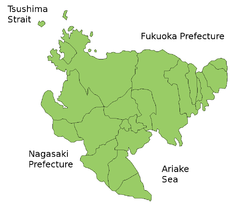
Cities of Japan
||A is a local administrative unit in Japan. Cities are ranked on the same level as and , with the difference that they are not a component of...
, 6 districts
Districts of Japan
The was most recently used as an administrative unit in Japan between 1878 and 1921 and is roughly equivalent to the county of the United States, ranking at the level below prefecture and above city, town or village. As of 2008, cities belong directly to prefectures and are independent from...
, and 10 towns
Towns of Japan
A town is a local administrative unit in Japan. It is a local public body along with prefecture , city , and village...
in Saga Prefecture, a total of 20 municipalities. As a part of the Great Heisei Merger, the number of municipalities has decreased since January 1, 2005 . On March 20, 2006 the village of Sefuri
Sefuri, Saga
was a village located in Kanzaki District, Saga, Japan.As of 2003, the village had an estimated population of 1,941 and a population density of 31.86 persons per km². The total area was 60.93 km²....
merged with the city of Kanzaki
Kanzaki, Saga
is a city located in Saga Prefecture, Japan. The city was created on March 20, 2006 by the merger of the towns of Kanzaki and Chiyoda, and the village of Sefuri, all from Kanzaki District...
, leaving Saga with no more villages.
Cities
|
Saga, Saga is the capital of Saga Prefecture, located on the island of Kyūshū, Japan.Saga was the capital of Saga Domain in the Edo period, and largest city of former Hizen Province.... (capital) Takeo, Saga is a city located in Saga Prefecture on the island of Kyūshū, Japan.-Geography:Takeo is located in the western part of Saga Prefecture. It is approximately west of Saga City and approximately east of Sasebo. Takeo has a complex topography including mountains, mountain basins and riverside... Taku, Saga is a city located in Saga Prefecture on the island of Kyūshū, Japan.The city was founded on May 1, 1954 through the merger of several towns and villages.-Elementary Schools:*Hokubu Elementary School*Midori-ga-Oka Elementary School*Tobu Elementary School... Tosu, Saga is a city located in the east part of Saga Prefecture on the island of Kyūshū, Japan.-Overview:Tosu is one of the major transportation hubs of Kyūshū. Its main train station is Tosu Station which connects the Nagasaki Main Line and the Kagoshima Main Line. There is also a junction connecting the... Ureshino, Saga is a city located in the western part of Saga Prefecture on the island of Kyūshū, Japan. The city was formed on January 1, 2006 by the merger of the towns of Ureshino and Shiota... |
Towns
|
Kamimine, Saga is a town located in Miyaki District, Saga, Japan.-Geography:Kamimine is located in the eastern part of Saga Prefecture about east of central Saga, the capital city. It is also about west of Kurume, a major city in Fukuoka Prefecture. There is a lot of flat land in Kamimine as the town area... Kiyama, Saga is a town located in Miyaki District, Saga Prefecture, Japan on the island of Kyūshū. It can be considered part of an economic sphere with nearby cities Tosu in Saga Prefecture and Ogōri and Kurume in Fukuoka Prefecture... Miyaki, Saga is a town in Miyaki District, Saga Prefecture, Japan. It is the first town in Saga to have its name spelled in hiragana rather than kanji. It is named after the district it is located in.-Geography:...
Arita, Saga is a town located in Nishimatsuura District, Saga, Japan. It is known for producing Arita porcelain, one of the traditional handicrafts of Japan. It also holds the largest ceramic fair in Western Japan, the Arita Ceramic Fair... |
Metropolitan areas
- Saga
- Saga, Taku, Ogi, Kanzaki
- Karatsu-Higashimatsuura
- Karatsu, Genkai
- Tosu
- Tosu, Kamimine, Kiyama, Yoshinogari, Miyaki
- Kitō
- Takeo, Kashima, Ureshino, Shiroishi, Ōmachi, Kōhoku, Tara
Economy
Agriculture, forestryForestry
Forestry is the interdisciplinary profession embracing the science, art, and craft of creating, managing, using, and conserving forests and associated resources in a sustainable manner to meet desired goals, needs, and values for human benefit. Forestry is practiced in plantations and natural stands...
, and coastal fisheries form a large portion of the prefectural economy. Regional agricultural specialties include Saga beef, onions, and strawberries. The prefecture is the largest producer of mochigome (sticky rice) and greenhouse
Greenhouse
A greenhouse is a building in which plants are grown. These structures range in size from small sheds to very large buildings...
mandarin oranges in Japan.
According to 2002 figures, regional trade exports are focused primarily towards North America (29.3%), Western Europe (26.1%), and the Newly Industrializing Economies of South Korea
South Korea
The Republic of Korea , , is a sovereign state in East Asia, located on the southern portion of the Korean Peninsula. It is neighbored by the People's Republic of China to the west, Japan to the east, North Korea to the north, and the East China Sea and Republic of China to the south...
, Taiwan, Hong Kong and Singapore
Singapore
Singapore , officially the Republic of Singapore, is a Southeast Asian city-state off the southern tip of the Malay Peninsula, north of the equator. An island country made up of 63 islands, it is separated from Malaysia by the Straits of Johor to its north and from Indonesia's Riau Islands by the...
(19.9%). Imports come principally from North America (40.6%), the ASEAN nations (23.3%), and the People's Republic of China (12.2%).
Universities
- Saga UniversitySaga University; abbreviated as or , is a higher education institution in Saga, Japan.The University has 5 faculties with a total of around about 7,000 students. Its 2 campuses are in and .-History:...
- Nishikyushu UniversityNishikyushu Universityis a private university in Kanzaki, Saga, Japan. The school was established in 1968.-External links:*...
- Saga Women's Junior College
- Saga Junior CollegeSaga Junior Collegeis a private junior college in Saga, Saga, Japan. The predecessor of the school was founded in 1946, and it was chartered as a university in 1963.-External links:*...
- Kyushu Ryukoku Junior CollegeKyushu Ryukoku Junior Collegeis a private junior college in Tosu, Saga, Japan, established in 1952. The predecessor of the school was founded in 1878.-External links:*...
- Saga Prefectural Agricultural College
Demographics
As of 2002, the census recorded a population 873,885 in Saga. Of these, 15.9% were aged 0–14, 62.7% were age 15–64, and 21.4% were over 65 years old. There were 3,596 foreigners (.4%) and 307 exchange students (.03%) living in the prefecture.Rail
Major stations in the prefecture include Saga StationSaga Station
is a train station in Saga City, Saga Prefecture, Japan. It is operated by JR Kyushu and is on the Nagasaki Main Line. Trains from this station also continue on to the Sasebo and Karatsu Lines. About 25,000 people pass through Saga Station every day...
, Tosu Station
Tosu Station
is a train station in Tosu city, Saga prefecture, Japan. It is operated by JR Kyushu and is the point where the Kagoshima Main Line and the Nagasaki Main Line intersect...
, Karatsu Station
Karatsu Station
is a train station in Karatsu, Saga Prefecture, Japan. It is operated by JR Kyushu and is on the Karatsu and Chikuhi lines. It is the main station of Karatsu City.-Environs:*Karatsu Castle*Maizuru Park*Hikiyama Exhibition Hall*Showa Bus Ōteguchi Bus Center...
and Imari Station. The new Kyūshū Shinkansen
Kyushu Shinkansen
The ' is a Japanese high-speed railway line between the Japanese cities of Fukuoka and Kagoshima in Kyushu, running parallel to the existing Kagoshima Main Line and operated by the Kyushu Railway Company . The southern 127 km opened on 13 March 2004...
line stop at the Shin-Tosu Station
Shin-Tosu Station
is a train station in Tosu, Saga, Japan, operated by Kyushu Railway Company . The station opened on March 12, 2011. The name of the station was officially announced by JR Kyushu on December 17, 2010.-Lines:...
.
- JR Kyushu
- Chikuhi LineChikuhi LineThe is a railway line in Japan running from Meinohama Station in Fukuoka City, Fukuoka Prefecture to Karatsu Station in Karatsu City, Saga Prefecture, and from Yamamoto Station in Karatsu City, Saga Prefecture to Imari Station in Imari City, Saga Prefecture....
- Kagoshima Main LineKagoshima Main LineThe is a major railway line operated by the Kyushu Railway Company between Mojikō in Kitakyūshū, and Kagoshima Station in Kagoshima City, at the southern end of Kyushu...
- Karatsu LineKaratsu LineThe is a regional railway line in Saga Prefecture, Japan running from Kubota Station in Saga to Nishi-Karatsu Station in Karatsu. It was originally constructed to carry coal from the Karatsu coal field to the Port of Karatsu.-Route data:*Operators and distances...
- Kyūshū ShinkansenKyushu ShinkansenThe ' is a Japanese high-speed railway line between the Japanese cities of Fukuoka and Kagoshima in Kyushu, running parallel to the existing Kagoshima Main Line and operated by the Kyushu Railway Company . The southern 127 km opened on 13 March 2004...
- Nagasaki Main Line
- Sasebo LineSasebo LineThe is a railway line in Japan running from Hizen-Yamaguchi Station in Kōhoku, Saga Prefecture to Sasebo Station in Sasebo, Nagasaki Prefecture. It is part of the route connecting Sasebo with Saga and Fukuoka...
- Chikuhi Line
- Matsuura RailwayMatsuura Railwayis a third sector railway company in Nagasaki and Saga Prefecture in Japan.-Principal investors:* Nagasaki Prefecture * Lucky Taxi * Tsuji Industry * Saihi Motor -History:...
- Nishi-Kyūshū LineNishi-Kyushu LineThe is a Japanese railway line operated by Matsuura Railway, which runs between Arita in Saga Prefecture and Sasebo in Nagasaki Prefecture.-Stations:Rapid Service: Down trains operate between Saza and Sasebo. Up trains operate between Sasebo and Tabira-Hiradoguchi.-History:The line was opened on...
- Nishi-Kyūshū Line
- Amagi Railway
Road
- Tollways
- Nagasaki ExpresswayNagasaki Expressway' is one of the Expressways of Japan from Tosu to Nagasaki. It runs through the prefecture of Saga, and the southern half of the Nagasaki prefecture...
, Kyūshū ExpresswayKyushu Expressway' is one of the Expressways of Japan from Kitakyūshū to west of Kagoshima linking with the Higashi Kyushu Expressway and the Ibusuki Skyline. It runs through the prefectures of Fukuoka, the eastern half of the Saga, Kumamoto, Miyazaki and the Kagoshima prefectures. The freeway runs entirely on...
, Nishikyūshū Expressway - Nijō-Hamatama Road, Kyūragi-Taku Road, Mitsuse Tunnel
- Nagasaki Expressway
- National highwaysNational highways of JapanJapan has a nationwide system of distinct from the expressways. The Ministry of Land, Infrastructure and Transport and other government agencies administer the national highways. Beginning in 1952, Japan classified these as Class 1 or Class 2. Class 1 highways had one- or two-digit numbers, while...
- Route 34, Route 35
- Route 202Route 202 (Japan)National Route 202 is a national highway of Japan connecting Hakata-ku, Fukuoka and Nagasaki, Nagasaki in Japan, with a total length of 199.6 km ....
, Route 203Route 203 (Japan)National Route 203 is a national highway of Japan connecting Karatsu, Saga and Saga, Saga in Japan, with a total length of 47.3 km ....
, Route 204Route 204 (Japan)National Route 204 is a national highway of Japan connecting Karatsu, Saga and Sasebo, Nagasaki in Japan, with a total length of 157 km ....
, Route 207, Route 263Route 263 (Japan)National Route 263 is a national highway of Japan connecting Sawara-ku, Fukuoka and Saga, Saga in Japan, with a total length of 48 km ....
, Route 264Route 264 (Japan)National Route 264 is a national highway of Japan connecting Saga, Saga and Kurume, Fukuoka in Japan, with a total length of 27.4 km ....
, Route 323Route 323 (Japan)National Route 323 is a national highway of Japan connecting Saga, Saga and Karatsu, Saga in Japan, with a total length of 46.8 km ....
, Route 385Route 385 (Japan)National Route 385 is a national highway of Japan connecting Yanagawa, Fukuoka and Hakata-ku, Fukuoka in Japan, with a total length of 68.1 km ....
, Route 444, Route 498
Culture
AritaArita, Saga
is a town located in Nishimatsuura District, Saga, Japan. It is known for producing Arita porcelain, one of the traditional handicrafts of Japan. It also holds the largest ceramic fair in Western Japan, the Arita Ceramic Fair...
, Imari and Karatsu
Karatsu, Saga
is a city located in Saga Prefecture on the island of Kyūshū, Japan. Its name, formed from the Japanese word roots 唐 kara , and 津 tsu , signifies its historical importance as an ancient trading port between Japan with China and Korea...
are famous for the beautiful porcelain that is created there. The top porcelain houses in the country are located in these areas, including Imaemon Porcelain, Genemon Porcelain and Fukagawa Porcelain.
Saga International Balloon Fiesta
The Saga International Balloon FiestaSaga International Balloon Fiesta
The is held at the beginning of November every year in Saga Prefecture, Japan. In 2009 it will take place between October 30 and November 3.The fiesta is held just outside of Saga City, along the Kase River...
is held at the beginning of November every year just outside of Saga City
Saga, Saga
is the capital of Saga Prefecture, located on the island of Kyūshū, Japan.Saga was the capital of Saga Domain in the Edo period, and largest city of former Hizen Province....
along the Kase River. This is a very popular event and attracts competitors from all over the world.
Karatsu Kunchi
The Karatsu KunchiKaratsu Kunchi
Karatsu Kunchi is a Japanese festival that takes place annually in the city of Karatsu, Saga Prefecture, on Japan's island of Kyūshū.- About :...
is held at the beginning of November in Karatsu City
Karatsu, Saga
is a city located in Saga Prefecture on the island of Kyūshū, Japan. Its name, formed from the Japanese word roots 唐 kara , and 津 tsu , signifies its historical importance as an ancient trading port between Japan with China and Korea...
. This is Saga's most famous festival and attracts around 500,000 visitors every year.
Kashima Gatalympics
The Kashima GatalympicsKashima Gatalympics
The Kashima Gatalympics is an event held in the mudflats of the Ariake Sea off Kashima city in Saga Prefecture, Japan. The event takes place every year at the end of May....
are held every May–June in the city of Kashima
Kashima, Saga
is a city located in the southern part of Saga Prefecture on the island of Kyūshū, Japan.-Geography:Kashima is located about 60 kilometers southwest of Saga City. It borders the Ariake Sea to the east and Nagasaki Prefecture to the southwest...
. This event involves playing a variety of sports in the mudflats of the Ariake Sea. For 2009 event, gatalympic will be held on June 7. Gatalympic will not be held if the weather is raining.
Imari Ton-Ten-Ton Festival
The Imari Ton-Ten-Ton FestivalImari Ton-Ten-Ton Festival
The Imari Ton-Ten-Ton Festival is a fighting festival held every year in the city of Imari, Saga Prefecture, Japan. Beginning at the Imari Shrine, the festival is well known as one of the three great fighting festivals of Japan.- External links :...
is held for 3 days every year near the end of October. Located in Imari City
Imari, Saga
is a city located in Saga Prefecture on the island of Kyūshū, Japan. Imari is most notable because of Imari porcelain, which is the European collectors' name for Japanese porcelain wares made in the town of Arita, Saga Prefecture. The porcelain was exported from the port of Imari specifically for...
, the festival is one of the three great fighting festivals in Japan. In the festival a crashing battle takes place between the two huge portable shrines, the Ara-mikoshi and the Danjiri. The name "Ton-Ten-Ton" represents the sound of drums used in the festival.
Sports Teams
Teams listed below are based in Saga Prefecture.Football (soccer)
- Sagan TosuSagan Tosuis a Japanese professional football club, currently playing in the J. League Division 2. The team is located in Tosu, Saga Prefecture.Sagan is a coined word with a couple of meanings behind it. One of its homophones is in Japanese. This symbolises many small elements uniting to form one...
(TosuTosu, Sagais a city located in the east part of Saga Prefecture on the island of Kyūshū, Japan.-Overview:Tosu is one of the major transportation hubs of Kyūshū. Its main train station is Tosu Station which connects the Nagasaki Main Line and the Kagoshima Main Line. There is also a junction connecting the...
)
Volleyball
- Hisamitsu SpringsHisamitsu SpringsHisamitsu Springs is a women's volleyball team based in Kobe city, Hyogo and Tosu city, Saga, Japan. It plays in V.Premier League. The club was founded in 1948....
(TosuTosu, Sagais a city located in the east part of Saga Prefecture on the island of Kyūshū, Japan.-Overview:Tosu is one of the major transportation hubs of Kyūshū. Its main train station is Tosu Station which connects the Nagasaki Main Line and the Kagoshima Main Line. There is also a junction connecting the...
)
Tourism
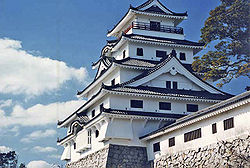
Karatsu, with its fine castleKaratsu Castle
is a Japanese castle located in Karatsu, Saga Prefecture, Japan. It is a hirayama-jō, a castle built on a plains rather than a hill or mountain. At the end of the Edo period, Karatsu castle was home to the Ogasawara clan, daimyo of Karatsu Domain...
, is a popular tourist destination in Saga. The remains of a Yayoi village in Yoshinogari
Yoshinogari, Saga
is a town located in Kanzaki District, Saga Prefecture, Japan. It is the result of a merger between the town of Mitagawa, and the village of Higashisefuri, both from Kanzaki District, on March 1, 2006.-Geography:...
also attract large numbers of sightseers. Another place to visit is Yūtoku Inari Shrine
Yutoku Inari Shrine
is a shrine located in Kashima City, Saga Prefecture. It is one of the most famous Inari shrines in Japan.- History :Dedicated to Inari, the wily fox kami, it is the third largest of its kind in Japan. It was constructed in 1688 as the family shrine of the Nabeshima clan who ruled what would become...
, one of Japan's three biggest Inari shrines.
Famous people
- ComedianOwaraiis a broad word used to describe Japanese comedy as seen on television. The word owarai is the honorific form of the word warai, meaning "a laugh" or "a smile". Owarai is most common on Japanese variety shows and the comedians are referred to as owarai geinin or owarai tarento...
and J-PopJ-pop, an abbreviation for Japanese pop, is a musical genre that entered the musical mainstream of Japan in the 1990s. Modern J-pop has its roots in 1960s music, such as The Beatles, and replaced kayōkyoku in the Japanese music scene...
singer HanawaHanawa(real name is a Japanese singer and comedian raised in Saga city. He plays the bass guitar.He rose to fame in Japan for a comical song about Saga Prefecture and its oddities.-External links:* *...
became famous for comically singing about Saga Prefecture and its oddities. - Comedian Masashi TashiroMasashi Tashirois a former Japanese television performer and the founding member of the band Rats & Star. Tashiro was a tenor vocalist for Rats & Star, and later on made himself a name as a TV entertainer in Japan...
was born in Saga Prefecture. - Musician Mukai Shutoku was born in Saga Prefecture before moving to Fukuoka PrefectureFukuoka Prefectureis a prefecture of Japan located on Kyūshū Island. The capital is the city of Fukuoka.- History :Fukuoka Prefecture includes the former provinces of Chikugo, Chikuzen, and Buzen....
to pursue his career. - World War II fighter ace Saburo SakaiSaburo SakaiSub-Lieutenant was a Japanese naval aviator and flying ace of the Imperial Japanese Navy during World War II. Sakai was the Imperial Navy's fourth-ranking ace and Japan's second leading fighter pilot to survive the war ....
was born in Saga Prefecture. - Actress and J-Pop singer Yasuko MatsuyukiYasuko Matsuyukiis a Japanese actress and singer signed to Stardust Promotion.-Biography:Yasuko Matsuyuki was born in 1972 in Tosu, Saga. In 1989, while she was in high school, Matsuyuki won a Non-no fashion magazine contest...
and her younger brother, J-Pop/Rock singer Yuna Katsuki (of Lazy Knack and RED) are from Saga city.
The Seven Wise Men Of Saga
"The Seven Wise Men of Saga" is the name given to these seven men from Saga, each of whom have made a significant contribution to the modernisation of Japan. Their contributions began in the last days of the Tokugawa ShogunateTokugawa shogunate
The Tokugawa shogunate, also known as the and the , was a feudal regime of Japan established by Tokugawa Ieyasu and ruled by the shoguns of the Tokugawa family. This period is known as the Edo period and gets its name from the capital city, Edo, which is now called Tokyo, after the name was...
, and continued into the Meiji Restoration
Meiji Restoration
The , also known as the Meiji Ishin, Revolution, Reform or Renewal, was a chain of events that restored imperial rule to Japan in 1868...
. Even today, this era shines impressively in Saga's history.
- Lord Naomasa NabeshimaNabeshima Naomasawas the 10th and final daimyō of Saga Domain in Hizen Province, Kyūshū, Japan. His honorary title was Hizen-no-Kami, and he was occasionally referred to as “Prince Hizen” in western accounts during the Bakumatsu period.-Biography:...
, feudal lord of the Nabeshima clanNabeshima clanThe Nabeshima clan was a prominent Japanese samurai clan of Kyūshū which controlled Saga Domain from the late Sengoku period through the Edo period.The Nabeshima clan was a cadet branch of the Shōni clan and was descended from the Fujiwara clan...
, helped to bring about the development of Saga through introducing European technology and culture. - Sano TsunetamiSano TsunetamiCount was a Japanese statesman and founder of the Japanese Red Cross Society. His son, Admiral Sano Tsuneha, was a leading figure in the establishment of the Scout Association of Japan.-Biography:...
founded the Japanese Red CrossJapanese Red CrossThe ' is the Japanese affiliate of the International Red Cross.The Imperial Family of Japan traditionally has supported the society, with Empress as Honorary President and other royal family members as vice-presidents. Its headquarters is located in Tokyo and local chapters are set up in all 47...
. - Shima YoshitakeShima Yoshitakewas a samurai from Saga domain. He later became a chamberlain and later a governor for Akita Prefecture.-External links:*...
contributed to the exploration of HokkaidōHokkaido, formerly known as Ezo, Yezo, Yeso, or Yesso, is Japan's second largest island; it is also the largest and northernmost of Japan's 47 prefectural-level subdivisions. The Tsugaru Strait separates Hokkaido from Honshu, although the two islands are connected by the underwater railway Seikan Tunnel...
. - Soejima TaneomiSoejima Taneomiwas a diplomat and statesman during early Meiji period Japan.-Biography:Soejima was born into a samurai family in Saga, in Hizen province . His father was a teacher in the domain's school and a scholar of National Learning . In 1866, Soejima was sent to Nagasaki by the domain leaders to study the...
served the roles of DietDiet of JapanThe is Japan's bicameral legislature. It is composed of a lower house, called the House of Representatives, and an upper house, called the House of Councillors. Both houses of the Diet are directly elected under a parallel voting system. In addition to passing laws, the Diet is formally...
member, Foreign Minister, Minister of Domestic Affairs and was well known for his Chinese Poetry and talented writing skills. - Ōki TakatōOki Takato, was a Japanese statesman during the early Meiji period. He was Governor of Tokyo in 1868 and a member of the Privy Council in 1889.Ōki was born into a samurai family in Saga, in Hizen province . He studied at the domain school Kodokan, and promoted reform of the domain administration...
was Minister of Civil Affairs, Education and Legal Affairs, held the position of a Diet member and made considerable contributions to the establishment of the modern education system in Japan. - Eto ShimpeiEto Shimpei, was a Japanese statesman during the early Meiji period, remembered chiefly for his role in the unsuccessful Saga Rebellion.- Early Life & Meiji Bureaucrat :...
, also once a Minister of Legal Affairs, became a Diet member and created the foundation for Japan's judicial system. - Ōkuma ShigenobuOkuma ShigenobuMarquis ; was a statesman in the Empire of Japan and the 8th and 17th Prime Minister of Japan...
served two terms as Prime Minister of JapanPrime Minister of JapanThe is the head of government of Japan. He is appointed by the Emperor of Japan after being designated by the Diet from among its members, and must enjoy the confidence of the House of Representatives to remain in office...
. He also established Waseda UniversityWaseda University, abbreviated as , is one of the most prestigious private universities in Japan and Asia. Its main campuses are located in the northern part of Shinjuku, Tokyo. Founded in 1882 as Tokyo Senmon Gakko, the institution was renamed "Waseda University" in 1902. It is known for its liberal climate...
.