
All Topics  
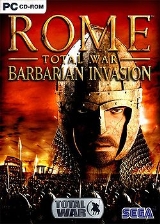
Rome: Total War: Barbarian Invasion


   Email Print
   Bookmark   Link


Rome: Total War: Barbarian Invasion


Barbarian Invasion is the first expansion for the personal computer game
Personal computer game

A personal computer game is a game played on a personal computer, rather than on a video game console or arcade machine. Computer games have evolved from the simple graphics and gameplay of early titles like Spacewar!, to a wide range of more visually advanced titles....
 Rome: Total War
Rome: Total War

Rome: Total War is a critically acclaimed strategy game composed of both turn-based strategy and real-time tactics, in which the player fights historical and fictitious battles set during late Roman Republic and early Roman Empire ....
 which takes the action forward to the period of the decline of the Western Roman Empire
Western Roman Empire

The Western Roman Empire refers to the western half of the Roman Empire, from its division by Diocletian in 285; the other half of the Roman Empire was the Eastern Roman Empire, today widely known as the Byzantine Empire....
. The campaign begins in 363 A.D. and ends in 476 A.D. If the player has not achieved the campaign goals in 476, an option to quit or to continue the game is presented. The expansion includes simulation of the religious tension of the period, as three major religions (Christianity
Christianity

Christianity is a Monotheistic religion #Christian view religion centered on the life and teachings of Jesus as New Testament view on Jesus' life....
, Zoroastrianism
Zoroastrianism

Zoroastrianism is the religion and philosophy based on the teachings ascribed to the prophet Zoroaster, after whom the religion is named. The term Zoroastrianism is in general usage, essentially synonymous with Mazdaism, i.e., the worship of Ahura Mazda, exalted by Zoroaster as the supreme divine authority....
 and Paganism
Paganism

Paganism is the blanket term given to describe religions and spiritual practices of pre-Christian Europe, and by extension a term for polytheistic?traditions or folk religion?worldwide seen from a Western or Christian viewpoint....
) fought for dominance.


Discussion
Ask a question about 'Rome: Total War: Barbarian Invasion'
Start a new discussion about 'Rome: Total War: Barbarian Invasion'
Answer questions from other users
Full Discussion Forum


Encyclopedia


Barbarian Invasion is the first expansion for the personal computer game
Personal computer game

A personal computer game is a game played on a personal computer, rather than on a video game console or arcade machine. Computer games have evolved from the simple graphics and gameplay of early titles like Spacewar!, to a wide range of more visually advanced titles....
 Rome: Total War
Rome: Total War

Rome: Total War is a critically acclaimed strategy game composed of both turn-based strategy and real-time tactics, in which the player fights historical and fictitious battles set during late Roman Republic and early Roman Empire ....
 which takes the action forward to the period of the decline of the Western Roman Empire
Western Roman Empire

The Western Roman Empire refers to the western half of the Roman Empire, from its division by Diocletian in 285; the other half of the Roman Empire was the Eastern Roman Empire, today widely known as the Byzantine Empire....
. The campaign begins in 363 A.D. and ends in 476 A.D. If the player has not achieved the campaign goals in 476, an option to quit or to continue the game is presented. The expansion includes simulation of the religious tension of the period, as three major religions (Christianity
Christianity

Christianity is a Monotheistic religion #Christian view religion centered on the life and teachings of Jesus as New Testament view on Jesus' life....
, Zoroastrianism
Zoroastrianism

Zoroastrianism is the religion and philosophy based on the teachings ascribed to the prophet Zoroaster, after whom the religion is named. The term Zoroastrianism is in general usage, essentially synonymous with Mazdaism, i.e., the worship of Ahura Mazda, exalted by Zoroaster as the supreme divine authority....
 and Paganism
Paganism

Paganism is the blanket term given to describe religions and spiritual practices of pre-Christian Europe, and by extension a term for polytheistic?traditions or folk religion?worldwide seen from a Western or Christian viewpoint....
) fought for dominance. Also depicted are the great migrations
Migration Period

The Migration Period, also called Barbarian Invasions or V?lkerwanderung , was a period of human migration which occurred within the period of roughly 300?700 Common Era in Europe, marking the transition from Late Antiquity to the Early Middle Ages....
 of the Germanic and steppe peoples (notably the Huns
Huns

The Huns were a confederation of Central Asian Eurasian nomads or semi-nomads, who had established an empire in Eurasia. The Huns may have stimulated the Migration Period, a contributing factor in the collapse of the Roman Empire....
) throughout Europe.

Gameplay


As Barbarian Invasion takes place 350 years after the end of the original game, factions and provinces are very different. Although the Roman Senate
Roman Senate

The Senate of the Roman Republic was a political institution in the ancient Roman Republic. According to the Greek historian Polybius, our principal source on the Constitution of the Roman Republic, the Roman Senate was the predominant branch of government....
 still exists it no longer has significant power, thus playing no role in the expansion. Rome has become an empire
Empire

Empire derives from the Latin word imperium, denoting ?military command? in Roman. Politically, an empire is a geographically extensive group of states and peoples united and ruled either by a monarch or an oligarchy....
, grown and then split into a Western and an Eastern empire, ruled from Rome and Constantinople
Constantinople

Constantinople was the empire capital of the Roman Empire , the Byzantine Empire , the Latin Empire , and the Ottoman Empire . Strategically located between the Golden Horn and the Sea of Marmara at the point where Europe meets Asia, Byzantine Constantinople had been the capital of a Christendom empire, successor to ancient ancient Greece...
 respectively; all Italy and the Mediterranean islands, Mauretania
Mauretania

In Antiquity, Mauretania was originally an independent Berber people monarchy on the Mediterranean coast of north Africa , corresponding to western Algeria, northern Morocco and Spain Plazas de soberan?a....
, Africa, Egypt
Egypt

Egypt is a country mainly in North Africa, with the Sinai Peninsula forming a land bridge in Western Asia. Covering an area of about , Egypt borders the Mediterranean Sea to the north, the Gaza Strip and Israel to the northeast, the Red Sea to the east, Sudan to the south and Libya to the west....
, Syria
Syria

Syria , officially the Syrian Arab Republic , is an Arab-majority country in Southwest Asia, bordering Lebanon and the Mediterranean Sea to the west, Israel to the southwest, Jordan to the south, Iraq to the east, and Turkey to the north....
 and Palestine
Palestine

Palestine is a name which has been widely used since Roman times to refer to the region between the Mediterranean Sea and the Jordan River. It is derived from a name used already much earlier for a narrower geographical region, mainly along the coastal region....
, Asia, Pontus
Pontus

Pontus or Pontos is a region on the southern coast of the Black Sea, located in modern-day northeastern Turkey. The name was applied to the coastal region in Antiquity by the Greeks who colonized the area, and derived from the Greek name of the Black Sea: Pontos Euxeinos , or simply Pontos....
, Greece, Thrace
Thrace

Thrace is a historical and geographic area in southeast Europe. Today the name Thrace designates a region spread over southern Bulgaria , northeastern Greece , and European Turkey ....
, Illyricum
Illyricum

Illyricum can refer to:* Illyricum * Diocese of Illyricum* Praetorian prefecture of Illyricum...
, Alpine countries, Spain, Gaul
Gaul

Gaul is the name used for the region of Western Europe comprising part of present day northern Italy, France, Belgium, western Switzerland and the parts of the Netherlands and Germany on the west bank of the River Rhine....
 and most of Britain
Great Britain

Great Britain is an island lying to the northwest of Continental Europe. It is the List of islands by area, and the largest in Europe. With a population of 58.9 million people it is List of islands by population....
 are now comprehended in the domain of imperial Rome. These subject regions represent the former factions of Egypt, Macedon, Pontus
Pontus

Pontus or Pontos is a region on the southern coast of the Black Sea, located in modern-day northeastern Turkey. The name was applied to the coastal region in Antiquity by the Greeks who colonized the area, and derived from the Greek name of the Black Sea: Pontos Euxeinos , or simply Pontos....
, the Greek city states
Polis

A polis -- plural: poleis --is a city, a city-state and also citizenship and body of citizens. When used to describe Classical Athens and its contemporaries, polis is often translated as "city-state."...
, Carthage
Carthage

Carthage refers both to an ancient city in present-day Tunisia, and a modern-day suburb of Tunis. The civilization that developed within the city's sphere of influence is referred to as Punic or Carthaginian....
, Gaul, Iberia
Iberia

The name Iberia refers to three historical regions of the old world:* Iberian Peninsula, in Southwest Europe, location of modern-day Spain and Portugal...
, the Britons and Numidians
Numidians

The Numidians were semi-nomadic Berber people tribes who lived in Numidia, in Algeria east of Constantine and in part of Tunisia and Morocco. The Numidians were one of the earliest natives to trade with the settlers of Carthage....
 all of who have been absorbed into the Roman Empire. The Seleucid Empire
Seleucid Empire

The Seleucid Empire /s?'lus?d/ was a Hellenistic empire, i.e. a successor state of Alexander the Great's empire. The Seleucid Empire was centered in the near East and at the height of its power included central Anatolia, the Levant, Mesopotamia, Persia, today's Turkmenistan, Pamir Mountains and parts of Pakistan....
 has collapsed and has been absorbed by Rome and former Parthia
Parthia

Parthia is a region of north-eastern Iran, best known for having been the political and cultural base of the Arsacid dynasty, after which the Arsacid Empire is then also known as the 'Parthian Empire'....
; the Parthian dynasty itself has been overthrown and replaced with the Sassanid dynasty. Dacia
Dacia

In ancient geography, Dacia was the land of the Dacians. It was named by the ancient Greeks "Getae". Dacia was a large district of East-Central Europe, bounded on the north by the Carpathian Mountains, on the south by the Danube, on the west by the Tisia or Tisza, on the east by the Tyras or Dniester, now in eastern Moldova....
 has been conquered by the Goths
Goths

The Goths were East Germanic tribes who, in the 3rd and 4th centuries, invasion the Roman Empire and later adopted Arian Christianity. In the 5th and 6th centuries, divided as the Visigoths and the Ostrogoths, they established powerful successor-states of the Roman Empire in the Iberian peninsula and Italy....
, and Numidia has been entirely replaced by Berbers. The Huns have invaded Europe, and several major Germanic tribes have unified and strengthened to the point where they are now capable of invading the Empire itself.

Hordes are a new feature which is introduced in Barbarian Invasion and is a privilege to some barbarian factions. When such a faction loses its last province (some factions, such as the Huns and Vandals, begin with no provinces), rather than being destroyed it becomes a horde and is forced to settle elsewhere. Hordes are very large armies, representing an entire nation; however, they do not require upkeep. When a horde army successfully seizes a city, they are given the option of sacking the city (which does massive damage to the population and buildings of a city, giving the horde a large amount of money) or of settling in the city - which allows the horde to begin anew, with the new city as its capital; the faction then is able to conquer other provinces normally. When the horde settles, a portion of their horde army is disbanded and the population distributed into the city.

Horde factions do not "die out" unless defeated on the battlefield or all characters die; when they have finally found a new homeland and it is successfully conquered by an enemy, the whole faction becomes a horde again and flees, in order to seek a new home. With the concept of a horde the developers tried to reflect the migrations of several "barbarian" peoples of that time - especially Huns, Goths
Goths

The Goths were East Germanic tribes who, in the 3rd and 4th centuries, invasion the Roman Empire and later adopted Arian Christianity. In the 5th and 6th centuries, divided as the Visigoths and the Ostrogoths, they established powerful successor-states of the Roman Empire in the Iberian peninsula and Italy....
, Vandals
Vandals

The Vandals were an East Germanic tribe that entered the late Roman Empire during the 5th century. The Goths Theodoric the Great, king of the Ostrogoths and regent of the Visigoths, was allied by marriage with the Vandals as well as with the Burgundians and the Franks under Clovis I....
, Franks
Franks

The Franks or Frankish people were a West Germanic ethnic group first identified in the 3rd century as living north and east of the Lower Rhine River....
, Burgundians
Burgundians

File:Roman Empire 125.svgThe Burgundians were an East Germanic language Germanic tribes which may have emigrated from mainland Scandinavia to the island of Bornholm, whose old form in Old Norse still was Burgundarholmr , and from there to mainland Europe....
 and Lombards
Lombards

The Lombards were a Germanic peoples originally from Northern Europe who settled in the valley of the Danube and from there invaded Byzantine Italian peninsula in 568 under the leadership of Alboin....
.

Victory conditions vary, depending on which faction is played. Each playable faction has its own territory requirement, including specific named territories--adding a layer of strategic complexity. Each faction is listed with a difficulty level relative to the other factions (apart from the game settings difficulty selected by the user). The Western Roman Empire may start the game with a lot of military and economic might--but everybody wants a piece of them, they require the most territories to win, and one of those required territories is the most contested (Northern Italy). The Saxons start small and do not have access to advanced technology, but they have a much smaller territory requirement--though they still have to contend with neighbors to the south who are crowding north to meet territory requirements.

Roman factions

The Roman factions represent the remnants of the once unified Roman Empire
Roman Empire

The Roman Empire was the Roman Republic phase of the Ancient Rome, characterised by an autocracy form of government and large territorial holdings in Europe and around the Mediterranean....
.

  • Western Roman Empire
    Western Roman Empire

    The Western Roman Empire refers to the western half of the Roman Empire, from its division by Diocletian in 285; the other half of the Roman Empire was the Eastern Roman Empire, today widely known as the Byzantine Empire....
    :
    Playable. Although large and apparently highly advanced, the Western Empire by this stage is weak. Early on it is assaulted by most of the 'Barbarian' factions, and later some of the 'Nomadic' and Hun factions. It is crippled by civil wars, religious strife, and economic collapse further confounded by the dilution of its military making its army inferior to its previous incarnation; however, they attempt to alleviate this by including barbarian units (including the general's bodyguard).


  • Eastern Roman Empire: Playable. The richest faction in the game, the Eastern Empire's army is a mixture of Eastern-style cavalry and Roman infantry . The Eastern Empire has very good cavalry including Cataphract
    Cataphract

    A cataphract was a form of heavy cavalry used by nomadic eastern Iranian people tribes and dynasties and later Ancient Greeks and Ancient Rome....
    s, Clibinarii (which are very heavily armored cavalry, somewhat similar to Cataphracts), and Dromedarii
    Dromedarii

    Dromedarii were camel riding auxiliaries forces recruited in the desert provinces of the east Roman empire.They were developed to take the place of horses where horses were not common....
    , as well as excellent archer and infantry units. It is also more stable and prosperous than its Western counterpart.


  • Romano-British
    Romano-British

    Romano-British culture is that of the Romanised Britons under the Roman Empire and later the Western Roman Empire, and of those exposed to Roman culture in the years after the Roman departure from Britain....
    :
    Non-playable. Culturally speaking, a Roman faction. They appear when the Western Roman Empire loses their British provinces. The Romano-British primarily use renamed Roman units such as "British Legionaries" and "Coastal Levies" (the latter being the same as the Roman Limitanei
    Limitanei

    The limitanei or riparian were border units in the armies of the late Roman Empire. They were light troops and served to hold off invaders until heavier troops could arrive....
    , apart from the fact that they are not equipped with javelins like their counterparts), but they can also recruit the legendary Graal
    Holy Grail

    According to Christian mythology, the Holy Grail was the dish, plate, or cup used by Jesus at the Last Supper, said to possess miraculous powers....
     knights from Arthurian legend. When they appear, they are an incredibly effective force, and their beginning army often includes very high experience units.


  • Eastern Roman rebels: Non-playable. This faction is spawned when Eastern Roman cities rebel; rather than joining the rebel faction as in the original, cities that revolt form this breakaway faction. They have the same units as the Eastern Romans and start out at war with them.


  • Western Roman rebels
    Western Roman Empire

    The Western Roman Empire refers to the western half of the Roman Empire, from its division by Diocletian in 285; the other half of the Roman Empire was the Eastern Roman Empire, today widely known as the Byzantine Empire....
    :
    Non-playable. The Western Roman rebels appear when Western Roman cities rebel, similar to the Eastern Empire rebels; their units are the same as those of the Western Romans.


Hunnic faction

The Hunnic faction is distinct from the Nomadic factions, for they are only represented by the fearsome Huns themselves.

  • Huns
    Huns

    The Huns were a confederation of Central Asian Eurasian nomads or semi-nomads, who had established an empire in Eurasia. The Huns may have stimulated the Migration Period, a contributing factor in the collapse of the Roman Empire....
    :
    Playable. their army is primarily made up of large units of cavalry with high endurance. They start as a horde near the Roxolani and Alan tribes north of the Black Sea. The Huns have some of the best horses in the game and have very skilled horse archers; however, their infantry selection is limited. They also have a lack of infrastructure and must often rely on captured buildings such as ports.


Nomadic factions

These barbarian factions start in Eastern Europe. "Nomadic" is an umbrella term; it includes both Iranic tribes and eastern Germanic tribes, as well as the Slavs. The Nomad cavalry is overall superior to that of their Western brethren; furthermore they have access to highly competent mounted archers. Their infantry should not be discounted, as it is also often of good quality. The main drawback of the Nomads is their lack in siege technology. All Nomadic factions are able to form a horde.

  • Goths
    Goths

    The Goths were East Germanic tribes who, in the 3rd and 4th centuries, invasion the Roman Empire and later adopted Arian Christianity. In the 5th and 6th centuries, divided as the Visigoths and the Ostrogoths, they established powerful successor-states of the Roman Empire in the Iberian peninsula and Italy....
    :
    Playable. Usually described as sacrificing captured enemies to their pagan god Tyz, in the beginning of the game most of them are already converted to Christianity. Their strength lies in their cavalry, although their advanced infantry is of high quality as well. They begin in the area of modern Romania, although they are soon displaced by steppe nomads.


  • Vandals
    Vandals

    The Vandals were an East Germanic tribe that entered the late Roman Empire during the 5th century. The Goths Theodoric the Great, king of the Ostrogoths and regent of the Visigoths, was allied by marriage with the Vandals as well as with the Burgundians and the Franks under Clovis I....
    :
    Playable. Settled in Rome's former northwest African provinces. Start as a horde located northwest of the Black Sea. Their armies emphasise horsemen with infantry in support. They are capable of adopting Christianity and are able to train mounted priests.


  • Sarmatians
    Sarmatians

    The Sarmatians, Sarmat? or Sauromat? were a people of Ancient Iranian peoples origin. Mentioned by Classics authors, they migrated from Central Asia to the Ural Mountains around fifth century B.C....
    :
    Playable. Tribe living northwest of the Black Sea
    Black Sea

    The Black Sea is an inland sea sea bounded by southeastern Europe, the Caucasus and the Anatolia and is ultimately connected to the Atlantic Ocean via the Mediterranean Sea and Aegean Seas and various straits....
     corresponding to modern Ukraine
    Ukraine

    Ukraine is a country in Eastern Europe. It is bordered by Russia to the east; Belarus to the north; Poland, Slovakia, and Hungary to the west; Romania and Moldova to the southwest; and the Black Sea and Sea of Azov to the south....
    ; they have high quality cavalry and woman-warriors, yet a very limited selection of infantry. Luckily, the main infantry unit of the Sarmatians, Bosphoran Infantry, are effective warriors against infantry and cavalry; this flexibility reduces the need for a larger unit roster. Usually in the first few turns of the game, they become conquered by the Sassanids, and will become a horde.


  • Ostrogoth
    Ostrogoth

    The Ostrogoths were a branch of the Goths, an East Germanic tribes that played a major role in the political events of the late Roman Empire. The other branch was the Visigoths....
    s
    Non-playable. Similar to the Roman rebels, the Ostrogoths are spawned when a Gothic city revolts. They have the same units as the Goths.


  • Roxolani: Non-playable. A tribe similar to the Sarmatians (they have the same unit roster); because they are neighbours to the Hunnic hordes north of the Black Sea, they tend be the first faction to fall to the Huns. Afterwards they form a horde as well.


  • Slavs
    Slavic peoples

    The Slavic Peoples are a linguistic branch of Indo-European peoples, living mainly in eastern Europe. From the early 6th century they spread from their original homeland to inhabit most of eastern Central Europe, Eastern Europe and the Balkans....
     Non-playable. The Slavs appear later in the game around 410 A.D. just east of the Baltic Sea
    Baltic Sea

    The Baltic Sea is a brackish inland sea located in Northern Europe, from 53?N to 66?N latitude and from 20?E to 26?E longitude. It is bounded by the Scandinavian Peninsula, the mainland of Europe, and the Denmark islands....
    . They have a similar unit roster to that of the Vandals.


Barbarian factions

Barbarian factions populate western and central Europe (at least those parts that are not under Roman rule). Their strength lies in their powerful melee infantry, and most of them can lay sieges like civilized factions. The Barbarians do mostly roam more or less mountainous terrain with many forests; hence, their cavalry is a bit lacking and artillery is rare.

  • Saxons: Playable. Start with only one settlement in the Jutland
    Jutland

    File:Jutland peninsula 2.pngJutland , historically also called Cimbria, is a peninsula in Europe. Jutland forms the mainland part of Denmark as well as the northernmost part of Germany....
     peninsula. They have access to top-notch infantry, all tiers of ports and are a pure pagan faction (most other factions are a mixture) making internal stability easier. They are, however, limited in cavalry, artillery and tactical infantry.


  • Franks
    Franks

    The Franks or Frankish people were a West Germanic ethnic group first identified in the 3rd century as living north and east of the Lower Rhine River....
    :
    Playable. Eventually settling in Rome's former Gallic provinces, the Franks begin in what is now central Germany. They have axe-throwers and durable infantry, and can form hordes. They are also one of the few barbarian factions with decent cavalry, in the form of paladin
    Paladin

    The paladins, sometimes known as the Twelve Peers, were the foremost warriors of Charlemagne's court, according to the literary cycle known as the Matter of France....
    s. They are capable of adopting Christianity as well, and are one of the few barbarian factions able to build onagers and ballistae. If they adopt Christianity, they can train Catholic Priests and Paladins. The Franks are the most technologically advanced Barbarians, as they are able to build paved roads and have farming techniques on par with the Romans. Their Fransisca soldiers are also some of the best in the game, and their thrown axes deal enormous damage to any enemy they encounter.


  • Alemanni: Playable. A confederation of Germanic tribes, their powerful infantry includes fearsome berserkers. They also have excellent archers from the outset, the best in the region and one of the best in the game. They begin in the area of the modern Baden-Württemberg
    Baden-Württemberg

    Baden-W?rttemberg is one of the 16 States of Germany of the Federal Republic of Germany. Baden-W?rttemberg is in the southwestern part of the country to the east of the Upper Rhine?but one which has some of its major cities straddling the banks of the Neckar River ....
    , and are tasked with expanding around that area.


  • Celt
    Celt

    Celts , is a modern term used to describe any of the European peoples who spoke, or speak, a Celtic languages. The term is also used in a wider sense to describe the Modern Celts of those peoples, notably those who participate in a Celtic culture....
    s
    Non-playable. This factions begins in modern Ireland and Scotland, and will be a threat to either the Western Romans or the Romano-British. Their army is composed of old-fashioned units, such as chariot
    Chariot

    The chariot is the earliest and simplest type of carriage, used in both peace and war as the chief vehicle of many ancient peoples. Chariots were built in Mesopotamia by the Mesopotamians as early as 3000 BC and in China during the 2nd millennium BC....
    s and gallowglass
    Gallowglass

    The gallowglass were a mercenary warrior ?lite among Gall-Gaidheal clans residing in the Western Isles of Scotland in the High Middle Ages and Scottish Highlands from the mid 13th century to the end of the 16th century....
    es (infantry armed with large, two-handed swords), and berserker-like "Hounds of Culann".


  • Burgundii
    Burgundians

    File:Roman Empire 125.svgThe Burgundians were an East Germanic language Germanic tribes which may have emigrated from mainland Scandinavia to the island of Bornholm, whose old form in Old Norse still was Burgundarholmr , and from there to mainland Europe....
     Non-playable. They tend to be rivals to the Franks, as their goal is to settle in Gaul as well. Their army contains powerful berserkers and other warriors, and they too can form horde groups. They have the same units as the Alemanni.


  • Lombardi
    Lombards

    The Lombards were a Germanic peoples originally from Northern Europe who settled in the valley of the Danube and from there invaded Byzantine Italian peninsula in 568 under the leadership of Alboin....
     Non-playable. A strong all-around nation, they seek to invade Italy. Their army is primarily infantry, including berserkers. They can also form into a horde, but are otherwise the same as the Alemanni.


Eastern faction

  • Sassanids: Playable. The new ruling dynasty of Persia; the strongest power in the East, and essentially the offspring-kingdom of the previous Parthian dynasty of Persia. They are rivals of the Eastern Romans, and are the only faction to follow Zoroastrianism
    Zoroastrianism

    Zoroastrianism is the religion and philosophy based on the teachings ascribed to the prophet Zoroaster, after whom the religion is named. The term Zoroastrianism is in general usage, essentially synonymous with Mazdaism, i.e., the worship of Ahura Mazda, exalted by Zoroaster as the supreme divine authority....
    , as well as to still use persian war elephants
    Persian war elephants

    Persians used war elephants first at the Battle of Gaugamela , which took place in what is now Iraq on October 1, 331 BC. The battle raged between king Alexander the Great of Macedon and king Darius III of Persia....
    . Their signature units are the excellent Clibinarii Immortals which accompany their generals. The Sassanids have (in comparison to the former Eastern factions) very strong infantry called Sughdians
    Sogdiana

    Sogdiana or Sogdia was the ancient civilization of an Iranian peoples and a province of the Achaemenid Empire Persian Empire, the eighteenth in the list in the Behistun Inscription of Darius I of Persia ....
     which almost equal the Roman comitatenses
    Comitatenses

    Comitatenses is the Latin plural of comitatensis, originally the adjective derived from comitatus , itself rooting in Comes .However, historically it became the accepted name for those Roman Army which were not merely garrisoned at a limes ? the limitanei or ripenses, i.e....
    . Their cavalry is second only to the Eastern Roman Empire's.


Northern African ("Carthaginian") faction

  • Berbers
    Berber people

    Berbers are the indigenous ethnic groups of North Africa west of the Nile Valley. They are discontinuously distributed from the Atlantic to the Siwa oasis, in Egypt, and from the Mediterranean to the Niger River....
     Non-playable. Found in the area of modern Algeria and Morocco, they concentrate on desert warfare, relying mainly on lightly armored, fast-moving units; they have a fairly restricted unit roster, and are lacking in technology (especially infrastructure). They are a Christian only faction.


Rebels

The Rebels are represented in Barbarian Invasion as well, but this time they do not hold so many provinces at the beginning as in Rome: Total War
Rome: Total War

Rome: Total War is a critically acclaimed strategy game composed of both turn-based strategy and real-time tactics, in which the player fights historical and fictitious battles set during late Roman Republic and early Roman Empire ....
. However, every time a city is sacked by a horde, it becomes rebellious (since the horde faction doesn't settle down), so rebel territory can grow quickly.

Historical inaccuracy in Barbarian Invasion

Like the original game, Barbarian Invasion has some historical inaccuracies, however they are relatively fewer when compared to the original game.

  • There are still "fantasy" units, which do not reflect historical units. For example, the bucellarii
    Bucellarii

    Bucellarii is a term for a unit of soldiers in the late Roman Empire and Byzantine empire, that were not supported by the state but rather by some individual such as a general or governor, in essence being his "household troops"....
     make an appearance as lightly armed crossbow
    Crossbow

    A crossbow is a weapon consisting of a Bow mounted on a stock that shoots projectiles, often called bolts. The medieval crossbow was called by many names, most of which derived from the word Ballista, a siege engine resembling a crossbow in mechanism and appearance....
    men, rather than as mercenary bodyguards hired by wealthy individuals, as they historically were. Fantasy combat units such as ninja-like praeventores (which were, in reality, spies and agents, similar to the earlier arcani), druids (who did not fight) and wardogs also make appearances.
  • Some weapons modeled in the game do not reflect historical outfits. Many cavalry units, especially cavalry archers, wield short swords or daggers as sidearms, which would have been difficult to use from horseback.
  • Some character details are incorrect. For example, the Western Roman Emperor at the beginning is Valentinian I
    Valentinian I

    Flavius Valentinianus, known in English as Valentinian I, was Roman Emperor from 364 until his death. Valentinian is often referred to as the "last great western emperor"....
    , and his heir apparent is named Leontius Flavius; however, the historical heir apparent was Valentinian's son, Gratian
    Gratian

    Flavius Gratianus , known usually by the anglicised name Gratian, was a Western Roman Emperor from 375 to 383.He favoured the Christian religion against Roman polytheism, refusing the traditional polytheistic attributes of the emperors and removing the Altar of Victory from the Roman Senate....
    . The Eastern Empire's Valens
    Valens

    Flamin Julius Valens was Roman Emperor , after he was given the Eastern part of the empire by his brother Valentinian I. Valens, sometimes known as the Last of the Romans, was defeated and killed in the Battle of Adrianople, which marked the beginning of the fall of the Western Roman Empire....
     is to be succeeded by his son Theodosius (while Theodosius I
    Theodosius I

    Flavius Theodosius , also called Theodosius I and Theodosius the Great , was Roman Emperor from 379 to 395. Reuniting the eastern and western portions of the empire, Theodosius was the last emperor of both the Eastern Roman Empire and Western Roman Empire....
     did in fact succeed Valens, Theodosius was not actually Valens' son). Similarly, the Sassanid king Shapur II
    Shapur II

    Shapur II was the ninth King of the Sassanid Empire from 309 to 379. During his long reign, the Sassanid Empire saw its first golden era since the reign of Shapur I ....
     was in fact succeeded by Ardashir II
    Ardashir II

    Ardashir II was the tenth sassanid dynasty King of Persia from 379 to 383.He is believed by some to be the son and by others to be the brother of Shapur II....
     (but Ardashir was Shapur's brother, not son). However, it should be noted that these last two can be attributed to the fact that the family trees do not differentiate between biological or adopted sons.
  • Some historical details are incorrect. Examples, Constantine is said to have renamed Byzantium
    Byzantium

    Byzantium was an Ancient Greece city, which was founded by Greeks colonists from Megara in 667 BC and named after their king Byzas or Byzantas ....
     Constantinople
    Constantinople

    Constantinople was the empire capital of the Roman Empire , the Byzantine Empire , the Latin Empire , and the Ottoman Empire . Strategically located between the Golden Horn and the Sea of Marmara at the point where Europe meets Asia, Byzantine Constantinople had been the capital of a Christendom empire, successor to ancient ancient Greece...
     "in his own honor" (in reality, he renamed it Nova Roma, or "New Rome"; "Constantinopolis" or "City of Constantine" was simply a popular nickname that outlasted Nova Roma). Also, the Eastern and Western Roman Empires can utilize Orthodox Christian priests
    Eastern Orthodox Church

    The Eastern Orthodox Church is the second largest single Christian communion in the world with an estimated 225 million members worldwide. It is considered by its adherents to be the Four Marks of the Church established by Jesus Christ and his Apostles nearly 2000 years ago....
     and Catholic Christian priests
    Roman Catholic Church

    The Roman Catholic Church, officially known as the Catholic Church is the world's largest Christianity Ecclesia , representing over half of all Christians and one-sixth of the world population....
     respectively, though the schism
    East-West Schism

    The East-West Schism, or the Great Schism, divided medieval Christendom into Eastern and Western branches, which later became known as the Eastern Orthodox Church and the Roman Catholic Church, respectively....
     involving both Christian churches happened in the 11th century, when the Western Empire had already fallen.
  • The historical information boxes that appear during the campaign are sometimes inaccurate as well; for example, the one telling of Hypatia of Alexandria
    Hypatia of Alexandria

    Hypatia of Alexandria was a Greeks scholar from Alexandria in Ancient Egypt, considered the first notable woman in mathematics, who also taught philosophy and astronomy....
    's murder appears in 467 A.D. (implying it happened around that time, although she was actually murdered in 415 A.D.). In addition, changing history does not prevent info boxes from appearing detailing real-life events. For example, if the Roman Empire converts to paganism, the infoboxes detailing events such as the Ecumenical Councils and the destruction of the Serapeum
    Serapeum

    A Serapeum is a temple or other religious institution dedicated to the syncretism Hellenistic civilization-Ancient Egypt god Serapis, who combined aspects of Osiris and Apis in a humanized form that was palatable to the Ptolemaic dynasty of Alexandria....
     still appear.
  • Barbarian Invasion also contains some incorrect Latin. For example, the Lombards
    Lombards

    The Lombards were a Germanic peoples originally from Northern Europe who settled in the valley of the Danube and from there invaded Byzantine Italian peninsula in 568 under the leadership of Alboin....
     are referred to as Lombardi when in historical Latin it ought to be Langobardi (their name in the game appears to be an attempted Latinization of the English term "Lombards"). There is some inconsistency concerning the names of various peoples: the Franks
    Franks

    The Franks or Frankish people were a West Germanic ethnic group first identified in the 3rd century as living north and east of the Lower Rhine River....
    , Saxons
    Saxons

    The Saxons were a confederation of Germanic peoples. Their modern-day descendants in Saxony are considered ethnic Germans; those in the eastern Netherlands are considered to be ethnic Dutch people; those in north eastern Belgium are considered to be ethnic Flemish people; and those in southern England ethnic English people ....
    , Celts, Goths
    Goths

    The Goths were East Germanic tribes who, in the 3rd and 4th centuries, invasion the Roman Empire and later adopted Arian Christianity. In the 5th and 6th centuries, divided as the Visigoths and the Ostrogoths, they established powerful successor-states of the Roman Empire in the Iberian peninsula and Italy....
     and others are referred to by their common English names (rather than Latin Franci, Saxones, Gothi, Celtae), whilst others, notably Lombards and Burgundians
    Burgundians

    File:Roman Empire 125.svgThe Burgundians were an East Germanic language Germanic tribes which may have emigrated from mainland Scandinavia to the island of Bornholm, whose old form in Old Norse still was Burgundarholmr , and from there to mainland Europe....
    , are called by Latin or pseudo-Latin names ("Lombardi", "Burgundii"). The territories of Barbarian
    Barbarian

    "Barbarian" is a pejorative term for an uncivilized person, either in a general reference to a member of a nation or ethnos, typically a tribal society as seen by an urban civilization either viewed as inferior, or admired as a noble savage....
     peoples are frequently designated as "Tribus" (followed by the Nominative Plural
    Plural

    Plural is a grammatical number, typically referring to more than one of the referent in the real world. In the English language, singular and plural are the only grammatical numbers....
     of the name of the tribe or nation concerned), when actually the Romans usually referred to "tribes" by the Latin words gens, civitas, or natio. A tribus was a Roman administrative unit; modern English words like "tribute" are related to the word tribus.
  • The portraits of family members of the Goths and Vandals
    Vandals

    The Vandals were an East Germanic tribe that entered the late Roman Empire during the 5th century. The Goths Theodoric the Great, king of the Ostrogoths and regent of the Visigoths, was allied by marriage with the Vandals as well as with the Burgundians and the Franks under Clovis I....
     (and Ostrogoths and Slavs, if they appear) show men who look very Asiatic, like steppe nomads, even though the Goths were a Germanic people. In fact the game counts the Goths and others as nomads, but this is incorrect: the Goths were agriculturalists who only left their sedentary existence when they were threatened by the Huns
    Huns

    The Huns were a confederation of Central Asian Eurasian nomads or semi-nomads, who had established an empire in Eurasia. The Huns may have stimulated the Migration Period, a contributing factor in the collapse of the Roman Empire....
    .
  • Another inaccuracy is the fact that in Zoroastrianism
    Zoroastrianism

    Zoroastrianism is the religion and philosophy based on the teachings ascribed to the prophet Zoroaster, after whom the religion is named. The term Zoroastrianism is in general usage, essentially synonymous with Mazdaism, i.e., the worship of Ahura Mazda, exalted by Zoroaster as the supreme divine authority....
     the dead are not buried or cremated, but left for the vultures in special buildings called dakhmas. However when you play as the Sassanids, who are claimed to be Zoroastrian, and a character dies, a body is seen lying on a table ready to be embalmed.
  • Moreover, Zoroastrians are Monotheistic, however during the opening of some battles the general leads a prayer (in a thick Arabic accent) that urges the soldiers to pray to the Gods. (plural)
  • Further the Sassanids are said to serve the Peacock Throne
    Peacock Throne

    The Peacock Throne, called Takht-e-T?vus in Persian language, is the name originally of a Mughal Empire throne of India, later used to describe the thrones of the Persian emperors from Nader Shah Afshari to Mohammad Reza Shah Pahlavi....
    . However, this is impossible since the Mughal Empire
    Mughal Empire

    The Mughal Empire was a Muslim imperial power of the Indian subcontinent which began in 1526, ruled most of the Indian Subcontinent by the late 17th and early 18th centuries, and ended in the mid-19th century....
     that originally created the Peacock Throne arose in the 16th century. The Sassanids lived about 1000 years earlier. Perhaps the creators made a mistake because the Peacock Throne is a synonym for the Iran
    Iran

    Iran , officially the Islamic Republic of Iran and formerly known internationally as Persian Empire until 1935, is a country in Central Eurasia, located on the northeastern shore of the Persian Gulf and the southern shore of the Caspian Sea....
    ian monarchy even though it was of much later period.
  • Celts have units called Hounds of Culann, in fact this was a mythological hero
    Cúchulainn

    C?chulainn is an Irish mythology hero who appears in the stories of the Ulster Cycle, as well as in Scottish folklore and Isle of Man folklore....
     and not any military unit although the hero did have a terrifying battle frenzy. Also the Gallowglass unit was not historically introduced until the late 10th century.
  • The Berbers have Islamic names. The game starts 350 years before the prophet Mohammed is born.


Modifications


There have been several modifications released for Rome Total War: Barbarian Invasion. These modifications not only changes models and skins, but almost every aspect of the original game's gameplay. Here follows a short list of modifications:

  • Invasio Barbarorum - Flagellum Dei, a total conversion
    Mod (computer gaming)

    Mod or modification is a term generally applied to Personal computer game, especially first-person shooters, Role-playing games and real-time strategy games....
     modification which starts in 410 AD, with the horde of Alaricus
    Alaric I

    Alaric I , was likely born about 370 on an Peuce Island at the mouth of the Danube. He was king of the Visigoths from 395–410 and the first Germanic peoples leader to take the city of Rome....
    's Goths at the gates of Rome, in the middle of the Great Migration period
    Migration Period

    The Migration Period, also called Barbarian Invasions or V?lkerwanderung , was a period of human migration which occurred within the period of roughly 300?700 Common Era in Europe, marking the transition from Late Antiquity to the Early Middle Ages....
    .


  • Fourth Age: Total War - A fan fiction
    Fan fiction

    Fan fiction is a broadly-defined term for stories about characters or settings written by fans of the original work, rather than by the original creator....
     modification that follows the story of the novel The Lord of the Rings
    The Lord of the Rings

    The Lord of the Rings is an Epic poetry high fantasy novel written by Philology J.R.R. Tolkien. The story began as a sequel to Tolkien's earlier, less complex children's fantasy novel The Hobbit , but eventually developed into a much larger work....
     over 200 years after the book's end.


  • Three Kingdoms: Total War - A total conversion modification that deals with the "Three Kingdoms" (Sanguo
    Three Kingdoms

    The Three Kingdoms period is a period in the history of China, part of an era of disunity called the Six Dynasties following immediately the loss of de facto power of the Han Dynasty emperors....
    ) era (220 - 280 AD) of ancient China.


  • Zhanguo - A total conversion that follows the Warring States
    Warring States Period

    The Warring States Period , also known as the Era of Warring States, covers the period from 476 BCE to the unification of China by the Qin Dynasty in 221 BCE....
     era in Chinese history.


External links