

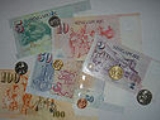
Singapore dollar

Encyclopedia
The Singapore dollar or Dollar (sign
: $; code
: SGD) is the official currency
of Singapore
. It is normally abbreviated with the dollar sign
$, or alternatively S$ to distinguish it from other dollar
-denominated currencies. It is divided into 100 cent
s.
.
This was replaced by the Malayan dollar
, and, from 1953, the Malaya and British Borneo dollar
, which were issued by the Board of Commissioners of Currency, Malaya and British Borneo.
Singapore continued to use the common currency upon joining Malaysia in 1963 but, two years after Singapore's expulsion and independence from Malaysia in 1965, the monetary union between Malaysia, Singapore and Brunei
broke down.
Singapore established the Board of Commissioners of Currency, Singapore, on April 7, 1967 and issued its first coins and notes. Nevertheless, the Singapore dollar was exchangeable at par with the Malaysian ringgit
until 1973, and interchangeability with the Brunei dollar
is still maintained.
Initially, the Singapore dollar was pegged to the British pound sterling
at a rate of S$60 = £7. This peg lasted until the demise of the Sterling Area
in the early 1970s, after which the Singapore dollar was linked to the US dollar
for a short period of time. As Singapore's economy grew and its trade links diversified to many other countries and regions, Singapore moved towards pegging its currency against a fixed and undisclosed trade-weighted basket of currencies from 1973 to 1985. From 1985 onwards, Singapore adopted a more market-oriented exchange regime – classified as a Monitoring Band – in which the Singapore dollar is allowed to float (within an undisclosed bandwidth of a central parity) but closely monitored by the Monetary Authority of Singapore
(MAS) against a concealed basket of currencies of Singapore's major trading partners and competitors. This in theory allows the Singaporean government to have more control over imported inflation and to ensure that Singapore's exports remain competitive. All issued Singapore dollar currency in circulation is fully backed by international assets to maintain public confidence. The foreign reserves officially stand at over US$230 billion - as of May 2011.
The Board of Commissioners of Currency, Singapore, was dissolved on October 1, 2002 and its functions, property and liabilities have been transferred to the MAS
.
The current series of coin
s feature the Coat of Arms of Singapore
on the obverse, and a floral theme on the reverse. This series was designed by Christopher Ironside
.
Note:
, was introduced in denominations of $1, $5, $10, $50, $100 & $1000. $25 & $500 notes were introduced on August 7, 1972, followed by $10,000 on January 29, 1973. Between 1976 & 1980, the Bird series
was introduced, including a $20 note introduced on August 6, 1979. This series did not include a $25 note. The Ship series
was introduced between 1985 & 1989 in the same denominations except for the absence of a $20 note. $2 notes were introduced on January 28, 1991.
, the first president of the Republic of Singapore, on the obverse, and the reverse depicts a feature of civic virtue. There are both paper and polymer notes in circulation. The designs of the polymer notes are very similar to the corresponding paper note except for the slightly slippery feel and a small transparent window design in the corner of the banknote. Polymer notes are progressively replacing the paper banknotes in circulation. The notes also have Braille patterns at the top right-hand corner of the front design.
The $10,000 note is the world's most valuable banknote. As of August 2011, it is worth over six times as much as the next most valuable, the 1000 Swiss franc
note.
On 27 June 2007, to commemorate 40 years of currency agreement with Brunei, a commemorative S$20 note was launched; the back is identical to the Bruneian $20 note launched simultaenously. A circulation version of the $20 note can be exchanged at banks in Singapore beginning July 16, 2007, limited to two pieces per transaction.
Currency sign
A currency sign is a graphic symbol used as a shorthand for a currency's name, especially in reference to amounts of money. They typically employ the first letter or character of the currency, sometimes with minor changes such as ligatures or overlaid vertical or horizontal bars...
: $; code
ISO 4217
ISO 4217 is a standard published by the International Standards Organization, which delineates currency designators, country codes , and references to minor units in three tables:* Table A.1 – Current currency & funds code list...
: SGD) is the official currency
Currency
In economics, currency refers to a generally accepted medium of exchange. These are usually the coins and banknotes of a particular government, which comprise the physical aspects of a nation's money supply...
of Singapore
Singapore
Singapore , officially the Republic of Singapore, is a Southeast Asian city-state off the southern tip of the Malay Peninsula, north of the equator. An island country made up of 63 islands, it is separated from Malaysia by the Straits of Johor to its north and from Indonesia's Riau Islands by the...
. It is normally abbreviated with the dollar sign
Dollar sign
The dollar or peso sign is a symbol primarily used to indicate the various peso and dollar units of currency around the world.- Origin :...
$, or alternatively S$ to distinguish it from other dollar
Dollar
The dollar is the name of the official currency of many countries, including Australia, Belize, Canada, Ecuador, El Salvador, Hong Kong, New Zealand, Singapore, Taiwan, and the United States.-Etymology:...
-denominated currencies. It is divided into 100 cent
Cent (currency)
In many national currencies, the cent is a monetary unit that equals 1⁄100 of the basic monetary unit. Etymologically, the word cent derives from the Latin word "centum" meaning hundred. Cent also refers to a coin which is worth one cent....
s.
History
Between 1845 and 1939, Singapore used the Straits dollarStraits dollar
The Straits dollar was the currency of the Straits Settlements from 1904 until 1939. At the same time, it was also used in the Federated Malay States, the Unfederated Malay States, Sarawak, Brunei, and British North Borneo.-History:...
.
This was replaced by the Malayan dollar
Malayan dollar
The dollar was the currency of the British colonies and protectorates in Malaya and Brunei until 1953. It was introduced in 1939, replacing the Straits dollar at par, with 1 dollar = two shillings four pence sterling .-Board of Commissioners of Currency, Malaya formed:The Malayan dollar was issued...
, and, from 1953, the Malaya and British Borneo dollar
Malaya and British Borneo dollar
The Malaya and British Borneo dollar was the currency of Malaya, Singapore, Sarawak, British North Borneo and Brunei from 1953 to 1967. The currency was issued by the Board of Commissioners of Currency, Malaya and British Borneo...
, which were issued by the Board of Commissioners of Currency, Malaya and British Borneo.
Singapore continued to use the common currency upon joining Malaysia in 1963 but, two years after Singapore's expulsion and independence from Malaysia in 1965, the monetary union between Malaysia, Singapore and Brunei
Brunei
Brunei , officially the State of Brunei Darussalam or the Nation of Brunei, the Abode of Peace , is a sovereign state located on the north coast of the island of Borneo, in Southeast Asia...
broke down.
Singapore established the Board of Commissioners of Currency, Singapore, on April 7, 1967 and issued its first coins and notes. Nevertheless, the Singapore dollar was exchangeable at par with the Malaysian ringgit
Malaysian ringgit
The Malaysian ringgit is the currency of Malaysia. It is divided into 100 sen...
until 1973, and interchangeability with the Brunei dollar
Brunei dollar
The ringgit Brunei or the Brunei dollar , has been the currency of the Sultanate of Brunei since 1967...
is still maintained.
Initially, the Singapore dollar was pegged to the British pound sterling
Pound sterling
The pound sterling , commonly called the pound, is the official currency of the United Kingdom, its Crown Dependencies and the British Overseas Territories of South Georgia and the South Sandwich Islands, British Antarctic Territory and Tristan da Cunha. It is subdivided into 100 pence...
at a rate of S$60 = £7. This peg lasted until the demise of the Sterling Area
Sterling Area
The sterling area came into existence at the outbreak of World War II. It was a wartime emergency measure which involved cooperation in exchange control matters between a group of countries, which at the time were mostly dominions and colonies of the British Empire...
in the early 1970s, after which the Singapore dollar was linked to the US dollar
United States dollar
The United States dollar , also referred to as the American dollar, is the official currency of the United States of America. It is divided into 100 smaller units called cents or pennies....
for a short period of time. As Singapore's economy grew and its trade links diversified to many other countries and regions, Singapore moved towards pegging its currency against a fixed and undisclosed trade-weighted basket of currencies from 1973 to 1985. From 1985 onwards, Singapore adopted a more market-oriented exchange regime – classified as a Monitoring Band – in which the Singapore dollar is allowed to float (within an undisclosed bandwidth of a central parity) but closely monitored by the Monetary Authority of Singapore
Monetary Authority of Singapore
The Monetary Authority of Singapore is Singapore's central bank and financial regulatory authority...
(MAS) against a concealed basket of currencies of Singapore's major trading partners and competitors. This in theory allows the Singaporean government to have more control over imported inflation and to ensure that Singapore's exports remain competitive. All issued Singapore dollar currency in circulation is fully backed by international assets to maintain public confidence. The foreign reserves officially stand at over US$230 billion - as of May 2011.
The Board of Commissioners of Currency, Singapore, was dissolved on October 1, 2002 and its functions, property and liabilities have been transferred to the MAS
Monetary Authority of Singapore
The Monetary Authority of Singapore is Singapore's central bank and financial regulatory authority...
.
Coins
In 1967, the first series of coins was introduced in denominations of 1, 5, 10, 20 and 50 cents and 1 dollar. Except for the bronze 1 cent, these coins were struck in cupro-nickel. In 1985, a second series of coins was introduced in the same denominations. The sizes of the coins were reduced (most substantially for the larger denominations) and the 5 cents was struck in aluminium-bronze. In 1987, the 1 dollar coin was further reduced in size and switched to being struck in aluminium-bronze.| First Series (1967–1985) http://www.singaporemint.com/display.php?ID=93 | ||||||||
|---|---|---|---|---|---|---|---|---|
| Value | Technical parameters | Description | Date of issue | |||||
| Diameter | Thickness | Mass | Composition | Edge | Obverse | Reverse | ||
| 1 cent | 17.780 mm | 1.118 mm | 1.940 g | Bronze Bronze Bronze is a metal alloy consisting primarily of copper, usually with tin as the main additive. It is hard and brittle, and it was particularly significant in antiquity, so much so that the Bronze Age was named after the metal... |
Plain | Value and Year | A high-rise public housing block with a fountain in front and clouds in the background | June 12, 1967 |
| 1 cent | 1.240 g | Copper Copper Copper is a chemical element with the symbol Cu and atomic number 29. It is a ductile metal with very high thermal and electrical conductivity. Pure copper is soft and malleable; an exposed surface has a reddish-orange tarnish... -clad steel Steel Steel is an alloy that consists mostly of iron and has a carbon content between 0.2% and 2.1% by weight, depending on the grade. Carbon is the most common alloying material for iron, but various other alloying elements are used, such as manganese, chromium, vanadium, and tungsten... |
1976 | |||||
| 5 cents | 16.26 mm | 1.02 mm | 1.410 g | Cupro-nickel | Milled | Value and Year | A snake-bird sitting in its nest and preening its feathers. | June 12, 1967 |
| 5 cents | 1.260 g | Cupro-nickel clad steel | ||||||
| 5 cents (FAO Food and Agriculture Organization The Food and Agriculture Organization of the United Nations is a specialised agency of the United Nations that leads international efforts to defeat hunger. Serving both developed and developing countries, FAO acts as a neutral forum where all nations meet as equals to negotiate agreements and... ) |
21.23 mm | 1.27 mm | 1.240 g | Aluminium Aluminium Aluminium or aluminum is a silvery white member of the boron group of chemical elements. It has the symbol Al, and its atomic number is 13. It is not soluble in water under normal circumstances.... |
A fish and the phrases "INCREASE PRODUCTION" and "MORE FOOD FROM THE SEA." | 1971 | ||
| 10 cents | 19.41 mm | 1.40 mm | 2.83 g | Cupro-nickel | A seahorse with a stylized piece of seaweed. | June 12, 1967 | ||
| 20 cents | 23.60 mm | 1.78 mm | 5.66 g | A swordfish against a background symbolizing water. | ||||
| 50 cents | 27.76 mm | 2.03 mm | 9.33 g | A lionfish from tropical waters. | ||||
| $1 | 33.32 mm | 2.39 mm | 16.85g | A stylized Singapore lion symbol flanked by two stalks of paddy. | ||||
The current series of coin
Coin
A coin is a piece of hard material that is standardized in weight, is produced in large quantities in order to facilitate trade, and primarily can be used as a legal tender token for commerce in the designated country, region, or territory....
s feature the Coat of Arms of Singapore
Coat of arms of Singapore
The coat of arms of Singapore was adopted in 1959, the year Singapore became self-governing within the British Empire. The committee that created it, headed by then Deputy Prime Minister Toh Chin Chye, was also responsible for the national flag and the national anthem...
on the obverse, and a floral theme on the reverse. This series was designed by Christopher Ironside
Christopher Ironside
Christopher Ironside FSIA 1970, OBE 1971, FRBS 1977 was an English painter and coin designer, particularly known for the reverse sides of the new British coins issued on decimalisation in 1971....
.
| Second Series (1985–present) http://www.mas.gov.sg/currency/currency_info/coins/second_series/Singapore_Circulation_Coins_Second_Series.html | ||||||||
|---|---|---|---|---|---|---|---|---|
| Value | Technical parameters | Description | Date of issue | |||||
| Diameter | Thickness | Mass | Composition | Edge | Obverse | Reverse | ||
| 1 cent | 15.9 mm | 1.1 mm | 1.24 g | Copper Copper Copper is a chemical element with the symbol Cu and atomic number 29. It is a ductile metal with very high thermal and electrical conductivity. Pure copper is soft and malleable; an exposed surface has a reddish-orange tarnish... -plated zinc Zinc Zinc , or spelter , is a metallic chemical element; it has the symbol Zn and atomic number 30. It is the first element in group 12 of the periodic table. Zinc is, in some respects, chemically similar to magnesium, because its ion is of similar size and its only common oxidation state is +2... |
Plain | Coat of Arms Coat of arms of Singapore The coat of arms of Singapore was adopted in 1959, the year Singapore became self-governing within the British Empire. The committee that created it, headed by then Deputy Prime Minister Toh Chin Chye, was also responsible for the national flag and the national anthem... , "Singapore" in 4 official languages |
Value, Vanda Miss Joaquim Vanda Miss Joaquim Vanda Miss Joaquim , also known as the Singapore Orchid and the Princess Aloha Orchid is a hybrid orchid cultivar that is Singapore's national flower.... |
September 28, 1987 |
| 5 cents | 16.75 mm | 1.22 mm | 1.56 g | Aluminium bronze Aluminium bronze Aluminium bronze is a type of bronze in which aluminium is the main alloying metal added to copper, in contrast to standard bronze or brass... |
Reeded | Coat of Arms Coat of arms of Singapore The coat of arms of Singapore was adopted in 1959, the year Singapore became self-governing within the British Empire. The committee that created it, headed by then Deputy Prime Minister Toh Chin Chye, was also responsible for the national flag and the national anthem... , "Singapore" in 4 official languages |
Value, Monstera deliciosa Monstera deliciosa Monstera deliciosa is a creeping vine native to tropical rainforests of southern Mexico south to Colombia.Common names include Ceriman, Swiss Cheese Plant , Fruit Salad Plant, Monster fruit, Monsterio Delicio, Monstereo, Mexican Breadfruit, Monstera, split-leaf philodendron, Locust and Wild Honey,... |
December 2, 1985 |
| 10 cents | 18.5 mm | 1.38 mm | 2.6 g | Cupronickel Cupronickel Cupronickel or copper-nickel or "cupernickel" is an alloy of copper that contains nickel and strengthening elements, such as iron and manganese. Cupronickel is highly resistant to corrosion in seawater, because its electrode potential is adjusted to be neutral with regard to seawater... |
Reeded | Coat of Arms Coat of arms of Singapore The coat of arms of Singapore was adopted in 1959, the year Singapore became self-governing within the British Empire. The committee that created it, headed by then Deputy Prime Minister Toh Chin Chye, was also responsible for the national flag and the national anthem... , "Singapore" in 4 official languages |
Value, Jasminum multiflorum Jasmine Jasminum , commonly known as jasmines, is a genus of shrubs and vines in the olive family . It contains around 200 species native to tropical and warm temperate regions of the Old World... |
December 2, 1985 |
| 20 cents | 21.36 mm | 1.72 mm | 4.5 g | Value, Calliandra surinamensis Calliandra Calliandra is a genus of flowering plants in the pea family, Fabaceae, subfamily Mimosoideae. It contains about 200 species that are native to tropical and subtropical regions of southern Asia, Africa, Australia and the Americas.-Biological description:... |
||||
| 50 cents | 24.66 mm | 2.06 mm | 7.29 g | Reeded | Value, Allamanda Cathartica Allamanda Allamanda, also known as Yellow Bell, Golden Trumpet or Buttercup Flower, is a genus of tropical shrubs or vines belonging to the dogbane family .The genus Alamanda is native to South and Central America... |
December 2, 1985 | ||
| 50 cents | Inscribed "REPUBLIC OF SINGAPORE" and the lion symbol | May 28, 1990 | ||||||
| $1 | 22.40 mm | 2.4 mm | 6.3 g | Aluminium bronze Aluminium bronze Aluminium bronze is a type of bronze in which aluminium is the main alloying metal added to copper, in contrast to standard bronze or brass... |
Inscribed "REPUBLIC OF SINGAPORE" and the lion symbol | Coat of Arms Coat of arms of Singapore The coat of arms of Singapore was adopted in 1959, the year Singapore became self-governing within the British Empire. The committee that created it, headed by then Deputy Prime Minister Toh Chin Chye, was also responsible for the national flag and the national anthem... , "Singapore" in 4 official languages |
Value, Lochnera rosea Apocynaceae The Apocynaceae or dogbane family is a family of flowering plants that includes trees, shrubs, herbs, and lianas.Many species are tall trees found in tropical rainforests, and most are from the tropics and subtropics, but some grow in tropical dry, xeric environments. There are also perennial herbs... |
September 28, 1987 |
Note:
- 6.81 million 1 cent coins are in circulation as at 1 December 2006, but are no longer issued since 2003.
- 5.86 million 5 cent coins are still in circulation as at 1 December 2006, but are no longer issued.
Early series
On June 12, 1967, the first series of notes, known as the Orchid seriesSingapore Orchid Series currency notes
The Orchid Series of currency notes is the earliest to be issued for circulation in Singapore. Issued in the years 1967 to 1976, it has nine denominations....
, was introduced in denominations of $1, $5, $10, $50, $100 & $1000. $25 & $500 notes were introduced on August 7, 1972, followed by $10,000 on January 29, 1973. Between 1976 & 1980, the Bird series
Singapore Bird Series currency notes
The Bird Series of currency notes is the second set of notes to be issued for circulation in Singapore. Issued in the years 1976 to 1984, it has nine denominations, the same number as in the Orchid Series, albeit the $25 note was replaced by the $20 note....
was introduced, including a $20 note introduced on August 6, 1979. This series did not include a $25 note. The Ship series
Singapore Ship Series currency notes
The Ship Series of currency notes is the third set of notes to be issued for circulation in Singapore. Issued in the years 1984 to 1999, it retains the number of denominations as was in the previous two series of notes, but switches the $20 note for the $2 one.A maritime theme to reflect...
was introduced between 1985 & 1989 in the same denominations except for the absence of a $20 note. $2 notes were introduced on January 28, 1991.
The latest (portrait) series
The current Portrait series was introduced in 1999, with the 1 and 500 dollar denominations omitted. These notes feature the face of Yusof bin IshakYusof bin Ishak
Yusof bin Ishak was an eminent Singaporean politician and the first President of Singapore of Minangkabau descent. His portrait appears on the Singapore Portrait Series currency notes introduced in 1999.-Early life:...
, the first president of the Republic of Singapore, on the obverse, and the reverse depicts a feature of civic virtue. There are both paper and polymer notes in circulation. The designs of the polymer notes are very similar to the corresponding paper note except for the slightly slippery feel and a small transparent window design in the corner of the banknote. Polymer notes are progressively replacing the paper banknotes in circulation. The notes also have Braille patterns at the top right-hand corner of the front design.
| 4th Series – Portrait Series (1999–present) Singapore Portrait Series currency notes The Portrait Series of currency notes is the fourth and current set of notes to be issued for circulation in Singapore. It was first introduced on 9 September 1999 by the Board of Commissioners of Currency Singapore whose role was since taken over by the Monetary Authority of Singapore ... http://www.mas.gov.sg/currency/currency_info/notes/portrait_series/Singapore_Circulation_Notes_Portrait_Series.html |
||||||||||||||||||
|---|---|---|---|---|---|---|---|---|---|---|---|---|---|---|---|---|---|---|
| Image | Value | Dimensions | Main Colour | Description | Date of issue | Status |  |  |
$2 | 126 × 63 mm | Purple | President Yusof bin Ishak Yusof bin Ishak Yusof bin Ishak was an eminent Singaporean politician and the first President of Singapore of Minangkabau descent. His portrait appears on the Singapore Portrait Series currency notes introduced in 1999.-Early life:... , Money Cowrie Cowry Cowry, also sometimes spelled cowrie, plural cowries, is the common name for a group of small to large sea snails, marine gastropod molluscs in the family Cypraeidae, the cowries... |
Education | September 9, 1999 | Circulation | Paper | ||
 |
 |
January 12, 2006 | Polymer | |||||||||||||||
 |
 |
$5 | 133 × 66 mm | Green | President Yusof bin Ishak Yusof bin Ishak Yusof bin Ishak was an eminent Singaporean politician and the first President of Singapore of Minangkabau descent. His portrait appears on the Singapore Portrait Series currency notes introduced in 1999.-Early life:... , Gold-Ringed Cowrie |
Garden City | September 9, 1999 | Paper | ||||||||||
 |
 |
May 18, 2007 | Polymer | |||||||||||||||
 |
 |
$10 | 141 × 69 mm | Red | President Yusof bin Ishak Yusof bin Ishak Yusof bin Ishak was an eminent Singaporean politician and the first President of Singapore of Minangkabau descent. His portrait appears on the Singapore Portrait Series currency notes introduced in 1999.-Early life:... , Wandering Cowrie |
Sports | September 9, 1999 | Paper | ||||||||||
 |
 |
May 4, 2004 | Polymer | |||||||||||||||
 |
 |
$50 | 156 × 74 mm | Blue | President Yusof bin Ishak Yusof bin Ishak Yusof bin Ishak was an eminent Singaporean politician and the first President of Singapore of Minangkabau descent. His portrait appears on the Singapore Portrait Series currency notes introduced in 1999.-Early life:... , Cylindrical Cowrie |
Arts | September 9, 1999 | Paper | ||||||||||
 |
 |
$100 | 162 × 77 mm | Orange | President Yusof bin Ishak Yusof bin Ishak Yusof bin Ishak was an eminent Singaporean politician and the first President of Singapore of Minangkabau descent. His portrait appears on the Singapore Portrait Series currency notes introduced in 1999.-Early life:... , Swallow Cowrie |
Youth | Paper | |||||||||||
 |
 |
$1000 | 170 × 83 mm | Pink | President Yusof bin Ishak Yusof bin Ishak Yusof bin Ishak was an eminent Singaporean politician and the first President of Singapore of Minangkabau descent. His portrait appears on the Singapore Portrait Series currency notes introduced in 1999.-Early life:... , Beautiful Cowrie |
Government | Paper | |||||||||||
 |
 |
$10,000 | 180 × 90 mm | Gold | President Yusof bin Ishak Yusof bin Ishak Yusof bin Ishak was an eminent Singaporean politician and the first President of Singapore of Minangkabau descent. His portrait appears on the Singapore Portrait Series currency notes introduced in 1999.-Early life:... , Onyx Cowrie |
Economics | Paper | |||||||||||
The $10,000 note is the world's most valuable banknote. As of August 2011, it is worth over six times as much as the next most valuable, the 1000 Swiss franc
Swiss franc
The franc is the currency and legal tender of Switzerland and Liechtenstein; it is also legal tender in the Italian exclave Campione d'Italia. Although not formally legal tender in the German exclave Büsingen , it is in wide daily use there...
note.
Commemorative banknotes
Commemorative banknotes are also released, usually in limited quantities. The first commemorative banknote was released in 24 July 1990, to celebrate the 25th anniversary of Singapore's independence. On December 8, 1999, to celebrate the coming millennium, 3 million $2 millennium notes were circulated. The note is similar to the $2 portrait series, except that the prefix of the serial number is replaced with a Millennium 2000 logo. These millennium notes are printed on paper as polymer notes were not introduced yet then.On 27 June 2007, to commemorate 40 years of currency agreement with Brunei, a commemorative S$20 note was launched; the back is identical to the Bruneian $20 note launched simultaenously. A circulation version of the $20 note can be exchanged at banks in Singapore beginning July 16, 2007, limited to two pieces per transaction.
| Singapore commemorative banknotes http://www.singaporemint.com/default.php?cPath=1_9_144 | ||||||||||||||||
|---|---|---|---|---|---|---|---|---|---|---|---|---|---|---|---|---|
| Image | Value | Dimensions | Main Colour | Description | Date of issue |  |  |
$20 | 145 × 69 mm | yellow/brown | President Yusof bin Ishak Yusof bin Ishak Yusof bin Ishak was an eminent Singaporean politician and the first President of Singapore of Minangkabau descent. His portrait appears on the Singapore Portrait Series currency notes introduced in 1999.-Early life:... ,“Dendrobium Puan Noor Aishah” orchid |
Text reading “BRUNEI DARUSSALAM ∙ SINGAPORE and CURRENCY INTERCHANGEABILITY AGREEMENT 1967 - 2007” and national landmarks of Singapore and Brunei. | June 27, 2007 | Polymer | ||
Trivia
- The $10000 note is one of the world's largest single notes in terms of real value.
- The S$1 coin is made to look like a Ba Gua, a traditional Chinese symbol used in Taoist ceremonies.