


Racquet

Encyclopedia
Ball
A ball is a round, usually spherical but sometimes ovoid, object with various uses. It is used in ball games, where the play of the game follows the state of the ball as it is hit, kicked or thrown by players. Balls can also be used for simpler activities, such as catch, marbles and juggling...
in such games as squash
Squash (sport)
Squash is a high-speed racquet sport played by two players in a four-walled court with a small, hollow rubber ball...
, tennis
Tennis
Tennis is a sport usually played between two players or between two teams of two players each . Each player uses a racket that is strung to strike a hollow rubber ball covered with felt over a net into the opponent's court. Tennis is an Olympic sport and is played at all levels of society at all...
, racquetball
Racquetball
For other sports often called "paddleball", see Paddleball .Racquetball is a racquet sport played with a hollow rubber ball in an indoor or outdoor court...
, and badminton
Badminton
Badminton is a racquet sport played by either two opposing players or two opposing pairs , who take positions on opposite halves of a rectangular court that is divided by a net. Players score points by striking a shuttlecock with their racquet so that it passes over the net and lands in their...
. Collectively, these games are known as racquet sports.
The frame of racquets for all sports was traditionally made of laminated wood
Engineered wood
Engineered wood, also called composite wood, man-made wood, or manufactured board; includes a range of derivative wood products which are manufactured by binding the strands, particles, fibers, or veneers of wood, together with adhesives, to form composite materials...
and the strings of animal intestine known as catgut
Catgut
Catgut is a type of cord that is prepared from the natural fibre found in the walls of animal intestines. Usually sheep or goat intestines are used, but it is occasionally made from the intestines of cattle, hogs, horses, mules, or donkeys.-Etymology:...
. The traditional racquet size was limited by the strength and weight of the wooden frame which had to be strong enough to hold the strings and stiff enough to hit the ball or shuttle. Manufacturers started adding non-wood laminates to wood racquets to improve stiffness. Non-wood racquets were made first of steel, then of aluminium, and then carbon fiber composites. Wood is still used for real tennis
Real tennis
Real tennis – one of several games sometimes called "the sport of kings" – is the original indoor racquet sport from which the modern game of lawn tennis , is descended...
, racquets
Racquets (sport)
Rackets or Racquets is an indoor racket sport played in the United Kingdom, United States, and Canada...
, and xare
Xare
Xare is racquet sport, a form of Basque pelota.-Ball:The ball is not exactly struck, nor is it quite caught—the effect is somewhere in between. The ball is very hard, and covered by parchment.-Court:...
. Most racquets are now made of composite materials including carbon fibre, fiberglass
Fiberglass
Glass fiber is a material consisting of numerous extremely fine fibers of glass.Glassmakers throughout history have experimented with glass fibers, but mass manufacture of glass fiber was only made possible with the invention of finer machine tooling...
, metals such as titanium
Titanium
Titanium is a chemical element with the symbol Ti and atomic number 22. It has a low density and is a strong, lustrous, corrosion-resistant transition metal with a silver color....
alloys or ceramic
Ceramic
A ceramic is an inorganic, nonmetallic solid prepared by the action of heat and subsequent cooling. Ceramic materials may have a crystalline or partly crystalline structure, or may be amorphous...
s.
Gut has partially been replaced by synthetic materials including nylon
Nylon
Nylon is a generic designation for a family of synthetic polymers known generically as polyamides, first produced on February 28, 1935, by Wallace Carothers at DuPont's research facility at the DuPont Experimental Station...
, polyamide
Polyamide
A polyamide is a polymer containing monomers of amides joined by peptide bonds. They can occur both naturally and artificially, examples being proteins, such as wool and silk, and can be made artificially through step-growth polymerization or solid-phase synthesis, examples being nylons, aramids,...
, and other polymers. Racquets are restrung when necessary, which may be after every match for a professional or never for a social player.
Badminton

Badminton
Badminton is a racquet sport played by either two opposing players or two opposing pairs , who take positions on opposite halves of a rectangular court that is divided by a net. Players score points by striking a shuttlecock with their racquet so that it passes over the net and lands in their...
racquets are light, with top quality racquets weighing between about 80 and 100 grams (with strings). Modern racquets are composed of carbon fibre composite (graphite reinforced plastic), which may be augmented by a variety of materials. Carbon fibre has an excellent strength to weight ratio, is stiff, and gives excellent kinetic energy
Kinetic energy
The kinetic energy of an object is the energy which it possesses due to its motion.It is defined as the work needed to accelerate a body of a given mass from rest to its stated velocity. Having gained this energy during its acceleration, the body maintains this kinetic energy unless its speed changes...
transfer. Before the adoption of carbon fibre composite, racquets were made of wood to their excessive weight and cost.
There is a wide variety of racquet designs, although the racquet size and shape are limited by the Laws. Different racquets have playing characteristics that appeal to different players. The traditional oval head shape is still available, but an isometric head shape is increasingly common in new racquets.
Racquets
This predecessor to the modern game of squash, racquetsRacquets (sport)
Rackets or Racquets is an indoor racket sport played in the United Kingdom, United States, and Canada...
, is played with 30½ inch (775 mm) wooden racquets. While squash equipment has evolved in the intervening century, racquets have changed little.
Racquetball
According to the current RacquetballRacquetball
For other sports often called "paddleball", see Paddleball .Racquetball is a racquet sport played with a hollow rubber ball in an indoor or outdoor court...
rules there are no limitations on the weight of a racquetball racquet.
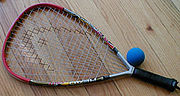
Racquetball racquets, unlike many other types, generally have little or no neck; the grip connecting directly to the head. They also tend to have head shapes that are notably wider at the top, with some older racquets looking almost triangular or teardrop shaped.
Real Tennis
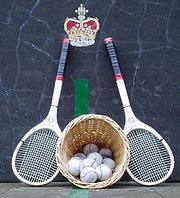
Real tennis
Real tennis – one of several games sometimes called "the sport of kings" – is the original indoor racquet sport from which the modern game of lawn tennis , is descended...
. The racquet head is bent slightly to make it easier to strike balls close to the floor or in corners.
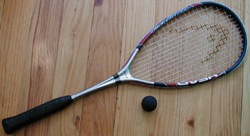
Squash
'Standard' squashSquash (sport)
Squash is a high-speed racquet sport played by two players in a four-walled court with a small, hollow rubber ball...
racquets are governed by the rules of the game. Traditionally they were made of laminated timber (typically Ash
Ash tree
Fraxinus is a genus flowering plants in the olive and lilac family, Oleaceae. It contains 45-65 species of usually medium to large trees, mostly deciduous though a few subtropical species are evergreen. The tree's common English name, ash, goes back to the Old English æsc, while the generic name...
), with a small strung area using natural 'gut' strings. After a rule change in the mid-1980s, they are now almost always made of composite materials or metals (graphite
Graphite
The mineral graphite is one of the allotropes of carbon. It was named by Abraham Gottlob Werner in 1789 from the Ancient Greek γράφω , "to draw/write", for its use in pencils, where it is commonly called lead . Unlike diamond , graphite is an electrical conductor, a semimetal...
, Kevlar
Kevlar
Kevlar is the registered trademark for a para-aramid synthetic fiber, related to other aramids such as Nomex and Technora. Developed at DuPont in 1965, this high strength material was first commercially used in the early 1970s as a replacement for steel in racing tires...
, titanium
Titanium
Titanium is a chemical element with the symbol Ti and atomic number 22. It has a low density and is a strong, lustrous, corrosion-resistant transition metal with a silver color....
, and/or boron
Boron
Boron is the chemical element with atomic number 5 and the chemical symbol B. Boron is a metalloid. Because boron is not produced by stellar nucleosynthesis, it is a low-abundance element in both the solar system and the Earth's crust. However, boron is concentrated on Earth by the...
) with synthetic strings. Modern racquets are 70 cm long, with a maximum strung area of 500 square centimetres (approximately 75 square inches) and a mass between 110 and 200 grams (4–7 ounces).
Tennis
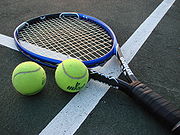
Modern tennis
Tennis
Tennis is a sport usually played between two players or between two teams of two players each . Each player uses a racket that is strung to strike a hollow rubber ball covered with felt over a net into the opponent's court. Tennis is an Olympic sport and is played at all levels of society at all...
racquets vary in length, weight, and head size. 21" to 26" is normally a junior's length, while 27" or 27.5" are for stronger and taller adult players. Weights of a racquet also vary between 8 ounces (226.8 g) unstrung and 12.5 ounces (354.4 g) strung. Racquets originally flared outward at the bottom of the handle to prevent slipping. The rounded bottom was called a bark bottom after its inventor Matthew Barker. But by 1947 this style became superfluous. Head size also plays a role in a racquet's qualities. A larger head size generally means more power, and a larger "sweet spot
Sweet spot
Sweet spot may refer to:*Sweet spot *Sweet spot *Sweet spot...
" that is more forgiving on off-center hits. A smaller head size offers more precise control. Current racquet head sizes vary between 88 sq. inches and 137 sq. inches, with most players adopting one from 95-105 sq. inches.
Throughout most of tennis' history, racquets were made of laminated wood, with heads of around 65 square inches. In the late 1960s, Wilson produced the T2000 steel racquet with wire wound around the frame to make string loops. It was popularized by the top American player Jimmy Connors
Jimmy Connors
James Scott "Jimmy" Connors is an American former world no. 1 tennis player....
. In 1975, aluminum construction allowed for the introduction of the first "oversized" racquet, which was manufactured by Weed. Prince popularized the oversize racquet, which had a head size of approximately 110 square-inches and opened the door for the introduction of racquets having other non-standard head sizes such as midsize (90 square inches) and mid-plus size (95 square inches). In the early 1980s, "graphite" (carbon fibre) composites were introduced, and other materials were added to the composite, including ceramics, glassfibre, boron, and titanium. The Dunlop Max200G used by John McEnroe
John McEnroe
John Patrick McEnroe, Jr. is a former world no. 1 professional tennis player from the United States. During his career, he won seven Grand Slam singles titles , nine Grand Slam men's doubles titles, and one Grand Slam mixed doubles title...
from 1983 was an early graphite racquet, along with the very popular Prince "Original" Graphite. Composite racquets are the contemporary standard.
Longer racquets were introduced by Dunlop
Dunlop Sport
Dunlop Sport is a tennis, squash, golf, badminton, clothing, travel and bicycle equipment brand, that specializes in sporting goods.After Dunlop Holdings was acquired by BTR plc in 1985, Dunlop Sport was combined with the Slazenger brand which Dunlop had acquired in 1959 to form Dunlop Slazenger...
in order to give additional reach for shots such as the serve and volley where shorter players may be at a disadvantage. Midsize or mid-plus racquets are the general standard for professional players.
Stringing (material, pattern, tension) is an important factor in the performance of a tennis racquet. A few elite players use natural gut, but the vast majority of strings are a nylon or polyester synthetic. Some (American champion Pete Sampras is a prominent example) consider the natural string to be more responsive, providing a better "feel", but synthetic is favored for its much superior durability, consistency, as well as much lower cost. String pattern (the vertical/horizontal grid) is a function of the racquet head size and design. A tighter pattern is considered to deliver more precise control; a more "open" pattern to offer greater potential for power and spin. Modern racquets are marked with a recommended string tension range. The basic rule is that a lower tension creates more power (from a "trampoline" effect) and a higher string tension creates more control (the less 'trampoline effect' the more predictable the power and angle of the departure from the string bed.)
Double strung tennis racquets were introduced in 1977 and then banned because they permitted excessive spin. A modern version of a legal double strung racquet has been introduced.
Table tennis

A table tennis racquet is used by players in the game table tennis
Table tennis
Table tennis, also known as ping-pong, is a sport in which two or four players hit a lightweight, hollow ball back and forth using table tennis rackets. The game takes place on a hard table divided by a net...
. The racquet is made from laminated wood covered with rubber on one or two sides depending on the grip of the player. This is called either a paddle, racquet, or a bat, with usage differing by region. In the USA the term "paddle" is common, in Europe the term is "bat", and the official ITTF
International Table Tennis Federation
The International Table Tennis Federation is the governing body for all national table tennis associations.-Founding history:The ITTF was founded in 1926, the nine founding members being Austria, Czechoslovakia, Denmark, England, Germany, Hungary, India, Sweden and Wales...
term is "racket".
External links
- Tennis racquet design by Howard Head; (1974) Smithsonian Institution Libraries
- The History of Tennis Racquets — Evolution of the Modern Racquet
- How Products are Made - Tennis Racquet
- Gelberg, J. Nadine, "The Big Technological Tennis Upset", Invention & Technology magazine, 1997