

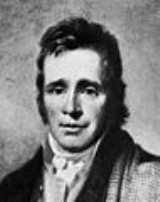
James Hogg

Encyclopedia
James Hogg was a Scottish
poet
and novelist who wrote in both Scots
and English
.
in 1770 and was baptized there on 9 December, his actual date of birth having never been recorded. His father, Robert Hogg (1729–1820), was a tenant farmer while his mother, Margaret Hogg (née
Laidlaw) (1730–1813), was noted for collecting native Scottish ballad
s. James was the second eldest of four brothers, his siblings being William, David, and Robert (from eldest to youngest). Robert and David later emigrated to the United States
, while James and William remained in Scotland for their entire lives.
James had little formal education, and became a shepherd, living in grinding poverty, hence his nickname, 'The Ettrick Shepherd'. His employer, James Laidlaw of Blackhouse in the Yarrow valley, seeing how hard he was working to improve himself, offered to help by making books available. Hogg used these to essentially teach himself to read and write (something he had achieved by the age of 14). In 1796 Robert Burns
died, and Hogg, who had only just come to hear of him, was devastated by the loss. He struggled to produce poetry of his own, and Laidlaw introduced him to Sir Walter Scott
, who asked him to help with a publication entitled The Minstrelsy of the Scottish Border.
for the first time. His first collection, The Mountain Bard, was published in 1807 but he struggled to make an impact on the literary scene. Another venture, a magazine, The Spy failed after a year. But his epic story-poem, The Queen's Wake (the setting being the return to Scotland of Mary, Queen of Scots (1561) after her exile in France
), was published in 1813 and was a success. Now a well-known literary figure (if often mocked for his rustic accent and appearance), he was recruited by William Blackwood
for Blackwood's Magazine
.
It was through Blackwood's that Hogg found fame, although it was not the sort that he wanted. Launched as a counter-blast to the Whig Edinburgh Review
, Blackwood wanted punchy content in his new publication. He found his ideal contributors in John Wilson
(who wrote as Christopher North) and John Gibson Lockhart
(later Walter Scott's son-in-law and biographer). Their first published article, "The Chaldee Manuscript", a thinly disguised satire of Edinburgh society in biblical language which Hogg started and Wilson and Lockhart elaborated, was so controversial that Wilson fled and Blackwood was forced to apologise. Soon Blackwood's Tory views and reviews - often scurrilous attacks on other writers - were notorious, and the magazine, or "Maga" as it came to be known, had become one of the best-selling journals of its day. But Hogg quickly found himself forced out of the inner circle. As other writers such as Walter Maginn and Thomas de Quincey
joined, he became not merely excluded from the lion's share of publication in Maga, but a figure of fun in its pages. Wilson and Lockhart were dangerous friends. Hogg's Memoirs of the Author's Life were savagely attacked by an anonymous reviewer, probably Wilson, and in 1822 the magazine launched the "Noctes Ambrosianae
" or "Ambrosian Nights", imaginary conversations in a drinking-den between semi-fictional characters such as North, O'Doherty, The Opium Eater and the Ettrick Shepherd. The Shepherd was Hogg. The Noctes continued until 1834, and were written after 1825 mostly by Wilson, although other writers, including Hogg himself, had a hand in them.
The Shepherd of the Noctes is a part-animal, part-rural simpleton, and part-savant. He became one of the best-known figures in topical literary affairs, famous throughout Britain and its colonies. Quite what the real James Hogg made of this is mostly unknown, although some of his letters to Blackwood and others express outrage and anguish. What is known is that in 1824, no longer highly regarded in Edinburgh, largely excluded from Blackwood's, now in his fifties but with a young family, and writing desperately quickly for money to try to save his failing farm, Hogg wrote his famous tale of persecution, delusion, devilish mimicry and tortured consciousness: The Private Memoirs and Confessions of a Justified Sinner
. It did not do well. Barely reviewed in Blackwood's, it became a largely forgotten book until over a century later, and is now considered by some as a masterpiece.
1835 "Extempore Effusion upon the Death of James Hogg", written in the year of his death, includes the lines:
This eulogy notwithstanding, Wordsworth's notes state "He was undoubtedly a man of original genius, but of coarse manners and low and offensive opinions."
, was loaned Justified Sinner by Raymond Mortimer
. Gide was amazed, writing that "It is long since I can remember being so taken hold of, so voluptuously tormented by any book." Its republication in 1947, with an enthusiastic introduction by Gide, helped bring about the modern critical and academic appreciation of this novel.
The bulk of Hogg's writing was bowdlerised in the 19th century and neglected for most of the 20th. Apart from The Confessions, which even his detractors acknowledged as unusually powerful (and often attributed to someone else, usually Lockhart), his novels were regarded as turgid, his verse as light, his short tales and articles as ephemera. But growing interest in The Confessions led to the rediscovery and reconsideration of his other work in the late 20th and early 21st centuries. Now his novel The Three Perils of Woman is also considered a classic and all his work, including his letters, is undergoing major publication in the Stirling/Carolina editions. However, Justified Sinner remains his most important work and is now seen as one of the major Scottish novels of its time, and absolutely crucial in terms of exploring one of the key themes of Scottish culture
and identity: Calvinism
. In a 2006 interview with Melvyn Bragg
for ITV1
, Scottish novelist Irvine Welsh
cited Hogg, especially The Confessions as a major influence on his writing. Hogg's story "The Brownie Of The Black Haggs" was dramatised for BBC radio 4 in 2003 by Scottish playwright Marty Ross as part of his "Darker Side Of The Border" series. More recently Ross returned to the villain of that story, Merodach, making him the villain of a Doctor Who
audiobook, Night's Black Agents
(Big Finish Productions
2010), in which this demonic figure assumes the pose of a Minister of the Kirk
.
Scotland
Scotland is a country that is part of the United Kingdom. Occupying the northern third of the island of Great Britain, it shares a border with England to the south and is bounded by the North Sea to the east, the Atlantic Ocean to the north and west, and the North Channel and Irish Sea to the...
poet
Poet
A poet is a person who writes poetry. A poet's work can be literal, meaning that his work is derived from a specific event, or metaphorical, meaning that his work can take on many meanings and forms. Poets have existed since antiquity, in nearly all languages, and have produced works that vary...
and novelist who wrote in both Scots
Scots language
Scots is the Germanic language variety spoken in Lowland Scotland and parts of Ulster . It is sometimes called Lowland Scots to distinguish it from Scottish Gaelic, the Celtic language variety spoken in most of the western Highlands and in the Hebrides.Since there are no universally accepted...
and English
English language
English is a West Germanic language that arose in the Anglo-Saxon kingdoms of England and spread into what was to become south-east Scotland under the influence of the Anglian medieval kingdom of Northumbria...
.
Early life
James Hogg was born in a small farm near Ettrick, ScotlandEttrick, Scotland
Ettrick is a small village and civil parish in the Scottish Borders area of Scotland, located around south-west of the town of Selkirk.-Local area:...
in 1770 and was baptized there on 9 December, his actual date of birth having never been recorded. His father, Robert Hogg (1729–1820), was a tenant farmer while his mother, Margaret Hogg (née
NEE
NEE is a political protest group whose goal was to provide an alternative for voters who are unhappy with all political parties at hand in Belgium, where voting is compulsory.The NEE party was founded in 2005 in Antwerp...
Laidlaw) (1730–1813), was noted for collecting native Scottish ballad
Ballad
A ballad is a form of verse, often a narrative set to music. Ballads were particularly characteristic of British and Irish popular poetry and song from the later medieval period until the 19th century and used extensively across Europe and later the Americas, Australia and North Africa. Many...
s. James was the second eldest of four brothers, his siblings being William, David, and Robert (from eldest to youngest). Robert and David later emigrated to the United States
United States
The United States of America is a federal constitutional republic comprising fifty states and a federal district...
, while James and William remained in Scotland for their entire lives.
James had little formal education, and became a shepherd, living in grinding poverty, hence his nickname, 'The Ettrick Shepherd'. His employer, James Laidlaw of Blackhouse in the Yarrow valley, seeing how hard he was working to improve himself, offered to help by making books available. Hogg used these to essentially teach himself to read and write (something he had achieved by the age of 14). In 1796 Robert Burns
Robert Burns
Robert Burns was a Scottish poet and a lyricist. He is widely regarded as the national poet of Scotland, and is celebrated worldwide...
died, and Hogg, who had only just come to hear of him, was devastated by the loss. He struggled to produce poetry of his own, and Laidlaw introduced him to Sir Walter Scott
Walter Scott
Sir Walter Scott, 1st Baronet was a Scottish historical novelist, playwright, and poet, popular throughout much of the world during his time....
, who asked him to help with a publication entitled The Minstrelsy of the Scottish Border.
Writing career
In 1801, Hogg visited EdinburghEdinburgh
Edinburgh is the capital city of Scotland, the second largest city in Scotland, and the eighth most populous in the United Kingdom. The City of Edinburgh Council governs one of Scotland's 32 local government council areas. The council area includes urban Edinburgh and a rural area...
for the first time. His first collection, The Mountain Bard, was published in 1807 but he struggled to make an impact on the literary scene. Another venture, a magazine, The Spy failed after a year. But his epic story-poem, The Queen's Wake (the setting being the return to Scotland of Mary, Queen of Scots (1561) after her exile in France
France
The French Republic , The French Republic , The French Republic , (commonly known as France , is a unitary semi-presidential republic in Western Europe with several overseas territories and islands located on other continents and in the Indian, Pacific, and Atlantic oceans. Metropolitan France...
), was published in 1813 and was a success. Now a well-known literary figure (if often mocked for his rustic accent and appearance), he was recruited by William Blackwood
William Blackwood
William Blackwood was a Scottish publisher who founded the firm of William Blackwood & Sons.Blackwood was born of humble parents in Edinburgh. At the age of fourteen he was apprenticed to a firm of booksellers in Edinburgh, and he followed his calling also in Glasgow and London for several years...
for Blackwood's Magazine
Blackwood's Magazine
Blackwood's Magazine was a British magazine and miscellany printed between 1817 and 1980. It was founded by the publisher William Blackwood and was originally called the Edinburgh Monthly Magazine. The first number appeared in April 1817 under the editorship of Thomas Pringle and James Cleghorn...
.
It was through Blackwood's that Hogg found fame, although it was not the sort that he wanted. Launched as a counter-blast to the Whig Edinburgh Review
Edinburgh Review
The Edinburgh Review, founded in 1802, was one of the most influential British magazines of the 19th century. It ceased publication in 1929. The magazine took its Latin motto judex damnatur ubi nocens absolvitur from Publilius Syrus.In 1984, the Scottish cultural magazine New Edinburgh Review,...
, Blackwood wanted punchy content in his new publication. He found his ideal contributors in John Wilson
John Wilson (Scottish writer)
John Wilson of Ellerey FRSE was a Scottish advocate, literary critic and author, the writer most frequently identified with the pseudonym Christopher North of Blackwood's Edinburgh Magazine....
(who wrote as Christopher North) and John Gibson Lockhart
John Gibson Lockhart
John Gibson Lockhart , was a Scottish writer and editor. He is best known as the author of the definitive "Life" of Sir Walter Scott...
(later Walter Scott's son-in-law and biographer). Their first published article, "The Chaldee Manuscript", a thinly disguised satire of Edinburgh society in biblical language which Hogg started and Wilson and Lockhart elaborated, was so controversial that Wilson fled and Blackwood was forced to apologise. Soon Blackwood's Tory views and reviews - often scurrilous attacks on other writers - were notorious, and the magazine, or "Maga" as it came to be known, had become one of the best-selling journals of its day. But Hogg quickly found himself forced out of the inner circle. As other writers such as Walter Maginn and Thomas de Quincey
Thomas de Quincey
Thomas Penson de Quincey was an English esssayist, best known for his Confessions of an English Opium-Eater .-Child and student:...
joined, he became not merely excluded from the lion's share of publication in Maga, but a figure of fun in its pages. Wilson and Lockhart were dangerous friends. Hogg's Memoirs of the Author's Life were savagely attacked by an anonymous reviewer, probably Wilson, and in 1822 the magazine launched the "Noctes Ambrosianae
Noctes Ambrosianae
The Noctes Ambrosianae, a series of 71 imaginary colloquies, appeared in Blackwood's Magazine from 1822 to 1835. The earlier ones had several different authors, including John Gibson Lockhart, William Maginn, James Hogg and Professor John Wilson, but from 1825, with the 19th in the series, the...
" or "Ambrosian Nights", imaginary conversations in a drinking-den between semi-fictional characters such as North, O'Doherty, The Opium Eater and the Ettrick Shepherd. The Shepherd was Hogg. The Noctes continued until 1834, and were written after 1825 mostly by Wilson, although other writers, including Hogg himself, had a hand in them.
The Shepherd of the Noctes is a part-animal, part-rural simpleton, and part-savant. He became one of the best-known figures in topical literary affairs, famous throughout Britain and its colonies. Quite what the real James Hogg made of this is mostly unknown, although some of his letters to Blackwood and others express outrage and anguish. What is known is that in 1824, no longer highly regarded in Edinburgh, largely excluded from Blackwood's, now in his fifties but with a young family, and writing desperately quickly for money to try to save his failing farm, Hogg wrote his famous tale of persecution, delusion, devilish mimicry and tortured consciousness: The Private Memoirs and Confessions of a Justified Sinner
The Private Memoirs and Confessions of a Justified Sinner
The Private Memoirs and Confessions of a Justified Sinner, is a novel that was written by the Scottish author James Hogg and published anonymously in...
. It did not do well. Barely reviewed in Blackwood's, it became a largely forgotten book until over a century later, and is now considered by some as a masterpiece.
Death
Wordsworth'sWilliam Wordsworth
William Wordsworth was a major English Romantic poet who, with Samuel Taylor Coleridge, helped to launch the Romantic Age in English literature with the 1798 joint publication Lyrical Ballads....
1835 "Extempore Effusion upon the Death of James Hogg", written in the year of his death, includes the lines:
- "The mighty Minstrel breathes no longer,
- 'Mid mouldering ruins low he lies;
- And death upon the braes of Yarrow,
- Has closed the Shepherd-poet's eyes."
This eulogy notwithstanding, Wordsworth's notes state "He was undoubtedly a man of original genius, but of coarse manners and low and offensive opinions."
Legacy
In 1924 the French writer, André GideAndré Gide
André Paul Guillaume Gide was a French author and winner of the Nobel Prize in literature in 1947. Gide's career ranged from its beginnings in the symbolist movement, to the advent of anticolonialism between the two World Wars.Known for his fiction as well as his autobiographical works, Gide...
, was loaned Justified Sinner by Raymond Mortimer
Raymond Mortimer
Charles Raymond Mortimer Bell , who wrote under the name Raymond Mortimer, was a British writer, known mostly as a critic and literary editor....
. Gide was amazed, writing that "It is long since I can remember being so taken hold of, so voluptuously tormented by any book." Its republication in 1947, with an enthusiastic introduction by Gide, helped bring about the modern critical and academic appreciation of this novel.
The bulk of Hogg's writing was bowdlerised in the 19th century and neglected for most of the 20th. Apart from The Confessions, which even his detractors acknowledged as unusually powerful (and often attributed to someone else, usually Lockhart), his novels were regarded as turgid, his verse as light, his short tales and articles as ephemera. But growing interest in The Confessions led to the rediscovery and reconsideration of his other work in the late 20th and early 21st centuries. Now his novel The Three Perils of Woman is also considered a classic and all his work, including his letters, is undergoing major publication in the Stirling/Carolina editions. However, Justified Sinner remains his most important work and is now seen as one of the major Scottish novels of its time, and absolutely crucial in terms of exploring one of the key themes of Scottish culture
Culture of Scotland
The culture of Scotland refers to the patterns of human activity and symbolism associated with Scotland and the Scottish people. Some elements of Scottish culture, such as its separate national church, are protected in law as agreed in the Treaty of Union, and other instruments...
and identity: Calvinism
Calvinism
Calvinism is a Protestant theological system and an approach to the Christian life...
. In a 2006 interview with Melvyn Bragg
Melvyn Bragg
Melvyn Bragg, Baron Bragg FRSL FRTS FBA, FRS FRSA is an English broadcaster and author best known for his work with the BBC and for presenting the The South Bank Show...
for ITV1
ITV1
ITV1 is a generic brand that is used by twelve franchises of the British ITV Network in the English regions, Wales, southern Scotland , the Isle of Man and the Bailiwicks of Jersey and Guernsey. The ITV1 brand was introduced by Carlton and Granada in 2001, alongside the regional identities of their...
, Scottish novelist Irvine Welsh
Irvine Welsh
Irvine Welsh is a contemporary Scottish novelist, best known for his novel Trainspotting. His work is characterised by raw Scottish dialect, and brutal depiction of the realities of Edinburgh life...
cited Hogg, especially The Confessions as a major influence on his writing. Hogg's story "The Brownie Of The Black Haggs" was dramatised for BBC radio 4 in 2003 by Scottish playwright Marty Ross as part of his "Darker Side Of The Border" series. More recently Ross returned to the villain of that story, Merodach, making him the villain of a Doctor Who
Doctor Who
Doctor Who is a British science fiction television programme produced by the BBC. The programme depicts the adventures of a time-travelling humanoid alien known as the Doctor who explores the universe in a sentient time machine called the TARDIS that flies through time and space, whose exterior...
audiobook, Night's Black Agents
Night's Black Agents
Night's Black Agents is a collection of fantasy and horror short stories by author Fritz Leiber. It was released in 1947 and was the author's first book...
(Big Finish Productions
Big Finish Productions
Big Finish Productions is a British company that produces books and audio plays based, primarily, on cult British science fiction properties...
2010), in which this demonic figure assumes the pose of a Minister of the Kirk
Kirk
Kirk can mean "church" in general or the Church of Scotland in particular. Many place names and personal names are also derived from it.-Basic meaning and etymology:...
.
Works
- The Forest Minstrel (1810) (poetry)
- The Pilgrims of the Sun (1815) (poetry)
- The Brownie of Bodsbeck (1817) (novel)
- The Surpassing Adventures of Allan Gordon (1818); biography of Allan GordonAllan GordonAllan Gordon of Aberdeen, Scotland, was the sole survivor of the Anne Forbes, a whaling ship that disappeared without a trace in 1757.-Early life :...
- Jacobite ReliquesJacobite ReliquesHogg's Jacobite Reliques is a collection of songs related to the Jacobite risings, compiled by James Hogg on commission from the Highland Society of London in 1817. Most of the songs in the collection are Jacobite, and a minority are Whig...
(1819) (collection of JacobiteJacobitismJacobitism was the political movement in Britain dedicated to the restoration of the Stuart kings to the thrones of England, Scotland, later the Kingdom of Great Britain, and the Kingdom of Ireland...
protest songs) - The Three Perils of Man (1822) (novel)
- The Three Perils of Woman (1823) (novel)
- The Private Memoirs and Confessions of a Justified SinnerThe Private Memoirs and Confessions of a Justified SinnerThe Private Memoirs and Confessions of a Justified Sinner, is a novel that was written by the Scottish author James Hogg and published anonymously in...
(1824) (novel) - Queen Hynde (1825) (poetry)
- Songs by the Ettrick Shepherd (1831) (songs/poetry)
- The Brownie of the Black Haggs (1828) (short story/tale)
- The Domestic Manner and Private Life of Sir Walter Scott (1834) ("unauthorised" biography)
- Tales and Sketches of the Ettrick Shepherd (1837)
See also
- Aikwood TowerAikwood TowerAikwood Tower is a 16th-century tower house in the Scottish Borders area of Scotland, southwest of the town of Selkirk, on the Ettrick Water. The tower is a Category A listed building....
, the home of Lord Steel, houses an exhibition on the life and work of James Hogg.
External links
- The James Hogg Society by the Department of English Studies, University of Stirling
- BBC - Writing Scotland - James Hogg