
Encyclopedia
The Championships, Wimbledon, commonly referred to as simply "
Wimbledon", is the oldest and arguably most prestigious event in the sport of
tennis. Held every June and July in
London,
United Kingdom the tournament is the third Grand Slam event played each year, preceded by the
Australian Open and the French Open, and followed by the U.S. Open. The tournament lasts for two weeks, subject to extensions for rain.
Separate tournaments are simultaneously held, all at the same venue, for Gentlemen's Singles, Ladies' Singles, Gentlemen's Doubles, Ladies' Doubles and Mixed Doubles. Youth tournaments — Boys' Singles, Girls' Singles, Boys' Doubles and Girls' Doubles — are also held. Additionally, special invitational tournaments are held: the 35 and over Gentlemen's Doubles, 45 and over Gentlemen's Doubles, 35 and over Ladies' Doubles and
wheelchair doubles.
History
The Championships were first played under the control of the All England Lawn Tennis and Croquet Club in 1877 at a ground near Worple Road, Wimbledon; the only event held was Gentlemen's Singles. In 1884, the All England Club added Ladies' Singles and Gentlemen's Doubles. Ladies' Doubles and Mixed Doubles were added in 1913. The Championships moved to their present location, at a ground near Church Road, in 1922. As with the other three
Grand Slam events, Wimbledon was contested by top-ranked amateur players until the advent of the open era in tennis in 1968. Britons are very proud of the tournament but it is a source of national anguish and humour — no British man has won the singles event at Wimbledon since
Fred Perry in 1936, and no British woman since Virginia Wade in 1977.
Events
There are five main events held at Wimbledon: Gentlemen's Singles, Ladies' Singles, Gentlemen's Doubles, Ladies' Doubles and Mixed Doubles. In addition, four events are held for juniors: Boys' Singles, Girls' Singles, Boys' Doubles and Girls' Doubles. Finally, four invitational events are held: the 35 and over Gentlemen's Invitation Doubles, the 45 and over Gentlemen's Invitation Doubles, the 35 and over Ladies' Invitation Doubles and the Wheelchair Gentlemen's Invitation Doubles.
Matches in the Gentlemen's Singles and Gentlemen's Doubles competitions are best-of-five sets; matches in all other events are best-of-three sets. Most events are single-elimination tournaments; in other words, a player who loses a single match is immediately eliminated from the tournament. However, the 35 and over Gentlemen's Invitation Doubles and the 35 and over Ladies' Invitation Doubles are both round-robin tournaments.
Up until 1921, the winners of the previous year's competition were automatically granted byes into the final round This led to many winners retaining their titles for successive years, as they were able to rest while their opponent competed from the start of the competition. From 1922, the title holders played through from the start of the championships.
Each year, the tournament begins on the Monday falling between 20 and 26 June . It is held two weeks after the
Queen's Club Championships, which are considered the major warm-up for Wimbledon for male players. Another important warm-up tournament for the men is the Gerry Weber Open, which is held in Halle, Germany at about the same time as the Queen's Club Championships. Wimbledon usually lasts for two weeks; the main events span both weeks, but the junior and invitational events are for the most part held during the second week. Traditionally, there is no play on the "Middle Sunday", which is considered a rest day. However, rain has forced play on the Middle Sunday thrice in the Championship's history: in 1991, 1997, and 2004. On each of these occasions, Wimbledon has staged a "People's Sunday", with unreserved seating and readily available, inexpensive tickets.
Players and seeding
A total of 128 players feature in each singles event, 64 pairs in each single-sex doubles event, and 48 pairs in Mixed Doubles. Players and doubles pairs are admitted to the main events on the basis of their international rankings, with consideration also given to their previous performances at grasscourt events. Currently 32 male and female players are given seedings in the Gentlemen's and Ladies' singles while 16 teams are seeded in the doubles events.
The Committee of Management and the Referee evaluate all applications for entry, and determine which players may be admitted to the tournament directly. The committee may admit a player without a high enough ranking as a wild card. Usually, wild cards are players who have performed well during previous tournaments, or would stimulate public interest in Wimbledon by participating. The only wild card to win the Gentlemen's Singles Championship was
Goran Ivanisevic ; no wild card has ever won the Ladies' Singles Title. Players and pairs who neither have high enough rankings nor receive wild cards may participate in a qualifying tournament held one week before Wimbledon at the Bank of England Sports Ground in Roehampton. The singles qualifying competitions are three-round events; the same-sex doubles competitions last for only one round. There is no qualifying tournament for Mixed Doubles. No qualifier has won either the Gentlemen's Singles or the Ladies' Singles tournaments. The furthest that any qualifier has progressed in the main draw of a Singles tournament is the semi-final round:
John McEnroe in 1977 and Vladimir Voltchkov of Belarus in 2000 , and Alexandra Stevenson in 1999 .
Players are admitted to the junior tournaments upon the recommendations of their national tennis associations, on their
International Tennis Federation world rankings and, in the case of the singles events, on the basis of a qualifying competition. The Committee of Management determines which players may enter the four invitational events.
The Committee seeds the top players and pairs on the basis of their rankings. A majority of the entrants are unseeded. Only two unseeded players have ever won the Gentlemen's Singles Championship:
Boris Becker in 1985 and
Goran Ivanisevic in 2001. No unseeded player has captured the Ladies' Singles title; the lowest seeded female champion was
Venus Williams, who won in 2005 as the fourteenth seed. Unseeded pairs have won the doubles titles on numerous occasions; the 2005 Gentlemen's Doubles champions were not only unseeded, but also qualifiers.
See article: Women's Seeds at The Championships, WimbledonGrounds
The nineteen courts used for Wimbledon are all composed purely of
rye grass. The speed and the low bounce of grass courts favours
serve and volley players, such as former champions
Rod Laver,
John McEnroe,
Boris Becker,
Stefan Edberg and
Pete Sampras. However, baseliners such as
Björn Borg have also performed very well, as have all-court players like
Roger Federer. Among women, the serve and volley strategy has been less common since around 1980. One of the few female serve and volleyers of the last 25 years,
Martina Navrátilová, won the Wimbledon singles titles a record nine times.
The main show courts, Centre Court and No. 1 Court, are normally used only for two weeks a year, during the Championships, but play can extend into a third week in exceptional circumstances. The remaining seventeen courts are regularly used for other events hosted by the All England Lawn Tennis and Croquet Club. The show courts will, however, be pressed into action for the second time in three months in 2012 as Wimbledon will host the tennis events of the 2012 Olympic Games.
Wimbledon is the only Grand Slam event played on grass courts. At one time, all the other Grand Slam events were played on grass. The French Open abandoned grass for its current red clay in 1928, while the U.S. and Australian Opens stayed with grass for decades longer. The U.S. Open abandoned grass for a synthetic clay surface in 1975 and changed again to a hard surface with its 1978 move to its current venue. The
Australian Open abandoned grass for Rebound Ace, a different type of hard surface, in 1988.
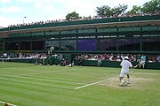
The main court, Centre Court, was opened in 1922 when the All England Lawn Tennis and Croquet Club moved from Worple Road to Church Road. Due to possibility of rain during Wimbledon, a retractable roof is planned for the court, which is expected to be completed in 2009. The court has a capacity of almost 14,000. At its south end is the Royal Box, from which members of the Royal Family and other dignitaries watch matches. Centre Court usually hosts the finals and semifinals of the main events, as well as many matches in the earlier rounds involving top-seeded players or local favorites.

The second most important court is No. 1 Court. The court was constructed in 1997 to replace the old No. 1 Court, which was adjacent to Centre Court . The old No. 1 Court was demolished because its capacity for spectators was too low. The court was said to have had a unique, more intimate atmosphere and was a favourite of many players. The new No. 1 Court has a capacity of approximately 11,000. The third-largest court, No. 2 Court, has been dubbed the "Graveyard of Champions" due to its reputation as the court on which many seeded players have been eliminated during the early rounds. Famous players who have lost on the Graveyard during early round play include
John McEnroe,
Pete Sampras,
Venus Williams, and
Serena Williams. The court has a capacity of about 3,000.
At the northern end of the grounds is a giant television screen on which important matches are broadcast. Fans watch from an area of grass officially known as Aorangi Park, but more commonly called
Henman Hill. The "hill" takes its name from local favourite
Tim Henman, who many fans hope will become the first British man to win the tournament since
Fred Perry did so in 1936. When other Brits do well at Wimbledon, the hill attracts fans for them, and is often re-named by the press for them:
Greg Rusedski's followers convened at "Rusedski Ridge," and the young Scotsman Andy Murray has had the hill nicknamed "Murray Mound," "Mount Murray," or "Murray Field" .
Traditions
Dark green and purple are the traditional Wimbledon colours. Green apparel was worn by the chair umpire, linesmen, ball boys and ball girls through the 2005 Championships; however, beginning with the 2006 Championships, officials, ball boys and ball girls were outfitted in new navy blue and cream coloured uniforms from American designer
Ralph Lauren. This marked the first time in the history of the Championships that an outside company was used to design Wimbledon apparel. As of June 2006, Wimbledon's contract with Ralph Lauren is set to last until 2009. The All England Club requires players to wear "almost entirely white" clothing during matches, a reason why a young
Andre Agassi boycotted the tournament in the early 1990s. No other Grand Slam tournament has such a strict dress code for players. During matches, female players are always referred to with the title "Miss" or "Mrs". On the other hand, the title "Mr" is never used for male players.
Previously, players bowed or curtsied to members of the Royal Family seated in the Royal Box upon entering or leaving Centre Court. In 2003, however, the President of the All England Club, HRH The Duke of Kent, decided to discontinue the tradition. Now, players are required to bow or curtsy only if the Queen or the Prince of Wales is present.
For the spectators,
strawberries and
cream is the traditional snack at Wimbledon. Approximately 62,000 pounds of strawberries and 1,540 gallons of cream are sold each year during the Championships.
Since 1992, Radio Wimbledon - an on-site radio station with a studio in the Centre Court building - has broadcast commentary, music and speech from 8am to 10pm daily throughout the championship. They also broadcast the draw on the Friday prior to the start of the tournament. Radio Wimbledon can be heard within a five-mile radius on 87.7
FM, and also online. It operates under a Restricted Service License and is arguably the most sophisticated RSL annually in the UK. The main presenters are Sam Lloyd and Nick Dye - typically they work alternate four hour shifts - reporters and commentators include Gigi Salmon, Nick Lestor, Rupert Bell, Nigel Bidmead, Guy Swindells, Lucie Ahl, Nadine Towell and Helen Whitaker. Often they will report from the 'Crow's Nest' - an elevated building housing the court 2 and 3 scoreboards which affords views of most of the outside courts. Regular guests include Sue Mappin. In recent years Radio Wimbledon acquired a second low-power FM frequency of 96.3 FM for uninterrupted Centre Court commentary, and, from 2006, a third for coverage from No. 1 Court on 97.8 FM. Hourly news bulletins and travel are also broadcast.
Trophies and prize money
The Gentlemen's Singles champion receives a silver gilt cup 18.5 inches in height and 7.5 inches in diameter. The trophy has been awarded since 1887. It bears the inscription: "The All England Lawn Tennis Club Single Handed Champion of the World." The Ladies' Singles champion receives a sterling silver salver commonly known as the "Venus Rosewater Dish", or simply the "Rosewater Dish". The salver, which is 18.75 inches in diameter, is decorated with figures from mythology. The winners of the Gentlemen's Doubles, Ladies' Doubles, and Mixed Doubles events receive silver cups. The runner-up in each event receives an inscribed silver plate. The trophies are usually presented by the President of the All England Club,
The Duke of Kent, and by his sister,
Princess Alexandra, The Honourable Lady Ogilvy.
At Wimbledon, more prize money is awarded in the Gentlemen's events than in the Ladies' events. The French Open also offered higher prize money for men until 2006, when it joined the Australian Open and the U.S. Open in offering equal prize money . In 2005, Wimbledon prize money exceeded Ł10 million in total for the first time. The sums awarded to the winners of each of the main events in 2006 are as follows :
- Gentlemen's Singles: Ł655,000
- Ladies' Singles: Ł625,000
- Gentlemen's Doubles: Ł220,690
- Ladies' Doubles: Ł205,280
- Mixed Doubles: Ł90,000
Champions
See: List of Wimbledon champions
|
Year ||
Champion ||
Runner-up ||
Score [i] ...
|
Year ||
Champion ||
Runner-up ||
Score [i] ...
- Gentlemen's Doubles
- Ladies' Doubles
- Mixed Doubles
- Last British Gentlemen's Singles champion: Fred Perry
- Last British Ladies' Singles champion: Virginia Wade
Records
External links