

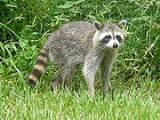
Raccoon

Encyclopedia
Procyon is a genus
of nocturnal mammal
s, comprising three species commonly known as raccoons, in the family
Procyonidae
. The most familiar species, the common raccoon
(P. lotor), is often known simply as "the" raccoon, as the two other raccoon species in the genus are native only to the tropics
and are considerably lesser-known. Genetic studies have shown that the closest relatives of the raccoon are the ring-tailed cat
s, coati
s and cacomistle
s.
s (though not opposable) enable them to open many closed containers (such as garbage cans and door
s). They are omnivore
s with a reputation for being clever and mischievous; their intelligence and dexterity equip them to survive in a wide range of environments and are one of the few medium-to-large-sized animals that have enlarged their range since human encroachment began (another is the coyote
). Raccoon hindfeet are plantigrade
similar to those of human
s and bear
s. Raccoons are sometimes considered vermin
or a nuisance. They have readily adapted to urban environments (compare urban opossums
, skunks and foxes), scavenging garbage bins and other food sources.
Although there is some variation depending on the species in question, raccoons range from 20–40 in (50.8–101.6 cm) in length (including the tail) and weigh between 10 and 35 lb (4.5 and 15.9 kg). The raccoon's tail
ranges from 8 to 16 in (20.3 to 40.6 cm) in length. Male raccoons are generally larger than females. A baby raccoon is called a kit.
Raccoons can live up to 16 years in the wild, though most do not make it through their second year. A raccoon that survives past its youth will live an average of five years. Primary causes of mortality include humans (hunting, trapping, cars) and malnutrition.
 There are three species of raccoon. The common raccoon, also known as the northern raccoon, has a natural range from southern Canada to Panama
, and has been introduced
to continental Europe
. Raccoons can live in the city or in the wild, and while they are not domesticated, they are on rare occasion kept as pets.
The tropical crab-eating Raccoon
(P. cancrivorus) ranges from Costa Rica
through most areas of South America
east of the Andes
down to northern Argentina
and Uruguay
.
A much rarer species, the Cozumel Island raccoon (P. pygmaeus), is native to Cozumel Island off the Atlantic coast of Yucatan
.
Some raccoons once considered separate species are now thought to be the same as or subspecies
of the common raccoon, including the Barbados raccoon
(P. gloveralleni), Nassau raccoon (P. maynardi), Guadeloupe raccoon
(P. minor), and Tres Marias raccoon
(P. insularis) (Helgen and Wilson 2005). Procyon brachyurus was described from captive specimens; its identity is undeterminable as the remains of the two animals assigned to this taxon
cannot be located anymore and may have been lost.
word aroughcoune, "he who scratches with his hands." Spanish-speaking colonists similarly adopted their term, mapache, from the Nahuatl
word for the animal, meaning roughly "that which has hands".
The genus name, Procyon, comes from the Greek
for "before the dog"; this term is also used for the star Procyon
of the constellation Canis Minor
.
Raccoons are today understood to have a relatively loose evolutionary relationship with bear
s, which was nonetheless seen as significant by the early taxonomists; Carolus Linnaeus
initially placed the raccoon in the genus Ursus
. In many languages, the raccoon is named for its characteristic dousing behavior in conjunction with that language's term for "bear": Waschbär in German
, mosómedve in Hungarian
, vaskebjørn in Danish
and Norwegian
, tvättbjörn in Swedish
, wasbeer in Dutch
, pesukarhu in Finnish
, araiguma (アライグマ) in Japanese
, orsetto lavatore in Italian
, huànxióng (浣熊) in Chinese
and mieshta mechka (миеща мечка) in Bulgarian
all mean "washing bear". One exception is Russian
, where raccoon is named yenot (енот) due to similarity between raccoon and genet
furs. However, the full name of the common raccoon in Russian is also “water-related”: it is called yenot-poloskun (енот-полоскун), which means "rinsing raccoon".
In some cases, the "washing" descriptor is applied only to the common raccoon species: for example, in French
the common raccoon is called raton laveur or "washing rat," while its Linnaean
binomial
is Procyon lotor or, roughly, "washing pre-dog." In contrast, the crab-eating raccoon is "little crab-catching rat" (raton crabier) and "crab-eating pre-dog" (Procyon cancrivorous) in French and Latin, respectively.
Genus
In biology, a genus is a low-level taxonomic rank used in the biological classification of living and fossil organisms, which is an example of definition by genus and differentia...
of nocturnal mammal
Mammal
Mammals are members of a class of air-breathing vertebrate animals characterised by the possession of endothermy, hair, three middle ear bones, and mammary glands functional in mothers with young...
s, comprising three species commonly known as raccoons, in the family
Family (biology)
In biological classification, family is* a taxonomic rank. Other well-known ranks are life, domain, kingdom, phylum, class, order, genus, and species, with family fitting between order and genus. As for the other well-known ranks, there is the option of an immediately lower rank, indicated by the...
Procyonidae
Procyonidae
Procyonidae is a New World family of the order Carnivora. It includes the raccoons, coatis, kinkajous, olingos, ringtails and cacomistles. Procyonids inhabit a wide range of environments, and are generally omnivorous.-Characteristics:...
. The most familiar species, the common raccoon
Raccoon
Procyon is a genus of nocturnal mammals, comprising three species commonly known as raccoons, in the family Procyonidae. The most familiar species, the common raccoon , is often known simply as "the" raccoon, as the two other raccoon species in the genus are native only to the tropics and are...
(P. lotor), is often known simply as "the" raccoon, as the two other raccoon species in the genus are native only to the tropics
Tropics
The tropics is a region of the Earth surrounding the Equator. It is limited in latitude by the Tropic of Cancer in the northern hemisphere at approximately N and the Tropic of Capricorn in the southern hemisphere at S; these latitudes correspond to the axial tilt of the Earth...
and are considerably lesser-known. Genetic studies have shown that the closest relatives of the raccoon are the ring-tailed cat
Ring-tailed Cat
The ringtail is a mammal of the raccoon family , native to arid regions of North America. It is also known as the ringtail cat, ring-tailed cat or miner's cat, and is also sometimes mistakenly called a "civet cat"...
s, coati
Coati
Coatis, genera Nasua and Nasuella, also known as the Brazilian aardvark, Mexican tejón, hog-nosed coon, pizotes, crackoons and snookum bears, are members of the raccoon family . They are diurnal mammals native to South America, Central America, and south-western North America...
s and cacomistle
Cacomistle
The cacomistle is a nocturnal, arboreal and omnivorous member of the carnivoran family Procyonidae. Its preferred habitats are wet, tropical, evergreen woodlands and mountain forests, though seasonally it will range into drier deciduous forests.Nowhere in its range is B. sumichrasti common...
s.
General attributes
Raccoons are unusual, for their thumbThumb
The thumb is the first digit of the hand. When a person is standing in the medical anatomical position , the thumb is the lateral-most digit...
s (though not opposable) enable them to open many closed containers (such as garbage cans and door
Door
A door is a movable structure used to open and close off an entrance, typically consisting of a panel that swings on hinges or that slides or rotates inside of a space....
s). They are omnivore
Omnivore
Omnivores are species that eat both plants and animals as their primary food source...
s with a reputation for being clever and mischievous; their intelligence and dexterity equip them to survive in a wide range of environments and are one of the few medium-to-large-sized animals that have enlarged their range since human encroachment began (another is the coyote
Coyote
The coyote , also known as the American jackal or the prairie wolf, is a species of canine found throughout North and Central America, ranging from Panama in the south, north through Mexico, the United States and Canada...
). Raccoon hindfeet are plantigrade
Plantigrade
right|151px|thumb|Human skeleton, showing plantigrade habitIn terrestrial animals, plantigrade locomotion means walking with the podials and metatarsals flat on the ground. It is one of three forms of locomotion adopted by mammals...
similar to those of human
Human
Humans are the only living species in the Homo genus...
s and bear
Bear
Bears are mammals of the family Ursidae. Bears are classified as caniforms, or doglike carnivorans, with the pinnipeds being their closest living relatives. Although there are only eight living species of bear, they are widespread, appearing in a wide variety of habitats throughout the Northern...
s. Raccoons are sometimes considered vermin
Vermin
Vermin is a term applied to various animal species regarded by some as pests or nuisances and especially to those associated with the carrying of disease. Since the term is defined in relation to human activities, which species are included will vary from area to area and even person to person...
or a nuisance. They have readily adapted to urban environments (compare urban opossums
Virginia Opossum
The Virginia opossum , commonly known as the North American opossum or tlacuache in Mexico, is the only marsupial found in North America north of Mexico. A solitary and nocturnal animal about the size of a domestic cat, and thus the largest opossum, it is a successful opportunist...
, skunks and foxes), scavenging garbage bins and other food sources.
Although there is some variation depending on the species in question, raccoons range from 20–40 in (50.8–101.6 cm) in length (including the tail) and weigh between 10 and 35 lb (4.5 and 15.9 kg). The raccoon's tail
Tail
The tail is the section at the rear end of an animal's body; in general, the term refers to a distinct, flexible appendage to the torso. It is the part of the body that corresponds roughly to the sacrum and coccyx in mammals, reptiles, and birds...
ranges from 8 to 16 in (20.3 to 40.6 cm) in length. Male raccoons are generally larger than females. A baby raccoon is called a kit.
Raccoons can live up to 16 years in the wild, though most do not make it through their second year. A raccoon that survives past its youth will live an average of five years. Primary causes of mortality include humans (hunting, trapping, cars) and malnutrition.
Species
Panama
Panama , officially the Republic of Panama , is the southernmost country of Central America. Situated on the isthmus connecting North and South America, it is bordered by Costa Rica to the northwest, Colombia to the southeast, the Caribbean Sea to the north and the Pacific Ocean to the south. The...
, and has been introduced
Introduced species
An introduced species — or neozoon, alien, exotic, non-indigenous, or non-native species, or simply an introduction, is a species living outside its indigenous or native distributional range, and has arrived in an ecosystem or plant community by human activity, either deliberate or accidental...
to continental Europe
Continental Europe
Continental Europe, also referred to as mainland Europe or simply the Continent, is the continent of Europe, explicitly excluding European islands....
. Raccoons can live in the city or in the wild, and while they are not domesticated, they are on rare occasion kept as pets.
The tropical crab-eating Raccoon
Crab-eating raccoon
The Crab-eating Raccoon is a species of raccoon native to marshy and jungle areas of Central and South America . It is found from Costa Rica south through most areas of South America east of the Andes down to northern Argentina and Uruguay...
(P. cancrivorus) ranges from Costa Rica
Costa Rica
Costa Rica , officially the Republic of Costa Rica is a multilingual, multiethnic and multicultural country in Central America, bordered by Nicaragua to the north, Panama to the southeast, the Pacific Ocean to the west and the Caribbean Sea to the east....
through most areas of South America
South America
South America is a continent situated in the Western Hemisphere, mostly in the Southern Hemisphere, with a relatively small portion in the Northern Hemisphere. The continent is also considered a subcontinent of the Americas. It is bordered on the west by the Pacific Ocean and on the north and east...
east of the Andes
Andes
The Andes is the world's longest continental mountain range. It is a continual range of highlands along the western coast of South America. This range is about long, about to wide , and of an average height of about .Along its length, the Andes is split into several ranges, which are separated...
down to northern Argentina
Argentina
Argentina , officially the Argentine Republic , is the second largest country in South America by land area, after Brazil. It is constituted as a federation of 23 provinces and an autonomous city, Buenos Aires...
and Uruguay
Uruguay
Uruguay ,officially the Oriental Republic of Uruguay,sometimes the Eastern Republic of Uruguay; ) is a country in the southeastern part of South America. It is home to some 3.5 million people, of whom 1.8 million live in the capital Montevideo and its metropolitan area...
.
A much rarer species, the Cozumel Island raccoon (P. pygmaeus), is native to Cozumel Island off the Atlantic coast of Yucatan
Yucatán
Yucatán officially Estado Libre y Soberano de Yucatán is one of the 31 states which, with the Federal District, comprise the 32 Federal Entities of Mexico. It is divided in 106 municipalities and its capital city is Mérida....
.
Some raccoons once considered separate species are now thought to be the same as or subspecies
Subspecies
Subspecies in biological classification, is either a taxonomic rank subordinate to species, ora taxonomic unit in that rank . A subspecies cannot be recognized in isolation: a species will either be recognized as having no subspecies at all or two or more, never just one...
of the common raccoon, including the Barbados raccoon
Barbados Raccoon
The Barbados raccoon is an extinct subspecies of the common raccoon , that was endemic on Barbados in the Lesser Antilles until 1964.- Classification :...
(P. gloveralleni), Nassau raccoon (P. maynardi), Guadeloupe raccoon
Guadeloupe Raccoon
The Guadeloupe raccoon is a subspecies of the common raccoon endemic on the two main islands Basse-Terre Island and Grande-Terre of Guadeloupe in the Lesser Antilles.- Classification :...
(P. minor), and Tres Marias raccoon
Tres Marias Raccoon
The Tres Marias raccoon is a subspecies of the common raccoon endemic on the two main islands of the Islas Marías, an archipelago off the western coast of the Mexican state of Nayarit.- Classification :...
(P. insularis) (Helgen and Wilson 2005). Procyon brachyurus was described from captive specimens; its identity is undeterminable as the remains of the two animals assigned to this taxon
Taxon
|thumb|270px|[[African elephants]] form a widely-accepted taxon, the [[genus]] LoxodontaA taxon is a group of organisms, which a taxonomist adjudges to be a unit. Usually a taxon is given a name and a rank, although neither is a requirement...
cannot be located anymore and may have been lost.
Nomenclature
The word "raccoon" is derived from the AlgonquianAlgonquin language
Algonquin is either a distinct Algonquian language closely related to the Ojibwe language or a particularly divergent Ojibwe dialect. It is spoken, alongside French and to some extent English, by the Algonquin First Nations of Quebec and Ontario...
word aroughcoune, "he who scratches with his hands." Spanish-speaking colonists similarly adopted their term, mapache, from the Nahuatl
Nahuatl
Nahuatl is thought to mean "a good, clear sound" This language name has several spellings, among them náhuatl , Naoatl, Nauatl, Nahuatl, Nawatl. In a back formation from the name of the language, the ethnic group of Nahuatl speakers are called Nahua...
word for the animal, meaning roughly "that which has hands".
The genus name, Procyon, comes from the Greek
Greek language
Greek is an independent branch of the Indo-European family of languages. Native to the southern Balkans, it has the longest documented history of any Indo-European language, spanning 34 centuries of written records. Its writing system has been the Greek alphabet for the majority of its history;...
for "before the dog"; this term is also used for the star Procyon
Procyon
Procyon is the brightest star in the constellation Canis Minor. To the naked eye, it appears to be a single star, the seventh brightest in the night sky with a visual apparent magnitude of 0.34...
of the constellation Canis Minor
Canis Minor
Canis Minor is a small constellation. It was included in the 2nd century astronomer Ptolemy's 48 constellations, and is still included among the 88 modern constellations...
.
Raccoons are today understood to have a relatively loose evolutionary relationship with bear
Bear
Bears are mammals of the family Ursidae. Bears are classified as caniforms, or doglike carnivorans, with the pinnipeds being their closest living relatives. Although there are only eight living species of bear, they are widespread, appearing in a wide variety of habitats throughout the Northern...
s, which was nonetheless seen as significant by the early taxonomists; Carolus Linnaeus
Carolus Linnaeus
Carl Linnaeus , also known after his ennoblement as , was a Swedish botanist, physician, and zoologist, who laid the foundations for the modern scheme of binomial nomenclature. He is known as the father of modern taxonomy, and is also considered one of the fathers of modern ecology...
initially placed the raccoon in the genus Ursus
Ursus (genus)
Ursus is a genus in the family Ursidae that includes the widely distributed brown bears, the polar bear, and black bears. The name is derived from the Latin ursus, meaning bear.-Species and subspecies of Ursus:...
. In many languages, the raccoon is named for its characteristic dousing behavior in conjunction with that language's term for "bear": Waschbär in German
German language
German is a West Germanic language, related to and classified alongside English and Dutch. With an estimated 90 – 98 million native speakers, German is one of the world's major languages and is the most widely-spoken first language in the European Union....
, mosómedve in Hungarian
Hungarian language
Hungarian is a Uralic language, part of the Ugric group. With some 14 million speakers, it is one of the most widely spoken non-Indo-European languages in Europe....
, vaskebjørn in Danish
Danish language
Danish is a North Germanic language spoken by around six million people, principally in the country of Denmark. It is also spoken by 50,000 Germans of Danish ethnicity in the northern parts of Schleswig-Holstein, Germany, where it holds the status of minority language...
and Norwegian
Norwegian language
Norwegian is a North Germanic language spoken primarily in Norway, where it is the official language. Together with Swedish and Danish, Norwegian forms a continuum of more or less mutually intelligible local and regional variants .These Scandinavian languages together with the Faroese language...
, tvättbjörn in Swedish
Swedish language
Swedish is a North Germanic language, spoken by approximately 10 million people, predominantly in Sweden and parts of Finland, especially along its coast and on the Åland islands. It is largely mutually intelligible with Norwegian and Danish...
, wasbeer in Dutch
Dutch language
Dutch is a West Germanic language and the native language of the majority of the population of the Netherlands, Belgium, and Suriname, the three member states of the Dutch Language Union. Most speakers live in the European Union, where it is a first language for about 23 million and a second...
, pesukarhu in Finnish
Finnish language
Finnish is the language spoken by the majority of the population in Finland Primarily for use by restaurant menus and by ethnic Finns outside Finland. It is one of the two official languages of Finland and an official minority language in Sweden. In Sweden, both standard Finnish and Meänkieli, a...
, araiguma (アライグマ) in Japanese
Japanese language
is a language spoken by over 130 million people in Japan and in Japanese emigrant communities. It is a member of the Japonic language family, which has a number of proposed relationships with other languages, none of which has gained wide acceptance among historical linguists .Japanese is an...
, orsetto lavatore in Italian
Italian language
Italian is a Romance language spoken mainly in Europe: Italy, Switzerland, San Marino, Vatican City, by minorities in Malta, Monaco, Croatia, Slovenia, France, Libya, Eritrea, and Somalia, and by immigrant communities in the Americas and Australia...
, huànxióng (浣熊) in Chinese
Chinese language
The Chinese language is a language or language family consisting of varieties which are mutually intelligible to varying degrees. Originally the indigenous languages spoken by the Han Chinese in China, it forms one of the branches of Sino-Tibetan family of languages...
and mieshta mechka (миеща мечка) in Bulgarian
Bulgarian language
Bulgarian is an Indo-European language, a member of the Slavic linguistic group.Bulgarian, along with the closely related Macedonian language, demonstrates several linguistic characteristics that set it apart from all other Slavic languages such as the elimination of case declension, the...
all mean "washing bear". One exception is Russian
Russian language
Russian is a Slavic language used primarily in Russia, Belarus, Uzbekistan, Kazakhstan, Tajikistan and Kyrgyzstan. It is an unofficial but widely spoken language in Ukraine, Moldova, Latvia, Turkmenistan and Estonia and, to a lesser extent, the other countries that were once constituent republics...
, where raccoon is named yenot (енот) due to similarity between raccoon and genet
Genet (animal)
Genets are Old World mammals from the order Carnivora, family Viverridae, related to civets and linsangs. All species are contained within the genus Genetta, although the Aquatic Genet is sometimes housed in its own genus Osbornictis....
furs. However, the full name of the common raccoon in Russian is also “water-related”: it is called yenot-poloskun (енот-полоскун), which means "rinsing raccoon".
In some cases, the "washing" descriptor is applied only to the common raccoon species: for example, in French
French language
French is a Romance language spoken as a first language in France, the Romandy region in Switzerland, Wallonia and Brussels in Belgium, Monaco, the regions of Quebec and Acadia in Canada, and by various communities elsewhere. Second-language speakers of French are distributed throughout many parts...
the common raccoon is called raton laveur or "washing rat," while its Linnaean
Linnaean taxonomy
Linnaean taxonomy can mean either of two related concepts:# the particular form of biological classification set up by Carl Linnaeus, as set forth in his Systema Naturæ and subsequent works...
binomial
Binomial nomenclature
Binomial nomenclature is a formal system of naming species of living things by giving each a name composed of two parts, both of which use Latin grammatical forms, although they can be based on words from other languages...
is Procyon lotor or, roughly, "washing pre-dog." In contrast, the crab-eating raccoon is "little crab-catching rat" (raton crabier) and "crab-eating pre-dog" (Procyon cancrivorous) in French and Latin, respectively.
Literature
- Helgen, K.M. & Wilson, D.E. 2005. A systematic and zoogeographic overview of the raccoons of Mexico and Central America. Pp. 219–234 in Sanchez-Cordero, V. & Medellin, R.A. (eds.). Contribuciones Mastozoologicas: en Homenaje a Bernardo Villa. Mexico City: Instituto de Biologia e Instituto de Ecologia, UNAM.
See also
- Raccoon dogRaccoon DogThe raccoon dog , also known as the magnut or tanuki, is a canid indigenous to east Asia. It is the only extant species in the genus Nyctereutes...
- an unrelated animal sometimes confused with raccoons - Red pandaRed PandaThe red panda , is a small arboreal mammal native to the eastern Himalayas and southwestern China. It is the only species of the genus Ailurus. Slightly larger than a domestic cat, it has reddish-brown fur, a long, shaggy tail, and a waddling gait due to its shorter front legs...
- Maine coonMaine CoonThe Maine Coon is a breed of domestic cat with a distinctive physical appearance and valuable hunting skills. It is one of the oldest natural breeds in North America, specifically native to the state of Maine, where it is the official State Cat....