
Home      Discussion      Topics      Dictionary      Almanac
Signup       Login
Red Panda

Red Panda

Overview
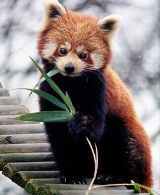
The red panda is a small arboreal mammal
Mammal
Mammals are members of a class of air-breathing vertebrate animals characterised by the possession of endothermy, hair, three middle ear bones, and mammary glands functional in mothers with young...

 native to the eastern Himalayas
Himalayas
The Himalaya Range or Himalaya Mountains Sanskrit: Devanagari: हिमालय, literally "abode of snow"), usually called the Himalayas or Himalaya for short, is a mountain range in Asia, separating the Indian subcontinent from the Tibetan Plateau...

 and southwestern China
China
Chinese civilization may refer to:* China for more general discussion of the country.* Chinese culture* Greater China, the transnational community of ethnic Chinese.* History of China* Sinosphere, the area historically affected by Chinese culture...

. It is the only species of the genus Ailurus. Slightly larger than a domestic cat, it has reddish-brown fur, a long, shaggy tail, and a waddling gait due to its shorter front legs. It feeds mainly on bamboo
Bamboo shoot
Bamboo shoots or bamboo sprouts are the edible shoots of many bamboo species including Bambusa vulgaris and Phyllostachys edulis. They are used in numerous Asian dishes and broths...

, but is omnivorous and may also eat eggs, bird
Bird
Birds are feathered, winged, bipedal, endothermic , egg-laying, vertebrate animals. Around 10,000 living species and 188 families makes them the most speciose class of tetrapod vertebrates. They inhabit ecosystems across the globe, from the Arctic to the Antarctic. Extant birds range in size from...

s, insect
Insect
Insects are a class of living creatures within the arthropods that have a chitinous exoskeleton, a three-part body , three pairs of jointed legs, compound eyes, and two antennae...

s, and small mammal
Mammal
Mammals are members of a class of air-breathing vertebrate animals characterised by the possession of endothermy, hair, three middle ear bones, and mammary glands functional in mothers with young...

s. It is a solitary animal, mainly active from dusk to dawn, and is largely sedentary
Sedentary lifestyle
Sedentary lifestyle is a medical term used to denote a type of lifestyle with no or irregular physical activity. A person who lives a sedentary lifestyle may colloquially be known as a couch potato. It is commonly found in both the developed and developing world...

 during the day.
Discussion
Ask a question about 'Red Panda'
Start a new discussion about 'Red Panda'
Answer questions from other users
Full Discussion Forum
 
Unanswered Questions
Recent Discussions
Encyclopedia
The red panda is a small arboreal mammal
Mammal
Mammals are members of a class of air-breathing vertebrate animals characterised by the possession of endothermy, hair, three middle ear bones, and mammary glands functional in mothers with young...

 native to the eastern Himalayas
Himalayas
The Himalaya Range or Himalaya Mountains Sanskrit: Devanagari: हिमालय, literally "abode of snow"), usually called the Himalayas or Himalaya for short, is a mountain range in Asia, separating the Indian subcontinent from the Tibetan Plateau...

 and southwestern China
China
Chinese civilization may refer to:* China for more general discussion of the country.* Chinese culture* Greater China, the transnational community of ethnic Chinese.* History of China* Sinosphere, the area historically affected by Chinese culture...

. It is the only species of the genus Ailurus. Slightly larger than a domestic cat, it has reddish-brown fur, a long, shaggy tail, and a waddling gait due to its shorter front legs. It feeds mainly on bamboo
Bamboo shoot
Bamboo shoots or bamboo sprouts are the edible shoots of many bamboo species including Bambusa vulgaris and Phyllostachys edulis. They are used in numerous Asian dishes and broths...

, but is omnivorous and may also eat eggs, bird
Bird
Birds are feathered, winged, bipedal, endothermic , egg-laying, vertebrate animals. Around 10,000 living species and 188 families makes them the most speciose class of tetrapod vertebrates. They inhabit ecosystems across the globe, from the Arctic to the Antarctic. Extant birds range in size from...

s, insect
Insect
Insects are a class of living creatures within the arthropods that have a chitinous exoskeleton, a three-part body , three pairs of jointed legs, compound eyes, and two antennae...

s, and small mammal
Mammal
Mammals are members of a class of air-breathing vertebrate animals characterised by the possession of endothermy, hair, three middle ear bones, and mammary glands functional in mothers with young...

s. It is a solitary animal, mainly active from dusk to dawn, and is largely sedentary
Sedentary lifestyle
Sedentary lifestyle is a medical term used to denote a type of lifestyle with no or irregular physical activity. A person who lives a sedentary lifestyle may colloquially be known as a couch potato. It is commonly found in both the developed and developing world...

 during the day.

The red panda has been classified as Vulnerable
Vulnerable species
On 30 January 2010, the IUCN Red List of Threatened Species identified 9694 Vulnerable species, subspecies and varieties, stocks and sub-populations.-References:...

 by IUCN because its population is estimated at fewer than 10,000 mature individuals. Although red pandas are protected by national laws in their range countries, their numbers in the wild continue to decline mainly due to habitat loss and fragmentation, poaching
Poaching
Poaching is the illegal taking of wild plants or animals contrary to local and international conservation and wildlife management laws. Violations of hunting laws and regulations are normally punishable by law and, collectively, such violations are known as poaching.It may be illegal and in...

, and inbreeding depression.

The red panda has been previously classified in the families Procyonidae
Procyonidae
Procyonidae is a New World family of the order Carnivora. It includes the raccoons, coatis, kinkajous, olingos, ringtails and cacomistles. Procyonids inhabit a wide range of environments, and are generally omnivorous.-Characteristics:...

 (raccoons) and Ursidae (bears), but recent research has placed it in its own family Ailuridae
Ailuridae
Ailuridae is a family in the mammal order Carnivora. The family includes the Red Panda and its extinct relatives.-Classification history:...

, in superfamily Musteloidea
Musteloidea
Musteloidea is a superfamily of carnivoran mammals united by shared characters of the skull and teeth. Musteloids share a common ancestor with the pinnipeds, the group which includes seals....

 along with Mustelidae
Mustelidae
Mustelidae , commonly referred to as the weasel family, are a family of carnivorous mammals. Mustelids are diverse and the largest family in the order Carnivora, at least partly because in the past it has been a catch-all category for many early or poorly differentiated taxa...

 and Procyonidae
Procyonidae
Procyonidae is a New World family of the order Carnivora. It includes the raccoons, coatis, kinkajous, olingos, ringtails and cacomistles. Procyonids inhabit a wide range of environments, and are generally omnivorous.-Characteristics:...

. Two subspecies are recognized.

Physical characteristics


The head and body length of red pandas averages 56 centimetre, and their tails about 37 centimetre. Males weigh 3.7 to 6.2 kg (8.2 to 13.7 lb) and females 4.2 to 6 kg (9.3 to 13.2 lb). They have long, soft reddish-brown fur on the upper parts, blackish fur on the lower parts, and a light face with tear markings and robust
Robustness (morphology)
In biology, robustness is used to describe a species with a morphology based on strength and a heavy build. The alternative morphology is the 'gracile' body type. For example, comparing similar species, rats have robust body types while mice are gracile. Male and females of the same species may...

 cranial-dental features. The light face has white badges similar to those of a raccoon
Raccoon
Procyon is a genus of nocturnal mammals, comprising three species commonly known as raccoons, in the family Procyonidae. The most familiar species, the common raccoon , is often known simply as "the" raccoon, as the two other raccoon species in the genus are native only to the tropics and are...

, but each individual can have distinctive markings. Their roundish head has medium-sized upright ears, a black nose, and very dark eyes: almost pitch black. Their long bushy tail with six alternating yellowish red transverse ochre
Ochre
Ochre is the term for both a golden-yellow or light yellow brown color and for a form of earth pigment which produces the color. The pigment can also be used to create a reddish tint known as "red ochre". The more rarely used terms "purple ochre" and "brown ochre" also exist for variant hues...

 rings provides balance and excellent camouflage
Camouflage
Camouflage is a method of concealment that allows an otherwise visible animal, military vehicle, or other object to remain unnoticed, by blending with its environment. Examples include a leopard's spotted coat, the battledress of a modern soldier and a leaf-mimic butterfly...

 against its habitat of moss- and lichen-covered trees. The legs are black and short with thick fur on the soles of the paws. This fur serves as thermal insulation on snow-covered or ice surfaces and conceals scent glands which are also present on the anus.

The red panda is specialized as a bamboo feeder with strong, curved and sharp semi-retractile claws standing inward for grasping of narrow tree branches, leaves and fruit. Like the giant panda
Giant Panda
The giant panda, or panda is a bear native to central-western and south western China. It is easily recognized by its large, distinctive black patches around the eyes, over the ears, and across its round body. Though it belongs to the order Carnivora, the panda's diet is 99% bamboo...

, it has a “false thumb” that is an extension of the wrist bone. When descending a tree headfirst, the red panda rotates its ankle to control its descent, one of the few climbing species to do so.

Distribution and habitat


The red panda is endemic to the temperate forest
Temperate broadleaf and mixed forests
Mixed forests are a temperate and humid biome. The typical structure of these forests includes four layers. The uppermost layer is the canopy composed of tall mature trees ranging from 33 to 66 m high. Below the canopy is the three-layered, shade-tolerant understory that is roughly 9 to...

s of the Himalayas, and ranges from the foothills of western Nepal
Nepal
Nepal , officially the Federal Democratic Republic of Nepal, is a landlocked sovereign state located in South Asia. It is located in the Himalayas and bordered to the north by the People's Republic of China, and to the south, east, and west by the Republic of India...

 to China
China
Chinese civilization may refer to:* China for more general discussion of the country.* Chinese culture* Greater China, the transnational community of ethnic Chinese.* History of China* Sinosphere, the area historically affected by Chinese culture...

 in the east. Its easternmost limit is the Qinling Mountains
Qinling Mountains
The Qin Mountains are a major east-west mountain range in southern Shaanxi province, China. The mountains provide a natural boundary between the North and South of the country, and support a huge variety of plant and wildlife, some of which is found nowhere else on Earth.To the north is the...

 of the Shaanxi Province in China. It is found in southern Tibet
Tibet
Tibet is a plateau region in Asia, north-east of the Himalayas. It is the traditional homeland of the Tibetan people as well as some other ethnic groups such as Monpas, Qiang, and Lhobas, and is now also inhabited by considerable numbers of Han and Hui people...

, Sikkim
Sikkim
Sikkim is a landlocked Indian state nestled in the Himalayan mountains...

, Assam
Assam
Assam , also, rarely, Assam Valley and formerly the Assam Province , is a northeastern state of India and is one of the most culturally and geographically distinct regions of the country...

 and Bhutan
Bhutan
Bhutan , officially the Kingdom of Bhutan, is a landlocked state in South Asia, located at the eastern end of the Himalayas and bordered to the south, east and west by the Republic of India and to the north by the People's Republic of China...

, in the northern mountains of Myanmar
Myanmar
Burma , officially the Republic of the Union of Myanmar , is a country in Southeast Asia. Burma is bordered by China on the northeast, Laos on the east, Thailand on the southeast, Bangladesh on the west, India on the northwest, the Bay of Bengal to the southwest, and the Andaman Sea on the south....

, and in southwestern China in the Hengduan Mountains of Sichuan
Sichuan
' , known formerly in the West by its postal map spellings of Szechwan or Szechuan is a province in Southwest China with its capital in Chengdu...

 and Gongshan Mountains in Yunnan
Yunnan
Yunnan is a province of the People's Republic of China, located in the far southwest of the country spanning approximately and with a population of 45.7 million . The capital of the province is Kunming. The province borders Burma, Laos, and Vietnam.Yunnan is situated in a mountainous area, with...

. It may also live in southwest Tibet
Tibet
Tibet is a plateau region in Asia, north-east of the Himalayas. It is the traditional homeland of the Tibetan people as well as some other ethnic groups such as Monpas, Qiang, and Lhobas, and is now also inhabited by considerable numbers of Han and Hui people...

 and northern Arunachal Pradesh
Arunachal Pradesh
Arunachal Pradesh is a state of India, located in the far northeast. It borders the states of Assam and Nagaland to the south, and shares international borders with Burma in the east, Bhutan in the west, and the People's Republic of China in the north. The majority of the territory is claimed by...

, but this has not been documented. Locations with the highest density of red pandas include an area in the Himalayas that has been proposed as having been a refuge for a variety of endemic species in the Pleistocene
Pleistocene
The Pleistocene is the epoch from 2,588,000 to 11,700 years BP that spans the world's recent period of repeated glaciations. The name pleistocene is derived from the Greek and ....

. The distribution range of the red panda should be considered disjunct, rather than continuous. A disjunct population inhabits the Meghalaya
Meghalaya subtropical forests
The Meghalaya subtropical forests is a montane subtropical moist broadleaf forest ecoregion of eastern India. The ecoregion covers an area of , encompassing the Khasi Hills, Garo Hills, and Jaintia Hills of India's Meghalaya state, and adjacent portions of Assam state...

 Plateau of northeastern India
India
India , officially the Republic of India , is a country in South Asia. It is the seventh-largest country by geographical area, the second-most populous country with over 1.2 billion people, and the most populous democracy in the world...

.

During a survey in the 1970s, signs of red pandas were found in Nepal's Dhorpatan Hunting Reserve
Dhorpatan Hunting Reserve
The Dhorpatan Hunting Reserve is the only hunting reserve in Nepal. Established in 1987 it covers an area of in the Dhaulagiri Himal of western Nepal in the Rukum, Myagdi and Baglung Districts. In altitude it ranges from .-External links:*...

. Their presence was confirmed in spring 2007 when four red pandas were sighted at elevations ranging from
3220 to 3610 m (10,564.3 to 11,843.8 ft). The species' westernmost limit is in Rara National Park
Rara National Park
Rara National Park is a protected area in the Himalayas of Nepal and was established in 1976. Covering an area of in the Mugu and Dolpa districts, it is the country's smallest national park. Its main feature is Rara Lake at an altitude of...

 located farther west of the Dhorpatan Hunting Reserve. Their presence was confirmed in 2008.

The red panda lives between 2200 and 4800 m (7,217.8 and 15,748 ft) altitude, inhabiting areas of moderate temperature between 10 and 25 °C (50 and 77 F) with little annual change. It prefers mountainous mixed deciduous
Deciduous
Deciduous means "falling off at maturity" or "tending to fall off", and is typically used in reference to trees or shrubs that lose their leaves seasonally, and to the shedding of other plant structures such as petals after flowering or fruit when ripe...

 and conifer forests, especially with old trees and dense understories of bamboo
Bamboo
Bamboo is a group of perennial evergreens in the true grass family Poaceae, subfamily Bambusoideae, tribe Bambuseae. Giant bamboos are the largest members of the grass family....

.

The effective population size of the Sichuan
Sichuan
' , known formerly in the West by its postal map spellings of Szechwan or Szechuan is a province in Southwest China with its capital in Chengdu...

 population is larger and more stable than that of the Yunnan
Yunnan
Yunnan is a province of the People's Republic of China, located in the far southwest of the country spanning approximately and with a population of 45.7 million . The capital of the province is Kunming. The province borders Burma, Laos, and Vietnam.Yunnan is situated in a mountainous area, with...

 population, implying a southward expansion from Sichuan to Yunnan.

In August 2010, archaeologists uncovered red panda fossil remains in Washington County in the US state of Tennessee
Tennessee
Tennessee is a U.S. state located in the Southeastern United States. It has a population of 6,346,105, making it the nation's 17th-largest state by population, and covers , making it the 36th-largest by total land area...

. Although none are known to exist in the wild in North America today, it is believed the red panda thrived in the mountains of eastern Tennessee approximately 4.5 million years ago.

The red panda has become extirpated
Local extinction
Local extinction, also known as extirpation, is the condition of a species which ceases to exist in the chosen geographic area of study, though it still exists elsewhere...

 from the Chinese provinces of Guizhou
Guizhou
' is a province of the People's Republic of China located in the southwestern part of the country. Its provincial capital city is Guiyang.- History :...

, Gansu
Gansu
' is a province located in the northwest of the People's Republic of China.It lies between the Tibetan and Huangtu plateaus, and borders Mongolia, Inner Mongolia, and Ningxia to the north, Xinjiang and Qinghai to the west, Sichuan to the south, and Shaanxi to the east...

, Shaanxi and Qinghai
Qinghai
Qinghai ; Oirat Mongolian: ; ; Salar:) is a province of the People's Republic of China, named after Qinghai Lake...

.

Distribution of subspecies


Distribution of the red panda is disjointed, and there are two extant subspecies:
  • Western red panda Ailurus fulgens fulgens (Cuvier
    Frédéric Cuvier
    Frédéric Cuvier was a French zoologist. He was the younger brother of noted naturalist and zoologist Georges Cuvier....

    , 1825) — lives in the western part of its range: in Nepal
    Nepal
    Nepal , officially the Federal Democratic Republic of Nepal, is a landlocked sovereign state located in South Asia. It is located in the Himalayas and bordered to the north by the People's Republic of China, and to the south, east, and west by the Republic of India...

    , Assam
    Assam
    Assam , also, rarely, Assam Valley and formerly the Assam Province , is a northeastern state of India and is one of the most culturally and geographically distinct regions of the country...

    , Sikkim
    Sikkim
    Sikkim is a landlocked Indian state nestled in the Himalayan mountains...

     and Bhutan
    Bhutan
    Bhutan , officially the Kingdom of Bhutan, is a landlocked state in South Asia, located at the eastern end of the Himalayas and bordered to the south, east and west by the Republic of India and to the north by the People's Republic of China...

    ;
  • Styan's red panda Ailurus fulgens styani — lives in the east-northeastern part of its range: in southern China
    China
    Chinese civilization may refer to:* China for more general discussion of the country.* Chinese culture* Greater China, the transnational community of ethnic Chinese.* History of China* Sinosphere, the area historically affected by Chinese culture...

     and northern Myanmar
    Myanmar
    Burma , officially the Republic of the Union of Myanmar , is a country in Southeast Asia. Burma is bordered by China on the northeast, Laos on the east, Thailand on the southeast, Bangladesh on the west, India on the northwest, the Bay of Bengal to the southwest, and the Andaman Sea on the south....

    .

Ailurus fulgens styani has been described by Thomas
Oldfield Thomas
Oldfield Thomas FRS was a British zoologist.Thomas worked at the Natural History Museum on mammals, describing about 2,000 new species and sub-species for the first time. He was appointed to the Museum Secretary's office in 1876, transferring to the Zoological Department in 1878...

 in 1902 based on one skull from a specimen collected in Szechwan. Pocock
Reginald Innes Pocock
Reginald Innes Pocock F.R.S. was a British zoologist.Pocock was born in Clifton, Bristol, the fourth son of Rev. Nicholas Pocock and Edith Prichard. He began showing interest in natural history at St. Edward's School, Oxford. He received tutoring in zoology from Sir Edward Poulton, and was allowed...

 distinguished styani from fulgens by its longer winter coat and more abundant blackness in the pelage, bigger skull, more strongly curved forehead, and more robust teeth. His description is based on skulls and skins collected in Szechwan, Myitkyina
Myitkyina District
Myitkyina District is a district of the Kachin State in northern Burma . The capital lies at Myitkyina.-Townships:The district contains the following townships:*Myitkyina Township*Waingmaw Township*Injangyang Township*Tanai Township...

 close to the border of Yunnan
Yunnan
Yunnan is a province of the People's Republic of China, located in the far southwest of the country spanning approximately and with a population of 45.7 million . The capital of the province is Kunming. The province borders Burma, Laos, and Vietnam.Yunnan is situated in a mountainous area, with...

, and Upper Burma.

The Styan's red panda is supposedly larger and darker in color than its Western cousin, but there is considerable variation in both subspecies, and some individuals may be brown or yellowish brown rather than red.

The Brahmaputra river is often considered the natural division between the two subspecies, where it makes a curve around the eastern end of the Himalayas
Himalayas
The Himalaya Range or Himalaya Mountains Sanskrit: Devanagari: हिमालय, literally "abode of snow"), usually called the Himalayas or Himalaya for short, is a mountain range in Asia, separating the Indian subcontinent from the Tibetan Plateau...

. Although some authors suggest that A. f. fulgens extends farther eastward, into China.

Behavior


Red pandas are territorial. Adults are solitary except during mating season. They are generally quiet except for some twittering and whistling communication sounds. They have been reported to be both nocturnal and crepuscular
Crepuscular
Crepuscular animals are those that are active primarily during twilight, that is during dawn and dusk. The word is derived from the Latin word crepusculum, meaning "twilight." Crepuscular is, thus, in contrast with diurnal and nocturnal behavior. Crepuscular animals may also be active on a bright...

, sleeping on tree branches or in tree hollows during the day and increasing their activity in the late afternoon and early evening hours. They sleep stretched out on a branch with legs dangling when it is hot, and curled up with its tail over the face when it is cold. They are very heat sensitive, with an optimal “well-being” temperature between 17 and 25 °C (62.6 and 77 F), and cannot tolerate temperatures over 25 °C (77 °F).
Shortly after waking, red pandas clean their fur like a cat, licking their front paws and then rubbing their back, stomach and sides. They also rub their back and belly along the sides of trees or rocks. Then they patrol their territory, marking it with urine and a weak musk-smelling secretion from their anal gland. They search for food running along the ground or through the trees. They use their front paws to place the food into the mouth, and drink by plunging a paw into the water and then licking the paw.

Predators of the red panda include the snow leopard
Snow Leopard
The snow leopard is a moderately large cat native to the mountain ranges of South Asia and Central Asia...

, marten
Marten
The martens constitute the genus Martes within the subfamily Mustelinae, in family Mustelidae.-Description:Martens are slender, agile animals, adapted to living in taigas, and are found in coniferous and northern deciduous forests across the northern hemisphere. They have bushy tails, and large...

s (Mustelidae
Mustelidae
Mustelidae , commonly referred to as the weasel family, are a family of carnivorous mammals. Mustelids are diverse and the largest family in the order Carnivora, at least partly because in the past it has been a catch-all category for many early or poorly differentiated taxa...

), and humans. If they feel threatened or sense danger, they may try to escape by climbing a rock column or tree. If they can no longer flee, they stand on their hind legs to make themselves appear larger and use the sharp claws on their front paws to defend themselves.

Diet


Red pandas are excellent climbers, and forage largely in trees. They eat mostly bamboo
Bamboo
Bamboo is a group of perennial evergreens in the true grass family Poaceae, subfamily Bambusoideae, tribe Bambuseae. Giant bamboos are the largest members of the grass family....

, and may eat small mammals, birds, eggs, blossoms, and berries. In captivity, they were observed to eat birds, blossoms, Acer
Acer
Acer may refer to:* Acer , the genus of trees and shrubs commonly known as Maple, from the Latin word ācer meaning sharp* Acer Inc., a Taiwan-based international computer company...

 and Morus
Morus
Morus may refer to:* Morus , a genus of trees* Morus , a genus of seabird in the family Sulidae* Thomas Morus, alias Thomas More, a philosopher...

 leaves, bark and the fruits of Acer, Fagus
Beech
Beech is a genus of ten species of deciduous trees in the family Fagaceae, native to temperate Europe, Asia and North America.-Habit:...

 and Morus.

Like the Giant Panda
Giant Panda
The giant panda, or panda is a bear native to central-western and south western China. It is easily recognized by its large, distinctive black patches around the eyes, over the ears, and across its round body. Though it belongs to the order Carnivora, the panda's diet is 99% bamboo...

, they cannot digest cellulose
Cellulose
Cellulose is an organic compound with the formula , a polysaccharide consisting of a linear chain of several hundred to over ten thousand β linked D-glucose units....

, so they must consume a large volume of bamboo to survive. Their diet consists of about two-thirds bamboo, but they also eat mushrooms, roots, acorns, lichen, and grasses. Occasionally, they supplement their diet with fish and insects. They do little more than eat and sleep due to their low-calorie diet.

Bamboo shoots are more easily digested than leaves, exhibiting the highest digestibility in summer and autumn, intermediate digestibility in the spring, and lowest digestibility in the winter. These variations correlate with the nutrient contents in the bamboo. Red pandas process bamboo poorly, especially the cellulose and cell wall components. This implies that microbial digestion plays only a minor role in their digestive strategy. In order to survive on this poor-quality diet, they have to eat the high-quality sections of the bamboo plant such as the tender leaves and shoots in large quantities, over 1.5 kilograms (3.3 lb) of fresh leaves and 4 kilograms (8.8 lb) of fresh shoots daily. This food passes through the digestive tract fairly rapidly (~2–4 hours) so as to maximize nutrient intake. Red pandas can taste artificial sweeteners such as aspartame
Aspartame
Aspartame is an artificial, non-saccharide sweetener used as a sugar substitute in some foods and beverages. In the European Union, it is codified as E951. Aspartame is a methyl ester of the aspartic acid/phenylalanine dipeptide. It was first sold under the brand name NutraSweet; since 2009 it...

, the only known non-primate to be able to do so.

Reproduction


Red pandas are able to reproduce at around 18 months of age, and are fully mature at 2–3 years. Adults rarely interact in the wild except to mate. Both sexes may mate with more than one partner during the mating season from mid-January to early March. A few days before birth, females begin to collect material, such as brushwood, grass, and leaves, to build a nest, which is normally located in a hollow tree or a rock crevice. After a gestation period of 112 to 158 days, the female gives birth in mid-June to late July to about one to four blind and deaf cubs weighing 110 to 130 g (3.9 to 4.6 oz) each.

After birth, the mother cleans the cubs and can then recognize each by their smell. At first, she spends 60% to 90% of her time with the cubs. After the first week, the mother starts spending more time outside the nest, returning every few hours to nurse and groom the cubs. She moves the young frequently among several nests, all of which she keeps clean. The cubs start to open their eyes at about 18 days of age. By about 90 days, they have achieved full adult fur and coloring, and begin to venture out of the nest. They also start eating solid foods at this point, weaning at around 6–8 months of age. The cubs stay with their mother until the next litter is born in the following summer. Males rarely help raise the young, and only if they live in pairs or in small groups.

The average lifespan is 8–10 years, but individuals have been known to reach 15 years.

Threats


The primary threats to red pandas are direct harvest from the wild, live or dead, competition with domestic livestock resulting in habitat degradation, and deforestation
Deforestation
Deforestation is the removal of a forest or stand of trees where the land is thereafter converted to a nonforest use. Examples of deforestation include conversion of forestland to farms, ranches, or urban use....

 resulting in habitat loss or fragmentation. The relative importance of these factors is different in each region, and is not well understood.
For instance, in India the biggest threat seems to be habitat loss followed by poaching
Poaching
Poaching is the illegal taking of wild plants or animals contrary to local and international conservation and wildlife management laws. Violations of hunting laws and regulations are normally punishable by law and, collectively, such violations are known as poaching.It may be illegal and in...

, while in China the biggest threat seems to be hunting and poaching. A 40% decrease in red panda populations has been reported in China over the last 50 years, and populations in western Himalayan areas are considered to be lower.

Deforestation
Deforestation
Deforestation is the removal of a forest or stand of trees where the land is thereafter converted to a nonforest use. Examples of deforestation include conversion of forestland to farms, ranches, or urban use....

 can inhibit the spread of red pandas and exacerbate the natural population subdivision by topography
Topography
Topography is the study of Earth's surface shape and features or those ofplanets, moons, and asteroids...

 and ecology
Ecology
Ecology is the scientific study of the relations that living organisms have with respect to each other and their natural environment. Variables of interest to ecologists include the composition, distribution, amount , number, and changing states of organisms within and among ecosystems...

, leading to severe fragmentation of the remaining wild population. Fewer than 40 animals in 4 separate groups share resources with humans in Nepal's Langtang National Park
Langtang National Park
Langtang National Park is the fourth national park in Nepal and was established in 1976 as the first Himalayan national park. The protected area exceeds an altitudinal range of and covers an area of in the Nuwakot, Rasuwa and Sindhulpalchok districts of the central Himalayan region encompassing...

, where only 6% of 1710 square kilometres (660.2 sq mi) is preferred red panda habitat. Although direct competition for food with domestic livestock is not significant, livestock
Livestock
Livestock refers to one or more domesticated animals raised in an agricultural setting to produce commodities such as food, fiber and labor. The term "livestock" as used in this article does not include poultry or farmed fish; however the inclusion of these, especially poultry, within the meaning...

 can depress bamboo growth by trampling.

Small groups of animals with little opportunity for exchange between them face the risk of inbreeding, decreased genetic diversity, and even extinction. In addition, clearcutting for firewood or agriculture, including hillside terracing, removes old trees that provide maternal dens and decreases the ability of some species of bamboo to regenerate.

In Southwest China
Southwest China
Southwest China is a region of the People's Republic of China defined by governmental bureaus that includes the municipality of Chongqing, the provinces of Sichuan, Yunnan and Guizhou, and the Tibet Autonomous Region.-Provinces:-Municipalities:...

, red pandas are hunted for their fur, especially for the highly-valued bushy tails from which hats are produced. In these areas, the fur is often used for local cultural ceremonies, and in wedding
Wedding
A wedding is the ceremony in which two people are united in marriage or a similar institution. Wedding traditions and customs vary greatly between cultures, ethnic groups, religions, countries, and social classes...

s the bridegroom traditionally carries the hide. The "good-luck charm" red panda-tail hats are also used by local newlyweds.

In the past, red pandas were captured and sold to zoo
Zoo
A zoological garden, zoological park, menagerie, or zoo is a facility in which animals are confined within enclosures, displayed to the public, and in which they may also be bred....

s. Glatston reports that "in International Zoo News, Munro (1969) reported he personally had handled 350 red pandas in seventeen years."

Thanks to CITES this number has decreased substantially in recent years, but poaching continues, and red pandas are often sold to private collectors at exorbitant prices. In some parts of Nepal and India, red pandas are kept as pets.

The red panda has a naturally low birth rate (usually single or twin births per year), and a high death rate in the wild.

Conservation


The red panda is listed in CITES Appendix I. The species has been classified as vulnerable
Vulnerable species
On 30 January 2010, the IUCN Red List of Threatened Species identified 9694 Vulnerable species, subspecies and varieties, stocks and sub-populations.-References:...

 in the IUCN Red List
IUCN Red List
The IUCN Red List of Threatened Species , founded in 1963, is the world's most comprehensive inventory of the global conservation status of biological species. The International Union for Conservation of Nature is the world's main authority on the conservation status of species...

 since 2008 because the global population is estimated at about 10,000 individuals, with a decreasing population trend; only about half of the total area of potential habitat of 142000 km² (54,826.5 sq mi) is actually being used by the species. Due to their shy and secretive nature, and their largely nocturnal habits, observation of red pandas is difficult. Therefore, population figures in the wild are determined by population density estimates and not direct counts.

Worldwide population estimates range from fewer than 2,500 individuals to between 16,000 and 20,000 individuals. In 1999, the total population in China was estimated at between 3,000 and 7,000 individuals. In 2001, the wild population in India was estimated at between 5,000 and 6,000 individuals. Estimates for Nepal indicate only a few hundred individuals. There are no records from Bhutan or Myanmar.

Reliable population numbers are hard to find, partly because other animals have been mistaken for the red panda. For instance, one report from Myanmar stated that red pandas were still fairly common in some areas, and was accompanied by a photograph of a “red panda” as proof. The photograph in question depicted a species of civet
Civet
The family Viverridae is made up of around 30 species of medium-sized mammal, including all of the genets, the binturong, most of the civets, and the two African linsangs....

.

The red panda is protected in all range countries, and hunting is illegal.
Beyond this, conservation efforts are highly variable between countries:
  • China
    China
    Chinese civilization may refer to:* China for more general discussion of the country.* Chinese culture* Greater China, the transnational community of ethnic Chinese.* History of China* Sinosphere, the area historically affected by Chinese culture...

     has 35 protected areas covering about 42.4% of red panda habitat.
  • India
    India
    India , officially the Republic of India , is a country in South Asia. It is the seventh-largest country by geographical area, the second-most populous country with over 1.2 billion people, and the most populous democracy in the world...

     has 20 protected areas with known or possible red panda populations in Sikkim
    Sikkim
    Sikkim is a landlocked Indian state nestled in the Himalayan mountains...

    , Arunachal Pradesh
    Arunachal Pradesh
    Arunachal Pradesh is a state of India, located in the far northeast. It borders the states of Assam and Nagaland to the south, and shares international borders with Burma in the east, Bhutan in the west, and the People's Republic of China in the north. The majority of the territory is claimed by...

     and West Bengal
    West Bengal
    West Bengal is a state in the eastern region of India and is the nation's fourth-most populous. It is also the seventh-most populous sub-national entity in the world, with over 91 million inhabitants. A major agricultural producer, West Bengal is the sixth-largest contributor to India's GDP...

     such as Khangchendzonga National Park
    Khangchendzonga National Park
    Khangchendzonga National Park also Kanchenjunga Biosphere Reserve is a National Park and a Biosphere reserve located in North Sikkim district in the Indian state of Sikkim....

    , Namdapha National Park
    Namdapha National Park
    Namdapha National Park is the largest protected area in the Eastern Himalaya biodiversity hotspot and is located in Arunachal Pradesh in Northeast India. It is also the largest national park in India in terms of area. It is located in the Eastern Himalayan sub-region and is recognized as one of the...

     and Singalila National Park
    Singalila National Park
    Singalila National Park is a national park of India located on the Singalila Ridge at an altitude of more than 7000 feet above sea level, in the Darjeeling district of West Bengal. It is well known for the trekking route to Sandakphu that runs through it....

    , and a coordinated conservation policy for the red panda.
  • In Nepal
    Nepal
    Nepal , officially the Federal Democratic Republic of Nepal, is a landlocked sovereign state located in South Asia. It is located in the Himalayas and bordered to the north by the People's Republic of China, and to the south, east, and west by the Republic of India...

    , known populations occur in Langtang National Park
    Langtang National Park
    Langtang National Park is the fourth national park in Nepal and was established in 1976 as the first Himalayan national park. The protected area exceeds an altitudinal range of and covers an area of in the Nuwakot, Rasuwa and Sindhulpalchok districts of the central Himalayan region encompassing...

    , Sagarmatha National Park
    Sagarmatha National Park
    Sagarmāthā National Park is a protected area in the Himalayas of eastern Nepal containing the southern half of Mount Everest. The park was created on July 19, 1976 and was inscribed as a Natural World Heritage Site in 1979...

    , Makalu Barun National Park, Rara National Park
    Rara National Park
    Rara National Park is a protected area in the Himalayas of Nepal and was established in 1976. Covering an area of in the Mugu and Dolpa districts, it is the country's smallest national park. Its main feature is Rara Lake at an altitude of...

    , Annapurna Conservation Area
    Annapurna Conservation Area
    The Annapurna Conservation Area is Nepal's largest protected area covering in the Annapurna range of the Himalayas.-External links:*...

    , Kanchenjunga Conservation Area
    Kanchenjunga Conservation Area
    The Kanchenjunga Conservation Area is a protected area in the Himalayas of eastern Nepal. Established in 1997 it covers in the Taplejung District. In the north it adjoins the Qomolangma Feng National Nature Reserve in Tibet, and in the east the Kanchanjunga Biosphere Reserve in Sikkim...

    , and in Dhorpatan Hunting Reserve
    Dhorpatan Hunting Reserve
    The Dhorpatan Hunting Reserve is the only hunting reserve in Nepal. Established in 1987 it covers an area of in the Dhaulagiri Himal of western Nepal in the Rukum, Myagdi and Baglung Districts. In altitude it ranges from .-External links:*...

    .
  • Bhutan
    Bhutan
    Bhutan , officially the Kingdom of Bhutan, is a landlocked state in South Asia, located at the eastern end of the Himalayas and bordered to the south, east and west by the Republic of India and to the north by the People's Republic of China...

     has 5 protected areas that support red panda populations.
  • Myanmar
    Myanmar
    Burma , officially the Republic of the Union of Myanmar , is a country in Southeast Asia. Burma is bordered by China on the northeast, Laos on the east, Thailand on the southeast, Bangladesh on the west, India on the northwest, the Bay of Bengal to the southwest, and the Andaman Sea on the south....

     has 26 protected areas, of which at least one or more host red panda populations.

In situ initiatives


A community-managed forest in Ilam District
Ilam District
Ilam district of 282,806. It is about 600 km from Kathmandu. The highest point is Sandakpur with an elevation of 3000m. Ilam attracts many researchers who come to study rare birds and the Red Panda...

 of eastern Nepal is home to 15 red pandas who generate household income through tourism activities including home stay. Villagers in the high‐altitude areas of Arunachal Pradesh
Arunachal Pradesh
Arunachal Pradesh is a state of India, located in the far northeast. It borders the states of Assam and Nagaland to the south, and shares international borders with Burma in the east, Bhutan in the west, and the People's Republic of China in the north. The majority of the territory is claimed by...

 have formed the Pangchen Red Panda Conservation Alliance comprising five villages with a community‐conserved forest area of 200 km² (77.2 sq mi) at an altitude of 2500 m (8,202.1 ft) to over 4000 m (13,123.4 ft).

In captivity


The red panda is quite adaptable to living in captivity, and is common in zoos worldwide. By 1992, there had been more than 300 births in captivity, and there were more than 300 individuals living in 85 institutions worldwide. By 2001, there were 182 individuals in North American zoos alone. As of 2006, the international studbook listed more than 800 individuals in zoos and parks around the world. Out of these, 511 individuals of subspecies fulgens were kept in 173 institutions and 306 individuals of subspecies styani were kept in 81 institutions.

The International Studbook is currently managed at the Rotterdam Zoo in the Netherlands
Netherlands
The Netherlands is a constituent country of the Kingdom of the Netherlands, located mainly in North-West Europe and with several islands in the Caribbean. Mainland Netherlands borders the North Sea to the north and west, Belgium to the south, and Germany to the east, and shares maritime borders...

. In cooperation with the International Red Panda Management Group, they coordinate the Species Survival Plan
Species Survival Plan
The American Species Survival Plan or SSP program was developed in 1981 by the Association of Zoos and Aquariums to help ensure the survival of selected species in zoos and aquariums, most of which are threatened or endangered in the wild....

 in North America, the European Endangered Species Programme
European Endangered Species Programme
The European Endangered Species Programme or EEP is the most intensive type of population management for a species kept in European Association of Zoos and Aquaria zoos...

 in Europe
Europe
Europe is, by convention, one of the world's seven continents. Comprising the westernmost peninsula of Eurasia, Europe is generally 'divided' from Asia to its east by the watershed divides of the Ural and Caucasus Mountains, the Ural River, the Caspian and Black Seas, and the waterways connecting...

 and other captive breeding
Captive breeding
Captive breedingis the process of breeding animals in human controlled environments with restricted settings, such as wildlife reserves, zoos and other conservation facilities; sometimes the process is construed to include release of individual organisms to the wild, when there is sufficient...

 programs in Australia
Australia
Australia , officially the Commonwealth of Australia, is a country in the Southern Hemisphere comprising the mainland of the Australian continent, the island of Tasmania, and numerous smaller islands in the Indian and Pacific Oceans. It is the world's sixth-largest country by total area...

, India
India
India , officially the Republic of India , is a country in South Asia. It is the seventh-largest country by geographical area, the second-most populous country with over 1.2 billion people, and the most populous democracy in the world...

, Japan
Japan
Japan is an island nation in East Asia. Located in the Pacific Ocean, it lies to the east of the Sea of Japan, China, North Korea, South Korea and Russia, stretching from the Sea of Okhotsk in the north to the East China Sea and Taiwan in the south...

 and China
People's Republic of China
China , officially the People's Republic of China , is the most populous country in the world, with over 1.3 billion citizens. Located in East Asia, the country covers approximately 9.6 million square kilometres...

.
In 2009, Sarah Glass, Curator of red pandas and Special Exhibits at the Knoxville Zoo
Knoxville Zoo
Knoxville Zoo is a zoo located just east of downtown Knoxville, Tennessee near exit 392 of Interstate 40. The zoo is home to about 800 animals and welcomes over 400,000 human visitors each year....

 in Knoxville, Tennessee
Knoxville, Tennessee
Founded in 1786, Knoxville is the third-largest city in the U.S. state of Tennessee, U.S.A., behind Memphis and Nashville, and is the county seat of Knox County. It is the largest city in East Tennessee, and the second-largest city in the Appalachia region...

, was appointed as coordinator for the North American Red Panda Species Survival Plan. The Knoxville Zoo has the largest number of captive red panda births in the Western Hemisphere (93 as of September 2009). Only the Rotterdam Zoo in the Netherlands
Netherlands
The Netherlands is a constituent country of the Kingdom of the Netherlands, located mainly in North-West Europe and with several islands in the Caribbean. Mainland Netherlands borders the North Sea to the north and west, Belgium to the south, and Germany to the east, and shares maritime borders...

 has had more captive births worldwide.

Successes in red panda captive breeding
Captive breeding
Captive breedingis the process of breeding animals in human controlled environments with restricted settings, such as wildlife reserves, zoos and other conservation facilities; sometimes the process is construed to include release of individual organisms to the wild, when there is sufficient...

 includes:
  • The Padmaja Naidu Himalayan Zoological Park
    Padmaja Naidu Himalayan Zoological Park
    Padmaja Naidu Himalayan Zoological Park is a zoo in the town of Darjeeling in the Indian state of West Bengal. The zoo was opened in 1958, and an average elevation of , is the largest high altitude zoo in India...

     in Darjeeling, India
    India
    India , officially the Republic of India , is a country in South Asia. It is the seventh-largest country by geographical area, the second-most populous country with over 1.2 billion people, and the most populous democracy in the world...

    , successfully released four captive bred red pandas to the wild in August and November 2003.
  • At the Edmonton Valley Zoo in Edmonton, Alberta, Canada, twins were born in 2007 and 2008, a single birth in 2009, and twins in 2010 (one died 9 September 2010)
  • At the Denver Zoo
    Denver Zoo
    The Denver Zoo is an facility located in City Park of Denver, Colorado, USA. Founded in 1896, it is owned by the City and County of Denver and funded in part by the Scientific and Cultural Facilities District . It was the most popular paid attraction in the Denver metropolitan area in 2005.The...

     in Denver, Colorado
    Denver, Colorado
    The City and County of Denver is the capital and the most populous city of the U.S. state of Colorado. Denver is a consolidated city-county, located in the South Platte River Valley on the western edge of the High Plains just east of the Front Range of the Rocky Mountains...

    , twins were born in 2008 and quadruplets in 2009.
  • At the Red River Zoo
    Red River Zoo
    The Red River Zoo is a zoo in Fargo, North Dakota. The zoo's first opened in the spring of 1999, and the zoo gained AZA-accreditation on September 25, 2006. The RRZ sits on of land that was once a farm . Several of the farm buildings were modified and are used today by the zoo...

     in Fargo, North Dakota
    Fargo, North Dakota
    Fargo is the largest city in the U.S. state of North Dakota and the county seat of Cass County. In 2010, its population was 105,549, and it had an estimated metropolitan population of 208,777...

    , twins were born in 2008 and triplets in 2009. In 2011, Wei Da, one of the 2009 triplets born at the zoo, gave birth to triplets.
  • Triplets in September 2009 at the Cleveland Metroparks Zoo
    Cleveland Metroparks Zoo
    The Cleveland Metroparks Zoo is a zoo in Cleveland, Ohio. The zoo is divided into several areas: the RainForest, the African Savanna, Northern Trek, the Australian Adventure, and the Primates, Cats, and Aquatics House. The Metroparks Zoo has one of the largest collections of primates in North...

     in Cleveland, Ohio
    Cleveland, Ohio
    Cleveland is a city in the U.S. state of Ohio and is the county seat of Cuyahoga County, the most populous county in the state. The city is located in northeastern Ohio on the southern shore of Lake Erie, approximately west of the Pennsylvania border...

    .
  • Twins in June 2010 at the Kristiansand Zoo and Amusement Park
    Kristiansand Zoo and Amusement Park
    The Kristiansand Zoo and Amusement Park is aZoological garden and amusement parksituated 11 km east of Kristiansand, Norway...

     in Kristiansand, Norway
  • Twins in June 2010 at the Zagreb Zoo
    Zagreb Zoo
    Zagreb Zoo is one of three zoo parks in Croatia.It has 275 animal species represented by 2,225 animals and located within the Maksimir Park.The zoo opened its doors on June 27, 1925...

     in Zagreb, Croatia
  • Twins in May 2010 at the Calgary Zoo
    Calgary Zoo
    The Calgary Zoo is located in Bridgeland, Calgary, Alberta, Canada, just east of the city's downtown and adjacent to the Inglewood and East Village neighbourhoods. It is accessible via Calgary's C-Train light rail system, by car via Memorial Drive and by bicycle and footpath via the Bow River...

     in Calgary, Alberta


Because the red panda is considered a very attractive or cute animal, and is not much larger than a house cat, it would seem to be ideal for a pet. Despite this, and despite reports that Indira Gandhi
Indira Gandhi
Indira Priyadarshini Gandhara was an Indian politician who served as the third Prime Minister of India for three consecutive terms and a fourth term . She was assassinated by Sikh extremists...

 kept red pandas as pets when she was a child, there does not seem to have ever been widespread adoption of these animals as pets. Due to its listing in CITES Appendix I, getting a red panda as a pet would now be quite difficult.

Phylogenetics


The taxonomic classification of the red panda has been controversial since it was discovered. French zoologist Frédéric Cuvier
Frédéric Cuvier
Frédéric Cuvier was a French zoologist. He was the younger brother of noted naturalist and zoologist Georges Cuvier....

 initially described the red panda in 1825, and classified it as a close relative of the Raccoon
Raccoon
Procyon is a genus of nocturnal mammals, comprising three species commonly known as raccoons, in the family Procyonidae. The most familiar species, the common raccoon , is often known simply as "the" raccoon, as the two other raccoon species in the genus are native only to the tropics and are...

 (Procyonidae
Procyonidae
Procyonidae is a New World family of the order Carnivora. It includes the raccoons, coatis, kinkajous, olingos, ringtails and cacomistles. Procyonids inhabit a wide range of environments, and are generally omnivorous.-Characteristics:...

), even though he gave it the genus name Ailurus "cat" based on superficial similarities with domestic cats. The specific epithet is the Latin
Latin
Latin is an Italic language originally spoken in Latium and Ancient Rome. It, along with most European languages, is a descendant of the ancient Proto-Indo-European language. Although it is considered a dead language, a number of scholars and members of the Christian clergy speak it fluently, and...

 adjective fulgens "shining". At various times it has been placed in Procyonidae
Procyonidae
Procyonidae is a New World family of the order Carnivora. It includes the raccoons, coatis, kinkajous, olingos, ringtails and cacomistles. Procyonids inhabit a wide range of environments, and are generally omnivorous.-Characteristics:...

, Ursidae, with Ailuropoda in Ailuridae
Ailuridae
Ailuridae is a family in the mammal order Carnivora. The family includes the Red Panda and its extinct relatives.-Classification history:...

, and in its own family, Ailuridae
Ailuridae
Ailuridae is a family in the mammal order Carnivora. The family includes the Red Panda and its extinct relatives.-Classification history:...

. This uncertainty comes from difficulty determining whether certain characteristics of Ailurus are phylogenetically conservative or are derived and convergent with species of similar ecological habits.

Evidence based on the fossil record, serology
Serology
Serology is the scientific study of blood serum and other bodily fluids. In practice, the term usually refers to the diagnostic identification of antibodies in the serum...

, karyology, behavior
Behavior
Behavior or behaviour refers to the actions and mannerisms made by organisms, systems, or artificial entities in conjunction with its environment, which includes the other systems or organisms around as well as the physical environment...

, anatomy
Anatomy
Anatomy is a branch of biology and medicine that is the consideration of the structure of living things. It is a general term that includes human anatomy, animal anatomy , and plant anatomy...

, and reproduction reflect closer affinities with Procyonidae
Procyonidae
Procyonidae is a New World family of the order Carnivora. It includes the raccoons, coatis, kinkajous, olingos, ringtails and cacomistles. Procyonids inhabit a wide range of environments, and are generally omnivorous.-Characteristics:...

 than Ursidae. However, ecological and foraging
Foraging
- Definitions and significance of foraging behavior :Foraging is the act of searching for and exploiting food resources. It affects an animal's fitness because it plays an important role in an animal's ability to survive and reproduce...

 specializations and distinct geographical distribution in relation to modern Procyonids support classification in the separate family Ailuridae
Ailuridae
Ailuridae is a family in the mammal order Carnivora. The family includes the Red Panda and its extinct relatives.-Classification history:...

.

Recent molecular-systematic
Systematic
Systematic is an American hard rock band from Oakland, California. They were one of the first signings to Metallica drummer Lars Ulrich's record label, The Music Company, via Elektra Records. The band released two studio albums before disbanding in 2004....

 DNA
DNA
Deoxyribonucleic acid is a nucleic acid that contains the genetic instructions used in the development and functioning of all known living organisms . The DNA segments that carry this genetic information are called genes, but other DNA sequences have structural purposes, or are involved in...

 research also places the red panda into its own family Ailuridae
Ailuridae
Ailuridae is a family in the mammal order Carnivora. The family includes the Red Panda and its extinct relatives.-Classification history:...

, which is in turn part of the broad superfamily Musteloidea
Musteloidea
Musteloidea is a superfamily of carnivoran mammals united by shared characters of the skull and teeth. Musteloids share a common ancestor with the pinnipeds, the group which includes seals....

that also includes skunk, raccoon
Procyonidae
Procyonidae is a New World family of the order Carnivora. It includes the raccoons, coatis, kinkajous, olingos, ringtails and cacomistles. Procyonids inhabit a wide range of environments, and are generally omnivorous.-Characteristics:...

, and weasel
Mustelidae
Mustelidae , commonly referred to as the weasel family, are a family of carnivorous mammals. Mustelids are diverse and the largest family in the order Carnivora, at least partly because in the past it has been a catch-all category for many early or poorly differentiated taxa...

 families.
The name Ailurus fulgens refulgens is sometimes incorrectly used for A. f. styani. This stems from a lapsus
Lapsus
A lapsus is an involuntary mistake made while writing or speaking. According to Freud's early psychoanalytic theory, a lapsus represents a missed deed that hides an unconscious desire....

 made by Henri Milne-Edwards
Henri Milne-Edwards
Henri Milne-Edwards was an eminent French zoologist.Henri Milne-Edwards was the 27th child of William Edwards, an English planter and militia colonel in Jamaica and Elisabeth Vaux, a French. He was born in Bruges, Belgium, where his parents had retired. At that time, Bruges was a part of the...

 in his 1874 paper "Recherches pour servir à l'histoire naturelle des mammifères comprenant des considérations sur la classification de ces animaux", making A. f. refulgens a nomen nudum
Nomen nudum
The phrase nomen nudum is a Latin term, meaning "naked name", used in taxonomy...

. The most recent edition of "Mammal Species of the World" still shows the subspecies as A. f. refulgens. This has been corrected in more recent works including "A guide to the mammals of China" and "Handbook of the Mammals of the World, Volume 1: Carnivores."

Evolutionary history


The red panda is considered a living fossil
Living fossil
Living fossil is an informal term for any living species which appears similar to a species otherwise only known from fossils and which has no close living relatives, or a group of organisms which have long fossil records...

 and only distantly related to the Giant Panda
Giant Panda
The giant panda, or panda is a bear native to central-western and south western China. It is easily recognized by its large, distinctive black patches around the eyes, over the ears, and across its round body. Though it belongs to the order Carnivora, the panda's diet is 99% bamboo...

 (Ailuropoda melanoleuca). Their common ancestor can be traced back to the Early Tertiary
Tertiary
The Tertiary is a deprecated term for a geologic period 65 million to 2.6 million years ago. The Tertiary covered the time span between the superseded Secondary period and the Quaternary...

 Period tens of millions of years ago, with a wide distribution across Eurasia
Eurasia
Eurasia is a continent or supercontinent comprising the traditional continents of Europe and Asia ; covering about 52,990,000 km2 or about 10.6% of the Earth's surface located primarily in the eastern and northern hemispheres...

. Fossil
Fossil
Fossils are the preserved remains or traces of animals , plants, and other organisms from the remote past...

s of the red panda Parailurus anglicus have been unearthed from China
China
Chinese civilization may refer to:* China for more general discussion of the country.* Chinese culture* Greater China, the transnational community of ethnic Chinese.* History of China* Sinosphere, the area historically affected by Chinese culture...

 in the east to Britain
United Kingdom
The United Kingdom of Great Britain and Northern IrelandIn the United Kingdom and Dependencies, other languages have been officially recognised as legitimate autochthonous languages under the European Charter for Regional or Minority Languages...

 in the west.

In 1977, a single tooth of the extinct panda Parailurus was discovered in the Pliocene
Pliocene
The Pliocene Epoch is the period in the geologic timescale that extends from 5.332 million to 2.588 million years before present. It is the second and youngest epoch of the Neogene Period in the Cenozoic Era. The Pliocene follows the Miocene Epoch and is followed by the Pleistocene Epoch...

 Ringold Formation of Washington State. This first North American record is almost identical to European specimens and indicates the immigration of this species from Asia. In 2004, a tooth from a red panda species never before recorded in North America
North America
North America is a continent wholly within the Northern Hemisphere and almost wholly within the Western Hemisphere. It is also considered a northern subcontinent of the Americas...

 was discovered at the Gray Fossil Site
Gray Fossil Site
The Gray Fossil Site is a Late Miocene-epoch assemblage of fossils located near the unincorporated town of Gray in Washington County, Northeast Tennessee, and dates from 7 to 4.5 million years BCE). The Gray Fossil Site was discovered by geologists in May 2000...

 in Tennessee
Tennessee
Tennessee is a U.S. state located in the Southeastern United States. It has a population of 6,346,105, making it the nation's 17th-largest state by population, and covers , making it the 36th-largest by total land area...

. The tooth dates from 4.5–7 million years ago. This species described as Pristinailurus bristoli indicates that a second, more primitive ailurine lineage inhabited North America
North America
North America is a continent wholly within the Northern Hemisphere and almost wholly within the Western Hemisphere. It is also considered a northern subcontinent of the Americas...

 during the Miocene
Miocene
The Miocene is a geological epoch of the Neogene Period and extends from about . The Miocene was named by Sir Charles Lyell. Its name comes from the Greek words and and means "less recent" because it has 18% fewer modern sea invertebrates than the Pliocene. The Miocene follows the Oligocene...

. Cladistic analysis suggests that Parailurus and Ailurus are sister-taxa.

The discovery in Spain of the postcranial remains of Simocyon batalleri, a Miocene
Miocene
The Miocene is a geological epoch of the Neogene Period and extends from about . The Miocene was named by Sir Charles Lyell. Its name comes from the Greek words and and means "less recent" because it has 18% fewer modern sea invertebrates than the Pliocene. The Miocene follows the Oligocene...

 relative to the red panda, supports a sister-group relationship between red pandas and giant pandas. The discovery suggests that the red panda's "false thumb" was an adaptation to arboreal locomotion — independent of the giant panda's adaptation to manipulate bamboo — one of the most dramatic cases of convergent evolution
Convergent evolution
Convergent evolution describes the acquisition of the same biological trait in unrelated lineages.The wing is a classic example of convergent evolution in action. Although their last common ancestor did not have wings, both birds and bats do, and are capable of powered flight. The wings are...

 among vertebrates.

Taxonomic history


The first known written record of the red panda occurs in a 13th-century Chinese scroll depicting a hunting scene between hunters and the red panda.

Major General Thomas Hardwicke
Thomas Hardwicke
Major-General Thomas Hardwicke was an English soldier and naturalist who was resident in India from 1777 to 1823. After returning to England he collaborated with John Edward Gray in the publication of Illustrations of Indian Zoology .At the age of 22, he joined the East India Company...

’s 1821 presentation of an article titled "Description of a new Genus of the Class Mammalia, from the Himalaya Chain of Hills Between Nepaul and the Snowy Mountains" at the Linnean Society in London
London
London is the capital city of :England and the :United Kingdom, the largest metropolitan area in the United Kingdom, and the largest urban zone in the European Union by most measures. Located on the River Thames, London has been a major settlement for two millennia, its history going back to its...

 is usually regarded as the moment the red panda became a bona fide species in Western science. Hardwicke proposed the name "Wha" and explained: "It is frequently discovered by its loud cry or call, resembling the word ‘Wha,’ often repeating the same : hence is derived one of the local names by which it is known. It is also called Chitwa." Hardwicke's paper was not published until 1827, by which time Frédéric Cuvier
Frédéric Cuvier
Frédéric Cuvier was a French zoologist. He was the younger brother of noted naturalist and zoologist Georges Cuvier....

 had published his description and a figure. Hardwicke's originally proposed taxonomic name was removed from the 1827 publication of his paper with his permission, and naming credit is now given to Cuvier.

Frédéric Cuvier had received the specimen he described from his brother's stepson Alfred Duvaucel
Alfred Duvaucel
Alfred Duvaucel was a French naturalist and explorer. He was the stepson of Georges Cuvier.- Journeys in South and Southeast Asia :...

 who had sent it "from the mountains north of India". He was the first who used both the binomial Ailurus fulgens and the vernacular name Panda in reference to the species in his description published in 1825 in Histoire Naturelle des Mammifères. Ailurus is adopted from the ancient Greek
Ancient Greek
Ancient Greek is the stage of the Greek language in the periods spanning the times c. 9th–6th centuries BC, , c. 5th–4th centuries BC , and the c. 3rd century BC – 6th century AD of ancient Greece and the ancient world; being predated in the 2nd millennium BC by Mycenaean Greek...

 word αἴλουρος meaning cat. Fulgens is Latin
Latin
Latin is an Italic language originally spoken in Latium and Ancient Rome. It, along with most European languages, is a descendant of the ancient Proto-Indo-European language. Although it is considered a dead language, a number of scholars and members of the Christian clergy speak it fluently, and...

 for shining, bright. Panda is the French name for the Roman goddess of peace and travelers, who was called upon before starting a difficult journey. Whether this is the origin of the French vernacular name Panda remains uncertain. In later publications, the name is claimed to be adopted from a Himalayan language.

Local names


The red panda's local names differ from place to place. The Lepcha people
Lepcha people
The Lepcha or Róng people , also called Róngkup , Mútuncí Róngkup Rumkup , and Rongpa , are the aboriginal people of Sikkim, who number between 30,000 and 50,000...

 call it sak nam. In Nepal, the species is called bhalu biralo (bear-cat) and habre. The Sherpa people of Nepal and Sikkim call it ye niglva ponva and wah donka. The word wậː is Sunuwari
Sunwar language
Sunuwari is a Kiranti language spoken in Nepal by the Sunuwar people. It was first comprehensively attested by the Himalayan Languages Project.-External links:**...

 meaning bear; in Tamang language
Tamang language
Tamang is a term used to collectively refer to a dialect cluster spoken in parts of Nepal and Sikkim. It comprises Eastern Tamang, Northwestern Tamang, Southwestern Tamang, Eastern Gorkha Tamang, and Western Tamang...

, a small, red bear is called tāwām. In the Kanchenjunga
Kanchenjunga Conservation Area
The Kanchenjunga Conservation Area is a protected area in the Himalayas of eastern Nepal. Established in 1997 it covers in the Taplejung District. In the north it adjoins the Qomolangma Feng National Nature Reserve in Tibet, and in the east the Kanchanjunga Biosphere Reserve in Sikkim...

 region of eastern Nepal, the Limbus
Limbu people
The Yakthung or Limbu tribes and clans belong to the Kirati nation or to the Kirat confederation.They are indigenous to the hill and mountainous regions of east Nepal between the Arun and Mechi rivers to as far as Southern Tibet, Bhutan and Sikkim....

 know red pandas as Kaala, which literally means dark because of their underside pelage; villagers of Tibetan origin call them Hoptongar.

Additionally, Pocock
Reginald Innes Pocock
Reginald Innes Pocock F.R.S. was a British zoologist.Pocock was born in Clifton, Bristol, the fourth son of Rev. Nicholas Pocock and Edith Prichard. He began showing interest in natural history at St. Edward's School, Oxford. He received tutoring in zoology from Sir Edward Poulton, and was allowed...

 lists the vernacular names Ye and Nigálya ponya (Nepal); Thokya and Thongwa (Limbu
Limbu language
Limbu is a Tibeto-Burman language spoken in Nepal, Bhutan, Sikkim, Kashmir and Darjeeling district, West Bengal, India, by the Limbu community. Virtually all Limbus are bilingual in Nepali....

); Oakdonga or Wakdonka and Woker (Bhotia); Saknam Sunam (Lepcha). Nigálya may originate from the Nepali
Nepali language
Nepali or Nepalese is a language in the Indo-Aryan branch of the Indo-European language family.It is the official language and de facto lingua franca of Nepal and is also spoken in Bhutan, parts of India and parts of Myanmar...

 word निङालो niṅālo or nĩgālo meaning a particular kind of small bamboo, namely Arundinaria
Arundinaria
Arundinaria, commonly known as the canes, is the sole genus of bamboo native to South Africa and eastern North America and the only temperate bamboo in North America. The genus is endemic to the eastern United States from New Jersey south to Florida and west to Ohio and Texas...

 intermedia, but also refers to a kind of small leopard, or cat-bear. The word pónya may originate from the Nepali word पञ्जा pajā meaning claw, or पौँजा paũjā meaning paw of an animal. Nigálya pónya may translate to 'bamboo claw' or 'bamboo paw'.

Nigálya pónya, nyala ponga, and poonya are said to mean eater of bamboo. It could be that the name panda originates from panjā.

In English, the red panda is also called lesser panda, though due to the pejorative implications of this name, "red" is generally preferred. Many other languages use red panda, or variations of shining/gold or lesser/small in their names for this species. For instance, червена панда in Bulgarian, panda roux in French, and panda rojo in Spanish all mean red panda. Since at least as far back as 1855, one of its French names has been panda éclatant (shining panda). In Finnish
Finnish language
Finnish is the language spoken by the majority of the population in Finland Primarily for use by restaurant menus and by ethnic Finns outside Finland. It is one of the two official languages of Finland and an official minority language in Sweden. In Sweden, both standard Finnish and Meänkieli, a...

, it is called kultapanda ("gold panda"). Variations of lesser panda occur in French
French language
French is a Romance language spoken as a first language in France, the Romandy region in Switzerland, Wallonia and Brussels in Belgium, Monaco, the regions of Quebec and Acadia in Canada, and by various communities elsewhere. Second-language speakers of French are distributed throughout many parts...

 petit panda ("small panda"), in Spanish
Spanish language
Spanish , also known as Castilian , is a Romance language in the Ibero-Romance group that evolved from several languages and dialects in central-northern Iberia around the 9th century and gradually spread with the expansion of the Kingdom of Castile into central and southern Iberia during the...

 panda menor ("lesser panda"), in Dutch
Dutch language
Dutch is a West Germanic language and the native language of the majority of the population of the Netherlands, Belgium, and Suriname, the three member states of the Dutch Language Union. Most speakers live in the European Union, where it is a first language for about 23 million and a second...

 kleine panda ("small panda"), in Russian
Russian language
Russian is a Slavic language used primarily in Russia, Belarus, Uzbekistan, Kazakhstan, Tajikistan and Kyrgyzstan. It is an unofficial but widely spoken language in Ukraine, Moldova, Latvia, Turkmenistan and Estonia and, to a lesser extent, the other countries that were once constituent republics...

 «малая панда» (malaya panda, "small panda"), in Korean
Korean language
Korean is the official language of the country Korea, in both South and North. It is also one of the two official languages in the Yanbian Korean Autonomous Prefecture in People's Republic of China. There are about 78 million Korean speakers worldwide. In the 15th century, a national writing...

 애기판다 (aeki panda, "baby panda"), in Japanese
Japanese language
is a language spoken by over 130 million people in Japan and in Japanese emigrant communities. It is a member of the Japonic language family, which has a number of proposed relationships with other languages, none of which has gained wide acceptance among historical linguists .Japanese is an...

 .

Other names attributed to this species include fire cat, bright panda and common panda.

In Chinese language
Chinese language
The Chinese language is a language or language family consisting of varieties which are mutually intelligible to varying degrees. Originally the indigenous languages spoken by the Han Chinese in China, it forms one of the branches of Sino-Tibetan family of languages...

, the red panda is called 小熊貓 (xiǎo​xióng​māo​, lesser panda), and / (hóng​xióng​māo, red panda).

The English name firefox is often claimed by English sources to be a literal translation of the Chinese name for the red panda. But the Chinese word huǒ​hú​ refers to the Firefox
Mozilla Firefox
Mozilla Firefox is a free and open source web browser descended from the Mozilla Application Suite and managed by Mozilla Corporation. , Firefox is the second most widely used browser, with approximately 25% of worldwide usage share of web browsers...

 web browser
Web browser
A web browser is a software application for retrieving, presenting, and traversing information resources on the World Wide Web. An information resource is identified by a Uniform Resource Identifier and may be a web page, image, video, or other piece of content...

.

The Giant Panda
Giant Panda
The giant panda, or panda is a bear native to central-western and south western China. It is easily recognized by its large, distinctive black patches around the eyes, over the ears, and across its round body. Though it belongs to the order Carnivora, the panda's diet is 99% bamboo...

 is called / (xióng māo, or "bear cat").

Cultural depictions


The red panda was recognized as the state animal of Sikkim
Sikkim
Sikkim is a landlocked Indian state nestled in the Himalayan mountains...

 in the early 1990s, and was the mascot of the Darjeeling Tea Festival.

In southwest China
China
Chinese civilization may refer to:* China for more general discussion of the country.* Chinese culture* Greater China, the transnational community of ethnic Chinese.* History of China* Sinosphere, the area historically affected by Chinese culture...

 red pandas are hunted for their fur
Fur
Fur is a synonym for hair, used more in reference to non-human animals, usually mammals; particularly those with extensives body hair coverage. The term is sometimes used to refer to the body hair of an animal as a complete coat, also known as the "pelage". Fur is also used to refer to animal...

, especially for the highly-valued bushy tail
Tail
The tail is the section at the rear end of an animal's body; in general, the term refers to a distinct, flexible appendage to the torso. It is the part of the body that corresponds roughly to the sacrum and coccyx in mammals, reptiles, and birds...

s from which hat
Hat
A hat is a head covering. It can be worn for protection against the elements, for ceremonial or religious reasons, for safety, or as a fashion accessory. In the past, hats were an indicator of social status...

s are produced. In these areas the fur is often used for local cultural ceremonies. In wedding
Wedding
A wedding is the ceremony in which two people are united in marriage or a similar institution. Wedding traditions and customs vary greatly between cultures, ethnic groups, religions, countries, and social classes...

s the bridegroom traditionally carries the hide. The "good-luck charm" red panda-tail hats are also used by local newlyweds. This practice may be quite old, as the red panda seems to be depicted in a 13th century Chinese pen and ink scroll showing a hunting scene. There is little or no mention of the red panda in the culture and folklore of Nepal.

The Firefox browser
Mozilla Firefox
Mozilla Firefox is a free and open source web browser descended from the Mozilla Application Suite and managed by Mozilla Corporation. , Firefox is the second most widely used browser, with approximately 25% of worldwide usage share of web browsers...

 is said to have been named after a Chinese name for red panda: 火狐, or "fire fox." However, Mozilla
Mozilla
Mozilla is a term used in a number of ways in relation to the Mozilla.org project and the Mozilla Foundation, their defunct commercial predecessor Netscape Communications Corporation, and their related application software....

 claims different motivations for the naming in its branding statements, saying:

In addition, an article on its branding by the artist says that although a firefox is a red panda, the logo design is a red fox. Despite these statements, Mozilla says that Firefox is another name for Red Panda (citing a mirror of the Wikipedia red panda article as its source), and in 2010 the Firefox Web site started linking to a "live feed of firefox cubs" (red pandas).

An anthropomorphic red panda was featured as Master Shifu, the Kung Fu teacher, in the 2008 movie Kung Fu Panda
Kung Fu Panda
Kung Fu Panda is a 2008 American computer-animated action comedy film produced by DreamWorks Animation and distributed by Paramount Pictures...

and its 2011 sequel Kung Fu Panda 2. Some of the comments about this film indicate the lack of awareness about the red panda in the United States when the first film was released. Although most of the reviewers got the species correct, some nevertheless mistook it for a tiny wolf, a rodent, and a lemur. In an interview, Dustin Hoffman
Dustin Hoffman
Dustin Lee Hoffman is an American actor with a career in film, television, and theatre since 1960. He has been known for his versatile portrayals of antiheroes and vulnerable characters....

 also indicated that he did not know much about the animal when he first agreed to voice the character.

In 2005, Babu, a male red panda at Birmingham Nature Centre
Birmingham Nature Centre
Birmingham Nature Centre is a small zoo on the edge of Cannon Hill Park in Birmingham, England. It is managed by Birmingham City Council.-Animals:The zoo features mainly small mammals...

 in Birmingham, England, escaped and briefly became a media celebrity, before being recaptured. He was subsequently voted "Brummie
Brummie
Brummie is a colloquial term for the inhabitants, accent and dialect of Birmingham, England, as well as being a general adjective used to denote a connection with the city, locally called Brum...

of the Year", the first animal to receive this honor.

Further reading

  • Mace, G.M. and Balmford, A. (2000). “Patterns and processes in contemporary mammalian extinction.” In Priorities for the Conservation of Mammalian Diversity. Has the Panda had its day?, A. Entwhistle and N. Dunstone (eds). Cambridge University Press, Cambridge. pp. 27–52.

External links