

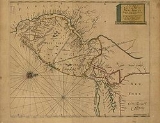
Province of New Jersey

Encyclopedia
The Province of New Jersey was one of the Middle Colonies
of Colonial America
and became the U.S. state
of New Jersey
in 1776. The province had originally been settled by Europeans as part of New Netherland
, but came under English
rule after the surrender of Fort Amsterdam
in 1664, becoming a proprietary colony
. The Dutch Republic
reasserted control for a brief period in 1673–1674. After that it consisted of two political divisions, East Jersey
and West Jersey
, until they were united as a royal colony
in 1702. The original boundaries of the province were slightly larger than the current state, extending into a part of the present state of New York
, until the border was finalized in 1773.
. The surrender of Fort Amsterdam
in September 1664 gave control over the entire Mid-Atlantic
region to the British
as part the Second Anglo-Dutch War
. The British justified the seizure by claiming that John Cabot
(c. 1450 – c. 1508), an Italian under the sponsorship of the English King Henry VII
, had been the first to discover the place, though it likely was to assert control over the profitable North Atlantic trade. Director-General of New Netherland
, Peter Stuyvesant
, (unable to rouse a military defense) relinquished control of the colony and was able in the articles of transfer to secure guarantees for property rights, laws of inheritance, and freedom of religion
. After the surrender Richard Nicolls
took the position as deputy-governor of New Amsterdam
and the rest of New Netherland, including those settlements on the west side of the North River (Hudson River) known as Bergen
, and those along the Delaware River
that had been New Sweden
.
In March, 1665, the Duke of York
was granted a Royal colony
which included New Netherland
and present-day Maine. This charter included parts of present-day Massachusetts
which conflicted with its charter. The charter allowed the traditional propriety rights and imposed the fewest restrictions upon his powers. In general terms, the charter was equivalent to a conveyance of land conferring on him the right of possession, control, and government, subject only to the limitation that the government must be consistent with the laws of England. The Duke of York never visited his colony and exercised little direct control of it. He elected to administer his government through governors, councils, and other officers appointed by himself. No provision was made for an elected assembly.
Part of the New York colony between the Hudson River
and the Delaware River
was then given by James to Sir George Carteret
in exchange for settlement of a debt. The territory was named after the Island of Jersey
, which was Carteret's ancestral home. The other section of New Jersey was sold to Lord Berkeley of Stratton
, who was a close friend of the Duke. As a result, Carteret and Berkeley became the two English Lords Proprietors
of New Jersey
.
The two proprietors of New Jersey attempted to attract more settlers to move to the province by granting sections of lands to settlers and by passing the Concession and Agreement
, a 1665 document that granted religious freedom to all inhabitants of New Jersey; under the British government, there was no such religious freedom as the Church of England
was the state church
. In return for the land, the settlers were supposed to pay annual fees known as quit-rent
s.
In 1665, Philip Carteret
became the first Governor of New Jersey, appointed by the two proprietors. He selected Elizabeth
as the capital of New Jersey. Immediately, Carteret issued several additional grants of land to landowners. Towns were started or given charters: were granted to Bergen (1668) Woodbridge (1669), Piscataway (1666), Shrewsbury
, Middletown (1693) and Newark (1666)
.
The idea of quitrents became increasingly difficult because many of the settlers refused to pay them. Most of them claimed that they owed nothing to the proprietors because they received land from Richard Nicolls, Governor of New York. This forced Berkeley to sell West Jersey to John Fenwick
and Edward Byllynge
, two English Quaker
s. Many more Quakers made their homes in New Jersey, seeking religious freedom from English (Church of England
) rule.
Meanwhile, conflicts began rising in New Jersey. Edmund Andros
, governor of New York, attempted to gain authority over East Jersey after the death of Proprietor George Carteret in 1680. However, he was unable to remove the position of governorship from Governor Phillip Carteret and subsequently moved to attack him and brought him to trial in New York. Carteret was later acquitted. In addition, quarrels occurred in between Eastern and Western New Jerseyans, between Native Americans
and New Jerseyans and between different religious groups. In the largest of these squabbles, some 210,000 acres (849.8 km²) of land were at stake between New York and New Jersey. The conflict was eventually settled by a royal commission in 1769.
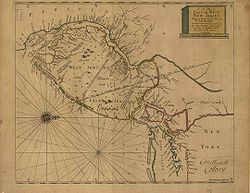
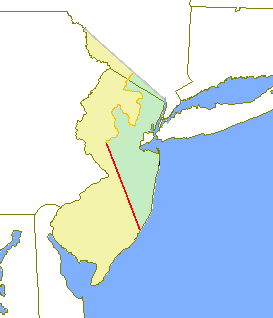
From 1674 to 1702, the Province of New Jersey was divided into East Jersey
and West Jersey
, each with its own governor. Each had its own constitution: the West Jersey Constitution (1681) and the East Jersey Constitution (1683).
The exact border between West and East Jersey was often disputed. The border between the two sides reached the Atlantic Ocean to the north of present-day Atlantic City
. The border line was created by George Keith
and can still be seen in the county boundaries between Burlington
and Ocean
Counties, and between Hunterdon
and Somerset
Counties. The Keith line
runs NNW from the southern part of Little Egg Harbor Township
, passing just north of Tuckerton
, and reaching upward to a point on the Delaware River which is just north of the Delaware Water Gap
. Later, the 1676 Quintipartite Deed
helped to lessen the disputes. More accurate surveys and maps were made to resolve property disputes. This resulted in the Thornton line, drawn around 1696, and the Lawrence line, drawn around 1743, which was adopted as the final line for legal purposes.
, the Province of East Jersey, and the Province of West Jersey were added to the Dominion. The capital was located in Boston
but, due to its size, New York and the Jerseys were run by the lieutenant governor from New York City
. After the overthrow of James II by William of Orange
in the Glorious Revolution
of 1688 reached Boston, the colonists rose up in rebellion, and the dominion was dissolved in 1689.
, the two sections of the proprietary colony were united and New Jersey became a royal colony
. Edward Hyde, Lord Cornbury, became the first governor of the colony as a royal colony. However, he was an ineffective and corrupt ruler, taking bribes and speculating on land. In 1708, Lord Cornbury was recalled back to England. New Jersey was then again ruled by the governors of New York, but this infuriated the settlers of New Jersey, accusing those governors of favoritism to New York. Judge Lewis Morris
led the case for a separate governor, and was appointed governor by King George II
in 1738.
was adopted on July 2, 1776. The American Revolutionary War
was underway and General George Washington
recently had been defeated in New York, putting the state in danger of invasion. The 1776 New Jersey State Constitution was drafted in five days and ratified within the next two days to establish a temporary government, thereby preventing New Jersey from collapsing and descending into anarchy. Among other provisions, it granted unmarried women and blacks who met property requirements the right to vote
.
Notable People:
John Berkeley, and George Carteret
Middle Colonies
The Middle Colonies comprised the middle region of the Thirteen Colonies of the British Empire in Northern America. In 1776 during the American Revolution, the Middle Colonies became independent of Britain as the states of New Jersey, Pennsylvania, New York and Delaware.Much of the area was part of...
of Colonial America
Colonial America
The colonial history of the United States covers the history from the start of European settlement and especially the history of the thirteen colonies of Britain until they declared independence in 1776. In the late 16th century, England, France, Spain and the Netherlands launched major...
and became the U.S. state
U.S. state
A U.S. state is any one of the 50 federated states of the United States of America that share sovereignty with the federal government. Because of this shared sovereignty, an American is a citizen both of the federal entity and of his or her state of domicile. Four states use the official title of...
of New Jersey
New Jersey
New Jersey is a state in the Northeastern and Middle Atlantic regions of the United States. , its population was 8,791,894. It is bordered on the north and east by the state of New York, on the southeast and south by the Atlantic Ocean, on the west by Pennsylvania and on the southwest by Delaware...
in 1776. The province had originally been settled by Europeans as part of New Netherland
New Netherland
New Netherland, or Nieuw-Nederland in Dutch, was the 17th-century colonial province of the Republic of the Seven United Netherlands on the East Coast of North America. The claimed territories were the lands from the Delmarva Peninsula to extreme southwestern Cape Cod...
, but came under English
Kingdom of England
The Kingdom of England was, from 927 to 1707, a sovereign state to the northwest of continental Europe. At its height, the Kingdom of England spanned the southern two-thirds of the island of Great Britain and several smaller outlying islands; what today comprises the legal jurisdiction of England...
rule after the surrender of Fort Amsterdam
Fort Amsterdam
For the historic fort on the island of Saint Martin, see Fort Amsterdam Fort Amsterdam was a fort on the southern tip of Manhattan that was the administrative headquarters for the Dutch and then British rule of New York from...
in 1664, becoming a proprietary colony
Proprietary colony
A proprietary colony was a colony in which one or more individuals, usually land owners, remaining subject to their parent state's sanctions, retained rights that are today regarded as the privilege of the state, and in all cases eventually became so....
. The Dutch Republic
Dutch Republic
The Dutch Republic — officially known as the Republic of the Seven United Netherlands , the Republic of the United Netherlands, or the Republic of the Seven United Provinces — was a republic in Europe existing from 1581 to 1795, preceding the Batavian Republic and ultimately...
reasserted control for a brief period in 1673–1674. After that it consisted of two political divisions, East Jersey
East Jersey
The Province of East Jersey and the Province of West Jersey were two distinct, separately governed parts of the Province of New Jersey that existed as separate provinces for 28 years, between 1674 and 1702. East Jersey's capital was located at Perth Amboy...
and West Jersey
West Jersey
West Jersey and East Jersey were two distinct parts of the Province of New Jersey. The political division existed for 28 years, between 1674 and 1702...
, until they were united as a royal colony
British colonization of the Americas
British colonization of the Americas began in 1607 in Jamestown, Virginia and reached its peak when colonies had been established throughout the Americas...
in 1702. The original boundaries of the province were slightly larger than the current state, extending into a part of the present state of New York
New York
New York is a state in the Northeastern region of the United States. It is the nation's third most populous state. New York is bordered by New Jersey and Pennsylvania to the south, and by Connecticut, Massachusetts and Vermont to the east...
, until the border was finalized in 1773.
Background
The Province of New Jersey was originally settled in the 1610s as part of the colony of New NetherlandNew Netherland
New Netherland, or Nieuw-Nederland in Dutch, was the 17th-century colonial province of the Republic of the Seven United Netherlands on the East Coast of North America. The claimed territories were the lands from the Delmarva Peninsula to extreme southwestern Cape Cod...
. The surrender of Fort Amsterdam
Fort Amsterdam
For the historic fort on the island of Saint Martin, see Fort Amsterdam Fort Amsterdam was a fort on the southern tip of Manhattan that was the administrative headquarters for the Dutch and then British rule of New York from...
in September 1664 gave control over the entire Mid-Atlantic
Mid-Atlantic States
The Mid-Atlantic states, also called middle Atlantic states or simply the mid Atlantic, form a region of the United States generally located between New England and the South...
region to the British
Great Britain
Great Britain or Britain is an island situated to the northwest of Continental Europe. It is the ninth largest island in the world, and the largest European island, as well as the largest of the British Isles...
as part the Second Anglo-Dutch War
Second Anglo-Dutch War
The Second Anglo–Dutch War was part of a series of four Anglo–Dutch Wars fought between the English and the Dutch in the 17th and 18th centuries for control over the seas and trade routes....
. The British justified the seizure by claiming that John Cabot
John Cabot
John Cabot was an Italian navigator and explorer whose 1497 discovery of parts of North America is commonly held to have been the first European encounter with the continent of North America since the Norse Vikings in the eleventh century...
(c. 1450 – c. 1508), an Italian under the sponsorship of the English King Henry VII
Henry VII of England
Henry VII was King of England and Lord of Ireland from his seizing the crown on 22 August 1485 until his death on 21 April 1509, as the first monarch of the House of Tudor....
, had been the first to discover the place, though it likely was to assert control over the profitable North Atlantic trade. Director-General of New Netherland
Director-General of New Netherland
This is a list of Directors, appointed by the Dutch West India Company, of the 17th century Dutch province of New Netherland in North America...
, Peter Stuyvesant
Peter Stuyvesant
Peter Stuyvesant , served as the last Dutch Director-General of the colony of New Netherland from 1647 until it was ceded provisionally to the English in 1664, after which it was renamed New York...
, (unable to rouse a military defense) relinquished control of the colony and was able in the articles of transfer to secure guarantees for property rights, laws of inheritance, and freedom of religion
Freedom of religion
Freedom of religion is a principle that supports the freedom of an individual or community, in public or private, to manifest religion or belief in teaching, practice, worship, and observance; the concept is generally recognized also to include the freedom to change religion or not to follow any...
. After the surrender Richard Nicolls
Richard Nicolls
Richard Nicolls was the first English colonial governor of New York province....
took the position as deputy-governor of New Amsterdam
New Amsterdam
New Amsterdam was a 17th-century Dutch colonial settlement that served as the capital of New Netherland. It later became New York City....
and the rest of New Netherland, including those settlements on the west side of the North River (Hudson River) known as Bergen
Bergen, New Netherland
Bergen was a part of the 17th century province of New Netherland, in the area in northeastern New Jersey along the Hudson and Hackensack Rivers that would become contemporary Hudson and Bergen Counties...
, and those along the Delaware River
Delaware River
The Delaware River is a major river on the Atlantic coast of the United States.A Dutch expedition led by Henry Hudson in 1609 first mapped the river. The river was christened the South River in the New Netherland colony that followed, in contrast to the North River, as the Hudson River was then...
that had been New Sweden
New Sweden
New Sweden was a Swedish colony along the Delaware River on the Mid-Atlantic coast of North America from 1638 to 1655. Fort Christina, now in Wilmington, Delaware, was the first settlement. New Sweden included parts of the present-day American states of Delaware, New Jersey, and Pennsylvania....
.
Proprietary government
- See also: Lords ProprietorLords ProprietorLords Proprietor was the name for the chief or highest owners or proprietors of certain English proprietary colonies in America, such as Carolina, New Jersey and Barbados....
(1665–1703) and Governors under the Proprietors (1665–1674)
In March, 1665, the Duke of York
James II of England
James II & VII was King of England and King of Ireland as James II and King of Scotland as James VII, from 6 February 1685. He was the last Catholic monarch to reign over the Kingdoms of England, Scotland, and Ireland...
was granted a Royal colony
Crown colony
A Crown colony, also known in the 17th century as royal colony, was a type of colonial administration of the English and later British Empire....
which included New Netherland
New Netherland
New Netherland, or Nieuw-Nederland in Dutch, was the 17th-century colonial province of the Republic of the Seven United Netherlands on the East Coast of North America. The claimed territories were the lands from the Delmarva Peninsula to extreme southwestern Cape Cod...
and present-day Maine. This charter included parts of present-day Massachusetts
Massachusetts
The Commonwealth of Massachusetts is a state in the New England region of the northeastern United States of America. It is bordered by Rhode Island and Connecticut to the south, New York to the west, and Vermont and New Hampshire to the north; at its east lies the Atlantic Ocean. As of the 2010...
which conflicted with its charter. The charter allowed the traditional propriety rights and imposed the fewest restrictions upon his powers. In general terms, the charter was equivalent to a conveyance of land conferring on him the right of possession, control, and government, subject only to the limitation that the government must be consistent with the laws of England. The Duke of York never visited his colony and exercised little direct control of it. He elected to administer his government through governors, councils, and other officers appointed by himself. No provision was made for an elected assembly.
Part of the New York colony between the Hudson River
Hudson River
The Hudson is a river that flows from north to south through eastern New York. The highest official source is at Lake Tear of the Clouds, on the slopes of Mount Marcy in the Adirondack Mountains. The river itself officially begins in Henderson Lake in Newcomb, New York...
and the Delaware River
Delaware River
The Delaware River is a major river on the Atlantic coast of the United States.A Dutch expedition led by Henry Hudson in 1609 first mapped the river. The river was christened the South River in the New Netherland colony that followed, in contrast to the North River, as the Hudson River was then...
was then given by James to Sir George Carteret
George Carteret
Vice Admiral Sir George Carteret, 1st Baronet , son of Elias de Carteret, was a royalist statesman in Jersey and England, who served in the Clarendon Ministry as Treasurer of the Navy...
in exchange for settlement of a debt. The territory was named after the Island of Jersey
Jersey
Jersey, officially the Bailiwick of Jersey is a British Crown Dependency off the coast of Normandy, France. As well as the island of Jersey itself, the bailiwick includes two groups of small islands that are no longer permanently inhabited, the Minquiers and Écréhous, and the Pierres de Lecq and...
, which was Carteret's ancestral home. The other section of New Jersey was sold to Lord Berkeley of Stratton
John Berkeley, 1st Baron Berkeley of Stratton
John Berkeley, 1st Baron Berkeley of Stratton was an English royalist soldier. From 1648 he was closely associated with James, Duke of York, and rose to prominence, fortune and fame.-First English Civil War:...
, who was a close friend of the Duke. As a result, Carteret and Berkeley became the two English Lords Proprietors
Lords Proprietor
Lords Proprietor was the name for the chief or highest owners or proprietors of certain English proprietary colonies in America, such as Carolina, New Jersey and Barbados....
of New Jersey
New Jersey
New Jersey is a state in the Northeastern and Middle Atlantic regions of the United States. , its population was 8,791,894. It is bordered on the north and east by the state of New York, on the southeast and south by the Atlantic Ocean, on the west by Pennsylvania and on the southwest by Delaware...
.
The two proprietors of New Jersey attempted to attract more settlers to move to the province by granting sections of lands to settlers and by passing the Concession and Agreement
Concession and Agreement
Concession and Agreement was a document that provided religious freedom in the colony of New Jersey. It was issued as a proclamation for the structure of the government for the colony written in 1665 by the two proprietors, Lord John Berkeley and Sir George Carteret.The document promised religious...
, a 1665 document that granted religious freedom to all inhabitants of New Jersey; under the British government, there was no such religious freedom as the Church of England
Church of England
The Church of England is the officially established Christian church in England and the Mother Church of the worldwide Anglican Communion. The church considers itself within the tradition of Western Christianity and dates its formal establishment principally to the mission to England by St...
was the state church
State church
State churches are organizational bodies within a Christian denomination which are given official status or operated by a state.State churches are not necessarily national churches in the ethnic sense of the term, but the two concepts may overlap in the case of a nation state where the state...
. In return for the land, the settlers were supposed to pay annual fees known as quit-rent
Quit-rent
Quit rent , Quit-rent, or quitrent, in practically all cases, is now effectively but not formally a tax or land tax imposed on freehold or leased land by a higher landowning authority, usually a government or its assigns....
s.
In 1665, Philip Carteret
Philip Carteret (Governor)
Philip Carteret was the first and fourth British colonial governor of New Jersey, from 1665 to 1672 and from 1674 to 1682.The English annexed the Dutch province of New Netherland in 1664, and lands west of the Hudson River were awarded to two Lords Proprietors, John Berkeley and George Carteret...
became the first Governor of New Jersey, appointed by the two proprietors. He selected Elizabeth
Elizabeth, New Jersey
Elizabeth is a city in Union County, New Jersey, United States. As of the 2010 United States Census, the city had a total population of 124,969, retaining its ranking as New Jersey's fourth largest city with an increase of 4,401 residents from its 2000 Census population of 120,568...
as the capital of New Jersey. Immediately, Carteret issued several additional grants of land to landowners. Towns were started or given charters: were granted to Bergen (1668) Woodbridge (1669), Piscataway (1666), Shrewsbury
Shrewsbury, New Jersey
Shrewsbury is a borough in Monmouth County, New Jersey, United States. As of the 2010 United States Census, the borough population was 3,809....
, Middletown (1693) and Newark (1666)
Newark, New Jersey
Newark is the largest city in the American state of New Jersey, and the seat of Essex County. As of the 2010 United States Census, Newark had a population of 277,140, maintaining its status as the largest municipality in New Jersey. It is the 68th largest city in the U.S...
.
The idea of quitrents became increasingly difficult because many of the settlers refused to pay them. Most of them claimed that they owed nothing to the proprietors because they received land from Richard Nicolls, Governor of New York. This forced Berkeley to sell West Jersey to John Fenwick
John Fenwick (Quaker)
John Fenwick founded the first English settlement in West Jersey. In 1675, John Fenwick led a group of English Quakers who emigrated to Salem, New Jersey to escape persecution for their religious beliefs.-Personal life:...
and Edward Byllynge
Edward Byllynge
Edward Byllynge was a British colonial administrator and governor of New Jersey from 1680 to 1687, until his death in England. Byllynge owned a large section of land in New Jersey with the Quakers....
, two English Quaker
Religious Society of Friends
The Religious Society of Friends, or Friends Church, is a Christian movement which stresses the doctrine of the priesthood of all believers. Members are known as Friends, or popularly as Quakers. It is made of independent organisations, which have split from one another due to doctrinal differences...
s. Many more Quakers made their homes in New Jersey, seeking religious freedom from English (Church of England
Church of England
The Church of England is the officially established Christian church in England and the Mother Church of the worldwide Anglican Communion. The church considers itself within the tradition of Western Christianity and dates its formal establishment principally to the mission to England by St...
) rule.
Meanwhile, conflicts began rising in New Jersey. Edmund Andros
Edmund Andros
Sir Edmund Andros was an English colonial administrator in North America. Andros was known most notably for his governorship of the Dominion of New England during most of its three-year existence. He also governed at various times the provinces of New York, East and West Jersey, Virginia, and...
, governor of New York, attempted to gain authority over East Jersey after the death of Proprietor George Carteret in 1680. However, he was unable to remove the position of governorship from Governor Phillip Carteret and subsequently moved to attack him and brought him to trial in New York. Carteret was later acquitted. In addition, quarrels occurred in between Eastern and Western New Jerseyans, between Native Americans
Native Americans in the United States
Native Americans in the United States are the indigenous peoples in North America within the boundaries of the present-day continental United States, parts of Alaska, and the island state of Hawaii. They are composed of numerous, distinct tribes, states, and ethnic groups, many of which survive as...
and New Jerseyans and between different religious groups. In the largest of these squabbles, some 210,000 acres (849.8 km²) of land were at stake between New York and New Jersey. The conflict was eventually settled by a royal commission in 1769.
East Jersey and West Jersey
- See also: Governors of East Jersey (1674–1702) and Governors of West Jersey (1680–1702)
From 1674 to 1702, the Province of New Jersey was divided into East Jersey
East Jersey
The Province of East Jersey and the Province of West Jersey were two distinct, separately governed parts of the Province of New Jersey that existed as separate provinces for 28 years, between 1674 and 1702. East Jersey's capital was located at Perth Amboy...
and West Jersey
West Jersey
West Jersey and East Jersey were two distinct parts of the Province of New Jersey. The political division existed for 28 years, between 1674 and 1702...
, each with its own governor. Each had its own constitution: the West Jersey Constitution (1681) and the East Jersey Constitution (1683).
The exact border between West and East Jersey was often disputed. The border between the two sides reached the Atlantic Ocean to the north of present-day Atlantic City
Atlantic City, New Jersey
Atlantic City is a city in Atlantic County, New Jersey, United States, and a nationally renowned resort city for gambling, shopping and fine dining. The city also served as the inspiration for the American version of the board game Monopoly. Atlantic City is located on Absecon Island on the coast...
. The border line was created by George Keith
George Keith
George Keith was a Scottish missionary.-Life:Born in Peterhead, Aberdeenshire, Scotland, to a Presbyterian family, he received an M.A. from the University of Aberdeen...
and can still be seen in the county boundaries between Burlington
Burlington County, New Jersey
There were 154,371 households out of which 34.30% had children under the age of 18 living with them, 57.70% were married couples living together, 10.90% had a female householder with no husband present, and 27.70% were non-families. 22.90% of all households were made up of individuals and 8.50% had...
and Ocean
Ocean County, New Jersey
-Demographics:As of the census of 2000, there were 510,916 people, 200,402 households, and 137,876 families residing in the county. The population density was 803 people per square mile . There were 248,711 housing units at an average density of 151/km²...
Counties, and between Hunterdon
Hunterdon County, New Jersey
Hunterdon County is a county located in the western section of the U.S. state of New Jersey. As of the 2010 United States Census, the population was 128,349. It is part of the New York Metropolitan Area. Its county seat is Flemington....
and Somerset
Somerset County, New Jersey
Somerset County is a county located in the U.S. state of New Jersey. In 2010, the population was 323,444. It is part of the New York Metropolitan Area. Its county seat is Somerville....
Counties. The Keith line
Keith line
The Keith line was a line drawn through the Province of New Jersey, dividing it into the Province of West Jersey and the Province of East Jersey. The line was created by Surveyor-General George Keith in 1686, when he ran the first survey to mark out the border between West Jersey and East Jersey...
runs NNW from the southern part of Little Egg Harbor Township
Little Egg Harbor Township, New Jersey
Little Egg Harbor Township is a Township in Ocean County, New Jersey, United States. As of the 2010 United States Census, the township population had increased to a record high of 20,065....
, passing just north of Tuckerton
Tuckerton, New Jersey
Tuckerton is a Borough in Ocean County, New Jersey, named for founder Ebenezer Tucker , and was a port of entry, but not the third Port of Entry as commonly believed, in the United States As of the 2000 United States Census, the borough population was 3,517.Tuckerton was incorporated as a borough...
, and reaching upward to a point on the Delaware River which is just north of the Delaware Water Gap
Delaware Water Gap
The Delaware Water Gap is on the border of New Jersey and Pennsylvania where the Delaware River cuts through a large ridge of the Appalachian Mountains...
. Later, the 1676 Quintipartite Deed
Quintipartite Deed
The Quintipartite Deed was a legal document that split the Province of New Jersey, dividing it into the Province of West Jersey and the Province of East Jersey from 1674 until 1702....
helped to lessen the disputes. More accurate surveys and maps were made to resolve property disputes. This resulted in the Thornton line, drawn around 1696, and the Lawrence line, drawn around 1743, which was adopted as the final line for legal purposes.
Dominion of New England
The Dominion of New England was a short-lived administrative union. On May 7, 1688, the Province of New YorkProvince of New York
The Province of New York was an English and later British crown territory that originally included all of the present U.S. states of New York, New Jersey, Delaware and Vermont, along with inland portions of Connecticut, Massachusetts, and Maine, as well as eastern Pennsylvania...
, the Province of East Jersey, and the Province of West Jersey were added to the Dominion. The capital was located in Boston
Boston
Boston is the capital of and largest city in Massachusetts, and is one of the oldest cities in the United States. The largest city in New England, Boston is regarded as the unofficial "Capital of New England" for its economic and cultural impact on the entire New England region. The city proper had...
but, due to its size, New York and the Jerseys were run by the lieutenant governor from New York City
New York City
New York is the most populous city in the United States and the center of the New York Metropolitan Area, one of the most populous metropolitan areas in the world. New York exerts a significant impact upon global commerce, finance, media, art, fashion, research, technology, education, and...
. After the overthrow of James II by William of Orange
William III of England
William III & II was a sovereign Prince of Orange of the House of Orange-Nassau by birth. From 1672 he governed as Stadtholder William III of Orange over Holland, Zeeland, Utrecht, Guelders, and Overijssel of the Dutch Republic. From 1689 he reigned as William III over England and Ireland...
in the Glorious Revolution
Glorious Revolution
The Glorious Revolution, also called the Revolution of 1688, is the overthrow of King James II of England by a union of English Parliamentarians with the Dutch stadtholder William III of Orange-Nassau...
of 1688 reached Boston, the colonists rose up in rebellion, and the dominion was dissolved in 1689.
Royal colony
On April 17, 1702, under the rule of Queen AnneAnne of Great Britain
Anne ascended the thrones of England, Scotland and Ireland on 8 March 1702. On 1 May 1707, under the Act of Union, two of her realms, England and Scotland, were united as a single sovereign state, the Kingdom of Great Britain.Anne's Catholic father, James II and VII, was deposed during the...
, the two sections of the proprietary colony were united and New Jersey became a royal colony
Crown colony
A Crown colony, also known in the 17th century as royal colony, was a type of colonial administration of the English and later British Empire....
. Edward Hyde, Lord Cornbury, became the first governor of the colony as a royal colony. However, he was an ineffective and corrupt ruler, taking bribes and speculating on land. In 1708, Lord Cornbury was recalled back to England. New Jersey was then again ruled by the governors of New York, but this infuriated the settlers of New Jersey, accusing those governors of favoritism to New York. Judge Lewis Morris
Lewis Morris (1671-1746)
Lewis Morris , chief justice of New York and British governor of New Jersey, was the first lord of the manor of Morrisania in New York .-Biography:...
led the case for a separate governor, and was appointed governor by King George II
George II of Great Britain
George II was King of Great Britain and Ireland, Duke of Brunswick-Lüneburg and Archtreasurer and Prince-elector of the Holy Roman Empire from 11 June 1727 until his death.George was the last British monarch born outside Great Britain. He was born and brought up in Northern Germany...
in 1738.
First state constitution
New Jersey's first state constitutionHistory of the New Jersey State Constitution
Originally, the state of New Jersey was a single British colony, the Province of New Jersey. After the English Civil War, Charles II assigned New Jersey as a proprietary colony to be held jointly by Sir George Carteret and John Berkeley, 1st Baron Berkeley of Stratton. Eventually, the collection of...
was adopted on July 2, 1776. The American Revolutionary War
American Revolutionary War
The American Revolutionary War , the American War of Independence, or simply the Revolutionary War, began as a war between the Kingdom of Great Britain and thirteen British colonies in North America, and ended in a global war between several European great powers.The war was the result of the...
was underway and General George Washington
George Washington
George Washington was the dominant military and political leader of the new United States of America from 1775 to 1799. He led the American victory over Great Britain in the American Revolutionary War as commander-in-chief of the Continental Army from 1775 to 1783, and presided over the writing of...
recently had been defeated in New York, putting the state in danger of invasion. The 1776 New Jersey State Constitution was drafted in five days and ratified within the next two days to establish a temporary government, thereby preventing New Jersey from collapsing and descending into anarchy. Among other provisions, it granted unmarried women and blacks who met property requirements the right to vote
Suffrage
Suffrage, political franchise, or simply the franchise, distinct from mere voting rights, is the civil right to vote gained through the democratic process...
.
See also
- Elizabethtown TractElizabethtown TractThe Elizabethtown Tract was a property that was purchased on October 28, 1664, by John Baily, Daniel Denton and Luke Watson from the Native Americans that is in the area of present-day Elizabeth, New Jersey....
- Horseneck TractHorseneck TractThe Horseneck Tract was an area in present-day Essex County, New Jersey, United States, that consisted of what are now the municipalities of Caldwell, West Caldwell, North Caldwell, Fairfield, Verona, Cedar Grove, Essex Fells, Roseland, and portions of Livingston and West Orange.On May 1, 1701...
- English NeighborhoodEnglish NeighborhoodThe English Neighborhood was the colonial-era name for the towns in eastern Bergen County, New Jersey, along the Hudson Palisades between the North River and the Hackensack River, particularly around its main tributary, Overpeck Creek. The region had been part of the Dutch New Netherland colony of...
- Colonial government in the Thirteen Colonies (Council and Assembly)
- Colonial history of New JerseyColonial history of New JerseyEuropean colonialization of New Jersey started soon after the 1609 exploration of its coast and bays by Sir Henry Hudson. Part of the state was settled by Dutch and Swedish as New Netherland and New Sweden. In 1664 the entire area was surrendered to the British, and given its name...
- List of colonial governors of New Jersey
- JerseyJerseyJersey, officially the Bailiwick of Jersey is a British Crown Dependency off the coast of Normandy, France. As well as the island of Jersey itself, the bailiwick includes two groups of small islands that are no longer permanently inhabited, the Minquiers and Écréhous, and the Pierres de Lecq and...
, Channel Islands - Robert TreatRobert TreatRobert Treat was an American colonial leader, militia officer and governor of Connecticut between 1683 and 1698....
- New York-New Jersey Line War
- List of the oldest buildings in New Jersey
External links
- Colonial Charters, Grants and Related Documents (at "New Jersey"). The Avalon Project: Documents in Law, History and Diplomacy. Lillian Goldman Law Library (Yale Law School). Retrieved 2010-03-14. This website has links to the following documents:
- 1664 – The Duke of York's Release to John Ford Berkeley, and Sir George Carteret, 24 June
- 1664 – The Concession and Agreement of the Lords Proprietors of the Province of New Caesarea, or New Jersey, to and With All and Every the Adventurers and All Such as Shall Settle or Plant There
- 1672 – A Declaration of the True Intent and Meaning of us the Lords Proprietors, and Explanation of There Concessions Made to the Adventurers and Planters of New Caesarea or New Jersey
- 1674 – His Royal Highness's Grant to the Lords Proprietors, Sir George Carteret, 29 July
- 1676 – The Charter or Fundamental Laws, of West New Jersey, Agreed Upon
- 1676 – Quintipartite Deed of Revision, Between E. and W Jersey: July 1
- 1680 – Duke of York's Second Grant to William Penn, Gawn Lawry, Nicholas Lucas, John Eldridge, Edmund Warner, and Edward Byllynge, for the Soil and Government of West New Jersey-August 6
- 1681 – Province of West New-Jersey, in America, The 25th of the Ninth Month Called November
- 1682 – Duke of York's Confirmation to the 24 Proprietors: 14 March
- 1683 – The Fundamental Constitutions for the Province of East New Jersey in America
- 1683 – The King's Letter Recognizing the Proprietors' Right to the Soil and Government
- 1702 – Surrender from the Proprietors of East and West New Jersey, of Their Pretended Right of Government to Her Majesty
- 1709 – The Queen's Acceptance of the Surrender of Government; April 17
- 1712 – Charles II's Grant of New England to the Duke of York, 1676 – Exemplified by Queen Anne
- 1776 – Constitution of New Jersey
Further reading
- Cunningham, John T. Colonial New Jersey (1971) 160pp
- Doyle, John Andrew. English Colonies in America: Volume IV The Middle Colonies (1907) online ch 7–8
- McCormick, Richard P. New Jersey from Colony to State, 1609–1789 (1964) 191pp
- Pomfret, John Edwin. Colonial New Jersey: a history (1973), the standard modern history
Notable People:
John Berkeley, and George Carteret