
The
colonial history of the United States covers the history from the start of
European settlementThe start of the European colonization of the Americas is typically dated to 1492. The first Europeans to reach the Americas were the Vikings during the 11th century, who established several colonies in Greenland and one short-lived settlement in present day Newfoundland...
and especially the history of the
thirteen colonies of BritainThe Thirteen Colonies were English and later British colonies established on the Atlantic coast of North America between 1607 and 1733. They declared their independence in the American Revolution and formed the United States of America...
until they declared independence in 1776. In the late 16th century,
EnglandThe Kingdom of England was, from 927 to 1707, a sovereign state to the northwest of continental Europe. At its height, the Kingdom of England spanned the southern two-thirds of the island of Great Britain and several smaller outlying islands; what today comprises the legal jurisdiction of England...
,
FranceThe Kingdom of France was one of the most powerful states to exist in Europe during the second millennium.It originated from the Western portion of the Frankish empire, and consolidated significant power and influence over the next thousand years. Louis XIV, also known as the Sun King, developed a...
, Spain and the Netherlands launched major colonization programs in eastern
North AmericaNorth America is a continent wholly within the Northern Hemisphere and almost wholly within the Western Hemisphere. It is also considered a northern subcontinent of the Americas...
. Many early attempts—notably the English Lost Colony of Roanoke—ended in failure, and everywhere the death rate of the first arrivals was very high, but key successful colonies were established. European settlers came from a variety of social and religious groups. No aristocrats settled permanently, but a number of adventurers, soldiers, farmers, and tradesmen arrived. Ethnic diversity was an American characteristic as the Dutch of
New NetherlandNew Netherland, or Nieuw-Nederland in Dutch, was the 17th-century colonial province of the Republic of the Seven United Netherlands on the East Coast of North America. The claimed territories were the lands from the Delmarva Peninsula to extreme southwestern Cape Cod...
, the Swedes and
FinnsFinnish Americans are Americans of Finnish descent, who currently number about 700,000.-History:Some Finns, like the ancestors of John Morton, came to the Swedish colony of New Sweden, that existed in mid-17th century....
of
New SwedenNew Sweden was a Swedish colony along the Delaware River on the Mid-Atlantic coast of North America from 1638 to 1655. Fort Christina, now in Wilmington, Delaware, was the first settlement. New Sweden included parts of the present-day American states of Delaware, New Jersey, and Pennsylvania....
, the English
QuakersThe Religious Society of Friends, or Friends Church, is a Christian movement which stresses the doctrine of the priesthood of all believers. Members are known as Friends, or popularly as Quakers. It is made of independent organisations, which have split from one another due to doctrinal differences...
of
PennsylvaniaThe Province of Pennsylvania, also known as Pennsylvania Colony, was founded in British America by William Penn on March 4, 1681 as dictated in a royal charter granted by King Charles II...
, the English
PuritanThe Puritans were a significant grouping of English Protestants in the 16th and 17th centuries. Puritanism in this sense was founded by some Marian exiles from the clergy shortly after the accession of Elizabeth I of England in 1558, as an activist movement within the Church of England...
s of
New EnglandNew England is a region in the northeastern corner of the United States consisting of the six states of Maine, New Hampshire, Vermont, Massachusetts, Rhode Island, and Connecticut...
, the English settlers of
JamestownJamestown was a settlement in the Colony of Virginia. Established by the Virginia Company of London as "James Fort" on May 14, 1607 , it was the first permanent English settlement in what is now the United States, following several earlier failed attempts, including the Lost Colony of Roanoke...
, and the "worthy poor" of
GeorgiaThe Province of Georgia was one of the Southern colonies in British America. It was the last of the thirteen original colonies established by Great Britain in what later became the United States...
, came to the new continent and built colonies with distinctive social, religious, political and economic styles. Occasionally one colony took control of another (during wars between their European parents), but unlike in
Nova ScotiaNova Scotia is one of Canada's three Maritime provinces and is the most populous province in Atlantic Canada. The name of the province is Latin for "New Scotland," but "Nova Scotia" is the recognized, English-language name of the province. The provincial capital is Halifax. Nova Scotia is the...
they did not expel the previous inhabitants, but instead lived side by side in peace. There were no major civil wars among the 13 colonies, and the two chief armed rebellions (in Virginia and New York) were short-lived failures.
The four distinct regions were:
New EnglandNew England is a region in the northeastern corner of the United States consisting of the six states of Maine, New Hampshire, Vermont, Massachusetts, Rhode Island, and Connecticut...
, the
Middle ColoniesThe Middle Colonies comprised the middle region of the Thirteen Colonies of the British Empire in Northern America. In 1776 during the American Revolution, the Middle Colonies became independent of Britain as the states of New Jersey, Pennsylvania, New York and Delaware.Much of the area was part of...
, the Chesapeake Bay Colonies (Upper South) and the
Lower SouthThe Southern Colonies in North America were established by Europeans during the 16th and 17th centuries and consisted of olden South Carolina, North Carolina, Maryland, Virginia and Georgia. Their historical names were the Colony and Dominion of Virginia, the Province of Carolina, and the Province...
. Some historians add a fifth region, the
frontierA frontier is a political and geographical term referring to areas near or beyond a boundary. 'Frontier' was absorbed into English from French in the 15th century, with the meaning "borderland"--the region of a country that fronts on another country .The use of "frontier" to mean "a region at the...
, which was never separately organized. By the time European settlers arrived around 1600-1650, the majority of the Native Americans living in the eastern United States had been decimated by new diseases, introduced to them decades before by explorers and sailors.
- For a timeline of the colonial history of the United States, see Timeline of Colonial America
-Pre-Columbian era, to 1500:* 30,000-11,000 B.C. - First native peoples enter North America from Asia via Beringia.* 11,000 B.C. - Disappearance of the land bridge between North America and Asia....
.
Goals of colonization
Colonizers came from European kingdoms with highly developed military, naval, governmental and entrepreneurial capabilities. The
SpanishThe history of Spain involves all the other peoples and nations within the Iberian peninsula formerly known as Hispania, and includes still today the nations of Andorra, Gibraltar, Portugal and Spain...
and
PortugueseThe history of Portugal, a European and an Atlantic nation, dates back to the Early Middle Ages. In the 15th and 16th centuries, it ascended to the status of a world power during Europe's "Age of Discovery" as it built up a vast empire including possessions in South America, Africa, Asia and...
centuries-old experience of conquest and colonization during the
ReconquistaThe Reconquista was a period of almost 800 years in the Middle Ages during which several Christian kingdoms succeeded in retaking the Muslim-controlled areas of the Iberian Peninsula broadly known as Al-Andalus...
, coupled with new oceanic ship navigation skills, provided the tools, ability, and desire to colonize the New World. England, France and the Netherlands started colonies in both the West Indies and North America. They had the ability to build ocean-worthy ships, but did not have as strong a history of colonization in foreign lands as did Spain. However, English entrepreneurs gave their colonies a base of merchant-based investment that needed much less government support.
Mercantilism
MercantilismMercantilism is the economic doctrine in which government control of foreign trade is of paramount importance for ensuring the prosperity and security of the state. In particular, it demands a positive balance of trade. Mercantilism dominated Western European economic policy and discourse from...
was the basic policy imposed by Britain on its colonies from the 1660s. Mercantilism meant that the government and merchants based in England became partners with the goal of increasing political power and private wealth, to the exclusion of other empires and even merchants based in its own colonies. The government protected its London-based merchants—and kept others out—by trade barriers, regulations, and subsidies to domestic industries in order to maximize exports from and minimize imports to the realm. The government had to fight smuggling, especially by American merchants, some of whose activities (which included direct trade with the French, Spanish, Dutch, and Portuguese) were classified as such by the
Navigation ActsThe English Navigation Acts were a series of laws that restricted the use of foreign shipping for trade between England and its colonies, a process which had started in 1651. Their goal was to force colonial development into lines favorable to England, and stop direct colonial trade with the...
. The goal of mercantilism was to run trade surpluses, so that gold and silver would pour into London. The government took its share through duties and taxes, with the remainder going to merchants in Britain. The government spent much of its revenue on a superb Royal Navy, which not only protected the British colonies but threatened the colonies of the other empires, and sometimes seized them. Thus the British Navy captured
New AmsterdamNew Amsterdam was a 17th-century Dutch colonial settlement that served as the capital of New Netherland. It later became New York City....
(New York) in 1664. The colonies were captive markets for British industry, and the goal was to enrich the mother country.
Religious persecution
The prospect of religious persecution by authorities of the crown and the
Church of EnglandThe Church of England is the officially established Christian church in England and the Mother Church of the worldwide Anglican Communion. The church considers itself within the tradition of Western Christianity and dates its formal establishment principally to the mission to England by St...
prompted a significant number of colonization efforts. People fleeing persecution by
King Charles ICharles I was King of England, King of Scotland, and King of Ireland from 27 March 1625 until his execution in 1649. Charles engaged in a struggle for power with the Parliament of England, attempting to obtain royal revenue whilst Parliament sought to curb his Royal prerogative which Charles...
and Anglican Archbishop
William LaudWilliam Laud was Archbishop of Canterbury from 1633 to 1645. One of the High Church Caroline divines, he opposed radical forms of Puritanism...
were responsible for settling most of
New EnglandNew England is a region in the northeastern corner of the United States consisting of the six states of Maine, New Hampshire, Vermont, Massachusetts, Rhode Island, and Connecticut...
, and the
Province of MarylandThe Province of Maryland was an English and later British colony in North America that existed from 1632 until 1776, when it joined the other twelve of the Thirteen Colonies in rebellion against Great Britain and became the U.S...
was founded in part to be a haven for Roman Catholics.
Early colonial failures
Numerous failed colonies were attempted--they died because of disease, starvation or wars with Indians or other European powers.
Spain had numerous failed attempts, including Lucas Vázquez de Ayllón in Georgia in 1526;
Pánfilo de NarváezPánfilo de Narváez was a Spanish conqueror and soldier in the Americas. He is most remembered as the leader of two expeditions, one to Mexico in 1520 to oppose Hernán Cortés, and the disastrous Narváez expedition to Florida in 1527....
in Florida in 1528-36;
PensacolaPensacola is the westernmost city in the Florida Panhandle and the county seat of Escambia County, Florida, United States of America. As of the 2000 census, the city had a total population of 56,255 and as of 2009, the estimated population was 53,752...
in West Florida 1559-61;
Fort San JuanJoara was a large Native American settlement, a regional chiefdom of the Mississippian culture, located in what is now Burke County, North Carolina. Joara is notable as a significant archaeological and historic site. It was a place of encounter in 1540 between the Mississippian people and the...
in North Carolina 1567-68; and the
Ajacan MissionThe Ajacán Mission was a failed attempt in 1570 to establish a Jesuit mission on the Virginia Peninsula. They intended to bring Christianity to the Virginia Indians. The effort to found what was to be called St...
1570-71, in Virginia.
The French failed at
Parris Island, South CarolinaParris Island is a former census-designated place , currently a portion of Port Royal in Beaufort County, South Carolina, United States. The population was 4,841 at the 2000 census. As defined by the U.S. Census Bureau, Parris Island is included within the Beaufort Urban Cluster and the larger...
in 1562-63;
Fort CarolineFort Caroline was the first French colony in the present-day United States. Established in what is now Jacksonville, Florida, on June 22, 1564, under the leadership of René Goulaine de Laudonnière, it was intended as a refuge for the Huguenots. It lasted one year before being obliterated by the...
, Florida, in 1564-65;
Saint Croix Island, MaineSaint Croix Island , long known to locals as Dochet Island, is a small uninhabited island in Maine near the mouth of the Saint Croix River that forms part of the International Boundary separating Maine from New Brunswick....
1604-5; and Fort Saint Louis, Texas in 1685-89.
The most notable English failures were the "
Lost Colony of RoanokeThe Roanoke Colony on Roanoke Island in Dare County, present-day North Carolina, United States was a late 16th-century attempt to establish a permanent English settlement in what later became the Virginia Colony. The enterprise was financed and organized by Sir Walter Raleigh and carried out by...
" (1587-90) in
North CarolinaNorth Carolina is a state located in the southeastern United States. The state borders South Carolina and Georgia to the south, Tennessee to the west and Virginia to the north. North Carolina contains 100 counties. Its capital is Raleigh, and its largest city is Charlotte...
and
Popham ColonyThe Popham Colony was a short-lived English colonial settlement in North America that was founded in 1607 and located in the present-day town of Phippsburg, Maine near the mouth of the Kennebec River by the proprietary Virginia Company of Plymouth...
in Maine (1607-8). It was at the Roanoke Colony that the first English child,
Virginia DareVirginia Dare was the first child born in the Americas to English parents, Eleanor and Ananias Dare. She was born into the short-lived Roanoke Colony in what is now North Carolina, USA. What became of Virginia and the other colonists remains a mystery...
, was born in the Americas; her fate is unknown. The
Kingdom of ScotlandThe Kingdom of Scotland was a Sovereign state in North-West Europe that existed from 843 until 1707. It occupied the northern third of the island of Great Britain and shared a land border to the south with the Kingdom of England...
tried to
establish a colonyThe Darién scheme was an unsuccessful attempt by the Kingdom of Scotland to become a world trading nation by establishing a colony called "New Caledonia" on the Isthmus of Panama in the late 1690s...
in
Central AmericaCentral America is the central geographic region of the Americas. It is the southernmost, isthmian portion of the North American continent, which connects with South America on the southeast. When considered part of the unified continental model, it is considered a subcontinent...
called "New Caledonia" in the 1690s; it was a total failure.
Spanish colonies
At one time, Spain claimed and controlled North America west of the Mississippi and south of the Canadian border. Additionally, Spain claimed what are now the states of Louisiana, Florida, and parts of Georgia and Mississippi.
Florida
SpainThe Spanish Empire comprised territories and colonies administered directly by Spain in Europe, in America, Africa, Asia and Oceania. It originated during the Age of Exploration and was therefore one of the first global empires. At the time of Habsburgs, Spain reached the peak of its world power....
established several small outposts in Florida. The most important,
St. Augustine, FloridaSt. Augustine is a city in the northeast section of Florida and the county seat of St. Johns County, Florida, United States. Founded in 1565 by Spanish explorer and admiral Pedro Menéndez de Avilés, it is the oldest continuously occupied European-established city and port in the continental United...
, founded in 1565, was repeatedly attacked and burned, but was the first permanent European settlement in what is now the continental United States. Pirate attacks were unrelenting against small outposts as well as St. Augustine. The British and their colonies repeatedly made war with Spain and its colonies and outposts. South Carolina launched large scale raiding expeditions in the early 18th century, which effectively destroyed the
Spanish mission systemBeginning in the second half of the 16th century, the Kingdom of Spain established a number of missions throughout la Florida in order to convert the Indians to Christianity, to facilitate control of the area, and to prevent its colonization by other countries, in particular, England and France...
. St. Augustine and
PensacolaPensacola is the westernmost city in the Florida Panhandle and the county seat of Escambia County, Florida, United States of America. As of the 2000 census, the city had a total population of 56,255 and as of 2009, the estimated population was 53,752...
survived, but English-allied Indians such as the
YamaseeThe Yamasee were a multiethnic confederation of Native Americans that lived in the coastal region of present-day northern coastal Georgia near the Savannah River and later in northeastern Florida.-History:...
conducted slave raids throughout Florida, killing or
enslavingSlavery among the indigenous peoples of the Americas took many forms throughout North and South America. Slavery was institution among various Pre-Columbian indigenous peoples of the Americas; however, chattel slavery was introduced after European and African contact. Indigenous peoples have...
most of the region's natives. In the mid-18th century, invading Seminoles from Georgia killed most of the remaining local Indians. Florida had about 3,000 Spaniards when Britain took control in 1763. Nearly all quickly left. Even though control was restored to Spain in 1783, Spain sent no more settlers or missionaries to Florida. The United States took possession in 1819.
New Mexico
Throughout the 16th century, Spain explored the southwest from Mexico with the most notable explorer being Francisco Coronado whose expedition rode throughout modern New Mexico, Arizona, southern Colorado, the panhandle of Oklahoma, and Kansas. The first colonization was under Don Juan de Oñate in 1598 where the first settlement in San Juan de Los Caballeros near
Española, New MexicoEspañola also known as Espanola , is a city primarily in Rio Arriba County, New Mexico, in the United States. A portion of the central and eastern section of the city is in Santa Fe County. Española was founded in 1880 as a railroad village, incorporated as a city in 1925. The city is situated in...
and later
Santa Fe, New MexicoSanta Fe is the capital of the U.S. state of New Mexico. It is the fourth-largest city in the state and is the seat of . Santa Fe had a population of 67,947 in the 2010 census...
around 1609. The second colonization came in 1692 under
Diego de VargasDiego de Vargas Zapata y Luján Ponce de León y Contreras , commonly known as Don Diego de Vargas, was a Spanish Governor of the New Spain territory of Santa Fe de Nuevo México, today the U.S. states of New Mexico and Arizona, titular 1690 – 1692, effective 1692 – 1696 and 1703 – 1704...
(after the
Pueblo RevoltThe Pueblo Revolt of 1680, or Popé's Rebellion, was an uprising of several pueblos of the Pueblo people against Spanish colonization of the Americas in the province of Santa Fe de Nuevo México.-Background:...
briefly drove the Spanish out). Ownership was by Spain (223 years) and Mexico (25 years) until 1846, when the
American Army of the WestThe Army of the West was the name of the United States force commanded by Stephen W. Kearny during the Mexican-American War, which played a prominent role in the conquest of New Mexico and California....
took over in the Mexican-American War. About of a third of the population in the 21st century descends from the Spanish settlers.
California
Spanish explorers sailed along the coast of present day
CaliforniaHuman history in California begins with indigenous Americans first arriving in California some 13,000-15,000 years ago. Exploration and settlement by Europeans along the coasts and in the inland valleys began in the 16th century...
from the early 16th century to the mid-18th century, but no settlements were established over those centuries.
Spain, from 1769 until the independence of Mexico in 1820, sent missionaries and soldiers to
Alta CaliforniaAlta California was a province and territory in the Viceroyalty of New Spain and later a territory and department in independent Mexico. The territory was created in 1769 out of the northern part of the former province of Las Californias, and consisted of the modern American states of California,...
who created a series of
Franciscan missionsThe Spanish missions in California comprise a series of religious and military outposts established by Spanish Catholics of the Franciscan Order between 1769 and 1823 to spread the Christian faith among the local Native Americans. The missions represented the first major effort by Europeans to...
, accompanied by presidios (forts), pueblos (settlements)s, and
ranchosThe Spanish, and later the Méxican government encouraged settlement of territory now known as California by the establishment of large land grants called ranchos, from which the English ranch is derived. Devoted to raising cattle and sheep, the owners of the ranchos attempted to pattern themselves...
(land grant ranches), along the southern and central coast of California. Father
Junípero SerraBlessed Junípero Serra, O.F.M., , known as Fra Juníper Serra in Catalan, his mother tongue was a Majorcan Franciscan friar who founded the mission chain in Alta California of the Las Californias Province in New Spain—present day California, United States. Fr...
, a
FranciscanMost Franciscans are members of Roman Catholic religious orders founded by Saint Francis of Assisi. Besides Roman Catholic communities, there are also Old Catholic, Anglican, Lutheran, ecumenical and Non-denominational Franciscan communities....
missionary, founded the first missions in Spanish upper
Las CaliforniasThe Californias, or in — - was the name given by the Spanish to their northwestern territory of New Spain, comprising the present day states of Baja California and Baja California Sur on the Baja California Peninsula in Mexico; and the present day U.S. state of California in the United States of...
, starting with
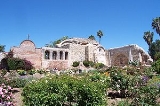
Mission San Diego de AlcaláMission Basilica San Diego de Alcalá, in San Diego, California, was the first Franciscan mission in the Las Californias Province of the Viceroyalty of New Spain. It was founded in 1769 by Spanish friar Junípero Serra in an area long inhabited by the Kumeyaay Indians...
in 1769. Through the Spanish and Mexican eras they eventually comprised a series of 21 missions to spread Christianity among the local Native Americans, linked by
El Camino RealEl Camino Real and sometimes associated with Calle Real usually refers to the 600-mile California Mission Trail, connecting the former Alta California's 21 missions , 4 presidios, and several pueblos, stretching from Mission San Diego de Alcalá in San Diego...
("The Royal Road"). They were established to convert the
indigenous peoples of CaliforniaThe Indigenous peoples of California are the indigenous inhabitants who have lived or currently live in the geographic area within the current boundaries of California before and after the arrival of Europeans. With over one hundred federally recognized tribes, California has the largest Native...
, while protecting historic Spanish claims to the area. The missions introduced European technology, livestock, and crops. The
Indian ReductionsReductions were settlements founded by the Spanish colonizers of the New World with the purpose of assimilating indigenous populations into European culture and religion.Already since the beginning of the Spanish presence in the Americas, the Crown had been concerned...
'converted' the native peoples into groups of
Mission IndiansMission Indians is a term for many Native California tribes, primarily living in coastal plains, adjacent inland valleys and mountains, and on the Channel Islands in central and southern California, United States. The tribes had established comparatively peaceful cultures varying from 250 to 8,000...
, which also forced many from their ancestral homelands and cultures, to be laborers in the missions and on their, and the ranchos, surrounding lands.
At the time of the 1846
U.S. acquisition of CaliforniaThe "Conquest of California" or Conquest of Alta California by the United States covers the initial 1846 period of the Mexican-American War in Alta California, the present day state of California, United States...
as a territory from Mexico, the missions had previously been
secularizedSecularization is the transformation of a society from close identification with religious values and institutions toward non-religious values and secular institutions...
and their lands transferred to hundreds of
Mexican land grant ranchos from
NorthernNorthern California is the northern portion of the U.S. state of California. The San Francisco Bay Area , and Sacramento as well as its metropolitan area are the main population centers...
to
Southern CaliforniaSouthern California is a megaregion, or megapolitan area, in the southern area of the U.S. state of California. Large urban areas include Greater Los Angeles and Greater San Diego. The urban area stretches along the coast from Ventura through the Southland and Inland Empire to San Diego...
. The
indigenous Native American populationEstimates of the Native Californian population have varied substantially, both with respect to California's pre-contact count and for changes during subsequent periods. Pre-contact estimates range from 133,000 to 705,000 with some recent scholars concluding that these estimates are low...
was around 150,000; the
CalifornioCalifornio is a term used to identify a Spanish-speaking Catholic people, regardless of race, born in California before 1848...
s (Mexican era Californians) around 10,000; with the rest immigrant Americans and other nationalities involved in trade and business in California.
New France
New France was the vast area explored and
claimedThe French colonization of the Americas began in the 16th century, and continued in the following centuries as France established a colonial empire in the Western Hemisphere. France founded colonies in much of eastern North America, on a number of Caribbean islands, and in South America...
by France. It was composed of several colonies. They were
AcadiaAcadia was the name given to lands in a portion of the French colonial empire of New France, in northeastern North America that included parts of eastern Quebec, the Maritime provinces, and modern-day Maine. At the end of the 16th century, France claimed territory stretching as far south as...
, Canada, Newfoundland,
LouisianaLouisiana or French Louisiana was an administrative district of New France. Under French control from 1682–1763 and 1800–03, the area was named in honor of Louis XIV, by French explorer René-Robert Cavelier, Sieur de la Salle...
, Île-Royale (present-day
Cape Breton IslandCape Breton Island is an island on the Atlantic coast of North America. It likely corresponds to the word Breton, the French demonym for Brittany....
), and Île Saint Jean (present-day
Prince Edward IslandPrince Edward Island is a Canadian province consisting of an island of the same name, as well as other islands. The maritime province is the smallest in the nation in both land area and population...
). Although all of these territories would come under British control in the 18th century, only portions of Canada and Louisiana became parts of the United States.
Pays d'en Haut
By 1660, French fur trappers based in Montreal pushed west along the Great Lakes and founded
Green BayGreen Bay is a city in and the county seat of Brown County in the U.S. state of Wisconsin, located at the head of Green Bay, a sub-basin of Lake Michigan, at the mouth of the Fox River. It has an elevation of above sea level and is located north of Milwaukee. As of the 2010 United States Census,...
,
Saint IgnaceSaint Ignace, usually written as St. Ignace, is a city in the U.S. state of Michigan. As of the 2000 census, the city population was 2,678. It is the county seat of Mackinac County. From the Lower Peninsula, St. Ignace is the gateway to the Upper Peninsula.St...
,
Sault Sainte MarieSault Ste. Marie is a city in and the county seat of Chippewa County in the U.S. state of Michigan. It is in the north-eastern end of Michigan's Upper Peninsula, on the Canadian border, separated from its twin city of Sault Ste. Marie, Ontario, by the St. Marys River...
,
VincennesVincennes is a city in and the county seat of Knox County, Indiana, United States. It is located on the Wabash River in the southwestern part of the state. The population was 18,701 at the 2000 census...
, and Detroit in 1701. By 1773, the population of Detroit was 1,400. At the end of the War for Independence in 1783, the region south of the Great Lakes formally became part of the United States.
Illinois Country
The
Illinois countryThe Illinois Country , also known as Upper Louisiana, was a region in what is now the Midwestern United States that was explored and settled by the French during the 17th and 18th centuries. The terms referred to the entire Upper Mississippi River watershed, though settlement was concentrated in...
by 1752 had a population of 2,573. Most of the population was concentrated around
KaskaskiaThe Kaskaskia were one of about a dozen cognate tribes that made up the Illiniwek Confederation or Illinois Confederation. Their longstanding homeland was in the Great Lakes region...
,
CahokiaCahokia Mounds State Historic Site is the area of an ancient indigenous city located in the American Bottom floodplain, between East Saint Louis and Collinsville in south-western Illinois, across the Mississippi River from St. Louis, Missouri. The site included 120 human-built earthwork mounds...
, and
Sainte GenevieveSte. Genevieve is a city in and the county seat of Ste. Genevieve County, Missouri, United States. The population was 11,654 at the 2000 census...
.
Louisiana
French LouisianaLouisiana or French Louisiana was an administrative district of New France. Under French control from 1682–1763 and 1800–03, the area was named in honor of Louis XIV, by French explorer René-Robert Cavelier, Sieur de la Salle...
, first settled at
MobileMobile is the third most populous city in the Southern US state of Alabama and is the county seat of Mobile County. It is located on the Mobile River and the central Gulf Coast of the United States. The population within the city limits was 195,111 during the 2010 census. It is the largest...
in 1702, started its growth when 7,000 French immigrants arrived in New Orleans in 1718. The areas around New Orleans and west of the Mississippi were given to Spain in 1760. Louisiana was taken back by France in 1800, and sold to the United States in 1803 in the
Louisiana PurchaseThe Louisiana Purchase was the acquisition by the United States of America of of France's claim to the territory of Louisiana in 1803. The U.S...
.
New Netherland
Nieuw-Nederland, or
New Netherland, chartered in 1614, was a colonial province of the Republic of the Seven United Netherlands in what became New York State and parts of
ConnecticutConnecticut is a state in the New England region of the northeastern United States. It is bordered by Rhode Island to the east, Massachusetts to the north, and the state of New York to the west and the south .Connecticut is named for the Connecticut River, the major U.S. river that approximately...
,
New JerseyNew Jersey is a state in the Northeastern and Middle Atlantic regions of the United States. , its population was 8,791,894. It is bordered on the north and east by the state of New York, on the southeast and south by the Atlantic Ocean, on the west by Pennsylvania and on the southwest by Delaware...
,
PennsylvaniaThe Commonwealth of Pennsylvania is a U.S. state that is located in the Northeastern and Mid-Atlantic regions of the United States. The state borders Delaware and Maryland to the south, West Virginia to the southwest, Ohio to the west, New York and Ontario, Canada, to the north, and New Jersey to...
and
DelawareDelaware is a U.S. state located on the Atlantic Coast in the Mid-Atlantic region of the United States. It is bordered to the south and west by Maryland, and to the north by Pennsylvania...
. The peak population was less than 10,000. The Dutch established a
patroonIn the United States, a patroon was a landholder with manorial rights to large tracts of land in the 17th century Dutch colony of New Netherland in North America...
system with feudal-like rights given to a few powerful landholders; they also established religious tolerance and free trade. The colony's capital,
New AmsterdamNew Amsterdam was a 17th-century Dutch colonial settlement that served as the capital of New Netherland. It later became New York City....
, founded in 1625 and located at the southern tip of the island of
ManhattanManhattan is the oldest and the most densely populated of the five boroughs of New York City. Located primarily on the island of Manhattan at the mouth of the Hudson River, the boundaries of the borough are identical to those of New York County, an original county of the state of New York...
, would grow to become a major world city. The city was captured by the English in 1664; they took complete control of the colony in 1674 and renamed it
New YorkThe Province of New York was an English and later British crown territory that originally included all of the present U.S. states of New York, New Jersey, Delaware and Vermont, along with inland portions of Connecticut, Massachusetts, and Maine, as well as eastern Pennsylvania...
. However the Dutch landholdings remained, and the Hudson River Valley maintained a traditional Dutch character until the 1820s.
New Sweden
New Sweden was a
SwedishSweden , officially the Kingdom of Sweden , is a Nordic country on the Scandinavian Peninsula in Northern Europe. Sweden borders with Norway and Finland and is connected to Denmark by a bridge-tunnel across the Öresund....
colony along the Delaware River Valley from 1638 to 1655. The few hundred settlers huddled around
Fort ChristinaFort Christina was the first Swedish settlement in North America and the principal settlement of the New Sweden colony...
. It was captured by the Dutch in 1655 and merged into
New NetherlandNew Netherland, or Nieuw-Nederland in Dutch, was the 17th-century colonial province of the Republic of the Seven United Netherlands on the East Coast of North America. The claimed territories were the lands from the Delmarva Peninsula to extreme southwestern Cape Cod...
, and most traces of Swedish culture faded away.
Russian colonies
Russia explored the area that became Alaska starting with the Second Kamchatka expedition in the 1730s and early 1740s. Their first settlement was founded in 1784 by
Grigory ShelikhovGrigory Ivanovich Shelekhov Grigory Ivanovich Shelekhov Grigory Ivanovich Shelekhov (Григорий Иванович Шелехов in Russian; (1747–July 20, 1795 (July 31, 1795 N.S.)) was a Russian seafarer and merchant born in Rylsk....
. The
Russian-American CompanyThe Russian-American Company was a state-sponsored chartered company formed largely on the basis of the so-called Shelekhov-Golikov Company of Grigory Shelekhov and Ivan Larionovich Golikov The Russian-American Company (officially: Under His Imperial Majesty's Highest Protection (patronage)...
was formed in 1799 with the influence of Nikolay Rezanov for the purpose of buying
sea otterThe sea otter is a marine mammal native to the coasts of the northern and eastern North Pacific Ocean. Adult sea otters typically weigh between 14 and 45 kg , making them the heaviest members of the weasel family, but among the smallest marine mammals...
s for their fur from native hunters. In 1867 the U.S.
purchased AlaskaThe Alaska Purchase was the acquisition of the Alaska territory by the United States from Russia in 1867 by a treaty ratified by the Senate. The purchase, made at the initiative of United States Secretary of State William H. Seward, gained of new United States territory...
and nearly all Russians left except a few missionaries of the
Russian Orthodox ChurchThe Russian Orthodox Church or, alternatively, the Moscow Patriarchate The ROC is often said to be the largest of the Eastern Orthodox churches in the world; including all the autocephalous churches under its umbrella, its adherents number over 150 million worldwide—about half of the 300 million...
working among the natives.
English colonies
England made its first successful efforts at the start of the 17th century for several reasons. During this era, English proto-nationalism and national assertiveness blossomed under the threat of Spanish invasion, assisted by a degree of Protestant militarism and the energy of Queen
ElizabethElizabeth I was queen regnant of England and Ireland from 17 November 1558 until her death. Sometimes called The Virgin Queen, Gloriana, or Good Queen Bess, Elizabeth was the fifth and last monarch of the Tudor dynasty...
. At this time, however, there was no official attempt by the English government to create a colonial empire. Rather, the motivation behind the founding of colonies was piecemeal and variable. Practical considerations, such as commercial enterprise, overpopulation and the desire for freedom of religion, played their parts. The main waves of settlement came in the 17th century. After 1700 most immigrants to Colonial America arrived as
indentured servantIndentured servitude refers to the historical practice of contracting to work for a fixed period of time, typically three to seven years, in exchange for transportation, food, clothing, lodging and other necessities during the term of indenture. Usually the father made the arrangements and signed...
s--young unmarried men and women seeking a new life in a much richer environment. In addition the British shipped 50,000 convicts to its American colonies.
Virginia
The first successful English colony was
JamestownJamestown was a settlement in the Colony of Virginia. Established by the Virginia Company of London as "James Fort" on May 14, 1607 , it was the first permanent English settlement in what is now the United States, following several earlier failed attempts, including the Lost Colony of Roanoke...
, established in 1607 near
Chesapeake BayThe Chesapeake Bay is the largest estuary in the United States. It lies off the Atlantic Ocean, surrounded by Maryland and Virginia. The Chesapeake Bay's drainage basin covers in the District of Columbia and parts of six states: New York, Pennsylvania, Delaware, Maryland, Virginia, and West...
. The business venture was financed and coordinated by the London Virginia Company, a joint stock company looking for gold. Its first years were extremely difficult, with very high death rates from disease and starvation, wars with local Indians, and little gold. The colony survived and flourished by turning to
tobaccoTobacco is an agricultural product processed from the leaves of plants in the genus Nicotiana. It can be consumed, used as a pesticide and, in the form of nicotine tartrate, used in some medicines...
as a
cash cropIn agriculture, a cash crop is a crop which is grown for profit.The term is used to differentiate from subsistence crops, which are those fed to the producer's own livestock or grown as food for the producer's family...
. By the late 17th century, Virginia's export economy was largely based on tobacco, and new, richer settlers came in to take up large portions of land, build large plantations and import indentured servants and slaves. In 1676,
Bacon's RebellionBacon's Rebellion was an uprising in 1676 in the Virginia Colony in North America, led by a 29-year-old planter, Nathaniel Bacon.About a thousand Virginians rose because they resented Virginia Governor William Berkeley's friendly policies towards the Native Americans...
occurred, but was suppressed by royal officials. After Bacon's Rebellion, African slaves rapidly replaced indentured servants as Virginia's main labor force.
The colonial assembly shared power with a royally appointed governor. On a more local level, governmental power was invested in county courts, which were self-perpetuating (the incumbents filled any vacancies and there never were popular elections). As cash crop producers, Chesapeake plantations were heavily dependent on trade with England. With easy navigation by river, there were few towns and no cities; planters shipped directly to Britain. High death rates and a very young population profile characterized the colony during its first years.
New England
Puritans
The Puritans, a much larger group than the Pilgrims, established the
Massachusetts Bay ColonyThe Massachusetts Bay Colony was an English settlement on the east coast of North America in the 17th century, in New England, situated around the present-day cities of Salem and Boston. The territory administered by the colony included much of present-day central New England, including portions...
in 1629 with 400 settlers. They sought to reform the
Church of EnglandThe Church of England is the officially established Christian church in England and the Mother Church of the worldwide Anglican Communion. The church considers itself within the tradition of Western Christianity and dates its formal establishment principally to the mission to England by St...
by creating a new, pure church in the New World. By 1640, 20,000 had arrived; many died soon after arrival, but the others found a healthy climate and an ample food supply. The Massachusetts settlement spawned other Puritan colonies in New England, including the
New HavenThe New Haven Colony was an English colonial venture in present-day Connecticut in North America from 1637 to 1662.- Quinnipiac Colony :A Puritan minister named John Davenport led his flock from exile in the Netherlands back to England and finally to America in the spring of 1637...
,
SaybrookThe Saybrook Colony was established in late 1635 at the mouth of the Connecticut River in present day Old Saybrook, Connecticut by John Winthrop, the Younger, son of John Winthrop, the Governor of Massachusetts. The former was designated Governor by the original settlers which included Colonel...
, and
ConnecticutThe Connecticut Colony or Colony of Connecticut was an English colony located in British America that became the U.S. state of Connecticut. Originally known as the River Colony, it was organized on March 3, 1636 as a haven for Puritan noblemen. After early struggles with the Dutch, the English...
colonies. During the 17th century the New Haven and Saybrook colonies were absorbed by Connecticut.
The Puritans created a deeply religious, socially tight-knit, and politically innovative culture that still influences the modern United States. They hoped this new land would serve as a "redeemer nation". They fled England and in America attempted to create a "nation of saints" or a "
City upon a HillA City Upon A Hill is a phrase from the parable of Salt and Light in Jesus' Sermon on the Mount. In Matthew 5:14, he tells his listeners, "You are the light of the world. A city that is set on a hill cannot be hidden."-American usage:...
": an intensely religious, thoroughly righteous community designed to be an example for all of Europe.
Roger WilliamsRoger Williams was an English Protestant theologian who was an early proponent of religious freedom and the separation of church and state. In 1636, he began the colony of Providence Plantation, which provided a refuge for religious minorities. Williams started the first Baptist church in America,...
, who preached religious toleration,
separation of Church and StateThe concept of the separation of church and state refers to the distance in the relationship between organized religion and the nation state....
, and a complete break with the Church of England, was banished and founded Rhode Island Colony, which became a haven for other refugees from the Puritan community, such as
Anne HutchinsonAnne Hutchinson was one of the most prominent women in colonial America, noted for her strong religious convictions, and for her stand against the staunch religious orthodoxy of 17th century Massachusetts...
.
Economically, Puritan New England fulfilled the expectations of its founders. Unlike the cash crop-oriented plantations of the Chesapeake region, the Puritan economy was based on the efforts of self-supporting farmsteads who traded only for goods they could not produce themselves. There was a generally higher economic standing and standard of living in New England than in the Chesapeake. Along with agriculture, fishing, and logging, New England became an important mercantile and shipbuilding center, serving as the hub for trading between the southern colonies and Europe.
Other New England
The Pilgrims were a small Protestant sect based in England and the Netherlands. One group sailed on the
MayflowerThe Mayflower was the ship that transported the English Separatists, better known as the Pilgrims, from a site near the Mayflower Steps in Plymouth, England, to Plymouth, Massachusetts, , in 1620...
and settled in Plymouth, Massachusetts in 1620. After drawing up the
Mayflower CompactThe Mayflower Compact was the first governing document of Plymouth Colony. It was written by the colonists, later together known to history as the Pilgrims, who crossed the Atlantic aboard the Mayflower...
by which they gave themselves broad powers of self-governance, they established the small
Plymouth ColonyPlymouth Colony was an English colonial venture in North America from 1620 to 1691. The first settlement of the Plymouth Colony was at New Plymouth, a location previously surveyed and named by Captain John Smith. The settlement, which served as the capital of the colony, is today the modern town...
.
William BradfordWilliam Bradford was an English leader of the settlers of the Plymouth Colony in Massachusetts, and served as governor for over 30 years after John Carver died. His journal was published as Of Plymouth Plantation...
was their main leader. Providence Plantation was founded in 1636 by Rev.
Roger WilliamsRoger Williams was an English Protestant theologian who was an early proponent of religious freedom and the separation of church and state. In 1636, he began the colony of Providence Plantation, which provided a refuge for religious minorities. Williams started the first Baptist church in America,...
on land provided by the Narragansett sachem Canonicus. Williams, fleeing from religious persecution in the Massachusetts Bay Colony, agreed with his fellow settlers on an egalitarian constitution providing for majority rule "in civil things" and "liberty of conscience".
Other colonists who disagreed with Puritans in Massachusetts settled to the north, mingling with adventurers and profit-oriented settlers to establish more religiously diverse colonies in
New HampshireThe Province of New Hampshire is a name first given in 1629 to the territory between the Merrimack and Piscataqua rivers on the eastern coast of North America. It was formally organized as an English royal colony on October 7, 1691, during the period of English colonization...
and
MaineThe Province of Maine refers to several English colonies of that name that existed in the 17th century along the northeast coast of North America, at times roughly encompassing portions of the present-day U.S. states of Maine, New Hampshire, and Vermont, as well as the Canadian provinces of Quebec...
. These small settlements were absorbed by Massachusetts when it made significant land claims in the 1640s and 1650s, but New Hampshire was eventually given a separate charter in 1679. (Maine remained a part of Massachusetts until achieving statehood in 1820.)
Dominion of New England
Under King
James II of EnglandJames II & VII was King of England and King of Ireland as James II and King of Scotland as James VII, from 6 February 1685. He was the last Catholic monarch to reign over the Kingdoms of England, Scotland, and Ireland...
, the New England colonies (as well as New York and the Jerseys) were briefly united as the
Dominion of New EnglandThe Dominion of New England in America was an administrative union of English colonies in the New England region of North America. The dominion was ultimately a failure because the area it encompassed was too large for a single governor to manage...
(1686–89). The administration eventually led by Governor Sir
Edmund AndrosSir Edmund Andros was an English colonial administrator in North America. Andros was known most notably for his governorship of the Dominion of New England during most of its three-year existence. He also governed at various times the provinces of New York, East and West Jersey, Virginia, and...
seized colonial charters, revoked land titles, and ruled without local assemblies, causing anger among the population. The
1689 Boston revoltThe 1689 Boston revolt was a popular uprising on April 18, 1689, against the rule of Sir Edmund Andros, the governor of the Dominion of New England. A well-organized "mob" of provincial militia and citizens formed in the city and arrested dominion officials...
, inspired by England's
Glorious RevolutionThe Glorious Revolution, also called the Revolution of 1688, is the overthrow of King James II of England by a union of English Parliamentarians with the Dutch stadtholder William III of Orange-Nassau...
against James II, caused Andros, Boston Anglicans, and senior dominion officials to be arrested by the Massachusetts militia. Andros was jailed for several months, then returned to England. The Dominion of New England was dissolved and governments resumed under their earlier charters. However, the Massachusetts charter had been revoked in 1684, and a new one was issued in 1691 that combined Massachusetts and Plymouth into the
Province of Massachusetts BayThe Province of Massachusetts Bay was a crown colony in North America. It was chartered on October 7, 1691 by William and Mary, the joint monarchs of the kingdoms of England and Scotland...
. Although
King WilliamWilliam III & II was a sovereign Prince of Orange of the House of Orange-Nassau by birth. From 1672 he governed as Stadtholder William III of Orange over Holland, Zeeland, Utrecht, Guelders, and Overijssel of the Dutch Republic. From 1689 he reigned as William III over England and Ireland...
sought at least to unite the New England colonies militarily (for example, by appointing
the Earl of BellomontRichard Coote, 1st Earl of Bellomont , known as The Lord Coote between 1683 and 1689, was a member of the English Parliament and a colonial governor...
to three simultaneous governorships, and military command over Connecticut and Rhode Island), these attempts at unified control failed.
Middle Colonies
The Middle Colonies, consisting of the present-day states of
New YorkNew York is a state in the Northeastern region of the United States. It is the nation's third most populous state. New York is bordered by New Jersey and Pennsylvania to the south, and by Connecticut, Massachusetts and Vermont to the east...
,
New JerseyNew Jersey is a state in the Northeastern and Middle Atlantic regions of the United States. , its population was 8,791,894. It is bordered on the north and east by the state of New York, on the southeast and south by the Atlantic Ocean, on the west by Pennsylvania and on the southwest by Delaware...
,
PennsylvaniaThe Commonwealth of Pennsylvania is a U.S. state that is located in the Northeastern and Mid-Atlantic regions of the United States. The state borders Delaware and Maryland to the south, West Virginia to the southwest, Ohio to the west, New York and Ontario, Canada, to the north, and New Jersey to...
, and
DelawareDelaware is a U.S. state located on the Atlantic Coast in the Mid-Atlantic region of the United States. It is bordered to the south and west by Maryland, and to the north by Pennsylvania...
, were characterized by a large degree of diversity—religious, political, economic, and ethnic. The Dutch colony of
New NetherlandNew Netherland, or Nieuw-Nederland in Dutch, was the 17th-century colonial province of the Republic of the Seven United Netherlands on the East Coast of North America. The claimed territories were the lands from the Delmarva Peninsula to extreme southwestern Cape Cod...
was taken over by the British and renamed New York but large numbers of Dutch remained in the colony. New Jersey began as a division of New York, and was for a time divided into the proprietary colonies of
EastThe Province of East Jersey and the Province of West Jersey were two distinct, separately governed parts of the Province of New Jersey that existed as separate provinces for 28 years, between 1674 and 1702. East Jersey's capital was located at Perth Amboy...
and
West JerseyWest Jersey and East Jersey were two distinct parts of the Province of New Jersey. The political division existed for 28 years, between 1674 and 1702...
. Many German and
IrishThe Irish people are an ethnic group who originate in Ireland, an island in northwestern Europe. Ireland has been populated for around 9,000 years , with the Irish people's earliest ancestors recorded having legends of being descended from groups such as the Nemedians, Fomorians, Fir Bolg, Tuatha...
immigrants settled in these areas, as well as in
ConnecticutConnecticut is a state in the New England region of the northeastern United States. It is bordered by Rhode Island to the east, Massachusetts to the north, and the state of New York to the west and the south .Connecticut is named for the Connecticut River, the major U.S. river that approximately...
. A large portion of the settlers who came to Pennsylvania were German. Philadelphia became the center of the colonies; by the end of the colonial period 30,000 people lived there, having come from divers nations and practicing numerous trades.
Pennsylvania was founded in 1681 as a proprietary colony of the Quaker
William PennWilliam Penn was an English real estate entrepreneur, philosopher, and founder of the Province of Pennsylvania, the English North American colony and the future Commonwealth of Pennsylvania. He was an early champion of democracy and religious freedom, notable for his good relations and successful...
. It came to include the territory of Delaware, which had once been part of New Netherland; Delaware had a government independent of that established in Philadelphia, but was never
a separate colonyDelaware Colony in the North American Middle Colonies was a region of the Province of Pennsylvania although never legally a separate colony. From 1682 until 1776 it was part of the Penn proprietorship and was known as the lower counties...
.
Lower South
The colonial South included the plantation colonies of the Chesapeake region (Virginia, Maryland, and, by some classifications, Delaware) and the lower South (Carolina, which eventually split into North and South Carolina; and Georgia).
Carolinas
The first attempted English settlement south of Virginia was the
Province of CarolinaThe Province of Carolina, originally chartered in 1629, was an English and later British colony of North America. Because the original Heath charter was unrealized and was ruled invalid, a new charter was issued to a group of eight English noblemen, the Lords Proprietors, in 1663...
. It was a private venture, financed by a group of English Lords Proprietors, who obtained a
Royal CharterA royal charter is a formal document issued by a monarch as letters patent, granting a right or power to an individual or a body corporate. They were, and are still, used to establish significant organizations such as cities or universities. Charters should be distinguished from warrants and...
to the Carolinas in 1663, hoping that a new colony in the south would become profitable like Jamestown. Carolina was not settled until 1670, and even then the first attempt failed because there was no incentive for emigration to that area. Eventually, however, the Lords combined their remaining capital and financed a settlement mission to the area, a mission led by Sir
John ColletonSir John Colleton, 1st Baronet served Charles I during the English Civil War. He rose through the Royalist ranks during the conflict, but later had his holdings seized when the Cavaliers were finally defeated by Parliamentary forces...
. The expedition located fertile and defensible ground at what was to become
CharlestonCharleston is the second largest city in the U.S. state of South Carolina. It was made the county seat of Charleston County in 1901 when Charleston County was founded. The city's original name was Charles Towne in 1670, and it moved to its present location from a location on the west bank of the...
(originally Charles Town for
Charles II of EnglandCharles II was monarch of the three kingdoms of England, Scotland, and Ireland.Charles II's father, King Charles I, was executed at Whitehall on 30 January 1649, at the climax of the English Civil War...
), thus beginning the English colonization of the mainland. The original settlers in South Carolina established a lucrative trade in provisions, deerskins and Indian captives with the Caribbean islands. The settlers came mainly from the English colony of
BarbadosBarbados is an island country in the Lesser Antilles. It is in length and as much as in width, amounting to . It is situated in the western area of the North Atlantic and 100 kilometres east of the Windward Islands and the Caribbean Sea; therein, it is about east of the islands of Saint...
and brought African slaves with them. Barbados, as a wealthy
sugarcaneSugarcane refers to any of six to 37 species of tall perennial grasses of the genus Saccharum . Native to the warm temperate to tropical regions of South Asia, they have stout, jointed, fibrous stalks that are rich in sugar, and measure two to six metres tall...
plantation island, was one of the early English colonies to use large numbers of Africans in plantation style agriculture. The cultivation of
riceRice is the seed of the monocot plants Oryza sativa or Oryza glaberrima . As a cereal grain, it is the most important staple food for a large part of the world's human population, especially in East Asia, Southeast Asia, South Asia, the Middle East, and the West Indies...
was introduced during the 1690s via Africans from the rice-growing regions of
AfricaAfrica is the world's second largest and second most populous continent, after Asia. At about 30.2 million km² including adjacent islands, it covers 6% of the Earth's total surface area and 20.4% of the total land area...
. North Carolina remained a frontier throughout the early colonial period.
At first, South Carolina was politically divided. Its ethnic makeup included the original settlers, a group of rich, slave-owning
EnglishThe Kingdom of England was, from 927 to 1707, a sovereign state to the northwest of continental Europe. At its height, the Kingdom of England spanned the southern two-thirds of the island of Great Britain and several smaller outlying islands; what today comprises the legal jurisdiction of England...
settlers from the island of Barbados; and Huguenots, a
FrenchFrench is a Romance language spoken as a first language in France, the Romandy region in Switzerland, Wallonia and Brussels in Belgium, Monaco, the regions of Quebec and Acadia in Canada, and by various communities elsewhere. Second-language speakers of French are distributed throughout many parts...
-speaking community of Protestants. Nearly continuous frontier warfare during the era of
King William's WarThe first of the French and Indian Wars, King William's War was the name used in the English colonies in America to refer to the North American theater of the Nine Years' War...
and
Queen Anne's WarQueen Anne's War , as the North American theater of the War of the Spanish Succession was known in the British colonies, was the second in a series of French and Indian Wars fought between France and England, later Great Britain, in North America for control of the continent. The War of the...
drove economic and political wedges between merchants and planters. The disaster of the 1715
Yamasee WarThe Yamasee War was a conflict between British settlers of colonial South Carolina and various Native American Indian tribes, including the Yamasee, Muscogee, Cherokee, Chickasaw, Catawba, Apalachee, Apalachicola, Yuchi, Savannah River Shawnee, Congaree, Waxhaw, Pee Dee, Cape Fear, Cheraw, and...
, which threatened the colony's viability, set off a decade of political turmoil. By 1729, the
proprietary governmentProprietary Governors were individuals authorized to govern proprietary colonies. Under the proprietary system, individuals or companies were granted commercial charters by the King of England to establish colonies. These proprietors then selected the governors and other officials in the colony....
had collapsed, and the Proprietors sold both colonies back to the British crown.
Georgia
James OglethorpeJames Edward Oglethorpe was a British general, member of Parliament, philanthropist, and founder of the colony of Georgia...
, an 18th century British
Member of ParliamentA Member of Parliament is a representative of the voters to a :parliament. In many countries with bicameral parliaments, the term applies specifically to members of the lower house, as upper houses often have a different title, such as senate, and thus also have different titles for its members,...
, established the Georgia Colony in 1733 as a common solution to two problems. At that time, tension between Spain and Great Britain was high, and the British feared that Spanish Florida was threatening the British Carolinas. Oglethorpe decided to establish a colony in the contested border region of Georgia and populate it with debtors who would otherwise have been imprisoned according to standard British practice. This plan would both rid Great Britain of its undesirable elements and provide her with a base from which to attack Florida. The first colonists arrived in 1733.
Georgia was established on strict
moralisticMorality is the differentiation among intentions, decisions, and actions between those that are good and bad . A moral code is a system of morality and a moral is any one practice or teaching within a moral code...
principles. Slavery was forbidden, as were alcohol and other forms of supposed immorality. However, the reality of the colony was far from ideal. The colonists were unhappy about the puritanical lifestyle and complained that their colony could not compete economically with the Carolina rice plantations. Georgia initially failed to prosper, but eventually the restrictions were lifted, slavery was allowed, and it became as prosperous as the Carolinas. The colony of Georgia never had a specific religion. It consisted of people of various faiths.
East and West Florida
In 1763, Spain ceded Florida to Great Britain, which established the colonies of
EastEast Florida was a colony of Great Britain from 1763–1783 and of Spain from 1783–1822. East Florida was established by the British colonial government in 1763; as its name implies it consisted of the eastern part of the region of Florida, with West Florida comprising the western parts. Its capital...
and
West FloridaWest Florida was a region on the north shore of the Gulf of Mexico, which underwent several boundary and sovereignty changes during its history. West Florida was first established in 1763 by the British government; as its name suggests it largely consisted of the western portion of the region...
. The Floridas remained loyal to Great Britain during the
American RevolutionThe American Revolution was the political upheaval during the last half of the 18th century in which thirteen colonies in North America joined together to break free from the British Empire, combining to become the United States of America...
. They were returned to Spain in 1783 (in exchange for the Bahamas), at which time most of the British left. The Spanish then neglected the Floridas: few Spaniards lived there when the US bought the area in 1819.
British colonial government
Each colony had a paid
colonial agentA colonial agent was the official representative of one of the Thirteen American Colonies in London in the period before 1775. About 200 men served. They were selected and paid a fixed salary by the colonial government, and given the long delays in communication, they played a major role in...
in London to represent its interests.
The three forms of colonial government in 1776 were provincial, proprietary, and charter. These governments were all subordinate to the king in London, with no explicit relationship with the British
ParliamentThe Parliament of Great Britain was formed in 1707 following the ratification of the Acts of Union by both the Parliament of England and Parliament of Scotland...
. Beginning late in the 17th century, the administration of all British colonies was overseen by a
Board of TradeThe Board of Trade is a committee of the Privy Council of the United Kingdom, originating as a committee of inquiry in the 17th century and evolving gradually into a government department with a diverse range of functions...
.
Provincial colonies
New Hampshire, New York, Virginia, North Carolina, South Carolina, Georgia, and eventually Massachusetts, were provincial colonies.
The provincial government was governed by commissions created at pleasure by the monarch. A governor (and in some provinces his council) were appointed by the crown. The governor was invested with general executive powers, and authorized to call a locally elected assembly. The governor's council would sit as an upper house when the assembly was in session in addition to its role in advising the governor. Assemblies were made up of representatives elected by the freeholders and planters (landowners) of the province. The governor had the power of absolute veto, and could prorogue (i.e., delay) and dissolve the assembly.
The assembly's role was to make all local laws and ordinances, ensuring that they were not inconsistent with the laws of England. In practice this did not always occur, since many of the provincial assemblies sought to expand their powers and limit those of the governor and crown. Laws could be examined by the Board of Trade, which also held veto power of legislation.
Proprietary colonies
Pennsylvania (which included Delaware), New Jersey, and Maryland were proprietary colonies. They were governed much as royal colonies except that lord proprietors, rather than the king, appointed the governor. They were set up after the
Restoration of 1660The Restoration of the English monarchy began in 1660 when the English, Scottish and Irish monarchies were all restored under Charles II after the Interregnum that followed the Wars of the Three Kingdoms...
and typically enjoyed greater civil and religious liberty.
Charter colonies
Massachusetts, Rhode Island and Providence Plantation, and Connecticut were charter colonies. The Massachusetts charter was revoked in 1684, and was replaced by a provincial charter that was issued in 1691.
Charter governments were political corporations created by
letters patentLetters patent are a type of legal instrument in the form of a published written order issued by a monarch or president, generally granting an office, right, monopoly, title, or status to a person or corporation...
, giving the grantees control of the land and the powers of legislative government. The charters provided a fundamental constitution and divided powers among legislative, executive, and judicial functions, with those powers being vested in officials.
Political culture
As Bonomi (1971) shows, the most distinctive feature of colonial society was the vibrant political culture, which attracted the most talented and ambitious young men into politics. First, suffrage was the most widespread in the world, with every man who owned a certain amount of property allowed to vote. While fewer than 1% of British men could vote, a majority of white American men were eligible. The roots of democracy were present, although deference was typically shown to social elites in colonial elections.
Second, in the colonies a very wide range of public and private business was decided by elected bodies, especially the assemblies and county governments in each colony. They handled land grants, commercial subsidies, and taxation, as well as oversight of roads, poor relief, taverns, and schools. Americans sued each other at a very high rate, with binding decisions made not by a great lord but by local judges and juries. This promoted the rapid expansion of the legal profession, so that the intense involvement of lawyers in politics became an American characteristic by the 1770s.
Thirdly, the American colonies were exceptional in the world because of the representation of many different interest groups in political decision-making. Unlike Europe, where aristocratic families and the established church were in control, the American political culture was open to economic, social, religious, ethnic and geographical interests, with merchants, landlords, petty farmers, artisans, Anglicans, Presbyterians, Quakers, Germans, Scotch Irish, Yankees, Yorkers, and many other identifiable groups taking part. Elected representatives learned to listen to these interests because 90% of the men in the lower houses lived in their districts, unlike England where it was common to have a member of Parliament and absentee member of Parliament.
Finally, and most dramatically, the Americans were fascinated by and increasingly adopted the political values of
RepublicanismRepublicanism is the political value system that has been a major part of American civic thought since the American Revolution. It stresses liberty and inalienable rights as central values, makes the people as a whole sovereign, supports activist government to promote the common good, rejects...
, which stressed equal rights, the need for virtuous citizens, and the evils of corruption, luxury, and aristocracy. Republicanism provided the framework for colonial resistance to British schemes of taxation after 1763, which escalated into the Revolution.
None of the colonies had stable political parties of the sort that formed in the 1790s, but each had shifting factions that vied for power, especially in the perennial battles between the appointed governor and the elected assembly. There were often "country" and "court" factions, representing those opposed and in favor, respectively, of the governor's actions and agenda. Massachusetts, which from its 1691 charter had particularly low requirements for voting eligibility and strong rural representation in its assembly, also had a strong populist faction that represented the province's lower classes.
Up and down the colonies non-English ethnic groups had clusters of settlements. The most numerous were the Scotch Irish and the Germans. Each group assimilated into the dominant English, Protestant commercial and political culture, albeit with local variations. They tended to vote in blocs and politicians negotiated with group leaders for votes. They generally retained their historic languages and cultural traditions, even as they merged into the emerging American culture.
Ethnocultural factors were most visible in Pennsylvania. During 1756-76, the Quakers were the largest faction in the legislature, but they were losing their dominance to the emerging Presbyterian faction based on Scotch-Irish votes, supported by Germans.
A common defense
Efforts at common defense of the colonies (principally against shared threats from Indians, the French, and the Dutch) began as early as the 1640s, when the Puritan colonies of New England formed
a confederationThe United Colonies of New England, commonly known as the New England Confederation, was a short-lived military alliance of the English colonies of Massachusetts, Plymouth, Connecticut, and New Haven. Established in 1643, its primary purpose was to unite the Puritan colonies against the Native...
to coordinate military and judicial matters. From the 1670s several royal governors, notably Sir
Edmund AndrosSir Edmund Andros was an English colonial administrator in North America. Andros was known most notably for his governorship of the Dominion of New England during most of its three-year existence. He also governed at various times the provinces of New York, East and West Jersey, Virginia, and...
(who at various times governed New York, New England, and Virginia) and
Francis NicholsonFrancis Nicholson was a British military officer and colonial administrator. His military service included time in Africa and Europe, after which he was sent as leader of the troops supporting Sir Edmund Andros in the Dominion of New England. There he distinguished himself, and was appointed...
(governed Maryland, Virginia, Nova Scotia, and Carolina) proposed or attempted to implement means to coordinate defensive and offensive military matters. Andros successfully negotiated the
Covenant ChainThe Covenant Chain was a series of alliances and treaties involving the Iroquois Confederacy , the British colonies of North America, and a number of other Indian tribes...
, a series of Indian treaties that brought relative calm to the frontiers of the middle colonies for many years.
One event that reminded colonists of their shared identity as British subjects was the
War of the Austrian SuccessionThe War of the Austrian Succession – including King George's War in North America, the Anglo-Spanish War of Jenkins' Ear, and two of the three Silesian wars – involved most of the powers of Europe over the question of Maria Theresa's succession to the realms of the House of Habsburg.The...
(1740–1748) in Europe. This conflict spilled over into the colonies, where it was known as "
King George's WarKing George's War is the name given to the operations in North America that formed part of the War of the Austrian Succession . It was the third of the four French and Indian Wars. It took place primarily in the British provinces of New York, Massachusetts Bay, New Hampshire, and Nova Scotia...
". The major battles took place in Europe, but American colonial troops fought the French and their Indian allies in New York, New England, and Nova Scotia.
At the
Albany CongressThe Albany Congress, also known as the Albany Conference and "The Conference of Albany" or "The Conference in Albany", was a meeting of representatives from seven of the thirteen British North American colonies in 1754...
of 1754,
Benjamin FranklinDr. Benjamin Franklin was one of the Founding Fathers of the United States. A noted polymath, Franklin was a leading author, printer, political theorist, politician, postmaster, scientist, musician, inventor, satirist, civic activist, statesman, and diplomat...
proposed that the colonies be united by a Grand Council overseeing a common policy for defense, expansion, and Indian affairs. While the plan was thwarted by colonial legislatures and King George II, it was an early indication that the British colonies of North America were headed towards unification.
French and Indian War
The
French and Indian WarThe French and Indian War is the common American name for the war between Great Britain and France in North America from 1754 to 1763. In 1756, the war erupted into the world-wide conflict known as the Seven Years' War and thus came to be regarded as the North American theater of that war...
(1754–1763) was the American extension of the general European conflict known as the
Seven Years' WarThe Seven Years' War was a global military war between 1756 and 1763, involving most of the great powers of the time and affecting Europe, North America, Central America, the West African coast, India, and the Philippines...
. Although previous colonial wars in North America had started in Europe and then spread to the colonies, the French and Indian War is notable for having started in North America and then having spread to Europe. Increasing competition between Britain and France, especially in the Great Lakes and Ohio valley, was one of the primary origins of the war.
The French and Indian War took on a new significance for the British North American colonists when
William Pitt the ElderWilliam Pitt, 1st Earl of Chatham PC was a British Whig statesman who led Britain during the Seven Years' War...
decided that, in order to win the war against France, major military resources needed to be devoted to North America. For the first time, the continent became one of the main theaters of what could be termed a "
world warA world war is a war affecting the majority of the world's most powerful and populous nations. World wars span multiple countries on multiple continents, with battles fought in multiple theaters....
". During the war, the position of the British colonies as part of the
British EmpireThe British Empire comprised the dominions, colonies, protectorates, mandates and other territories ruled or administered by the United Kingdom. It originated with the overseas colonies and trading posts established by England in the late 16th and early 17th centuries. At its height, it was the...
was made truly apparent, as British military and civilian officials took on an increased presence in the lives of Americans. The war also increased a sense of American unity in other ways. It caused men, who might normally have never left their own colony, to travel across the continent, fighting alongside men from decidedly different, yet still "American", backgrounds. Throughout the course of the war, British officers trained American ones (most notably
George WashingtonGeorge Washington was the dominant military and political leader of the new United States of America from 1775 to 1799. He led the American victory over Great Britain in the American Revolutionary War as commander-in-chief of the Continental Army from 1775 to 1783, and presided over the writing of...
) for battle—which would later benefit the American Revolution. Also, colonial legislatures and officials had to cooperate intensively, for the first time, in pursuit of the continent-wide military effort. The relations between the British military establishment and the colonists were not always positive, setting the stage for later distrust and dislike of British troops.
In the
Treaty of Paris (1763)The Treaty of Paris, often called the Peace of Paris, or the Treaty of 1763, was signed on 10 February 1763, by the kingdoms of Great Britain, France and Spain, with Portugal in agreement. It ended the French and Indian War/Seven Years' War...
, France formally ceded the eastern part of its vast North American empire to Britain (having secretly given the territory of
LouisianaLouisiana or French Louisiana was an administrative district of New France. Under French control from 1682–1763 and 1800–03, the area was named in honor of Louis XIV, by French explorer René-Robert Cavelier, Sieur de la Salle...
west of the Mississippi River to Spain the previous year). Before the war, Britain held the thirteen American colonies, most of present-day
Nova ScotiaNova Scotia is one of Canada's three Maritime provinces and is the most populous province in Atlantic Canada. The name of the province is Latin for "New Scotland," but "Nova Scotia" is the recognized, English-language name of the province. The provincial capital is Halifax. Nova Scotia is the...
, and most of the
Hudson BayHudson Bay , sometimes called Hudson's Bay, is a large body of saltwater in northeastern Canada. It drains a very large area, about , that includes parts of Ontario, Quebec, Saskatchewan, Alberta, most of Manitoba, southeastern Nunavut, as well as parts of North Dakota, South Dakota, Minnesota,...
watershed. Following the war, Britain gained all French territory east of the Mississippi River, including Quebec, the Great Lakes, and the Ohio River valley. Britain also gained
Spanish FloridaSpanish Florida refers to the Spanish territory of Florida, which formed part of the Captaincy General of Cuba, the Viceroyalty of New Spain, and the Spanish Empire. Originally extending over what is now the southeastern United States, but with no defined boundaries, la Florida was a component of...
, from which it formed the colonies of
EastEast Florida was a colony of Great Britain from 1763–1783 and of Spain from 1783–1822. East Florida was established by the British colonial government in 1763; as its name implies it consisted of the eastern part of the region of Florida, with West Florida comprising the western parts. Its capital...
and
West FloridaWest Florida was a region on the north shore of the Gulf of Mexico, which underwent several boundary and sovereignty changes during its history. West Florida was first established in 1763 by the British government; as its name suggests it largely consisted of the western portion of the region...
. In removing a major foreign threat to the thirteen colonies, the war also largely removed the colonists' need of colonial protection.
The British and colonists triumphed jointly over a common foe. The colonists' loyalty to the mother country was stronger than ever before. However, disunity was beginning to form. British Prime Minister William Pitt the Elder had decided to wage the war in the colonies with the use of troops from the colonies and tax funds from Britain itself. This was a successful wartime strategy, but after the war was over, each side believed that it had borne a greater burden than the other. The British elite, the most heavily taxed of any in Europe, pointed out angrily that the colonists paid little to the royal coffers. The colonists replied that their sons had fought and died in a war that served European interests more than their own. This dispute was a link in the chain of events that soon brought about the American Revolution.
Ties to the British Empire
Although the colonies were very different from one another, they were still a part of the
British EmpireThe British Empire comprised the dominions, colonies, protectorates, mandates and other territories ruled or administered by the United Kingdom. It originated with the overseas colonies and trading posts established by England in the late 16th and early 17th centuries. At its height, it was the...
in more than just name.
Socially, the colonial elite of
BostonBoston is the capital of and largest city in Massachusetts, and is one of the oldest cities in the United States. The largest city in New England, Boston is regarded as the unofficial "Capital of New England" for its economic and cultural impact on the entire New England region. The city proper had...
, New York, Charleston, and Philadelphia saw their identity as British. Although many had never been to Britain, they imitated British styles of dress, dance, and etiquette. This social upper echelon built its mansions in the
Georgian styleGeorgian architecture is the name given in most English-speaking countries to the set of architectural styles current between 1720 and 1840. It is eponymous for the first four British monarchs of the House of Hanover—George I of Great Britain, George II of Great Britain, George III of the United...
, copied the furniture designs of
Thomas ChippendaleThomas Chippendale was a London cabinet-maker and furniture designer in the mid-Georgian, English Rococo, and Neoclassical styles. In 1754 he published a book of his designs, titled The Gentleman and Cabinet Maker's Director...
, and participated in the intellectual currents of Europe, such as the
EnlightenmentThe Age of Enlightenment was an elite cultural movement of intellectuals in 18th century Europe that sought to mobilize the power of reason in order to reform society and advance knowledge. It promoted intellectual interchange and opposed intolerance and abuses in church and state...
. To many of their inhabitants, the seaport cities of colonial America were truly British cities.
Republicanism
Many of the
political structures of the coloniesThe organization and structure of British colonial governments in America shared many attributes. While each of the Thirteen Colonies destined to become the United States had its own history and development, there emerged over time some common features and patterns to the structure andd...
drew upon the
republicanismRepublicanism is the political value system that has been a major part of American civic thought since the American Revolution. It stresses liberty and inalienable rights as central values, makes the people as a whole sovereign, supports activist government to promote the common good, rejects...
expressed by opposition leaders in Britain, most notably the
Commonwealth menThe Commonwealth men, Commonwealth's men, or Commonwealth Party were highly outspoken British Protestant religious, political, and economic reformers during the early 18th century. They were active in the movement called the Country Party...
and the
WhigThe Whigs were a party in the Parliament of England, Parliament of Great Britain, and Parliament of the United Kingdom, who contested power with the rival Tories from the 1680s to the 1850s. The Whigs' origin lay in constitutional monarchism and opposition to absolute rule...
traditions. Many Americans at the time saw the colonies' systems of governance as modeled after the British constitution of the time, with the king corresponding to the governor, the
House of CommonsThe House of Commons is the lower house of the Parliament of the United Kingdom, which also comprises the Sovereign and the House of Lords . Both Commons and Lords meet in the Palace of Westminster. The Commons is a democratically elected body, consisting of 650 members , who are known as Members...
to the colonial assembly, and the
House of LordsThe House of Lords is the upper house of the Parliament of the United Kingdom. Like the House of Commons, it meets in the Palace of Westminster....
to the Governor's council. The codes of law of the colonies were often drawn directly from English law; indeed, English
common lawCommon law is law developed by judges through decisions of courts and similar tribunals rather than through legislative statutes or executive branch action...
survives not only in Canada, but also throughout the United States. Eventually, it was a dispute over the meaning of some of these political ideals, especially political representation, and
republicanismRepublicanism is the political value system that has been a major part of American civic thought since the American Revolution. It stresses liberty and inalienable rights as central values, makes the people as a whole sovereign, supports activist government to promote the common good, rejects...
that led to the
American RevolutionThe American Revolution was the political upheaval during the last half of the 18th century in which thirteen colonies in North America joined together to break free from the British Empire, combining to become the United States of America...
.
Consumption
Another point on which the colonies found themselves more similar than different was the booming import of British goods. The British economy had begun to grow rapidly at the end of the 17th century, and by the mid-18th century, small factories in Britain were producing much more than the nation could consume. Finding a market for their goods in the British colonies of North America, Britain increased her exports to that region by 360% between 1740 and 1770. Because British merchants offered generous
creditCredit is the trust which allows one party to provide resources to another party where that second party does not reimburse the first party immediately , but instead arranges either to repay or return those resources at a later date. The resources provided may be financial Credit is the trust...
to their customers, Americans began buying staggering amounts of British goods. From
Nova ScotiaNova Scotia is one of Canada's three Maritime provinces and is the most populous province in Atlantic Canada. The name of the province is Latin for "New Scotland," but "Nova Scotia" is the recognized, English-language name of the province. The provincial capital is Halifax. Nova Scotia is the...
to
GeorgiaGeorgia is a state located in the southeastern United States. It was established in 1732, the last of the original Thirteen Colonies. The state is named after King George II of Great Britain. Georgia was the fourth state to ratify the United States Constitution, on January 2, 1788...
, all British subjects bought similar products, creating and anglicizing a sort of common identity.
Atlantic world
In recent years historians have enlarged their perspective to cover the entire Atlantic world in a subfield now known as
Atlantic historyAtlantic history is a specialty field in history that studies of the Atlantic World in the early modern period. It is premised on the idea that, following the rise of sustained European contact with the New World in the 16th century, the continents that bordered the Atlantic Ocean—the...
. Of special interest are such themes as international migration, trade, colonization, comparative military and governmental institutions, the transmission of religions and missionary work, and the slave trade. It was the Age of the Enlightenment, and ideas flowed back and forth across the Atlantic, with Philadelphian
Benjamin FranklinDr. Benjamin Franklin was one of the Founding Fathers of the United States. A noted polymath, Franklin was a leading author, printer, political theorist, politician, postmaster, scientist, musician, inventor, satirist, civic activist, statesman, and diplomat...
playing a major role. Warfare was critical, for as Furstenberg, (2008) explains, from 1754 to 1815, the major imperial players - Britain, the American colonies, Spain, France, the First Nations (Indians) and the United States fought a series of conflicts that can be called a "Long War for the West" over control of the region.
Women played a role in the emergence of the capitalist economy in the Atlantic world. The types of local commercial exchange in which they participated independently - especially markets in dairy and produce commodities - were well integrated with the trade networks between colonial merchants throughout the Atlantic region. For example, local women merchants were important suppliers of foodstuffs to transatlantic shipping concerns.
Tax protests lead to Revolution
In the colonial era, Americans insisted on their rights as Englishmen to have their own legislature raise all taxes. Tax loads in practice were very light, and far lower than in England. Beginning in 1765 the British Parliament asserted its supreme authority to lay taxes, and a series of American protests began that led directly to the
American RevolutionThe American Revolution was the political upheaval during the last half of the 18th century in which thirteen colonies in North America joined together to break free from the British Empire, combining to become the United States of America...
. The first wave of protests attacked the
Stamp Act of 1765The Stamp Act 1765 was a direct tax imposed by the British Parliament specifically on the colonies of British America. The act required that many printed materials in the colonies be produced on stamped paper produced in London, carrying an embossed revenue stamp...
, and marked the first time Americans from each of the 13 colonies met together and planned a common front against illegal taxes. The
Boston Tea PartyThe Boston Tea Party was a direct action by colonists in Boston, a town in the British colony of Massachusetts, against the British government and the monopolistic East India Company that controlled all the tea imported into the colonies...
of 1773 dumped British tea into Boston Harbor because it contained a hidden tax Americans refused to pay. The British responded by trying to crush traditional liberties in Massachusetts, leading to the
American revolutionThe American Revolution was the political upheaval during the last half of the 18th century in which thirteen colonies in North America joined together to break free from the British Empire, combining to become the United States of America...
starting in 1775.
The Parliament attempted a series of taxes and punishments which met more and more resistance: First
Quartering Act The Quartering Act is the name of at least two 18th-century acts of the Parliament of Great Britain. These Quartering Acts ordered the local governments of the American colonies to provide housing and provisions for British soldiers. They were amendments to the Mutiny Act, which had to be renewed...
(1765);
Declaratory ActThe Declaratory Act was a declaration by the British Parliament in 1766 which accompanied the repeal of the Stamp Act 1765. The government repealed the Stamp Act because boycotts were hurting British trade and used the declaration to justify the repeal and save face...
(1766); Townshend Revenue Act (1767); and
Tea ActThe Tea Act was an Act of the Parliament of Great Britain. Its principal overt objective was to reduce the massive surplus of tea held by the financially troubled British East India Company in its London warehouses. A related objective was to undercut the price of tea smuggled into Britain's...
(1773). In response to the Boston Tea Party Parliament passed the
Intolerable ActsThe Intolerable Acts or the Coercive Acts are names used to describe a series of laws passed by the British Parliament in 1774 relating to Britain's colonies in North America...
: Second
Quartering Act The Quartering Act is the name of at least two 18th-century acts of the Parliament of Great Britain. These Quartering Acts ordered the local governments of the American colonies to provide housing and provisions for British soldiers. They were amendments to the Mutiny Act, which had to be renewed...
(1774);
Quebec ActThe Quebec Act of 1774 was an Act of the Parliament of Great Britain setting procedures of governance in the Province of Quebec...
(1774);
Massachusetts Government ActThe Massachusetts Government Act was passed by the Parliament of Great Britain and became a law on May 20, 1774. The act is one of the Intolerable Acts , designed to suppress dissent and restore order in the Province of Massachusetts Bay...
(1774);
Administration of Justice ActThe Administration of Justice Act, or Act for the Impartial Administration of Justice, also popularly called the Murdering Act or Murder Act, an Act passed by the Parliament of Great Britain and becoming law on May 20, 1774, is one of the measures The Administration of Justice Act, or Act for the...
(1774);
Boston Port ActThe Boston Port Act is an Act of the Parliament of Great Britain which became law on March 30, 1774, and is one of the measures that were designed to secure Great Britain's jurisdictions over her American dominions.A response to the Boston Tea Party, it outlawed the use...
(1774);
Prohibitory ActThe Prohibitory Act 1775 was passed as a measure of retaliation by Great Britain against the general rebellion then going on in her American colonies, which became known as the American Revolutionary War...
(1775). By this point the 13 colonies had organized themselves into the
Continental CongressThe Continental Congress was a convention of delegates called together from the Thirteen Colonies that became the governing body of the United States during the American Revolution....
and began setting up shadow governments and drilling their militia in preparation for war.
New England
In New England, the Puritans created self-governing communities of religious congregations of farmers, or
yeomenYeoman refers chiefly to a free man owning his own farm, especially from the Elizabethan era to the 17th century. Work requiring a great deal of effort or labor, such as would be done by a yeoman farmer, came to be described as "yeoman's work"...
, and their families. High-level politicians gave out plots of land to male settlers, or proprietors, who then divided the land amongst themselves. Large portions were usually given to men of higher social standing, but every white man—who wasn't indentured or criminally bonded—had enough land to support a family. Every male citizen had a voice in the town meeting. The town meeting levied taxes, built roads, and elected officials who managed town affairs. The towns did not have courts--that was a function of a larger unit, the county, whose officials were appointed by the state government.
The
Congregational ChurchCongregational churches are Protestant Christian churches practicing Congregationalist church governance, in which each congregation independently and autonomously runs its own affairs....
, the church the Puritans founded, was not automatically joined by all New England residents because of Puritan beliefs that
GodGod is the English name given to a singular being in theistic and deistic religions who is either the sole deity in monotheism, or a single deity in polytheism....
singled out only a few specific people for salvation. Instead, membership was limited to those who could convincingly "test" before members of the church that they had been saved. They were known as "the elect" or "Saints" and made up less than 40% of the population of New England.
Farm life
A majority of New England residents were small farmers. Within these small farm families, and English families as well, a man had complete power over the property and his wife. When married, an English woman lost her maiden name and personal identity, meaning she could not own property, file lawsuits, or participate in political life, even when widowed. The role of wives was to raise and nurture healthy children and support their husbands. Most women carried out these duties. In the mid-18th century, women usually married in their early 20s and had 6 to 8 children, most of whom survived to adulthood. Farm women provided most of the materials needed by the rest of the family by spinning yarn from wool and knitting sweaters and stockings, making candles and soap from ashes, and churning milk into butter.

Most New England parents tried to help their sons establish farms of their own. When sons married, fathers gave them gifts of land, livestock, or farming equipment; daughters received household goods, farm animals, and/or cash. Arranged marriages were very unusual; normally, children chose their own spouses from within a circle of suitable acquaintances who shared their race, religion, and social standing. Parents retained veto power over their children's marriages.
New England farming families generally lived in wooden houses because of the abundance of trees. A typical New England farmhouse was one-and-a-half stories tall and had a strong frame (usually made of large square timbers) that was covered by wooden clapboard siding. A large chimney stood in the middle of the house that provided cooking facilities and warmth during the winter. One side of the ground floor contained a hall, a general-purpose room where the family worked and ate meals. Adjacent to the hall was the parlor, a room used to entertain guests that contained the family's best furnishings and the parent's bed. Children slept in a loft above, while the kitchen was either part of the hall or was located in a shed along the back of the house. Because colonial families were large, these small dwellings had much activity and there was little privacy.
By the middle of the 18th century, this way of life was facing a crisis as the region's population had nearly doubled each generation—from 100,000 in 1700 to 200,000 in 1725, to 350,000 by 1750—because farm households had many children, and most people lived until they were 60 years old. As colonists in Massachusetts, Connecticut, and Rhode Island continued to subdivide their land between farmers, the farms became too small to support single families. This overpopulation threatened the New England ideal of a society of independent yeoman farmers.
Some farmers obtained land grants to create farms in undeveloped land in Massachusetts and Connecticut or bought plots of land from speculators in New Hampshire and what later became Vermont. Other farmers became agricultural innovators. They planted nutritious English grass such as
red cloverTrifolium pratense is a species of clover, native to Europe, Western Asia and northwest Africa, but planted and naturalised in many other regions....
and
timothy-grassTimothy-grass , is an abundant perennial grass native to most of Europe except for the Mediterranean region. It grows to 50–150 cm tall, with leaves up to 45 cm long and 1 cm broad. The flowerhead is 7–15 cm long and 8–10 mm broad, with densely packed spikelets...
, which provided more feed for livestock, and potatoes, which provided a high production rate that was an advantage for small farms. Families increased their productivity by exchanging goods and labor with each other. They loaned livestock and grazing land to one another and worked together to spin yarn, sew quilts, and shuck corn. Migration, agricultural innovation, and economic cooperation were creative measures that preserved New England's yeoman society until the 19th century.
Town life
By the mid-18th century in New England, shipbuilding was a staple. The British crown often turned to the cheap, yet strongly built American ships. There was a shipyard at the mouth of almost every river in New England.
By 1750, a variety of artisans, shopkeepers, and merchants provided services to the growing farming population.
BlacksmithA blacksmith is a person who creates objects from wrought iron or steel by forging the metal; that is, by using tools to hammer, bend, and cut...
s,
wheelwrightA wheelwright is a person who builds or repairs wheels. The word is the combination of "wheel" and the archaic word "wright", which comes from the Old English word "wryhta", meaning a worker or maker...
s, and furniture makers set up shops in
ruralRural areas or the country or countryside are areas that are not urbanized, though when large areas are described, country towns and smaller cities will be included. They have a low population density, and typically much of the land is devoted to agriculture...
villages. There they built and repaired goods needed by farm families. Stores selling English manufactures such as cloth, iron utensils, and window glass as well as West Indian products like sugar and
molassesMolasses is a viscous by-product of the processing of sugar cane, grapes or sugar beets into sugar. The word molasses comes from the Portuguese word melaço, which ultimately comes from mel, the Latin word for "honey". The quality of molasses depends on the maturity of the sugar cane or sugar beet,...
were set up by traders. The storekeepers of these shops sold their imported goods in exchange for crops and other local products including
roof shingleRoof shingles are a roof covering consisting of individual overlapping elements. These elements are typically flat rectangular shapes laid in rows from the bottom edge of the roof up, with each successive higher row overlapping the joints in the row below...
s,
potashPotash is the common name for various mined and manufactured salts that contain potassium in water-soluble form. In some rare cases, potash can be formed with traces of organic materials such as plant remains, and this was the major historical source for it before the industrial era...
, and
barrelA barrel or cask is a hollow cylindrical container, traditionally made of vertical wooden staves and bound by wooden or metal hoops. Traditionally, the barrel was a standard size of measure referring to a set capacity or weight of a given commodity. A small barrel is called a keg.For example, a...
staves. These local goods were shipped to towns and cities all along the Atlantic Coast. Enterprising men set up
stableA stable is a building in which livestock, especially horses, are kept. It most commonly means a building that is divided into separate stalls for individual animals...
s and
tavernA tavern is a place of business where people gather to drink alcoholic beverages and be served food, and in some cases, where travelers receive lodging....
s along wagon roads to service this transportation system.
After these products had been delivered to port towns such as
BostonBoston is the capital of and largest city in Massachusetts, and is one of the oldest cities in the United States. The largest city in New England, Boston is regarded as the unofficial "Capital of New England" for its economic and cultural impact on the entire New England region. The city proper had...
and
SalemSalem is a city in Essex County, Massachusetts, United States. The population was 40,407 at the 2000 census. It and Lawrence are the county seats of Essex County...
in Massachusetts,
New HavenNew Haven is the second-largest city in Connecticut and the sixth-largest in New England. According to the 2010 Census, New Haven's population increased by 5.0% between 2000 and 2010, a rate higher than that of the State of Connecticut, and higher than that of the state's five largest cities, and...
in Connecticut, and
NewportNewport is a city on Aquidneck Island in Newport County, Rhode Island, United States, about south of Providence. Known as a New England summer resort and for the famous Newport Mansions, it is the home of Salve Regina University and Naval Station Newport which houses the United States Naval War...
and
ProvidenceProvidence is the capital and most populous city of Rhode Island and was one of the first cities established in the United States. Located in Providence County, it is the third largest city in the New England region...
in Rhode Island, merchants then exported them to the West Indies where they were traded for molasses, sugar, gold coins, and bills of exchange (credit slips). They carried the West Indian products to New England factories where the raw sugar was turned into granulated sugar and the molasses distilled into
rumRum is a distilled alcoholic beverage made from sugarcane by-products such as molasses, or directly from sugarcane juice, by a process of fermentation and distillation. The distillate, a clear liquid, is then usually aged in oak barrels...
. The gold and credit slips were sent to England where they were exchanged for manufactures, which were shipped back to the colonies and sold along with the sugar and rum to farmers.
Other New England merchants took advantage of the rich fishing areas along the Atlantic Coast and financed a large fishing fleet, transporting its catch of
mackerelMackerel is a common name applied to a number of different species of fish, mostly, but not exclusively, from the family Scombridae. They may be found in all tropical and temperate seas. Most live offshore in the oceanic environment but a few, like the Spanish mackerel , enter bays and can be...
and
codCod is the common name for genus Gadus, belonging to the family Gadidae, and is also used in the common name for various other fishes. Cod is a popular food with a mild flavor, low fat content and a dense, flaky white flesh. Cod livers are processed to make cod liver oil, an important source of...
to the West Indies and Europe. Some merchants exploited the vast amounts of timber along the coasts and rivers of northern New England. They funded
sawmillA sawmill is a facility where logs are cut into boards.-Sawmill process:A sawmill's basic operation is much like those of hundreds of years ago; a log enters on one end and dimensional lumber exits on the other end....
s that supplied cheap wood for houses and shipbuilding. Hundreds of New England shipwrights built oceangoing ships, which they sold to British and American merchants.
Many merchants became very wealthy by providing their goods to the agricultural population and ended up dominating the society of sea port cities. Unlike yeoman farmhouses, these merchants resembled the lifestyle of that of the upper class of England living in elegant -story houses designed the new Georgian style. These Georgian houses had a symmetrical
façadeA facade or façade is generally one exterior side of a building, usually, but not always, the front. The word comes from the French language, literally meaning "frontage" or "face"....
with equal numbers of windows on both sides of the central door. The interior consisted of a passageway down the middle of the house with specialized rooms such as a library, dining room, formal parlor, and master bedroom off the sides. Unlike the multi-purpose space of the yeoman houses, each of these rooms served a separate purpose. In a Georgian house, men mainly used certain rooms, such as the library, while women mostly used the kitchen. These houses contained bedrooms on the second floor that provided privacy to parents and children.
Culture and education
Education was primarily the responsibility of families, but numerous religious groups, especially the Puritans in New England, established tax-supported elementary schools so their children could read the Bible. Nearly all the religious denominations set up their own schools and colleges to train ministers. Each city, and most towns, had private academies for the children of affluent families.
Elementary education was widespread in New England. Early Puritan settlers believed it was necessary to study the Bible, so children were taught to read at an early age. It was also required that each town pay for a primary school. About 10 percent enjoyed secondary schooling and funded
grammar schoolA grammar school is one of several different types of school in the history of education in the United Kingdom and some other English-speaking countries, originally a school teaching classical languages but more recently an academically-oriented secondary school.The original purpose of mediaeval...
s in larger towns. Most boys learned skills from their fathers on the farm or as apprentices to artisans. Few girls attended formal schools, but most were able to get some education at home or at so-called "Dame schools" where women taught basic reading and writing skills in their own houses. By 1750, nearly 90% of New England's women and almost all of its men could read and write. Puritans founded
Harvard CollegeHarvard College, in Cambridge, Massachusetts, is one of two schools within Harvard University granting undergraduate degrees...
in 1636 and
Yale CollegeYale College was the official name of Yale University from 1718 to 1887. The name now refers to the undergraduate part of the university. Each undergraduate student is assigned to one of 12 residential colleges.-Residential colleges:...
in 1701. Later, Baptists founded
Rhode Island CollegeRhode Island College is a nationally ranked, coeducational, state-supported comprehensive college founded in 1854, located in Providence, Rhode Island, USA...
(now
Brown UniversityBrown University is a private, Ivy League university located in Providence, Rhode Island, United States. Founded in 1764 prior to American independence from the British Empire as the College in the English Colony of Rhode Island and Providence Plantations early in the reign of King George III ,...
) in 1764 and Congregationalists established
Dartmouth CollegeDartmouth College is a private, Ivy League university in Hanover, New Hampshire, United States. The institution comprises a liberal arts college, Dartmouth Medical School, Thayer School of Engineering, and the Tuck School of Business, as well as 19 graduate programs in the arts and sciences...
in 1769. Virginia founded schools the
College of William and MaryThe College of William & Mary in Virginia is a public research university located in Williamsburg, Virginia, United States...
in 1693; it was primarily Anglican. The colleges were designed for aspiring ministers, lawyers or doctors. There were no departments or majors, as every student shared the same curriculum, which focused on Latin and Greek, mathematics, and history, philosophy, logic, ethics, rhetoric, oratory, and a little basic science. There were no sports or fraternities and few extracurricular activities apart from literary societies. There were no separate seminaries, law schools, or divinity schools. The first medical schools were founded late in the colonial era in Philadelphia and New York.
New Englanders wrote journals, pamphlets, books and especially sermons—more than all of the other colonies combined.
Cotton MatherCotton Mather, FRS was a socially and politically influential New England Puritan minister, prolific author and pamphleteer; he is often remembered for his role in the Salem witch trials...
, a Boston minister published
Magnalia Christi AmericanaMagnalia Christi Americana is a book published in 1702 by Cotton Mather . Its title is in Latin, but its subtitle is in English: The Ecclesiastical History of New England...
(The Great Works of Christ in America, 1702), while revivalist Jonathan Edwards wrote his philosophical work, A Careful and Strict Enquiry Into...Notions of...Freedom of Will... (1754). Most music had a religious theme as well and was mainly the singing of Psalms. Because of New England's deep religious beliefs, artistic works that were insufficiently religious or too "worldly" were banned, especially the theater. The leading theologian and philosopher of the colonial era was Jonathan Edwards of Massachusetts, an interpreter of Calvinism, and the leader of the
First Great AwakeningThe First Awakening was a Christian revitalization movement that swept Protestant Europe and British America, and especially the American colonies in the 1730s and 1740s, leaving a permanent impact on American religion. It resulted from powerful preaching that gave listeners a sense of personal...
.
Religion
Some migrants who came to Colonial America were in search of religious freedom. London did not make the Church of England official in the colonies—it never sent a bishop—so religious practice became diverse.
The
Great AwakeningThe First Awakening was a Christian revitalization movement that swept Protestant Europe and British America, and especially the American colonies in the 1730s and 1740s, leaving a permanent impact on American religion. It resulted from powerful preaching that gave listeners a sense of personal...
was a major religious revival movement that took place in most colonies in the 1730s and 1740s. The movement began with Jonathan Edwards, a Massachusetts preacher who sought to return to the Pilgrims' strict Calvinist roots and to reawaken the "Fear of God." English preacher
George WhitefieldGeorge Whitefield , also known as George Whitfield, was an English Anglican priest who helped spread the Great Awakening in Britain, and especially in the British North American colonies. He was one of the founders of Methodism and of the evangelical movement generally...
and other itinerant preachers continued the movement, traveling across the colonies and preaching in a dramatic and emotional style. Followers of Edwards and other preachers of similar religiosity called themselves the "New Lights", as contrasted with the "Old Lights", who disapproved of their movement. To promote their viewpoints, the two sides established academies and colleges, including
PrincetonPrinceton University is a private research university located in Princeton, New Jersey, United States. The school is one of the eight universities of the Ivy League, and is one of the nine Colonial Colleges founded before the American Revolution....
and
Williams CollegeWilliams College is a private liberal arts college located in Williamstown, Massachusetts, United States. It was established in 1793 with funds from the estate of Ephraim Williams. Originally a men's college, Williams became co-educational in 1970. Fraternities were also phased out during this...
. The Great Awakening has been called the first truly American event.
A similar pietistic revival movement took place among some German and Dutch settlers, leading to more divisions. By the 1770s, the Baptists were growing rapidly both in the north (where they founded
Brown UniversityBrown University is a private, Ivy League university located in Providence, Rhode Island, United States. Founded in 1764 prior to American independence from the British Empire as the College in the English Colony of Rhode Island and Providence Plantations early in the reign of King George III ,...
), and in the South (where they challenged the previously unquestioned moral authority of the Anglican establishment).
Mid-Atlantic Region
Unlike New England, the Mid-Atlantic Region gained much of its population from new immigration, and by 1750, the combined populations of
New YorkNew York is a state in the Northeastern region of the United States. It is the nation's third most populous state. New York is bordered by New Jersey and Pennsylvania to the south, and by Connecticut, Massachusetts and Vermont to the east...
,
New JerseyNew Jersey is a state in the Northeastern and Middle Atlantic regions of the United States. , its population was 8,791,894. It is bordered on the north and east by the state of New York, on the southeast and south by the Atlantic Ocean, on the west by Pennsylvania and on the southwest by Delaware...
, and
PennsylvaniaThe Commonwealth of Pennsylvania is a U.S. state that is located in the Northeastern and Mid-Atlantic regions of the United States. The state borders Delaware and Maryland to the south, West Virginia to the southwest, Ohio to the west, New York and Ontario, Canada, to the north, and New Jersey to...
had reached nearly 300,000 people. By 1750, about 60,000 Irish and 50,000
GermansGerman Americans are citizens of the United States of German ancestry and comprise about 51 million people, or 17% of the U.S. population, the country's largest self-reported ancestral group...
came to live in British North America, many of them settling in the Mid-Atlantic Region.
William PennWilliam Penn was an English real estate entrepreneur, philosopher, and founder of the Province of Pennsylvania, the English North American colony and the future Commonwealth of Pennsylvania. He was an early champion of democracy and religious freedom, notable for his good relations and successful...
, the man who founded the colony of Pennsylvania in 1682, attracted an influx of British Quakers with his policies of religious liberty and freehold ownership. ("Freehold" meant owning land free and clear, with the right to resell it to anyone.) The first major influx of settlers were the Scotch Irish, who headed to the frontier. Many Germans came to escape the religious conflicts and declining economic opportunities in Germany and Switzerland.
Ways of life
Much of the architecture of the Middle Colonies reflects the diversity of its peoples. In
AlbanyAlbany is the capital city of the U.S. state of New York, the seat of Albany County, and the central city of New York's Capital District. Roughly north of New York City, Albany sits on the west bank of the Hudson River, about south of its confluence with the Mohawk River...
and New York City, a majority of the buildings were Dutch style with brick exteriors and high gables at each end while many Dutch churches were shaped liked an octagon. Using cut stone to build their houses, German and Welsh settlers in Pennsylvania followed the way of their homeland and completely ignored the plethora of timber in the area. An example of this would be
GermantownGermantown is a neighborhood in the northwest section of the city of Philadelphia, Pennsylvania, United States, about 7–8 miles northwest from the center of the city...
, Pennsylvania where 80 percent of the buildings in the town were made entirely of stone. On the other hand, settlers from Ireland took advantage of America's ample supply of timber and constructed sturdy
log cabinA log cabin is a house built from logs. It is a fairly simple type of log house. A distinction should be drawn between the traditional meanings of "log cabin" and "log house." Historically most "Log cabins" were a simple one- or 1½-story structures, somewhat impermanent, and less finished or less...
s.
Ethnic cultures also affected the styles of furniture. Rural Quakers preferred simple designs in furnishings such as tables, chairs, chests and shunned elaborate decorations. However, some urban Quakers had much more elaborate furniture. The city of Philadelphia became a major center of furniture-making because of its massive wealth from Quaker and British merchants. Philadelphian cabinet makers built elegant desks and highboys. German artisans created intricate carved designs on their chests and other furniture with painted scenes of flowers and birds. German potters also crafted a large array of jugs, pots, and plates, of both elegant and traditional design.
There were ethnic differences in the treatment of women. Among Puritan settlers in New England, wives almost never worked in the fields with their husbands. In German communities in Pennsylvania, however, many women worked in fields and stables. German and Dutch immigrants granted women more control over property, which was not permitted in the local English law. Unlike English colonial wives, German and Dutch wives owned their own clothes and other items and were also given the ability to write wills disposing of the property brought into the marriage.
By the time of the Revolutionary War, approximately 85 percent of white Americans were of English, Irish, Welsh, or Scottish descent. Approximately 8.8 percent of whites were of German ancestry, and 3.5 percent were of Dutch origin.
Farming
Ethnicity made a difference in agricultural practice. As an example, German farmers generally preferred oxen rather than horses to pull their plows and Scots-Irish made a farming economy based on hogs and corn. In Ireland, people farmed intensively, working small pieces of land trying to get the largest possible production-rate from their crops. In the American colonies, settlers from northern Ireland focused on mixed-farming. Using this technique, they grew corn for human consumption and as feed for hogs and other livestock. Many improvement-minded farmers of all different backgrounds began using new agricultural practices to raise their output. During the 1750s, these agricultural innovators replaced the hand sickles and
scytheA scythe is an agricultural hand tool for mowing grass, or reaping crops. It was largely replaced by horse-drawn and then tractor machinery, but is still used in some areas of Europe and Asia. The Grim Reaper is often depicted carrying or wielding a scythe...
s used to harvest
hayHay is grass, legumes or other herbaceous plants that have been cut, dried, and stored for use as animal fodder, particularly for grazing livestock such as cattle, horses, goats, and sheep. Hay is also fed to pets such as rabbits and guinea pigs...
,
wheatWheat is a cereal grain, originally from the Levant region of the Near East, but now cultivated worldwide. In 2007 world production of wheat was 607 million tons, making it the third most-produced cereal after maize and rice...
, and
barleyBarley is a major cereal grain, a member of the grass family. It serves as a major animal fodder, as a base malt for beer and certain distilled beverages, and as a component of various health foods...
with the cradle scythe, a tool with wooden fingers that arranged the stalks of grain for easy collection. This tool was able to triple the amount of work done by farmers in one day. Farmers also began fertilizing their fields with
dungFeces, faeces, or fæces is a waste product from an animal's digestive tract expelled through the anus or cloaca during defecation.-Etymology:...
and
limeAgricultural lime, also called aglime, agricultural limestone, garden lime or liming, is a soil additive made from pulverized limestone or chalk. The primary active component is calcium carbonate...
and
rotating their cropsCrop rotation is the practice of growing a series of dissimilar types of crops in the same area in sequential seasons.Crop rotation confers various benefits to the soil. A traditional element of crop rotation is the replenishment of nitrogen through the use of green manure in sequence with cereals...
to keep the soil fertile.
Before 1720, most colonists in the mid-Atlantic region worked with small-scale farming and paid for imported manufactures by supplying the West Indies with corn and flour. In New York, a fur-pelt export trade to Europe flourished adding additional wealth to the region. After 1720, mid-Atlantic farming stimulated with the international demand for wheat. A massive population explosion in Europe brought wheat prices up. By 1770, a bushel of wheat cost twice as much as it did in 1720. Farmers also expanded their production of flax seed and corn since flax was a high demand in the Irish
linenLinen is a textile made from the fibers of the flax plant, Linum usitatissimum. Linen is labor-intensive to manufacture, but when it is made into garments, it is valued for its exceptional coolness and freshness in hot weather....
industry and a demand for corn existed in the West Indies.
Some immigrants who just arrived purchased farms and shared in this export wealth, but many poor German and Irish immigrants were forced to work as agricultural wage laborers. Merchants and artisans also hired these homeless workers for a domestic system for the manufacture of cloth and other goods. Merchants often bought
woolWool is the textile fiber obtained from sheep and certain other animals, including cashmere from goats, mohair from goats, qiviut from muskoxen, vicuña, alpaca, camel from animals in the camel family, and angora from rabbits....
and flax from farmers and employed newly arrived immigrants, who had been
textileA textile or cloth is a flexible woven material consisting of a network of natural or artificial fibres often referred to as thread or yarn. Yarn is produced by spinning raw fibres of wool, flax, cotton, or other material to produce long strands...
workers in Ireland and Germany, to work in their homes spinning the materials into yarn and cloth. Large farmers and merchants became wealthy, while farmers with smaller farms and artisans only made enough for subsistence. The Mid-Atlantic region, by 1750, was divided by both ethnic background and wealth.
Seaports
Seaports, which expanded from wheat trade, had more social classes than anywhere else in the Middle Colonies. By 1750, the population of Philadelphia had reached 25,000, New York 15,000, and the port of Baltimore 7,000. Merchants dominated seaport society and about 40 merchants controlled half of Philadelphia's trade. Wealthy merchants in Philadelphia and New York, like their counterparts in New England, built elegant Georgian-style mansions.
Shopkeepers, artisans, shipwrights,
butcherA butcher is a person who may slaughter animals, dress their flesh, sell their meat or any combination of these three tasks. They may prepare standard cuts of meat, poultry, fish and shellfish for sale in retail or wholesale food establishments...
s,
cooperTraditionally, a cooper is someone who makes wooden staved vessels of a conical form, of greater length than breadth, bound together with hoops and possessing flat ends or heads...
s, seamstresses,
cobblerShoemaking is the process of making footwear. Originally, shoes were made one at a time by hand. Traditional handicraft shoemaking has now been largely superseded in volume of shoes produced by industrial mass production of footwear, but not necessarily in quality, attention to detail, or...
s,
bakerA baker is someone who bakes and sells bread, Cakes and similar foods may also be produced, as the traditional boundaries between what is produced by a baker as opposed to a pastry chef have blurred in recent decades...
s,
carpenterA carpenter is a skilled craftsperson who works with timber to construct, install and maintain buildings, furniture, and other objects. The work, known as carpentry, may involve manual labor and work outdoors....
s,
masonsMasonry is the building of structures from individual units laid in and bound together by mortar; the term masonry can also refer to the units themselves. The common materials of masonry construction are brick, stone, marble, granite, travertine, limestone; concrete block, glass block, stucco, and...
, and many other specialized professions, made up the middle class of seaport society. Wives and husbands often worked as a team and taught their children their crafts to pass it on through the family. Many of these artisans and traders made enough money to create a modest life.
Laborers stood at the bottom of seaport society. These poor people worked on the docks unloading inbound vessels and loading outbound vessels with wheat, corn, and flaxseed. Many of these were
African AmericanAfrican Americans are citizens or residents of the United States who have at least partial ancestry from any of the native populations of Sub-Saharan Africa and are the direct descendants of enslaved Africans within the boundaries of the present United States...
; some were free while others were enslaved. In 1750, blacks made up about 10 percent of the population of New York and Philadelphia. Hundreds of seamen, some who were African American, worked as sailors on merchant ships.
Southern Colonies
The Southern Colonies were mainly dominated by the wealthy planters in Maryland, Virginia, and South Carolina. They owned increasingly large plantations that were worked by African slaves. Of the 650,000 inhabitants of the South in 1750, about 250,000 or 40 percent, were slaves. The plantations grew tobacco, indigo and rice for export, and raised most of their own food supplies. In addition, many small subsistence farms were family owned and operated by
yeomanThe Plain Folk of the Old South refers to the middling class of white farmers in the Southern United States before the Civil War, located between the rich planters and the poor whites. At the time they were often called "yeomen". They owned land and had no slaves or only a few. Most of them were...
. Most white men owned some land, and therefore could vote.
Women in the South
Since the
social historySocial history, often called the new social history, is a branch of History that includes history of ordinary people and their strategies of coping with life. In its "golden age" it was a major growth field in the 1960s and 1970s among scholars, and still is well represented in history departments...
revolution in the 1970s historians have paid special attention to the role of women, family and gender in the colonial South. In the early
ChesapeakeThe Chesapeake Bay is the largest estuary in the United States. It lies off the Atlantic Ocean, surrounded by Maryland and Virginia. The Chesapeake Bay's drainage basin covers in the District of Columbia and parts of six states: New York, Pennsylvania, Delaware, Maryland, Virginia, and West...
colonies, very few women were present. Much of the population consisted of young, single, white indentured servants, and as such the colonies, to a large degree, lacked any social cohesiveness. African women entered the colony as early as 1619, although their status: free, slave or indentured servant remains a historical debate. In the 17th century high mortality rates for newcomers and a very high ratio of men to women made family life either impossible or unstable for most colonists. These factors, along with dispersed settlements and a reluctance to live in villages, together with a growing immigration of white indentured servants and black slaves made families and communities in the Virginia-Maryland region before 1700 fundamentally different from their counterparts in Europe and New England. These extreme conditions both demeaned and empowered women. Lacking male protectors, women, especially teenage girls who were indentured servants, often were vulnerable to exploitation and abuse. On the other hand, without parental oversight, young women had much more freedom in choosing spouses, and the shortage of eligible women enabled them to use marriage as an avenue to upward mobility. The high death rates meant that Chesapeake wives generally became widows who inherited property; many widows increased their property by remarrying as soon as possible. As the population began to stabilize around 1700, women married younger, remained wed longer, bore more children, and lost influence within the family polity.
Slaves
the enslaved African (known as African
slavesSlavery is a system under which people are treated as property to be bought and sold, and are forced to work. Slaves can be held against their will from the time of their capture, purchase or birth, and deprived of the right to leave, to refuse to work, or to demand compensation...
, although they were not considered slaves until they were officially purchased by a planter or plantation owner) who worked on the
indigoIndigofera tinctoria bears the common name True indigo. The plant was one of the original sources of indigo dye. It has been naturalized to tropical and temperate Asia, as well as parts of Africa, but its native habitat is unknown since it has been in cultivation worldwide for many centuries. Today...
,
tobaccoTobacco is an agricultural product processed from the leaves of plants in the genus Nicotiana. It can be consumed, used as a pesticide and, in the form of nicotine tartrate, used in some medicines...
, and
riceRice is the seed of the monocot plants Oryza sativa or Oryza glaberrima . As a cereal grain, it is the most important staple food for a large part of the world's human population, especially in East Asia, Southeast Asia, South Asia, the Middle East, and the West Indies...
fields in the South came from mainly western and central Africa. Slavery in Colonial America was very oppressive as it passed on from generation to generation, and slaves had no legal rights. The colonies that had the most specialization in production of goods, such as sugar and coffee, relied most on slaves and consequentially, had the highest per capita (including slaves) income in the New World. However, the slaves did not accrue wages or receive rights and provided free labor to those who purchased them and received just enough to live. They were considered in Chattel slavery. Between 1500 and 1700, over 60% of the 6 million people who were brought or traveled to the New World were involuntary slaves. In 1700, there were about 9,600 slaves in the
ChesapeakeThe Chesapeake Bay is the largest estuary in the United States. It lies off the Atlantic Ocean, surrounded by Maryland and Virginia. The Chesapeake Bay's drainage basin covers in the District of Columbia and parts of six states: New York, Pennsylvania, Delaware, Maryland, Virginia, and West...
region and a few hundred in the Carolinas. About 170,000 more Africans were forcibly brought over the next five decades. By 1750, there were more than 250,000 slaves in British America; and, in the Carolinas, they made up about 60 percent of the total population. The first post-colonial Census found 697,681 slaves and 59,527 free blacks, who together made up about 20% of the country's population. Most slaves in South Carolina were born in Africa, while half the slaves in Virginia and Maryland were born in the colonies.
See also
- Timeline of Colonial America
-Pre-Columbian era, to 1500:* 30,000-11,000 B.C. - First native peoples enter North America from Asia via Beringia.* 11,000 B.C. - Disappearance of the land bridge between North America and Asia....
- American Revolution
The American Revolution was the political upheaval during the last half of the 18th century in which thirteen colonies in North America joined together to break free from the British Empire, combining to become the United States of America...
- Colonial American military history
Colonial American military history is the military record of the Thirteen Colonies from their founding to the American Revolution in 1775. - Rangers :...
- Disease in colonial America
Disease in colonial America was a very dangerous unknown entity with very few remedies at the beginning of Colonial America. Throughout Colonial America many diseases came, some deadly and others treatable but all had in common, that they were the first diseases that were seen by the new country....
- List of place names in the United States of Native American origin
- New France
New France was the area colonized by France in North America during a period beginning with the exploration of the Saint Lawrence River by Jacques Cartier in 1534 and ending with the cession of New France to Spain and Great Britain in 1763...
Reference books
- American National Biography (20 vol 2000; also online); scholarly biographies of every major figure
- Ciment, James, ed. Colonial America: An Encyclopedia of Social, Political, Cultural, and Economic History (2005)
- Cooke, Jacob Ernest, ed. Encyclopedia of the North American Colonies (3 vol 1993)
- Cooke, Jacob, ed. North America in Colonial Times: An Encyclopedia for Students (1998)
- Gallay, Alan, ed. Colonial Wars of North America, 1512-1763: An Encyclopedia (1996) excerpt and text search
- Gipson, Lawrence. The British Empire Before the American Revolution (15 volumes) (1936–1970), Pulitzer Prize; highly detailed discussion of every British colony in the New World
- Vickers, Daniel, ed. A Companion to Colonial America (2006)
Surveys
- Adams, James Truslow. The Founding of New England (1921). online (the standard overview in four volumes) (online at ACLS
The American Council of Learned Societies , founded in 1919, is a private nonprofit federation of seventy scholarly organizations.ACLS is best known as a funder of humanities research through fellowships and grants awards. ACLS Fellowships are designed to permit scholars holding the Ph.D...
History e-book project)
- Conforti, Joseph A. Saints and Strangers: New England in British North America (2006). 236pp; the latest scholarly history of New England
- Greene, Evarts Boutelle. Provincial America, 1690-1740 (1905) online edition old, comprehensive overview by scholar
- Kupperman, Karen Ordahl, ed. Major Problems In American Colonial History: Documents and Essays (1999) short excerpts from scholars and primary sources
- McNeese, Tim. Colonial America 1543-1763 (2010), short survey
- Middleton, Richard and Anne Lombard. Colonial America: A History, 1565-1776 (4th ed 2011), 624pp excerpt and text search
- Savelle, Max. Seeds of Liberty: The Genesis of the American Mind (1965) comprehensive survey of intellectual history online edition
- Taylor, Alan. American Colonies, (2001) survey by leading scholar excerpt and text search
Special topics
Also online at
JSTORJSTOR is an online system for archiving academic journals, founded in 1995. It provides its member institutions full-text searches of digitized back issues of several hundred well-known journals, dating back to 1665 in the case of the Philosophical Transactions of the Royal Society...
online
- Beeman, Richard R. "The Varieties of Political Experience in Eighteenth-Century America (2006) excerpt and text search
- Beer, George Louis. "British Colonial Policy, 1754-1765," Political Science Quarterly, vol 22 (March 1907) pp 1–48; online edition
- Berkin, Carol. First Generations: Women in Colonial America (1997) 276pp excerpt and text search
- Brown, Kathleen M. Good Wives, Nasty Wenches, and Anxious Patriarchs: Gender, Race, and Power in Colonial Virginia (1996) 512pp excerpt and text search
- Bruce, Philip A. Economic History of Virginia in the Seventeenth Century: An Inquiry into the Material Condition of the People, Based on Original and Contemporaneous Records. (1896), very old fashioned history online edition
- Carr, Lois Green and Philip D. Morgan. Colonial Chesapeake Society (1991), 524pp excerpt and text search in JSTOR
- Fischer, David Hackett. Albion's Seed: Four British Folkways in America (1989), comprehensive look at major ethnic groups excerpt and text search
- Hatfield, April Lee. Atlantic Virginia: Intercolonial Relations in the Seventeenth Century (2007) excerpt and text search
- Illick, Joseph E. Colonial Pennsylvania: A History, (1976) online edition
- Kammen, Michael. Colonial New York: A History, (2003)
- Kidd, Thomas S. The Great Awakening: The Roots of Evangelical Christianity in Colonial America (2009)
- Labaree, Benjamin Woods. Colonial Massachusetts: A History, (1979)
- Morgan, Edmund S. American Slavery, American Freedom: The Ordeal of Colonial Virginia (1975) Pulitzer Prize online edition
- Tate, Thad W. Chesapeake in the Seventeenth Century (1980) excerpt and text search
- Wood, Betty. Slavery in Colonial America, 1619-1776 (2005)
Primary sources
- Kavenagh, W. Keith, ed. Foundations of Colonial America: A Documentary History (1973) 4 vol.
- Rushforth, Brett, Paul Mapp, and Alan Taylor, eds. North America and the Atlantic World: A History in Documents (2008)
- Sarson, Steven, and Jack P. Greene, eds. The American Colonies and the British Empire, 1607-1783 (8 vol, 2010); primary sources
Online sources
External links