

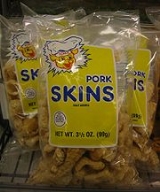
Pork rind

Encyclopedia
Pork rind is the fried or roasted skin (rind) of a pig
. Frying melts most of the fat from the pork rind. Uncooked pork rind may be used as a fishing bait, or cooked with beans or stewed vegetables or in soups. The pork rind may have subcutaneous fat attached; see fatback
.
Microwavable
pork rinds are sold which are microwaved in bags that resemble microwave popcorn
(although not exhibiting the popping sound) and can be eaten still warm. Pickled
pork rinds, on the other hand, are often enjoyed refrigerated and cold. Unlike the crisp and fluffy texture of fried pork rinds, pickled pork rinds are very rich and buttery, much like foie gras
.
For example, a 14 gram serving of Utz
Regular Pork Rinds contains 5 g of fat and 230 mg of sodium, whereas the same serving of Utz Regular Potato Chips contains 4.5 g of fat and 47 mg of sodium. Pork rinds generally contain 8 g of protein in a 14 g serving, more than most foods except dried meats, such as jerky
. The fat content of jerky, however, is much lower. Microwaveable pork rinds are lower in fat than the deep-fried variety, with only 2 g of fat per 14 g serving and 0 g of saturated fat, although the sodium level may be as high as 350 mg per serving. According to the Atkins diet, the low carbohydrate content of pork rinds makes them more appropriate for that diet regimen than low-fat snack foods, such as high-carbohydrate, fat-free pretzel
s.
According to Men's Health
:
"A 1 ounces (28.3 g) serving contains zero carbohydrates, 17 grams (g) of protein, and 9 g fat. That's nine times the protein and less fat than you'll find in a serving of carb-packed potato chips. Even better, 43 percent of a pork rind's fat is unsaturated
, and most of that is oleic acid
— the same healthy fat found in olive oil
. Another 13 percent of its fat content is stearic acid
, a type of saturated fat that's considered harmless, because it doesn't raise cholesterol levels."
term for small pieces of pork rind or pork fatback fried until rendered and crispy. They are often used as a flavouring over other foods, such as salt fish and potatoes, and mainly used as a condiment for fish and brewis
. http://www.heritage.nf.ca/dictionary/azindex/pages/3947.html http://www.billcasselman.com/canadian_food_words/cfw_two.htm
In Quebec
, they are often called oreilles de Christ (Christ ears) or oreilles de crisse, and are eaten almost exclusively as part of traditional cabane a sucre meals.
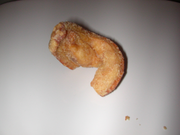 Pork scratchings is the British name for deep-fried, salted, crunchy pork rind with fat produced separately from the meat. This is then eaten cold.
Pork scratchings typically are heavy and hard, have a crispy layer of fat under the skin, and are flavored only with salt. The pig hair is usually removed by quickly burning the skin of the pig before it is cut into pieces and cooked in hot fat. However, this process is not 100% effective, so scratchings occasionally retain a few hairs.
In the United Kingdom
, pork scratchings (though not crackling — see above) are sold as a snack food
in the same way pork rinds are in the USA. Unlike the physically large, but relatively light bags of 'deep-fried skin without the fat' sold around the world, in the UK they are sold in relatively small bags, which usually weigh between 42g and 90g. Traditionally, they are eaten as an accompaniment to a pint
of beer
in a pub, just like crisps or peanut
s. Scratchings can also be bought from butchers, supermarkets or newsagents.
They have been taken to both the North
and South Pole
s on various expeditions, because of their lack of weight and high amount of energy, which is essential on these types of trips.
They have been popular in the UK and especially in the Black Country
since the times when families would fatten up a "tunkey pig" (a pig fattened especially for Christmas
), then slaughter it for meat and slice the skin with the fat into strips, which they would then deep fry. Some believe their popularity grew in the early 19th century when new uses were found for offcuts from pigs.
In the UK, the term 'pork rind' usually refers to the uncooked layer of skin on bacon or a joint of pork. Many people choose to cut the raw rind off their bacon before cooking it.
or other animals. Pieces of fried meat, skin, or membrane produced as a byproduct of rendering lard
are also called cracklings. Cracklings consist of either roasted or fried pork rind that has had salt rubbed into it and scored with a sharp knife: "a crackling offers a square of skin that cracks when you bite into it, giving way to a little pocket of hot fat and a salty layer of pork meat."
Cajun cracklings (or "cracklins") from Cajun cuisine
are fried pieces of pork fat with a small amount of attached skin, flavored after frying with a mixture of peppery Cajun spices.
Pork rinds normally refers to a snack food commercially sold in plastic bags. They are made in a two-step process: pork skin is first rendered and dried, and then fried and puffed. These are also called by the Mexican name, chicharrón, in reference to the popular Mexican food.
In 2003, sales of pork rind experienced a "meteoric rise", but they have dropped "by $31 million since 2004, when they reached $134 million, and now make up barely more than 1 percent of the salty snack market."
, pork rinds are known as grattons, and are an essential ingredient to some slow-cooked stews, such as cassoulet
. In Spain
, they are called cortezas de cerdo or cueritos when they do not have any solid fat attached, and chicharrones or torreznos when they do. In Catalonia
and other Catalan
-speaking areas, they are usually called cotnes (sing. cotna), which is the pork rinds per se, when prepared as snacks, whereas llardons (sing. llardó) are a specially prepared, pressed variety. The latter are also known regionally as greixons (sing. greixó) or llardufes (sing. llardufa), among other names. Portugal
has torresmos and couratos, the latter normally on sale at large popular gatherings, such as football matches, usually on a sandwich
, and accompanied by beer
. In the Netherlands
, they are known as knabbelspek, which translates to "nibbling bacon". They are usually sold with no flavorings other than salt at most butchers and supermarkets. They are usually eaten as a snack food. In Denmark
, they are known as flæskesvær and can be found in most grocery stores and kiosks. In Austria, they have recently become popular as Schweinekrusten (pig crusts).
, pork rinds are called tepertő or töpörtyű and are fried in lard and eaten with bread and spring onions. Tepertő is a traditional food in Hungary, connected to peasant cookery (see also szalonna
). In Serbia
and Croatia
, pork rinds are called čvarci
, a popular home-made peasant food in the lowland Pannonian regions. Known as пръжки in Bulgaria
, they are a popular winter
food, usually deep-fried in fat. The skin may or may not be attached, but any hair is generally removed. Čvarci are most often made during the traditional slaughter of pigs in Croatia and Serbia. A special kind of čvarci in Serbia is called duvan čvarci (tobacco cracklings): they are made by pressing čvarci during the preparation to have appearance of tobacco. In the Czech Republic
, pork rinds, called škvarky, are generally prepared in lard. In some parts of the country, a spread (škvarková pomazánka) is produced by mincing the rinds. They are traditionally connected with the pig slaughtering during winter months, but today are available in most butcher's and selected supermarkets all year round, usually in lard. In Romania, pork rinds are called jumări and are prepared in a similar fashion to the British scratchings, but the most common use for the pork rind is şorici. Traditionally, the pig is slaughtered on St. Ignatius' Day, December 20.
. In Spanish
-speaking areas, they are known as chicharrones
(the singular form, chicharrón, is also used as a mass noun
). They are eaten alone as a snack, or as the meat portion in various stews and soups, which can be eaten with cachapa
s, or as a stuffing in arepa
s, pupusa
s, or in a taco
or gordita
with salsa verde.
They are usually made with different cuts of pork
, but sometimes with other meats, like poultry
, beef
, mutton, etc. In Cuba
, Puerto Rico
and Venezuela
, chicharrones are also made with chicken, similar to Jewish gribenes
, and, in Argentina
with beef. In these cases, they are consumed mostly as snack
s.
In Colombia
, they are part of the bandeja Paisa
, which is considered to be Colombia's national dish.
In Brazil
, pork rinds called torresmo are eaten as a snack with beer, or as a side to some dishes, such as feijoada
.
In Mexico
, the Chicharrón is a popular specialty item, where the pork skin is sold dry in large slices, up to the full back of the pig. Then it is served as a central piece where each person breaks off a serving to accompany other foods and salsas.
The cueritos type is a Mexican
snack made with pork skins and marinated in vinegar instead of being deep-fried.
Many restaurants in Mexico offer a non-meat dairy version known as Chicharrón de Queso. A vegetarian version is popular as street food
, deep-fried and sold throughout Mexican cities by street vendors, typically seasoned with chile, salt
and lime
.
On the Island of Utila
, in Honduras
, it is deep-fried in a large pot at the beach on Sundays, and is garnished with fried green plantains or fried breadfruit
and coleslaw
.
word chicharrón). They may also be referred to by their English name "cracklings" if they contain a considerable portion of meat. Another form of crackling in the Philippines, tsitsarong manok, is made from seasoned chicken skin fried in its own rendered fat.
Crunchy pork rinds are one of the more popular choices for finger foods, locally called pulutan, during alcohol-drinking sessions. They are served with a spicy vinegar and soy sauce dip mixed with crushed garlic and/or onions. A popular beer snack is tsitsarong bulaklak ("flower" crackling) which is fried chitterlings
(pork intestines).
It is also used as a topping in various dishes such as pancit
and mami
.
In China, pork rinds may be stewed with yams or soybeans, or fried and sometimes eaten spicy.
before the Doi moi program in 1986. Due to many economic difficulties in the pre-Doi moi era, cooking oil
and meat
were still "luxury goods", consequently fat liquid and pork rind became excellent replacements in Vietnamese daily meals. Nowadays, when Vietnam's economy is much better than before, pork rind is no longer a substitute food but a delicious and special component in many Vietnamese dishes, such as cơm tấm
, noodle and snails (bún ốc), noodle soup
,...
In Vietnamese, pork rind is called tóp mỡ, literally means "dried piece of fat".
. They can be used with jig
heads as an addition to either marabou, bucktail, or rubber-skirted jigs. A reference to using pork as bait for trout was made by Henry David Thoreau
.
Pig
A pig is any of the animals in the genus Sus, within the Suidae family of even-toed ungulates. Pigs include the domestic pig, its ancestor the wild boar, and several other wild relatives...
. Frying melts most of the fat from the pork rind. Uncooked pork rind may be used as a fishing bait, or cooked with beans or stewed vegetables or in soups. The pork rind may have subcutaneous fat attached; see fatback
Fatback
Fatback is a cut of meat from a domestic pig. It consists of the layer of adipose tissue under the skin of the back, with or without the skin...
.
History
It is believed that the pork scratching originated in the West Midlands or Black Country, where they were widely consumed by the working classes. The pork scratching dates back to the 1800's, when families kept their own pigs as a source of food; in order to not waste any element of the pig, due to the scarcity of food, even the offcuts of fat and skin were fried for food.Types of pork snack
In the UK, there are three distinct types. Traditional scratchings are made from shank rind and cooked just once. Pork crackling is also made from shoulder rind but is fried twice. It is first rendered at a low heat, and then cooked at a higher temperature for a less fatty, crispier result. A more recent development is the pork crunch, which is made from back rind and again double-fried to become a large puffy snack.Microwavable
Microwave oven
A microwave oven is a kitchen appliance that heats food by dielectric heating, using microwave radiation to heat polarized molecules within the food...
pork rinds are sold which are microwaved in bags that resemble microwave popcorn
Popcorn
Popcorn, or popping corn, is corn which expands from the kernel and puffs up when heated. Corn is able to pop because, like sorghum, quinoa and millet, its kernels have a hard moisture-sealed hull and a dense starchy interior. This allows pressure to build inside the kernel until an explosive...
(although not exhibiting the popping sound) and can be eaten still warm. Pickled
Pickling
Pickling, also known as brining or corning is the process of preserving food by anaerobic fermentation in brine to produce lactic acid, or marinating and storing it in an acid solution, usually vinegar . The resulting food is called a pickle. This procedure gives the food a salty or sour taste...
pork rinds, on the other hand, are often enjoyed refrigerated and cold. Unlike the crisp and fluffy texture of fried pork rinds, pickled pork rinds are very rich and buttery, much like foie gras
Foie gras
Foie gras ; French for "fat liver") is a food product made of the liver of a duck or goose that has been specially fattened. This fattening is typically achieved through gavage corn, according to French law, though outside of France it is occasionally produced using natural feeding...
.
Health issues
Since most pork snacks are low in carbohydrates, they are an alternative snack food for those following the Atkins diet. However, pork snacks are often very high in fat and sodium; the fat content of pork rinds is similar to that of potato chips, but the amount of sodium in a serving of pork rinds is nearly five times that of a serving of potato chips.For example, a 14 gram serving of Utz
Utz Quality Foods, Inc.
Utz Quality Foods, Inc. , based in Hanover, Pennsylvania, is the largest independent privately held snack brand in the United States. The company was founded in 1921 and distributes a variety of potato chips and other snack foods throughout the United States....
Regular Pork Rinds contains 5 g of fat and 230 mg of sodium, whereas the same serving of Utz Regular Potato Chips contains 4.5 g of fat and 47 mg of sodium. Pork rinds generally contain 8 g of protein in a 14 g serving, more than most foods except dried meats, such as jerky
Jerky (food)
Jerky is lean meat that has been trimmed of fat, cut into strips, and then been dried to prevent spoilage. Normally, this drying includes the addition of salt, to prevent bacteria from developing on the meat before sufficient moisture has been removed. The word "jerky" is a bastardization of the...
. The fat content of jerky, however, is much lower. Microwaveable pork rinds are lower in fat than the deep-fried variety, with only 2 g of fat per 14 g serving and 0 g of saturated fat, although the sodium level may be as high as 350 mg per serving. According to the Atkins diet, the low carbohydrate content of pork rinds makes them more appropriate for that diet regimen than low-fat snack foods, such as high-carbohydrate, fat-free pretzel
Pretzel
A pretzel is a type of baked food made from dough in soft and hard varieties and savory or sweet flavors in a unique knot-like shape, originating in Europe...
s.
According to Men's Health
Men's Health (magazine)
Men's Health , published by Rodale Inc. in Emmaus, Pennsylvania, United States, is the world’s largest men’s magazine brand, with 44 editions around the world. It is also the best-selling men's magazine on U.S. newsstands. It covers fitness, nutrition, sexuality, lifestyle and other aspects of...
:
"A 1 ounces (28.3 g) serving contains zero carbohydrates, 17 grams (g) of protein, and 9 g fat. That's nine times the protein and less fat than you'll find in a serving of carb-packed potato chips. Even better, 43 percent of a pork rind's fat is unsaturated
Unsaturated fat
An unsaturated fat is a fat or fatty acid in which there is at least one double bond within the fatty acid chain. A fat molecule is monounsaturated if it contains one double bond, and polyunsaturated if it contains more than one double bond. Where double bonds are formed, hydrogen atoms are...
, and most of that is oleic acid
Oleic acid
Oleic acid is a monounsaturated omega-9 fatty acid found in various animal and vegetable fats. It has the formula CH37CH=CH7COOH. It is an odorless, colourless oil, although commercial samples may be yellowish. The trans isomer of oleic acid is called elaidic acid...
— the same healthy fat found in olive oil
Olive oil
Olive oil is an oil obtained from the olive , a traditional tree crop of the Mediterranean Basin. It is commonly used in cooking, cosmetics, pharmaceuticals, and soaps and as a fuel for traditional oil lamps...
. Another 13 percent of its fat content is stearic acid
Stearic acid
Stearic acid is the saturated fatty acid with an 18 carbon chain and has the IUPAC name octadecanoic acid. It is a waxy solid, and its chemical formula is CH316CO2H. Its name comes from the Greek word στέαρ "stéatos", which means tallow. The salts and esters of stearic acid are called stearates...
, a type of saturated fat that's considered harmless, because it doesn't raise cholesterol levels."
Canada
Scrunchions is a NewfoundlandNewfoundland English
Newfoundland English is a name for several accents and dialects thereof the English found in the province of Newfoundland and Labrador. Most of these differ substantially from the English commonly spoken elsewhere in Canada...
term for small pieces of pork rind or pork fatback fried until rendered and crispy. They are often used as a flavouring over other foods, such as salt fish and potatoes, and mainly used as a condiment for fish and brewis
Fish and Brewis
Fish and brewis is a traditional Newfoundland meal consisting of codfish and hard bread or hard tack. With the abundance of cod around the coasts of Newfoundland and Labrador it became synonymous with many Newfoundland households as a delicacy to be served as a main meal.The recipe may vary from...
. http://www.heritage.nf.ca/dictionary/azindex/pages/3947.html http://www.billcasselman.com/canadian_food_words/cfw_two.htm
In Quebec
Quebec
Quebec or is a province in east-central Canada. It is the only Canadian province with a predominantly French-speaking population and the only one whose sole official language is French at the provincial level....
, they are often called oreilles de Christ (Christ ears) or oreilles de crisse, and are eaten almost exclusively as part of traditional cabane a sucre meals.
United Kingdom
Pork crackling is the British name for the salted, crunchy, pork rind produced when roasting a joint of pork. The heat of the oven causes the fatty pork skin to dry, bubble up and become crunchy. The layer of fat underneath is retained, and can be eaten with the skin or removed. Some supermarkets now sell just the layer of skin and fat (no meat), in a raw form for home grilling or roasting, or cooked and ready to eat from hot food counters.Pork scratchings typically are heavy and hard, have a crispy layer of fat under the skin, and are flavored only with salt. The pig hair is usually removed by quickly burning the skin of the pig before it is cut into pieces and cooked in hot fat. However, this process is not 100% effective, so scratchings occasionally retain a few hairs.
In the United Kingdom
United Kingdom
The United Kingdom of Great Britain and Northern IrelandIn the United Kingdom and Dependencies, other languages have been officially recognised as legitimate autochthonous languages under the European Charter for Regional or Minority Languages...
, pork scratchings (though not crackling — see above) are sold as a snack food
Snack food
A snack is a portion of food oftentimes smaller than that of a regular meal, that is generally eaten between meals. Snacks come in a variety of forms including packaged and processed foods and items made from fresh ingredients at home....
in the same way pork rinds are in the USA. Unlike the physically large, but relatively light bags of 'deep-fried skin without the fat' sold around the world, in the UK they are sold in relatively small bags, which usually weigh between 42g and 90g. Traditionally, they are eaten as an accompaniment to a pint
Pint
The pint is a unit of volume or capacity that was once used across much of Europe with values varying from state to state from less than half a litre to over one litre. Within continental Europe, the pint was replaced with the metric system during the nineteenth century...
of beer
Beer
Beer is the world's most widely consumed andprobably oldest alcoholic beverage; it is the third most popular drink overall, after water and tea. It is produced by the brewing and fermentation of sugars, mainly derived from malted cereal grains, most commonly malted barley and malted wheat...
in a pub, just like crisps or peanut
Peanut
The peanut, or groundnut , is a species in the legume or "bean" family , so it is not a nut. The peanut was probably first cultivated in the valleys of Peru. It is an annual herbaceous plant growing tall...
s. Scratchings can also be bought from butchers, supermarkets or newsagents.
They have been taken to both the North
North Pole
The North Pole, also known as the Geographic North Pole or Terrestrial North Pole, is, subject to the caveats explained below, defined as the point in the northern hemisphere where the Earth's axis of rotation meets its surface...
and South Pole
South Pole
The South Pole, also known as the Geographic South Pole or Terrestrial South Pole, is one of the two points where the Earth's axis of rotation intersects its surface. It is the southernmost point on the surface of the Earth and lies on the opposite side of the Earth from the North Pole...
s on various expeditions, because of their lack of weight and high amount of energy, which is essential on these types of trips.
They have been popular in the UK and especially in the Black Country
Black Country
The Black Country is a loosely defined area of the English West Midlands conurbation, to the north and west of Birmingham, and to the south and east of Wolverhampton. During the industrial revolution in the 19th century this area had become one of the most intensely industrialised in the nation...
since the times when families would fatten up a "tunkey pig" (a pig fattened especially for Christmas
Christmas
Christmas or Christmas Day is an annual holiday generally celebrated on December 25 by billions of people around the world. It is a Christian feast that commemorates the birth of Jesus Christ, liturgically closing the Advent season and initiating the season of Christmastide, which lasts twelve days...
), then slaughter it for meat and slice the skin with the fat into strips, which they would then deep fry. Some believe their popularity grew in the early 19th century when new uses were found for offcuts from pigs.
In the UK, the term 'pork rind' usually refers to the uncooked layer of skin on bacon or a joint of pork. Many people choose to cut the raw rind off their bacon before cooking it.
United States
Cracklings is the American name for fried or roasted skins of pigs, geeseGoose
The word goose is the English name for a group of waterfowl, belonging to the family Anatidae. This family also includes swans, most of which are larger than true geese, and ducks, which are smaller....
or other animals. Pieces of fried meat, skin, or membrane produced as a byproduct of rendering lard
Lard
Lard is pig fat in both its rendered and unrendered forms. Lard was commonly used in many cuisines as a cooking fat or shortening, or as a spread similar to butter. Its use in contemporary cuisine has diminished because of health concerns posed by its saturated-fat content and its often negative...
are also called cracklings. Cracklings consist of either roasted or fried pork rind that has had salt rubbed into it and scored with a sharp knife: "a crackling offers a square of skin that cracks when you bite into it, giving way to a little pocket of hot fat and a salty layer of pork meat."
Cajun cracklings (or "cracklins") from Cajun cuisine
Cajun cuisine
Cajun cuisine is the style of cooking named for the French-speaking Acadian or "Cajun" immigrants deported by the British from Acadia in Canada to the Acadiana region of Louisiana, USA. It is what could be called a rustic cuisine — locally available ingredients predominate, and preparation...
are fried pieces of pork fat with a small amount of attached skin, flavored after frying with a mixture of peppery Cajun spices.
Pork rinds normally refers to a snack food commercially sold in plastic bags. They are made in a two-step process: pork skin is first rendered and dried, and then fried and puffed. These are also called by the Mexican name, chicharrón, in reference to the popular Mexican food.
In 2003, sales of pork rind experienced a "meteoric rise", but they have dropped "by $31 million since 2004, when they reached $134 million, and now make up barely more than 1 percent of the salty snack market."
Western Europe
In FranceFrance
The French Republic , The French Republic , The French Republic , (commonly known as France , is a unitary semi-presidential republic in Western Europe with several overseas territories and islands located on other continents and in the Indian, Pacific, and Atlantic oceans. Metropolitan France...
, pork rinds are known as grattons, and are an essential ingredient to some slow-cooked stews, such as cassoulet
Cassoulet
Cassoulet is a rich, slow-cooked bean stew or casserole originating in the south of France, containing meat , pork skin and white haricot beans....
. In Spain
Spain
Spain , officially the Kingdom of Spain languages]] under the European Charter for Regional or Minority Languages. In each of these, Spain's official name is as follows:;;;;;;), is a country and member state of the European Union located in southwestern Europe on the Iberian Peninsula...
, they are called cortezas de cerdo or cueritos when they do not have any solid fat attached, and chicharrones or torreznos when they do. In Catalonia
Catalonia
Catalonia is an autonomous community in northeastern Spain, with the official status of a "nationality" of Spain. Catalonia comprises four provinces: Barcelona, Girona, Lleida, and Tarragona. Its capital and largest city is Barcelona. Catalonia covers an area of 32,114 km² and has an...
and other Catalan
Catalan language
Catalan is a Romance language, the national and only official language of Andorra and a co-official language in the Spanish autonomous communities of Catalonia, the Balearic Islands and Valencian Community, where it is known as Valencian , as well as in the city of Alghero, on the Italian island...
-speaking areas, they are usually called cotnes (sing. cotna), which is the pork rinds per se, when prepared as snacks, whereas llardons (sing. llardó) are a specially prepared, pressed variety. The latter are also known regionally as greixons (sing. greixó) or llardufes (sing. llardufa), among other names. Portugal
Portugal
Portugal , officially the Portuguese Republic is a country situated in southwestern Europe on the Iberian Peninsula. Portugal is the westernmost country of Europe, and is bordered by the Atlantic Ocean to the West and South and by Spain to the North and East. The Atlantic archipelagos of the...
has torresmos and couratos, the latter normally on sale at large popular gatherings, such as football matches, usually on a sandwich
Sandwich
A sandwich is a food item, typically consisting of two or more slices of :bread with one or more fillings between them, or one slice of bread with a topping or toppings, commonly called an open sandwich. Sandwiches are a widely popular type of lunch food, typically taken to work or school, or...
, and accompanied by beer
Beer
Beer is the world's most widely consumed andprobably oldest alcoholic beverage; it is the third most popular drink overall, after water and tea. It is produced by the brewing and fermentation of sugars, mainly derived from malted cereal grains, most commonly malted barley and malted wheat...
. In the Netherlands
Netherlands
The Netherlands is a constituent country of the Kingdom of the Netherlands, located mainly in North-West Europe and with several islands in the Caribbean. Mainland Netherlands borders the North Sea to the north and west, Belgium to the south, and Germany to the east, and shares maritime borders...
, they are known as knabbelspek, which translates to "nibbling bacon". They are usually sold with no flavorings other than salt at most butchers and supermarkets. They are usually eaten as a snack food. In Denmark
Denmark
Denmark is a Scandinavian country in Northern Europe. The countries of Denmark and Greenland, as well as the Faroe Islands, constitute the Kingdom of Denmark . It is the southernmost of the Nordic countries, southwest of Sweden and south of Norway, and bordered to the south by Germany. Denmark...
, they are known as flæskesvær and can be found in most grocery stores and kiosks. In Austria, they have recently become popular as Schweinekrusten (pig crusts).
Eastern Europe
In HungaryHungary
Hungary , officially the Republic of Hungary , is a landlocked country in Central Europe. It is situated in the Carpathian Basin and is bordered by Slovakia to the north, Ukraine and Romania to the east, Serbia and Croatia to the south, Slovenia to the southwest and Austria to the west. The...
, pork rinds are called tepertő or töpörtyű and are fried in lard and eaten with bread and spring onions. Tepertő is a traditional food in Hungary, connected to peasant cookery (see also szalonna
Szalonna (bacon)
Szalonna is Hungarian for back bacon made of smoked pork fat with the rind and is traditional in Hungarian cuisine. It is often smoked or cooked in some manner before purchase so that the buyer can eat it without further preparation. It is very different from popular American bacon, which is...
). In Serbia
Serbia
Serbia , officially the Republic of Serbia , is a landlocked country located at the crossroads of Central and Southeast Europe, covering the southern part of the Carpathian basin and the central part of the Balkans...
and Croatia
Croatia
Croatia , officially the Republic of Croatia , is a unitary democratic parliamentary republic in Europe at the crossroads of the Mitteleuropa, the Balkans, and the Mediterranean. Its capital and largest city is Zagreb. The country is divided into 20 counties and the city of Zagreb. Croatia covers ...
, pork rinds are called čvarci
Cvarci
Čvarci is a specialty of west Balkan cuisine, a variant of pork rinds. They are a kind of pork 'crisps', with fat thermally extracted from the bacon....
, a popular home-made peasant food in the lowland Pannonian regions. Known as пръжки in Bulgaria
Bulgaria
Bulgaria , officially the Republic of Bulgaria , is a parliamentary democracy within a unitary constitutional republic in Southeast Europe. The country borders Romania to the north, Serbia and Macedonia to the west, Greece and Turkey to the south, as well as the Black Sea to the east...
, they are a popular winter
Winter
Winter is the coldest season of the year in temperate climates, between autumn and spring. At the winter solstice, the days are shortest and the nights are longest, with days lengthening as the season progresses after the solstice.-Meteorology:...
food, usually deep-fried in fat. The skin may or may not be attached, but any hair is generally removed. Čvarci are most often made during the traditional slaughter of pigs in Croatia and Serbia. A special kind of čvarci in Serbia is called duvan čvarci (tobacco cracklings): they are made by pressing čvarci during the preparation to have appearance of tobacco. In the Czech Republic
Czech Republic
The Czech Republic is a landlocked country in Central Europe. The country is bordered by Poland to the northeast, Slovakia to the east, Austria to the south, and Germany to the west and northwest....
, pork rinds, called škvarky, are generally prepared in lard. In some parts of the country, a spread (škvarková pomazánka) is produced by mincing the rinds. They are traditionally connected with the pig slaughtering during winter months, but today are available in most butcher's and selected supermarkets all year round, usually in lard. In Romania, pork rinds are called jumări and are prepared in a similar fashion to the British scratchings, but the most common use for the pork rind is şorici. Traditionally, the pig is slaughtered on St. Ignatius' Day, December 20.
Latin America
Pork rinds are also popular in Latin AmericaLatin America
Latin America is a region of the Americas where Romance languages – particularly Spanish and Portuguese, and variably French – are primarily spoken. Latin America has an area of approximately 21,069,500 km² , almost 3.9% of the Earth's surface or 14.1% of its land surface area...
. In Spanish
Spanish language
Spanish , also known as Castilian , is a Romance language in the Ibero-Romance group that evolved from several languages and dialects in central-northern Iberia around the 9th century and gradually spread with the expansion of the Kingdom of Castile into central and southern Iberia during the...
-speaking areas, they are known as chicharrones
Chicharrones
Chicharrón is a dish made of fried pork rinds. It is sometimes made from chicken, mutton, or beef.Chicharrón is popular in Andalucia, Spain, and in Latin America and other countries with Spanish influence, it is part of the traditional cuisines of Argentina, Bolivia, Brazil , Colombia, Cuba,...
(the singular form, chicharrón, is also used as a mass noun
Mass noun
In linguistics, a mass noun is a noun that refers to some entity as an undifferentiated unit rather than as something with discrete subsets. Non-count nouns are best identified by their syntactic properties, and especially in contrast with count nouns. The semantics of mass nouns are highly...
). They are eaten alone as a snack, or as the meat portion in various stews and soups, which can be eaten with cachapa
Cachapa
Cachapas are a traditional Venezuelan dish made from corn. Like arepas, they are popular at roadside stands. They can be made like pancakes of fresh corn dough, or wrapped in dry corn leaves and boiled...
s, or as a stuffing in arepa
Arepa
An arepa is a dish made of ground corn dough or cooked flour, popular in Colombia, Venezuela and other Spanish-speaking countries. It is similar in shape to the Salvadoran pupusa...
s, pupusa
Pupusa
A pupusa is a traditional Salvadoran dish made of thick, hand-made corn tortilla that is usually filled with a blend of the following: cheese , cooked pork meat ground to a paste consistency...
s, or in a taco
Taco
A taco is a traditional Mexican dish composed of a corn or wheat tortilla folded or rolled around a filling. A taco can be made with a variety of fillings, including beef, chicken, seafood, vegetables and cheese, allowing for great versatility and variety...
or gordita
Gordita
A gordita in Mexican cuisine is a corn cake made with masa harina and stuffed with cheese, meat or other fillings. It is similar to a pasty and to the Colombian/Venezuelan arepa. Gordita means "little fat one" in Spanish. A gordita is typically fried in a deep wok-shaped comal or baked on a...
with salsa verde.
They are usually made with different cuts of pork
Pork
Pork is the culinary name for meat from the domestic pig , which is eaten in many countries. It is one of the most commonly consumed meats worldwide, with evidence of pig husbandry dating back to 5000 BC....
, but sometimes with other meats, like poultry
Poultry
Poultry are domesticated birds kept by humans for the purpose of producing eggs, meat, and/or feathers. These most typically are members of the superorder Galloanserae , especially the order Galliformes and the family Anatidae , commonly known as "waterfowl"...
, beef
Beef
Beef is the culinary name for meat from bovines, especially domestic cattle. Beef can be harvested from cows, bulls, heifers or steers. It is one of the principal meats used in the cuisine of the Middle East , Australia, Argentina, Brazil, Europe and the United States, and is also important in...
, mutton, etc. In Cuba
Cuba
The Republic of Cuba is an island nation in the Caribbean. The nation of Cuba consists of the main island of Cuba, the Isla de la Juventud, and several archipelagos. Havana is the largest city in Cuba and the country's capital. Santiago de Cuba is the second largest city...
, Puerto Rico
Puerto Rico
Puerto Rico , officially the Commonwealth of Puerto Rico , is an unincorporated territory of the United States, located in the northeastern Caribbean, east of the Dominican Republic and west of both the United States Virgin Islands and the British Virgin Islands.Puerto Rico comprises an...
and Venezuela
Venezuela
Venezuela , officially called the Bolivarian Republic of Venezuela , is a tropical country on the northern coast of South America. It borders Colombia to the west, Guyana to the east, and Brazil to the south...
, chicharrones are also made with chicken, similar to Jewish gribenes
Gribenes
Gribenes or grieven are crisp chicken or goose skin cracklings with fried onions, a kosher food somewhat similar to pork rinds. Gribenes are a byproduct of schmaltz preparation....
, and, in Argentina
Argentina
Argentina , officially the Argentine Republic , is the second largest country in South America by land area, after Brazil. It is constituted as a federation of 23 provinces and an autonomous city, Buenos Aires...
with beef. In these cases, they are consumed mostly as snack
Snack food
A snack is a portion of food oftentimes smaller than that of a regular meal, that is generally eaten between meals. Snacks come in a variety of forms including packaged and processed foods and items made from fresh ingredients at home....
s.
In Colombia
Colombia
Colombia, officially the Republic of Colombia , is a unitary constitutional republic comprising thirty-two departments. The country is located in northwestern South America, bordered to the east by Venezuela and Brazil; to the south by Ecuador and Peru; to the north by the Caribbean Sea; to the...
, they are part of the bandeja Paisa
Bandeja paisa
Bandeja paisa, also known as bandeja de arriero, bandeja montañera, or bandeja antioqueña, is a typical fusion cuisine Colombian dish...
, which is considered to be Colombia's national dish.
In Brazil
Brazil
Brazil , officially the Federative Republic of Brazil , is the largest country in South America. It is the world's fifth largest country, both by geographical area and by population with over 192 million people...
, pork rinds called torresmo are eaten as a snack with beer, or as a side to some dishes, such as feijoada
Feijoada
Feijoada is a stew of beans with beef and pork, which is a typical from Brazilian Cuisine, is also typical in Angola, Mozambique, Goa, India and other former Portuguese colonies. In Brazil, feijoada is considered by many as the national dish...
.
In Mexico
Mexico
The United Mexican States , commonly known as Mexico , is a federal constitutional republic in North America. It is bordered on the north by the United States; on the south and west by the Pacific Ocean; on the southeast by Guatemala, Belize, and the Caribbean Sea; and on the east by the Gulf of...
, the Chicharrón is a popular specialty item, where the pork skin is sold dry in large slices, up to the full back of the pig. Then it is served as a central piece where each person breaks off a serving to accompany other foods and salsas.
The cueritos type is a Mexican
Mexico
The United Mexican States , commonly known as Mexico , is a federal constitutional republic in North America. It is bordered on the north by the United States; on the south and west by the Pacific Ocean; on the southeast by Guatemala, Belize, and the Caribbean Sea; and on the east by the Gulf of...
snack made with pork skins and marinated in vinegar instead of being deep-fried.
Many restaurants in Mexico offer a non-meat dairy version known as Chicharrón de Queso. A vegetarian version is popular as street food
Street food
Street food is ready-to-eat food or drink sold in a street or other public place, such as a market or fair, by a hawker or vendor, often from a portable stall. While some street foods are regional, many are not, having spread beyond their region of origin. Most street food are both finger and fast...
, deep-fried and sold throughout Mexican cities by street vendors, typically seasoned with chile, salt
Salt
In chemistry, salts are ionic compounds that result from the neutralization reaction of an acid and a base. They are composed of cations and anions so that the product is electrically neutral...
and lime
Lime (fruit)
Lime is a term referring to a number of different citrus fruits, both species and hybrids, which are typically round, green to yellow in color, 3–6 cm in diameter, and containing sour and acidic pulp. Limes are a good source of vitamin C. Limes are often used to accent the flavors of foods and...
.
On the Island of Utila
Útila
Utila is the third largest of Honduras' Bay Islands, after Roatán and Guanaja, in a region that marks the south end of the Mesoamerican Barrier Reef System, the second-largest in the world...
, in Honduras
Honduras
Honduras is a republic in Central America. It was previously known as Spanish Honduras to differentiate it from British Honduras, which became the modern-day state of Belize...
, it is deep-fried in a large pot at the beach on Sundays, and is garnished with fried green plantains or fried breadfruit
Breadfruit
Breadfruit is a species of flowering tree in the mulberry family, Moraceae, growing throughout Southeast Asia and most Pacific Ocean islands...
and coleslaw
Coleslaw
Coleslaw, sometimes simply called slaw in some American dialects, is a salad consisting primarily of shredded raw cabbage. It may also include shredded carrots and other ingredients such as fruits and vegetables, apples, onions, green onions, peppers and various spices.-History:The term "coleslaw"...
.
Philippines
Fried pork skins go by various names in Filipino cuisine, including tsitsaron (from the SpanishSpanish in the Philippines
Spanish was imposed as an official language of the Philippines from the beginning of Spanish rule since the times of Miguel López de Legazpi in the late 16th century, through American rule and independence, until the change of Constitution in 1973...
word chicharrón). They may also be referred to by their English name "cracklings" if they contain a considerable portion of meat. Another form of crackling in the Philippines, tsitsarong manok, is made from seasoned chicken skin fried in its own rendered fat.
Crunchy pork rinds are one of the more popular choices for finger foods, locally called pulutan, during alcohol-drinking sessions. They are served with a spicy vinegar and soy sauce dip mixed with crushed garlic and/or onions. A popular beer snack is tsitsarong bulaklak ("flower" crackling) which is fried chitterlings
Chitterlings
Chitterlings are the intestines of a pig, although cattle and other animals' intestines are similarly used, that have been prepared as food. In various countries across the world, such food is prepared and eaten either as part of a daily diet, or at special events, holidays or religious...
(pork intestines).
It is also used as a topping in various dishes such as pancit
Pancit
Pancit or pansit is the term for noodles in Filipino cuisine. Noodles were introduced into the Philippines by the Chinese and have since been adopted into local cuisine. The term pancit is derived from the Hokkien pian i sit which means "something conveniently cooked fast." Different kinds of...
and mami
Noodle soup
Noodle soup refers to a variety of soups with noodles and other ingredients served in a light broth. Noodle soup is an East and Southeast Asian staple. Less well known, a form of fresh noodle is used in soup in certain parts of Europe , and in northern China; usually, it is served for breakfast...
.
China
In China, pork rinds are considered to have certain medicinal properties; they are held to be good for the cardiovascular and cerebro-vascular systems in particular. They are also considered to make the skin more moisturized.In China, pork rinds may be stewed with yams or soybeans, or fried and sometimes eaten spicy.
Vietnam
Pork rinds used to be a very common food in VietnamVietnam
Vietnam – sometimes spelled Viet Nam , officially the Socialist Republic of Vietnam – is the easternmost country on the Indochina Peninsula in Southeast Asia. It is bordered by China to the north, Laos to the northwest, Cambodia to the southwest, and the South China Sea –...
before the Doi moi program in 1986. Due to many economic difficulties in the pre-Doi moi era, cooking oil
Cooking oil
Cooking oil is purified fat of plant origin, which is usually liquid at room temperature ....
and meat
Meat
Meat is animal flesh that is used as food. Most often, this means the skeletal muscle and associated fat and other tissues, but it may also describe other edible tissues such as organs and offal...
were still "luxury goods", consequently fat liquid and pork rind became excellent replacements in Vietnamese daily meals. Nowadays, when Vietnam's economy is much better than before, pork rind is no longer a substitute food but a delicious and special component in many Vietnamese dishes, such as cơm tấm
Com tam
Cơm tấm in Vietnamese is cooked rice from fractured rice grains. Tấm refers to the broken rice grains, while cơm refers to cooked rice....
, noodle and snails (bún ốc), noodle soup
Noodle soup
Noodle soup refers to a variety of soups with noodles and other ingredients served in a light broth. Noodle soup is an East and Southeast Asian staple. Less well known, a form of fresh noodle is used in soup in certain parts of Europe , and in northern China; usually, it is served for breakfast...
,...
In Vietnamese, pork rind is called tóp mỡ, literally means "dried piece of fat".
Other uses
Unfried pork rind is also processed into colorful and appealing shapes for use as fish baitBait (luring substance)
Bait is any substance used to attract prey, e.g. in a mousetrap.-In Australia:Baiting in Australia refers to specific campaigns to control foxes, wild dogs and dingos by poisoning in areas where they are a problem...
. They can be used with jig
Jig (fishing)
Jigging is the practice of fishing with a jig, a type of fishing lure. A jig consists of a lead sinker with a hook molded into it and usually covered by a soft body to attract fish. Jigs are intended to create a jerky, vertical motion, as opposed to spinnerbaits which move through the water...
heads as an addition to either marabou, bucktail, or rubber-skirted jigs. A reference to using pork as bait for trout was made by Henry David Thoreau
Henry David Thoreau
Henry David Thoreau was an American author, poet, philosopher, abolitionist, naturalist, tax resister, development critic, surveyor, historian, and leading transcendentalist...
.
See also
- CiccioliCiccioliCiccioli is a food prepared from pig fat in the Italian district of Emilia Romagna and elsewhere in northern and central Italy. It is popular in Modena, Bologna, Parma and in Romagna....
, an Italian food made from pressed pork scraps. - GribenesGribenesGribenes or grieven are crisp chicken or goose skin cracklings with fried onions, a kosher food somewhat similar to pork rinds. Gribenes are a byproduct of schmaltz preparation....
, a Jewish snack made from chicken skin.