

Pennsylvania Railroad

Encyclopedia
- "PRR" redirects here. For other uses, see PRR (disambiguation)PRR (disambiguation)PRR is the Pennsylvania Railroad.PRR may also refer to:* Parietal Reach Region in the parietal lobe* Pattern recognition receptor, in cell biology* Personal Role Radio, carried by UK troops* Pichi Richi Railway, a heritage railway in Australia...
United States
The United States of America is a federal constitutional republic comprising fifty states and a federal district...
Class I railroad
Class I railroad
A Class I railroad in the United States and Mexico, or a Class I rail carrier in Canada, is a large freight railroad company, as classified based on operating revenue.Smaller railroads are classified as Class II and Class III...
, founded in 1846. Commonly referred to as the "Pennsy", the PRR was headquartered in Philadelphia, Pennsylvania
Philadelphia, Pennsylvania
Philadelphia is the largest city in the Commonwealth of Pennsylvania and the county seat of Philadelphia County, with which it is coterminous. The city is located in the Northeastern United States along the Delaware and Schuylkill rivers. It is the fifth-most-populous city in the United States,...
.
The PRR was the largest railroad by traffic and revenue in the U.S. for the first half of the twentieth century and was at one time the largest publicly traded corporation in the world. At its peak it controlled about 10000 miles (16,093.4 km) of rail line; in the 1920s it carried about three times the traffic (measured by ton-miles of freight) as other railroads of comparable length, such as Union Pacific
Union Pacific Railroad
The Union Pacific Railroad , headquartered in Omaha, Nebraska, is the largest railroad network in the United States. James R. Young is president, CEO and Chairman....
or Santa Fe
Atchison, Topeka and Santa Fe Railway
The Atchison, Topeka and Santa Fe Railway , often abbreviated as Santa Fe, was one of the larger railroads in the United States. The company was first chartered in February 1859...
. The only rival was New York Central
New York Central Railroad
The New York Central Railroad , known simply as the New York Central in its publicity, was a railroad operating in the Northeastern United States...
, which carried around three-quarters of PRR's ton-miles.
During its history the PRR merged with or had an interest in at least 800 other rail lines and companies. The corporation still holds the record for the longest continuous dividend history: it paid out annual dividends to shareholders for more than 100 years in a row. At one point the budget for the PRR was larger than that of the U.S. government; at its peak it employed about 250,000 workers.
In 1968 the Pennsylvania Railroad merged with its rival, the New York Central Railroad, to form the Penn Central Transportation Company. The Interstate Commerce Commission
Interstate Commerce Commission
The Interstate Commerce Commission was a regulatory body in the United States created by the Interstate Commerce Act of 1887. The agency's original purpose was to regulate railroads to ensure fair rates, to eliminate rate discrimination, and to regulate other aspects of common carriers, including...
required that the ailing New York, New Haven and Hartford Railroad
New York, New Haven and Hartford Railroad
The New York, New Haven and Hartford Railroad , was a railroad that operated in the northeast United States from 1872 to 1968 which served the states of Connecticut, New York, Rhode Island, and Massachusetts...
be added in 1969. A series of events including inflation, poor management, abnormally harsh weather and the withdrawal of a government-guaranteed $200-million operating loan forced the Penn Central to file for bankruptcy
Bankruptcy
Bankruptcy is a legal status of an insolvent person or an organisation, that is, one that cannot repay the debts owed to creditors. In most jurisdictions bankruptcy is imposed by a court order, often initiated by the debtor....
protection on June 21, 1970. The viable parts of the Penn Central system were transferred in 1976 to Conrail, which began earning a profit in 1981. The Norfolk Southern Railway
Norfolk Southern Railway
The Norfolk Southern Railway is a Class I railroad in the United States, owned by the Norfolk Southern Corporation. With headquarters in Norfolk, Virginia, the company operates 21,500 route miles in 22 eastern states, the District of Columbia and the province of Ontario, Canada...
and CSX Transportation
CSX Transportation
CSX Transportation operates a Class I railroad in the United States known as the CSX Railroad. It is the main subsidiary of the CSX Corporation. The company is headquartered in Jacksonville, Florida, and owns approximately 21,000 route miles...
acquired Conrail in approximately equal portions in 1999, with Norfolk Southern now owning most of the former Pennsylvania Railroad, including the old Pennsy Main Line across Pennsylvania.
The Pennsylvania Railroad's corporate symbol was the keystone
Keystone (architecture)
A keystone is the wedge-shaped stone piece at the apex of a masonry vault or arch, which is the final piece placed during construction and locks all the stones into position, allowing the arch to bear weight. This makes a keystone very important structurally...
, which is Pennsylvania
Pennsylvania
The Commonwealth of Pennsylvania is a U.S. state that is located in the Northeastern and Mid-Atlantic regions of the United States. The state borders Delaware and Maryland to the south, West Virginia to the southwest, Ohio to the west, New York and Ontario, Canada, to the north, and New Jersey to...
's state symbol, with the letters PRR intertwined inside. When colored, it was bright red with a silver-grey inline and lettering.
Main Line
The Commonwealth of Pennsylvania, as part of the Main Line of Public WorksMain Line of Public Works
The Main Line of Public Works was a railroad and canal system built by the Commonwealth of Pennsylvania in the 19th century. It ran from Philadelphia west through Harrisburg and across the state to Pittsburgh and connected with other divisions of the Pennsylvania Canal...
, chartered the Pennsylvania Railroad in 1846 to build a rail line that would connect Harrisburg
Harrisburg, Pennsylvania
Harrisburg is the capital of Pennsylvania. As of the 2010 census, the city had a population of 49,528, making it the ninth largest city in Pennsylvania...
to Pittsburgh
Pittsburgh, Pennsylvania
Pittsburgh is the second-largest city in the US Commonwealth of Pennsylvania and the county seat of Allegheny County. Regionally, it anchors the largest urban area of Appalachia and the Ohio River Valley, and nationally, it is the 22nd-largest urban area in the United States...
. This western line from Harrisburg would complete the main line, which was to be a railroad and canal corridor across the state.
With capital provided in part by the municipal government of Philadelphia, work on the western part of the main line was completed in 1854, and rail service from Philadelphia across the state to Pittsburgh was available. In 1857, the PRR purchased the main line from the State of Pennsylvania. This line is still an important cross-state corridor, carrying Amtrak
Amtrak
The National Railroad Passenger Corporation, doing business as Amtrak , is a government-owned corporation that was organized on May 1, 1971, to provide intercity passenger train service in the United States. "Amtrak" is a portmanteau of the words "America" and "track". It is headquartered at Union...
's Philadelphia to Harrisburg Main Line and the Norfolk Southern Railway's Pittsburgh Subdivision.
John Edgar Thomson
John Edgar Thomson
John Edgar Thomson was an American civil engineer and industrialist. Thomson was an entrepreneur best known for his leadership of the Pennsylvania Railroad from 1852 until his death 1874, making it the largest business enterprise in the world and a world-class model for technological and...
(1808 – 1874) was the entrepreneur who led the PRR from 1852 to his death in 1874, making it the largest business enterprise in the world and a world-class model for technological and managerial innovation. He served as PRR's first Chief Engineer and third President. Thomson's sober, technical, methodical, and non-ideological personality had an important influence on the Pennsylvania Railroad, which in the mid-19th century was on the technical cutting edge of rail development, while nonetheless reflecting Thomson's personality in its conservatism and its steady growth while avoiding financial risks. His Pennsylvania Railroad was in his day the largest railroad in the world, with 6000 miles of track, and was famous for steady financial dividends, for high quality construction, constantly improving equipment, technological advances (such as replacing wood with coal), and innovation in management techniques for a large complex organization.
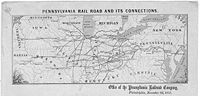
New York, Philadelphia, Baltimore, and Washington lines
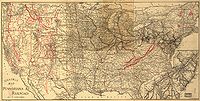
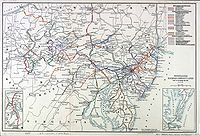
Northern Central Railway
The Northern Central Railway was a Class I Railroad connecting Baltimore, Maryland with Sunbury, Pennsylvania. Completed in 1858, the line came under the control of the Pennsylvania Railroad in 1861, when the PRR acquired a controlling interest in the Northern Central's stock to compete with the...
, giving it access to Baltimore, Maryland, along the Susquehanna River
Susquehanna River
The Susquehanna River is a river located in the northeastern United States. At long, it is the longest river on the American east coast that drains into the Atlantic Ocean, and with its watershed it is the 16th largest river in the United States, and the longest river in the continental United...
via connections at Columbia, Pennsylvania
Columbia, Pennsylvania
Columbia, once colonial Wright's Ferry, is a borough in Lancaster County, Pennsylvania, 28 miles southeast of Harrisburg on the left bank Susquehanna River across from Wrightsville and York County. Originally, the area may have been called Conejohela Flats, for the many islands and islets in the...
, or Harrisburg.
On December 1, 1871, the PRR leased the United New Jersey Railroad and Canal Company
United New Jersey Railroad and Canal Company
The United New Jersey Railroad and Canal Company was part of the Pennsylvania Railroad system in New Jersey, including their main line to New York City...
, which included the original Camden and Amboy Railroad from Camden, New Jersey (across the Delaware River
Delaware River
The Delaware River is a major river on the Atlantic coast of the United States.A Dutch expedition led by Henry Hudson in 1609 first mapped the river. The river was christened the South River in the New Netherland colony that followed, in contrast to the North River, as the Hudson River was then...
from Philadelphia) to South Amboy, New Jersey
South Amboy, New Jersey
South Amboy is a city in Middlesex County, New Jersey, on the Raritan Bay. As of the 2000 United States Census, the city population was 7,913.South Amboy, and Perth Amboy across the Raritan River, are collectively referred to as The Amboys...
(across Raritan Bay
Raritan Bay
Raritan Bay is a bay located at the southern portion of Lower New York Bay between the U.S. states of New York and New Jersey and is part of the New York Bight. The bay is bounded on the northwest by New York's Staten Island, on the west by Perth Amboy, New Jersey, on the south by the Raritan...
from New York City
New York City
New York is the most populous city in the United States and the center of the New York Metropolitan Area, one of the most populous metropolitan areas in the world. New York exerts a significant impact upon global commerce, finance, media, art, fashion, research, technology, education, and...
), as well as a newer line from Philadelphia to Jersey City, New Jersey
Jersey City, New Jersey
Jersey City is the seat of Hudson County, New Jersey, United States.Part of the New York metropolitan area, Jersey City lies between the Hudson River and Upper New York Bay across from Lower Manhattan and the Hackensack River and Newark Bay...
, much closer to New York, via Trenton, New Jersey
Trenton, New Jersey
Trenton is the capital of the U.S. state of New Jersey and the county seat of Mercer County. As of the 2010 United States Census, Trenton had a population of 84,913...
. Track connection in Philadelphia was made via the United Companies' Connecting Railway
Connecting Railway
The Connecting Railway was a subsidiary of the Pennsylvania Railroad, incorporated to build a connection between the Philadelphia and Trenton Railroad and the PRR in the city of Philadelphia.-Connecting railway:...
and the jointly owned Junction Railroad (Philadelphia)
Junction Railroad (Philadelphia)
The Junction Railroad was a railroad in the U.S. state of Pennsylvania, connecting lines west of downtown Philadelphia, Pennsylvania. It came under Pennsylvania Railroad control in 1881, and was eliminated by merger in 1908.-History:...
.
The PRR's Baltimore and Potomac Rail Road
Baltimore and Potomac Rail Road
The Baltimore and Potomac Railroad operated from Baltimore, Maryland, southwest to Washington, DC, from 1872 to 1902. The company was controlled by the Pennsylvania Railroad. It was the second railroad company to provide railroad service from Washington to the northeastern states, and became a...
opened on July 2, 1872, between Baltimore and Washington, D.C.
Washington, D.C.
Washington, D.C., formally the District of Columbia and commonly referred to as Washington, "the District", or simply D.C., is the capital of the United States. On July 16, 1790, the United States Congress approved the creation of a permanent national capital as permitted by the U.S. Constitution....
This route required transfer via horse car in Baltimore to the other lines heading north from the city. On June 29, 1873, the Baltimore and Potomac Tunnel
Baltimore and Potomac Tunnel
The Baltimore and Potomac Tunnel is a double track, masonry arch railroad tunnel beneath Baltimore, Maryland. It now serves Northeast Corridor rail service operated by Amtrak and MARC Train passenger railroads with an average of 135 trains per weekday traversing the tunnel.Whether considered a...
through Baltimore was completed. The PRR started the misleadingly named Pennsylvania Air Line service via the Northern Central Railway and Columbia, Pennsylvania. This service was 54.5 miles (87.5 km) longer than the old route but avoided the transfer in Baltimore. The Union Railroad (Baltimore) line opened on July 24, 1873. This route eliminated the transfer in Baltimore. PRR officials contracted with both the Union Railroad and the Philadelphia, Wilmington and Baltimore Railroad
Philadelphia, Wilmington and Baltimore Railroad
The Philadelphia, Wilmington and Baltimore Railroad was the Pennsylvania Railroad's main line from Philadelphia, Pennsylvania southwest to Baltimore, Maryland in the 19th and early 20th centuries...
(PW&B) Railroad for access to this line. The PRR's New York–Washington trains began using the route the next day, ending Pennsylvania Air Line service. In the early 1880s, the PRR acquired a majority of PW&B Railroad's stock. This action forced the Baltimore and Ohio Railroad
Baltimore and Ohio Railroad
The Baltimore and Ohio Railroad was one of the oldest railroads in the United States and the first common carrier railroad. It came into being mostly because the city of Baltimore wanted to compete with the newly constructed Erie Canal and another canal being proposed by Pennsylvania, which...
(B&O) to build the Baltimore and Philadelphia Railroad
Baltimore and Philadelphia Railroad
The Baltimore and Philadelphia Railroad was a railroad line built by the Baltimore and Ohio Railroad from Philadelphia, Pennsylvania to Baltimore, Maryland. It was built in the 1880s after the B&O lost access to its previous route to Philadelphia, the Philadelphia, Wilmington and Baltimore Railroad...
to keep its Philadelphia access, where it connected with the Reading Railroad
Reading Company
The Reading Company , usually called the Reading Railroad, officially the Philadelphia and Reading Rail Road and then the Philadelphia and Reading Railway until 1924, operated in southeast Pennsylvania and neighboring states...
for its competing Royal Blue Line passenger trains to reach New York.
In 1885, the PRR began passenger train service from New York City via Philadelphia to Washington with limited stops along the route. This service became known as the "Congressional Limited Express." The service expanded, and by the 1920s, the PRR was operating hourly passenger train service between New York, Philadelphia and Washington. In the early 1950s, 18-car stainless steel
Stainless steel
In metallurgy, stainless steel, also known as inox steel or inox from French "inoxydable", is defined as a steel alloy with a minimum of 10.5 or 11% chromium content by mass....
streamliners were introduced on the Morning Congressional and Afternoon Congressional between New York and Washington, as well as the Senator from Boston to Washington.
New York-Chicago
On July 1, 1869, the Pennsylvania Railroad formally leased the Pittsburgh, Fort Wayne and Chicago RailwayPittsburgh, Fort Wayne and Chicago Railway
The Pittsburgh, Fort Wayne and Chicago Railway was a major part of the Pennsylvania Railroad system, extending the PRR west from Pittsburgh, Pennsylvania via Fort Wayne, Indiana to Chicago, Illinois...
, in which it had previously been an investor. This lease gave the PRR complete control of that line's direct route through northern Ohio
Ohio
Ohio is a Midwestern state in the United States. The 34th largest state by area in the U.S.,it is the 7th‑most populous with over 11.5 million residents, containing several major American cities and seven metropolitan areas with populations of 500,000 or more.The state's capital is Columbus...
and Indiana
Indiana
Indiana is a US state, admitted to the United States as the 19th on December 11, 1816. It is located in the Midwestern United States and Great Lakes Region. With 6,483,802 residents, the state is ranked 15th in population and 16th in population density. Indiana is ranked 38th in land area and is...
as well as entry into the then-emerging rail hub city of Chicago, Illinois.
On June 15, 1887, passenger service began between New York City and Chicago as the Pennsylvania Limited. The occasion was also the first introduction by any railroad of the vestibule
Vestibuled train
A vestibuled train is a passenger train whose cars have enclosed vestibules at their ends, in contrast to the open platforms on early cars. Typically, a vestibule has doorways on either side to allow passenger egress at stations, a door into the body of the car, and, at the end of the car, a...
, an enclosed platform at the end of each passenger car, allowing protected access to the entire train. In 1902, the Pennsylvania Limited was replaced by the Pennsylvania Special, which in turn was replaced in 1912 by the Broadway Limited
Broadway Limited
The Broadway Limited was the Pennsylvania Railroad's premier named passenger train, operating daily in each direction between New York City and Chicago, via North Philadelphia. It replaced its predecessors, the Pennsylvania Limited and the Pennsylvania Special...
which became the most famous train operated by the Pennsylvania Railroad. This train ran from New York City to Chicago, via Philadelphia, with an additional section between Harrisburg and Washington (later operated as a separate Washington–Chicago train, the Liberty Limited).
"Low-grade" lines
Around 1900, the PRR built several low-grade lines for freight to bypass areas of steep grade (slope). These included:- 1892: Trenton Branch (PRR) and Trenton Cut-Off Railroad from Glen Loch, Pennsylvania east to Morrisville, PennsylvaniaMorrisville, Bucks County, PennsylvaniaMorrisville is a borough in Bucks County, Pennsylvania, United States. The population was 8,728 at the 2010 census.-Geography:Morrisville is located at . It is situated on the Delaware River directly across from Trenton, New Jersey...
(not only a low-grade line but a long-distance bypass of Philadelphia) - 1892: Waverly and Passaic RailroadPassaic and Harsimus LineConrail's Passaic and Harsimus Line serves freight in northeastern New Jersey, as an alternate to the mainly passenger Northeast Corridor. It takes trains from the Northeast Corridor and Lehigh Line near Newark Liberty International Airport northeast and east into Jersey City, New Jersey, serving...
(finished by the New York Bay Railroad) from Waverly, New Jersey to Kearny, New JerseyKearny, New JerseyKearny is a town in Hudson County, New Jersey, United States. It was named after Civil War general Philip Kearny. As of the United States 2010 Census, the town population was 40,684. The town is a suburb of the nearby city of Newark.... - 1904: Reopening of the New Portage Railroad from the Gallitzin TunnelGallitzin TunnelThe Gallitzin Tunnels in Gallitzin, Pennsylvania, formed the Pennsylvania Railroad's passage through the Allegheny Mountains in western Pennsylvania. Ownership of the tunnels has been successively transferred from the Pennsylvania Railroad to Penn Central Transportation Company, then to Conrail...
s east to New Portage Junction, then continuing north over the Hollidaysburg Branch to Altoona - 1906: Philadelphia and Thorndale Branch from Thorndale, PennsylvaniaThorndale, PennsylvaniaThorndale is a census-designated place in Chester County, Pennsylvania, United States. The population was 3,407 at the 2010 census. Thorndale is the commercial and administrative center of Caln Township. The community's main street is Business U.S. Route 30...
east to Glen Loch (abandoned by Conrail in 1989) - 1906: Atglen and Susquehanna BranchAtglen and Susquehanna BranchThe Atglen and Susquehanna Branch is an abandoned branch line of the Pennsylvania Railroad.-History:The Atglen and Susquehanna Branch was built by the Pennsylvania Railroad between 1902 and 1906. The branch was built to relieve congestion on the Philadelphia to Harrisburg Main Line and the...
from Harrisburg via the Northern Central Railway south to Wago Junction, then east to ParkesburgParkesburg, PennsylvaniaParkesburg is a borough in Chester County, Pennsylvania, United States. The population was 3,593 at the 2010 census. The Zip code is 19365.-History:...
(abandoned by Conrail in 1990)
The Pennsylvania and Newark Railroad was incorporated in 1905 to build a low-grade line from Morrisville, Pennsylvania to Colonia, New Jersey. It was never completed, but some work was done in the Trenton area, including bridge piers in the Delaware River. North of Colonia, the alignment was going to be separate, but instead two extra tracks were added to the existing line. Work was suspended in 1916.
Pennsylvania Railroad electrification
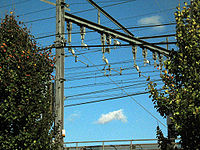
Direct current
Direct current is the unidirectional flow of electric charge. Direct current is produced by such sources as batteries, thermocouples, solar cells, and commutator-type electric machines of the dynamo type. Direct current may flow in a conductor such as a wire, but can also flow through...
(DC) 650-volt third rail powered PRR locomotives (and LIRR passenger cars). The system was put into service in 1910.
The next area to be electrified was the Philadelphia terminal area, where PRR officials decided to use overhead lines
Overhead lines
Overhead lines or overhead wires are used to transmit electrical energy to trams, trolleybuses or trains at a distance from the energy supply point...
to supply power to the suburban trains running out of Broad Street Station
Broad Street Station (Philadelphia)
Broad Street Station at Broad & Market Streets was the primary passenger terminal for the Pennsylvania Railroad in Philadelphia, Pennsylvania from 1881 to the 1950s...
. Unlike the New York terminal system, overhead wires would carry 11,000-volt 25-Hertz alternating current
Alternating current
In alternating current the movement of electric charge periodically reverses direction. In direct current , the flow of electric charge is only in one direction....
(AC) power, the system used for all future installations. In 1915, electrification of the line from Philadelphia to Paoli, Pennsylvania
Paoli, Pennsylvania
Paoli is a census-designated place in Chester County near Philadelphia, Pennsylvania, United States. It is situated in portions of two townships: Tredyffrin and Willistown...
was completed. Other Philadelphia lines electrified were the Chestnut Hill Branch
Chestnut Hill West Line
The Chestnut Hill West Line , is a route of the SEPTA Regional Rail system. The route serves the northwestern section of Philadelphia with service to Germantown, Mount Airy, and Chestnut Hill...
(1918), White Marsh (1924), West Chester
West Chester Branch
The West Chester Branch was a local passenger and freight railroad line owned by the Pennsylvania Railroad and later Penn Central. The line connected with the Philadelphia-Washington Main Line at Arsenal Junction near the University of Pennsylvania and the Philadelphia-Chicago Main Line near...
(1928), the main line to Wilmington, Delaware
Wilmington, Delaware
Wilmington is the largest city in the state of Delaware, United States, and is located at the confluence of the Christina River and Brandywine Creek, near where the Christina flows into the Delaware River. It is the county seat of New Castle County and one of the major cities in the Delaware Valley...
, and in 1930 the Norristown branch along, with the rest of the main line to Trenton.
PRR's president William Atterbury announced in 1928 plans to electrify the lines between New York, Philadelphia, Washington and Harrisburg. In January 1933, through main-line service between New York and Philadelphia/Wilmington/Paoli was placed in operation. The first test run of an electric train between Philadelphia and Washington occurred on January 28, 1935. On February 1 the Congressional Limiteds in both directions were the first trains in regular electric operation between New York and Washington, drawn by the first of the GG1
PRR GG1
The PRR GG1 is a class of electric locomotives that was built for the Pennsylvania Railroad for use in the northeastern United States. A total of 140 GG1s were constructed by its designer General Electric and the Pennsylvania's Altoona Works from 1934 to 1943....
-type locomotives
Electric locomotive
An electric locomotive is a locomotive powered by electricity from overhead lines, a third rail or an on-board energy storage device...
. All regular passenger trains between these cities were electrified by March 15.
To complete the electrification project initiated in 1928, work was started January 27, 1937, on the main line from Paoli to Harrisburg; the low-grade freight line from Morrisville through Columbia to Enola Yard
Enola Yard
Enola Yard is a large rail yard located in East Pennsboro Township, Pennsylvania, along the western shore of the Susquehanna River at Harrisburg, Pennsylvania. It was the world's largest freight yard through 1956. The yard continues to operate today at lower traffic levels.-History:The yard was...
in Pennsylvania; the Port Road Branch from Perryville
Perryville, Maryland
Perryville is a town in Cecil County, Maryland, United States. The population was 3,672 at the 2000 census. The town is located off Interstate 95, on the north side of the mouth of the Susquehanna River.-History:...
to Columbia; the Jamesburg Branch and Amboy Secondary freight line from Monmouth Junction to South Amboy; and the Landover-South End freight line from Landover, Maryland through Washington, DC to Potomac Yard
Potomac Yard
Potomac Yard was one of the busiest rail yards on the Eastern Seaboard of the United States. Today, it refers to the neighborhood encompassing the same, which straddles southeastern Arlington County and northern Alexandria, Virginia, bounded by U.S. Route 1, the George Washington Memorial Parkway,...
in Alexandria, VA (now called the Landover Subdivision and RF&P Subdivision of CSX). In less than a year, on the following January 15, the first passenger train, the Metropolitan, went into operation over the newly electrified line from Philadelphia to Harrisburg. On April 15 the electrified freight service from Harrisburg and Enola Yard east was inaugurated, thus completing the Pennsy's eastern seaboard electrification program with a total of 2677 miles (4,308.2 km) of track electrified—41 percent of the total electrically operated standard railroad trackage of the United States. Portions of the electrified trackage are still in use, owned and operated by Amtrak as the Northeast Corridor and Keystone Corridor high-speed rail routes.
Railroad shops
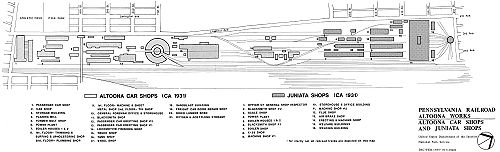
In 1849, PRR officials developed plans to construct a repair facility at AltoonaAltoona, Pennsylvania
-History:A major railroad town, Altoona was founded by the Pennsylvania Railroad in 1849 as the site for a shop complex. Altoona was incorporated as a borough on February 6, 1854, and as a city under legislation approved on April 3, 1867, and February 8, 1868...
. Construction was started in 1850, and soon a long building was completed that housed a machine shop, woodworking shop, blacksmith
Blacksmith
A blacksmith is a person who creates objects from wrought iron or steel by forging the metal; that is, by using tools to hammer, bend, and cut...
shop, locomotive repair shop and foundry
Foundry
A foundry is a factory that produces metal castings. Metals are cast into shapes by melting them into a liquid, pouring the metal in a mold, and removing the mold material or casting after the metal has solidified as it cools. The most common metals processed are aluminum and cast iron...
. This facility was later torn down to make room for continuing expansion.
In time additional PRR repair facilities were located in Harrisburg, Pittsburgh, and Mifflin, and the Altoona Works expanded in adjacent Juniata, Pennsylvania. Inventor Alexander Graham Bell
Alexander Graham Bell
Alexander Graham Bell was an eminent scientist, inventor, engineer and innovator who is credited with inventing the first practical telephone....
sent two assistants to the Altoona shops in 1875 to study the feasibility of installing telephone
Telephone
The telephone , colloquially referred to as a phone, is a telecommunications device that transmits and receives sounds, usually the human voice. Telephones are a point-to-point communication system whose most basic function is to allow two people separated by large distances to talk to each other...
lines. In May 1877, telephone lines were installed for various departments to communicate with one another.
Fort Wayne, Indiana
Fort Wayne, Indiana
Fort Wayne is a city in the US state of Indiana and the county seat of Allen County. The population was 253,691 at the 2010 Census making it the 74th largest city in the United States and the second largest in Indiana...
, also held a key position for the railroad. By the turn of the 20th century, its repair shops and locomotive manufacturing facilities became known as the "Altoona of the West."
By 1945 the Altoona Works had grown to be one of the largest repair and construction facilities for locomotives and cars in the world. During World War II, PRR facilities (including the Altoona Shops) were on target lists of German saboteurs
Operation Pastorius
Operation Pastorius was a failed plan for sabotage via a series of attacks by Nazi German agents inside the United States. The operation was staged in June 1942 and was to be directed against strategic U.S. economic targets...
. They were caught before they could complete their missions.
In 1875 the Altoona Works started a testing department for PRR equipment. In following years, the Pennsylvania Railroad led the nation in the development of research and testing procedures of practical value for the railroad industry. Use of the testing facilities was discontinued in 1968 and many of the structures were demolished.
Penn Central merger and Conrail
On February 1, 1968, the PRR merged with its arch-rival, the New York Central railroad, to form the Penn CentralPenn Central Transportation
The Penn Central Transportation Company, commonly abbreviated to Penn Central, was an American railroad company that operated from 1968 until 1976. It was created by the merger on February 1, 1968, of the Pennsylvania Railroad and the New York Central Railroad...
. The Interstate Commerce Commission
Interstate Commerce Commission
The Interstate Commerce Commission was a regulatory body in the United States created by the Interstate Commerce Act of 1887. The agency's original purpose was to regulate railroads to ensure fair rates, to eliminate rate discrimination, and to regulate other aspects of common carriers, including...
(ICC) required that the ailing New York, New Haven & Hartford Railroad be added in 1969. A series of events including inflation, poor management, abnormally harsh weather conditions and the withdrawal of a government-guaranteed 200-million-dollar operating loan forced the Penn Central to file for bankruptcy protection on June 21, 1970. The Penn Central
Penn Central Transportation
The Penn Central Transportation Company, commonly abbreviated to Penn Central, was an American railroad company that operated from 1968 until 1976. It was created by the merger on February 1, 1968, of the Pennsylvania Railroad and the New York Central Railroad...
rail lines were split between Amtrak
Amtrak
The National Railroad Passenger Corporation, doing business as Amtrak , is a government-owned corporation that was organized on May 1, 1971, to provide intercity passenger train service in the United States. "Amtrak" is a portmanteau of the words "America" and "track". It is headquartered at Union...
(Northeast Corridor
Northeast Corridor
The Northeast Corridor is a fully electrified railway line owned primarily by Amtrak serving the Northeast megalopolis of the United States from Boston in the north, via New York to Washington, D.C. in the south, with branches serving other cities...
and Keystone Corridor
Keystone Corridor
The Keystone Corridor is a Federal Railroad Administration "designated high speed corridor" with a 349-mile railroad line between Philadelphia, Pennsylvania and Pittsburgh, Pennsylvania with a top speed of...
) and Conrail in the 1970s.
After the breakup of Conrail in 1999, the portion which had formerly been PRR territory largely became part of the Norfolk Southern Railway
Norfolk Southern Railway
The Norfolk Southern Railway is a Class I railroad in the United States, owned by the Norfolk Southern Corporation. With headquarters in Norfolk, Virginia, the company operates 21,500 route miles in 22 eastern states, the District of Columbia and the province of Ontario, Canada...
. The select few parts of the PRR which are now owned by CSX as a result of the Conrail split are (1) the western end of the Fort Wayne Line across western Ohio and northern Indiana, (2) the Pope's Creek Secondary in Maryland just to the east of Washington, DC, and (3) the Landover Subdivision, a former Pennsy freight line in DC which connects to Amtrak
Amtrak
The National Railroad Passenger Corporation, doing business as Amtrak , is a government-owned corporation that was organized on May 1, 1971, to provide intercity passenger train service in the United States. "Amtrak" is a portmanteau of the words "America" and "track". It is headquartered at Union...
's ex Pennsy Northeast Corridor
Northeast Corridor
The Northeast Corridor is a fully electrified railway line owned primarily by Amtrak serving the Northeast megalopolis of the United States from Boston in the north, via New York to Washington, D.C. in the south, with branches serving other cities...
and CSX's ex B&O Alexandria Extension on the north end, and CSX's RF&P Subdivision on the south end via the ex Pennsy "Long Bridge" across the Potomac River.
Timeline
- 1846 The PRR is chartered to construct a rail line from HarrisburgHarrisburg, PennsylvaniaHarrisburg is the capital of Pennsylvania. As of the 2010 census, the city had a population of 49,528, making it the ninth largest city in Pennsylvania...
to PittsburghPittsburgh, PennsylvaniaPittsburgh is the second-largest city in the US Commonwealth of Pennsylvania and the county seat of Allegheny County. Regionally, it anchors the largest urban area of Appalachia and the Ohio River Valley, and nationally, it is the 22nd-largest urban area in the United States...
. - 1850 Construction started on repair shop at AltoonaAltoona, Pennsylvania-History:A major railroad town, Altoona was founded by the Pennsylvania Railroad in 1849 as the site for a shop complex. Altoona was incorporated as a borough on February 6, 1854, and as a city under legislation approved on April 3, 1867, and February 8, 1868...
. - 1860–1890 PRR expands throughout the eastern U.S.
- 1869 PPR leases the Pittsburgh, Ft. Wayne & ChicagoPittsburgh, Fort Wayne and Chicago RailwayThe Pittsburgh, Fort Wayne and Chicago Railway was a major part of the Pennsylvania Railroad system, extending the PRR west from Pittsburgh, Pennsylvania via Fort Wayne, Indiana to Chicago, Illinois...
, formally giving it control of a direct route into the heart of the MidwestMidwestern United StatesThe Midwestern United States is one of the four U.S. geographic regions defined by the United States Census Bureau, providing an official definition of the American Midwest....
.
- 1869 PPR leases the Pittsburgh, Ft. Wayne & Chicago
- 1885 The "Congressional Limited Express" from New York City to Washington, DC is introduced.
- 1887 The Pennsylvania Limited was inaugurated, running between New York and Chicago. It is the first vestibuled trainVestibuled trainA vestibuled train is a passenger train whose cars have enclosed vestibules at their ends, in contrast to the open platforms on early cars. Typically, a vestibule has doorways on either side to allow passenger egress at stations, a door into the body of the car, and, at the end of the car, a...
. - 1894 The Pennsylvania Pacific Corporation is formed by the PRR.
- 1902 The Pennsylvania Special was inaugurated, replacing the Pennsylvania Limited between New York and Chicago.
- 1906 An accident in Atlantic City1906 Atlantic City train wreckThe 1906 Atlantic City train wreck happened in Atlantic City, New Jersey on Sunday October 28, 1906 when a West Jersey and Seashore Railroad electric train fell off a draw bridge, drowning 53 people.-Accident:...
kills 53 people - 1910 Completion of the North River Tunnels under the Hudson RiverHudson RiverThe Hudson is a river that flows from north to south through eastern New York. The highest official source is at Lake Tear of the Clouds, on the slopes of Mount Marcy in the Adirondack Mountains. The river itself officially begins in Henderson Lake in Newcomb, New York...
, providing direct service from New Jersey to Manhattan on electrified lines, terminating at the massive new Penn Station - 1912 The Broadway Limited was inaugurated, replacing the Pennsylvania Special.
- 1915 PRR electrifies its suburban PhiladelphiaPhiladelphia, PennsylvaniaPhiladelphia is the largest city in the Commonwealth of Pennsylvania and the county seat of Philadelphia County, with which it is coterminous. The city is located in the Northeastern United States along the Delaware and Schuylkill rivers. It is the fifth-most-populous city in the United States,...
lines between Central Philly and Paoli (PA)Paoli, PennsylvaniaPaoli is a census-designated place in Chester County near Philadelphia, Pennsylvania, United States. It is situated in portions of two townships: Tredyffrin and Willistown...
. - 1916 PRR adopts new motto, "Standard Railroad of the World". The first I1sPRR I1sThe Pennsylvania Railroad's class I1s steam locomotives were the largest class of 2-10-0 "Decapods" built in the United States, with 598 built 1916–1923 . These locomotives were the premier freight locomotive type on the system until World War II, and they remained in service until the end of...
"Decapod" locomotive is completed, and switching locomotives of the A5s and B6sbPRR B6The Pennsylvania Railroad's class B6 was its most successful class of switcher, or as the PRR termed them, "shifter". The PRR preferred the 0-6-0 wheel arrangement for larger switchers, whereas on other roads the 0-8-0 gained preference...
class are introduced. - 1918 PRR stock bottoms at $40¼ (equal to $ today), the lowest since 1877, due largely to Federal railroad controlUnited States Railroad AdministrationThe United States Railroad Administration was the name of the nationalized railroad system of the United States between 1917 and 1920. It was possibly the largest American experiment with nationalization, and was undertaken against a background of war emergency.- Background :On April 6, 1917, the...
. Emergency freight is routed through New York Penn Station and the Hudson River tunnels by the USRAUnited States Railroad AdministrationThe United States Railroad Administration was the name of the nationalized railroad system of the United States between 1917 and 1920. It was possibly the largest American experiment with nationalization, and was undertaken against a background of war emergency.- Background :On April 6, 1917, the...
to relieve congestion. Locomotive class N1sPRR N1sThe Pennsylvania Railroad's N1s was a class of steam locomotive built for Lines West. They were of 2-10-2 "Santa Fe" wheel arrangement, ten driving wheels with a two-wheel leading truck and a two-wheel cast KW-pattern trailing truck under a giant firebox...
is introduced for PRR's western lines. The PRR electrifies the suburban commuter line between Central Philadelphia and Chestnut HillChestnut Hill, Philadelphia, PennsylvaniaChestnut Hill is a neighborhood in the Northwest Philadelphia section of the United States city of Philadelphia, Pennsylvania.-Boundaries:Chestnut Hill is bounded as follows:...
. - 1928–1938 PRR electrified its New York–Washington main line, the Chicago–Philadelphia main line between Harrisburg and Paoli, several Philadelphia and New York area commuter lines, and major through freight lines.
- 1943 An accident at Frankford Junction, PennsylvaniaFrankford Junction train wreckThe Frankford Junction train wreck occurred on September 6, 1943 when Pennsylvania Railroad's premier train, the Congressional Limited crashed at Frankford Junction in the Kensington neighborhood of Philadelphia, Pennsylvania in the United States, killing 79 people and injuring 117...
kills 79. - 1946 The PRR reported a net loss for the first time in its history.
- 1951 An accident in Woodbridge, New JerseyWoodbridge train wreckThe Woodbridge train wreck occurred on February 6, 1951 in Woodbridge, New Jersey when a train derailed crossing a temporary wooden trestle, killing 85 people...
kills 85 people. - 1957 Steam locomotives are removed from active service in the PRR fleet.
- 1968 Pennsylvania Railroad merges with New York Central to form the Penn Central Transportation Company (Penn Central).
Post PRR-era Timeline
- 1970 Penn Central files for bankruptcy protection on June 21, 1970.
- 1976 The United StatesUnited StatesThe United States of America is a federal constitutional republic comprising fifty states and a federal district...
federal government forms Consolidated Rail CorporationConsolidated Rail CorporationThe Consolidated Rail Corporation, commonly known as Conrail , was the primary Class I railroad in the Northeast U.S. between 1976 and 1999. The federal government created it to take over the potentially profitable lines of bankrupt carriers, including the Penn Central Transportation Company and...
(Conrail) from the remnants of Penn Central and other bankrupt northeastern & Midwest railroads. Amtrak acquires the majority of the Northeast Corridor line. - 1986 Conrail is privatized.
- 1998-1999 The U.S. government allows Conrail to be split between and sold to CSX TransportationCSX TransportationCSX Transportation operates a Class I railroad in the United States known as the CSX Railroad. It is the main subsidiary of the CSX Corporation. The company is headquartered in Jacksonville, Florida, and owns approximately 21,000 route miles...
(CSX) and Norfolk Southern RailwayNorfolk Southern RailwayThe Norfolk Southern Railway is a Class I railroad in the United States, owned by the Norfolk Southern Corporation. With headquarters in Norfolk, Virginia, the company operates 21,500 route miles in 22 eastern states, the District of Columbia and the province of Ontario, Canada...
(NS), with CSX getting 42% and NS 58% (including most of the former PRR lines).
Standard Railroad of the World

For a long time this was true. It was the first railroad to completely replace wooden-bodied passenger cars with steel-bodied cars, and the first to introduce the vestibuled train. Over its history it led the way in many safety and efficiency improvements. In later years the PRR abandoned the use of the slogan.
The Pennsylvania Railroad was "standard" in another way. It was an early proponent of standardization. While other railroads used whatever was available, the PRR tested and experimented with equipment designs. When they found the right design, it became standard across the whole company. This gave the railroad a feel of uniformity, and it also reduced costs. This was unlike other railroads who purchased locomotive
Locomotive
A locomotive is a railway vehicle that provides the motive power for a train. The word originates from the Latin loco – "from a place", ablative of locus, "place" + Medieval Latin motivus, "causing motion", and is a shortened form of the term locomotive engine, first used in the early 19th...
s and railroad car
Railroad car
A railroad car or railway vehicle , also known as a bogie in Indian English, is a vehicle on a rail transport system that is used for the carrying of cargo or passengers. Cars can be coupled together into a train and hauled by one or more locomotives...
s in small lots, taking whatever was available from manufacturers at the time. The PRR was also an early adopter of standard color schemes for their equipment.
Equipment colors and painting
As noted above, the PRR colors and paint schemes were standardized. Locomotives were painted in a shade of green so dark it seemed almost black. The official name for this color was DGLE (Dark Green Locomotive Enamel). Often it was referred to as "Brunswick Green." The undercarriage of the locomotives were painted in black, referred to as "True Black." The passenger cars of the Pennsylvania Railroad were painted Tuscan Red. This is a brick-colored shade of red. Some electric locomotiveElectric locomotive
An electric locomotive is a locomotive powered by electricity from overhead lines, a third rail or an on-board energy storage device...
s and most passenger-hauling diesel locomotive
Diesel locomotive
A diesel locomotive is a type of railroad locomotive in which the prime mover is a diesel engine, a reciprocating engine operating on the Diesel cycle as invented by Dr. Rudolf Diesel...
s were also painted in Tuscan Red. Freight cars of the PRR had their own color. It was known as "Freight Car Color," which was an iron-oxide shade of red. On passenger locomotives and cars, the lettering and outlining was originally done in real gold leaf
Gold leaf
right|thumb|250px|[[Burnishing]] gold leaf with an [[agate]] stone tool, during the water gilding processGold leaf is gold that has been hammered into extremely thin sheets and is often used for gilding. Gold leaf is available in a wide variety of karats and shades...
. After World War II
World War II
World War II, or the Second World War , was a global conflict lasting from 1939 to 1945, involving most of the world's nations—including all of the great powers—eventually forming two opposing military alliances: the Allies and the Axis...
the lettering was done in a light shade of yellow called Buff Yellow.
Signaling

Signal aspects were displayed as rows of three lit lights. These signal aspects corresponded with upper-quadrant semaphore signal positions: vertical display for proceed, a 45° angle display for approach, and horizontal display for stop. Additionally, a row of lights at a 45° angle leaning left of vertical (perpendicular to the approach aspect) was also used for a restricting aspect. A "X" shape was a "take siding" aspect (message) and a full circle was a "raise pantograph" aspect in electrified territory. Additional aspects were conveyed with a second target head below the first, either a single light, a partial target, or a full target, depending on the location.
In later years, the two outside lights in the horizontal "stop" row were often given red lenses, and the center lamp would be extinguished when the signal displayed a stop aspect.
Starting in the late 1920s the Pennsylvania Railroad installed Pulse code cab signaling
Pulse code cab signaling
Pulse code cab signaling is a form of cab signaling developed in the United States by the Union Switch and Signal corporation for the Pennsylvania Railroad in the 1920s...
over much of its eastern system from Pittsburgh to Philadelphia, New York and Washington where the higher speeds of passenger trains made cab signalling
Cab signalling
Cab signalling is a railway safety system that communicates track status information to the cab, crew compartment or driver's compartment of a locomotive, railcar or multiple unit, where the train driver or engine driver can see the information....
desirable. In this system, signal information is transmitted through the rails using track circuits and picked up by a sensor on the locomotive, where the signal is displayed in the engineer's cab. This technology was subsequently adopted by several other US railroads, especially on lines with passenger trains. When first installed by the PRR this was an advanced technology, and is still in use today by Amtrak.
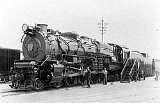
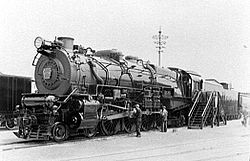
Steam locomotives
.jpg)
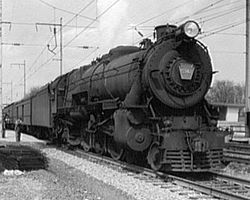
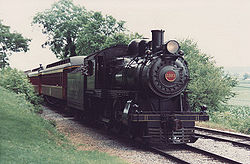
Outside builders were used due to the sheer number of locomotives the PRR ordered. The number required exceeded the capacity that its own shops could produce. PRR used a commercial builder as a subcontractor, building exact replicas of an existing PRR design. This was unlike most railroads who gave only a broad specification, thereby leaving the majority of the decision making and design to the locomotive builder.
When it needed to use a commercial locomotive builder, the PRR favored Philadelphia's
Philadelphia, Pennsylvania
Philadelphia is the largest city in the Commonwealth of Pennsylvania and the county seat of Philadelphia County, with which it is coterminous. The city is located in the Northeastern United States along the Delaware and Schuylkill rivers. It is the fifth-most-populous city in the United States,...
Baldwin Locomotive Works
Baldwin Locomotive Works
The Baldwin Locomotive Works was an American builder of railroad locomotives. It was located in Philadelphia, Pennsylvania, originally, and later in nearby Eddystone, Pennsylvania. Although the company was very successful as a producer of steam locomotives, its transition to the production of...
. Baldwin was a major PRR customer, receiving its raw materials and shipping out its finished products on PRR lines. Moreover, the two companies were headquartered in the same city, with PRR and Baldwin management, along with the engineers, knowing each other well. When both the PRR and Baldwin shops were at capacity, orders went to the Lima Locomotive Works
Lima Locomotive Works
Lima Locomotive Works was an American firm that manufactured railroad locomotives from the 1870s through the 1950s. The company took the most distinctive part of its name from its main shops location in Lima, Ohio. The shops were located between the Baltimore & Ohio's Cincinnati-Toledo main line...
in Lima, Ohio. Only as a last resort would the PRR use the American Locomotive Company
American Locomotive Company
The American Locomotive Company, often shortened to ALCO or Alco , was a builder of railroad locomotives in the United States.-Early history:...
(ALCO) based in Schenectady, New York. This may have been due to the fact that Alco was serviced by, as well as the favorite locomotive supplier to, the PRR's arch-rival: the New York Central Railroad
New York Central Railroad
The New York Central Railroad , known simply as the New York Central in its publicity, was a railroad operating in the Northeastern United States...
.
The PRR had a design style that it favored in its locomotives. One example is the square-shouldered Belpaire firebox
Belpaire firebox
The Belpaire firebox is a type of firebox used on steam locomotives. It was invented by Alfred Belpaire of Belgium. It has a greater surface area at the top of the firebox, improving heat transfer and steam production...
. This British style firebox was a PRR trademark that was rarely used by other locomotive builders in the United States. Also, the PRR used track pan
Track pan
A track pan or water trough is a device to enable a steam railway locomotive to replenish its water supply while in motion...
s extensively to pick up water, for the locomotive, while on the move. Using this system meant that the tenders of their locomotives had a comparatively large proportion of coal (which could not be taken on board while running) compared to water capacity. Locomotives of the PRR had a clean look to them. Only necessary devices were used and they were mounted neatly on the locomotive.
Smoke box fronts bore a round locomotive number board denoting a freight locomotive or a keystone number board denoting a passenger locomotive. Otherwise, the smoke box was uncluttered with the exception of a headlamp mounted at the top and a steam-driven turbo-generator behind it. In later years the positions of the two were reversed, since the generator needs more maintenance than the lamp.
Each class of steam locomotive was assigned a class designation. Early on, this was simply an alphabetical letter, but when these began to run out, the scheme was changed so that each wheel arrangement
Wheel arrangement
In rail transport, a wheel arrangement is a system of classifying the way in which wheels are distributed beneath a locomotive.. Several notations exist to describe the wheel assemblies of a locomotive by type, position, and connections, with the adopted notations varying by country...
had its own letter, and different types of the same arrangement were defined by a subsequent number. Subtypes were in turn indicated by a lower-case letter; superheating was designated by an "s" until the mid 1920s, by which time all new locomotives were superheated. Thus, for example, a K4sa class was a 4-6-2
4-6-2
4-6-2, in the Whyte notation for the classification of steam locomotives, represents the wheel arrangement of four leading wheels on two axles , six powered and coupled driving wheels on three axles, and two trailing wheels on one axle .These locomotives are also known as Pacifics...
"Pacific" type (K) and of the fourth class of Pacifics designed by the PRR. It was superheated (s) and was of the first variant type (a) after the original (unlettered). Steam locomotives remained part of the PRR fleet until 1957 when they were retired from active service.
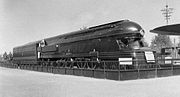
It should be noted that the PRR's reliance on steam locomotives in the mid 20th century was a factor contributing to its downfall. Steam locomotives require more maintenance than diesel locomotives, are less cost efficient, and require more personnel to operate. Also, the PRR was unable to update its roster during the World War II years, and by the end of the war their roster was in rough shape. In addition, during World War II and immediately thereafter, the PRR was saddled with unsuccessful experimental steam locomotives such as the Q1
PRR Q1
The Pennsylvania Railroad's class Q1 comprised a single experimental steam locomotive for freight service, #6130, built in March 1942. A duplex locomotive, it had a wheel arrangement of 4-6-4-4, comprising a four-wheel leading truck, two sets of driving wheels in a rigid locomotive frame, and a...
, S1
PRR S1
The PRR S1 class steam locomotive was an experimental locomotive that was the largest rigid frame passenger locomotive ever built. The streamlined Art Deco styled shell of the locomotive was designed by Raymond Loewy....
, and T1
PRR T1
The Pennsylvania Railroad's 52 T1 class duplex-drive 4-4-4-4 steam locomotives, introduced in 1942 and 1946 , were their last-built steam locomotives and their most controversial. They were ambitious, technologically sophisticated, powerful, fast, and uniquely streamlined by Raymond Loewy...
"Duplex Drive
Duplex locomotive
A duplex locomotive is a steam locomotive that divides the driving force on its wheels by using two pairs of cylinders rigidly mounted to a single locomotive frame; it is not an articulated locomotive...
" locomotives, and the S2 turbine locomotive
PRR S2
The Pennsylvania Railroad's class S2 was a steam turbine locomotive. Only one prototype was built, #6200, delivered in 1944. The S2 was the sole example of the 6-8-6 wheel arrangement in the Whyte notation, featuring a six-wheel leading truck, eight driving wheels, and a six-wheel trailing truck...
. Unlike most of their competition, the PRR did not acquire any 4-8-4
4-8-4
Under the Whyte notation classification of steam locomotives, 4-8-4 represents the wheel arrangement of four leading wheels on two axles , eight powered and coupled driving wheels on four axles, and four trailing wheels on two axles .Other equivalent classifications are:UIC classification: 2D2...
locomotives, which those other roads used with great success.
The PRR's competitors managed this period better with their diesel locomotive rosters.
The PRR was historically minded when it voluntarily preserved a roundhouse-full of representative steam locomotives at Northumberland, Pennsylvania
Northumberland, Pennsylvania
Northumberland is a borough in Northumberland County, Pennsylvania, United States. The population was 3,714 at the 2000 census.-History:Northumberland was founded in 1772. The land that became Northumberland was purchased from the Iroquois in the first Treaty of Fort Stanwix in 1768, and the...
in 1957, and kept them there for several decades. These locomotives, with the exception of I1sa #4483 which is on display at Hamburg, New York, are now at the Railroad Museum of Pennsylvania in Strasburg, Pennsylvania
Strasburg, Pennsylvania
Strasburg is a borough in Lancaster County, Pennsylvania, United States. It developed as a linear village along the Great Conestoga Road, stretching about two miles along path later known as the Strasburg Road...
. In sharp contrast, the New York Central's Alfred E. Perlman deliberately scrapped all but two large NYC steam locomotives, and these survived only by accident.
On December 18, 1987 the Commonwealth of Pennsylvania designated the Pennsylvania Railroad's K4s as the official State Steam Locomotive. The two surviving Locomotives can be seen on display at Strasburg and Altoona.
Electric locomotives
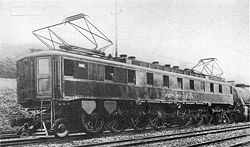
Pennsylvania Station (New York City)
Pennsylvania Station—commonly known as Penn Station—is the major intercity train station and a major commuter rail hub in New York City. It is one of the busiest rail stations in the world, and a hub for inbound and outbound railroad traffic in New York City. The New York City Subway system also...
was in progress, the type of electric locomotives to be used was an important consideration. At that time just a few electric locomotives had been built anywhere. Several experimental locomotives were designed by railroad and Westinghouse engineers and tried on the West Jersey and Seashore Railroad
West Jersey and Seashore Railroad
The West Jersey and Seashore Railroad was a Pennsylvania Railroad subsidiary that became part of Pennsylvania-Reading Seashore Lines in 1933.-History:...
track. From these tests the DD1
PRR DD1
The Pennsylvania Railroad's class DD1 were semi-permanently coupled pairs of third rail direct current electric locomotives built for the railroad's initial New York-area electrification. They operated between Manhattan Transfer and Pennsylvania Station in New York City, and from there to the...
class was developed. The DD1
PRR DD1
The Pennsylvania Railroad's class DD1 were semi-permanently coupled pairs of third rail direct current electric locomotives built for the railroad's initial New York-area electrification. They operated between Manhattan Transfer and Pennsylvania Station in New York City, and from there to the...
s were used in pairs (back to back). Thirty-three of these engines having Westinghouse equipment were built at Altoona. They were capable of speeds up to 85 miles per hour (38 m/s) . Placed in service in 1910, they proved to be very efficient.
Steel suburban passenger cars capable of being electrified for MU
Electric multiple unit
An electric multiple unit or EMU is a multiple unit train consisting of self-propelled carriages, using electricity as the motive power. An EMU requires no separate locomotive, as electric traction motors are incorporated within one or a number of the carriages...
operation were designed due to the need for such cars in service to Penn Station through its associated tunnels and were designated MP54
PRR MP54
The Pennsylvania Railroad's MP54 class of electric multiple unit cars was their first and largest class of this type of car. They were initially built for the original Philadelphia-based network of electrified suburban lines and were eventually used throughout the railroad's electrified area...
. Designs for corresponding cars accommodating baggage and mail were produced also. Eight of these cars were electrified with DC equipment to provide shuttle service fromm Penn Station to Manhattan Transfer between 1910 and 1922. More extensive electrification plans required AC electrification, starting with 93 cars for the Paoli Line in 1915. With the expansion of the AC electrification, additional MP54 cars were electrified or purchased new until a total of 481 cars was reached in 1951. Replacement with newer types of cars began in 1958 and the last MP54 cars were retired in 1980.
The single FF1
PRR FF1
The Pennsylvania Railroad's class FF1 was an American electric locomotive, a single prototype numbered #3931 and nicknamed "Big Liz" by its crews. It was built in 1917 for the task of hauling freight trains across the Allegheny Mountains, which the PRR planned to electrify; this was never...
appeared in 1917 and ran experimentally for a number of years in preparation for electrification over the Allegheny Mountains
Allegheny Mountains
The Allegheny Mountain Range , also spelled Alleghany, Allegany and, informally, the Alleghenies, is part of the vast Appalachian Mountain Range of the eastern United States and Canada...
that never came to fruition. Its AC induction motors and side-rod drive powered six axles. It developed a starting tractive force of 140,000 pounds, which was capable of ripping couplers out of the fragile wooden freight cars in use at the time.
In 1924 another side-rod locomotive was designed: (the L5
PRR L5
The Pennsylvania Railroad's class L5 were the railroad's second generation of production electric locomotives after the DD1, and the last to use a jackshaft and side rods to drive the wheels. The L5 was a single-unit locomotive instead of the twin-unit DD1. Thirteen were built...
class). Two DC engines were built for the New York electrified zone and a third, road number 3930, was AC-equipped and put in service at Philadelphia. Later 21 more L-5 locomotives were built for the New York service. A six-wheeled switching engine was the next electric motive power designed, being classified as B1
PRR B1
The Pennsylvania Railroad's class B1 comprised 42 switcher-type electric locomotives built between 1926 and 1935. They were of 0-6-0 wheel arrangement in the Whyte notation with 700 horsepower. As built, the first 28 locomotives formed permanently coupled pairs, known as BB1's...
. Of the first 16 AC engines, two were used at Philadelphia and 14 on the Bay Ridge line, while 12 DC-equipped engines were assigned to Sunnyside Yard
Sunnyside Yard
Sunnyside Yard is a large coach yard, a railroad yard for passenger cars, in Sunnyside, Queens in New York City.-Description:The yard is owned by Amtrak and is also used by New Jersey Transit. The shared tracks of the Long Island Rail Road Main Line and Amtrak's Northeast Corridor pass along the...
in New York City.
The O1
PRR O1
The Pennsylvania Railroad's class O1 comprised eight experimental boxcab electric locomotivesbuilt in 1930 and 1931.They had the wheel arrangement classified as 4-4-4 in the Whyte notation . Although successful, they were not powerful enough for the railroad's increasingly heavy trains...
class was a light passenger type. Eight of these engines were built from June 1930 to December 1931. The P5
PRR P5
The Pennsylvania Railroad's class P5 comprised 92 mixed-traffic electric locomotives constructed 1931–1935 by the PRR, Westinghouse and General Electric....
class was also introduced, with two of this class being placed in service during July and August 1931. Following these came the P5A
PRR P5
The Pennsylvania Railroad's class P5 comprised 92 mixed-traffic electric locomotives constructed 1931–1935 by the PRR, Westinghouse and General Electric....
, a slightly heavier design capable of traveling 80 miles per hour (35.8 m/s) and with a tractive force of 56,250 pounds. In all, 89 of these locomotives were built. The first had a box cab design and were placed in service in 1932. The following year, the last 28 under construction were redesigned to have a streamlined type of cab. Some of these engines underwent regearing for freight service.
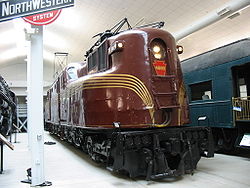
PRR R1
The Pennsylvania Railroad's class R1 comprised a single prototype electric locomotive constructed in 1934 by the Baldwin Locomotive Works of Philadelphia, Pennsylvania, USA, with the electrical equipment by Westinghouse....
and the GG1
PRR GG1
The PRR GG1 is a class of electric locomotives that was built for the Pennsylvania Railroad for use in the northeastern United States. A total of 140 GG1s were constructed by its designer General Electric and the Pennsylvania's Altoona Works from 1934 to 1943....
class. The R-1 had a rigid frame for its four driving axles, while the GG-1 had two frames which were articulated. Both of these prototypes, along with an O-1
PRR O1
The Pennsylvania Railroad's class O1 comprised eight experimental boxcab electric locomotivesbuilt in 1930 and 1931.They had the wheel arrangement classified as 4-4-4 in the Whyte notation . Although successful, they were not powerful enough for the railroad's increasingly heavy trains...
, a P5A
PRR P5
The Pennsylvania Railroad's class P5 comprised 92 mixed-traffic electric locomotives constructed 1931–1935 by the PRR, Westinghouse and General Electric....
and a K4s
PRR K4s
The Pennsylvania Railroad's K4s 4-6-2 "Pacific" was their premier passenger-hauling steam locomotive from 1914 through the end of steam on the PRR in 1957....
steam locomotive underwent exhaustive testing. Testing was conducted over a special section of test track near Claymont, Delaware
Claymont, Delaware
Claymont is a census-designated place in New Castle County, Delaware, United States. The population was 9,220 at the 2000 census.-History:...
and lasted for nearly two years.
As a result of these experiments, the GG1 type was chosen and the construction of 57 locomotives was authorized. The first GG1 was finished in April and by August 1935 all 57 were completed. These first GG1 engines were designated for passenger service, while most of the P5A type were made available for freight service. Some of the later-built GG1s were assigned to freight service as well. The total number of GG1s built was 139. They are rated at 4620 hp at speeds of 100 mph (160 km/h).
On August 26, 1999, The United States Postal Service
United States Postal Service
The United States Postal Service is an independent agency of the United States government responsible for providing postal service in the United States...
issued commemorative 33-cent All Aboard! 20th Century American Trains
All Aboard! 20th Century American Trains
In August 1999, the United States Postal Service issued a set of 33¢ postage stamps entitled All Aboard! 20th Century American Trains to "pay tribute to American industry and design, and specifically to the heritage of our railroads." Artist Ted Rose created five watercolor images depicting the...
stamps. These commemorative stamps featured five celebrated American passenger trains from the 1930s and 1940s. One of the five stamps features an image of a GG-1 locomotive pulling the "Congressional Limited Express." The official Pennsylvania State Electric Locomotive is the GG-1 #4859. It received this designation on December 18, 1987 and is currently on display in Harrisburg, Pennsylvania.
Diesel locomotives
In the mid 1940s, the PRR began to add diesel locomotives to their fleet. From 1945 through 1949 it purchased 74 E7EMD E7
The EMD E7 was a , A1A-A1A passenger train locomotive manufactured by General Motors' Electro-Motive Division of La Grange, Illinois. The cab version, or E7A, was manufactured from February, 1945 to April, 1949, and 428 were produced. The booster version, or E7B, was manufactured from March, 1945...
class locomotives from General Motors EMD (Electro-Motive Division). These units were given the classification EP20 by the PRR. Sixty of this number were designated "A" units, meaning that they had a cab for the train crew. The remaining 14 were designated "B" units; these were cabless booster units that were controlled by an "A" unit.
Another addition to the PRR diesel locomotive fleet was the Baldwin DR-12-8-1500/2
Baldwin DR-12-8-1500/2
The Baldwin DR-12-8-1500/2 was the Baldwin Locomotive Works' first serious attempt at a production road diesel locomotive. The Baldwin type designation was DR-12-8-1500/2 meaning Diesel Road locomotive, with 12 axles , and two engines of 1,500 horsepower each...
, referred to as the "Centipede." Twenty-four of these units were purchased, and PRR classified them as BP60. These units had reliability problems and were soon obsolete. They were relegated to helper service.
In 1948 the PRR purchased twenty-seven DR-6 locomotives from Baldwin Locomotive Works. These units were given the PRR classification BP20. Originally for the passenger service fleet, these locomotive proved troublesome, and some were reclassified as BF16z freight locomotives.
From 1950 to 1952, the PRR purchased another group of 74 locomotives from EMD. These were EMD's E8
EMD E8
The EMD E8 was a , A1A-A1A passenger train locomotive manufactured by General Motors' Electro-Motive Division of La Grange, Illinois. The cab version, or E8A, was manufactured from August, 1949 to December, 1953, and 449 were produced – 446 for U.S., and 3 for Canada...
locomotives (successor to the E7). All of this group were "A" units. The PRR gave these units the classification EP22s.
Major passenger stations
The PRR built several grand railroad passenger stations in major cities, either alone or in conjunction with other railroads. These architectural marvels served as the hubs for the PRR's extensive passenger service. Many of these stations are still in use today, served by AmtrakAmtrak
The National Railroad Passenger Corporation, doing business as Amtrak , is a government-owned corporation that was organized on May 1, 1971, to provide intercity passenger train service in the United States. "Amtrak" is a portmanteau of the words "America" and "track". It is headquartered at Union...
as well as regional passenger carriers. See also Pennsylvania Station
Pennsylvania Station
Pennsylvania Station is a label first applied by the Pennsylvania Railroad to several of its grand passenger terminals.-New York City:...
, the name given to many of them.
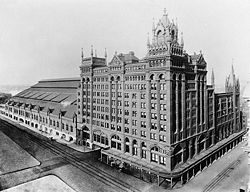
Broad Street Station was the first of the great passenger stations built by the PRR. Opened in 1881, the station was dramatically expanded in the early 1890s by famed Philadelphia architect Frank Furness
Frank Furness
Frank Heyling Furness was an acclaimed American architect of the Victorian era. He designed more than 600 buildings, most in the Philadelphia area, and is remembered for his eclectic, muscular, often idiosyncratically scaled buildings, and for his influence on the Chicago architect Louis Sullivan...
, and for most of its existence served with City Hall as arguably one of the crown jewels of Philadelphia's architecture, and for thirty years had the largest train shed in the world (a 91 m span). It was the terminal station for the PRR service into Philadelphia, bringing trains right into the center of the city. It was demolished in 1953 after the PRR moved all its hub service to 30th Street Station
30th Street Station
30th Street Station is the main railroad station in Philadelphia, Pennsylvania, and one of the five stations in SEPTA's Center City fare zone. It is also a major stop on Amtrak's Northeast and Keystone Corridors...
.
Penn Station - Baltimore, Maryland
The main train station of Baltimore, this Beaux-Arts building was built in 1911 from a design by architect Kenneth MacKenzie Murchison
Kenneth MacKenzie Murchison
Kenneth MacKenzie Murchison was a U.S. architect. He was born in New York City in 1872 and died in New York in 1938.Murchison graduated from Columbia University in 1894 and from the Ecole des Beaux-Arts in Paris, France, in 1900...
. It is served by Amtrak and MARC Train
MARC Train
MARC , known prior to 1984 as Maryland Rail Commuter Service, is a regional rail system comprising three lines in the Baltimore-Washington Metropolitan Area. MARC is administered by the Maryland Transit Administration , a Maryland Department of Transportation agency, and is operated under contract...
commuter service. Notably, both approaches to the station are via tunnels, the B&P Tunnel to the south and the Union Tunnel
Union Tunnel (Baltimore)
The Union Tunnel is a railroad tunnel on Amtrak's Northeast Corridor in Baltimore, Maryland that connects Pennsylvania Station to the Pennsylvania Railroad's original mainline to Philadelphia, Pennsylvania and points north....
to the north.
Union Station - Chicago, Illinois
The Pennsylvania Railroad, along with the Milwaukee Road and the Burlington Route, built Chicago's Union Station, the only one of Chicago's old stations to continue to be used as a train station (the rest of Chicago's six passenger stations have either been demolished, substantially remodeled or repurposed). It was designed by Graham, Anderson, Probst & White
Graham, Anderson, Probst & White
Graham, Anderson, Probst & White is a Chicago architecture firm that was founded in 1912 originally as Graham, Burnham & Co. This firm was the successor to D. H. Burnham & Co. by Daniel Burnham's surviving partner Ernest Graham and Burnham's sons Hubert Burnham and Daniel Burnham Jr...
in the Beaux-Arts style.
Penn Station - Newark, New Jersey
Newark's Pennsylvania Station was designed by McKim, Mead and White and is considered an architectural jewel. It opened in 1935 as part of the PRR's Northeast Corridor
Northeast Corridor
The Northeast Corridor is a fully electrified railway line owned primarily by Amtrak serving the Northeast megalopolis of the United States from Boston in the north, via New York to Washington, D.C. in the south, with branches serving other cities...
infrastructure, and was refurbished in 2007. Its style is a mixture of Art Deco
Art Deco
Art deco , or deco, is an eclectic artistic and design style that began in Paris in the 1920s and flourished internationally throughout the 1930s, into the World War II era. The style influenced all areas of design, including architecture and interior design, industrial design, fashion and...
and Neo-Classical
Neoclassicism
Neoclassicism is the name given to Western movements in the decorative and visual arts, literature, theatre, music, and architecture that draw inspiration from the "classical" art and culture of Ancient Greece or Ancient Rome...
. All Amtrak trains stop here, and the station serves three commuter lines, PATH
Port Authority Trans-Hudson
PATH, derived from Port Authority Trans-Hudson, is a rapid transit railroad linking Manhattan, New York City with Newark, Harrison, Hoboken and Jersey City in metropolitan northern New Jersey...
rapid transit to Jersey City and Manhattan, and the Newark City Subway.
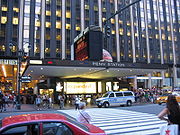
The original Pennsylvania Station was designed by the noted architectural firm of McKim, Mead and White and was modeled on the Roman Baths of Caracalla
Baths of Caracalla
The Baths of Caracalla in Rome, Italy were Roman public baths, or thermae, built in Rome between AD 212 and 216, during the reign of the Emperor Caracalla.- History :...
; it was notable for its enormous rail shed and the spectacular architecture of the high vaulted ceilings in the passenger terminal. It was infamous for being demolished for redevelopment in the railroad's waning years. The station was built in 1910 to provide direct access to Manhattan from New Jersey without having to use a ferry, and was served by the PRR's own trains as well as those of the PRR's subsidiary, the Long Island Rail Road
Long Island Rail Road
The Long Island Rail Road or LIRR is a commuter rail system serving the length of Long Island, New York. It is the busiest commuter railroad in North America, serving about 81.5 million passengers each year. Established in 1834 and having operated continuously since then, it is the oldest US...
. Its 1963 demolition did not extend to the platforms, the tracks, or even some of the staircases. The station continues as a completely underground operation (serving Amtrak, New Jersey Transit
New Jersey Transit
The New Jersey Transit Corporation is a statewide public transportation system serving the United States state of New Jersey, and New York, Orange, and Rockland counties in New York State...
and LIRR) and is the busiest intercity railroad station in the United States.
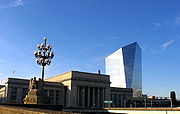
In classical grandeur, the 30th Street Station displays its majestic—and traditional—architectural style with its enormous waiting room and its vestibules. The station, in spite of its apparent architectural classicism, opened in 1933, when modern and Art Deco styles were more popular. Its construction was needed to accommodate increased intercity and suburban traffic. It replaced the 32nd Street Station geographically, and replaced the Broad Street Station functionally. It is now the primary rail station in Philadelphia, serving both long-distance and commuter trains.
Union Station - Washington, D.C.
Union Station, built jointly with the B&O, served as a hub for PRR passenger services in the nation's capital, with connections to the B&O, and Southern Railway (US). The station was designed by architect Daniel Burnham
Daniel Burnham
Daniel Hudson Burnham, FAIA was an American architect and urban planner. He was the Director of Works for the World's Columbian Exposition in Chicago. He took a leading role in the creation of master plans for the development of a number of cities, including Chicago and downtown Washington DC...
and opened in 1908. The Richmond, Fredericksburg and Potomac Railroad
Richmond, Fredericksburg and Potomac Railroad
The Richmond, Fredericksburg, and Potomac Railroad was a railroad connecting Richmond, Virginia, to Washington, D.C. It is now a portion of the CSX Transportation system....
provided a link to Richmond, Virginia
Richmond, Virginia
Richmond is the capital of the Commonwealth of Virginia, in the United States. It is an independent city and not part of any county. Richmond is the center of the Richmond Metropolitan Statistical Area and the Greater Richmond area...
, about 100 miles (160.9 km) to the south, where major north–south lines of the Atlantic Coast Line Railroad
Atlantic Coast Line Railroad
The Atlantic Coast Line Railroad was an American railroad that existed between 1900 and 1967, when it merged with the Seaboard Air Line Railroad, its long-time rival, to form the Seaboard Coast Line Railroad...
and Seaboard Air Line Railroad
Seaboard Air Line Railroad
The Seaboard Air Line Railroad , which styled itself "The Route of Courteous Service," was an American railroad whose corporate existence extended from April 14, 1900, until July 1, 1967, when it merged with the Atlantic Coast Line Railroad, its longtime rival, to form the Seaboard Coast Line...
provided service to the Carolinas, Georgia, and Florida.
Corporate officers
Presidents of the Pennsylvania Railroad:- Samuel V. MerrickSamuel Vaughn MerrickSamuel Vaughan Merrick was a 19th-century American manufacturer.Born in Hallowell, Maine, Merrick left school 1816 and moved to Philadelphia...
(1847–1849) - William C. Patterson (1849–1852)
- J. Edgar Thomson (1852–1874)
- Thomas A. Scott (1874–1880)
- George Brooke RobertsGeorge Brooke RobertsGeorge Brooke Roberts was a civil engineer and the 5th president of the Pennsylvania Railroad ....
(1880–1896) - Frank ThomsonFrank ThomsonFrank Thomson was a railroad executive from the United States, and the sixth president of the Pennsylvania Railroad .-Life:Frank Thomson was born in Chambersburg, Pennsylvania in 1841. At age 17, Thomson became an apprentice in the PRR machine shops in Altoona, and studied mechanical engineering...
(1897–1899) - Alexander J. Cassatt (1899–1906)
- James McCreaJames McCreaJames McCrea was the 8th president of the Pennsylvania Railroad . He completed the construction of Pennsylvania Station in 1910, bringing the PRR lines under the Hudson River and, for the first time, into New York City....
(1907–1912) - Samuel ReaSamuel ReaSamuel Rea was an American engineer and the 9th president of the Pennsylvania Railroad . He was awarded the Franklin Medal in 1926.-Early life and career:...
(1913–1925) - William W. AtterburyWilliam W. AtterburyWilliam Wallace Atterbury was a Brigadier General during World War I. He was instrumental in reorganizing railroad traffic during the war for more efficient transportation of troops and supplies for the American Expeditionary Forces. After the war, he became the 10th president of the...
(1925–1935) - Martin W. ClementMartin W. ClementMartin W. Clement was the 11th president of the Pennsylvania Railroad .He attended Trinity College in Hartford, Connecticut, ....
(1935–1948) - Walter S. FranklinWalter S. Franklin (PRR)Walter Sidmonds Franklin, Jr. was the 12th president of the Pennsylvania Railroad ....
(1948–1954) - James M. Symes (1954–1960)
- Allen J. Greenough (1960–1968)
Chief Executive Officers of the Pennsylvania Railroad:
- James M. Symes (1960–1963)
- Stuart T. SaundersStuart T. SaundersStuart Thomas Saunders was an American railroad executive.Saunders served as president of the Norfolk and Western Railway, one of the nation's most profitable, from 1958 to 1963...
(1963–1968)
The controlling non-institutional shareholders of the Pennsylvania Railroad were, during the early 1960s, Henry Stryker Taylor, who was a part of the Jacob Bunn business dynasty of Illinois
Illinois
Illinois is the fifth-most populous state of the United States of America, and is often noted for being a microcosm of the entire country. With Chicago in the northeast, small industrial cities and great agricultural productivity in central and northern Illinois, and natural resources like coal,...
, and Howard Butcher, a principal in the Philadelphia brokerage house of Butcher & Singer (formerly Butcher & Sherrerd).
See also
- Conrail - successor to Penn Central from 1976
- Horseshoe Curve (Altoona, Pennsylvania)
- List of Pennsylvania Railroad lines east of Pittsburgh
- List of Pennsylvania Railroad lines west of Pittsburgh
- List of Pennsylvania Railroad passenger trains
- List of Pennsylvania Railroad predecessor railroads
- PRR locomotive classificationPRR locomotive classificationLocomotive classification on the Pennsylvania Railroad took several forms. Early on, steam locomotives were given single-letter classes. As the 26 letters were quickly assigned, that scheme was abandoned for a more complex system...
- New York Central RailroadNew York Central RailroadThe New York Central Railroad , known simply as the New York Central in its publicity, was a railroad operating in the Northeastern United States...
— longtime adversary, eventual merger partner - New York, New Haven and Hartford RailroadNew York, New Haven and Hartford RailroadThe New York, New Haven and Hartford Railroad , was a railroad that operated in the northeast United States from 1872 to 1968 which served the states of Connecticut, New York, Rhode Island, and Massachusetts...
— longtime partner in run-through trains, also became part of Penn Central - Norfolk Southern RailwayNorfolk Southern RailwayThe Norfolk Southern Railway is a Class I railroad in the United States, owned by the Norfolk Southern Corporation. With headquarters in Norfolk, Virginia, the company operates 21,500 route miles in 22 eastern states, the District of Columbia and the province of Ontario, Canada...
— successor to Conrail in former PRR territory - Penn Central TransportationPenn Central TransportationThe Penn Central Transportation Company, commonly abbreviated to Penn Central, was an American railroad company that operated from 1968 until 1976. It was created by the merger on February 1, 1968, of the Pennsylvania Railroad and the New York Central Railroad...
— successor to the PRR and NYC in 1968 - Pennsylvania CompanyPennsylvania CompanyThe Pennsylvania Company was a major holding company, owning and operating much of the Lines West territory of the Pennsylvania Railroad, including the Pittsburgh, Fort Wayne and Chicago Railway, the PRR's main route to Chicago. It also owned but did not operate the Pittsburgh, Cincinnati, Chicago...
, holding companyHolding companyA holding company is a company or firm that owns other companies' outstanding stock. It usually refers to a company which does not produce goods or services itself; rather, its purpose is to own shares of other companies. Holding companies allow the reduction of risk for the owners and can allow...
incorporated in 1870 to own and operate much of the Lines West of Pittsburgh - Pennsylvania Lines LLCPennsylvania Lines LLCPennsylvania Lines LLC was a limited liability company that owned railroad lines in the United States that are owned and operated by the Norfolk Southern Railway. The company was formed in 1998 to own Conrail lines assigned to Norfolk Southern in the split of Conrail between Norfolk Southern and...
- Conrail subsidiary that owned ex-PRR trackage and PRR reporting mark - Pennsylvania StationPennsylvania StationPennsylvania Station is a label first applied by the Pennsylvania Railroad to several of its grand passenger terminals.-New York City:...
, the name for several major stations - Monopoly (game)Monopoly (game)Marvin Gardens, the leading yellow property on the board shown, is actually a misspelling of the original location name, Marven Gardens. The misspelling was said to be introduced by Charles Todd and passed on when his home-made Monopoly board was copied by Charles Darrow and thence to Parker...
- One of the railroads in the Atlantic City themed version of the game is the PRR.
External links
- Pennsylvania Railroad Technical and Historical Society
- Railroad Museum of Pennsylvania Strasburg, Pennsylvania
- PRR Chronology — in depth
- PRR Corporate History
- PennsyRR.com — comprehensive PRR facts and history site, comprising multiple individual websites.
- prr.railfan.net — contains a lot of PRR information, including diagrams of passenger and freight cars as well as locomotives
- The New York tunnel extension of the Pennsylvania Railroad Transactions of the American Society of Civil Engineers, vol. LXVIII, Sept. 1910, by B.F. Cresson, Jr, from Project GutenbergProject GutenbergProject Gutenberg is a volunteer effort to digitize and archive cultural works, to "encourage the creation and distribution of eBooks". Founded in 1971 by Michael S. Hart, it is the oldest digital library. Most of the items in its collection are the full texts of public domain books...
- Orr, John W. Set Up Running: The Life of a Pennsylvania Railroad Engineman, 1904–1949, Penn State Press, 2001 ISBN 0-271-02056-3
- Pennsylvania Railroad GG-1 p. 1 of 2: Stan's Railpix
- 1/16/1904;Sectional view Of Pennsylvania Railroad Tunnel Now Under Construction Beneath the Hudson River
- William G. Thomas "The Countryside Transformed:The Eastern Shore of Virginia, the Pennsylvania Railroad, and the Creation of a Modern Landscape Southern Spaces July 31, 2007.