

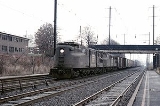
PRR GG1

Encyclopedia
The PRR GG1 is a class of electric locomotive
s that was built for the Pennsylvania Railroad
for use in the northeastern United States
. A total of 140 GG1s were constructed by its designer General Electric
and the Pennsylvania's Altoona Works
from 1934 to 1943.
Initially introduced into service by the Pennsylvania in 1935, the GG1 was operated by its successor companies — Penn Central, Conrail
and Amtrak
. The last GG1 was retired from service by New Jersey Transit
in 1983. Most of the GG1s were scrapped, but several were preserved by various museums around the United States.
of the locomotive was formed from two bridge-like truss
es joined together with ball and socket joint
s. The body rested on the frame and was clad in welded
steel plates. The two cabs are in the middle of the locomotive, situated for greater crew safety in the event of a collision. A pantograph
mounted on each end of the locomotive body was used to collect the 25 Hz
, 11,000 V
alternating current
(AC) from the overhead lines
. Transformer
s located between the two cabs stepped down the 11,000 V to the voltages needed for the traction motor
s and other electrical equipment on the engine.
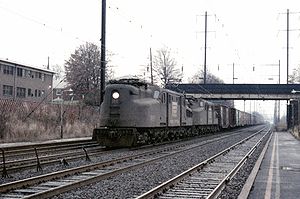 Twelve 385 hp GEA-627-A1 traction motors drove the GG1's six 57 inches (144.8 cm) diameter driving wheel
s on three axles using a quill drive
. Four unpowered leading
/trailing
wheels were mounted on each end of the locomotive. Using Whyte notation
for steam locomotive
s, each frame is a 4-6-0
locomotive, which in the Pennsylvania Railroad classification system
is a "G". The GG1 is composed of two such frames mounted back to back, 4-6-0+0-6-4. The AAR wheel arrangement
is 2-C+C-2 meaning two sets of three powered axles that are hinged together, with two unpowered axles on either side.
. In 1933, the Pennsylvania decided the replace its P5a locomotives and instructed both General Electric and Westinghouse
to design a prototype locomotive with the following specifications: a lighter axle load
and more power than the P5a, be capable of at least 100 miles per hour (160.9 km/h), a streamlined body design and a central cab.
Both companies delivered their prototypes to the Pennsylvania in August 1934. General Electric submitted the GG1 and Westinghouse submitted the R1
. The R1 was essentially "little more than an elongated and more powerful version of the P5a" with an AAR wheel arrangement of 2-D-2. Both locomotives were tested for ten weeks in regular service between New York and Philadelphia and on a test track in Claymont, Delaware
. Because the R1's rigid wheelbase prevented it from negotiating sharp curves and some railroad switch
es, the Pennsylvania chose the GG1 and ordered 57 additional locomotives on November 10, 1934. Of the 57, 14 were to be built entirely by General Electric
in Erie
and 18 at the Altoona Works
. The remaining locomotives were to be assembled in Altoona with electrical components from Westinghouse
in East Pittsburgh
and chassis
from the Baldwin Locomotive Works
in Eddystone
.
On January 28, 1935, to mark the completion of the electric line from Washington, D.C to New York City
, the Pennsylvania ran a special train pulled by PRR 4800
before it opened the line for revenue service on February 10. It made a round trip from D.C. to Philadelphia and, on its return trip, set a speed record by arriving back in D.C. 1 hour and 50 minutes after its departure from Philadelphia.
A Pennsylvania GG-1 was used to pull the funeral train of President
Franklin D. Roosevelt
from Washington D.C.'s Union Station
to New York City's Pennsylvania Station
in 1945.
Styling of the prototype body shell is attributed to Westinghouse industrial designer Donald Roscoe Dohner. Subsequently the Pennsylvania hired Raymond Loewy
to "enhance the GG1's aesthetics". Loewy recommended the use of a smooth, welded body instead of rivet
ed one used in the prototype. Loewy also added five gold pinstripe
s and a Brunswick green paint scheme. The paint scheme was changed to Tuscan red
in 1952 and the pinstripes were simplified to single stripe and large red keystone
s were added in 1955.
Timetable speed limit for the GG1 was 80 mph until 1967-68 when it was raised to 100 mph for a year or two; when the Metroliner cars were being overhauled in the late 1970s GG1s were again allowed 100 mph when pulling Amfleet cars on trains scheduled to run 224.6 miles from New York to Washington in 3 hrs 20-25 minutes.
headed up Train 173, the Federal
, from Boston
, Massachusetts
to Washington, D.C. The train passed a signal
2.1 miles (3.4 km) north of Union Station
traveling between 60 and 70 mph (96.6 and 112.7 km/h) and the engineer decreased the throttle and started applying the brakes in preparation for entering the station. When the engineer realized that the train was not slowing down, and applying the emergency brake
had no effect, he proceeded to sound the engine's horn. A signalman
, on hearing the horn and noting the excessive speed of the 4876, phoned ahead to the station master
's office. 4876 negotiated several switches
without derailing, at speeds well over the safe speed limits and entered the station at around 35 to 40 mph (15.6 to 17.9 ). The train rammed the buffer stop
s, continued through the station master's office and into the concourse
. The weight of 4876 caused it to fall through the floor and into the station's basement. A temporary floor was erected over the engine, and the hole it created, for the inauguration of President
Dwight D. Eisenhower
. 4876 was eventually dismantled and removed from the basement. It was reassembled in Altoona, before being put back into service.
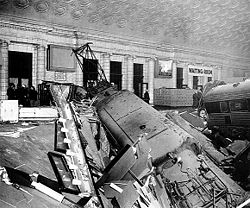 The accident was determined to have been caused by an "angle cock", a valve on the front and rear of a locomotive and rail cars used in the train's airbraking system, on the rear of the third car in the train that had inadvertently closed. The handle of the angle cock had been improperly placed and had come into contact with the bottom of the car. Once it was closed, the brakes on all the cars behind the closed valve would not have been able to be applied.
The only major breakdown
of the GG1 was caused by a blizzard which swept across the northeastern United States in February 1958. The storm put nearly half of the GG1s out of commission. Exceptionally fine snow, caused by the extreme low temperatures, was able to pass through the locomotives' air filters and into the electrical components. The snow then melted and short circuit
ed the components.
in 1968, its fleet of GG1s was acquired by Penn Central. After its creation in 1971, Amtrak
also inherited several GG1s. Amtrak intended to replace the GG1s in 1975 when it introduced the General Electric E60
. As the E60 never received clearance for speeds over 85 miles per hour (136.8 km/h), Amtrak imported a small, lightweight engine from Sweden
that became nicknamed the "Swedish swifty". Electro-Motive Diesel, then a part of General Motors
, was licensed to build it in the United States and the "Swedish swifty" became the base of the AEM-7
. With the AEM-7s on hand Amtrak was finally able to replace its GG1s. Penn Central went bankrupt in 1970 and its freight operations were assumed by the government-controlled Conrail. The last remaining GG1s in use were assigned to New Jersey Transit for its North Jersey Coast Line
between New York and South Amboy
and were, eventually, retired on October 29, 1983.
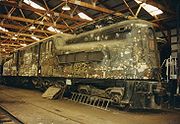
Of the 140 total GG1s built, 15 production locomotives and the prototype were preserved in museums:
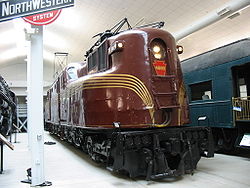
became popular, especially with locomotives, as it conveyed a sense of speed. While other railroads were introducing streamlined trains, like the Union Pacific
's M-10000
or the Chicago, Burlington and Quincy Railroad
with the Zephyr
, the Pennsylvania had the GG1. The GG1 has "shown up over the years in more advertisements and movie clips than any other locomotive." It was also featured in art calendars provided by the Pennsylvania, which were used to "promote its reputation in the public eye." It has appeared in the films The Clock
in 1945, Blast of Silence in 1961, the 1962 version of The Manchurian Candidate
, and Avalon
in 1990 in the livery
of the Pennsylvania. Two GG1s appear in the 1973 film The Seven-Ups
—a black Penn Central locomotive and a silver, red and blue Amtrak locomotive. A Penn Central GG1 also appears in another 1973 film The Last Detail
. PRR GG1 4821 appears briefly in the 1952 film The Greatest Show on Earth
, pulling the Ringling Bros. and Barnum & Bailey Circus Train into Philadelphia's Greenwich Yard, with the movie's director Cecil B. DeMille narrating the scene of their arrival. Two Penn Central GG1s train pulled Robert F. Kennedy
's funeral train
on June 8, 1968.
The GG1 and the Congressional were featured on a postage stamp
as part of the United States Postal Service
's All Aboard! 20th Century American Trains
set in 1999.
Electric locomotive
An electric locomotive is a locomotive powered by electricity from overhead lines, a third rail or an on-board energy storage device...
s that was built for the Pennsylvania Railroad
Pennsylvania Railroad
The Pennsylvania Railroad was an American Class I railroad, founded in 1846. Commonly referred to as the "Pennsy", the PRR was headquartered in Philadelphia, Pennsylvania....
for use in the northeastern United States
Northeastern United States
The Northeastern United States is a region of the United States as defined by the United States Census Bureau.-Composition:The region comprises nine states: the New England states of Connecticut, Maine, Massachusetts, New Hampshire, Rhode Island and Vermont; and the Mid-Atlantic states of New...
. A total of 140 GG1s were constructed by its designer General Electric
General Electric
General Electric Company , or GE, is an American multinational conglomerate corporation incorporated in Schenectady, New York and headquartered in Fairfield, Connecticut, United States...
and the Pennsylvania's Altoona Works
Altoona Works
Altoona Works is a large railroad industrial complex in Altoona, Pennsylvania. It was built by the Pennsylvania Railroad to supply the railroad with locomotives, railroad cars and related equipment. For many years it was the largest railroad shop complex in the world.-History:In 1849, PRR...
from 1934 to 1943.
Initially introduced into service by the Pennsylvania in 1935, the GG1 was operated by its successor companies — Penn Central, Conrail
Consolidated Rail Corporation
The Consolidated Rail Corporation, commonly known as Conrail , was the primary Class I railroad in the Northeast U.S. between 1976 and 1999. The federal government created it to take over the potentially profitable lines of bankrupt carriers, including the Penn Central Transportation Company and...
and Amtrak
Amtrak
The National Railroad Passenger Corporation, doing business as Amtrak , is a government-owned corporation that was organized on May 1, 1971, to provide intercity passenger train service in the United States. "Amtrak" is a portmanteau of the words "America" and "track". It is headquartered at Union...
. The last GG1 was retired from service by New Jersey Transit
New Jersey Transit
The New Jersey Transit Corporation is a statewide public transportation system serving the United States state of New Jersey, and New York, Orange, and Rockland counties in New York State...
in 1983. Most of the GG1s were scrapped, but several were preserved by various museums around the United States.
Technical information
A GG1-class locomotive is 79 in 6 in (24.23 m) long and weighs 475000 pounds (215,456.4 kg). The frameLocomotive frame
A locomotive frame is the structure that forms the backbone of the railway locomotive, giving it strength and supporting the superstructure elements such as a cab, boiler or bodywork. The vast majority of locomotives have had a frame structure of some kind...
of the locomotive was formed from two bridge-like truss
Truss
In architecture and structural engineering, a truss is a structure comprising one or more triangular units constructed with straight members whose ends are connected at joints referred to as nodes. External forces and reactions to those forces are considered to act only at the nodes and result in...
es joined together with ball and socket joint
Ball and socket joint
A ball and socket joint is a joint in which the distal bone is capable of motion around an indefinite number of axes, which have one common center...
s. The body rested on the frame and was clad in welded
Welding
Welding is a fabrication or sculptural process that joins materials, usually metals or thermoplastics, by causing coalescence. This is often done by melting the workpieces and adding a filler material to form a pool of molten material that cools to become a strong joint, with pressure sometimes...
steel plates. The two cabs are in the middle of the locomotive, situated for greater crew safety in the event of a collision. A pantograph
Pantograph (rail)
A pantograph for rail lines is a hinged electric-rod device that collects electric current from overhead lines for electric trains or trams. The pantograph typically connects to a one-wire line, with the track acting as the ground wire...
mounted on each end of the locomotive body was used to collect the 25 Hz
Hertz
The hertz is the SI unit of frequency defined as the number of cycles per second of a periodic phenomenon. One of its most common uses is the description of the sine wave, particularly those used in radio and audio applications....
, 11,000 V
Volt
The volt is the SI derived unit for electric potential, electric potential difference, and electromotive force. The volt is named in honor of the Italian physicist Alessandro Volta , who invented the voltaic pile, possibly the first chemical battery.- Definition :A single volt is defined as the...
alternating current
Alternating current
In alternating current the movement of electric charge periodically reverses direction. In direct current , the flow of electric charge is only in one direction....
(AC) from the overhead lines
Overhead lines
Overhead lines or overhead wires are used to transmit electrical energy to trams, trolleybuses or trains at a distance from the energy supply point...
. Transformer
Transformer
A transformer is a device that transfers electrical energy from one circuit to another through inductively coupled conductors—the transformer's coils. A varying current in the first or primary winding creates a varying magnetic flux in the transformer's core and thus a varying magnetic field...
s located between the two cabs stepped down the 11,000 V to the voltages needed for the traction motor
Traction motor
Traction motor refers to an electric motor providing the primary rotational torque of a machine, usually for conversion into linear motion ....
s and other electrical equipment on the engine.
Driving wheel
On a steam locomotive, a driving wheel is a powered wheel which is driven by the locomotive's pistons...
s on three axles using a quill drive
Quill drive
A quill drive is a mechanism that allows a drive shaft to shift its position relative to its driving shaft. It consists of a hollow driving shaft with a driven shaft inside it...
. Four unpowered leading
Leading wheel
The leading wheel or leading axle of a steam locomotive is an unpowered wheel or axle located in front of the driving wheels. The axle or axles of the leading wheels are normally located in a truck...
/trailing
Trailing wheel
On a steam locomotive, a trailing wheel or trailing axle is generally an unpowered wheel or axle located behind the driving wheels. The axle of the trailing wheels was usually located on a trailing truck...
wheels were mounted on each end of the locomotive. Using Whyte notation
Whyte notation
The Whyte notation for classifying steam locomotives by wheel arrangement was devised by Frederick Methvan Whyte and came into use in the early twentieth century encouraged by an editorial in American Engineer and Railroad Journal...
for steam locomotive
Steam locomotive
A steam locomotive is a railway locomotive that produces its power through a steam engine. These locomotives are fueled by burning some combustible material, usually coal, wood or oil, to produce steam in a boiler, which drives the steam engine...
s, each frame is a 4-6-0
4-6-0
Under the Whyte notation for the classification of steam locomotives, 4-6-0 represents the wheel arrangement of four leading wheels on two axles in a leading truck, six powered and coupled driving wheels on three axles, and no trailing wheels. This wheel arrangement became the second-most popular...
locomotive, which in the Pennsylvania Railroad classification system
PRR locomotive classification
Locomotive classification on the Pennsylvania Railroad took several forms. Early on, steam locomotives were given single-letter classes. As the 26 letters were quickly assigned, that scheme was abandoned for a more complex system...
is a "G". The GG1 is composed of two such frames mounted back to back, 4-6-0+0-6-4. The AAR wheel arrangement
AAR wheel arrangement
The AAR wheel arrangement system is a method of classifying locomotive wheel arrangements that was developed by the Association of American Railroads. It is essentially a simplification of the European UIC classification, and it is widely used in North America to describe diesel and electric...
is 2-C+C-2 meaning two sets of three powered axles that are hinged together, with two unpowered axles on either side.
History
The mechanical design of the GG1 was based largely on the New Haven EP3, which had been borrowed earlier from the New Haven Railroad by the Pennsylvania to compare it to its current standard electric locomotive, the P5aPRR P5
The Pennsylvania Railroad's class P5 comprised 92 mixed-traffic electric locomotives constructed 1931–1935 by the PRR, Westinghouse and General Electric....
. In 1933, the Pennsylvania decided the replace its P5a locomotives and instructed both General Electric and Westinghouse
Westinghouse Electric (1886)
Westinghouse Electric was an American manufacturing company. It was founded in 1886 as Westinghouse Electric Company and later renamed Westinghouse Electric Corporation by George Westinghouse. The company purchased CBS in 1995 and became CBS Corporation in 1997...
to design a prototype locomotive with the following specifications: a lighter axle load
Axle load
The axle load of a wheeled vehicle is the total weight felt by the roadway for all wheels connected to a given axle. Viewed another way, it is the fraction of total vehicle weight resting on a given axle...
and more power than the P5a, be capable of at least 100 miles per hour (160.9 km/h), a streamlined body design and a central cab.
Both companies delivered their prototypes to the Pennsylvania in August 1934. General Electric submitted the GG1 and Westinghouse submitted the R1
PRR R1
The Pennsylvania Railroad's class R1 comprised a single prototype electric locomotive constructed in 1934 by the Baldwin Locomotive Works of Philadelphia, Pennsylvania, USA, with the electrical equipment by Westinghouse....
. The R1 was essentially "little more than an elongated and more powerful version of the P5a" with an AAR wheel arrangement of 2-D-2. Both locomotives were tested for ten weeks in regular service between New York and Philadelphia and on a test track in Claymont, Delaware
Claymont, Delaware
Claymont is a census-designated place in New Castle County, Delaware, United States. The population was 9,220 at the 2000 census.-History:...
. Because the R1's rigid wheelbase prevented it from negotiating sharp curves and some railroad switch
Railroad switch
A railroad switch, turnout or [set of] points is a mechanical installation enabling railway trains to be guided from one track to another at a railway junction....
es, the Pennsylvania chose the GG1 and ordered 57 additional locomotives on November 10, 1934. Of the 57, 14 were to be built entirely by General Electric
General Electric
General Electric Company , or GE, is an American multinational conglomerate corporation incorporated in Schenectady, New York and headquartered in Fairfield, Connecticut, United States...
in Erie
Erie, Pennsylvania
Erie is a city located in northwestern Pennsylvania in the United States. Named for the lake and the Native American tribe that resided along its southern shore, Erie is the state's fourth-largest city , with a population of 102,000...
and 18 at the Altoona Works
Altoona Works
Altoona Works is a large railroad industrial complex in Altoona, Pennsylvania. It was built by the Pennsylvania Railroad to supply the railroad with locomotives, railroad cars and related equipment. For many years it was the largest railroad shop complex in the world.-History:In 1849, PRR...
. The remaining locomotives were to be assembled in Altoona with electrical components from Westinghouse
Westinghouse Electric (1886)
Westinghouse Electric was an American manufacturing company. It was founded in 1886 as Westinghouse Electric Company and later renamed Westinghouse Electric Corporation by George Westinghouse. The company purchased CBS in 1995 and became CBS Corporation in 1997...
in East Pittsburgh
East Pittsburgh, Pennsylvania
East Pittsburgh is a borough in Allegheny County, Pennsylvania, about southeast of the confluence of the Monongahela and the Allegheny rivers at Pittsburgh. The population in 1900 stood at 2,883, and in 1910, at 5,615. As of the 2010 census, the borough population was 1,822, having fallen from...
and chassis
Chassis
A chassis consists of an internal framework that supports a man-made object. It is analogous to an animal's skeleton. An example of a chassis is the underpart of a motor vehicle, consisting of the frame with the wheels and machinery.- Vehicles :In the case of vehicles, the term chassis means the...
from the Baldwin Locomotive Works
Baldwin Locomotive Works
The Baldwin Locomotive Works was an American builder of railroad locomotives. It was located in Philadelphia, Pennsylvania, originally, and later in nearby Eddystone, Pennsylvania. Although the company was very successful as a producer of steam locomotives, its transition to the production of...
in Eddystone
Eddystone, Pennsylvania
Eddystone is a borough in Delaware County, Pennsylvania, United States. The population was 2,442 at the 2000 census.-Early history:The area at the mouth of Ridley Creek was first called "Tequirassy" by Native Americans. The land was owned by Olof Persson Stille, one of the early settlers from New...
.
On January 28, 1935, to mark the completion of the electric line from Washington, D.C to New York City
New York City
New York is the most populous city in the United States and the center of the New York Metropolitan Area, one of the most populous metropolitan areas in the world. New York exerts a significant impact upon global commerce, finance, media, art, fashion, research, technology, education, and...
, the Pennsylvania ran a special train pulled by PRR 4800
PRR 4800
PRR 4800, nicknamed "Old Rivets", is a GG1-class electric locomotive located at the Railroad Museum of Pennsylvania, outside of Strasburg, Pennsylvania in the United States. It is the prototype GG1 and was originally numbered 4899. Built by General Electric in 1934, the locomotive competed against...
before it opened the line for revenue service on February 10. It made a round trip from D.C. to Philadelphia and, on its return trip, set a speed record by arriving back in D.C. 1 hour and 50 minutes after its departure from Philadelphia.
A Pennsylvania GG-1 was used to pull the funeral train of President
President of the United States
The President of the United States of America is the head of state and head of government of the United States. The president leads the executive branch of the federal government and is the commander-in-chief of the United States Armed Forces....
Franklin D. Roosevelt
Franklin D. Roosevelt
Franklin Delano Roosevelt , also known by his initials, FDR, was the 32nd President of the United States and a central figure in world events during the mid-20th century, leading the United States during a time of worldwide economic crisis and world war...
from Washington D.C.'s Union Station
Union Station (Washington, D.C.)
Washington Union Station is a train station and leisure destination visited by 32 million people each year in the center of Washington, D.C. The train station is served by Amtrak, MARC and Virginia Railway Express commuter rail services as well as by Washington Metro subway trains and local buses...
to New York City's Pennsylvania Station
Pennsylvania Station (New York City)
Pennsylvania Station—commonly known as Penn Station—is the major intercity train station and a major commuter rail hub in New York City. It is one of the busiest rail stations in the world, and a hub for inbound and outbound railroad traffic in New York City. The New York City Subway system also...
in 1945.
Styling of the prototype body shell is attributed to Westinghouse industrial designer Donald Roscoe Dohner. Subsequently the Pennsylvania hired Raymond Loewy
Raymond Loewy
Raymond Loewy was an industrial designer, and the first to be featured on the cover of Time Magazine, on October 31, 1949. Born in France, he spent most of his professional career in the United States...
to "enhance the GG1's aesthetics". Loewy recommended the use of a smooth, welded body instead of rivet
Rivet
A rivet is a permanent mechanical fastener. Before being installed a rivet consists of a smooth cylindrical shaft with a head on one end. The end opposite the head is called the buck-tail. On installation the rivet is placed in a punched or pre-drilled hole, and the tail is upset, or bucked A rivet...
ed one used in the prototype. Loewy also added five gold pinstripe
Pin striping
Pin striping is the application of a very thin line of paint or other material called a pin stripe, and is generally used for decoration. Freehand pin stripers use a specialty brush known as a pinstriping brush...
s and a Brunswick green paint scheme. The paint scheme was changed to Tuscan red
Tuscan Red
Tuscan red is a shade of red that was used on the passenger cars of the Pennsylvania Railroad, as well as on the PRR TrucTrailers. It also was used extensively by the New South Wales Government Railways in Australia, in a similar fashion to the PRR. The Canadian Pacific Railway used it historically...
in 1952 and the pinstripes were simplified to single stripe and large red keystone
Keystone (architecture)
A keystone is the wedge-shaped stone piece at the apex of a masonry vault or arch, which is the final piece placed during construction and locks all the stones into position, allowing the arch to bear weight. This makes a keystone very important structurally...
s were added in 1955.
Timetable speed limit for the GG1 was 80 mph until 1967-68 when it was raised to 100 mph for a year or two; when the Metroliner cars were being overhauled in the late 1970s GG1s were again allowed 100 mph when pulling Amfleet cars on trains scheduled to run 224.6 miles from New York to Washington in 3 hrs 20-25 minutes.
Incidents
On January 15, 1953, PRR 4876PRR 4876
PRR 4876 is a GG1-class electric locomotive located at the B&O Railroad Museum in Baltimore, Maryland, United States. It was built in 1939 and was involved in the only accident to befall a GG1. In 1953, the locomotive overran the buffer stop and crashed into Union Station in Washington, D.C. after...
headed up Train 173, the Federal
Federal Express (passenger train)
The Federal Express was an overnight named passenger train run by the Pennsylvania Railroad and the New York, New Haven and Hartford Railroad between Washington, DC's Union Station and Boston, Massachusetts's South Station from 1912 to 1971. Train numbers on both railroads were 172 northbound and...
, from Boston
Boston
Boston is the capital of and largest city in Massachusetts, and is one of the oldest cities in the United States. The largest city in New England, Boston is regarded as the unofficial "Capital of New England" for its economic and cultural impact on the entire New England region. The city proper had...
, Massachusetts
Massachusetts
The Commonwealth of Massachusetts is a state in the New England region of the northeastern United States of America. It is bordered by Rhode Island and Connecticut to the south, New York to the west, and Vermont and New Hampshire to the north; at its east lies the Atlantic Ocean. As of the 2010...
to Washington, D.C. The train passed a signal
Railway signal
A signal is a mechanical or electrical device erected beside a railway line to pass information relating to the state of the line ahead to train/engine drivers. The driver interprets the signal's indication and acts accordingly...
2.1 miles (3.4 km) north of Union Station
Union Station (Washington, D.C.)
Washington Union Station is a train station and leisure destination visited by 32 million people each year in the center of Washington, D.C. The train station is served by Amtrak, MARC and Virginia Railway Express commuter rail services as well as by Washington Metro subway trains and local buses...
traveling between 60 and 70 mph (96.6 and 112.7 km/h) and the engineer decreased the throttle and started applying the brakes in preparation for entering the station. When the engineer realized that the train was not slowing down, and applying the emergency brake
Emergency brake (train)
On trains, the expression emergency brake has several meanings:* The maximum brake force available to the driver/engineer from his conventional braking system, usually operated by taking the brake handle to its furthest postion, through a gate mechanism, or by pushing a separate plunger in the cab*...
had no effect, he proceeded to sound the engine's horn. A signalman
Signalman (rail)
A signalman or signaller is an employee of a railway transport network who operates the points and signals from a signal box in order to control the movement of trains.- History :...
, on hearing the horn and noting the excessive speed of the 4876, phoned ahead to the station master
Station master
The station master was the person in charge of railway stations, in the United Kingdom and some other countries, before the modern age. He would manage the other station employees and would have responsibility for safety and the efficient running of the station...
's office. 4876 negotiated several switches
Railroad switch
A railroad switch, turnout or [set of] points is a mechanical installation enabling railway trains to be guided from one track to another at a railway junction....
without derailing, at speeds well over the safe speed limits and entered the station at around 35 to 40 mph (15.6 to 17.9 ). The train rammed the buffer stop
Buffer stop
A buffer stop or bumper is a device to prevent railway vehicles from going past the end of a physical section of track.The design of the buffer stop is dependent in part upon the kind of couplings that the railway uses, since the coupling gear is the first part of the vehicle that the buffer stop...
s, continued through the station master's office and into the concourse
Concourse
A concourse is a place where pathways or roads meet, such as in a hotel, a convention center, a railway station, an airport terminal, a hall, or other space.-Examples:Examples of concourses include:* Meeting halls* Universities* Railway stations...
. The weight of 4876 caused it to fall through the floor and into the station's basement. A temporary floor was erected over the engine, and the hole it created, for the inauguration of President
President of the United States
The President of the United States of America is the head of state and head of government of the United States. The president leads the executive branch of the federal government and is the commander-in-chief of the United States Armed Forces....
Dwight D. Eisenhower
Dwight D. Eisenhower
Dwight David "Ike" Eisenhower was the 34th President of the United States, from 1953 until 1961. He was a five-star general in the United States Army...
. 4876 was eventually dismantled and removed from the basement. It was reassembled in Altoona, before being put back into service.
The only major breakdown
Breakdown (vehicle)
A vehicle breakdown is the operational failure of a motor vehicle in such a way that the underlying problem prevents the vehicle from being operated at all, or impedes the vehicle's operation so much, that it is very difficult or nearly impossible, or dangerous to operate, or else at risk of...
of the GG1 was caused by a blizzard which swept across the northeastern United States in February 1958. The storm put nearly half of the GG1s out of commission. Exceptionally fine snow, caused by the extreme low temperatures, was able to pass through the locomotives' air filters and into the electrical components. The snow then melted and short circuit
Short circuit
A short circuit in an electrical circuit that allows a current to travel along an unintended path, often where essentially no electrical impedance is encountered....
ed the components.
Disposition
When the Pennsylvania Railroad was merged with the New York Central RailroadNew York Central Railroad
The New York Central Railroad , known simply as the New York Central in its publicity, was a railroad operating in the Northeastern United States...
in 1968, its fleet of GG1s was acquired by Penn Central. After its creation in 1971, Amtrak
Amtrak
The National Railroad Passenger Corporation, doing business as Amtrak , is a government-owned corporation that was organized on May 1, 1971, to provide intercity passenger train service in the United States. "Amtrak" is a portmanteau of the words "America" and "track". It is headquartered at Union...
also inherited several GG1s. Amtrak intended to replace the GG1s in 1975 when it introduced the General Electric E60
GE E60
The GE E60 is a C-C electric locomotive made by GE Transportation Systems. The E60's were based on existing locomotives designed for freight service...
. As the E60 never received clearance for speeds over 85 miles per hour (136.8 km/h), Amtrak imported a small, lightweight engine from Sweden
Sweden
Sweden , officially the Kingdom of Sweden , is a Nordic country on the Scandinavian Peninsula in Northern Europe. Sweden borders with Norway and Finland and is connected to Denmark by a bridge-tunnel across the Öresund....
that became nicknamed the "Swedish swifty". Electro-Motive Diesel, then a part of General Motors
General Motors
General Motors Company , commonly known as GM, formerly incorporated as General Motors Corporation, is an American multinational automotive corporation headquartered in Detroit, Michigan and the world's second-largest automaker in 2010...
, was licensed to build it in the United States and the "Swedish swifty" became the base of the AEM-7
EMD AEM-7
The AEM-7 is a B-B electric locomotive that is used in the United States on the Northeast Corridor between Washington DC and Boston and the Keystone Corridor between Philadelphia and Harrisburg in Pennsylvania. They were built by Electro-Motive Division from 1978 to 1988...
. With the AEM-7s on hand Amtrak was finally able to replace its GG1s. Penn Central went bankrupt in 1970 and its freight operations were assumed by the government-controlled Conrail. The last remaining GG1s in use were assigned to New Jersey Transit for its North Jersey Coast Line
North Jersey Coast Line
The North Jersey Coast Line is a New Jersey Transit commuter rail service operating between New York Penn Station or Hoboken Terminal and Bay Head, New Jersey...
between New York and South Amboy
South Amboy, New Jersey
South Amboy is a city in Middlesex County, New Jersey, on the Raritan Bay. As of the 2000 United States Census, the city population was 7,913.South Amboy, and Perth Amboy across the Raritan River, are collectively referred to as The Amboys...
and were, eventually, retired on October 29, 1983.
Of the 140 total GG1s built, 15 production locomotives and the prototype were preserved in museums:
- PRR 4800PRR 4800PRR 4800, nicknamed "Old Rivets", is a GG1-class electric locomotive located at the Railroad Museum of Pennsylvania, outside of Strasburg, Pennsylvania in the United States. It is the prototype GG1 and was originally numbered 4899. Built by General Electric in 1934, the locomotive competed against...
— Railroad Museum of PennsylvaniaRailroad Museum of PennsylvaniaThe Railroad Museum of Pennsylvania is a railroad museum in Strasburg, Lancaster County, Pennsylvania.The museum is located on the east side of Strasburg along Pennsylvania Route 741...
, Strasburg, PennsylvaniaStrasburg, PennsylvaniaStrasburg is a borough in Lancaster County, Pennsylvania, United States. It developed as a linear village along the Great Conestoga Road, stretching about two miles along path later known as the Strasburg Road...
(nicknamed "Old Rivets") - PRR 4859PRR 4859PRR 4859 is a GG1-class electric locomotive located in the Transportation Center in Harrisburg, Pennsylvania, United States. It was operated by the Pennsylvania Railroad and its successors, Penn Central and Conrail. 4859 pulled the first electrically powered train from Philadelphia to Harrisburg on...
— Transportation CenterHarrisburg Transportation CenterThe Harrisburg Transportation Center is a large railway station and transportation hub in Harrisburg, Pennsylvania. It is located on the eastern edge of Downtown Harrisburg between the intersections of Aberdeen and Market Streets and 4th and Chestnut Streets...
, Harrisburg, PennsylvaniaHarrisburg, PennsylvaniaHarrisburg is the capital of Pennsylvania. As of the 2010 census, the city had a population of 49,528, making it the ninth largest city in Pennsylvania...
(designated Pennsylvania state electric locomotive in 1987) - PRR 4876PRR 4876PRR 4876 is a GG1-class electric locomotive located at the B&O Railroad Museum in Baltimore, Maryland, United States. It was built in 1939 and was involved in the only accident to befall a GG1. In 1953, the locomotive overran the buffer stop and crashed into Union Station in Washington, D.C. after...
— B&O Railroad MuseumB&O Railroad MuseumThe B&O Railroad Museum is a museum exhibiting historic railroad equipment in Baltimore, Maryland, originally named the Baltimore & Ohio Transportation Museum when it opened on July 4, 1953. It has been called one of the most significant collections of railroad treasures in the world and has the...
, Baltimore, Maryland - PRR 4877PRR 4877PRR 4877, nicknamed "Big Red", is a GG1-class electric locomotive located in the New Jersey Transit station in Lebanon, New Jersey, United States.- Background :...
— [United Railroad Historical Society of New Jersey, Boonton, New Jersey (nicknamed "Big Red") - PRR 4879 — United Railroad Historical Society of New Jersey, Boonton, New JerseyBoonton, New JerseyBoonton is a town in Morris County, New Jersey that was chartered in 1867. As of the 2010 United States Census, the town population was 8,347. The town was originally called "Boone-Towne" in 1761 in honor of the Colonial Governor Thomas Boone....
- PRR 4882 — National New York Central Railroad MuseumNational New York Central Railroad MuseumThe National New York Central Railroad Museum is a railroad museum located in Elkhart, Indiana that preserves the history of the New York Central Railroad....
, Elkhart, IndianaElkhart, IndianaElkhart is a city in Elkhart County, Indiana, United States. The city is located east of South Bend, northwest of Fort Wayne, east of Chicago, and north of Indianapolis...
(currently painted in Penn Central colors) - PRR 4890 — National Railroad MuseumNational Railroad MuseumThe National Railroad Museum is a railroad museum located in Ashwaubenon, Wisconsin, in suburban Green Bay.The museum is one of the oldest institutions in the United States dedicated to preserving and interpreting the nation's railroad history. It was founded in 1956 by community volunteers in...
, Green Bay, WisconsinGreen Bay, WisconsinGreen Bay is a city in and the county seat of Brown County in the U.S. state of Wisconsin, located at the head of Green Bay, a sub-basin of Lake Michigan, at the mouth of the Fox River. It has an elevation of above sea level and is located north of Milwaukee. As of the 2010 United States Census,... - PRR 4903 / Amtrak 4906 — Museum of the American RailroadMuseum of the American RailroadThe Museum of the American Railroad, formerly known as the Age of Steam Railroad Museum, is located at 1105 Washington Street in Fair Park, Dallas, Texas. The museum has a large collection of steam, diesel and passenger railroad equipment...
, Dallas, TexasDallas, TexasDallas is the third-largest city in Texas and the ninth-largest in the United States. The Dallas-Fort Worth Metroplex is the largest metropolitan area in the South and fourth-largest metropolitan area in the United States...
(pulled Robert Kennedy's funeral trainFuneral trainA funeral train is a train specially chartered in order to carry a coffin or coffins to a resting place. Funeral trains today are often reserved for leaders and national heroes, as part of a state funeral, but in the past were sometimes the chief means of transporting coffins and mourners to...
along with GG1 4901 from New York to Washington on June 8, 1968). - PRR 4909 / Amtrak 4932 — Leatherstocking Railway Museum, Cooperstown Junction, New York (purchased by The Henry FordThe Henry FordThe Henry Ford, a National Historic Landmark, , in the Metro Detroit suburb of Dearborn, Michigan, USA, is a large indoor and outdoor history museum complex...
) - PRR 4913 / Amtrak 4913 — Railroaders Memorial MuseumRailroaders Memorial MuseumThe Railroaders Memorial Museum is a railroad museum in Altoona, Pennsylvania. The museum is dedicated to revealing, interpreting, commemorating and celebrating the significant contributions of railroaders and their families to American life and industry.Altoona is one of the hubs of the area's...
, Altoona, PennsylvaniaAltoona, Pennsylvania-History:A major railroad town, Altoona was founded by the Pennsylvania Railroad in 1849 as the site for a shop complex. Altoona was incorporated as a borough on February 6, 1854, and as a city under legislation approved on April 3, 1867, and February 8, 1868... - PRR 4917 / Amtrak 4934 — Leatherstocking Railway Museum, Cooperstown Junction, New York
- PRR 4918 / Amtrak 4916 — Museum of TransportationMuseum of TransportationThe Museum of Transportation of the St. Louis County, Missouri, United States Parks Department is a museum located in the Greater St. Louis area. It was first founded in 1944 by a group of individuals dedicated to preserving the past and has a wide variety of vehicles from American history...
, St. Louis, MissouriSt. Louis, MissouriSt. Louis is an independent city on the eastern border of Missouri, United States. With a population of 319,294, it was the 58th-largest U.S. city at the 2010 U.S. Census. The Greater St...
(was once the property of the Smithsonian InstitutionSmithsonian InstitutionThe Smithsonian Institution is an educational and research institute and associated museum complex, administered and funded by the government of the United States and by funds from its endowment, contributions, and profits from its retail operations, concessions, licensing activities, and magazines...
). - PRR 4919 / Amtrak 4917 — Virginia Museum of TransportationVirginia Museum of TransportationThe Virginia Museum of Transportation is a museum devoted to the topic of transportation located in Downtown Roanoke, Virginia, U.S.A..- History :...
, Roanoke, VirginiaRoanoke, VirginiaRoanoke is an independent city in the Mid-Atlantic U.S. state of Virginia and is the tenth-largest city in the Commonwealth. It is located in the Roanoke Valley of the Roanoke Region of Virginia. The population within the city limits was 97,032 as of 2010... - PRR 4927 / Amtrak 4939 — Illinois Railway MuseumIllinois Railway MuseumThe Illinois Railway Museum is the largest railroad museum in the United States and is located in Union, Illinois, northwest of Chicago...
, Union, IllinoisUnion, IllinoisUnion is a village in McHenry County, Illinois, United States. The population was 580 at the 2010 census, up from 576 at the 2000 census.-Geography:Union is located at .... - PRR 4933 / Amtrak 4926 — Central New York Chapter of the National Railroad Historical Society, Syracuse, New YorkSyracuse, New YorkSyracuse is a city in and the county seat of Onondaga County, New York, United States, the largest U.S. city with the name "Syracuse", and the fifth most populous city in the state. At the 2010 census, the city population was 145,170, and its metropolitan area had a population of 742,603...
. It has been cosmetically restored and is on display at the NYS Fairgrounds Historic Train Exhibit. - PRR 4935 / Amtrak 4935 — Railroad Museum of Pennsylvania, Strasburg, Pennsylvania (nicknamed "Blackjack")
In popular culture
During the mid-1930s, the art of streamliningStreamliner
A streamliner is a vehicle incorporating streamlining in a shape providing reduced air resistance. The term is applied to high-speed railway trainsets of the 1930s to 1950s, and to their successor "bullet trains". Less commonly, the term is applied to fully faired recumbent bicycles...
became popular, especially with locomotives, as it conveyed a sense of speed. While other railroads were introducing streamlined trains, like the Union Pacific
Union Pacific Railroad
The Union Pacific Railroad , headquartered in Omaha, Nebraska, is the largest railroad network in the United States. James R. Young is president, CEO and Chairman....
's M-10000
M-10000
The Union Pacific Railroad's M-10000, delivered to the railroad on February 12, 1934, at a cost of $230,997, was the first internal combustion engine, lightweight streamlined express passenger train in the United States. The carbodies and interior fittings were built by Pullman-Standard...
or the Chicago, Burlington and Quincy Railroad
Chicago, Burlington and Quincy Railroad
The Chicago, Burlington and Quincy Railroad was a railroad that operated in the Midwestern United States. Commonly referred to as the Burlington or as the Q, the Burlington Route served a large area, including extensive trackage in the states of Colorado, Illinois, Iowa, Kentucky, Missouri,...
with the Zephyr
Pioneer Zephyr
The Pioneer Zephyr is a diesel-powered railroad train formed of railroad cars permanently articulated together with Jacobs bogies, built by the Budd Company in 1934 for the Chicago, Burlington and Quincy Railroad , commonly known as the Burlington...
, the Pennsylvania had the GG1. The GG1 has "shown up over the years in more advertisements and movie clips than any other locomotive." It was also featured in art calendars provided by the Pennsylvania, which were used to "promote its reputation in the public eye." It has appeared in the films The Clock
The Clock (film)
The Clock is a 1945 film starring Judy Garland and Robert Walker and directed by Garland's future husband, Vincente Minnelli. This was Garland's first dramatic role as well as her first starring vehicle in which she did not sing.-Plot:...
in 1945, Blast of Silence in 1961, the 1962 version of The Manchurian Candidate
The Manchurian Candidate (1962 film)
The Manchurian Candidate is a 1962 American Cold War political thriller film starring Frank Sinatra, Laurence Harvey, Janet Leigh and Angela Lansbury, and featuring Henry Silva, James Gregory, Leslie Parrish and John McGiver...
, and Avalon
Avalon (1990 film)
Avalon is a feature film directed by Barry Levinson. It is a mostly autobiographical story of a family of Polish-Jewish immigrants to the United States who settle in Baltimore, Maryland, at the beginning of the 20th century. The movie follows the family as they grow, become more prosperous, and...
in 1990 in the livery
Livery
A livery is a uniform, insignia or symbol adorning, in a non-military context, a person, an object or a vehicle that denotes a relationship between the wearer of the livery and an individual or corporate body. Often, elements of the heraldry relating to the individual or corporate body feature in...
of the Pennsylvania. Two GG1s appear in the 1973 film The Seven-Ups
The Seven-Ups
The Seven-Ups is a 1973 American film released by 20th Century Fox. It stars Roy Scheider as a renegade policeman who is the leader of The Seven-Ups, a police team who uses dirty, unorthodox tactics to snare their quarry on charges leading to prison sentences of seven years or more upon...
—a black Penn Central locomotive and a silver, red and blue Amtrak locomotive. A Penn Central GG1 also appears in another 1973 film The Last Detail
The Last Detail
The Last Detail is a 1973 American comedy-drama film directed by Hal Ashby with a screenplay adapted by Robert Towne from a novel of the same name by Daryl Ponicsan. The film became known for its frequent use of profanity.-Plot:...
. PRR GG1 4821 appears briefly in the 1952 film The Greatest Show on Earth
The Greatest Show on Earth
The Greatest Show on Earth is a 1952 drama film set in the Ringling Bros. and Barnum & Bailey Circus. The film was produced, directed, and narrated by Cecil B. DeMille, and won the Academy Award for Best Picture...
, pulling the Ringling Bros. and Barnum & Bailey Circus Train into Philadelphia's Greenwich Yard, with the movie's director Cecil B. DeMille narrating the scene of their arrival. Two Penn Central GG1s train pulled Robert F. Kennedy
Robert F. Kennedy
Robert Francis "Bobby" Kennedy , also referred to by his initials RFK, was an American politician, a Democratic senator from New York, and a noted civil rights activist. An icon of modern American liberalism and member of the Kennedy family, he was a younger brother of President John F...
's funeral train
Funeral train
A funeral train is a train specially chartered in order to carry a coffin or coffins to a resting place. Funeral trains today are often reserved for leaders and national heroes, as part of a state funeral, but in the past were sometimes the chief means of transporting coffins and mourners to...
on June 8, 1968.
The GG1 and the Congressional were featured on a postage stamp
Postage stamp
A postage stamp is a small piece of paper that is purchased and displayed on an item of mail as evidence of payment of postage. Typically, stamps are made from special paper, with a national designation and denomination on the face, and a gum adhesive on the reverse side...
as part of the United States Postal Service
United States Postal Service
The United States Postal Service is an independent agency of the United States government responsible for providing postal service in the United States...
's All Aboard! 20th Century American Trains
All Aboard! 20th Century American Trains
In August 1999, the United States Postal Service issued a set of 33¢ postage stamps entitled All Aboard! 20th Century American Trains to "pay tribute to American industry and design, and specifically to the heritage of our railroads." Artist Ted Rose created five watercolor images depicting the...
set in 1999.
External links
- GG1: An American Classic, 1984 documentary on the last run of the GG1 at YouTubeYouTubeYouTube is a video-sharing website, created by three former PayPal employees in February 2005, on which users can upload, view and share videos....
- Anecdote about how fast the GG1 could actually go (WMVWindows Media Video'Windows Media Video is a video compression format for several proprietary codecs developed by Microsoft. The original video format, known as WMV, was originally designed for Internet streaming applications, as a competitor to RealVideo. The other formats, such as WMV Screen and WMV Image, cater...
file)