
| |
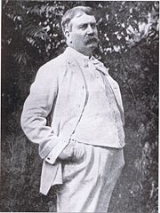
Daniel Hudson Burnham, FAIA (September 4, 1846 – June 1, 1912) was an American architect and urban planner. He was the Director of Works for the World's Columbian Exposition and designed several famous buildings, including the Flatiron Building in New York City and Union Station in Washington D.C.
ham was born in Henderson, New York and raised in Chicago, Illinois. His parents brought him up under the teachings of the Swedenborgian Church of New Jerusalem, which ingrained in him the strong belief that man should strive to be of service to others.

Discussion
Ask a question about 'Daniel Burnham'
Start a new discussion about 'Daniel Burnham'
Answer questions from other users
|
Recent Posts

Quotations
Stevenson, Burton Egber. MacMillan Book of Proverbs, Maxims, and Famous Phrases (1948) New York, Macmillan; Page 1806.
Burnham, Daniel

Encyclopedia
Daniel Hudson Burnham, FAIA (September 4, 1846 – June 1, 1912) was an American architect and urban planner. He was the Director of Works for the World's Columbian Exposition and designed several famous buildings, including the Flatiron Building in New York City and Union Station in Washington D.C.
Biography
Burnham was born in Henderson, New York and raised in Chicago, Illinois. His parents brought him up under the teachings of the Swedenborgian Church of New Jerusalem, which ingrained in him the strong belief that man should strive to be of service to others. After failing admissions tests for both Harvard and Yale, and an unsuccessful stint at politics, Burnham apprenticed as a draftsman under William LeBaron Jenney. At age 26, Burnham moved on to the Chicago offices of Carter, Drake, and Wight, where he met future business partner John Wellborn Root (1850–1891). Burnham and Root were the architects of one of the first American skyscrapers: the Masonic Temple Building in Chicago. Measuring 21 stories and 302 feet, the Temple held claims as the tallest building of its time, but was torn down in 1939. Under the design influence of Root, the firm had produced modern buildings as part of the Chicago School. Following Root’s premature death from pneumonia in 1891, the firm became known as D.H. Burnham & Company.
World's Columbian Exposition
Burnham and Root had accepted responsibility to oversee construction of the World's Columbian Exposition in Chicago’s then-desolate Jackson Park on the south lakefront. The largest world's fair to that date (1892), it celebrated the 400-year anniversary of Christopher Columbus' famous voyage. After Root's death, a team of distinguished American architects and landscape architects, including Burnham, Frederick Law Olmsted, Charles McKim and Louis Sullivan, radically changed Root's modern and colorful style to a Classical Revival style. Under Burnham's direction, the construction of the Fair overcame huge financial and logistical hurdles, including a worldwide financial panic and an extremely tight timeframe, to open on time.
Considered the first example of a comprehensive planning document in the nation, the fairground was complete with grand boulevards, classical building facades, and lush gardens. Often called the "White City", it popularized neoclassical architecture in a monumental and rational Beaux-Arts plan. The remaining population of architects in the U.S. was soon asked by clients to incorporate similar elements into their designs.
City planning and "The Plan of Chicago" Beginning in 1906 and published in 1909, Burnham and assistant Edward H. Bennett prepared "The Plan of Chicago", which laid out plans for the future of the city. It was the first comprehensive plan for the controlled growth of an American city, and an outgrowth of the City Beautiful movement. The plan included ambitious proposals for the lakefront and river and declared that every citizen should be within walking distance of a park. Sponsored by the Commercial Club of Chicago, Burnham donated his services in hopes of furthering his own cause.
Plans and conceptual designs of the south lakefront from the Exposition came in handy, as he envisioned Chicago being a "Paris on the Prairie". French-inspired public works constructions, fountains, and boulevards radiating from a central, domed municipal palace became Chicago's new backdrop. The plan set the standard for urban design, anticipating future need to control unexpected urban growth.
City planning projects did not stop at Chicago though; Burnham helped shape cities such as Cleveland (the Group Plan), San Francisco, Washington, DC (the McMillan Plan), and Manila and Baguio in the Philippines, details of which appear in "The Chicago Plan" publication of 1909. The Plan for Manila was not fulfilled, except for a shore road, which became Dewey boulevard, now known as Roxas boulevard.
Much of his career work modeled the classical style of Greece and Rome. In his 1924 autobiography, Louis Sullivan, considered by many to be the greatest architect from the Chicago School, chastised the late Burnham for his lack of original expression and dependence on Classicism. Sullivan claimed the neoclassical example of the World's Fair had "set back architecture fifty years"—a sentiment edged with bitterness, as corporate America of the early twentieth century had demonstrated a strong preference for Burnham's architectural style over Sullivan's.
Burnham was quoted as saying, "Make no little plans. They have no magic to stir men's blood and probably will not themselves be realized." (Moore 1921) This slogan has been taken to capture the essence of Burnham's spirit.
A man of influence, Burnham was considered the preeminent architect in America at the turn of the twentieth century. He held many positions during his lifetime, including the presidency of the American Institute of Architects. In 1912, when he died in Heidelberg, Germany, D.H. Burnham and Co. was the world's largest architectural firm. Legendary architect Frank Lloyd Wright eulogized, "(Burnham) made masterful use of the methods and men of his time... (as) an enthusiastic promoter of great construction enterprises... his powerful personality was supreme." His firm continues its work today under the name Graham, Anderson, Probst & White, which it adopted in 1917.
Almost as a tribute to his urban planning ethos, Burnham's final resting spot is given special attention, being located on the only island in the park-like Graceland Cemetery, situated in Chicago's Lakeview neighborhood.
Because he was the planner and architect of Baguio City in the Philippines, the city's Burnham Park was named after him. In his honor, the American Planning Association named a major annual prize the Daniel Burnham Award for a Comprehensive Plan.
Collections of Burnham's personal and professional papers, photographs, and other archival materials are held by the Ryerson and Burnham Archives at the Art Institute of Chicago.
Notable commissions
Philippines
* Burnham Park
Chicago
Detroit
Pittsburgh
- Union Trust Building 1898 (337 Fourth Avenue - Not the 1917 structure of the same name on Grant Street)
- Pennsylvania Union Station 1900-1902
- Frick Building 1902
- McCreery Department Store (now offices - 300 Sixth Avenue Building) 1904
- Highland Building 1910 (121 South Highland Avenue)
- Henry W. Oliver Building 1910
Washington, D.C.
Others
- Flatiron Building, New York City
- Wyandotte Building, Columbus, Ohio
- Columbus Union Station of 1897
- Ellicott Square Building,
- , Richmond, Indiana
- Cleveland Mall with Arnold Brunner and John Carrère, 1903
- Union Station, El Paso, Texas
- Fayette Bank Building (now Fayette Building), Uniontown, Pennsylvania, 1902
- John Wanamaker department store (now Macy's), Philadelphia
- John Wanamaker department store, New York City
- Selfridge & Co. Department Store, London
- Filene's Department Store, Boston
- Terminal Arcade, Terre Haute, Indiana
Appearances In Popular Culture
- The Devil in the White City, a non-fiction book by Erik Larson, intertwines the true tale of two men: H.H. Holmes, a serial killer famed for his 'murderous hotel' in Chicago, and Daniel Burnham.
- In the role-playing game, Unknown Armies, Daniel Burnham is quoted by the True King of Chicago, James K MaGowan and held up as being part of that cities mysterious and magical past.
External links
|