
|
|
|
|
Allegheny Mountains
|
| |
|
| |
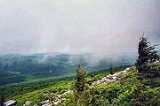
The Allegheny Mountain Range (also spelled Alleghany and Allegany) — informally, the Alleghenies — is part of the vast Appalachian Mountain Range of the eastern United States and Canada. It has a northeast-southwest orientation and runs for about 400 miles (640 km) from north-central Pennsylvania, through western Maryland and eastern West Virginia, to southwestern Virginia.
name derives from the Allegheny River, which drains only a small portion of the Alleghenies in west-central Pennsylvania.

Discussion
Ask a question about 'Allegheny Mountains'
Start a new discussion about 'Allegheny Mountains'
Answer questions from other users
|
Encyclopedia
The Allegheny Mountain Range (also spelled Alleghany and Allegany) — informally, the Alleghenies — is part of the vast Appalachian Mountain Range of the eastern United States and Canada. It has a northeast-southwest orientation and runs for about 400 miles (640 km) from north-central Pennsylvania, through western Maryland and eastern West Virginia, to southwestern Virginia.
Name
The name derives from the Allegheny River, which drains only a small portion of the Alleghenies in west-central Pennsylvania. The meaning of the word, which comes from the Lenape (Delaware) Indians, is not definitively known, but is usually translated as "fine river". A Lenape legend tells of an ancient tribe called the "Allegewi" who lived on the river and were defeated by the Lenape. Allegheny is the French spelling (as in Allegheny River, which was once part of New France), and Allegany is the English spelling (as in Allegany County, Maryland, a former British Colony).
The word "Allegheny" was once commonly used to refer to the whole of what are now called the Appalachian Mountains. John Norton used it (spelled variously) around 1810 to refer to the mountains in Tennessee and Georgia. Around the same time, Washington Irving proposed renaming the United States either "Appalachia" or "Alleghania".. In 1861, Arnold Henry Guyot published the first systematic geologic study of the whole mountain range. His map labeled the range as the "Alleghanies", but his book was titled On the Appalachian Mountain System. John Muir, in his book A Thousand Mile Walk to the Gulf (written in 1867), used the word "Alleghanies" for the southern Appalachians. Other people used the word "Appalachians". An early example of Virginians and English arrivals in New England using the 18th century term's derivative, "Appalachian", for the lower range of the Allegheny that meets the Unaka Range, a range of which the "Great Smoky Mountains" are a part of, can be found in "Mountaynes Apalatsi:" Capt. Newport's Discoveries, 1607 Public Record Office, London; also American Antiquarian Society, Transactions, vol. iv, 40, 46-48 ; and Brawn, A. First Republic in America, 34.
There was no general agreement about the "Appalachians" versus the "Alleghanies" until the late 19th century. The term "Appalachian" became commonly used for the whole range, first by geologists and eventually, everyone.
Geography
- See also: List of Mountains of the Alleghenies
Extent
From northeast to southwest, the Allegheny Mountains run about 400 miles (640 km). From west to east, at their widest, they are about 100 miles (160 km).
Although there are no official boundaries to the Allegheny Mountains region, it may be generally defined to the east by the Great Valley (locally called the Cumberland Valley in Pennsylvania and the Shenandoah Valley in Virginia); to the north by the Susquehanna River valley; and to the south by the New River valley. To the west, the Alleghenies grade down into the dissected Allegheny Plateau (of which they are sometimes considered to be a part). The westernmost ridges are considered to be the Laurel and Chestnut Ridges in Pennsylvania and Laurel and Rich Mountains in West Virginia.
The mountains to the south of the Alleghenies -- the Appalachians in westernmost Virginia, eastern Kentucky, and eastern Tennessee -- are the Cumberlands. The Alleghenies and the Cumberlands both constitute part of the Ridge and Valley Province of the Appalachians.
The Allegheny Front and the “Allegheny Highlands”
The eastern edge of the Alleghenies is marked by the Allegheny Front, which is also sometimes considered the eastern terminus of the Allegheny Plateau. This great escarpment represents a portion of the Eastern Continental Divide in this area. A number of impressive gorges and valleys drain the Alleghenies: to the east, Smoke Hole Canyon (South Branch Potomac River) and the Shenandoah Valley, and to the west the New River Gorge and the Blackwater and Cheat Canyons. Thus, about half the precipitation falling on the Alleghenies makes its way west to the Mississippi and half goes east to Chesapeake Bay and the Atlantic seaboard.
The highest ridges of the Alleghenies are just west of the Front, which has an east/west elevational change of up to . Absolute elevations of the Allegheny Highlands reach nearly , with the highest elevations in the southern part of the range. The highest point in the Allegheny Mountains is Spruce Knob (4,863 ft/1,482 m), on Spruce Mountain in West Virginia. Other notable Allegheny highpoints include Thorny Flat on Cheat Mountain (4,848 ft/1478 m), Bald Knob on Back Allegheny Mountain (4,842 ft/1476 m), and Mount Porte Crayon (4,770 ft/1,454 m), all in West Virginia; Dans Mountain (2,898 ft/883m) in Maryland, Backbone Mountain (3360 ft/1024 m), the highest point in Maryland; Mount Davis (3,213 ft/979 m), the highest point in Pennsylvania, and the second highest, Blue Knob (3,146 ft/959 m).
Development
There are very few sizable cities in the Alleghenies. The four largest are (in order of population): Altoona, State College, Johnstown (all in Pennsylvania) and Cumberland (in Maryland).
Protected areas
Much of the Monongahela (West Virginia), George Washington (West Virginia, Virginia) and Jefferson (Virginia) National Forests lie within the Allegheny Mountains. The Alleghenies also include a number of federally-designated wilderness areas, such as the Dolly Sods Wilderness, Laurel Fork Wilderness, and Cranberry Wilderness in West Virginia.
- The mostly completed Allegheny Trail, a project of the West Virginia Scenic Trails Association since 1975, runs the length of the range within West Virginia. The northern terminus is at the Mason-Dixon Line and the southern is at the West Virginia-Virginia border on Peters Mountain.
Geology
The bedrock of the Alleghenies is mostly sandstone and metamorphosed sandstone, quartzite, which is extremely resistant to weathering. Prominent beds of resistant conglomerate can be found in some areas, such as the Dolly Sods. When it weathers, it leaves behind a pure white quartzite gravel. The rock layers of the Alleghenies were formed during the Alleghenian orogeny.
Because of intense freeze-thaw cycles in the higher Alleghenies, there is little native bedrock exposed in most areas. The ground surface usually rests on a massive jumble of sandstone rocks, with air space between them, that are gradually moving down-slope. The crest of the Allegheny Front is an exception, where high bluffs are often exposed, revealing an exceptional view.
Flora and fauna
The Alleghenies of West Virginia are noted for their forests of red spruce, balsam fir, and mountain ash, trees typically found much farther north.
History
Prior to European exploration and settlement, trails through the Alleghenies had been transited for many generations by American Indian tribes such as the Iroquois, Shawnee, Delaware, Catawba and others, for purposes of trade, hunting and, especially, warfare.
Among the first whites to penetrate into the Allegheny Mountains were surveyors attempting to settle a dispute over the extent of lands belonging to either Thomas Fairfax, 6th Lord Fairfax of Cameron or to the English Privy Council. An expedition of 1736 by John Savage established the location of the source of the North Branch Potomac River. An expedition ten years later by Peter Jefferson and Thomas Lewis emplaced the “Fairfax Stone” at the source and established a line of demarcation (the “Fairfax Line”) extending from the Stone south-east to the headwaters of the Rappahannock. Lewis's journal of that expedition provides a valuable view of the Allegheny country before its settlement.
Trans-Allegheny travel had been facilitated when a military trail — Braddock Road — was blazed and opened by the Ohio Company in 1751. (It followed an earlier Indian and pioneer trail known as Nemacolin's Path.) Braddock Road connected Cumberland, Maryland (the upper limit of navigation on the Potomac River) and the forks of the Ohio River (the future Pittsburgh, Pennsylvania). It received its name from the British leader of the French and Indian War, General Edward Braddock, who had led the ill-fated Braddock expedition four years later. In addition to the war, hunting and trading with Indians were primary motivations for white movement across the mountains. Permanent white settlement of the Alleghenies was preceded by the explorations of such noted Marylanders as the Indian fighter and trader Thomas Cresap (1702-90) and the backwoodsman and hunter Meshach Browning (1781-1859).
The Braddock Road was superseded by the Cumberland Road (also called the National Road), one of the first major improved highways in the United States to be built by the federal government. Construction began in 1811 at Cumberland and the road reached Wheeling, Virginia (now West Virginia) on the Ohio River in 1818.
Dr Martin Luther King referenced the Allegheny Mountains in his famous "I Have a Dream" speech (1963), when he said "Let freedom ring from the heightening Alleghenies of Pennsylvania!"
Photo gallery
Citations
Other sources
- McNeill, G.D. (Douglas), The Last Forest, Tales of the Allegheny Woods, n.p., 1940 (Reprinted with preface by Louise McNeill, Pocahontas Communications Cooperative Corporation, Dunmore, W.Va. and McClain Printing Company, Parsons, W.Va, 1989.)
- Rosier, George L., Compiler, Hiking Guide to the Allegheny Trail, Second edition, West Virginia Scenic Trails Association, Kingwood, W.Va., 1990.
- Smith, J. Lawrence, The High Alleghenies: The Drama and Heritage of Three Centuries, Tornado, West Virginia: Allegheny Vistas; Illustrations by Bill Pitzer, 1982.
External links
- [ USGS GNIS - Allegheny Mountains]
-
|
| |
|
|