
|
|
|
|
Long Island Rail Road
|
| |
|
| |
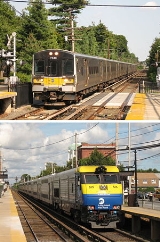
The Long Island Rail Road or LIRR is a commuter rail system serving the length of Long Island, New York that has been classified as a Class II railroad by the Surface Transportation Board. It is the busiest commuter railroad in North America, servicing around 81 million passengers each year, and the oldest US railroad still operating under its original name and charter.

Discussion
Ask a question about 'Long Island Rail Road'
Start a new discussion about 'Long Island Rail Road'
Answer questions from other users
|
Recent Posts

Encyclopedia
The Long Island Rail Road or LIRR is a commuter rail system serving the length of Long Island, New York that has been classified as a Class II railroad by the Surface Transportation Board. It is the busiest commuter railroad in North America, servicing around 81 million passengers each year, and the oldest US railroad still operating under its original name and charter. There are 124 stations on the LIRR, and more than 700 miles (1100 km) of track on its two lines to the two forks of the island and eight major branches. Each weekday, the LIRR provides more than 280,000 rides to customers. It is publicly owned by the Metropolitan Transportation Authority, which has styled it MTA Long Island Rail Road.
In addition to commuter trains, the LIRR runs trains for travelers to eastern Long Island, including the express Cannonball to the Hamptons, operated since the 1890s.
Freight service on the system has been operated by the New York and Atlantic Railway since 1997, including four freight-only branches and Bay Ridge Yard in Bay Ridge, Brooklyn.
On May 17 2007, Long Island Rail Road was awarded a Bronze E. H. Harriman Award for its safety record in 2006.
The current LIRR logo combines the circular MTA logo with the text "Long Island Rail Road", and appears on the sides of trains.
History
The Long Island Rail Road Company was originally chartered in 1834 to provide a daily train service between New York and Boston via a ferry connection between its Greenport, New York terminal on Long Island's North Fork and Stonington, Connecticut. This initially popular service was superseded by the New York, New Haven, and Hartford Railroad's all land route through Connecticut in 1849 which was direct and shorter. The LIRR thus began to refocus its attentions towards servicing Long Island itself. Competition was rife until Conrad Poppenhusen and Austin Corbin consolidated all the railroads.
The LIRR throughout much of its history was a money loser; however, in 1900 the Pennsylvania Railroad purchased a controlling interest, as part of a joint plan to provide direct access to Manhattan which commenced on September 8, 1910. The wealthy PRR subsidized the LIRR during the first half of the new century, allowing much expansion and modernization.
By the end of the Second World War, however, the downturn in the railroad industry and dwindling profits caused the PRR to relinquish the LIRR from its payroll. The bankrupt LIRR went into receivership in 1949 with its assets being transferred to the American Contract and Trust Company. Nonetheless the State of New York, realizing how important the railroad was to the future of Long Island, began to subsidize the railroad gradually throughout the 1950s and 60's. Finally in 1966, New York State Governor Nelson A. Rockefeller, fearful that the railroad might be completely abandoned, was able to buy the railroad's controlling stock from the PRR and put it under the newly formed Metropolitan Transportation Authority. With MTA subsidies, the LIRR was able to modernize further and grow into the busiest commuter railroad in the United States.
The LIRR is one of the few railroads that has survived as an intact company from its original charter to the present day.
Power Transmission
The LIRR's electrified lines are powered by third rail.
Terminals
The LIRR has three western terminals, all in New York City.
Pennsylvania Station
Pennsylvania Station, in Midtown Manhattan, is the busiest of the three, serving almost 500 daily trains. It is reached via the Amtrak-owned East River Tunnels (the only LIRR-used trackage not owned by the LIRR) from the Main Line in Long Island City. The New York City Subway's 34th Street–Penn Station (IRT Broadway–Seventh Avenue Line) and 34th Street–Penn Station (IND Eighth Avenue Line) stations are located next to the terminal.
Flatbush Avenue
Flatbush Avenue station in Downtown Brooklyn serves most other trains. It is located next to the New York City Subway's Atlantic Avenue–Pacific Street station complex, providing easy access to Lower Manhattan.
Hunterspoint Avenue and Long Island City
A handful of daily trains run to Hunterspoint Avenue or beyond to Long Island City on the East River in Long Island City. From Hunterspoint Avenue, the Hunters Point Avenue (IRT Flushing Line) subway station can be reached for Midtown Manhattan access.
Grand Central Terminal
Access to a fourth major terminal is currently under construction. In 2013 the LIRR intends to initiate service to Grand Central Terminal via the East Side Access project; provision was made for this route on the lower level of the 63rd Street Tunnel under the East River, which currently carries the IND 63rd Street Line (F (New York City Subway)) of the New York City Subway on its upper level. Construction of the East Side Access project will reduce congestion during rush hour times as well as increase the number of trains operating during peak hours.
Jamaica Station
Jamaica Station is a major station and transfer point in Jamaica, Queens, where the railroad's headquarters are located. (The parent MTA is headquartered in Manhattan.) Jamaica encompasses eight tracks and six platforms, plus yard and bypass tracks(see image at right). At Jamaica, passengers can transfer between trains on all LIRR lines except the Port Washington Branch, leading to the saying echoed by generations of LIRR Conductors "Change at Jamaica." Transfer is also made to separate facilities for three different subway lines (at the Sutphin Boulevard/Archer Avenue–JFK station), a number of bus routes, and the AirTrain automated electric rail system to JFK Airport.
Fare Structure
The LIRR, like Metro North, and New Jersey Transit, has a fare system that is based on the distance a passenger travels, as opposed to the New York City Subway which has a flat rate throughout the entire system. The railroad is broken up in to eight numbered fare zones. Zone 1 includes all of the city terminals and stations west of Jamaica. Zone 3 includes Jamaica and all stations east of Jamaica within the boundaries of New York City, except Far Rockaway. Zones 4, 7, 9, 10, 12, and 14 include all of the remaining stations in Nassau and Suffolk Counties. Each zone contains many stations, and the same fare applies for travel between any station in the origin zone and any station in the destination zone.
Peak fares are charged during the week on trains that arrive at western terminals between the hours of 6AM and 10AM, and for trains that arrive at an eastern terminal between the hours of 4PM and 8PM. Any passenger holding an off peak ticket on a peak train is required to pay a step up fee. Passengers have the options of buying tickets from ticket agents or ticket vending machines (TVMs) or on the train from railroad conductors yet will incur an on-board penalty fee for doing so. This fee is waived for seniors citizen and disabled passengers and also for passengers who board from stations where there are no ticket agencies or TVMs.
There are several types of tickets that a passenger can buy: one way, round trip, peak, off-peak, AM peak or off-peak senior/citizen disabled, peak child, and off-peak child. On off-peak trains, passengers can buy a family ticket for children who are accompanied by a 17 year old for $0.75 if bought from the station agent or TVM, $1.00 if bought on the train from the conductor. Additionally senior citizen/disabled passengers traveling during the morning peak hours are required to pay the AM peak senior citizen/disabled rate. This rate is not charged during PM peak hours.
Daily commuters can also buy a peak or off-peak ten trip ride, or a unlimited monthly pass. Monthly passes are good on any train regardless of the time of day, but are only valid within the fare zones specified on the pass.
On weekends the railroad offers a special reduced-fare City Ticket for those passengers who travel within Zones 1 and 3. City Tickets can only be bought from ticket agents or machines and are non-refundable.
During the summer season the railroad offers special summer package ticket deals to places such as Long Beach, Jones Beach, the Hamptons, Montauk, and Greenport. Passengers traveling to the Hamptons and Montauk on the LIRR Cannonball also have the option of buying a reserved ticket to sit in one of the trains all reserved Parlor Cars. However, the LIRR suggests that these tickets be booked in advanced based on limited availability.
Passenger Lines and Services
The Long Island Rail Road system is made up of eleven passenger branches. Two main trunk lines, the Main Line and Montauk Branches, spin off nine smaller branches. For scheduling and advertising purposes some of these branches are furthur divided into sections such as the case with the Montauk Branch, which is known as the Babylon Branch service in the electrified portion of the line between Jamaica and Babylon, while the diesel service beyond Babylon to Montauk is referred to as Montauk Branch service. All the lines with the exception the Port Washington Branch pass through Jamaica; the trackage west of Jamaica (except to Port Washington) is known as the City Terminal Zone. The City Terminal Zone includes portions of the Main Line and Atlantic and Montauk Branches, as well as the Amtrak-owned East River Tunnels to Penn Station.
Main Line
The Main Line runs from Long Island City east to Greenport; trains using the East River Tunnels from New York Penn Station join the line at Sunnyside Yard. It is electrified west of Ronkonkoma; diesel trains continue to Greenport. The services that run along this line are named after the branches that they use; trains beyond Hicksville, where the Port Jefferson Branch splits, are known as Ronkonkoma Branch and sometimes Greenport Branch trains. A short unnamed electric branch from Queens Village serves Belmont Park on race days.
Montauk Branch
The Montauk Branch runs from Long Island City to Montauk, meeting the Main Line at Long Island City and Jamaica. It is electrified from Jamaica east to Babylon; only diesel trains use the "Lower Montauk" section west of Jamaica or the outer section east of Babylon. Only trains east of Babylon are considered part of the Montauk Branch service; the line from Lynbrook to Babylon carries Babylon Branch trains.
Atlantic Branch
The electrified Atlantic Branch runs from Downtown Brooklyn east to Jamaica, where it meets the Main Line, and then heads southeast to end at the Montauk Branch at Valley Stream. East of Valley stream the line turns south and is considered part of the Far Rockaway Branch service.
Port Washington Branch
The electrified Port Washington Branch - the only one that doesn't serve Jamaica - branches from the Main Line east of Woodside and heads east and northeast to Port Washington.
Port Jefferson Branch
The Port Jefferson Branch branches from the Main Line at Hicksville, with electric service to Huntington and diesel service to Port Jefferson. Until 1938, it continued east to Wading River.
Hempstead Branch
The electrified Hempstead Branch branches from the Main Line at Floral Park and runs east to Hempstead.
West Hempstead Branch
The electrified West Hempstead Branch branches from the Babylon Branch at Valley Stream and runs northeast to West Hempstead, originally continuing to junction the Hempstead Branch and Main Line.
Oyster Bay Branch
The Oyster Bay Branch splits from the Main Line at Mineola and heads north and east to Oyster Bay. The first bit to East Williston is electrified; only diesel trains run along the majority of the line to Oyster Bay.
Central Branch
The diesel Central Branch runs southeast from the Main Line at Bethpage to the Montauk Branch at Babylon, giving an alternate route to the Montauk Branch east of Babylon. The Central Branch used to continue west from Bethpage to near Garden City, where it used what is now the Hempstead Branch to the Main Line at Floral Park.
Far Rockaway Branch
The electrified Far Rockaway Branch splits from the Atlantic Branch at Valley Stream and runs south and southwest to Far Rockaway. It used to continue west along what is now the New York City Subway's IND Rockaway Line to Hammels and Rockaway Park.
Long Beach Branch
The electrified Long Beach Branch splits from the Far Rockaway Branch at Valley Stream but does not curve away until Lynbrook, where it turns south to end at Long Beach.
Former Branches
In addition the railroad has abandoned a number of branches due to lack of ridership over the years. Some of these lines have been either sold off to the New York City Subway, while others have been downgraded to freight branches, and the rest just outright abandoned.
Additional Services
In addition to the commuter services, the LIRR operates trains for vacationers, including the premier Cannonball, to the Hamptons.. The Cannonball runs from May thru September between Hunterspoint Avenue in Queens and Montauk and after stopping in Jamaica runs express all the way to Westhampton Beach. The Cannonball offers two Parlor Cars, (all reserved seating with full bar service), and is the only named train on a mainline passenger railroad, not including tourist lines, left outside of those trains on the Amtrak system. In the off-season a Friday only express train follows the same schedule as The Cannonball but does
offer Parlor Car service.
The LIRR first entered the Hamptons service with the Sag Harbor Branch in 1869, and begin to serve Montauk in 1895 with the completion of the Montauk Branch. By 1895, a special fast train on the Main Line to Greenport was known as the Cannon Ball; a section split at Manorville to serve Montauk via the Manorville Branch and Montauk Branch by 1897. In 1949, when the Manorville Branch was abandoned, the Cannon Ball was shifted to the Central Branch. The Sunrise Special, a first-class train to Montauk, was added in 1926. For a time, Pullman parlor cars and sleeping cars were operated through Penn Station to Montauk from points such as Pittsburgh and Washington.
During the summer the railroad also provides a number of extra trains out to the Shinnecock Hills Golf Club located in Southampton for special golf tournaments.
In addition the railroad runs the daily Belmont Park race trains during the racetracks Spring and Fall meets, with a heavy service on the day of the famed Belmont Stakes race. The Belmont trains used to be part of a more extensive network of racing trains operated by the LIRR first starting with service to the old Sheepshead Bay Race Track that was served by the railroads now abandoned Manhattan Beach Branch. Over the years the railroad provided race trains to Aqueduct Racetrack in Queens, the service having since been taken over by the NYC Subway, and also to the now closed and demolished Jamaica Racetrack and Roosevelt Raceway.
From April thru October the railroad also runs an extensive amount of extra trains between Woodside and Shea Stadium (soon to be Citifield), to service those passengers traveling to see the New York Mets home games. In the case of the extra Mets trains the railroad operates a gateing program at Shea with LIRR Conductors selling and servicing passengers tickets before they get on the train.
Other eastern Long Island services included the local "Scoot", which operated between the two forks (Greenport on the North Fork to Amagansett on the South Fork) via the Manorville Branch. It was eliminated in February 1931 due to the effect of the Great Depression and competition from the automobile.
Freight Branches and Service
The LIRR and other railroads that became part of the system have always had freight service, though this has diminished over the years. The process of shedding freight service accelerated with the acquisition of the railroad by New York State.
In recent years there has been some appreciation of the need for better railroad freight service in New York City and elsewhere on Long Island. Both areas are primarily served by trucking for freight haulage, an irony in a region with the most extensive rail transit service in the Americas as well as the worst traffic conditions. Proposals for a Cross-Harbor Rail Tunnel for freight have languished more than a century.
Freight service is now operated on lease by the New York and Atlantic Railway, a short line railroad owned by the Anacostia and Pacific Company. It has its own equipment and crews, but uses the rail facilities of the LIRR. To the east, freight service operates to the ends of the West Hempstead, Port Jefferson and Montauk branches, and to Southold on the Mainline. On the western end it provides service on the surviving freight-only tracks of the LIRR: the Bay Ridge and Bushwick branches; the nearly freight-only "Lower Montauk"; and to an interchange connection at Fresh Pond Junction in Queens with the CSX, Canadian Pacific, and Providence and Worcester railroads.
Four non-electrified lines are only used for freight, now operated by the New York and Atlantic Railway.
The Montauk Cutoff Secondary is a short connection from the Main Line at Sunnyside Yard south to the Montauk Branch, separating passenger and freight movements.
The Bushwick Lead Track runs west from the Montauk Branch at Maspeth to Bushwick Terminal. This was originally was a passenger branch until the discontinuince of service in 1924.
The Bay Ridge Branch runs south and west from the Montauk Branch at Fresh Pond to Bay Ridge. At Fresh Pond, it meets CSX Transportation's Fremont Secondary, which goes over the Hell Gate Bridge towards Upstate New York and New England. This branch to also ran a passenger service until 1924
The Garden City-Mitchel Field Secondary is a remnant of the Central Branch from Garden City to Mitchel Field.
Planned Service Expansions
Besides the long anticipated Eastside Access project, the LIRR has several other planned service expansions such as:
Main Line Track and Electrification Expansions
In conjuction with the commencement of service to Grand Central Terminal, the LIRR is in the final planning stages of adding a third track on the Main Line between Floral Park and Hicksville which will aid in relieving the crowding on the Main Line which is expected to grow after the Eastside project is complete. This project has drawn concern from locals in the adjoining towns about the effects of the construction and eventual increase in service.
In addition the railroad is also actively pursuing adding a second track along the Main Line between Farmingdale and Ronkonkoma to relieve the crowding on that portion of the Main Line (currently there is only one track with passing sidings between Farmingdale and Ronkonkoma.) If these projects are carried out the LIRR plans to extend electrification towards Yaphank and possibly to Riverhead in order to build a new yard facility to store MU trains. Stations on this portion of the Main Line were modified in the late 1990s for future electrification.
Lower Manhattan Rail Terminal
Expansion of the Atlantic Branch from Flatbush Avenue to a new terminal near the PATH station located at the former World Trade Center site has also been in the works. This project would also include an expansion of the Air Train to Lower Manhattan. However, as of 2008 this project has received low priority.
Central Branch Electrification
Electrification of the Central Branch is also another planned project. This would allow a reduction in the congestion on the Montauk Branch and also allow for electric trains coming from Babylon to have an alternative route into Jamaica. Rail ties along this branch have been replaced over the years in anticipation of this service.
Port Jefferson and Montauk Branch Electrification
Expansion of electrification to both Port Jefferson and to Patchouge and Speonk on the Montauk Branch, two diesel branches that have a significant commuter service, have also been planned over the years. However, as recently as 2008 Newsday reported that, although electrification to Port Jefferson, and the building of an electric yard their, is desirable, the recent financial troubles of the MTA will likely delay this type of project for a few years. Additionally there is mixed feelings from locals in the area about the side affects an increased service would create.
Passenger Issues
The LIRR has a long history of rocky relations with its passengers , especially daily commuters . Various commuter advocacy groups have been formed to try to represent those interests, in addition to the state mandated .
One criticism of the LIRR is that the railroad has not improved service to the "east end" of Long Island as the twin forks continue to grow in popularity as a year round tourist and residential destination. Demand is evidenced by flourishing bus services and the early formative stages of a new .
It is claimed that the On Time Performance (OTP) calculated by the LIRR is manipulated to be artificially high. The "percentage" measure is used by many other US passenger railroads but the criticism over accuracy is specific to the LIRR. As defined by the LIRR, a train is "on time" if it arrives at a station within 5 minutes and 59 seconds of the scheduled time. The criterion was 4 minutes and 59 seconds until the LIRR changed it because of a bug in their computer systems. Critics believe the OTP measure does not reflect what commuters experience on a daily basis, and that the 'real' On Time Performance of the LIRR is about 70% to 75% rather than the 92% to 96% that is published. The LIRR publishes the current OTP in a monthly booklet called .
A more accurate way to measure delays and OTP has been proposed to the LIRR. Called the "Passenger Hours Delayed" index it can measure total person-hours of a specific delay. This would be useful in comparing performance of specific days or incidents, day-to-day (or week-to-week) periods, something the current measure cannot do. This 'PHD' index measure is used by some transportation research organizations and would be more meaningful to commuters. it has not been adopted. The two methods are not mutually exclusive and could be kept and published simultaneously.
2007 ridership was 86.1 million, up 4.9% over 2006. The all time highest ridership was 91.8 million in 1949.
Law enforcement The former LIRR Police Department, which was founded in 1863, was absorbed along with the Metro-North Railroad Police to form the Metropolitan Transportation Authority Police (MTA Police) in 1998.
Alcohol restrictions
Section 1097.5 of the Rules and Regulations Governing the Conduct and Safety of the Public and Use of the Long Island Rail Road Company Terminals, Stations and Trains prohibits drinking any alcoholic beverage or possess any opened or unsealed container of alcoholic beverage, except in premises or areas allowing the sale or consumption of alcoholic beverages, such as on trains or platforms or in bars or restaurants.
"In an effort to maintain orderly travel for our customers attending the St. Patrick’s Day Parade" as claimed by LIRR, LIRR has banned alcoholic beverage on St. Patrick’s Day. In 2007, such a ban to confiscate opened and even unopened beverages and fine their possessors about 50 USD created controversies. New York State Senator Martin Golden proposed that the MTA lift what he dubbed a discriminatory ban.
LIRR has also banned alcohol on New Year's Eve.
Allegation of pension and disability fraud
As a result of a New York Times investigation into alleged abuses of pension and disability payments to retirees of the Long Island Rail Road, Railroad Retirement Agents from Chicago inspected the Long Island office of the Railroad Retirement Board on September 23, 2008. New York Governor David Paterson issued a statement calling for Congress to conduct a full review of the Board's mission and daily activities. Officials at the Board's headquarters in Chicago responded to the investigation stating that all Occupational Disability annuities were issued in accordance with applicable laws. On November 17, 2008, former LIRR pension manager Frederick S. Kreuder was arrested and charged with official misconduct for assisting railroad employees in filing disability claims in exchange for money while on company pay.
See also
External links
|
| |
|
|