

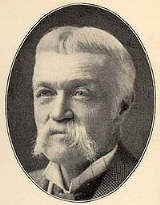
Frank Furness

Encyclopedia
Frank Heyling Furness was an acclaimed American architect of the Victorian era
. He designed more than 600 buildings, most in the Philadelphia area, and is remembered for his eclectic, muscular, often idiosyncratically scaled buildings, and for his influence on the Chicago architect Louis Sullivan
. Furness was also a Medal of Honor
recipient for his bravery during the Civil War
.
Toward the end of his life, his bold style fell out of fashion, and many of his significant works were demolished in the 20th century. Among his most important surviving buildings are the University of Pennsylvania Library (now the Fisher Fine Arts Library
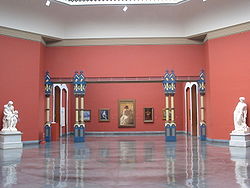
), the Pennsylvania Academy of the Fine Arts
, and the First Unitarian Church of Philadelphia
, all in Philadelphia, Pennsylvania
.
, was a prominent Unitarian
minister and abolitionist, and his brother, Horace Howard Furness, became America's outstanding Shakespeare scholar. Frank, however, did not attend a university and apparently did not travel to Europe. He began his architectural training in the office of John Fraser
, Philadelphia, in the 1850s. He attended the Ecole des Beaux-Arts
-inspired atelier of Richard Morris Hunt
in New York from 1859 to 1861, and again in 1865, following his military service. Furness considered himself Hunt's apprentice and was influenced by Hunt's dynamic personality and accomplished, elegant buildings. He was also influenced by the architectural concepts of the French engineer Viollet-le-Duc and the British critic John Ruskin
.
 Furness's first commission, Germantown Unitarian Church (1866–67, demolished ca. 1928), was a solo effort, but in 1867 he formed a partnership with Fraser, his former teacher, and George Hewitt, who had worked in the office of John Notman
. The trio lasted less than five years, and its major commissions were Rodef Shalom Synagogue (1868–69, demolished) and the Lutheran Church of the Holy Communion (1870–75, demolished). Following Fraser's move to Washington, D.C.
, to become supervising architect for the U.S. Treasury Department, the two younger men formed a partnership in 1871, and soon won the design competition for the Pennsylvania Academy of the Fine Arts
(1871–76). Louis Sullivan
worked briefly as a draftsman for Furness & Hewitt (June - November 1873), and his later use of organic decorative motifs can be traced, at least in part, to Furness. By the beginning of 1876, Furness had broken with Hewitt, and the firm carried only his name. Hewitt and his brother William formed their own firm, G.W. & W.D. Hewitt, and became Furness's biggest competitor. In 1881, Furness promoted his chief draftsman, Allen Evans, to partner (Furness & Evans), and, in 1886, did the same for four other long-time employees. The firm continued under the name Furness, Evans & Company as late as 1932, two decades after its founder's death.
 Over his 45-year career, Furness designed more than 600 buildings, including banks, office buildings, churches, and synagogues. As chief architect of the Reading Railroad, he designed about 130 stations and industrial buildings. For the Pennsylvania Railroad
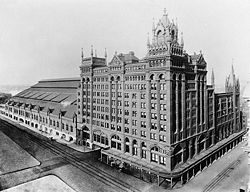
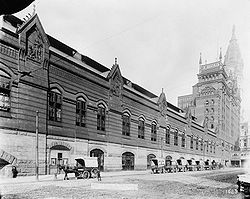
, he designed the great Broad Street Station
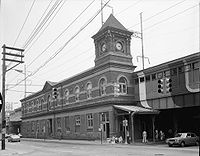
(demolished 1953) at Broad and Market Streets in Philadelphia, and, for the Baltimore & Ohio Railroad, the ingenious 24th Street Station
(demolished 1963) alongside the Chestnut Street Bridge. He was one of the most highly paid architects of his era, and a founder of the Philadelphia Chapter of the American Institute of Architects
. His residential buildings included numerous mansions in Philadelphia and its suburbs (especially the Main Line
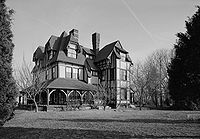
), as well as commissioned houses at the New Jersey seashore, Newport, Rhode Island, Bar Harbor, Maine, Washington, D.C., New York state, and Chicago, Illinois.
Furness designed custom interiors and furniture in collaboration with Philadelphia cabinetmaker Daniel Pabst
. Examples are in the collections of the Metropolitan Museum of Art
, the Philadelphia Museum of Art
, and the High Museum in Atlanta, Georgia. Mark-Lee Kirk's set designs for Orson Welles
's 1942 film The Magnificent Ambersons
seem to be based on Furness's ornate Neo-Grec interiors of the 1870s. A fictional desk designed by Furness is featured in the John Bellairs
novel The Mansion in the Mist.
Furness broke from dogmatic adherence to European trends, and juxtaposed styles and elements in a forceful manner. His strong architectural will is seen in the unorthodox way he combined materials: stone, iron, glass, terra cotta
, and brick. And his straightforward use of these materials, often in innovative or technologically-advanced ways, reflected Philadelphia's industrial-realist culture of the post–Civil War period.
Furness's independence and modernist Victorian-Gothic style inspired 20th-century architects Louis Kahn
and Robert Venturi
. Living in Philadelphia and teaching at the University of Pennsylvania
, they often visited Furness's Pennsylvania Academy of the Fine Arts
—built for the 1876 Centennial—and his University of Pennsylvania Library
.
Furness married Fanny Fassit in 1866, and they had four children: Radclyffe, Theodore, James, and Annis Lee. Furness died on June 27, 1912, and is buried in Laurel Hill Cemetery
in Philadelphia.
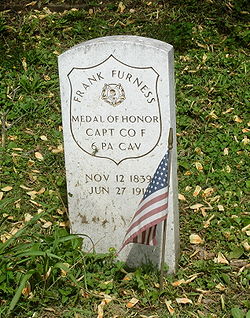 During the Civil War, Furness served as Captain and commander of Company F, 6th Pennsylvania Volunteer Cavalry ("Rush's Lancers"). He received the Medal of Honor
for his gallantry at the Battle of Trevilian Station
, Virginia, on June 12, 1864, becoming the only American architect to receive this honor. Twenty-five years after fighting in the Battle of Gettysburg
, he designed the monument to his regiment on South Cavalry Field:
Citation:
 Following decades of neglect, during which many of Furness's most important buildings were demolished, there was a revival of interest in his work in the mid-20th century. The critic Lewis Mumford
, tracing the creative forces that had influenced Louis Sullivan
and Frank Lloyd Wright
, wrote in The Brown Decades (1931): "Frank Furness was the designer of a bold, unabashed, ugly, and yet somehow healthily pregnant architecture."
The architectural historian Henry-Russell Hitchcock
, in his comprehensive survey Architecture: Nineteenth and Twentieth Centuries (revised 1963), saw beauty in that ugliness:
Architect and critic Robert Venturi
in Complexity and Contradiction in Architecture (1966) wrote, not unadmiringly, of the National Bank of the Republic (later the Philadelphia Clearing House):
On the occasion of its centennial in 1969, the Philadelphia Chapter of the American Institute of Architects
memorialized Furness as its great architect of the past:
In 1973, the Philadelphia Museum of Art
mounted the first retrospective of Furness's work, curated by James F. O'Gorman
, George E. Thomas and Hyman Myers. Thomas, Jeffrey A. Cohen and Michael J. Lewis authored Frank Furness: The Complete Works (1991, revised 1996), with an introduction by Robert Venturi
. Lewis wrote the first biography: Frank Furness: Architecture and the Violent Mind (2001).

Victorian era
The Victorian era of British history was the period of Queen Victoria's reign from 20 June 1837 until her death on 22 January 1901. It was a long period of peace, prosperity, refined sensibilities and national self-confidence...
. He designed more than 600 buildings, most in the Philadelphia area, and is remembered for his eclectic, muscular, often idiosyncratically scaled buildings, and for his influence on the Chicago architect Louis Sullivan
Louis Sullivan
Louis Henri Sullivan was an American architect, and has been called the "father of skyscrapers" and "father of modernism" He is considered by many as the creator of the modern skyscraper, was an influential architect and critic of the Chicago School, was a mentor to Frank Lloyd Wright, and an...
. Furness was also a Medal of Honor
Medal of Honor
The Medal of Honor is the highest military decoration awarded by the United States government. It is bestowed by the President, in the name of Congress, upon members of the United States Armed Forces who distinguish themselves through "conspicuous gallantry and intrepidity at the risk of his or her...
recipient for his bravery during the Civil War
American Civil War
The American Civil War was a civil war fought in the United States of America. In response to the election of Abraham Lincoln as President of the United States, 11 southern slave states declared their secession from the United States and formed the Confederate States of America ; the other 25...
.
Toward the end of his life, his bold style fell out of fashion, and many of his significant works were demolished in the 20th century. Among his most important surviving buildings are the University of Pennsylvania Library (now the Fisher Fine Arts Library
Fisher Fine Arts Library
The Anne & Jerome Fisher Fine Arts Library, also known as the Furness Library, is located on the campus of the University of Pennsylvania, on the east side of College Green...
), the Pennsylvania Academy of the Fine Arts
Pennsylvania Academy of the Fine Arts
The Pennsylvania Academy of the Fine Arts is a museum and art school in Philadelphia, Pennsylvania. It was founded in 1805 and is the oldest art museum and school in the United States. The academy's museum is internationally known for its collections of 19th and 20th century American paintings,...
, and the First Unitarian Church of Philadelphia
First Unitarian Church of Philadelphia
The First Unitarian Church of Philadelphia is a Unitarian Universalist congregation located at 2125 Chestnut Street in Philadelphia, Pennsylvania...
, all in Philadelphia, Pennsylvania
Pennsylvania
The Commonwealth of Pennsylvania is a U.S. state that is located in the Northeastern and Mid-Atlantic regions of the United States. The state borders Delaware and Maryland to the south, West Virginia to the southwest, Ohio to the west, New York and Ontario, Canada, to the north, and New Jersey to...
.
Biography
Furness was born in Philadelphia on November 12, 1839. His father, William Henry FurnessWilliam Henry Furness
Rev. William Henry Furness was an American clergyman, theologian, reformer and abolitionist. Following the American Civil War, he raised funds for Black schools in the South, including Morehouse College....
, was a prominent Unitarian
Unitarianism
Unitarianism is a Christian theological movement, named for its understanding of God as one person, in direct contrast to Trinitarianism which defines God as three persons coexisting consubstantially as one in being....
minister and abolitionist, and his brother, Horace Howard Furness, became America's outstanding Shakespeare scholar. Frank, however, did not attend a university and apparently did not travel to Europe. He began his architectural training in the office of John Fraser
John Fraser (architect)
John Fraser was a Scottish-born American architect who practiced in Philadelphia, Pennsylvania and Washington, DC....
, Philadelphia, in the 1850s. He attended the Ecole des Beaux-Arts
École des Beaux-Arts
École des Beaux-Arts refers to a number of influential art schools in France. The most famous is the École nationale supérieure des Beaux-Arts, now located on the left bank in Paris, across the Seine from the Louvre, in the 6th arrondissement. The school has a history spanning more than 350 years,...
-inspired atelier of Richard Morris Hunt
Richard Morris Hunt
Richard Morris Hunt was an American architect of the nineteenth century and a preeminent figure in the history of American architecture...
in New York from 1859 to 1861, and again in 1865, following his military service. Furness considered himself Hunt's apprentice and was influenced by Hunt's dynamic personality and accomplished, elegant buildings. He was also influenced by the architectural concepts of the French engineer Viollet-le-Duc and the British critic John Ruskin
John Ruskin
John Ruskin was the leading English art critic of the Victorian era, also an art patron, draughtsman, watercolourist, a prominent social thinker and philanthropist. He wrote on subjects ranging from geology to architecture, myth to ornithology, literature to education, and botany to political...
.
John Notman
John Notman was a Scottish-born American architect, who settled in Philadelphia, Pennsylvania. He is remembered for his churches, and for popularizing the Italianate style and the use of brownstone.-Career:...
. The trio lasted less than five years, and its major commissions were Rodef Shalom Synagogue (1868–69, demolished) and the Lutheran Church of the Holy Communion (1870–75, demolished). Following Fraser's move to Washington, D.C.
Washington, D.C.
Washington, D.C., formally the District of Columbia and commonly referred to as Washington, "the District", or simply D.C., is the capital of the United States. On July 16, 1790, the United States Congress approved the creation of a permanent national capital as permitted by the U.S. Constitution....
, to become supervising architect for the U.S. Treasury Department, the two younger men formed a partnership in 1871, and soon won the design competition for the Pennsylvania Academy of the Fine Arts
Pennsylvania Academy of the Fine Arts
The Pennsylvania Academy of the Fine Arts is a museum and art school in Philadelphia, Pennsylvania. It was founded in 1805 and is the oldest art museum and school in the United States. The academy's museum is internationally known for its collections of 19th and 20th century American paintings,...
(1871–76). Louis Sullivan
Louis Sullivan
Louis Henri Sullivan was an American architect, and has been called the "father of skyscrapers" and "father of modernism" He is considered by many as the creator of the modern skyscraper, was an influential architect and critic of the Chicago School, was a mentor to Frank Lloyd Wright, and an...
worked briefly as a draftsman for Furness & Hewitt (June - November 1873), and his later use of organic decorative motifs can be traced, at least in part, to Furness. By the beginning of 1876, Furness had broken with Hewitt, and the firm carried only his name. Hewitt and his brother William formed their own firm, G.W. & W.D. Hewitt, and became Furness's biggest competitor. In 1881, Furness promoted his chief draftsman, Allen Evans, to partner (Furness & Evans), and, in 1886, did the same for four other long-time employees. The firm continued under the name Furness, Evans & Company as late as 1932, two decades after its founder's death.
Pennsylvania Railroad
The Pennsylvania Railroad was an American Class I railroad, founded in 1846. Commonly referred to as the "Pennsy", the PRR was headquartered in Philadelphia, Pennsylvania....
, he designed the great Broad Street Station
Broad Street Station (Philadelphia)
Broad Street Station at Broad & Market Streets was the primary passenger terminal for the Pennsylvania Railroad in Philadelphia, Pennsylvania from 1881 to the 1950s...
(demolished 1953) at Broad and Market Streets in Philadelphia, and, for the Baltimore & Ohio Railroad, the ingenious 24th Street Station
24th Street Station (Philadelphia)
24th St. Station was an intercity railroad station built for the Baltimore and Ohio Railroad, designed by architect Frank Furness. It stood at 24th and Chestnut Streets in Philadelphia, Pennsylvania, and opened in 1888....
(demolished 1963) alongside the Chestnut Street Bridge. He was one of the most highly paid architects of his era, and a founder of the Philadelphia Chapter of the American Institute of Architects
American Institute of Architects
The American Institute of Architects is a professional organization for architects in the United States. Headquartered in Washington, D.C., the AIA offers education, government advocacy, community redevelopment, and public outreach to support the architecture profession and improve its public image...
. His residential buildings included numerous mansions in Philadelphia and its suburbs (especially the Main Line
Pennsylvania Main Line
The Main Line is an unofficial historical and socio-cultural region of suburban Philadelphia, Pennsylvania, comprising a collection of affluent towns built along the old Main Line of the Pennsylvania Railroad which ran northwest from downtown Philadelphia parallel to Lancaster Avenue , a road...
), as well as commissioned houses at the New Jersey seashore, Newport, Rhode Island, Bar Harbor, Maine, Washington, D.C., New York state, and Chicago, Illinois.
Furness designed custom interiors and furniture in collaboration with Philadelphia cabinetmaker Daniel Pabst
Daniel Pabst
A virtuoso cabinetmaker of the Victorian Era, Daniel Pabst created some of the most extraordinary hand-carved furniture in America. Sometimes working in collaboration with architect Frank Furness , he crafted pieces in the Neo-Grec, Renaissance Revival, Modern Gothic, and Colonial Revival styles...
. Examples are in the collections of the Metropolitan Museum of Art
Metropolitan Museum of Art
The Metropolitan Museum of Art is a renowned art museum in New York City. Its permanent collection contains more than two million works, divided into nineteen curatorial departments. The main building, located on the eastern edge of Central Park along Manhattan's Museum Mile, is one of the...
, the Philadelphia Museum of Art
Philadelphia Museum of Art
The Philadelphia Museum of Art is among the largest art museums in the United States. It is located at the west end of the Benjamin Franklin Parkway in Philadelphia's Fairmount Park. The Museum was established in 1876 in conjunction with the Centennial Exposition of the same year...
, and the High Museum in Atlanta, Georgia. Mark-Lee Kirk's set designs for Orson Welles
Orson Welles
George Orson Welles , best known as Orson Welles, was an American film director, actor, theatre director, screenwriter, and producer, who worked extensively in film, theatre, television and radio...
's 1942 film The Magnificent Ambersons
The Magnificent Ambersons (film)
The Magnificent Ambersons is a 1942 American drama film written and directed by Orson Welles. His second feature film, it is based on the 1918 novel of the same name by Booth Tarkington and stars Joseph Cotten, Dolores Costello, Anne Baxter, Tim Holt, Agnes Moorehead and Ray Collins...
seem to be based on Furness's ornate Neo-Grec interiors of the 1870s. A fictional desk designed by Furness is featured in the John Bellairs
John Bellairs
John Anthony Bellairs was an American author, best known for his well-respected fantasy novel The Face in the Frost as well as many gothic mystery novels for young adults featuring Lewis Barnavelt, Anthony Monday, and Johnny Dixon.-Biography:After earning degrees at University of Notre Dame and...
novel The Mansion in the Mist.
Furness broke from dogmatic adherence to European trends, and juxtaposed styles and elements in a forceful manner. His strong architectural will is seen in the unorthodox way he combined materials: stone, iron, glass, terra cotta
Terra cotta
Terracotta, Terra cotta or Terra-cotta is a clay-based unglazed ceramic, although the term can also be applied to glazed ceramics where the fired body is porous and red in color...
, and brick. And his straightforward use of these materials, often in innovative or technologically-advanced ways, reflected Philadelphia's industrial-realist culture of the post–Civil War period.
Furness's independence and modernist Victorian-Gothic style inspired 20th-century architects Louis Kahn
Louis Kahn
Louis Isadore Kahn was an American architect, based in Philadelphia, Pennsylvania, United States. After working in various capacities for several firms in Philadelphia, he founded his own atelier in 1935...
and Robert Venturi
Robert Venturi
Robert Charles Venturi, Jr. is an American architect, founding principal of the firm Venturi, Scott Brown and Associates, and one of the major figures in the architecture of the twentieth century...
. Living in Philadelphia and teaching at the University of Pennsylvania
University of Pennsylvania
The University of Pennsylvania is a private, Ivy League university located in Philadelphia, Pennsylvania, United States. Penn is the fourth-oldest institution of higher education in the United States,Penn is the fourth-oldest using the founding dates claimed by each institution...
, they often visited Furness's Pennsylvania Academy of the Fine Arts
Pennsylvania Academy of the Fine Arts
The Pennsylvania Academy of the Fine Arts is a museum and art school in Philadelphia, Pennsylvania. It was founded in 1805 and is the oldest art museum and school in the United States. The academy's museum is internationally known for its collections of 19th and 20th century American paintings,...
—built for the 1876 Centennial—and his University of Pennsylvania Library
Fisher Fine Arts Library
The Anne & Jerome Fisher Fine Arts Library, also known as the Furness Library, is located on the campus of the University of Pennsylvania, on the east side of College Green...
.
Furness married Fanny Fassit in 1866, and they had four children: Radclyffe, Theodore, James, and Annis Lee. Furness died on June 27, 1912, and is buried in Laurel Hill Cemetery
Laurel Hill Cemetery
Laurel Hill Cemetery, in Philadelphia, Pennsylvania, is the second major garden or rural cemetery in the United States. It was designated a National Historic Landmark in 1998, one of only a few cemeteries to receive the distinction....
in Philadelphia.
Military service
Medal of Honor
The Medal of Honor is the highest military decoration awarded by the United States government. It is bestowed by the President, in the name of Congress, upon members of the United States Armed Forces who distinguish themselves through "conspicuous gallantry and intrepidity at the risk of his or her...
for his gallantry at the Battle of Trevilian Station
Battle of Trevilian Station
The Battle of Trevilian Station was fought on June 11–12, 1864, in Union Lt. Gen. Ulysses S. Grant's Overland Campaign against Confederate Gen. Robert E. Lee's Army of Northern Virginia. Union cavalry under Maj. Gen. Philip Sheridan fought against Confederate cavalry under Maj. Gens...
, Virginia, on June 12, 1864, becoming the only American architect to receive this honor. Twenty-five years after fighting in the Battle of Gettysburg
Battle of Gettysburg
The Battle of Gettysburg , was fought July 1–3, 1863, in and around the town of Gettysburg, Pennsylvania. The battle with the largest number of casualties in the American Civil War, it is often described as the war's turning point. Union Maj. Gen. George Gordon Meade's Army of the Potomac...
, he designed the monument to his regiment on South Cavalry Field:
"In design it is a simple granite block, as massive as a dolmenDolmenA dolmen—also known as a portal tomb, portal grave, dolmain , cromlech , anta , Hünengrab/Hünenbett , Adamra , Ispun , Hunebed , dös , goindol or quoit—is a type of single-chamber megalithic tomb, usually consisting of...
, but surrounded by a corona of bronze lances that are models of the original lances. ... [T]hey are depicted in a resting position, as if waiting to be seized at any instant and brought into battle. The sense of suspended action before the moment of the battle is all the more potent because it is rendered in stone and metal, making it perpetual. Of the hundreds of monuments at Gettysburg, Furness's is among the most haunting."
Medal of Honor citation
Rank and organization: Captain, Company F, 6th Pennsylvania Cavalry. Place and date: At Trevilian Station, Va., June 12, 1864. Entered service at: Philadelphia, Pa. Birth:------. Date of issue: October 20, 1899.Citation:
Voluntarily carried a box of ammunition across an open space swept by the enemy's fire to the relief of an outpost whose ammunition had become almost exhausted, but which was thus enabled to hold its important position.
Rediscovery
Lewis Mumford
Lewis Mumford was an American historian, philosopher of technology, and influential literary critic. Particularly noted for his study of cities and urban architecture, he had a broad career as a writer...
, tracing the creative forces that had influenced Louis Sullivan
Louis Sullivan
Louis Henri Sullivan was an American architect, and has been called the "father of skyscrapers" and "father of modernism" He is considered by many as the creator of the modern skyscraper, was an influential architect and critic of the Chicago School, was a mentor to Frank Lloyd Wright, and an...
and Frank Lloyd Wright
Frank Lloyd Wright
Frank Lloyd Wright was an American architect, interior designer, writer and educator, who designed more than 1,000 structures and completed 500 works. Wright believed in designing structures which were in harmony with humanity and its environment, a philosophy he called organic architecture...
, wrote in The Brown Decades (1931): "Frank Furness was the designer of a bold, unabashed, ugly, and yet somehow healthily pregnant architecture."
The architectural historian Henry-Russell Hitchcock
Henry-Russell Hitchcock
Henry-Russell Hitchcock was the leading American architectural historian of his generation. A long-time professor at Smith College and New York University, he is best known for writings that helped to define Modern architecture.-Biography:...
, in his comprehensive survey Architecture: Nineteenth and Twentieth Centuries (revised 1963), saw beauty in that ugliness:
"[O]f the highest quality, is the intensely personal work of Frank Furness (1839-1912) in Philadelphia. His building for the Pennsylvania Academy of the Fine ArtsPennsylvania Academy of the Fine ArtsThe Pennsylvania Academy of the Fine Arts is a museum and art school in Philadelphia, Pennsylvania. It was founded in 1805 and is the oldest art museum and school in the United States. The academy's museum is internationally known for its collections of 19th and 20th century American paintings,...
in Broad Street was erected in 1872-76 in preparation for the Centennial Exposition. The exterior has a largeness of scale and a vigor in the detailing that would be notable anywhere, and the galleries are top-lit with exceptional efficiency. Still more original and impressive were his banks, even though they lay quite off the main line of development of commercial architecture in this period. The most extraordinary of these, and Furness's masterpiece, was the Provident InstitutionProvident Life & Trust CompanyThe Provident Life & Trust Company in Philadelphia, Pennsylvania, a demolished Victorian-era building by architect Frank Furness, is considered to have been one of his greatest works...
in Walnut [sic Chestnut] Street, built as late as 1879. This was most unfortunately demolished in the Philadelphia urban renewal campaign several years ago, but the gigantic and forceful scale of the granite membering alone should have justified its respectful preservation.
No small part of Furness's historical significance lies in the fact that the young Louis SullivanLouis SullivanLouis Henri Sullivan was an American architect, and has been called the "father of skyscrapers" and "father of modernism" He is considered by many as the creator of the modern skyscraper, was an influential architect and critic of the Chicago School, was a mentor to Frank Lloyd Wright, and an...
picked this office - then known as Furness & Hewitt - to work in for a short period after he left Ware's School in Boston. As Sullivan's Autobiography of an Idea testifies, the vitality and originality of Furness meant more to him than what he was taught at the Massachusetts Institute of TechnologyMassachusetts Institute of TechnologyThe Massachusetts Institute of Technology is a private research university located in Cambridge, Massachusetts. MIT has five schools and one college, containing a total of 32 academic departments, with a strong emphasis on scientific and technological education and research.Founded in 1861 in...
, or later at the Ecole des Beaux-ArtsÉcole des Beaux-ArtsÉcole des Beaux-Arts refers to a number of influential art schools in France. The most famous is the École nationale supérieure des Beaux-Arts, now located on the left bank in Paris, across the Seine from the Louvre, in the 6th arrondissement. The school has a history spanning more than 350 years,...
in Paris."
Architect and critic Robert Venturi
Robert Venturi
Robert Charles Venturi, Jr. is an American architect, founding principal of the firm Venturi, Scott Brown and Associates, and one of the major figures in the architecture of the twentieth century...
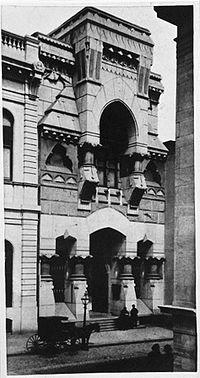
in Complexity and Contradiction in Architecture (1966) wrote, not unadmiringly, of the National Bank of the Republic (later the Philadelphia Clearing House):
"The city street facade can provide a type of juxtaposed contradiction that is essentially two-dimensional. Frank Furness' Clearing House, now demolished like many of his best works in Philadelphia, contained an array of violent pressures within a rigid frame. The half-segmental arch, blocked by the submerged tower which, in turn, bisects the facade into a near duality, and the violent adjacencies of rectangles, squares, lunettes, and diagonals of contrasting sizes, compose a building seemingly held up by the buildings next door: it is an almost insane short story of a castle on a city street."
On the occasion of its centennial in 1969, the Philadelphia Chapter of the American Institute of Architects
American Institute of Architects
The American Institute of Architects is a professional organization for architects in the United States. Headquartered in Washington, D.C., the AIA offers education, government advocacy, community redevelopment, and public outreach to support the architecture profession and improve its public image...
memorialized Furness as its great architect of the past:
"For designing original and bold buildings free of the prevalent Victorian academicism and imitation, buildings of such vigor that the flood of classical traditionalism could not overwhelm them, or him, or his clients ...
For shaping iron and concrete with a sensitive understanding of their particular characteristics that was unique for his time ...
For his significance as innovator-architect along with his contemporaries John Root, Louis SullivanLouis SullivanLouis Henri Sullivan was an American architect, and has been called the "father of skyscrapers" and "father of modernism" He is considered by many as the creator of the modern skyscraper, was an influential architect and critic of the Chicago School, was a mentor to Frank Lloyd Wright, and an...
and Frank Lloyd WrightFrank Lloyd WrightFrank Lloyd Wright was an American architect, interior designer, writer and educator, who designed more than 1,000 structures and completed 500 works. Wright believed in designing structures which were in harmony with humanity and its environment, a philosophy he called organic architecture...
...
For his masterworks, the Pennsylvania Academy of the Fine ArtsPennsylvania Academy of the Fine ArtsThe Pennsylvania Academy of the Fine Arts is a museum and art school in Philadelphia, Pennsylvania. It was founded in 1805 and is the oldest art museum and school in the United States. The academy's museum is internationally known for its collections of 19th and 20th century American paintings,...
, the Provident Trust CompanyProvident Life & Trust CompanyThe Provident Life & Trust Company in Philadelphia, Pennsylvania, a demolished Victorian-era building by architect Frank Furness, is considered to have been one of his greatest works...
, the Baltimore and Ohio Railroad Station24th Street Station (Philadelphia)24th St. Station was an intercity railroad station built for the Baltimore and Ohio Railroad, designed by architect Frank Furness. It stood at 24th and Chestnut Streets in Philadelphia, Pennsylvania, and opened in 1888....
, and the University of Pennsylvania LibraryFisher Fine Arts LibraryThe Anne & Jerome Fisher Fine Arts Library, also known as the Furness Library, is located on the campus of the University of Pennsylvania, on the east side of College Green...
(now renamed the Furness Building) ...
For his outstanding abilities as draftsman, teacher and inventor ...
For being a founder of the Philadelphia Chapter and of the John Stewardson Memorial Scholarship in Architecture ...
And above all, for creating architecture of imagination, decisive self-reliance, courage, and often great beauty, an architecture which to our eyes and spirits still expresses the unusual personal character, spirit and courage for which he was awarded the Congressional Medal of HonorMedal of HonorThe Medal of Honor is the highest military decoration awarded by the United States government. It is bestowed by the President, in the name of Congress, upon members of the United States Armed Forces who distinguish themselves through "conspicuous gallantry and intrepidity at the risk of his or her...
for bravery on a Civil War battlefield."
In 1973, the Philadelphia Museum of Art
Philadelphia Museum of Art
The Philadelphia Museum of Art is among the largest art museums in the United States. It is located at the west end of the Benjamin Franklin Parkway in Philadelphia's Fairmount Park. The Museum was established in 1876 in conjunction with the Centennial Exposition of the same year...
mounted the first retrospective of Furness's work, curated by James F. O'Gorman
James F. O'Gorman
Dr. James F. O'Gorman is a leading American architectural historian, author, lecturer, editor, and consultant who taught for many years at Wellesley College. O'Gorman received a B.Arch. degree from Washington University in St. Louis in 1956 and an M.Arch. from the University of Illinois,...
, George E. Thomas and Hyman Myers. Thomas, Jeffrey A. Cohen and Michael J. Lewis authored Frank Furness: The Complete Works (1991, revised 1996), with an introduction by Robert Venturi
Robert Venturi
Robert Charles Venturi, Jr. is an American architect, founding principal of the firm Venturi, Scott Brown and Associates, and one of the major figures in the architecture of the twentieth century...
. Lewis wrote the first biography: Frank Furness: Architecture and the Violent Mind (2001).
Selected architectural works
Philadelphia buildings
- Northern Savings Fund Society Building, 1871-72.
- Thomas Hockley house, 1875.
- Parish House, St. Luke's ChurchChurch of St. Luke and The Epiphany (Philadelphia)The Church of Saint Luke and The Epiphany at 330 South 13th Street , Center City, Philadelphia, Pennsylvania, is an Episcopal church. It is part of the Diocese of Pennsylvania. The church was formed in 1898 as a result of the merger of St. Luke's Church and The Church of The Epiphany . Today the...
, Philadelphia, c. 1875. - Gatehouses, Philadelphia Zoological Gardens, 1875-76.
- Pennsylvania Academy of the Fine ArtsPennsylvania Academy of the Fine ArtsThe Pennsylvania Academy of the Fine Arts is a museum and art school in Philadelphia, Pennsylvania. It was founded in 1805 and is the oldest art museum and school in the United States. The academy's museum is internationally known for its collections of 19th and 20th century American paintings,...
, 1876. - Centennial National BankCentennial National Bank-History:The bank was chartered on January 19, 1876 to finance the Centennial Exposition.The bank's headquarters building, designed by noted Philadelphia architect Frank Furness, was completed in April 1876. The building's interior was modified in 1893, and again in 1899, when Philadelphia...
, 1876 (now Paul Peck Alumni Center, Drexel UniversityDrexel UniversityDrexel University is a private research university with the main campus located in Philadelphia, Pennsylvania, USA. It was founded in 1891 by Anthony J. Drexel, a noted financier and philanthropist. Drexel offers 70 full-time undergraduate programs and accelerated degrees...
). - Kensington National Bank, 1877.
- KnowltonKnowlton MansionKnowlton Mansion, also known as the Rhawn Residence, is a historic mansion in the Fox Chase neighborhood of Philadelphia, Pennsylvania, United States....
(William H. Rhawn mansion), 1881. - Undine Barge ClubUndine Barge ClubUndine Barge Club is an amateur rowing club located at #13 Boathouse Row in the historic Boathouse Row along the Schuylkill River in Philadelphia, Pennsylvania. The club was founded in 1856. Undine was not initially listed as a founder of the Schuylkill Navy, but is now considered a founder...
, 1882-83. - First Unitarian Church of PhiladelphiaFirst Unitarian Church of PhiladelphiaThe First Unitarian Church of Philadelphia is a Unitarian Universalist congregation located at 2125 Chestnut Street in Philadelphia, Pennsylvania...
, 1885. - University of Pennsylvania LibraryFisher Fine Arts LibraryThe Anne & Jerome Fisher Fine Arts Library, also known as the Furness Library, is located on the campus of the University of Pennsylvania, on the east side of College Green...
, 1891 (now the Anne and Jerome Fisher Fine Arts Library). - Mortuary Chapel, Mount Sinai Cemetery (Frankford), 1891-92.
- Horace Jayne house, 1895.
- Girard Trust Company Building, 1907 (now The Ritz-Carlton PhiladelphiaThe Ritz-Carlton PhiladelphiaThe Ritz-Carlton Philadelphia is a 394 feet 30-storey skyscraper located south of City Hall in the Center City of Philadelphia, Pennsylvania. It was built in 1930-1931 as the Girard Trust Building. The tower was actually an addition to a domed low-rise building which was constructed in 1908. It...
) constructed for the Girard Trust Company.
Demolished Philadelphia buildings
- Germantown Unitarian Church, 1866-67
- Rodef Shalom Synagogue, 1868-69.
- Thomas and H. Pratt McKean townhouses, 1923-25 Walnut St., 1869, demolished 1897 and 1920s.
- Lutheran Church of the Holy Communion, 1870-75.
- Guarantee Trust and Safe Deposit Company, 1875.
- Brazilian Section, Main Exhibition Building, Centennial ExpositionCentennial ExpositionThe Centennial International Exhibition of 1876, the first official World's Fair in the United States, was held in Philadelphia, Pennsylvania, from May 10 to November 10, 1876, to celebrate the 100th anniversary of the signing of the Declaration of Independence in Philadelphia. It was officially...
(1876). - Church of the Redeemer for Seamen and their Families, 1878.
- Provident Life & Trust CompanyProvident Life & Trust CompanyThe Provident Life & Trust Company in Philadelphia, Pennsylvania, a demolished Victorian-era building by architect Frank Furness, is considered to have been one of his greatest works...
, 1879. - Library Company of Philadelphia Building, 1879-80.
- Reliance Insurance CompanyReliance Insurance CompanyReliance Insurance Company, now officially known as Reliance Insurance Company [in Liquidation], was founded in Philadelphia in 1817 and has undergone numerous corporate makeovers in the intervening years...
Building, 1881-82. - National Bank of the Republic (later Philadelphia Clearing House), 1883-84.
- Baltimore & Ohio Railroad Station (24th Street Station)24th Street Station (Philadelphia)24th St. Station was an intercity railroad station built for the Baltimore and Ohio Railroad, designed by architect Frank Furness. It stood at 24th and Chestnut Streets in Philadelphia, Pennsylvania, and opened in 1888....
, 1886-88. - Alexander J. Cassatt townhouse, 202 West Rittenhouse Square, c. 1888.
- Broad Street StationBroad Street Station (Philadelphia)Broad Street Station at Broad & Market Streets was the primary passenger terminal for the Pennsylvania Railroad in Philadelphia, Pennsylvania from 1881 to the 1950s...
, Pennsylvania RailroadPennsylvania RailroadThe Pennsylvania Railroad was an American Class I railroad, founded in 1846. Commonly referred to as the "Pennsy", the PRR was headquartered in Philadelphia, Pennsylvania....
, 1892-93. - Arcade Building and pedestrian bridge to Broad Street Station, 1901-02.
Buildings elsewhere
- Grubb Cottage (E. Burd Grubb Estate), Burlington, New Jersey, 1872
- Lindenshade (Horace Howard Furness house), Wallingford, PA, 1873 (demolished 1940).
- Fairholme (Fairman RogersFairman RogersFairman Rogers was an American civil engineer, educator, and philanthropist, born in Philadelphia, Pennsylvania....
mansion) Carriage House, Newport, Rhode IslandNewport, Rhode IslandNewport is a city on Aquidneck Island in Newport County, Rhode Island, United States, about south of Providence. Known as a New England summer resort and for the famous Newport Mansions, it is the home of Salve Regina University and Naval Station Newport which houses the United States Naval War...
, 1874-1875 (now Jean and David W. Wallace Hall, Salve Regina UniversitySalve Regina UniversitySalve Regina University is a university in Newport, Rhode Island. Founded by the Sisters of Mercy, the university is a Catholic, co-educational, private, non-profit institution chartered by the State of Rhode Island in 1934. In 1947 the university acquired Ochre Court and welcomed its first class...
). - J. F. Fryer cottage, Cape May, New JerseyCape May, New JerseyCape May is a city at the southern tip of Cape May Peninsula in Cape May County, New Jersey, where the Delaware Bay meets the Atlantic Ocean and is one of the country's oldest vacation resort destinations. It is part of the Ocean City Metropolitan Statistical Area. As of the 2010 United States...
, 1878-79. - Emlen Physick houseEmlen Physick EstateThe Emlen Physick Estate is a Victorian house museum in Cape May, New Jersey, located at 1048 Washington Street. The 18-room mansion, attributed to acclaimed American architect Frank Furness, was built in 1879 for Dr. Emlen Physick Jr. , descendant of a well-known Philadelphia family, his widowed...
, Cape May, New JerseyCape May, New JerseyCape May is a city at the southern tip of Cape May Peninsula in Cape May County, New Jersey, where the Delaware Bay meets the Atlantic Ocean and is one of the country's oldest vacation resort destinations. It is part of the Ocean City Metropolitan Statistical Area. As of the 2010 United States...
, 1879. - Wallingford StationWallingford (SEPTA station)Wallingford is a railway station along the SEPTA Media/Elwyn Line, the former Pennsylvania Railroad West Chester Line. It is located at Kershaw Road and Possum Hollow Road , Wallingford, Pennsylvania....
, Wallingford, Pennsylvania, c. 1880. - Dolobran (Clement A. GriscomClement GriscomClement Acton Griscom was a prominent American Quaker businessman and nineteenth century shipping magnate.-Biography:...
mansion), Haverford, PennsylvaniaHaverford, PennsylvaniaHaverford is an unincorporated community located partially in Haverford Township in Delaware County, Pennsylvania, USA, but primarily in Lower Merion Township in Montgomery County, about west of Philadelphia. It is on the Main Line, which is known historically for its wealth. As of August 2009,...
, 1881. - St. Michael's Protestant Episcopal Church, Birdsboro, PennsylvaniaBirdsboro, PennsylvaniaBirdsboro is a borough along the Schuylkill River in Berks County, Pennsylvania, eight miles southeast of Reading. In the past, Birdsboro was noted for its large foundries and machine shops, none of which remain in operation today.-History:...
, 1884-85. - Sixth Pennsylvania Cavalry (Rush's Lancers) Monument, Gettysburg Battlefield, Gettysburg, PennsylvaniaGettysburg, PennsylvaniaGettysburg is a borough that is the county seat, part of the Gettysburg Battlefield, and the eponym for the 1863 Battle of Gettysburg. The town hosts visitors to the Gettysburg National Military Park and has 3 institutions of higher learning: Lutheran Theological Seminary, Gettysburg College, and...
, 1888. - Idlewild (Frank Furness house), Idlewild Lane, Media, PA (c. 1888)
- Williamson Free School of Mechanical TradesWilliamson Free School of Mechanical TradesThe Williamson Free School of Mechanical Trades is a men's junior trade college located in Media, Pennsylvania, 14 miles away from both Philadelphia and Wilmington, Delaware...
, Elwyn, PennsylvaniaElwyn, PennsylvaniaElwyn is a town in the Philadelphia-Camden metropolitan area. Elwyn is in Middletown Township, Delaware County, Pennsylvania, USA. Middletown Township had a population of 16,000 in the 2000 census...
, 1889-90. - Baldwin SchoolBaldwin SchoolThe Baldwin School is an all-girls private day school located in Bryn Mawr, Pennsylvania. The school, founded in 1888 by Florence Baldwin, consists of a Lower, Middle, and Upper School totaling approximately 600 in enrollment...
(built as the second Bryn Mawr Hotel), Bryn Mawr, PennsylvaniaBryn Mawr, PennsylvaniaBryn Mawr from Welsh for "big hill") is a census-designated place in Lower Merion Township, Montgomery County, Pennsylvania, just west of Philadelphia along Lancaster Avenue and the border with Delaware County...
, 1890. - Church of Our Father, Hull's Cove, Mount Desert Island, Maine, 1890-91.
- Recitation Hall, University of DelawareUniversity of DelawareThe university is organized into seven colleges:* College of Agriculture and Natural Resources* College of Arts and Sciences* Alfred Lerner College of Business and Economics* College of Earth, Ocean and Environment* College of Education and Human Development...
, Newark, DelawareNewark, DelawareNewark is an American city in New Castle County, Delaware, west-southwest of Wilmington. According to the 2010 Census, the population of the city is 31,454. Newark is the home of the University of Delaware.- History :...
, 1891. - New Castle Public Library, New Castle, DelawareNew Castle, DelawareNew Castle is a city in New Castle County, Delaware, six miles south of Wilmington, situated on the Delaware River. In 1900, 3,380 people lived here; in 1910, 3,351...
, 1892 (now Old Library Museum, New Castle Historical Society). - Merion Cricket ClubMerion Cricket ClubMerion Cricket Club is a private club in Haverford, Pennsylvania, founded in 1865. The current clubhouse is its sixth, the last four having been designed by Philadelphia architect Frank Furness and his partner, Allen Evans .-History:...
, Haverford, PennsylvaniaHaverford, PennsylvaniaHaverford is an unincorporated community located partially in Haverford Township in Delaware County, Pennsylvania, USA, but primarily in Lower Merion Township in Montgomery County, about west of Philadelphia. It is on the Main Line, which is known historically for its wealth. As of August 2009,...
(Allen Evans, Furness's partner, is credited with the design), 1896-97. - Haverford School, Haverford, PennsylvaniaHaverford, PennsylvaniaHaverford is an unincorporated community located partially in Haverford Township in Delaware County, Pennsylvania, USA, but primarily in Lower Merion Township in Montgomery County, about west of Philadelphia. It is on the Main Line, which is known historically for its wealth. As of August 2009,...
, 1902.
Three adjacent buildings in Wilmington, Delaware
Reputed to be the largest grouping of Furness-designed railroad buildings.- Water Street Station, Baltimore & Ohio Railroad, ca. 1887.
- Pennsylvania Railroad Building, 1905.
- French Street StationWilmington Station (Delaware)Joseph R. Biden Jr. Railroad Station, normally called Wilmington Station, is a passenger rail station in Wilmington, Delaware, formerly known as Pennsylvania Station. The station is located on Front Street between French and Walnut Streets in downtown Wilmington...
(Wilmington Station), Pennsylvania RailroadPennsylvania RailroadThe Pennsylvania Railroad was an American Class I railroad, founded in 1846. Commonly referred to as the "Pennsy", the PRR was headquartered in Philadelphia, Pennsylvania....
(now AmtrakAmtrakThe National Railroad Passenger Corporation, doing business as Amtrak , is a government-owned corporation that was organized on May 1, 1971, to provide intercity passenger train service in the United States. "Amtrak" is a portmanteau of the words "America" and "track". It is headquartered at Union...
), 1908.
See also
- List of American Civil War Medal of Honor recipients: A–F
External links
- Project List - Furness, Evans & Co. at Philadelphia Architects and Buildings
- Project List - Frank Furness at Philadelphia Architects and Buildings
- Friends of Furness Railroad District in WilmingtonWilmington, DelawareWilmington is the largest city in the state of Delaware, United States, and is located at the confluence of the Christina River and Brandywine Creek, near where the Christina flows into the Delaware River. It is the county seat of New Castle County and one of the major cities in the Delaware Valley...
, DelawareDelawareDelaware is a U.S. state located on the Atlantic Coast in the Mid-Atlantic region of the United States. It is bordered to the south and west by Maryland, and to the north by Pennsylvania...