


Baldwin Locomotive Works

Encyclopedia
The Baldwin Locomotive Works was an American
builder of railroad (railway) locomotive
s. It was located in Philadelphia, Pennsylvania
, originally, and later in nearby Eddystone, Pennsylvania
. Although the company was very successful as a producer of steam locomotive
s, its transition to the production of diesels
was far less so. Later, when the early demand for diesel locomotives to replace steam tapered off, Baldwin could not compete in the marketplace. It stopped producing locomotives in 1956 and went out of business in 1972.
, the founder, was a jeweller and silversmith
, who, in 1825, formed a partnership with a machinist, and engaged in the manufacture of bookbinders' tools and cylinders for calico printing. Baldwin then designed and constructed for his own use a small stationary engine, the workmanship of which was so excellent and its efficiency so great that he was solicited to build others like it for various parties, and thus led to turn his attention to steam engineering. The original engine was in use and powered many departments of the works for well over 60 years. It still exists in the Smithsonian Institution
in Washington, DC.
In 1831, at the request of the Philadelphia Museum, he built a miniature locomotive for exhibition which was such a success that he that year received an order from a railway company for a locomotive to run on a short line to the suburbs of Philadelphia. The Camden and Amboy Railroad Company (C&A) had shortly before imported a locomotive (John Bull
) from England
, which was stored in Bordentown, New Jersey
. It had not yet been assembled by Isaac Dripps (under the direction of C&A president Robert L. Stevens) when Baldwin visited the spot. He inspected the detached parts and made notes of the principal dimensions. Aided by these figures, he commenced his task.
The difficulties attending the execution of this first order were such that they are not easily comprehened by present day mechanics. Modern machine tools simply did not exist; the cylinders were bored by a chisel fixed in a block of wood and turned by hand; the workmen had to be taught how to do nearly all the work; and Baldwin himself did a great deal of it with his own hands.
It was under such circumstances that his first locomotive, christened Old Ironsides, was completed and tried on the Philadelphia, Germantown and Norristown Railroad on November 23, 1832. It was at once put in active service, and did duty for over 20 years. It was a four-wheeled engine, weighing a little over five ton
s; the driving wheels were 54 inches (1.37 m) in diameter, and the cylinders 9½ inches (24 cm) in diameter by 18 inches (45.7 cm) stroke
. The wheels were of heavy cast iron hubs, with wooden spokes and rims, and wrought iron tires, and the frame was made of wood placed outside the wheels.
. Production fell from 40 locomotives in 1837 to just nine in 1840 and the company was heavily in debt. As part of the survival strategy, Matthias Baldwin took on two partners, George Vail and George Hufty. Although the partnerships proved relatively short-lived, they helped Baldwin pull through the economic hard times.
Zerah Colburn
was one of many engineers who had a close association with the Baldwin Locomotive Works. Between 1854 and the start of his weekly paper, the Railroad Advocate
and 1861, when Colburn went to work more or less permanently in London, England
, the journalist was in frequent touch with M. W. Baldwin, as recorded in Zerah Colburn: The Spirit of Darkness. Colburn was full of praise for the quality of Baldwin's work.
Initially, Baldwin would build many more steam locomotive
s at its cramped 196 acre
(0.79 km2) Broad Street Philadelphia shop but would begin an incremental shift in production to a 616 acre (2.5 km2) site located at Spring Street in nearby Eddystone, Pennsylvania
, in 1906. Broad Street was constricted, but even so, it was a huge complex, occupying the better part of 8 square city blocks from Broad to 18th St. and Spring Garden to the Reading tracks just past Noble Street. Eddystone on the other hand was spread out over 600 acres. Its capacity was well over 3000 locomotives per year. The move from Broad Street was completed in the late 1920s.
In the 1850s, railroad building became a national obsession, with many new carriers starting up, particularly in the Midwest and South. While this helped drive up demand for Baldwin products, it also increased competition as more companies entered the locomotive-production field.
Still, Baldwin had trouble keeping pace with orders and in the early 1850s began paying workers piece-rate
pay. Taking advantage of human nature, this increased incentives and productivity. By 1857, the company turned out 66 locomotives and employed 600 men. But another economic downturn, this time the Panic of 1857
, cut into business again. Output fell by 50 percent in 1858.
at first appeared disastrous for Baldwin. According to John K. Brown in The Baldwin Locomotive Works, 1831-1915: A Study in American Industrial Practice, at the start of the conflict Baldwin had a great dependence on Southern railways as its primary market. In 1860, nearly 80 percent of Baldwin's output went to carriers in states that would soon secede from the Union. As a result, Baldwin's production in 1861 fell more than 50 percent compared to the previous year. However, the loss in Southern sales was counterbalanced by purchases by the U.S. Military Railroads and the Pennsylvania Railroad
, which saw its traffic soar, as Baldwin produced more than 100 engines for carrier during the 1861–1865 war.
By the time Matthias Baldwin died in 1866, his company was vying with Rogers Locomotive and Machine Works
for the top spot among locomotive producers. By 1870 Baldwin had taken the lead and a decade later, it was producing 2½ times as many engines as its nearest competitor, according to the U.S. Manufacturing Census.
stepped up its activities. This, coupled with the Hepburn act, precipitated the Panic of 1907
. Both of these events would have a direct negative effect on the railway industry, especially the locomotive builders.
One the key blows to Baldwin and the railroad industry as a whole was the Hepburn Act
, which was passed in 1906. The act revitalized the Interstate Commerce Commission and authorized greater governmental authority over railroads. Thanks to the Hepburn Act, the ICC was given the power to set maximum railroad rates. It also included a provision that gave the ICC the power to replace existing rates with “just-and-reasonable” maximum rates, with the ICC to define what was just and reasonable.
The limitation on railroad rates depreciated the value of railroad securities, a factor in causing the Panic of 1907.
What it meant to Baldwin was that railroad carriers stopped ordering new locomotives. Baldwin’s output dropped from 2,666 locomotives in 1906 to 614 in 1908. The company cut its workforce from 18,499 workers in 1907 to 4,600 the following year. Baldwin’s business was further imperiled when William P. Henszey, one of Baldwin’s partners died, leaving Baldwin with a US $6 million liability. In response, Baldwin incorporated and released US $10 million worth of bonds. Samuel Vauclain
wanted to use these funds to expand Baldwin’s capacities so it would be prepared for another boom. While other Baldwin officers opposed this expansion, Vauclain’s vision won out; Baldwin would continue to expand its Eddystone plant until its completion in 1928. By 1928, the company moved all locomotive production there though the plant would never exceed more than one-third of its production capacity.
war effort in World War I
. Baldwin built 5,551 locomotives for the Allies including separate designs for Russian, French, British and United States Trench railways
. Baldwin built railway gun
carriages for the United States Navy
and manufactured 6,565,355 artillery shells for Russia, England and the United States. From 1915 to 1918, Remington Arms
subcontracted the production of nearly 2 million Pattern 1914 Enfield and M1917 Enfield rifle
s to the Baldwin Locomotive Works.
After the end of World War I Baldwin continued to supply export orders as the European powers strove to replace large numbers of locomotives worn out by the war effort and European locomotive factories were still re-tooling from armaments production back to railroad production. In 1919 and 1920 Baldwin supplied 50 4-6-0 locomotives to the Palestine Military Railway that became the Palestine Railways H class
.
became the standard on American railways. By the 1920s the major locomotive manufacturers had strong incentives to maintain the dominance of the steam engine. Nevertheless, Alco
, while remaining committed to steam production, pursued R&D strategies in the 1920s and '30s that would ensure its competitiveness in the event that diesel locomotives would predominate. In contrast, Baldwin opposed any development of diesel locomotive technology in the 1930s. In 1930 Samuel Vauclain, Chairman of the Board, stated in a speech that advances in steam technology would ensure the dominance of the steam engine until at least 1980. Baldwin’s Vice President and Director of Sales stated in December 1937 that “Some time in the future, when all this is reviewed, it will be found that our railroads are no more dieselized than they electrified.” Baldwin had deep roots in the steam locomotive industry, and may have been influenced by heavy investment in its Eddystone plant. Baldwin began an attempt to diversify its product line in 1929, but the Great Depression
thwarted these efforts and Baldwin declared bankruptcy
in 1935.
When Baldwin emerged from bankruptcy in 1938 it underwent a drastic change in management. The new management was dedicated to diesel power but the company was already too far behind. Business declined drastically in the postwar years as EMD and Alco seized the bulk of the diesel market from Baldwin, Lima-Hamilton and Fairbanks-Morse
.
In 1939 Baldwin offered its first standard line of diesel locomotives, all designed for yard service. By this time, General Motors
had already marketing its first diesel road freight locomotive. Two years later the United States' entry into World War II
destroyed Baldwin's diesel development program when the War Production Board
dictated that Alco
and Baldwin produce only steamers and diesel-electric yard switching engines. Electro-Motive Division (EMD) was assigned the task of producing road freight diesels (namely, the FT
series), which might plausibly have given the latter a distinct advantage over its competitors in that product line in the years that followed World War II, due to the head start in diesel R&D and production. But longtime GM leader Alfred P. Sloan
presents a timeline in his memoir that belies this assumption. He says that GM's diesel-engine R&D efforts of the 1920s and 1930s, and its application of model design standardization (yielding lower unit costs) and marketing lessons learned in the automotive industry, were the principal reason for EMD's competitive advantage in the late 1940s and afterward (clearly implying that the wartime production assignments were merely nails in a coffin that Baldwin and Lima had already built for themselves before the war). In his telling, the R&D needed to adapt earlier diesels (best suited to marine and stationary use) to locomotive use (smaller; higher power-to-weight ratio; more reliable given more vibration and less maintenance) was a capital-intensive
project that almost no one among the railroad owners or locomotive builders was willing (latter) or able (former) to invest in during the 1920s and 1930s, save the people of Winton, Electro-Motive, and Charles F. Kettering of the GM Research Corporation.
During World War II
Baldwin was one of the manufacturers of the Sherman tank.
Between 1940 and 1948, domestic steam locomotive sales declined from 30 percent of the market to 2 percent. By 1949, there was no demand for steam locomotives. In July 1948 Westinghouse Electric, which had teamed with Baldwin to build diesel and electric carbodies, purchased 500,000 shares, or 21 percent, of Baldwin stock, which made Westinghouse Baldwin's largest shareholder. Baldwin used the money to cover various debts. Westinghouse vice president Marvin W. Smith became Baldwin's president in May 1949. In a move to diversify its operations Baldwin merged with Lima-Hamilton on December 4, 1950, to become Baldwin-Lima-Hamilton. However market share continued to dwindle. In 1953 Westinghouse discontinued building electrical traction equipment, and so Baldwin was forced to purchase electrical equipment from General Electric
.
In 1965 Baldwin became a wholly owned subsidiary of Armour and Company
. Greyhound Corporation
purchased Armour and Company in 1970, and in 1972 Greyhound closed Baldwin-Lima for good. Even so, thousands of Baldwin steamers and diesel locomotives can still be found today, prowling many of the world's rails with builders plates proudly procaiming "Baldwin Locomotive Works, Philadelphia, USA".
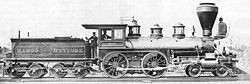
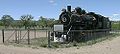
 Baldwin built many 4-4-0
"American" type locomotives, surviving examples of which include the 1872 Countess of Dufferin
and 1875's Virginia and Truckee Railroad No.22 "Inyo", but it was perhaps best known for the 2-8-2
"Mikado" and 2-8-0
"Consolidation" types. It was also well known for the unique cab-forward 4-8-8-2
articulateds built for the Southern Pacific Company and massive 2-10-2
for the Atchison, Topeka and Santa Fe Railway
. Baldwin also produced the most powerful steam engines in history, the 2-8-8-4
"Yellowstone" for the Duluth, Missabe and Iron Range Railroad. Yellowstone could put down over 140000 lbf (622.8 kN) of tractive force. The Yellowstones were so good that the D,M&IR refused to part with them; they hauled ore trains well into the diesel era, and the last one retired in the late 1960s. Three still survive. One of Baldwin's last new and improved locomotive designs were the 4-8-4
"Northern" locomotives. Baldwin's last domestic steam locomotives were 2-6-6-2
s built for the Chesapeake and Ohio Railway
in 1949. Baldwin 60000
, the company's 1926 demonstration steam locomotive, is on display at the Franklin Institute
in Philadelphia.
On a separate note, the restored and running 2-6-2
steam locomotive at Fort Edmonton Park
was built by Baldwin in 1919.
Baldwin Locomotive Works built steam engines for narrow-gauge railways as well. They also built many boilers for heating and powering buildings and industry. One of the more notable series of narrow gauge locomotives built by Baldwin was the K-36 class Mikados of the Denver and Rio Grande Western RR. Built in 1925, the fleet of ten has seen only one scrapped (485 in 1955, as a result of falling into the turntable pit in Salida, CO). Of the nine remaining, eight of the nine are operating today on the Durango and Silverton RR, or the Cumbres and Toltec Scenic RR.
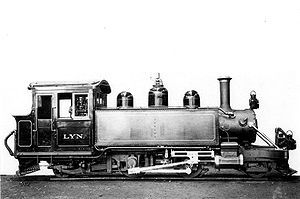
A six-ton, 60-cm gauge 4-4-0 built for the Tacubaya Railroad in 1897 was the smallest ever built by Baldwin for commercial use. The Baldwin works built a 2-4-2T tank engine - Lyn
- for the 1 foot gauge Lynton and Barnstaple Railway
in England in 1898. The loco was shipped in crates and assembled at the line's Pilton Yard but was scrapped when the line closed in 1935. A replica locomotive is under construction and this will carry the name 'Lyn'. This locomotive is being built by L&B revivalists, scheduled for completion in 2012 and is currently at The Boston Lodge works of the Ffestiniog Railway in North Wales UK.
In the same year two 2-6-2T 'Prairie' tank engines were built for Victorian Railways
(VR). They were used as a trial on the new 2 in 6 in (762 mm) narrow gauge railways. Fifteen more NA class
locomotives were built by VR. Unfortunately only six have survived and both of the original Baldwin engines were among those scrapped.
The Welsh Highland Railway
in Wales
borrowed a 4-6-0 WD pannier tank engine from Baldwin during World War I
. Unfortunately this locomotive was scrapped in the 1940s due to being prone to rough riding and derailments. But the Welsh Highland Railway
is planning to build a full-scale replica of this locomotive numbered 794.
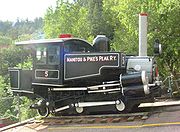
Baldwin also built three engines for the Manitou and Pike's Peak Railway
, which were delivered in 1890. A fourth was delivered in 1892. These engines featured steeply inclined boilers and used the Abt rack system to propel them up the average 16 percent grade. Over the years the engines were scrapped or rebuilt. The last Baldwin engine was taken out of regular service in 1955. During the following years the engines were used as back-up engines and for snow removal. Three of the engines are currently on static display around Colorado
. One (No. 1) is located at the Colorado Railroad Museum
in Golden, Colorado
. The other two on display are located in Manitou Springs, Colorado
: one (No. 2) near city hall and the other (No. 5) at the Manitou and Pike's Peak Railway
depot. The fourth engine (No. 4) is still in limited operation for photo opportunities and special events. However, it no longer completes the journey to the top of Pike's Peak due to the fact that many of the water tanks along the line have been removed.
Number 6 (builder plate number 12288), a 36" 2-6-0
was built by Baldwin in 1891 for the Surry Sussex & Southampton Railway in Virginia. The SS&S installed Southern valve gear
, a graceful outside drive gear. The 6 was eventually sold to the Argent Lumber Company in South Carolina. In 1960, the 6 was purchased by southeastern Iowa's Midwest Central Railroad
as part of a package deal including the 2 (below). It was the first locomotive to operate on a regular basis at the MCRR and was their main engine until 1971 when it was taken out of service for a major overhaul. Completed in 1988, this ground up rebuild included a new boiler and conversion to oil fire. A "medium" boiler repair was started in 2009, with the work completed in September 2010, in time for the 2010 Midwest Old Thresher's Reunion.
The Midwest Central Railroad
also owns Number 2, a 36" 2-6-0
, which was built for the New Berlin & Winfield Railroad in 1906. The NB&W operated an 8 miles (12.9 km) line in Pennsylvania for an agricultural community. The 2 hauled freight and passengers on this small operation until the mid 1910's. In 1917, the locomotive was sold to the Argent Lumber Company in South Carolina where it worked along with the 6 in swamp trackage, hauling logs to the mill in Hardeeville. Upon arrival at the MCRR in 1960, it received substantial repairs and was put into service by the early 70's, replacing the 6 as the MCRR's main engine. In 1987, the 2 was taken out of service for a complete rebuild which is still in progress as of January 2011.
to build electric locomotive
s for American and foreign markets. The electric locomotive was increasingly popular; electrification was expensive, but for high traffic levels or mountainous terrain it could pay for itself, and in addition some cities like New York, were banning the steam locomotive because of its pollution and the propensity for accidents in smoke-choked terminals. Baldwin built or subcontracted out the bodywork and running gear, and Westinghouse built the electrical gear.
Baldwin built the famed EP-1 (1906), EF-1 (1912) and EP-2 (1923) box cab electric locomotives for the New York, New Haven and Hartford Railroad
. Baldwin also delivered the EP-3 box cab electric locomotives to the Milwaukee Road
for use on their line between Harlowton, Montana
, and Avery, Idaho
.
Baldwin built several electric locomotive types for the Pennsylvania Railroad
as well including the P5A, R1 and the famed GG1
. Baldwin built the first GG1 prototype electric locomotive for use on the Pennsylvania Railroad’s electrified line, which was completed in 1935 between New York and Washington, D.C.
class 6-8-6
steam turbine locomotive
for the Pennsylvania Railroad.
Between 1947 and 1948 Baldwin built three unique coal
-fired steam turbine-electric locomotives, designed for passenger service on the Chesapeake and Ohio Railway
(C&O). The 6000 hp units, which were equipped with Westinghouse electrical systems and had a 2-C1+2-C1-B wheel arrangement, were 106 feet (32 m) long, making them the longest locomotives ever built for passenger service. The cab was mounted in the center, with a coal bunker ahead of it and a backwards-mounted boiler behind it (the tender only carried water). These locomotives were intended for a route from Washington, D.C.
, to Cincinnati, Ohio
, but could never travel the whole route without some sort of failure. Coal dust
and water frequently got into the traction motors. These problems could have been fixed given time, but it was obvious that these locomotives would always be expensive to maintain, and all three were scrapped in 1950.
In May 1954 Baldwin built a 4500 hp steam turbine-electric locomotive for freight service on the Norfolk and Western Railway
(N&W), nicknamed the "Jawn Henry" after the legend of John Henry
, a steel-driver on a track crew who famously raced against a steam drill and won, only to die immediately afterwards. The unit was similar in appearance to the C&O turbines but very different mechanically; it had a C+C-C+C wheel arrangement, and an improved watertube boiler which was fitted with automatic controls. Unfortunately the boiler controls were sometimes problematic, and (as with the C&O turbines) coal dust and water got into the motors. "Jawn Henry" was retired from the N&W roster on January 4, 1958.
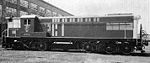 Baldwin switchers were well known for their haulage ability, but the company failed to make the jump to building reliable road units. Baldwin also misjudged the market, remaining fond of steam power and concentrating on products of little interest to railroads.
Baldwin diesel locomotives, though fairly successful in the marketplace, did not do so well as others. Baldwins, thanks to their robust Westinghouse
electrical gear, were excellent haulers, but the diesel prime movers were less reliable than comparable EMD and ALCO products.
:Category:Baldwin locomotives
United States
The United States of America is a federal constitutional republic comprising fifty states and a federal district...
builder of railroad (railway) locomotive
Locomotive
A locomotive is a railway vehicle that provides the motive power for a train. The word originates from the Latin loco – "from a place", ablative of locus, "place" + Medieval Latin motivus, "causing motion", and is a shortened form of the term locomotive engine, first used in the early 19th...
s. It was located in Philadelphia, Pennsylvania
Philadelphia, Pennsylvania
Philadelphia is the largest city in the Commonwealth of Pennsylvania and the county seat of Philadelphia County, with which it is coterminous. The city is located in the Northeastern United States along the Delaware and Schuylkill rivers. It is the fifth-most-populous city in the United States,...
, originally, and later in nearby Eddystone, Pennsylvania
Eddystone, Pennsylvania
Eddystone is a borough in Delaware County, Pennsylvania, United States. The population was 2,442 at the 2000 census.-Early history:The area at the mouth of Ridley Creek was first called "Tequirassy" by Native Americans. The land was owned by Olof Persson Stille, one of the early settlers from New...
. Although the company was very successful as a producer of steam locomotive
Steam locomotive
A steam locomotive is a railway locomotive that produces its power through a steam engine. These locomotives are fueled by burning some combustible material, usually coal, wood or oil, to produce steam in a boiler, which drives the steam engine...
s, its transition to the production of diesels
Diesel locomotive
A diesel locomotive is a type of railroad locomotive in which the prime mover is a diesel engine, a reciprocating engine operating on the Diesel cycle as invented by Dr. Rudolf Diesel...
was far less so. Later, when the early demand for diesel locomotives to replace steam tapered off, Baldwin could not compete in the marketplace. It stopped producing locomotives in 1956 and went out of business in 1972.
Beginning
The Baldwin Locomotive Works had a humble beginning. Matthias W. BaldwinMatthias W. Baldwin
Matthias William Baldwin was an American manufacturer of steam locomotives. He opened his machine shop in 1825...
, the founder, was a jeweller and silversmith
Silversmith
A silversmith is a craftsperson who makes objects from silver or gold. The terms 'silversmith' and 'goldsmith' are not synonyms as the techniques, training, history, and guilds are or were largely the same but the end product varies greatly as does the scale of objects created.Silversmithing is the...
, who, in 1825, formed a partnership with a machinist, and engaged in the manufacture of bookbinders' tools and cylinders for calico printing. Baldwin then designed and constructed for his own use a small stationary engine, the workmanship of which was so excellent and its efficiency so great that he was solicited to build others like it for various parties, and thus led to turn his attention to steam engineering. The original engine was in use and powered many departments of the works for well over 60 years. It still exists in the Smithsonian Institution
Smithsonian Institution
The Smithsonian Institution is an educational and research institute and associated museum complex, administered and funded by the government of the United States and by funds from its endowment, contributions, and profits from its retail operations, concessions, licensing activities, and magazines...
in Washington, DC.
In 1831, at the request of the Philadelphia Museum, he built a miniature locomotive for exhibition which was such a success that he that year received an order from a railway company for a locomotive to run on a short line to the suburbs of Philadelphia. The Camden and Amboy Railroad Company (C&A) had shortly before imported a locomotive (John Bull
John Bull (locomotive)
John Bull is a British-built railroad steam locomotive that operated in the United States. It was operated for the first time on September 15, 1831, and it became the oldest operable steam locomotive in the world when the Smithsonian Institution operated it in 1981...
) from England
England
England is a country that is part of the United Kingdom. It shares land borders with Scotland to the north and Wales to the west; the Irish Sea is to the north west, the Celtic Sea to the south west, with the North Sea to the east and the English Channel to the south separating it from continental...
, which was stored in Bordentown, New Jersey
Bordentown, New Jersey
Bordentown City is in Burlington County, New Jersey, United States. As of the 2010 United States Census, the city population was 3,924. Bordentown is located at the confluence of the Delaware River, Blacks Creek and Crosswicks Creek...
. It had not yet been assembled by Isaac Dripps (under the direction of C&A president Robert L. Stevens) when Baldwin visited the spot. He inspected the detached parts and made notes of the principal dimensions. Aided by these figures, he commenced his task.
The difficulties attending the execution of this first order were such that they are not easily comprehened by present day mechanics. Modern machine tools simply did not exist; the cylinders were bored by a chisel fixed in a block of wood and turned by hand; the workmen had to be taught how to do nearly all the work; and Baldwin himself did a great deal of it with his own hands.
It was under such circumstances that his first locomotive, christened Old Ironsides, was completed and tried on the Philadelphia, Germantown and Norristown Railroad on November 23, 1832. It was at once put in active service, and did duty for over 20 years. It was a four-wheeled engine, weighing a little over five ton
Ton
The ton is a unit of measure. It has a long history and has acquired a number of meanings and uses over the years. It is used principally as a unit of weight, and as a unit of volume. It can also be used as a measure of energy, for truck classification, or as a colloquial term.It is derived from...
s; the driving wheels were 54 inches (1.37 m) in diameter, and the cylinders 9½ inches (24 cm) in diameter by 18 inches (45.7 cm) stroke
Stroke
A stroke, previously known medically as a cerebrovascular accident , is the rapidly developing loss of brain function due to disturbance in the blood supply to the brain. This can be due to ischemia caused by blockage , or a hemorrhage...
. The wheels were of heavy cast iron hubs, with wooden spokes and rims, and wrought iron tires, and the frame was made of wood placed outside the wheels.
Early Years
Baldwin struggled to survive the Panic of 1837Panic of 1837
The Panic of 1837 was a financial crisis or market correction in the United States built on a speculative fever. The end of the Second Bank of the United States had produced a period of runaway inflation, but on May 10, 1837 in New York City, every bank began to accept payment only in specie ,...
. Production fell from 40 locomotives in 1837 to just nine in 1840 and the company was heavily in debt. As part of the survival strategy, Matthias Baldwin took on two partners, George Vail and George Hufty. Although the partnerships proved relatively short-lived, they helped Baldwin pull through the economic hard times.
Zerah Colburn
Zerah Colburn (locomotive designer)
Zerah Colburn was an American engineer specialising in steam locomotive design, technical journalist and publisher.- Career :Without any formal schooling, Colburn was a teenage prodigy...
was one of many engineers who had a close association with the Baldwin Locomotive Works. Between 1854 and the start of his weekly paper, the Railroad Advocate
Railroad Advocate
The Railroad Advocate was a weekly newspaper started by Zerah Colburn, the locomotive designer, editor, and publisher. The first issue appeared on November 11, 1854, when it was titled the Rail Road Advocate. It later became Colburn's Railroad Advocate, and then Holley's Railroad Advocate when it...
and 1861, when Colburn went to work more or less permanently in London, England
England
England is a country that is part of the United Kingdom. It shares land borders with Scotland to the north and Wales to the west; the Irish Sea is to the north west, the Celtic Sea to the south west, with the North Sea to the east and the English Channel to the south separating it from continental...
, the journalist was in frequent touch with M. W. Baldwin, as recorded in Zerah Colburn: The Spirit of Darkness. Colburn was full of praise for the quality of Baldwin's work.
Initially, Baldwin would build many more steam locomotive
Steam locomotive
A steam locomotive is a railway locomotive that produces its power through a steam engine. These locomotives are fueled by burning some combustible material, usually coal, wood or oil, to produce steam in a boiler, which drives the steam engine...
s at its cramped 196 acre
Acre
The acre is a unit of area in a number of different systems, including the imperial and U.S. customary systems. The most commonly used acres today are the international acre and, in the United States, the survey acre. The most common use of the acre is to measure tracts of land.The acre is related...
(0.79 km2) Broad Street Philadelphia shop but would begin an incremental shift in production to a 616 acre (2.5 km2) site located at Spring Street in nearby Eddystone, Pennsylvania
Eddystone, Pennsylvania
Eddystone is a borough in Delaware County, Pennsylvania, United States. The population was 2,442 at the 2000 census.-Early history:The area at the mouth of Ridley Creek was first called "Tequirassy" by Native Americans. The land was owned by Olof Persson Stille, one of the early settlers from New...
, in 1906. Broad Street was constricted, but even so, it was a huge complex, occupying the better part of 8 square city blocks from Broad to 18th St. and Spring Garden to the Reading tracks just past Noble Street. Eddystone on the other hand was spread out over 600 acres. Its capacity was well over 3000 locomotives per year. The move from Broad Street was completed in the late 1920s.
In the 1850s, railroad building became a national obsession, with many new carriers starting up, particularly in the Midwest and South. While this helped drive up demand for Baldwin products, it also increased competition as more companies entered the locomotive-production field.
Still, Baldwin had trouble keeping pace with orders and in the early 1850s began paying workers piece-rate
Piece work
Piece work is any type of employment in which a worker is paid a fixed "piece rate" for each unit produced or action performed regardless of time...
pay. Taking advantage of human nature, this increased incentives and productivity. By 1857, the company turned out 66 locomotives and employed 600 men. But another economic downturn, this time the Panic of 1857
Panic of 1857
The Panic of 1857 was a financial panic in the United States caused by the declining international economy and over-expansion of the domestic economy. Indeed, because of the interconnectedness of the world economy by the time of the 1850s, the financial crisis which began in the autumn of 1857 was...
, cut into business again. Output fell by 50 percent in 1858.
1860-1870
The Civil WarAmerican Civil War
The American Civil War was a civil war fought in the United States of America. In response to the election of Abraham Lincoln as President of the United States, 11 southern slave states declared their secession from the United States and formed the Confederate States of America ; the other 25...
at first appeared disastrous for Baldwin. According to John K. Brown in The Baldwin Locomotive Works, 1831-1915: A Study in American Industrial Practice, at the start of the conflict Baldwin had a great dependence on Southern railways as its primary market. In 1860, nearly 80 percent of Baldwin's output went to carriers in states that would soon secede from the Union. As a result, Baldwin's production in 1861 fell more than 50 percent compared to the previous year. However, the loss in Southern sales was counterbalanced by purchases by the U.S. Military Railroads and the Pennsylvania Railroad
Pennsylvania Railroad
The Pennsylvania Railroad was an American Class I railroad, founded in 1846. Commonly referred to as the "Pennsy", the PRR was headquartered in Philadelphia, Pennsylvania....
, which saw its traffic soar, as Baldwin produced more than 100 engines for carrier during the 1861–1865 war.
By the time Matthias Baldwin died in 1866, his company was vying with Rogers Locomotive and Machine Works
Rogers Locomotive and Machine Works
Rogers Locomotive and Machine Works was a 19th-century manufacturer of railroad steam locomotives based in Paterson, in Passaic County, New Jersey, in the United States. It built more than six thousand steam locomotives for railroads around the world. Most railroads in 19th-century United States...
for the top spot among locomotive producers. By 1870 Baldwin had taken the lead and a decade later, it was producing 2½ times as many engines as its nearest competitor, according to the U.S. Manufacturing Census.
Gilded Age
The American railroad industry expanded significantly between 1898 and 1907, with domestic demand for locomotives hitting its highest point in 1905. Baldwin’s business boomed during this period while it modernized its Broad Street facilities. Despite this boom, Baldwin faced many challenges including the constraints of space in the Philadelphia facility, inflation, increased labor costs, the substantial increase in the size of the locomotives being manufactured, labor tensions, and the formation of an aggressive competitor (ALCO). A year later the Interstate Commerce CommissionInterstate Commerce Commission
The Interstate Commerce Commission was a regulatory body in the United States created by the Interstate Commerce Act of 1887. The agency's original purpose was to regulate railroads to ensure fair rates, to eliminate rate discrimination, and to regulate other aspects of common carriers, including...
stepped up its activities. This, coupled with the Hepburn act, precipitated the Panic of 1907
Panic of 1907
The Panic of 1907, also known as the 1907 Bankers' Panic, was a financial crisis that occurred in the United States when the New York Stock Exchange fell almost 50% from its peak the previous year. Panic occurred, as this was during a time of economic recession, and there were numerous runs on...
. Both of these events would have a direct negative effect on the railway industry, especially the locomotive builders.
One the key blows to Baldwin and the railroad industry as a whole was the Hepburn Act
Hepburn Act
The Hepburn Act is a 1906 United States federal law that gave the Interstate Commerce Commission the power to set maximum railroad rates. This led to the discontinuation of free passes to loyal shippers. In addition, the ICC could view the railroads' financial records, a task simplified by...
, which was passed in 1906. The act revitalized the Interstate Commerce Commission and authorized greater governmental authority over railroads. Thanks to the Hepburn Act, the ICC was given the power to set maximum railroad rates. It also included a provision that gave the ICC the power to replace existing rates with “just-and-reasonable” maximum rates, with the ICC to define what was just and reasonable.
The limitation on railroad rates depreciated the value of railroad securities, a factor in causing the Panic of 1907.
What it meant to Baldwin was that railroad carriers stopped ordering new locomotives. Baldwin’s output dropped from 2,666 locomotives in 1906 to 614 in 1908. The company cut its workforce from 18,499 workers in 1907 to 4,600 the following year. Baldwin’s business was further imperiled when William P. Henszey, one of Baldwin’s partners died, leaving Baldwin with a US $6 million liability. In response, Baldwin incorporated and released US $10 million worth of bonds. Samuel Vauclain
Samuel M. Vauclain
thumb|Samuel Matthews Vauclain was an American engineer, inventor of the Vauclain compound locomotive, and president of the Baldwin Locomotive Works. He was awarded the John Scott Award and the Elliott Cresson Medal by The Franklin Institute in 1891...
wanted to use these funds to expand Baldwin’s capacities so it would be prepared for another boom. While other Baldwin officers opposed this expansion, Vauclain’s vision won out; Baldwin would continue to expand its Eddystone plant until its completion in 1928. By 1928, the company moved all locomotive production there though the plant would never exceed more than one-third of its production capacity.
War Effort
Baldwin was an important contributor to the AlliedAllies of World War I
The Entente Powers were the countries at war with the Central Powers during World War I. The members of the Triple Entente were the United Kingdom, France, and the Russian Empire; Italy entered the war on their side in 1915...
war effort in World War I
World War I
World War I , which was predominantly called the World War or the Great War from its occurrence until 1939, and the First World War or World War I thereafter, was a major war centred in Europe that began on 28 July 1914 and lasted until 11 November 1918...
. Baldwin built 5,551 locomotives for the Allies including separate designs for Russian, French, British and United States Trench railways
Trench railways
Trench Railways represented military adaptation of early 20th century railway technology to the problem of keeping soldiers supplied during the static trench warfare phase of World War I...
. Baldwin built railway gun
Railway gun
A railway gun, also called a railroad gun, is a large artillery piece, often surplus naval ordnance, mounted on, transported by, and fired from a specially designed railway wagon. Many countries have built railway guns, but the best known are the large Krupp-built pieces used by Germany in World...
carriages for the United States Navy
United States Navy
The United States Navy is the naval warfare service branch of the United States Armed Forces and one of the seven uniformed services of the United States. The U.S. Navy is the largest in the world; its battle fleet tonnage is greater than that of the next 13 largest navies combined. The U.S...
and manufactured 6,565,355 artillery shells for Russia, England and the United States. From 1915 to 1918, Remington Arms
Remington Arms
Remington Arms Company, Inc. was founded in 1816 by Eliphalet Remington in Ilion, New York, as E. Remington and Sons. It is the oldest company in the United States which still makes its original product, and is the oldest continuously operating manufacturer in North America. It is the only U.S....
subcontracted the production of nearly 2 million Pattern 1914 Enfield and M1917 Enfield rifle
M1917 Enfield rifle
The M1917 Enfield, the "American Enfield" , formally named "United States Rifle, cal .30, Model of 1917" was an American modification and production of the British .303 caliber P14 rifle developed and manufactured during the period 1917-1918.-History:Before World War I developed, the British had as...
s to the Baldwin Locomotive Works.
After the end of World War I Baldwin continued to supply export orders as the European powers strove to replace large numbers of locomotives worn out by the war effort and European locomotive factories were still re-tooling from armaments production back to railroad production. In 1919 and 1920 Baldwin supplied 50 4-6-0 locomotives to the Palestine Military Railway that became the Palestine Railways H class
Palestine Railways H class
The Palestine Railways H class was a type of standard gauge mixed traffic steam locomotive on the Palestine Military Railway and its civilian successors Palestine Railways and Israel Railways...
.
Decline
After World War I, Baldwin's business would decline as the diesel engineDiesel engine
A diesel engine is an internal combustion engine that uses the heat of compression to initiate ignition to burn the fuel, which is injected into the combustion chamber...
became the standard on American railways. By the 1920s the major locomotive manufacturers had strong incentives to maintain the dominance of the steam engine. Nevertheless, Alco
American Locomotive Company
The American Locomotive Company, often shortened to ALCO or Alco , was a builder of railroad locomotives in the United States.-Early history:...
, while remaining committed to steam production, pursued R&D strategies in the 1920s and '30s that would ensure its competitiveness in the event that diesel locomotives would predominate. In contrast, Baldwin opposed any development of diesel locomotive technology in the 1930s. In 1930 Samuel Vauclain, Chairman of the Board, stated in a speech that advances in steam technology would ensure the dominance of the steam engine until at least 1980. Baldwin’s Vice President and Director of Sales stated in December 1937 that “Some time in the future, when all this is reviewed, it will be found that our railroads are no more dieselized than they electrified.” Baldwin had deep roots in the steam locomotive industry, and may have been influenced by heavy investment in its Eddystone plant. Baldwin began an attempt to diversify its product line in 1929, but the Great Depression
Great Depression
The Great Depression was a severe worldwide economic depression in the decade preceding World War II. The timing of the Great Depression varied across nations, but in most countries it started in about 1929 and lasted until the late 1930s or early 1940s...
thwarted these efforts and Baldwin declared bankruptcy
Bankruptcy
Bankruptcy is a legal status of an insolvent person or an organisation, that is, one that cannot repay the debts owed to creditors. In most jurisdictions bankruptcy is imposed by a court order, often initiated by the debtor....
in 1935.
When Baldwin emerged from bankruptcy in 1938 it underwent a drastic change in management. The new management was dedicated to diesel power but the company was already too far behind. Business declined drastically in the postwar years as EMD and Alco seized the bulk of the diesel market from Baldwin, Lima-Hamilton and Fairbanks-Morse
Fairbanks-Morse
Fairbanks Morse and Company was a manufacturing company in the late 19th and early 20th century. Originally a weighing scale manufacturer, it later diversified into pumps, engines, windmills, locomotives and industrial supplies until it was merged in 1958...
.
In 1939 Baldwin offered its first standard line of diesel locomotives, all designed for yard service. By this time, General Motors
General Motors
General Motors Company , commonly known as GM, formerly incorporated as General Motors Corporation, is an American multinational automotive corporation headquartered in Detroit, Michigan and the world's second-largest automaker in 2010...
had already marketing its first diesel road freight locomotive. Two years later the United States' entry into World War II
World War II
World War II, or the Second World War , was a global conflict lasting from 1939 to 1945, involving most of the world's nations—including all of the great powers—eventually forming two opposing military alliances: the Allies and the Axis...
destroyed Baldwin's diesel development program when the War Production Board
War Production Board
The War Production Board was established as a government agency on January 16, 1942 by executive order of Franklin D. Roosevelt.The purpose of the board was to regulate the production and allocation of materials and fuel during World War II in the United States...
dictated that Alco
American Locomotive Company
The American Locomotive Company, often shortened to ALCO or Alco , was a builder of railroad locomotives in the United States.-Early history:...
and Baldwin produce only steamers and diesel-electric yard switching engines. Electro-Motive Division (EMD) was assigned the task of producing road freight diesels (namely, the FT
EMD FT
The EMD FT was a diesel-electric locomotive produced between November 1939, and November 1945, by General Motors' Electro-Motive Division . All told 555 cab-equipped A units were built, along with 541 cabless booster B units, for a grand total of 1,096 units. The locomotives were all sold to...
series), which might plausibly have given the latter a distinct advantage over its competitors in that product line in the years that followed World War II, due to the head start in diesel R&D and production. But longtime GM leader Alfred P. Sloan
Alfred P. Sloan
Alfred Pritchard Sloan, Jr. was an American business executive in the automotive industry. He was a long-time president, chairman, and CEO of General Motors Corporation...
presents a timeline in his memoir that belies this assumption. He says that GM's diesel-engine R&D efforts of the 1920s and 1930s, and its application of model design standardization (yielding lower unit costs) and marketing lessons learned in the automotive industry, were the principal reason for EMD's competitive advantage in the late 1940s and afterward (clearly implying that the wartime production assignments were merely nails in a coffin that Baldwin and Lima had already built for themselves before the war). In his telling, the R&D needed to adapt earlier diesels (best suited to marine and stationary use) to locomotive use (smaller; higher power-to-weight ratio; more reliable given more vibration and less maintenance) was a capital-intensive
Capital intensity
Capital intensity is the term in economics for the amount of fixed or real capital present in relation to other factors of production, especially labor...
project that almost no one among the railroad owners or locomotive builders was willing (latter) or able (former) to invest in during the 1920s and 1930s, save the people of Winton, Electro-Motive, and Charles F. Kettering of the GM Research Corporation.
During World War II
World War II
World War II, or the Second World War , was a global conflict lasting from 1939 to 1945, involving most of the world's nations—including all of the great powers—eventually forming two opposing military alliances: the Allies and the Axis...
Baldwin was one of the manufacturers of the Sherman tank.
Between 1940 and 1948, domestic steam locomotive sales declined from 30 percent of the market to 2 percent. By 1949, there was no demand for steam locomotives. In July 1948 Westinghouse Electric, which had teamed with Baldwin to build diesel and electric carbodies, purchased 500,000 shares, or 21 percent, of Baldwin stock, which made Westinghouse Baldwin's largest shareholder. Baldwin used the money to cover various debts. Westinghouse vice president Marvin W. Smith became Baldwin's president in May 1949. In a move to diversify its operations Baldwin merged with Lima-Hamilton on December 4, 1950, to become Baldwin-Lima-Hamilton. However market share continued to dwindle. In 1953 Westinghouse discontinued building electrical traction equipment, and so Baldwin was forced to purchase electrical equipment from General Electric
General Electric
General Electric Company , or GE, is an American multinational conglomerate corporation incorporated in Schenectady, New York and headquartered in Fairfield, Connecticut, United States...
.
End
In 1956 the Pennsylvania Railroad (PRR) finally planned to retire its steam fleet and buy a large order of diesels. Baldwin bid, expecting its lifelong loyal customer to help keep Baldwin in business by buying at least some Baldwin diesels. General Motors' EMD division, however, gave the PRR an exceptional deal on new, reliable GP9s, so the PRR—which was in a financial pinch itself —sent the business to GM. This one deal proved to be the end of the line, and- after 125 years of continuous production- Baldwin closed most of its Eddystone plant. It produced no more locomotives after 1956, instead concentrating on heavy construction equipment. More than 70,500 locomotives had been produced when production ceased in 1956.In 1965 Baldwin became a wholly owned subsidiary of Armour and Company
Armour and Company
Armour & Company was an American slaughterhouse and meatpacking company founded in Chicago, Illinois, in 1867 by the Armour brothers, led by Philip Danforth Armour. By 1880, the company was Chicago's most important business and helped make the city and its Union Stock Yards the center of the...
. Greyhound Corporation
Greyhound Lines
Greyhound Lines, Inc., based in Dallas, Texas, is an intercity common carrier of passengers by bus serving over 3,700 destinations in the United States, Canada and Mexico, operating under the well-known logo of a leaping greyhound. It was founded in Hibbing, Minnesota, USA, in 1914 and...
purchased Armour and Company in 1970, and in 1972 Greyhound closed Baldwin-Lima for good. Even so, thousands of Baldwin steamers and diesel locomotives can still be found today, prowling many of the world's rails with builders plates proudly procaiming "Baldwin Locomotive Works, Philadelphia, USA".
Later steam locomotives
4-4-0
Under the Whyte notation for the classification of steam locomotives, 4-4-0 represents the wheel arrangement of four leading wheels on two axles , four powered and coupled driving wheels on two axles, and no trailing wheels...
"American" type locomotives, surviving examples of which include the 1872 Countess of Dufferin
Countess of Dufferin
The Countess of Dufferin was the first steam locomotive to operate in the Canadian prairie provinces and is named after Hariot Hamilton-Temple-Blackwood, Countess of Dufferin , the wife of the Earl of Dufferin, a Governor General of Canada. The locomotive was built by the Baldwin Locomotive Works...
and 1875's Virginia and Truckee Railroad No.22 "Inyo", but it was perhaps best known for the 2-8-2
2-8-2
Under the Whyte notation for the classification of steam locomotives, 2-8-2 represents the wheel arrangement of two leading wheels on one axle , eight powered and coupled driving wheels on four axles, and two trailing wheels on one axle...
"Mikado" and 2-8-0
2-8-0
Under the Whyte notation for the classification of steam locomotives, 2-8-0 represents the wheel arrangement of two leading wheels on one axle , eight powered and coupled driving wheels on four axles, and no trailing wheels...
"Consolidation" types. It was also well known for the unique cab-forward 4-8-8-2
4-8-8-2
Under the Whyte notation for the classification of steam locomotives, a 4-8-8-2 is a locomotive with four leading wheels, two sets of eight driving wheels, and a two-wheel trailing truck.Other equivalent classifications are:...
articulateds built for the Southern Pacific Company and massive 2-10-2
2-10-2
Under the Whyte notation for the classification of steam locomotives, 2-10-2 represents the wheel arrangement of two leading wheels on one axle, usually in a leading truck, ten powered and coupled driving wheels on five axles, and two trailing wheels on one axle, usually in a trailing truck...
for the Atchison, Topeka and Santa Fe Railway
Atchison, Topeka and Santa Fe Railway
The Atchison, Topeka and Santa Fe Railway , often abbreviated as Santa Fe, was one of the larger railroads in the United States. The company was first chartered in February 1859...
. Baldwin also produced the most powerful steam engines in history, the 2-8-8-4
2-8-8-4
Under the Whyte notation for the classification of steam locomotives, a 2-8-8-4 is a steam locomotive with two leading wheels, two sets of eight driving wheels, and a four-wheel trailing truck.Other equivalent classifications are:...
"Yellowstone" for the Duluth, Missabe and Iron Range Railroad. Yellowstone could put down over 140000 lbf (622.8 kN) of tractive force. The Yellowstones were so good that the D,M&IR refused to part with them; they hauled ore trains well into the diesel era, and the last one retired in the late 1960s. Three still survive. One of Baldwin's last new and improved locomotive designs were the 4-8-4
4-8-4
Under the Whyte notation classification of steam locomotives, 4-8-4 represents the wheel arrangement of four leading wheels on two axles , eight powered and coupled driving wheels on four axles, and four trailing wheels on two axles .Other equivalent classifications are:UIC classification: 2D2...
"Northern" locomotives. Baldwin's last domestic steam locomotives were 2-6-6-2
2-6-6-2
In Whyte notation, 2-6-6-2 refers to a railroad steam locomotive that has two leading wheels followed by six coupled driving wheels, a second set of six coupled driving wheels, and two trailing wheels...
s built for the Chesapeake and Ohio Railway
Chesapeake and Ohio Railway
The Chesapeake and Ohio Railway was a Class I railroad formed in 1869 in Virginia from several smaller Virginia railroads begun in the 19th century. Led by industrialist Collis P...
in 1949. Baldwin 60000
Baldwin 60000
Baldwin 60000 is an experimental steam locomotive built by the Baldwin Locomotive Works in Eddystone, Pennsylvania in 1926, during the height of the railroading industry. It received its number for being the 60,000th locomotive built by Baldwin....
, the company's 1926 demonstration steam locomotive, is on display at the Franklin Institute
Franklin Institute
The Franklin Institute is a museum in Philadelphia, Pennsylvania, and one of the oldest centers of science education and development in the United States, dating to 1824. The Institute also houses the Benjamin Franklin National Memorial.-History:On February 5, 1824, Samuel Vaughn Merrick and...
in Philadelphia.
On a separate note, the restored and running 2-6-2
2-6-2
Under the Whyte notation for the classification of steam locomotives, 2-6-2 represents the wheel arrangement of two leading wheels, six coupled driving wheels and two trailing wheels.Other equivalent classifications are:...
steam locomotive at Fort Edmonton Park
Fort Edmonton Park
Fort Edmonton Park is an attraction in Edmonton, Alberta, Canada. Named for the first enduring European post in the area of modern-day Edmonton, the park is the largest living history museum in Canada by area...
was built by Baldwin in 1919.
Baldwin Locomotive Works built steam engines for narrow-gauge railways as well. They also built many boilers for heating and powering buildings and industry. One of the more notable series of narrow gauge locomotives built by Baldwin was the K-36 class Mikados of the Denver and Rio Grande Western RR. Built in 1925, the fleet of ten has seen only one scrapped (485 in 1955, as a result of falling into the turntable pit in Salida, CO). Of the nine remaining, eight of the nine are operating today on the Durango and Silverton RR, or the Cumbres and Toltec Scenic RR.
A six-ton, 60-cm gauge 4-4-0 built for the Tacubaya Railroad in 1897 was the smallest ever built by Baldwin for commercial use. The Baldwin works built a 2-4-2T tank engine - Lyn
Lyn locomotive
Lyn was a 2-4-2 tank steam locomotive built by the Baldwin Locomotive Works in 1898 for the Lynton and Barnstaple Railway. After construction in Philadelphia, the loco was broken down, crated to Barnstaple, and reassembled by L&B staff in their Pilton workshops.Lyn, like all the locomotives on...
- for the 1 foot gauge Lynton and Barnstaple Railway
Lynton and Barnstaple Railway
The Lynton & Barnstaple Railway opened as an independent railway in May 1898. It was a single track narrow gauge railway slightly over long running through the rugged and picturesque area bordering Exmoor in North Devon, England. Although opened after the 1896 Light Railways Act came into force,...
in England in 1898. The loco was shipped in crates and assembled at the line's Pilton Yard but was scrapped when the line closed in 1935. A replica locomotive is under construction and this will carry the name 'Lyn'. This locomotive is being built by L&B revivalists, scheduled for completion in 2012 and is currently at The Boston Lodge works of the Ffestiniog Railway in North Wales UK.
In the same year two 2-6-2T 'Prairie' tank engines were built for Victorian Railways
Victorian Railways
The Victorian Railways operated railways in the Australian state of Victoria from 1859 to 1983. The first railways in Victoria were private companies, but when these companies failed or defaulted, the Victorian Railways was established to take over their operations...
(VR). They were used as a trial on the new 2 in 6 in (762 mm) narrow gauge railways. Fifteen more NA class
Victorian Railways NA class
The Victorian Railways NA class was a 2-6-2 tank locomotive built for their 2' 6" gauge branch lines.Baldwin Locomotive Works in the United States supplied the first two 2-6-2 tank locomotives, as well as parts for a further two locos. One each of the supplied locos and the parts kits was a...
locomotives were built by VR. Unfortunately only six have survived and both of the original Baldwin engines were among those scrapped.
The Welsh Highland Railway
Welsh Highland Railway
The Welsh Highland Railway is a long restored narrow gauge heritage railway in North Wales, operating from Caernarfon to Porthmadog, and passing through a number of popular tourist destinations including Beddgelert and the Aberglaslyn Pass. At Porthmadog it connects with the Ffestiniog Railway...
in Wales
Wales
Wales is a country that is part of the United Kingdom and the island of Great Britain, bordered by England to its east and the Atlantic Ocean and Irish Sea to its west. It has a population of three million, and a total area of 20,779 km²...
borrowed a 4-6-0 WD pannier tank engine from Baldwin during World War I
World War I
World War I , which was predominantly called the World War or the Great War from its occurrence until 1939, and the First World War or World War I thereafter, was a major war centred in Europe that began on 28 July 1914 and lasted until 11 November 1918...
. Unfortunately this locomotive was scrapped in the 1940s due to being prone to rough riding and derailments. But the Welsh Highland Railway
Welsh Highland Railway
The Welsh Highland Railway is a long restored narrow gauge heritage railway in North Wales, operating from Caernarfon to Porthmadog, and passing through a number of popular tourist destinations including Beddgelert and the Aberglaslyn Pass. At Porthmadog it connects with the Ffestiniog Railway...
is planning to build a full-scale replica of this locomotive numbered 794.
Baldwin also built three engines for the Manitou and Pike's Peak Railway
Manitou and Pike's Peak Railway
The Manitou and Pike's Peak Railway is an Abt rack system cog railway in Colorado, USA, climbing the well-known mountain Pikes Peak. The base station is in Manitou Springs, Colorado near Colorado Springs....
, which were delivered in 1890. A fourth was delivered in 1892. These engines featured steeply inclined boilers and used the Abt rack system to propel them up the average 16 percent grade. Over the years the engines were scrapped or rebuilt. The last Baldwin engine was taken out of regular service in 1955. During the following years the engines were used as back-up engines and for snow removal. Three of the engines are currently on static display around Colorado
Colorado
Colorado is a U.S. state that encompasses much of the Rocky Mountains as well as the northeastern portion of the Colorado Plateau and the western edge of the Great Plains...
. One (No. 1) is located at the Colorado Railroad Museum
Colorado Railroad Museum
The Colorado Railroad Museum is a non-profit railroad museum The museum is located on at a point where Clear Creek flows between North and South Table Mountains in Golden, Colorado....
in Golden, Colorado
Golden, Colorado
The City of Golden is a home rule municipality that is the county seat of Jefferson County, Colorado, United States. Golden lies along Clear Creek at the edge of the foothills of the Front Range of the Rocky Mountains. Founded during the Pike's Peak Gold Rush on 16 June 1859, the mining camp was...
. The other two on display are located in Manitou Springs, Colorado
Manitou Springs, Colorado
The city of Manitou Springs is a Home Rule Municipality located in El Paso County, Colorado, United States. The population was 4,980 at the 2000 census.Students are served by Manitou Springs School District 14 and Manitou Springs High School....
: one (No. 2) near city hall and the other (No. 5) at the Manitou and Pike's Peak Railway
Manitou and Pike's Peak Railway
The Manitou and Pike's Peak Railway is an Abt rack system cog railway in Colorado, USA, climbing the well-known mountain Pikes Peak. The base station is in Manitou Springs, Colorado near Colorado Springs....
depot. The fourth engine (No. 4) is still in limited operation for photo opportunities and special events. However, it no longer completes the journey to the top of Pike's Peak due to the fact that many of the water tanks along the line have been removed.
Number 6 (builder plate number 12288), a 36" 2-6-0
2-6-0
Under the Whyte notation for the classification of steam locomotives, 2-6-0 represents the wheel arrangement of two leading wheels on one axle, usually in a leading truck, six powered and coupled driving wheels on three axles, and no trailing wheels. This arrangement is commonly called a Mogul...
was built by Baldwin in 1891 for the Surry Sussex & Southampton Railway in Virginia. The SS&S installed Southern valve gear
Southern valve gear
Southern valve gear was briefly popular on steam locomotives in the United States. It combines elements of the Walschaerts and Baker patterns.-History:...
, a graceful outside drive gear. The 6 was eventually sold to the Argent Lumber Company in South Carolina. In 1960, the 6 was purchased by southeastern Iowa's Midwest Central Railroad
Midwest Central Railroad
The Midwest Central Railroad is a narrow gauge heritage railroad operating on the grounds of the Midwest Old Thresher's Reunion in Mount Pleasant, Iowa....
as part of a package deal including the 2 (below). It was the first locomotive to operate on a regular basis at the MCRR and was their main engine until 1971 when it was taken out of service for a major overhaul. Completed in 1988, this ground up rebuild included a new boiler and conversion to oil fire. A "medium" boiler repair was started in 2009, with the work completed in September 2010, in time for the 2010 Midwest Old Thresher's Reunion.
The Midwest Central Railroad
Midwest Central Railroad
The Midwest Central Railroad is a narrow gauge heritage railroad operating on the grounds of the Midwest Old Thresher's Reunion in Mount Pleasant, Iowa....
also owns Number 2, a 36" 2-6-0
2-6-0
Under the Whyte notation for the classification of steam locomotives, 2-6-0 represents the wheel arrangement of two leading wheels on one axle, usually in a leading truck, six powered and coupled driving wheels on three axles, and no trailing wheels. This arrangement is commonly called a Mogul...
, which was built for the New Berlin & Winfield Railroad in 1906. The NB&W operated an 8 miles (12.9 km) line in Pennsylvania for an agricultural community. The 2 hauled freight and passengers on this small operation until the mid 1910's. In 1917, the locomotive was sold to the Argent Lumber Company in South Carolina where it worked along with the 6 in swamp trackage, hauling logs to the mill in Hardeeville. Upon arrival at the MCRR in 1960, it received substantial repairs and was put into service by the early 70's, replacing the 6 as the MCRR's main engine. In 1987, the 2 was taken out of service for a complete rebuild which is still in progress as of January 2011.
Electric locomotives
From the early years of the 20th century Baldwin had a relationship with the Westinghouse Electric CompanyWestinghouse Electric Company
Westinghouse Electric Company LLC is a nuclear power company, offering a wide range of nuclear products and services to utilities throughout the world, including nuclear fuel, service and maintenance, instrumentation and control and advanced nuclear plant designs...
to build electric locomotive
Electric locomotive
An electric locomotive is a locomotive powered by electricity from overhead lines, a third rail or an on-board energy storage device...
s for American and foreign markets. The electric locomotive was increasingly popular; electrification was expensive, but for high traffic levels or mountainous terrain it could pay for itself, and in addition some cities like New York, were banning the steam locomotive because of its pollution and the propensity for accidents in smoke-choked terminals. Baldwin built or subcontracted out the bodywork and running gear, and Westinghouse built the electrical gear.
Baldwin built the famed EP-1 (1906), EF-1 (1912) and EP-2 (1923) box cab electric locomotives for the New York, New Haven and Hartford Railroad
New York, New Haven and Hartford Railroad
The New York, New Haven and Hartford Railroad , was a railroad that operated in the northeast United States from 1872 to 1968 which served the states of Connecticut, New York, Rhode Island, and Massachusetts...
. Baldwin also delivered the EP-3 box cab electric locomotives to the Milwaukee Road
Chicago, Milwaukee, St. Paul and Pacific Railroad
The Milwaukee Road, officially the Chicago, Milwaukee, St. Paul and Pacific Railroad , was a Class I railroad that operated in the Midwest and Northwest of the United States from 1847 until its merger into the Soo Line Railroad on January 1, 1986. The company went through several official names...
for use on their line between Harlowton, Montana
Harlowton, Montana
Harlowton is a city in and the county seat of Wheatland County, Montana, United States. The population was 1,062 at the 2000 census. The city was once the eastern terminus of electric operations of the Milwaukee Road railroad's "Pacific Extension" route, which went all the way to Avery, Idaho. ...
, and Avery, Idaho
Avery, Idaho
Avery is a small unincorporated town nestled in the St. Joe River Valley in Shoshone County, Idaho, United States. Avery is located in the middle of the St. Joe District of the Idaho Panhandle National Forest...
.
Baldwin built several electric locomotive types for the Pennsylvania Railroad
Pennsylvania Railroad
The Pennsylvania Railroad was an American Class I railroad, founded in 1846. Commonly referred to as the "Pennsy", the PRR was headquartered in Philadelphia, Pennsylvania....
as well including the P5A, R1 and the famed GG1
PRR GG1
The PRR GG1 is a class of electric locomotives that was built for the Pennsylvania Railroad for use in the northeastern United States. A total of 140 GG1s were constructed by its designer General Electric and the Pennsylvania's Altoona Works from 1934 to 1943....
. Baldwin built the first GG1 prototype electric locomotive for use on the Pennsylvania Railroad’s electrified line, which was completed in 1935 between New York and Washington, D.C.
Washington, D.C.
Washington, D.C., formally the District of Columbia and commonly referred to as Washington, "the District", or simply D.C., is the capital of the United States. On July 16, 1790, the United States Congress approved the creation of a permanent national capital as permitted by the U.S. Constitution....
Steam-turbine locomotives
In the waning years of steam Baldwin also undertook several attempts at alternative technologies to diesel power. In 1944 Baldwin outshopped an S2PRR S2
The Pennsylvania Railroad's class S2 was a steam turbine locomotive. Only one prototype was built, #6200, delivered in 1944. The S2 was the sole example of the 6-8-6 wheel arrangement in the Whyte notation, featuring a six-wheel leading truck, eight driving wheels, and a six-wheel trailing truck...
class 6-8-6
6-8-6
In Whyte notation, a 6-8-6 is a steam locomotive with:* six unpowered leading wheels arranged into a three-axle leading truck,* eight powered driving wheels, and* six unpowered trailing wheels arranged into a three-axle trailing truck....
steam turbine locomotive
Steam turbine locomotive
A steam turbine locomotive is a steam locomotive which transmits steam power to the wheels via a steam turbine. Numerous attempts at this type of locomotive were made, mostly without success...
for the Pennsylvania Railroad.
Between 1947 and 1948 Baldwin built three unique coal
Coal
Coal is a combustible black or brownish-black sedimentary rock usually occurring in rock strata in layers or veins called coal beds or coal seams. The harder forms, such as anthracite coal, can be regarded as metamorphic rock because of later exposure to elevated temperature and pressure...
-fired steam turbine-electric locomotives, designed for passenger service on the Chesapeake and Ohio Railway
Chesapeake and Ohio Railway
The Chesapeake and Ohio Railway was a Class I railroad formed in 1869 in Virginia from several smaller Virginia railroads begun in the 19th century. Led by industrialist Collis P...
(C&O). The 6000 hp units, which were equipped with Westinghouse electrical systems and had a 2-C1+2-C1-B wheel arrangement, were 106 feet (32 m) long, making them the longest locomotives ever built for passenger service. The cab was mounted in the center, with a coal bunker ahead of it and a backwards-mounted boiler behind it (the tender only carried water). These locomotives were intended for a route from Washington, D.C.
Washington, D.C.
Washington, D.C., formally the District of Columbia and commonly referred to as Washington, "the District", or simply D.C., is the capital of the United States. On July 16, 1790, the United States Congress approved the creation of a permanent national capital as permitted by the U.S. Constitution....
, to Cincinnati, Ohio
Cincinnati, Ohio
Cincinnati is a city in the U.S. state of Ohio. Cincinnati is the county seat of Hamilton County. Settled in 1788, the city is located to north of the Ohio River at the Ohio-Kentucky border, near Indiana. The population within city limits is 296,943 according to the 2010 census, making it Ohio's...
, but could never travel the whole route without some sort of failure. Coal dust
Coal dust
Coal dust is a fine powdered form of coal, which is created by the crushing, grinding, or pulverizing of coal. Because of the brittle nature of coal, coal dust can be created during mining, transportation, or by mechanically handling coal.-Explosions:...
and water frequently got into the traction motors. These problems could have been fixed given time, but it was obvious that these locomotives would always be expensive to maintain, and all three were scrapped in 1950.
In May 1954 Baldwin built a 4500 hp steam turbine-electric locomotive for freight service on the Norfolk and Western Railway
Norfolk and Western Railway
The Norfolk and Western Railway , a US class I railroad, was formed by more than 200 railroad mergers between 1838 and 1982. It had headquarters in Roanoke, Virginia for most of its 150 year existence....
(N&W), nicknamed the "Jawn Henry" after the legend of John Henry
John Henry (folklore)
John Henry is an American folk hero and tall tale. Henry worked as a "steel-driver"—a man tasked with hammering and chiseling rock in the construction of tunnels for railroad tracks. In the legend, John Henry's prowess as a steel-driver was measured in a race against a steam powered hammer,...
, a steel-driver on a track crew who famously raced against a steam drill and won, only to die immediately afterwards. The unit was similar in appearance to the C&O turbines but very different mechanically; it had a C+C-C+C wheel arrangement, and an improved watertube boiler which was fitted with automatic controls. Unfortunately the boiler controls were sometimes problematic, and (as with the C&O turbines) coal dust and water got into the motors. "Jawn Henry" was retired from the N&W roster on January 4, 1958.
Diesel-electric locomotives
Baldwin diesel locomotives, though fairly successful in the marketplace, did not do so well as others. Baldwins, thanks to their robust Westinghouse
Westinghouse Electric (1886)
Westinghouse Electric was an American manufacturing company. It was founded in 1886 as Westinghouse Electric Company and later renamed Westinghouse Electric Corporation by George Westinghouse. The company purchased CBS in 1995 and became CBS Corporation in 1997...
electrical gear, were excellent haulers, but the diesel prime movers were less reliable than comparable EMD and ALCO products.
See also
- List of Baldwin diesel locomotives
- Whitcomb Locomotive WorksWhitcomb Locomotive WorksWhitcomb Locomotive Works was founded by George Dexter Whitcomb , of Chicago, Illinois, who started a modest machine shop in 1878, and began the manufacture of coal mining machinery, laying the foundation for the concern that became known as The Whitcomb Locomotive Company.-Beginnings:Mr. Whitcomb...
:Category:Baldwin locomotives
- Samuel M. VauclainSamuel M. Vauclainthumb|Samuel Matthews Vauclain was an American engineer, inventor of the Vauclain compound locomotive, and president of the Baldwin Locomotive Works. He was awarded the John Scott Award and the Elliott Cresson Medal by The Franklin Institute in 1891...
steam locomotiveSteam locomotiveA steam locomotive is a railway locomotive that produces its power through a steam engine. These locomotives are fueled by burning some combustible material, usually coal, wood or oil, to produce steam in a boiler, which drives the steam engine...
Designer and Railway pioneer - Vauclain compoundVauclain compoundThe Vauclain compound was a type of compound steam locomotive that was briefly popular around 1900. Developed at the Baldwin Locomotive Works, it featured two pistons moving in parallel, driving a common crosshead and controlled by a common valve gear using a single, complex piston...
External links
- Preserved Baldwin Steam Locomotives
- SteamLocomotive.com - a large amount of information on steam locomotives.
- Baldwin locomotives used in Finland
- A workshop drawing of an 1872 Baldwin 4-4-0 engine (zipped)
- Baldwin Locomotive Works collection (engine registers and order books) 1833-1956 Archives Center, National Museum of American History, Smithsonian Institution.
- Baldwin Locomotive Works drawings, 1870 - 1890 Archives Center, National Museum of American History, Smithsonian Institution.
- The Baldwin Locomotive Works Records, 1825-1869, including correspondence, accounts, diagrams and illustrations, are available for research use at the Historical Society of PennsylvaniaHistorical Society of PennsylvaniaThe Historical Society of Pennsylvania is a historical society founded in 1824 and based in Philadelphia. The Society's building, designed by Addison Hutton and listed on Philadelphia's Register of Historical Places, houses some 600,000 printed items and over 19 million manuscript and graphic items...
. - The Cotton Boll Conspiracy, How the Feds Crippled a Transportation Giant, Dec. 7, 2010
- A brazilian Baldwin-Westinghouse electric box locomotive
- Baldwin-Lima-Hamilton Corporation Records, 1854-1925 (5.5 linear ft.) are housed in the Department of Special Collections and University Archives at Stanford University Libraries
- Baldwin Locomotive Works: Illustrated Catalogue of Locomotives, 1871 is located at the Special Collections/Digital Library in Falvey Memorial Library at Villanova University.
- Information on Baldwin 590, one of the narrow-gauge engines that Baldwin built
- Information about the "590 Restoration Project
- Midwest Central Railroad