

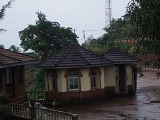
Tulu Nadu

Encyclopedia
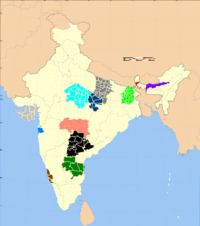
Tulu Nadu is a Tulu-speaking region spread over to parts of present Karnataka
and Kerala
States of India
. It consists of the Dakshina Kannada and Udupi
districts of Karnataka
and the northern parts of the Kasaragod district
of Kerala up to the Payaswini
River. Mangalore
(Kudla), Udupi (Odipu) and Kasaragod
(Kasrodu) are its important cities.
ethnic group. Other ethnic groups who settled here include Kannadigas, Konkanis, Beary
s, Thuluva Vellalar and Malayali
s.
.
 .
.
and Kerala regions. Like them, Tulu Nadu is bounded on the west by the Arabian Sea
and on the east by the Western Ghats
.
Tulu Nadu spans an area of 8441 km² (3,259 sq mi), roughly 4.4% of the total geographical area of present Karnataka
State.
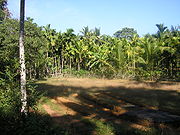
season. The coastal area of Tulu Nadu is very rich with respect to rainforest
s and backwater
s. Tulu Nadu has a tropical climate
; summer and winter months experience similar temperate conditions, with average temperatures ranging from 24 °C to 33 °C. The pleasant months are December and January. Tulu Nadu extends a high range of Tropical vegetation, sun and backwaters to explore.
 During the birth of Christ, Tulu Nadu was inhabited by a people called as the Kōṅkiḷaṅkōcar or Kōcar in Sangam period works. There are believed to be the same people as the Satyapūtras of the Asokan inscriptions.
Historically, Tulu Nadu included the two separate lands of Haiva and Tuluva. The Ballal Kings of Sullia had ruled this area around 1100 years back. The Bunt
/ Nair
, Brahmin migration to Tulunadu might have happened during the lifetime of the Kadamba king Mayuravarma at 345 AD. Madhvacharya
in the 13th century built the eight monasteries (Matha
) in Udupi.
During the rule of Vijayanagara Tulu nadu was administered in two parts – Mangaluru Rajya and Barakuru Rajya. Tulunad was the original homeland of the dynasty that founded the Vijayanagar Empire based in eastern Karnataka. Tulu Nadu was governed by feudatories of the Vijayanagara Empire
until the 17th century. The longest reigning dynasty of Tulu Nadu was the Alupas
. They were the feudatories of the prominent dynasties of Karnataka. The Kadamba dynasty of Banavasi was the earliest, under which the Alupas flourished. Later the Rashtrakutas of Manyakheta, Chalukyas of Badami, Chalukyas of Kalyani, Hoysalas of Durasamudra and Rayas of Vijayanagara were the overlords. The Alupas, however, were independent and their subordination was nominal at best. They ruled until the Vijayanagara kings totally dominated the Tulu Nadu from 14th to the 17th centuries. The region became extremely prosperous during Vijayanagara period with Barkur and Mangalore gaining importance. After the decline of the Vijayanagara Empire, the Keladi Nayaka
s of Ikkeri
controlled much of Tulu Nadu.
 Over the following many centuries, more ethnic groups migrated to the area. Konkanis and Goud Saraswat Brahmins arrived by sea, as Mangalore was a major port that served not only the Portuguese but also the Arabs for maritime trades. Jains
were already a prominent group and even today are uniquely preserved in Tulu Nadu. Though small in number, the Jains left behind indelible reminders of their glory with temples (bastis
) in (Moodabidri
) and monolithic statues of Bahubali
in Karkala
, Venoor and Dharmasthala
. In the 16th century there was a large influx of Catholics to Tulu Nadu from Goa. They built excellent educational institutes and contributed to the development of education in the region. The Muslim community of Tulu Nadu were basically Arab traders who married local women and settled there. Some of them speak the Beary
language, which is a mix of Tulu
and Malayalam and others speak Urdu.
Under Portugal
, the region was called the Missao do Sul (Mission of the South).In the 18th, it was conquered by Hyder Ali
, the ruler of Mysore
. After the British defeated Haidar's successor Tipu Sultan
in 1799, the region was attached to the Madras Presidency
before being reverted to the state of Mysore in the aftermath of independence. Mysore has since been renamed Karnataka
. At the end of 18th century, Hyder Ali
and Tippu Sultan controlled the region. Mangalore
played a prominent role in Tippu’s battles with the British. The British gained full control in 1801, after the defeat of Tippu in 1799. The British ruled the region with Madras (now Chennai
) as its headquarters. Tipu Sultan
conquered the region and the British conquered it from him. Under the British, the region was organized as the Districts of North Canara and South Canara
.
When the states were reorganised on linguistic basis in the 1956, Tulu Nadu (South Canara) which was earlier part of Madras Presidency
& North Canara which was part of Bombay Presidency
became part of the newly formed Mysore state which was later renamed as Karnataka. Kasargod became part of the newly formed Kerala state.
 The Yakshagana
is a night-long dance and drama performance practiced in Tulu Nadu with great fanfare. Piliyesa
is a unique form of folk dance in the region fascinating the young and the old alike, which is performed during Marnemi (as Dussara is called in Tulu) and Krishna Janmashtami. Karadi Vesha (Bear Dance) is one more popular dance performed during Dasara
in Tulu Nadu.
Bhuta Kola or spirit worship, which is usually done at night is practised here. Kambala
or buffalo race is conducted in water filled paddy fields. Korikatta (Cockfight
) is another favourite sport for the people. Nagaradhane
or Snake worship is practised in the Tulu Nadu according to the popular belief of the Naga Devatha
to go underground and guard the species on the top.
Tulu
is a Dravidian language
of India with over three million speakers. Most of its speakers are native to the districts of Dakshina Kannada and Udupi in the west of the state of Karnataka and Kasargod district of northern Kerala. Besides Tulu, Kannada
(by virtue of it being the state language) and Konkani
are also widely spoken in the area. Also, a sizeable population of Muslims
, Beary
s, speak Beary bashe
an offshoot of Malayalam. The Tulu speakers are known as Tuluva
s. The Tulu script, also known as the Tigalari script, bears partial similarity to the Malayalam script. A script called Tulu
is used in Tulunadu for centuries. All Tulu classics discovered recently are in Tulu script, and som in other scripts. This Tulu script was being used by Brahmins. Till in the recent past, they were using it for writing Mantras, for accounts etc.. (This has been proved in detail by Vidwan P V Puninchathaya in 'Tulu -Nadu-Nudi'). The Tulu language was also once spoken in Uttara Kannada
, which for this reason is sometimes considered part of Tulu Nadu as well.
Tulu Nadu cuisine is popular across South India
, mostly due to udupi restaurants
, which are primarily vegetarian. Apart from Southern India, there are famous Udupi Hotels in Mumbai and New Delhi too.
, horse gram
, vegetables and fruits. Plantation crops like coconut, areca
nut, cocoa, cashew
nut, and pepper are also grown. In the early 20th century, the red clay roof tile industry, cashew nut processing, and the banking industry grew substantially. Tulu Nadu is called "the cradle of Indian banking." Five major banks of India (Syndicate Bank, Canara Bank, Corporation Bank, Vijaya Bank and Karnataka Bank
) have their origins here. In the early part of the 21st century the area has been transforming itself into a hub of the information technology and medical services industries. This is due to the excellent educational facilities and hospitals available in Tulu Nadu, covering all fields, and the abundance of skilled workers. There has been large-scale decline in agriculture and related industries due to the non-availability of labour and preference for white-collar jobs. Agricultural land is being converted to commercial and real estate properties, and environmental pollution is increasing drastically due to large-scale deforestation and increase in automobile use. A public sector petroleum refinery (MRPL) was established in the 1990s. Some chemical plants (e.g., fertilizers and pesticides) have been established. Tulu Nadu contributes the second highest revenue to Karnataka state after the city of Bangalore. This region has an international airport at Mangalore which is well connected to the rest of India and middle eastern countries. New Mangalore port (NMPT) is one of the major port of India is located at Panambur
, Mangalore.
and Manipal
are the major cities that accommodate these students. KMC Manipal
is one among the top ten Medical Colleges in India and stands at sixth position
Image:Chandragiri1.JPG|thumb|Chandragiri River - The South-end of Tulu Nadu]]
Karnataka
Karnataka , the land of the Kannadigas, is a state in South West India. It was created on 1 November 1956, with the passing of the States Reorganisation Act and this day is annually celebrated as Karnataka Rajyotsava...
and Kerala
Kerala
or Keralam is an Indian state located on the Malabar coast of south-west India. It was created on 1 November 1956 by the States Reorganisation Act by combining various Malayalam speaking regions....
States of India
India
India , officially the Republic of India , is a country in South Asia. It is the seventh-largest country by geographical area, the second-most populous country with over 1.2 billion people, and the most populous democracy in the world...
. It consists of the Dakshina Kannada and Udupi
Udupi district
Udupi district , ಉಡುಪಿ ಜಿಲ್ಲೆ) in the Karnataka state of India was created in August 1997. The three northern taluks, Udupi, Kundapur and Karkal, were separated from Dakshina Kannada District to form Udupi district. Udupi district is surrounded by Uttara Kannada district in north, Dakshina Kannada...
districts of Karnataka
Districts of Karnataka
The Indian State of Karnataka is located within 11°30' North and 18°30' North latitudes and 74° East and 78°30' East longitude. It is situated on a tableland where the Western and Eastern Ghat ranges converge into the Nilgiri hill complex, in the western part of the Deccan Peninsular region of India...
and the northern parts of the Kasaragod district
Kasaragod district
Kasaragod District is one of the districts of the Indian state of Kerala. Kasaragod District was organised as a separate district on 24 May 1984...
of Kerala up to the Payaswini
Payaswini
Payaswini also known by the name Chandragiri is a river in Kasaragod district of Kerala state, south India. On the banks of this river is 17th century Chandragiri fort...
River. Mangalore
Mangalore
Mangalore is the chief port city of the Indian state of Karnataka. It is located about west of the state capital, Bangalore. Mangalore lies between the Arabian Sea and the Western Ghat mountain ranges, and is the administrative headquarters of the Dakshina Kannada district in south western...
(Kudla), Udupi (Odipu) and Kasaragod
Kasaragod
Kasaragod is a town and a municipality in Kasaragod district in the Indian state of Kerala. It is the administrative headquarters of Kasaragod district as well as of Kasaragod Taluk...
(Kasrodu) are its important cities.
Demographics
According to Census of India 2001, the population of this region was 3,005,898.Population
The majority of the population in Tulunadu is TuluvaTuluva
The Tuluva -Geographic Distribution :Though most of the Tuluva population is found in the Tulu Nadu region, migrant poplulations are found the world over. In recent times, the first period of migration started at the beginning of the 20th century to places such as Mumbai and Chennai and other...
ethnic group. Other ethnic groups who settled here include Kannadigas, Konkanis, Beary
Beary
The Beary is a small Muslim community concentrated mostly in coastal South Kanara , in the district of Karnataka, a south Indian state. It is an ethnic society, having its own unique traditions and distinct cultural identity...
s, Thuluva Vellalar and Malayali
Malayali
Malayali is the term used to refer to the native speakers of Malayalam, originating from the Indian state of Kerala...
s.
Language
Majority of the people in this region speak TuluTulu language
The Tulu language |?]]]) is a Dravidian language spoken by 1.95 million native speakers mainly in the southwest part of Indian state Karnataka known as Tulu Nadu. In India, 1.72 million people speak it as their mother tongue , increased by 10 percent over the 1991 census...
.
Geography
Tulu Nadu lies along the Konkan Coast and shares a number of geographic, culinary, and social traits with the neighbouring KonkanKonkan
The Konkan also called the Konkan Coast or Karavali is a rugged section of the western coastline of India from Raigad to Mangalore...
and Kerala regions. Like them, Tulu Nadu is bounded on the west by the Arabian Sea
Arabian Sea
The Arabian Sea is a region of the Indian Ocean bounded on the east by India, on the north by Pakistan and Iran, on the west by the Arabian Peninsula, on the south, approximately, by a line between Cape Guardafui in northeastern Somalia and Kanyakumari in India...
and on the east by the Western Ghats
Western Ghats
The Western Ghats, Western Ghauts or the Sahyādri is a mountain range along the western side of India. It runs north to south along the western edge of the Deccan Plateau, and separates the plateau from a narrow coastal plain along the Arabian Sea. The Western Ghats block rainfall to the Deccan...
.
Tulu Nadu spans an area of 8441 km² (3,259 sq mi), roughly 4.4% of the total geographical area of present Karnataka
Karnataka
Karnataka , the land of the Kannadigas, is a state in South West India. It was created on 1 November 1956, with the passing of the States Reorganisation Act and this day is annually celebrated as Karnataka Rajyotsava...
State.
Climate
Tulu Nadu also experience heavy rainfalls during MonsoonMonsoon
Monsoon is traditionally defined as a seasonal reversing wind accompanied by corresponding changes in precipitation, but is now used to describe seasonal changes in atmospheric circulation and precipitation associated with the asymmetric heating of land and sea...
season. The coastal area of Tulu Nadu is very rich with respect to rainforest
Rainforest
Rainforests are forests characterized by high rainfall, with definitions based on a minimum normal annual rainfall of 1750-2000 mm...
s and backwater
Backwater
Backwater or Backwaters may refer to:* Backwater , water in a main river which is backed up by an obstruction such as the tide or a dam, or a branch of a main river which runs alongside it before rejoining it...
s. Tulu Nadu has a tropical climate
Tropical climate
A tropical climate is a climate of the tropics. In the Köppen climate classification it is a non-arid climate in which all twelve months have mean temperatures above...
; summer and winter months experience similar temperate conditions, with average temperatures ranging from 24 °C to 33 °C. The pleasant months are December and January. Tulu Nadu extends a high range of Tropical vegetation, sun and backwaters to explore.
History
Historically, Tulu Nadu included the two separate lands of Haiva and Tuluva. The Ballal Kings of Sullia had ruled this area around 1100 years back. The Bunt
Bunt (community)
Bunt , previously spelled Bant, are a community of erstwhile nobility, feudatory and gentry from the region of Tulu Nadu in the south west of India which comprises the districts of Udupi and Dakshina Kannada in the Indian state of Karnataka and Kasaragod taluk of Kerala...
/ Nair
Nair
Nair , also known as Nayar , refers to "not a unitary group but a named category of castes", which historically embody several castes and many subdivisions, not all of whom bore the Nair title. These people historically live in the present-day Indian state of Kerala...
, Brahmin migration to Tulunadu might have happened during the lifetime of the Kadamba king Mayuravarma at 345 AD. Madhvacharya
Madhvacharya
Madhvācārya was the chief proponent of Tattvavāda "Philosophy of Reality", popularly known as the Dvaita school of Hindu philosophy. It is one of the three most influential Vedānta philosophies. Madhvācārya was one of the important philosophers during the Bhakti movement. He was a pioneer in...
in the 13th century built the eight monasteries (Matha
Matha
A matha ) is a term for monastic and similar religious establishments of Hinduism and Jainism. A matha is usually more formal, hierarchical, and rule-based than an ashram.-Advaita Mathas:...
) in Udupi.
During the rule of Vijayanagara Tulu nadu was administered in two parts – Mangaluru Rajya and Barakuru Rajya. Tulunad was the original homeland of the dynasty that founded the Vijayanagar Empire based in eastern Karnataka. Tulu Nadu was governed by feudatories of the Vijayanagara Empire
Vijayanagara Empire
The Vijayanagara Empire , referred as the Kingdom of Bisnaga by the Portuguese, was an empire based in South Indian in the Deccan Plateau region. It was established in 1336 by Harihara I and his brother Bukka Raya I of the Yadava lineage. The empire rose to prominence as a culmination of attempts...
until the 17th century. The longest reigning dynasty of Tulu Nadu was the Alupas
Alupas
The Alupas kings were a minor dynasty who ruled parts of coastal Karnataka. Later with the dominance of Kadambas in Banavasi, they became feudatory to them. With the changing political scenario, soon they became the feudatories to Chalukyas, Hoysalas and Vijayanagara Rayas...
. They were the feudatories of the prominent dynasties of Karnataka. The Kadamba dynasty of Banavasi was the earliest, under which the Alupas flourished. Later the Rashtrakutas of Manyakheta, Chalukyas of Badami, Chalukyas of Kalyani, Hoysalas of Durasamudra and Rayas of Vijayanagara were the overlords. The Alupas, however, were independent and their subordination was nominal at best. They ruled until the Vijayanagara kings totally dominated the Tulu Nadu from 14th to the 17th centuries. The region became extremely prosperous during Vijayanagara period with Barkur and Mangalore gaining importance. After the decline of the Vijayanagara Empire, the Keladi Nayaka
Keladi Nayaka
Keladi Nayaka Kingdom were an important ruling dynasty of post-medieval Karnataka, India. They initially started to rule as a feudatory of the Vijayanagar Empire...
s of Ikkeri
Ikkeri
Ikkeri is situated in Shimoga district of Karnataka state at about 6 km to the south of Sagara. The word Ikkeri in Kannada means "Two Streets". It was, from about 1560 to 1640 AD, the capital of the Keladi chiefs, afterwards removed to Bednur...
controlled much of Tulu Nadu.
Jainism
Jainism is an Indian religion that prescribes a path of non-violence towards all living beings. Its philosophy and practice emphasize the necessity of self-effort to move the soul towards divine consciousness and liberation. Any soul that has conquered its own inner enemies and achieved the state...
were already a prominent group and even today are uniquely preserved in Tulu Nadu. Though small in number, the Jains left behind indelible reminders of their glory with temples (bastis
Basadi
Basadi is a Jain shrine or temple.The word is generally used in South India, including Maharashtra. Its historical use in North is preserved in the names of the Vimala Vasahi and Luna Vasahi temples of Mount Abu...
) in (Moodabidri
Moodabidri
Moodabidri , is a small town 37 km northeast of the Dakshina Kannada district headquarters, Mangalore, in Karnataka, India....
) and monolithic statues of Bahubali
Bahubali
According to Jainism, Bahubali, called Gomateshwara , was the second of the hundred sons of the first Tirthankara, Rishabha, and king of Podanpur. The Adipurana, a 10th century Kannada text by Jain poet Adikavi Pampa According to Jainism, Bahubali, called Gomateshwara , was the second of the...
in Karkala
Karkala
Karkala is a town and the headquarters of Karkala taluk in the Udupi district of Karnataka, India. Located about 380 km from Bangalore, it lies near the Western Ghats....
, Venoor and Dharmasthala
Dharmasthala
Dharmasthala is a temple village on the banks of the Nethravathi River in the Belthangadi taluk of the Dakshina Kannada district in Karnataka....
. In the 16th century there was a large influx of Catholics to Tulu Nadu from Goa. They built excellent educational institutes and contributed to the development of education in the region. The Muslim community of Tulu Nadu were basically Arab traders who married local women and settled there. Some of them speak the Beary
Beary
The Beary is a small Muslim community concentrated mostly in coastal South Kanara , in the district of Karnataka, a south Indian state. It is an ethnic society, having its own unique traditions and distinct cultural identity...
language, which is a mix of Tulu
Tulu language
The Tulu language |?]]]) is a Dravidian language spoken by 1.95 million native speakers mainly in the southwest part of Indian state Karnataka known as Tulu Nadu. In India, 1.72 million people speak it as their mother tongue , increased by 10 percent over the 1991 census...
and Malayalam and others speak Urdu.
Under Portugal
Portugal
Portugal , officially the Portuguese Republic is a country situated in southwestern Europe on the Iberian Peninsula. Portugal is the westernmost country of Europe, and is bordered by the Atlantic Ocean to the West and South and by Spain to the North and East. The Atlantic archipelagos of the...
, the region was called the Missao do Sul (Mission of the South).In the 18th, it was conquered by Hyder Ali
Hyder Ali
Hyder Ali was the de facto ruler of the Kingdom of Mysore in southern India. Born Hyder Naik, he distinguished himself militarily, eventually drawing the attention of Mysore's rulers...
, the ruler of Mysore
Kingdom of Mysore
The Kingdom of Mysore was a kingdom of southern India, traditionally believed to have been founded in 1399 in the vicinity of the modern city of Mysore. The kingdom, which was ruled by the Wodeyar family, initially served as a vassal state of the Vijayanagara Empire...
. After the British defeated Haidar's successor Tipu Sultan
Tipu Sultan
Tipu Sultan , also known as the Tiger of Mysore, was the de facto ruler of the Kingdom of Mysore. He was the son of Hyder Ali, at that time an officer in the Mysorean army, and his second wife, Fatima or Fakhr-un-Nissa...
in 1799, the region was attached to the Madras Presidency
Madras Presidency
The Madras Presidency , officially the Presidency of Fort St. George and also known as Madras Province, was an administrative subdivision of British India...
before being reverted to the state of Mysore in the aftermath of independence. Mysore has since been renamed Karnataka
Karnataka
Karnataka , the land of the Kannadigas, is a state in South West India. It was created on 1 November 1956, with the passing of the States Reorganisation Act and this day is annually celebrated as Karnataka Rajyotsava...
. At the end of 18th century, Hyder Ali
Hyder Ali
Hyder Ali was the de facto ruler of the Kingdom of Mysore in southern India. Born Hyder Naik, he distinguished himself militarily, eventually drawing the attention of Mysore's rulers...
and Tippu Sultan controlled the region. Mangalore
Mangalore
Mangalore is the chief port city of the Indian state of Karnataka. It is located about west of the state capital, Bangalore. Mangalore lies between the Arabian Sea and the Western Ghat mountain ranges, and is the administrative headquarters of the Dakshina Kannada district in south western...
played a prominent role in Tippu’s battles with the British. The British gained full control in 1801, after the defeat of Tippu in 1799. The British ruled the region with Madras (now Chennai
Chennai
Chennai , formerly known as Madras or Madarasapatinam , is the capital city of the Indian state of Tamil Nadu, located on the Coromandel Coast off the Bay of Bengal. Chennai is the fourth most populous metropolitan area and the sixth most populous city in India...
) as its headquarters. Tipu Sultan
Tipu Sultan
Tipu Sultan , also known as the Tiger of Mysore, was the de facto ruler of the Kingdom of Mysore. He was the son of Hyder Ali, at that time an officer in the Mysorean army, and his second wife, Fatima or Fakhr-un-Nissa...
conquered the region and the British conquered it from him. Under the British, the region was organized as the Districts of North Canara and South Canara
South Canara
South Canara was a district under the British empire, located at . It was bifurcated in 1859 from Canara district. It was the undivided Dakshina Kannada district...
.
When the states were reorganised on linguistic basis in the 1956, Tulu Nadu (South Canara) which was earlier part of Madras Presidency
Madras Presidency
The Madras Presidency , officially the Presidency of Fort St. George and also known as Madras Province, was an administrative subdivision of British India...
& North Canara which was part of Bombay Presidency
Bombay Presidency
The Bombay Presidency was a province of British India. It was established in the 17th century as a trading post for the English East India Company, but later grew to encompass much of western and central India, as well as parts of post-partition Pakistan and the Arabian Peninsula.At its greatest...
became part of the newly formed Mysore state which was later renamed as Karnataka. Kasargod became part of the newly formed Kerala state.
Culture
Yakshagana
Yakshagana is a musical theater popular in the coastal and Malenadu regions of Karnataka, India. Yakshagana is the recent scholastic name for what are known as kēḷike, āṭa, bayalāṭa, bayalāṭa, daśāvatāra . It is believed to have evolved from pre-classical music and theatre during Bhakti movement...
is a night-long dance and drama performance practiced in Tulu Nadu with great fanfare. Piliyesa
Hulivesha
Hulivesha "Tiger Masque" is a folk dance unique to the Tulu Nadu region of Karnataka. Hulivēṣa is performed during Navratri to honour the goddess Sharada - an aspect of Saraswati whose favoured animal is the tiger...
is a unique form of folk dance in the region fascinating the young and the old alike, which is performed during Marnemi (as Dussara is called in Tulu) and Krishna Janmashtami. Karadi Vesha (Bear Dance) is one more popular dance performed during Dasara
Mysore Dasara
Mysore Dasara is the Nadahabba of the state of Karnataka. It is also called Navaratri and is a 10-day festival with the last day being Vijayadashami, the most auspicious day of Dasara. Dasara usually falls in the month of September or October...
in Tulu Nadu.
Bhuta Kola or spirit worship, which is usually done at night is practised here. Kambala
Kambala
Kambaḷa is a traditional water buffalo race in muddy waters held from December until March. It is the native sport of Tulu Nadu region of South India.-Format :...
or buffalo race is conducted in water filled paddy fields. Korikatta (Cockfight
Cockfight
A cockfight is a blood sport between two roosters , held in a ring called a cockpit. Cockfighting is now illegal throughout all states in the United States, Brazil, Australia and in most of Europe. It is still legal in several U.S. territories....
) is another favourite sport for the people. Nagaradhane
Nagaradhane
Nagaradhane is a form of snake worship which, along with Bhuta Kola, is one of the unique traditions prevalent in coastal districts of Dakshina Kannada , Udupi and Kasaragod alternatively known as Tulu Nadu- Origin of Nagaradhane :...
or Snake worship is practised in the Tulu Nadu according to the popular belief of the Naga Devatha
Naga
Naga or NAGA may refer to:* Nāga, a group of serpent deities in Hindu and Buddhist mythology.-People:* Nayan / Nayar/Nair people of Kerala Society* Naga people, a diverse ethnic identity in Northeast India...
to go underground and guard the species on the top.
Tulu
Tulu language
The Tulu language |?]]]) is a Dravidian language spoken by 1.95 million native speakers mainly in the southwest part of Indian state Karnataka known as Tulu Nadu. In India, 1.72 million people speak it as their mother tongue , increased by 10 percent over the 1991 census...
is a Dravidian language
Dravidian languages
The Dravidian language family includes approximately 85 genetically related languages, spoken by about 217 million people. They are mainly spoken in southern India and parts of eastern and central India as well as in northeastern Sri Lanka, Pakistan, Nepal, Bangladesh, Afghanistan, Iran, and...
of India with over three million speakers. Most of its speakers are native to the districts of Dakshina Kannada and Udupi in the west of the state of Karnataka and Kasargod district of northern Kerala. Besides Tulu, Kannada
Kannada language
Kannada or , is a language spoken in India predominantly in the state of Karnataka. Kannada, whose native speakers are called Kannadigas and number roughly 50 million, is one of the 30 most spoken languages in the world...
(by virtue of it being the state language) and Konkani
Konkani language
KonkaniKonkani is a name given to a group of several cognate dialects spoken along the narrow strip of land called Konkan, on the west coast of India. This is, however, somewhat an over-generalisation. Geographically, Konkan is defined roughly as the area between the river Damanganga to the north...
are also widely spoken in the area. Also, a sizeable population of Muslims
Islam in India
Islam is the second-most practiced religion in the Republic of India after Hinduism, with more than 13.4% of the country's population ....
, Beary
Beary
The Beary is a small Muslim community concentrated mostly in coastal South Kanara , in the district of Karnataka, a south Indian state. It is an ethnic society, having its own unique traditions and distinct cultural identity...
s, speak Beary bashe
Beary bashe
Beary bashe is a dialect mainly spoken by the Muslim communities of Dakshina Kannada and Udupi districts of Karnataka known as Bearys and a small number of Hindus in the District of Kasargod in Kerala state....
an offshoot of Malayalam. The Tulu speakers are known as Tuluva
Tuluva
The Tuluva -Geographic Distribution :Though most of the Tuluva population is found in the Tulu Nadu region, migrant poplulations are found the world over. In recent times, the first period of migration started at the beginning of the 20th century to places such as Mumbai and Chennai and other...
s. The Tulu script, also known as the Tigalari script, bears partial similarity to the Malayalam script. A script called Tulu
Tulu Script
The Tulu script The Tulu script The Tulu script (Tulu: —written in Tulu script, is the original script of the Tulu language. It evolved from the Grantha script. It bears partial similarity to the Malayalam script, which also evolved from the Grantha....
is used in Tulunadu for centuries. All Tulu classics discovered recently are in Tulu script, and som in other scripts. This Tulu script was being used by Brahmins. Till in the recent past, they were using it for writing Mantras, for accounts etc.. (This has been proved in detail by Vidwan P V Puninchathaya in 'Tulu -Nadu-Nudi'). The Tulu language was also once spoken in Uttara Kannada
Uttara Kannada
Uttara Kannada also known as North Canara or North Kanara, is a district in the southern Indian state of Karnataka. It is bordered by the state of Goa and Belgaum District to the north, Dharwad District and Haveri District to the east, Shimoga District and Udupi District to the south and the...
, which for this reason is sometimes considered part of Tulu Nadu as well.
Tulu Nadu cuisine is popular across South India
South India
South India is the area encompassing India's states of Andhra Pradesh, Karnataka, Kerala and Tamil Nadu as well as the union territories of Lakshadweep and Pondicherry, occupying 19.31% of India's area...
, mostly due to udupi restaurants
Udupi cuisine
Udupi cuisine is a world-renowned cuisine of South India. It forms an important part of the Cuisine of Karnataka and takes its name from Udupi, a town on the southwest coast of India in the state of Karnataka. The Udupi cuisine has its origin in the Ashta mathas of Udupi founded by...
, which are primarily vegetarian. Apart from Southern India, there are famous Udupi Hotels in Mumbai and New Delhi too.
Economy
Tulu Nadu was once primarily dependent on agriculture and fishing. The main crops grown were rice, bengal gramChickpea
The chickpea is a legume of the family Fabaceae, subfamily Faboideae...
, horse gram
Horse gram
Horse Gram is one of the lesser known beans. The whole seeds of horse gram are generally utilized as cattle feed. However, it is consumed as a whole seed, as sprouts, or as whole meal by a large population in rural areas of southern India. Medical uses of these legumes have been discussed...
, vegetables and fruits. Plantation crops like coconut, areca
Areca
Areca is a genus of about 50 species of single-stemmed palms in the family Arecaceae, found in humid tropical forests from Malaysia to the Solomon Islands. The generic name Areca is derived from a name used locally on the Malabar Coast of India....
nut, cocoa, cashew
Cashew
The cashew is a tree in the family Anacardiaceae. Its English name derives from the Portuguese name for the fruit of the cashew tree, caju, which in turn derives from the indigenous Tupi name, acajú. It is now widely grown in tropical climates for its cashew nuts and cashew apples.-Etymology:The...
nut, and pepper are also grown. In the early 20th century, the red clay roof tile industry, cashew nut processing, and the banking industry grew substantially. Tulu Nadu is called "the cradle of Indian banking." Five major banks of India (Syndicate Bank, Canara Bank, Corporation Bank, Vijaya Bank and Karnataka Bank
Karnataka Bank
Karnataka Bank Limited is a private sector banking institution based in the town of Mangalore in Karnataka, India. The Reserve Bank of India has designated Karnataka Bank as an A1+-class scheduled commercial bank....
) have their origins here. In the early part of the 21st century the area has been transforming itself into a hub of the information technology and medical services industries. This is due to the excellent educational facilities and hospitals available in Tulu Nadu, covering all fields, and the abundance of skilled workers. There has been large-scale decline in agriculture and related industries due to the non-availability of labour and preference for white-collar jobs. Agricultural land is being converted to commercial and real estate properties, and environmental pollution is increasing drastically due to large-scale deforestation and increase in automobile use. A public sector petroleum refinery (MRPL) was established in the 1990s. Some chemical plants (e.g., fertilizers and pesticides) have been established. Tulu Nadu contributes the second highest revenue to Karnataka state after the city of Bangalore. This region has an international airport at Mangalore which is well connected to the rest of India and middle eastern countries. New Mangalore port (NMPT) is one of the major port of India is located at Panambur
Panambur
Panambur is the site of New Mangalore Port. It is located in Dakshina Kannada district of Karnataka state, India, north of the Gurupura river. The name Panambur is derived from 'Panam' which means Money and 'Ur' which means place or village in Tulu language.There is a Nandaneshwara temple in...
, Mangalore.
Education
Tulu Nadu is the most prominent Educational Hub on the western coast of India. There are hundreds of professional colleges in Tulu Nadu. Thousands of students from all over India and countries abroad study in these institutions. MangaloreMangalore
Mangalore is the chief port city of the Indian state of Karnataka. It is located about west of the state capital, Bangalore. Mangalore lies between the Arabian Sea and the Western Ghat mountain ranges, and is the administrative headquarters of the Dakshina Kannada district in south western...
and Manipal
Manipal
Manipal is a university town situated in the state of Karnataka in India. It is a suburb within Udupi city and is administered by Udupi City Municipality. It is located in the rocky hinterland of the Malabar Coast of south west India, about 8 km from the Arabian Sea...
are the major cities that accommodate these students. KMC Manipal
Kasturba Medical College, Manipal
Kasturba Medical College is a medical college based in Manipal, Udupi District Karnataka, India.Established by Dr T.M.A. Pai on 30 June 1953, KMC was the first private sector medical college in India. The college started with only the pre-clinical section at Manipal and the students had to go to...
is one among the top ten Medical Colleges in India and stands at sixth position
Contributions by Tulu Nadu people
The people of Tulu Nadu have made several notable contributions to the nation. Some of them are :- Four nationalisedGovernment-owned corporationA government-owned corporation, state-owned company, state-owned entity, state enterprise, publicly owned corporation, government business enterprise, or parastatal is a legal entity created by a government to undertake commercial activities on behalf of an owner government...
bankBankA bank is a financial institution that serves as a financial intermediary. The term "bank" may refer to one of several related types of entities:...
s and also a leading private sectorPrivate sectorIn economics, the private sector is that part of the economy, sometimes referred to as the citizen sector, which is run by private individuals or groups, usually as a means of enterprise for profit, and is not controlled by the state...
bank were started by eminent personalities of Tulu Nadu. Hence Dakshina Kannada district is known as the "Cradle of Indian Banking".
- Dr. Shivaram Karanth (1902–1997) was a major Kannada writer, social activist, environmentalist, YakshaganaYakshaganaYakshagana is a musical theater popular in the coastal and Malenadu regions of Karnataka, India. Yakshagana is the recent scholastic name for what are known as kēḷike, āṭa, bayalāṭa, bayalāṭa, daśāvatāra . It is believed to have evolved from pre-classical music and theatre during Bhakti movement...
artist, film maker and thinker. He was a recipient of the Jnanpith AwardJnanpith AwardThe Jnanpith Award is a literary award in India. Along with the Sahitya Akademi Fellowship, it is one of the two most prestigious literary honours in the country...
, India's highest literary honour. Ramachandra GuhaRamachandra GuhaRamachandra Guha is an Indian writer whose research interests have included environmental, social, political and cricket history. He is also a columnist for the newspapers The Telegraph , and The Hindustan Times.-Early life and education:Born in Dehra Dun, Uttarakhand, India in 1958, Guha studied...
described him as the "Rabindranath Tagore of modern India [and the] finest novelist-activist since independence".
- People from Tulu Nadu have established various hospitals and educational institutions.
- People of Tulu Nadu are considered to be progressive and intellectually strong, having a good foresight for the overall progress of society.
Demand for a separate Tulu Nadu state
The Tuluvas of Southern India are a separate culture from the Kannadigas within India. From India's independence and the following Reorganisation of States, the Tuluvas had been demanding official language status for Tulu and a separate state for themselves. Though a bit subdued in between, this demand has grown stronger in recent years. Several organizations like the Tulu Rajya Horata Samiti have taken up the cause of the Tuluvas and frequent meetings and demonstrations are held across the towns of Tulu Nadu (like Mangalore, Udupi etc) to voice their demands.Notable people
- Abbakka RaniAbbakka RaniAbbakka Rani or Abbakka Mahadevi was the queen of Tulunadu who fought the Portuguese in the latter half of the 16th century. She belonged to the Chowta dynasty who ruled over the area from the temple town of Moodabidri. The port town of Ullal served as their subsidiary capital. The Portuguese...
: queen of Tulu Nadu who fought the Portuguese in the latter half of the 16th century - K. S. Hegde: former Speaker of Loksabha and Supreme CourtSupreme Court of IndiaThe Supreme Court of India is the highest judicial forum and final court of appeal as established by Part V, Chapter IV of the Constitution of India...
Judge - T. M. A. PaiT. M. A. PaiDr. Tonse Madhav Ananth Pai, , , a Goud Saraswat Brahmin was an Indian doctor, educationist, banker and philanthropist, most well known for building the university town of Manipal, Karnataka, India....
: founder of Manipal University and Syndicate BankSyndicate BankSyndicate Bank Ltd. is one of the oldest and major commercial banks of India. At the time of its establishment, the bank was known as Canara Industrial and Banking Syndicate Limited. The bank, along with 13 major commercial banks of India, was nationalized on 19 July 1969, by the Government of... - Janardhana PoojaryJanardhana PoojaryB. Janardhana Poojary is a senior politician from Indian National Congress party. He was a former Union Minister and Karnataka's Congress President. During the Prime Ministership of Smt...
: former Union Minister of State for Finance - Veerendra HeggadeVeerendra HeggadeDharma Adhikari Veerendra Heggade is a philanthropist and the hereditary administrator of the Dharmasthala Temple. He succeeded to the post of dharmadhikari at the age of 20, on October 24, 1968 becoming the 21st Dharmadhikari of Dharmasthala Temple dedicated to the Hindu God...
: Dharmadikari of Shri Kshethra Dharmasthala - Devi Prasad ShettyDevi Prasad ShettyDr Devi Prasad Shetty is an Indian philanthropist and a cardiac surgeon. He also served as a member of the Board of Governors of Medical Council of India for 1 year between May 2010 and May 2011, after the MCI was reconstituted.-Life and career:...
: cardiac surgeonCardiac surgeonA cardiac surgeon is a surgeon who performs cardiac surgery—operative procedures on the heart and great vessels.-Training:A cardiac surgery residency typically comprises anywhere from six to nine years of training to become a fully qualified surgeon...
and philanthropistPhilanthropistA philanthropist is someone who engages in philanthropy; that is, someone who donates his or her time, money, and/or reputation to charitable causes... - Vijay MallyaVijay MallyaVijay Mallya is an Indian liquor and airline baron. The son of industrialist Vittal Mallya, he is the chairman of the United Breweries Group and Kingfisher Airlines. His United Spirits is world's second largest liquor maker, by volume...
: business tycoon - Madhwacharya: saintSaintA saint is a holy person. In various religions, saints are people who are believed to have exceptional holiness.In Christian usage, "saint" refers to any believer who is "in Christ", and in whom Christ dwells, whether in heaven or in earth...
, philosopher - Aravind AdigaAravind AdigaAravind Adiga is an Indian writer and journalist. His debut novel, The White Tiger, won the 2008 Man Booker Prize.-Early life and education:...
: Booker Prize winner - U. R. RaoU. R. RaoUdupi Ramachandra Rao, popularly known as U. R. Rao is a space scientist and former chairman of the Indian Space Research Organisation. Presently he is the Chairman of the Governing Council of the Physical Research Laboratory at Ahmedabad, which is considered as the cradle of India's Space Program...
: former Chairman ISRO Bangalore - George FernandesGeorge FernandesGeorge Mathew Fernandes is an Indian trade unionist, politician, journalist, agriculturist, and member of Rajya Sabha from Bihar. He is a key member of the Janata Dal , and was the founder of the Samata Party...
: former RailwayMinistry of Railways (India)The Ministry of Railways in India is in charge of the Indian Railways, an organisation that operates as a monopoly in rail transport in India. Dinesh Trivedi is the current minister responsible for railways....
and Defence MinisterMinister of Defence (India)The Minister of Defence is the head of the Ministry of Defence and one of the cabinet ministers of the Government of India.-List of Cabinet Ministers of Defence :* Baldev Singh * Kailash Nath Katju * V. K... - Veerappa MoilyVeerappa MoilyMoodbidri Veerappa Moily is the current Minister of Corporate Affairs in the Indian government. Moily was elected as MP of the Chickballapur district by a wide margin in 2009. He currently serves as the All India Congress Committee General Secretary in charge of Andhra Pradesh...
: former Chief Minister of Karnataka - Budhi KunderanBudhi KunderanBudhisagar Krishnappa Kunderan was an Indian cricketer...
: Indian Test cricket wicketkeeper - Ravi ShastriRavi ShastriRavishankar Jayadritha Shastri is a former Indian cricketer and captain. He was an all–rounder who batted right-handed and bowled left arm spin. His international career started when he was 18 years old and lasted for 12 years...
: former Indian Test cricket captain - Anil KumbleAnil KumbleAnil Kumble is a former Indian cricketer and captain of the Indian Test cricket team. He is a right-arm leg spin bowler and a right-hand batsman. He is currently the leading wicket-taker for India in both Test and One Day International matches...
: former Indian cricketer - Ashish Kumar BallalAshish Kumar BallalAshish Ballal has represented India in the Olympics , World Cup , 3 Champions Trophy tournaments , 2 Asian Games and 2 Asia Cups . Ballal became a household name in India when he saved two tie-breaker goals in the 1998 Bangkok Asian Games hockey final between India and South Korea...
: former Indian hockey captain - Prakash PadukonePrakash PadukonePrakash Padukone is a former badminton player from Karnataka, India. Among other championships, he won the All England Championship and became the first Indian to do so. Prakash was awarded the Padma Sri in 1982...
: All England BadmintonAll England Open Badminton ChampionshipsThe All England Open Badminton Championships, or simply All England, is one of the world's oldest and most prestigious badminton tournaments. Played annually, it developed after the success of world's first badminton tournament held in Guildford in 1898...
champion - Daya NayakDaya NayakDaya Nayak is a sub-inspector with the Mumbai police force. He is currently awaiting reinstation following a suspension order based on allegations of disproportionate income by an underworld criminal...
: sub-inspector with the Mumbai police force - Aishwarya RaiAishwarya RaiAishwarya Rai Bachchan is an Indian film actress. She worked as a model before starting her acting career, and ultimately won the Miss World pageant in 1994...
: former Miss WorldMiss WorldThe Miss World pageant is the oldest surviving major international beauty pageant. It was created in the United Kingdom by Eric Morley in 1951...
, Bollywood actresss - Shilpa ShettyShilpa ShettyShilpa Shetty is an Indian film actress and model. Since making her debut in the film Baazigar , she has appeared in nearly 40 Bollywood, Tamil, Telugu and Kannada films, her first leading role being in the 1994 Aag. Although she has been through years of decline during her career, Shetty has been...
: Bollywood actress - Sunil Shetty: Bollywood actor, producer, hotelier and liquor and fashion boutique owner
- Guru DuttGuru DuttVasanth Kumar Shivashankar Padukone , popularly known as Guru Dutt, was an Indian film director, producer and actor. He is often credited with ushering in the golden era of Hindi cinema...
: Bollywood actor - Deepika PadukoneDeepika PadukoneDeepika Padukone is an Indian actress and a former model. She appears mostly in Hindi as well as Tamil and Kannada language films. Born to Badminton player Prakash Padukone, she chose to become an actress and not pursue a career in sports.Padukone made her acting debut in the 2006 Kannada film...
: Bollywood actress - Reshma ShettyReshma Shetty-Education:Shetty was born to Indian parents and was raised in England and Richmond, Virginia. She originally studied pre-med at James Madison University, but success in vocal competitions prompted her to switch majors and graduate with a B.A. in opera performance...
: American actress - RiaRiaA ria is a coastal inlet formed by the partial submergence of an unglaciated river valley. It is a drowned river valley that remains open to the sea. Typically, rias have a dendritic, treelike outline although they can be straight and without significant branches. This pattern is inherited from the...
: Dubai based TV anchor in ZEE TV and a Malayalam movie actress in Casanova with Mr Mohanlal - Ganesh HegdeGanesh HegdeGanesh Hegde , is an Indian singer, performer, video director and Bollywood choreographer.-Choreography:Born in a Bunt family in Mumbai.His parents are Harish Subbaya Hegde and Vidya Hegde, Hegde is best known for his work in the Oscar-nominated film Lagaan and for his musical numbers in Company...
: Indian singer, performer, video director and Bollywood choreographer - Prakash Raj: film actor, director, 2008 National Award winnerNational Film Award for Best ActorThe National Film Award for Best Actor is an honor presented annually at the National Film Awards of India to an actor who has delivered the best performance in a leading role within the Indian film industry.-Background:The Directorate of Film Festivals makes awards annually in several categories...
- UpendraUpendraUpendra is a cine actor, director, script writer and singer. Born in a middle class family at Koteshwara near Kundapura, he belongs to Kannada speaking Kota Brahmin community. Upendra started his career off with famous director Kashinath as a writer and an assistant director...
: Kannada actor, director - RatnakaravarniRatnakaravarniRatnakaravarni was a 16th-century Kannada poet and writer. He is considered to be one of the trailblazers in the native shatpadi and sangatya metric tradition that was popularised in Kannada literature during the rule of the Vijayanagara empire in modern Karnataka...
: Kannada poet - M. Govinda PaiM. Govinda PaiManjeshwar Govinda Pai , also known as Rastrakavi Govinda Pai, was a Kannada poet. He was awarded the Rashtrakavi title by the Madras Government...
: Kannada poet - K. Shivaram KaranthK. Shivaram KaranthKota Shivaram Karanth was a major Kannada writer, social activist, environmentalist, Yakshagana artist, film maker and thinker. He was described as the "Rabindranath Tagore of Modern India who has been one of the finest novelists-activists since independence" by Ramachandra Guha...
: Kannada writer - Gopalkrishna Adiga: Kannada writer
- Bannanje GovindacharyaBannanje GovindacharyaShri Bannanje Govindacharya is a scholar, well-versed in Madhva tradition. He hails from Bannanje locality of Udupi in Karnataka, India. He was born in 1936. He is in particular one of the greatest experts on the Madhva Tattva Shastras or Madhva philosophy...
: vedic scholar - Anant Pai: creator of Indian comic series TinkleTinkleTinkle is an Indian monthly magazine, published mainly in India. Originally owned by the India Book House, the Tinkle brand was acquired by ACK Media in 2007. The Magazine contains comics, stories, puzzles, quizzes, contests and other features targeted at school children, although its readership...
and Amar Chitra KathaAmar Chitra KathaAmar Chitra Katha Stories") is one of India's largest selling comic book series, with more than 90 million copies sold in 20 Indian languages. Founded in 1967, the imprint has more than 400 titles that retell stories from the great Indian epics, mythology, history, folklore, and fables in a comic... - M. V. KamathM. V. Kamath'Madhav Vittal Kamath' is an Indian journalist. He was the former chairman of Prasar Bharati. He worked as the editor of 'The Sunday Times ' for two years during 1967-69 and as the its Washington Correspondent of 'Times of India' during 1969-78. He has also served as editor of 'The Illustrated...
: former Chairman Prasar Bharthi - K. V. KamathK. V. KamathKundapur Vaman Kamath is the Chairman of Infosys Limited, the second-largest IT services company in India, and Non-Executive Chairman of ICICI Bank, India's largest private bank. Mr...
: former Chairman ICICI Bank - V. T. RajshekarV. T. RajshekarV. T. Rajshekar, in full Vontibettu Thimmappa Rajshekar, also known as V. T. Rajshekar Shetty, is a controversial Indian journalist who is the founder and editor of the Dalit Voice, which has been described in a release by Human Rights Watch as "India’s most widely circulated Dalit journal".He is...
: journalist, founder and editor of the Dalit VoiceDalit VoiceDalit Voice is a political magazine published in Bangalore, India that claims to express the views of Dalits, Muslims, Sikhs, Scheduled Castes, Scheduled Tribes and Other Backward Castes of India which it claims make up 85% of India's population... - Sandeep ChowtaSandeep ChowtaSandeep Chowta is an Indian Bollywood and Tollywood music director and head of Columbia Records in India. He has also sung some of his songs.In 2003, he produced an anti substance abuse documentary, titled Dead End, that was entered into numerous film festivals and was government acclaimed...
: BollywoodBollywoodBollywood is the informal term popularly used for the Hindi-language film industry based in Mumbai , Maharashtra, India. The term is often incorrectly used to refer to the whole of Indian cinema; it is only a part of the total Indian film industry, which includes other production centers producing...
and TollywoodTollywoodTollywood may refer to either of the following two Indian film industries:* Cinema of West Bengal, Bengali language film industry based in Tollygunge, southern part of the city of Kolkata in the state of West Bengal, India...
music director, head of Columbia RecordsColumbia RecordsColumbia Records is an American record label, owned by Japan's Sony Music Entertainment, operating under the Columbia Music Group with Aware Records. It was founded in 1888, evolving from an earlier enterprise, the American Graphophone Company — successor to the Volta Graphophone Company...
in India - GurukiranGurukiranGurukiran or Gurukiran Shetty is a noted music director of the Kannada film industry in India. He started his career as a music director of the Kannada movie "A", directed and acted by Upendra. His music for the movie Upendra further consolidated his position in Kannada movie industry. He is a...
: singer, music director in the Kannada film industry - V. Manohar: lyricist, music composer
- B. V. KaranthB. V. KaranthBabukodi Venkataramana Karanth was a renowned film and theatre personality from India...
: playwright, director - Yograj BhatYograj BhatYograj Bhat is a prominent Kannada film director, producer, screenwriter and a lyricist. He is most predominantly known for the 2006 film Mungaru Male, which he co-wrote with Preetam Gubbi. He was also the director of the film and was one of the lyricists in the film...
: director - Rohit ShettyRohit ShettyRohit Shetty is an Indian film director, presenter and cinematographer. His work as director include the hits Golmaal, Golmaal Returns, Golmaal 3 and Singham....
: BollywoodBollywoodBollywood is the informal term popularly used for the Hindi-language film industry based in Mumbai , Maharashtra, India. The term is often incorrectly used to refer to the whole of Indian cinema; it is only a part of the total Indian film industry, which includes other production centers producing...
director - Santosh Rai PathajeSantosh Rai PathajeSantosh Rai Pathaje is an ace Cinematographer and Director of Kannada Film Industry, also known popularly as Sandalwood. He is the Cinematographer of many Kannada movies like Bhaava Bhamaida, Law and Order, etc.-Early days:...
: cinematographer, director in the Kannada film industry - Freida PintoFreida PintoFreida Pinto is an Indian actress and model best known for her portrayal of Latika in the 2008 Academy Award winning film Slumdog Millionaire, for which she won a Screen Actors Guild Award for Outstanding Performance by a Cast in a Motion Picture...
: model and actress best known for her portrayal of Latika in the 2009 film Slumdog MillionaireSlumdog MillionaireSlumdog Millionaire is a 2008 British epic romantic drama adventure film directed by Danny Boyle, written by Simon Beaufoy, and co-directed in India by Loveleen Tandan. It is an adaptation of the novel Q & A by Indian author and diplomat Vikas Swarup... - B. R. Shetty: businessman
- V. S. AcharyaV. S. AcharyaDr. Vedavyas Srinivas Acharya is a senior BJP leader of Karnataka state. He is presently the Higher education Minister in the Government of Karnataka Formerly he had served as minister of medical education and animal husbandry in the BJP-JDS coalition government. He is a native of Udupi and a...
: Home Minister of Karnataka state - Nitte Santosh Hegde: former justice of the Supreme Court of India
- Anushka ShettyAnushka ShettyAnushka Shetty is an Indian film actress who works mainly in the Telugu and Tamil film industries. She debuted in the 2005 Telugu film Super and rose to fame following her performance in Vikramarkudu...
: Telugu and Tamil film actress - Eesha Narang: Bollywood actress (aka Isha Koppikar)
- Genelia D'SouzaGenelia D'SouzaGenelia D'Souza is an Indian actress, model, and host. She has appeared in Telugu, Hindi, Tamil, Kannada, and Malayalam language films. After gaining wide attention in a Parker Pen commercial with Amitabh Bachchan, D'Souza began her acting career with Tujhe Meri Kasam in 2003...
: Bollywood and South Indian actress - Amrita RaoAmrita RaoAmrita Rao is an Indian actress who appears in Bollywood films.Beginning her career as a model, Rao made her acting debut with Ab Ke Baras...
: Bollywood actress - Sheethal Mallar :Model
- Sachin Suvarna :(Bollywood/Kannada)actor
- Shirish KunderShirish KunderShirish Kunder is an editor and film director in the Hindi Film Industry. He was born in Mangalore on May 24, 1973.- Career :He graduated as an electronics engineer from SDM College of Engineering and Technology, Dharwad, Karnataka and worked for Motorola. He later entered the film industry as an...
: Bollywood - Suman Talwar :(Telugu/Tamil/Kannada)actor
- Kaiyyara Kinhanna Rai : poet, writer
- Ram Shetty : stunt director bollywoood
- Suresh KalmadiSuresh KalmadiSuresh Kalmadi is an Indian politician and senior sports administrator. He was formerly a member of the Indian National Congress...
: M P Pune - Pradeep Uppoor : Reputed Film & Television Series Producer (CIDCID-Criminal investigation:* Criminal Investigation Department, the branch of British police forces and many other Commonwealth police forces to which plain clothes detectives belong...
and AahatAahatAahat is an Indian thriller/horror television series shown on Sony Entertainment Television. The first three seasons were broadcast on Saturdays only, at 10 p.m. IST. The fourth season was broadcast on Fridays and Saturdays at 11 p.m. IST which ended on June 26, 2010. The fifth season was...
on Sony TV) - Siddhanth ThingalayaSiddhanth ThingalayaSiddhanth Thingalaya is an Indian track and field athlete from Mumbai who specializes in the 110 metre hurdles. He holds the current national record in 110 m hurdles with a time of 13.77 seconds, set at the 51st National Senior Athletic Championship held in Kolkata on 13 September...
: Indian track and field athlete
Image:Chandragiri1.JPG|thumb|Chandragiri River - The South-end of Tulu Nadu]]
See also
- North MalabarNorth MalabarNorth Malabar , is a historic as well as geographic distinction in India used to refer the area covering; present Kasaragod and Kannur Districts, Mananthavady taluk of Wayanad District and Koyilandy & Vatakara taluks of Kozhikode District in modern Kerala and the entire Mahé sub-Division of...
- TuluvaTuluvaThe Tuluva -Geographic Distribution :Though most of the Tuluva population is found in the Tulu Nadu region, migrant poplulations are found the world over. In recent times, the first period of migration started at the beginning of the 20th century to places such as Mumbai and Chennai and other...
s - Shivalli Brahmins
- BuntsBunt (community)Bunt , previously spelled Bant, are a community of erstwhile nobility, feudatory and gentry from the region of Tulu Nadu in the south west of India which comprises the districts of Udupi and Dakshina Kannada in the Indian state of Karnataka and Kasaragod taluk of Kerala...
- Kota brahminKota brahminKota Brahmins hail from the Kundapur and surrounding areas of Udupi district in Karnataka, Bantwal and Puttur Taluk in Mangalore District and Kasargod District in Kerala...
s - Havyaka BrahminHavyaka BrahminHavyaka Brahmins are a Hindu Pancha Dravida Brahmin subsect primarily from the Indian state of Karnataka and Northern Kerala. Havyakas profess the Advaita philosophy propounded by Adi Shankaracharya.-Etymology:...
- Sthanika BrahminsSthanika BrahminsSthānika Brāhmins are Smartha Brahmins, and come under the classification of Tuluva Brahmins; The belong to Pancha-Drāvida Brahmin Community. The Kuladevatha of Sthānika Brahmin's is Subramanya...
- DevadigaDevadigaDevadiga are Tulu speaking Hindu community of temple musicians and Temple attendants who mainly hail from the region of Tulu Nadu in the south west of India which comprises the districts of Udupi and Dakshina Kannada in the Indian state of Karnataka and Kasaragod taluk of Kerala.-Origins:The name...
- Mogaveera
- BillavaBillavaThe Billava, or Ilava people make up one of the largest Hindu communities of the Tulu ethnic group in India. They are also found in the Kannada-speaking Kundapura region of Karnataka and some parts of Kerala, including Kasaragod district...
- Goud Saraswat Brahmin
- Rajapur Saraswat BrahminsRajapur Saraswat BrahminsRājāpur/Bhālāvalikar Gauda Sāraswat Brāhmins , as they are known, belong to the "Pancha Gauda Brahmana" groups or "Gaudadi Panchakas". Rājāpur Sāraswat Brahmins are a branch of the saraswat brahmins, who were supposed to have resided on the banks of the legendary Saraswati River. They migrated to...
- Chitrapur Saraswat Brahmin
- BearyBearyThe Beary is a small Muslim community concentrated mostly in coastal South Kanara , in the district of Karnataka, a south Indian state. It is an ethnic society, having its own unique traditions and distinct cultural identity...
- Mangalorean Catholics
- Mangalorean ProtestantsMangalorean Protestants-The community:The biggest denomination among Mangalorean Protestants is the Church of South India , composed of the Basel Mission Protestant church and the Anglican church. They number about 60,434 and are spread all over the South Canara district. They have a Theological College of their own and...
- Mangalorean
- Tulu languageTulu languageThe Tulu language |?]]]) is a Dravidian language spoken by 1.95 million native speakers mainly in the southwest part of Indian state Karnataka known as Tulu Nadu. In India, 1.72 million people speak it as their mother tongue , increased by 10 percent over the 1991 census...
- Tulu scriptTulu ScriptThe Tulu script The Tulu script The Tulu script (Tulu: —written in Tulu script, is the original script of the Tulu language. It evolved from the Grantha script. It bears partial similarity to the Malayalam script, which also evolved from the Grantha....
- Kasaragod TuluKasaragod TuluKasaragod Tulu is the variety of Tulu spoken in northern Kasaragod in the state of Kerala, southwestern India. This is the Southwest geographical dialect of Tulu. The Tulu spoken in this region is influenced by Malayalam and differs a little bit from Tulu spoken in Dakshina Kannada and Udupi...
- Kundagannada dialect
- Koraga languageKoraga languageKoraga language , also called, Koragar, Koragara, Korangi or Korra Koraga is a Dravidian language spoken by the Koraga tribe, a Scheduled tribe people of Tulu Nadu, region in South West, India, Tulu Nadu comprises the districts of Udupi and Dakshina Kannada in Karnataka State and Kasaragod district...
- Temples in TulunaduTemples in TulunaduTulunadu is famous for its numerous temples. While the place is famous for its Vishnu, Shiva and Durga temples, there are hundreds of temples of other deities as well.- References :*...