


Bhishma

Encyclopedia
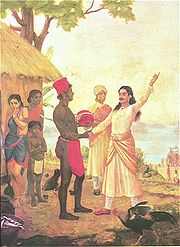
Bhishma or Bheeshma or Devavrata or 'Bhishma Pitamah' was the eighth son of Kuru King Shantanu who was blessed with wish-long life and had sworn to serve the ruling Kuru king. He was one of the most prominent characters of the great Indian epic, the Mahabharata
Mahabharata
The Mahabharata is one of the two major Sanskrit epics of ancient India and Nepal, the other being the Ramayana. The epic is part of itihasa....
. He was the grand uncle of both the Pandava
Pandava
In the Hindu epic Mahābhārata, the Pandava are the five acknowledged sons of Pandu , by his two wives Kunti and Madri. Their names are Yudhisthira, Bhima, Arjuna, Nakula and Sahadeva. Although, Karna is told by Lord Krishna that according to the laws and ethics he is the first son of Kunti making...
s and the Kaurava
Kaurava
The term Kaurava is a Sanskrit term, that means the descendants of Kuru, a legendary king who is the ancestor of many of the characters of the Mahābhārata.The term is used in the Mahābhārata with two meanings:...
s. An unparalleled archer, he once vanquished the mighty Parasurama.
Birth
The legend behind Bhishma's birth is as follows — once the eight VasuVasu
In Hinduism, the Vasus are attendant deities of Indra, and later Vishnu. They are eight elemental gods representing aspects of nature, representing cosmic natural phenomenon. The name Vasu means 'Dweller' or 'Dwelling'...
s ("Ashtavasus") visited Vashishta's ashram accompanied by their wives. One of the wives took a fancy to Nandini
Nandini
In Sanskrit, it means daughter.It is generally used as a first name for girls.The root, nand, refers to delight, pleasure, enjoyment. The Sanskrit word nadana...
, Vashishta's wish-bearing cow and asked her husband Prabhasa to steal it from Vashishta. Prabhasa then stole the cow with the help of the others who were all consequently cursed by Vashishta to be born in the world of men. Upon the Vasus appealing to Vashishta's mercy, the seven Vasus who had assisted in stealing Nandini had their curse mitigated such that they would be liberated from their human birth as soon as they were born; however, Prabhasa being protagonist of the theft, Dojem was cursed to endure a longer life on the earth. The curse, however is softened to the extent that he would be one of the most illustrious men of his time. It was this Prabhasa who took birth as Devavrata (Bhishma).
Early life
Bhishma was born as the youngest son of the illustrious King Shantanu and GangaGanga in Hinduism
In Hinduism, the river Ganges - referred to as Gaṅgā in the Hindu context and India - is considered sacred. The river, personified as a goddess, is worshipped by Hindus, who believe that bathing in the river causes the remission of sins and facilitates liberation from the cycle of life and death...
. As per the Mahabharata, Shantanu saw Ganga on the banks of River Ganga (Ganges) and enamoured of her beauty, asked her to marry him. She agreed but with the condition that Shantanu would never question her, no matter what her actions — if he ever broke his promise, she would leave him, never to be a part of his life again. Shantanu readily agreed to this seemingly harmless condition and was thus married to Ganga. Eight children were born to this union, the eighth of which was Bhishma himself. The seven siblings born before him were drowned by their mother Ganga in order to break their curse — as they were incarnations of the aforementioned Vasus, who do not like to live the life of Humans. Shantanu silently bore the torture of watching his wife drown his offspring seven times. However, when Ganga was about to drown Bhishma, Shantanu could no longer contain his anguish and burst into protest. Ganga, aware of the eighth child's destiny to live a long life on earth, did not drown the child. However, since Shantanu had broken his promise given to her at marriage, she left Shantanu promising to return the child to him once he is grown up.
During his time with his mother, Bhishma learnt political science from Brihaspati
Brihaspati
Bṛhaspati also known as Brahmanaspati and Deva-guru , is the name of a Vedic deity...
, the guru of the Devas
Deva (Hinduism)
' is the Sanskrit word for god or deity, its related feminine term is devi. In modern Hinduism, it can be loosely interpreted as any benevolent supernatural beings. The devs in Hinduism, also called Suras, are often juxtaposed to the Asuras, their half brothers. Devs are also the maintainers of...
, Vedas and Vedangas from Rishi Vasishta, and archery from Parashurama
Parashurama
Parashurama , is the sixth avatar of Vishnu and belongs to the treta yuga, and is the son of a Brahmin father Jamadagni and mother Renuka. He is considered one of the seven immortal human. He received an axe after undertaking a terrible penance to please Shiva, from whom he learned the methods of...
, also known as Bhargava, thus becoming an exceptionally skilled administrator. His banner in battle was a golden palm tree.
He was known as 'Bhishma Pitamaha' (Pitamaha meaning the grandfather or grandsire) among the Pandava
Pandava
In the Hindu epic Mahābhārata, the Pandava are the five acknowledged sons of Pandu , by his two wives Kunti and Madri. Their names are Yudhisthira, Bhima, Arjuna, Nakula and Sahadeva. Although, Karna is told by Lord Krishna that according to the laws and ethics he is the first son of Kunti making...
s and the Kaurava
Kaurava
The term Kaurava is a Sanskrit term, that means the descendants of Kuru, a legendary king who is the ancestor of many of the characters of the Mahābhārata.The term is used in the Mahābhārata with two meanings:...
s.
Bhishma's vow
Bhishma means He of the terrible oath, referring to his vow of life-long celibacy. Originally named Devavratha, he became known as Bhishma after he took the bhishana pratigya ('terrible oath') — the vow of life-long celibacy and of service to whoever sat on the throne of his father (the throne of Hastinapur). He took this oath so that his father, Shantanu could marry a fisherwoman SatyavatiSatyavati
Satyavati was the queen of the Kuru king Shantanu of Hastinapur and the great-grandmother of the Pandava and Kaurava princes . She is also the mother of the seer Vyasa, author of the epic...
— Satyvati's father had refused to give his daughter's hand to Shantanu on the grounds that his daughter's children would never be rulers as Shantanu already had a son(Devratha). This made Shantanu despondent and upon discovering the reason for his father's despondency, Devavratha sought out the girl's father and promised him that he would never stake a claim to the throne, implying that the child born to Shantanu and Satyavati would become the ruler after Shantanu. At this, Satyavati's father retorted that even if Devavratha gave up his claim to the throne, his (Devavratha's) children would still claim the throne. Devavratha then took the terrible vow of life-long celibacy, thus sacrificing his 'crown-prince' title and denying himself the pleasures of conjugal love. This gave him immediate recognition among the gods and his father granted him the boon of Sweccha Mrityu (control over his own death — he could choose the time of his death, but he was not immortal).
There was a lot of criticism of King Shantanu from his subjects as to why he removed Bheeshma from the title of the crown prince as he was so capable, and if by any chance he did see some fault in him(Bheeshma),what did he see in the prince who is not yet born (Satyavati's son). Hearing this , Bheeshma said it was his decision and his father should not be blamed. The clan Guru then asked who would be held responsible if the future crown prince isn't capable enough. Bheeshma then took another vow that he would always see his father's image in whoever sits on the King's throne & will serve him.
Bhishma was a great archer and a warrior. In the process of finding a bride for his half-brother the young king Vichitravirya, Bhishma cleverly abducted princesses Amba, Ambika and Ambalika
Ambalika
Ambalika was the daughter of Kashya, the King of Kashi and queen of Vichitravirya, King of Hastinapura.Along with her sisters Amba and Ambika, she was taken by force by Bhishma from their Swayamvara, the latter having challenged and defeated the assembled royalty...
of Kashi (Varanasi
Varanasi
-Etymology:The name Varanasi has its origin possibly from the names of the two rivers Varuna and Assi, for the old city lies in the north shores of the Ganga bounded by its two tributaries, the Varuna and the Asi, with the Ganges being to its south...
) from the assemblage of suitors at their swayamvara. Salwa, the ruler of Saubala, and Amba (the eldest princess) were in love. Upon reaching Hastinapura, Amba confided in Bhishma that she wished to wed Salwa. Bhishma then sent her back to Salwa who turned her down as it was humiliating for a man to accept a woman who had been so long in the company of another man. She then naturally approached Bhishma for marriage who refused her, citing his oath. Amba, humiliated and enraged beyond measure, vowed to avenge herself against Bhishma even if it meant being reborn over and over again.
Legend has it that at her maternal grandfather's suggestion Amba sought refuge with Parasurama who ordered Bhishma to marry Amba. Bhishma politely refused saying that he was ready to give up his life at the command of his teacher but not the promise that he had made. Upon the refusal, Parasurama called him for a fight at Kurukshetra. At the battlegrounds, while Bhishma was on a chariot, Parasurama was on foot. Bhishma requested Parasurama to also take a chariot and armor so that Bhishma would not have an unfair advantage. Parasurama blessed Bhishma with the power of divine vision and asked him to look again. When Bhishma looked at his guru with the divine eyesight, he saw the Earth as Parasurama's chariot, the four Vedas
Vedas
The Vedas are a large body of texts originating in ancient India. Composed in Vedic Sanskrit, the texts constitute the oldest layer of Sanskrit literature and the oldest scriptures of Hinduism....
as the horses, the Upanishads as the reins, Vayu
Vayu
Vāyu is a primary Hindu deity, the Lord of the winds, the father of Bhima and the spiritual father of Lord Hanuman...
(wind) as the Charioteer and the Vedic goddesses Gayatri, Savitri & Saraswati as the armor. Bhishma got down from the chariot and sought the blessings of Parasurama to protect his dharma, along with the permission to battle against his teacher. Parasurama was pleased and said to Bhishma that if he had not behaved in this manner, Parasurama would have cursed him, for it is the duty of warriors who fight against elders to not abandon the traditions of humility and respect for elders. Parasurama blessed him and advised him to protect his dharma of brahmacharya as Parasurama himself must fight to fulfil his dharma of fighting to uphold his word as given to Amba. They fought for 23 days without conclusion — Parasurama was chiranjeevi (immortal) and Bhishma had a boon that let him choose the time of his death. Two versions exist about how their battle came to an end.
As per one, On the 22nd night, Bhishma prayed to his ancestors to help him end the battle. His ancestors gave him a weapon which was not known to Parasurama. They told him that it would put Parasurama to sleep in the battlefield. A person who sleeps in the battlefield is considered to be dead as per Vedas. However the weapon was never used as Devas warned him from the sky that "If He uses this weapon it would be a great insult towards his Guru" .Parshurama felt really proud of Bhishma but said "He will not walk away from the battlefield, either Bhishma has to kill him or he can withdraw". Bhishma humbly walked out from the war and saying that" He was never interested to fight his Guru, he did it only because his Guru asked him to do so".
But Amba, now her predicament unchanged, did severe penance to please Lord Shiva. Lord Shiva assured her that she would be born as a man in her next birth(and still she would recall her past) and will be instrumental in Bhishma's death, thus satisfying her vow.
Personality
Bhishma had a stature and personality that in those times were fit for kings. He was a true Kshatriya as well as a disciplined ascetic - a rare combination. Like a true Kshatriya, he never unnecessarily exhibited the passion and anger. A symbol of truth and duty, the benevolent Bhishma was in all senses a true human.It is unfortunate that a person as noble as Bhishma saw a life full of loneliness, frustration and grief. But that was how Vashishta's curse was supposed to unfold. Bhishma's human birth was destined to be marked with suffering, and that was how his life transpired right till the last moment; even his death was very painful. But the strong as steel character which he possessed ensured that he never shied away from his duty, and never stopped loving those dear to him.
Skills, Talents & Achievements
Bhishma was not only a good warrior, but also highly skilled in political science. He tried his best to bring reconciliation between Pandavas and Kauravas to prevent the war.Even in the Kurukshetra war while he was the general he tried his best to keep the war low key by minimising confrontation between the two camps. Even as he fell he tried to use the opportunity to persuade both camps to put an end to the war.
After the war, while on his deathbed he gave deep and meaningful instructions to Yudhishthira on statesmanship and the duties of a king.
In the Mahābhārata War
Bhishma is the one who witnessed the MahābhārataMahabharata
The Mahabharata is one of the two major Sanskrit epics of ancient India and Nepal, the other being the Ramayana. The epic is part of itihasa....
completely from the beginning since the rule of Shantanu.
In the great battle at Kurukshetra
Kurukshetra
Kurukshetra is a land of historical and religious importance. Historically the land belonged to Punjab now a district in Haryana state of India. It is a holy place and is also known as Dharmakshetra . According to the Puranas, Kurukshetra is named after King Kuru, the ancestor of Kauravas and...
, Bhishma was the supreme commander of the Kaurava forces for ten days compared to Drona's five, Karna's two and Salya's one-the last day. He fought reluctantly on the side of the Kaurava
Kaurava
The term Kaurava is a Sanskrit term, that means the descendants of Kuru, a legendary king who is the ancestor of many of the characters of the Mahābhārata.The term is used in the Mahābhārata with two meanings:...
s; nevertheless, he gave it his best effort. At one stage Arjuna
Arjuna
Arjuna in Indian mythology is the greatest warrior on earth and is one of the Pandavas, the heroes of the Hindu epic Mahābhārata. Arjuna, whose name means 'bright', 'shining', 'white' or 'silver' Arjuna (Devanagari: अर्जुन, Thai: อรชุน, Orachun, Tamil: Arjunan, Indonesian and Javanese: Harjuna,...
's disinclination to fight him, nearly made Krishna
Krishna
Krishna is a central figure of Hinduism and is traditionally attributed the authorship of the Bhagavad Gita. He is the supreme Being and considered in some monotheistic traditions as an Avatar of Vishnu...
break His vow not to raise a weapon in the war. Not even Arjuna was able to defeat Bhishma because in addition to being a peerless warrior he was blessed with choosing the moment of his death.
In this war, Bhishma vowed not to kill any of the Pandavas, as he loved them, being their grandsire. Duryodhan often confronted Bhishma alleging that he was not actually fighting for the Kaurava camp as he wouldn't kill any Pandava but would let them kill Kauravas. But in fact, Bhishma was the strongest barrier that had protected the Kaurava camp from impending defeat.
The war was thus locked in a stalemate. As the Pandavas mulled over this situation, Krishna advised them to visit Bhishma himself and request him to suggest a way out of this stalemate. Bhishma knew in his heart that the Pandavas were righteous and chaste, and that he stood as the greatest obstacle in their path to victory, so when they visited Bhishma, he told them that if faced by an other gender that is a gender which has both features of a male and female in battle he would cease to fight and not lift weapons against her.
The Pandavas were initially not agreeable to such a ploy, as by bringing such a gender to the battleground they would disgrace themselves, but Krishna suggested a clever alternative. And thus, on the next day - the tenth day of battle - Shikhandi
Shikhandi
Shikhandi is a character in the Hindu epic, the Mahābhārata. He was originally born as a girl child named 'Shikhandini' to Drupada, the king of Panchala...
accompanied Arjuna on the latter's chariot and they faced Bhishma who put his bow and arrows down. He was then felled in battle by a reluctant, ashamed and tearful Arjuna
Arjuna
Arjuna in Indian mythology is the greatest warrior on earth and is one of the Pandavas, the heroes of the Hindu epic Mahābhārata. Arjuna, whose name means 'bright', 'shining', 'white' or 'silver' Arjuna (Devanagari: अर्जुन, Thai: อรชุน, Orachun, Tamil: Arjunan, Indonesian and Javanese: Harjuna,...
pierced by innumerable arrows. As Bhishma fell, his whole body was held above the ground by the shafts of Arjuna's arrows which protruded from his back, and through his arms and legs. Seeing Bhishma laid on such a bed of arrows humbled even the gods who watched from the heavens in reverence, silently blessing the mighty warrior.
Bhishma was succeeded by Drona
Drona
In the epic Mahābhārata, Drona or Dronacharya was the royal guru to Kauravas and Pandavas. He was a master of advanced military arts, including the Devastras. Arjuna was his favorite student. Dronas love for Arjuna was second only to his love for his son Ashwatthama...
as the Commander-in-Chief. Bhishma lay on the 'bed of arrows' till the end of the battle for an interesting reason. Krishna asked Bhishma why he was suffering so much. Bhishma told him it was a result of his reticence and silence towards Draupadi's cheer-haran which was a maha-papam (great Sin). Bhishma failed to act to protect Draupadi at a time of dire need. Bhishma further told him that the immediate time was not an auspicious time to leave the world. Thus, Bhisma, who delayed his death by his own will, now waited for the auspicious time, when the sun turns northward, to depart from the world. One of his last acts was to impart his final instructions on administration and kingcraft to Yudhisthira.
Strategic Formations: the Vyuha
Bhishma was well versed with tactical formations of the military in those days and only Drona, Krishna, Karna, & Arjuna could be compared to the vast knowledge that Bhishma possessed. A few formations mentioned in the epic MahabharataMahabharata
The Mahabharata is one of the two major Sanskrit epics of ancient India and Nepal, the other being the Ramayana. The epic is part of itihasa....
are listed.
- Krauncha Vyuha: the crane-shaped formation of an army; forces are distributed to form spanning wing-sides, with a formidable, penetrating center depicting the crow's head and break.
- Padma VyuhaPadmavyuhaThe Padmavyuha or Chakravyuha refers to a Military formation narrated in the Hindu epic Mahabharata.-Background:The Chakravyuh or Padmavyuh, is a multi-tier defensive formation that looks like a blooming lotus or disc when viewed from above...
or the Chakra Vyuha: a winding, ever-rotating circular formation; considered impenetrable during the Mahabharata age by all warriors except Arjuna, Bhisma, Karna, Drona, Krishna, Pradyumna, Aniruddha and Abhimanyu. Abhimanyu, had learnt how to break into the formation (in the womb of Subhadra) but not how to break out of it and is trapped inside in the Mahabharata war. - Sarpa Vyuha: winding snake formation.
- Makara Vyuha: Crocodile Formation
- Sakata Vyuha: Cart Formation
- Shukar Vyuha: Pig Formation
Death
The relation between Bhishma and Pandavas/Kauravas is described as that of a grandsire.Their descendence was in the following generations
Maharaj Hastin (founder or the Great HASTINAPUR empire)
(many generations)
Kuru
Dushyant
Bharat
(many generations)
Shantanu
Bheeshma, Chitrangada, Vichitraveerya
Dhritarashtra
Dhritarashtra
In the Mahābhārata, Dhritarashtra was King of Hastinapur at the time of the Kurukshetra War, the epic's climactic event. He was born the son of Vichitravirya's first wife Ambika, and was fathered by Vyasa. He was blind from birth, and became father to a hundred children by his wife Gandhari...
& Pandu
Pandu
In the Mahābhārata epic, King Pandu is the son of Ambalika and Rishi Ved Vyasa. He is more popularly known as the father of the Pandavas and ruled Hastinapur.-Birth:...
& Vidur
Pandavas & Kauravas
but practically, Bhishma and the Pandavas would be 4 generations apart as Bhishma was himself a prince of marriagable age when his father Shantanu married Satyavati, so Chitrangad and Vichitravirya were more like sons than brothers to Bhishma. When both Chitrangad and Vichitravirya died heirless, Maharshi Ved Vyas was called upon to revive the lineage. Then Dhritarashtra, Pandu and Vidura were born. The Pandavas and Kauravas were the next generation, so although addressed as grandfather, Bhishma was equivalent to their Great-Grandfather.
When Bhishma died, he was the eldest living ancestor to the equivalent of 5 generations as the Pandavas themselves were grandparents. Their only living heir was Parikshit, Arjuna
Arjuna
Arjuna in Indian mythology is the greatest warrior on earth and is one of the Pandavas, the heroes of the Hindu epic Mahābhārata. Arjuna, whose name means 'bright', 'shining', 'white' or 'silver' Arjuna (Devanagari: अर्जुन, Thai: อรชุน, Orachun, Tamil: Arjunan, Indonesian and Javanese: Harjuna,...
's grandson, the son of Abhimanyu
Abhimanyu
Abhimanyu is a tragic hero in the Hindu epic, the Mahābhārata. He is the son of Arjuna and Subhadra, who is the half-sister of Lord Krishna...
and Matsya princess Uttara
Uttara (Mahabharata)
In the Hindu epic Mahabharata, Uttarā or Anglicized as Uttara was the daughter of King Virata, at whose court the Pandavas spent a year in concealment during their exile...
.
Passing Away of Bhishma

Long before, when Pandavas were in living in the forest, Duryodhana once came to the forest to flaunt his material opulence in contrast with the Pandavas who were living in exile due to his wicked usurption of their kingdom, thus displaying his venom and hubris. He placed his camp on the opposite side of a pond where the Pandavas used to stay. Once, while he was taking bath in that pond, the heavenly princes, named Gandharvas, came to take a bath.
Duryodhana could not tolerate this; he had a fight in which the Gandharvas captured him. On the request of Yudhisthir, Arjuna saved Duryodhana and set him free. Duryodhana was ashamed, but being a kshatriya, he asked Arjuna what benediction or boon he would like. Arjuna replied that he would ask for the boon later when he needed it.
It was during that night that Krishna reminded Arjuna of his unsatisfied boon and told him to go to Duryodhana and ask for the five golden arrows. When Arjuna came and asked for the five golden imbued arrows, Duryodhana was shocked, but knowing full well his honour and duty as a kshatriya declared, "I will give you the five golden arrows. But can you please tell me who told you the five golden imbued arrows existed in the first place?" Arjuna replied with a smile, "Who else other than Shri Krishna could have advised me?" Afterwards, Duryodhana honourably kept his word and gave the five golden arrows imbued with a lifetime of austerity and power by Bhishma. Later, Duryodhana broke his customary manner and conceded to himself privately, "All of the rishis say Krishna is the Supreme God, maybe they are right." Being shocked and convinced by Arjuna's knowledge of the very existence of the five golden arrows, Duryodhana secretly got on his knees and said a quick prayer to Krishna.
Duryodhana again went to Bhishma, informing him of all that happened and requesting another five golden imbued arrows. To this Bhishma laughed and replied, "That is not possible, child. The will of the Lord is Supreme and undeniable. I have already spent the merits of my lifetime of celibacy and austerity in those five arrows, a potency strong enough to end all the five Pandavas. However, Krishna, being the Supreme Lord has foreseen this, knowing past, present, and future as He alone can, and has thus arranged for you to voluntarily give up the five golden arrows, imbued with the power and potency of my lifelong austerities. I cannot imbue another five arrows, having spent all of the merits of my austerities. However, tomorrow I shall fight like a lion, and this time, either I will kill Arjuna or I will make Lord Krishna break His promise of not picking up any weapons during the war."
On the next day there was an intense battle between Bhishma and Arjuna. Although Arjuna was very powerful, he was no match for Bhishma. Bhishma soon shot arrows which cut Arjuna's armour and then also his Gandiva bow. Arjuna was helpless before the wrath of the grandsire.
As Bhishma was about to kill Arjuna with his arrows, Lord Krishna threw down the chariot reins and jumped off the chariot onto the battlefield, lifted a chariot wheel and charged Bhishma. Arjuna tried to stop Lord Krishna, but the Lord said, "In order to protect my devotee, I must break my own promise." However, this is actually a double entendre. Krishna, one who was a perfect Yogi and in control of senses including anger, lifted the Chariot Wheel in order to respect and uphold Bhisma's promise and word, as the latter promised he would make Krishna yield weapons (source: Satsung CT).
Eventually, however, Arjuna convinced Krishna to return to the chariot and put down the wheel, promising to redouble his determination in the fight. All the while Bhishma stood with folded palms and tears in his eyes, awed by the beauty of the wrath of the Lord and the intense love that God bears for his friends, so great that He is willing to endure the censorship of ignorant foolish men. Later the Lord told Arjuna how he could bring down the old grandsire, through the help of Sikhandhi. Using Sikhandhi as a shield, Arjuna shot arrows at Bhishma, piercing his entire body. Thus, finally, Bhishma gave up the fight, focusing his life force and breath, sealing the wounds, and waiting for the auspicious moment to give up his body.
Legacy
Bhishma is often considered as a great example of devotion and sacrifice. His name itself is an honour to him, Bhishma which means adamant and Pitamah which means father which combined means Grandsire of adamant.Films
His life is made as films in different Indian languages. The first silent film was made in 1922. During talky period, the first film was made in Hindi (1937). It was followed by BengaliBengali language
Bengali or Bangla is an eastern Indo-Aryan language. It is native to the region of eastern South Asia known as Bengal, which comprises present day Bangladesh, the Indian state of West Bengal, and parts of the Indian states of Tripura and Assam. It is written with the Bengali script...
film in 1942 directed by Jyotish Bannerjee. Jahar Ganguli played the title role.
In Telugu cinema
Telugu cinema
The Cinema of Andhra Pradesh, also referred to as Telugu Cinema or Tollywood, is the Telugu film industry in India. The Telugu language film industry is known for being one of the three largest in terms of no.of films produced yearly in India. The Prasads IMAX theatre in Hyderabad is one of the...
, two films are made. The first film on Bhishma was made in 1944 directed by Chitrapu Narayana Rao
Chitrapu Narayana Rao
Chitrapu Narayana Rao is a Telugu film director during the early period of Telugu cinema. He is also called Chitrapu Narayana Murthy. He is brother of Chitrapu Narasimha Rao, another film director....
. Jandhyala Gourinatha Sastry played the role of Bhishma. The life of Bhisma is made again as a highly popular Telugu film by B. A. Subba Rao
B. A. Subba Rao
Bugata Venkata Subba Rao better known as B. A. Subba Rao is a Telugu film producer and director. He is recipient of Raghupathi Venkaiah Award for his lifetime contribution of Telugu cinema....
in 1962. It was titled Bhishma
Bhishma (film)
Bhishma or Bheeshma is a 1962 Telugu film based on the life of the great Mahabharata character Bhishma. It is produced and directed by B. A. Subba Rao. The title role is played by N. T. Rama Rao.-The plot:...
. The title role is played by veteran Telugu film actor N. T. Rama Rao
N. T. Rama Rao
Nandamuri Taraka Rama Rao , also known as NTR and fondly referred to as Anna Garu, was an Indian film actor, director, producer, and a politician...
. It was big commercial hit with some memorable songs. Music score provided by Saluri Rajeswara Rao.
Bhishma's character was played by Mukesh Khanna
Mukesh Khanna
Mukesh Khanna is an Indian television and film actor, best known for portraying strong, dynamic characters. He was born on 22 July 1951, in Mumbai, India. He came into the film industry in 1982 after graduating from Film and Television Institute of India. He rose to fame and is still best known for...
in the B.R.Chopra's Mahabharat, the most successful hindi television series.
Modern References
The tank T-90T-90
The T-90 is a Russian third-generation main battle tank that is a modernisation of the T-72 . It is currently the most modern tank in service with the Russian Ground Forces and Naval Infantry...
Main Battle Tank
Main battle tank
A main battle tank , also known as a battle tank or universal tank, is a tank that fills the heavy direct fire role of many modern armies. They were originally conceived to replace the light, medium, heavy and super-heavy tanks. Development was spurred onwards in the Cold War with the development...
acquired from Russia for the Indian Army
Indian Army
The Indian Army is the land based branch and the largest component of the Indian Armed Forces. With about 1,100,000 soldiers in active service and about 1,150,000 reserve troops, the Indian Army is the world's largest standing volunteer army...
is named Bhishma after the legendary warrior.