


Life unworthy of life

Encyclopedia
The phrase "life unworthy of life" (in ) was a Nazi designation for the segments of populace which had no right to live
and thus were to be "euthanized". The term included people with serious medical problems and those considered grossly inferior according to racial policy of the Third Reich. This concept formed an important component of the ideology
of Nazism
and eventually helped lead to the Holocaust. How the killing was carried out is described in the article, Action T4
.
, retired from the University of Leipzig
, and psychiatrist Alfred Hoche
from the University of Freiburg
, both professor
s. According to Hoch, some living people who were brain damaged, mentally retarded, psychiatrically ill were "mentally dead", "human ballast" and "empty shells of human beings". Hoch felt killing such people was useful. Some people were simply considered disposable.
Later the killing was extended to people considered racially impure or racially inferior according to Nazi thinking.
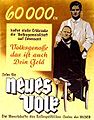 Those considered to be "deviant" or a "source of social turmoil" in Nazi Germany
and the occupied Europe fell under this designation. The "deviant" category included the mentally ill, people with disabilities, political dissidents
, homosexuals, interracial couples
, and criminals
. The "social turmoil" category included some clergy
, Communists, Jews
, Romani people, Jehovah's Witnesses
, "non-white" or non-Caucasian
peoples, ethnic Poles and a variety of other groups in society. More than any other of these groups, the Jews soon became the primary focus of this genocidal
policy.
The concept culminated in Nazi extermination camps, instituted to systematically kill those who were unworthy to live according to Nazi ideologists. It also justified various human experimentation
and eugenics
programs, as well as Nazi racial policies. The policies included ethnic Poles, with Adolf Hitler
writing to his generals in the Eastern Front to kill "without pity or mercy, all men, women, and children of Polish descent or language", and Heinrich Himmler
writing, "All Poles will disappear from the world. [...] It is essential that the great German people should consider it as its major task to destroy all Poles."
Robert Jay Lifton
, the policy went through a number of iterations and modifications:
Right to life
Right to life is a phrase that describes the belief that a human being has an essential right to live, particularly that a human being has the right not to be killed by another human being...
and thus were to be "euthanized". The term included people with serious medical problems and those considered grossly inferior according to racial policy of the Third Reich. This concept formed an important component of the ideology
Ideology
An ideology is a set of ideas that constitutes one's goals, expectations, and actions. An ideology can be thought of as a comprehensive vision, as a way of looking at things , as in common sense and several philosophical tendencies , or a set of ideas proposed by the dominant class of a society to...
of Nazism
Nazism
Nazism, the common short form name of National Socialism was the ideology and practice of the Nazi Party and of Nazi Germany...
and eventually helped lead to the Holocaust. How the killing was carried out is described in the article, Action T4
Action T4
Action T4 was the name used after World War II for Nazi Germany's eugenics-based "euthanasia" program during which physicians killed thousands of people who were "judged incurably sick, by critical medical examination"...
.
History
The expression first occurs in the title of a 1920 book, Die Freigabe der Vernichtung Lebensunwerten Lebens (Allowing the Destruction of Life Unworthy of Life) by jurist Karl BindingKarl Binding
Karl Ludwig Lorenz Binding was a German jurist known as a promoter of the theory of retributive justice. His influential book, Die Freigabe der Vernichtung Lebensunwertem Lebens , written together with the psychiatrist Alfred Hoche, was used by the Nazis to justify their T-4 Euthanasia Program.-...
, retired from the University of Leipzig
University of Leipzig
The University of Leipzig , located in Leipzig in the Free State of Saxony, Germany, is one of the oldest universities in the world and the second-oldest university in Germany...
, and psychiatrist Alfred Hoche
Alfred Hoche
Alfred Erich Hoche was a German psychiatrist well-known for his writings about eugenics and euthanasia.-Life:Hoche studied in Berlin and Heidelberg and became a psychiatrist in 1890. He moved to Strasbourg in 1891. From 1902 he was a professor at Freiburg im Breisgau and was a director of the...
from the University of Freiburg
University of Freiburg
The University of Freiburg , sometimes referred to in English as the Albert Ludwig University of Freiburg, is a public research university located in Freiburg im Breisgau, Baden-Württemberg, Germany.The university was founded in 1457 by the Habsburg dynasty as the...
, both professor
Professor
A professor is a scholarly teacher; the precise meaning of the term varies by country. Literally, professor derives from Latin as a "person who professes" being usually an expert in arts or sciences; a teacher of high rank...
s. According to Hoch, some living people who were brain damaged, mentally retarded, psychiatrically ill were "mentally dead", "human ballast" and "empty shells of human beings". Hoch felt killing such people was useful. Some people were simply considered disposable.
Later the killing was extended to people considered racially impure or racially inferior according to Nazi thinking.
Nazi categorization
Nazi Germany
Nazi Germany , also known as the Third Reich , but officially called German Reich from 1933 to 1943 and Greater German Reich from 26 June 1943 onward, is the name commonly used to refer to the state of Germany from 1933 to 1945, when it was a totalitarian dictatorship ruled by...
and the occupied Europe fell under this designation. The "deviant" category included the mentally ill, people with disabilities, political dissidents
Dissident
A dissident, broadly defined, is a person who actively challenges an established doctrine, policy, or institution. When dissidents unite for a common cause they often effect a dissident movement....
, homosexuals, interracial couples
Miscegenation
Miscegenation is the mixing of different racial groups through marriage, cohabitation, sexual relations, and procreation....
, and criminals
Crime
Crime is the breach of rules or laws for which some governing authority can ultimately prescribe a conviction...
. The "social turmoil" category included some clergy
Clergy
Clergy is the generic term used to describe the formal religious leadership within a given religion. A clergyman, churchman or cleric is a member of the clergy, especially one who is a priest, preacher, pastor, or other religious professional....
, Communists, Jews
Jews
The Jews , also known as the Jewish people, are a nation and ethnoreligious group originating in the Israelites or Hebrews of the Ancient Near East. The Jewish ethnicity, nationality, and religion are strongly interrelated, as Judaism is the traditional faith of the Jewish nation...
, Romani people, Jehovah's Witnesses
Jehovah's Witnesses
Jehovah's Witnesses is a millenarian restorationist Christian denomination with nontrinitarian beliefs distinct from mainstream Christianity. The religion reports worldwide membership of over 7 million adherents involved in evangelism, convention attendance of over 12 million, and annual...
, "non-white" or non-Caucasian
Caucasian peoples
This article deals with the various ethnic groups inhabiting the Caucasus region. There are more than50 ethnic groups living in the region.-Peoples speaking Caucasian languages:...
peoples, ethnic Poles and a variety of other groups in society. More than any other of these groups, the Jews soon became the primary focus of this genocidal
Genocide
Genocide is defined as "the deliberate and systematic destruction, in whole or in part, of an ethnic, racial, religious, or national group", though what constitutes enough of a "part" to qualify as genocide has been subject to much debate by legal scholars...
policy.
The concept culminated in Nazi extermination camps, instituted to systematically kill those who were unworthy to live according to Nazi ideologists. It also justified various human experimentation
Nazi human experimentation
Nazi human experimentation was a series of medical experiments on large numbers of prisoners by the Nazi German regime in its concentration camps mainly in the early 1940s, during World War II and the Holocaust. Prisoners were coerced into participating: they did not willingly volunteer and there...
and eugenics
Nazi eugenics
Nazi eugenics were Nazi Germany's racially-based social policies that placed the improvement of the Aryan race through eugenics at the center of their concerns...
programs, as well as Nazi racial policies. The policies included ethnic Poles, with Adolf Hitler
Adolf Hitler
Adolf Hitler was an Austrian-born German politician and the leader of the National Socialist German Workers Party , commonly referred to as the Nazi Party). He was Chancellor of Germany from 1933 to 1945, and head of state from 1934 to 1945...
writing to his generals in the Eastern Front to kill "without pity or mercy, all men, women, and children of Polish descent or language", and Heinrich Himmler
Heinrich Himmler
Heinrich Luitpold Himmler was Reichsführer of the SS, a military commander, and a leading member of the Nazi Party. As Chief of the German Police and the Minister of the Interior from 1943, Himmler oversaw all internal and external police and security forces, including the Gestapo...
writing, "All Poles will disappear from the world. [...] It is essential that the great German people should consider it as its major task to destroy all Poles."
Development of the concept
According to the author of Medical Killing and the Psychology of Genocide psychiatristPsychiatrist
A psychiatrist is a physician who specializes in the diagnosis and treatment of mental disorders. All psychiatrists are trained in diagnostic evaluation and in psychotherapy...
Robert Jay Lifton
Robert Jay Lifton
Robert Jay Lifton is an American psychiatrist and author, chiefly known for his studies of the psychological causes and effects of war and political violence and for his theory of thought reform...
, the policy went through a number of iterations and modifications:
See also
- Glossary of Nazi Germany
- Nazi eugenicsNazi eugenicsNazi eugenics were Nazi Germany's racially-based social policies that placed the improvement of the Aryan race through eugenics at the center of their concerns...
- Action T4Action T4Action T4 was the name used after World War II for Nazi Germany's eugenics-based "euthanasia" program during which physicians killed thousands of people who were "judged incurably sick, by critical medical examination"...
- Department of Film (Nazi Germany)Department of Film (Nazi Germany)The Department of Film was one of five departments that comprised the Central Party Propaganda Office of the NSDAP, established by Adolf Hitler in 1933 as part of the Reichspropagandaleitung. The Central Party Propaganda Office was separate from the official government Ministry of Public...
- Nazism and raceNazism and raceNazism developed several theories concerning races. The Nazis claimed to scientifically measure a strict hierarchy of human race; at the top was the master race, the "Aryan race", narrowly defined by the Nazis as being identical with the Nordic race, followed by lesser races.At the bottom of this...
- EugenicsEugenicsEugenics is the "applied science or the bio-social movement which advocates the use of practices aimed at improving the genetic composition of a population", usually referring to human populations. The origins of the concept of eugenics began with certain interpretations of Mendelian inheritance,...
External links
- "Life Unworthy of Life" and other Medical Killing Programmes by Dr. Stuart D. Stein, University of the West of EnglandUniversity of the West of EnglandThe University of the West of England is a university based in the English city of Bristol. Its main campus is at Frenchay, about five miles north of the city centre...