

University of Pennsylvania Museum of Archaeology and Anthropology

Encyclopedia
The University of Pennsylvania Museum of Archaeology and Anthropology, commonly called The Penn Museum, is an archaeology
and anthropology
museum that is part of the University of Pennsylvania
in the University City neighborhood of Philadelphia, Pennsylvania
.
On June 1, Director Dr. Richard Hodges announced that newly defined positions as "Associate Curator" or "Research Project Manager" have been offered to 11 of the 18 individuals affected.
The Museum has stated that its commitment to research remains firm, as indicated by more than 50 research projects spanning five continents that engage nearly 200 Museum-affiliated scholars—more than can be found at any other archaeological and anthropological institute/museum in North America. See the museum's statement about restructuring.
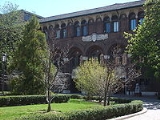
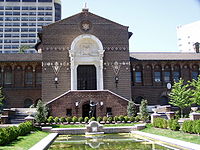 The Museum is housed in a Beaux Arts building that is one of the landmarks of the University of Pennsylvania campus. The existing original building (onto which have been grafted several later additions) is actually only approximately one-third of an ambitious design that would have created one of the largest museum buildings in the United States. Features of the extant building include a dramatic rotunda
and gardens that include Egyptian papyrus
. The Penn Museum was designed by a team of Philadelphia architects, all of whom taught on the faculty of the University: Wilson Eyre
, Cope & Stewardson
and Frank Miles Day
. The first phase was completed in 1899 and housed the discoveries from an expedition sponsored by the University to the ancient site of Nippur
. In 1915, the rotunda, which houses the Harrison Auditorium in the basement was completed. Charles Klauder
designed the Coxe Memorial Wing, which opened in 1926 to house the Museum's Egyptian collection. The Sharpe Wing was completed in 1929.
The Coxe Memorial Egyptian Wing was added to the museum in 1924 through a bequest by former museum board president Eckley Coxe. The administrative wing was added in 1929. The Academic Wing, which provided laboratories for the Anthropology department and classrooms was opened in 1971. The most recent major addition was made in 2002, with the addition of the Mainwaring (Collections Storage) Wing.
which belonged to Empress Dowager Cixi
— one of the finest in existence. Along with an Egyptian status of Osiris
, the crystal ball was stolen in 1988, and its elegant silver stand, a stylized ocean wave, was found in a culvert not far from the Museum. The items were recovered in 1991 after a former museum staff member saw the statue in an area antique shop; the crystal ball was traced to a home in New Jersey and returned to the Museum.
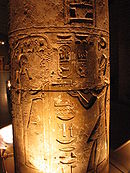 The museum's collection of Egyptian artifacts is considered one of the finest in the world. The museum's Egyptian galleries house an extensive collection of statuary, mummies, and reliefs. Most notably, the museum houses a set of architectural elements, including large columns and a 13-ton granite Sphinx of Ramesses II
, circa 1200 B.C., from the palace of the Pharaoh
Merenptah. These were excavated by a museum expedition to Egypt in 1915. In the late 1970s Karl-Theodor Zauzich (attendant of the Egytian section) discovered 3 missing fragments of the Insinger Papyrus
in the Museum's collections.
, which The University of Pennsylvania co–excavated with the British Museum
in Iraq
. Ur was an important and wealthy city-state in ancient Sumer
, and the artifacts from its royal tombs showcase the city's wealth. The collections consists of a variety of crowns, figures, and musical instruments, many of which have been inlaid with gold and precious stones. The often traveling collection includes a well known Bull-headed lyre
. The museum's Babylonia
n section houses a collection of almost 30,000 clay tablet
s inscribed in Sumerian
and Akkadian
cuneiform
, making it one of the ten largest collections in the world. The collection contains the largest number of Sumerian school tablets and literary compositions of any of the world's museums, as well as important administrative archives ranging from 2900 to 500 BCE.
, Guatemala
from 1956 to 1970. Many important artifacts from this excavation are on view in the museum, along with several stelae from the contemporary cities of Caracol
and Piedras Negras. The gallery also displays many Aztecan, Oaxacan, and Teotihuacano artifacts.
Archaeology
Archaeology, or archeology , is the study of human society, primarily through the recovery and analysis of the material culture and environmental data that they have left behind, which includes artifacts, architecture, biofacts and cultural landscapes...
and anthropology
Anthropology
Anthropology is the study of humanity. It has origins in the humanities, the natural sciences, and the social sciences. The term "anthropology" is from the Greek anthrōpos , "man", understood to mean mankind or humanity, and -logia , "discourse" or "study", and was first used in 1501 by German...
museum that is part of the University of Pennsylvania
University of Pennsylvania
The University of Pennsylvania is a private, Ivy League university located in Philadelphia, Pennsylvania, United States. Penn is the fourth-oldest institution of higher education in the United States,Penn is the fourth-oldest using the founding dates claimed by each institution...
in the University City neighborhood of Philadelphia, Pennsylvania
Philadelphia, Pennsylvania
Philadelphia is the largest city in the Commonwealth of Pennsylvania and the county seat of Philadelphia County, with which it is coterminous. The city is located in the Northeastern United States along the Delaware and Schuylkill rivers. It is the fifth-most-populous city in the United States,...
.
History
An internationally renowned educational and research institution dedicated to the understanding of cultural diversity and the exploration of the history of humankind, the University of Pennsylvania Museum of Archaeology and Anthropology—which has conducted more than 400 archaeological and anthropological expeditions around the world—was founded during the administration of Provost William Pepper. In 1887, Provost Pepper persuaded the Trustees of the University of Pennsylvania to erect a fireproof building to house artifacts from an upcoming expedition to the ancient site of Nippur in modern-day Iraq (then part of the Ottoman Empire). During the late 19th and early 20th centuries, North American and European museums regularly sponsored such excavations throughout the Mediterranean and Near East, sharing the ownership of their discoveries with the host country. Penn Museum followed this practice in acquiring the vast majority of its collections, and, as a result, most of the Museum's objects have a known archaeological context, increasing their value for archaeological and anthropological research and presentation. Today the Museum's three floors of gallery space feature materials from the ancient Mediterranean World, Egypt, the Levant, Mesopotamia, South and East Asia, and Mesoamerica, as well as artifacts from the native peoples of the Americas, Africa, and Oceania. Since 1958, the Penn Museum has published Expedition Magazine. (ISSN 0014-4738)2009 Restructuring
On 19 November 2008, University of Pennsylvania Museum Administration announced its decision to terminate 18 Research Specialist positions in archaeological and anthropological research in the Mediterranean world, the Middle East, and the Americas, effective May 31, 2009. The scientific research center MASCA (Museum Applied Science Center for Archaeology)] was also closed, although the MASCA scientists were moved to other Sections within the museum. The decision received local and world-wide criticisms and reactions among archaeologists and concerned communities, who felt that it represented a decided departure from the original mission of the Penn Museum as a research institution since its foundation in 1887. Museum administrators announced that this was a measure taken due to the current financial crisis and the deep budget cuts at the University of Pennsylvania.On June 1, Director Dr. Richard Hodges announced that newly defined positions as "Associate Curator" or "Research Project Manager" have been offered to 11 of the 18 individuals affected.
The Museum has stated that its commitment to research remains firm, as indicated by more than 50 research projects spanning five continents that engage nearly 200 Museum-affiliated scholars—more than can be found at any other archaeological and anthropological institute/museum in North America. See the museum's statement about restructuring.
Museum building
Rotunda (architecture)
A rotunda is any building with a circular ground plan, sometimes covered by a dome. It can also refer to a round room within a building . The Pantheon in Rome is a famous rotunda. A Band Rotunda is a circular bandstand, usually with a dome...
and gardens that include Egyptian papyrus
Papyrus
Papyrus is a thick paper-like material produced from the pith of the papyrus plant, Cyperus papyrus, a wetland sedge that was once abundant in the Nile Delta of Egypt....
. The Penn Museum was designed by a team of Philadelphia architects, all of whom taught on the faculty of the University: Wilson Eyre
Wilson Eyre
Wilson Eyre, Jr. was an influential American architect, teacher and writer who practiced in the Philadelphia area...
, Cope & Stewardson
Cope & Stewardson
Cope & Stewardson was an architecture firm best known for its academic building and campus designs. The firm is often regarded as a Master of the Collegiate Gothic style. Walter Cope and John Stewardson established the firm in 1885, and were later joined by Emlyn Stewardson in 1887...
and Frank Miles Day
Frank Miles Day
Frank Miles Day was a Philadelphia-based architect who specialized in residences and academic buildings. In 1883, he graduated from the Towne School of the University of Pennsylvania, and traveled to Europe. In England, he apprenticed under two architects, and won the 1885 prize from the...
. The first phase was completed in 1899 and housed the discoveries from an expedition sponsored by the University to the ancient site of Nippur
Nippur
Nippur was one of the most ancient of all the Sumerian cities. It was the special seat of the worship of the Sumerian god Enlil, the "Lord Wind," ruler of the cosmos subject to An alone...
. In 1915, the rotunda, which houses the Harrison Auditorium in the basement was completed. Charles Klauder
Charles Klauder
Charles Zeller Klauder was an American architect best known for his work on university buildings and campus designs, especially his Cathedral of Learning at the University of Pittsburgh, the first educational skyscraper.-Biography:...
designed the Coxe Memorial Wing, which opened in 1926 to house the Museum's Egyptian collection. The Sharpe Wing was completed in 1929.
The Coxe Memorial Egyptian Wing was added to the museum in 1924 through a bequest by former museum board president Eckley Coxe. The administrative wing was added in 1929. The Academic Wing, which provided laboratories for the Anthropology department and classrooms was opened in 1971. The most recent major addition was made in 2002, with the addition of the Mainwaring (Collections Storage) Wing.
Collections
Penn Museum's extensive collections fall into two main divisions: archaeology, the artifacts recovered from the past by excavation, and ethnology, the objects and ideas collected from living peoples. There is also an extensive collection of skeletal material, which is not on display. More than 30 galleries feature materials from around the world and throughout the ages including:China
The Chinese collection is housed in a spacious gallery underneath the museum's Harrison Rotunda, which measures ninety feet across and ninety feet from the floor and is one of the largest unsupported masonry domes in the nation. This gallery houses large paintings and sculptures, as well as a perfectly spherical carved Chinese crystalCrystal
A crystal or crystalline solid is a solid material whose constituent atoms, molecules, or ions are arranged in an orderly repeating pattern extending in all three spatial dimensions. The scientific study of crystals and crystal formation is known as crystallography...
which belonged to Empress Dowager Cixi
Empress Dowager Cixi
Empress Dowager Cixi1 , of the Manchu Yehenara clan, was a powerful and charismatic figure who became the de facto ruler of the Manchu Qing Dynasty in China for 47 years from 1861 to her death in 1908....
— one of the finest in existence. Along with an Egyptian status of Osiris
Osiris
Osiris is an Egyptian god, usually identified as the god of the afterlife, the underworld and the dead. He is classically depicted as a green-skinned man with a pharaoh's beard, partially mummy-wrapped at the legs, wearing a distinctive crown with two large ostrich feathers at either side, and...
, the crystal ball was stolen in 1988, and its elegant silver stand, a stylized ocean wave, was found in a culvert not far from the Museum. The items were recovered in 1991 after a former museum staff member saw the statue in an area antique shop; the crystal ball was traced to a home in New Jersey and returned to the Museum.
Egypt
Ramesses II
Ramesses II , referred to as Ramesses the Great, was the third Egyptian pharaoh of the Nineteenth dynasty. He is often regarded as the greatest, most celebrated, and most powerful pharaoh of the Egyptian Empire...
, circa 1200 B.C., from the palace of the Pharaoh
Pharaoh
Pharaoh is a title used in many modern discussions of the ancient Egyptian rulers of all periods. The title originates in the term "pr-aa" which means "great house" and describes the royal palace...
Merenptah. These were excavated by a museum expedition to Egypt in 1915. In the late 1970s Karl-Theodor Zauzich (attendant of the Egytian section) discovered 3 missing fragments of the Insinger Papyrus
Insinger Papyrus
Insinger Papyrus is a papyrus find from Ancient Egypt and contains one of the oldest extant writings about Egyptian wisdom teachings...
in the Museum's collections.
Iraq
The museum's most important collection is arguably that of the Royal Tombs of UrUr
Ur was an important city-state in ancient Sumer located at the site of modern Tell el-Muqayyar in Iraq's Dhi Qar Governorate...
, which The University of Pennsylvania co–excavated with the British Museum
British Museum
The British Museum is a museum of human history and culture in London. Its collections, which number more than seven million objects, are amongst the largest and most comprehensive in the world and originate from all continents, illustrating and documenting the story of human culture from its...
in Iraq
Iraq
Iraq ; officially the Republic of Iraq is a country in Western Asia spanning most of the northwestern end of the Zagros mountain range, the eastern part of the Syrian Desert and the northern part of the Arabian Desert....
. Ur was an important and wealthy city-state in ancient Sumer
Sumer
Sumer was a civilization and historical region in southern Mesopotamia, modern Iraq during the Chalcolithic and Early Bronze Age....
, and the artifacts from its royal tombs showcase the city's wealth. The collections consists of a variety of crowns, figures, and musical instruments, many of which have been inlaid with gold and precious stones. The often traveling collection includes a well known Bull-headed lyre
Lyre
The lyre is a stringed musical instrument known for its use in Greek classical antiquity and later. The word comes from the Greek "λύρα" and the earliest reference to the word is the Mycenaean Greek ru-ra-ta-e, meaning "lyrists", written in Linear B syllabic script...
. The museum's Babylonia
Babylonia
Babylonia was an ancient cultural region in central-southern Mesopotamia , with Babylon as its capital. Babylonia emerged as a major power when Hammurabi Babylonia was an ancient cultural region in central-southern Mesopotamia (present-day Iraq), with Babylon as its capital. Babylonia emerged as...
n section houses a collection of almost 30,000 clay tablet
Clay tablet
In the Ancient Near East, clay tablets were used as a writing medium, especially for writing in cuneiform, throughout the Bronze Age and well into the Iron Age....
s inscribed in Sumerian
Sumerian language
Sumerian is the language of ancient Sumer, which was spoken in southern Mesopotamia since at least the 4th millennium BC. During the 3rd millennium BC, there developed a very intimate cultural symbiosis between the Sumerians and the Akkadians, which included widespread bilingualism...
and Akkadian
Akkadian language
Akkadian is an extinct Semitic language that was spoken in ancient Mesopotamia. The earliest attested Semitic language, it used the cuneiform writing system derived ultimately from ancient Sumerian, an unrelated language isolate...
cuneiform
Cuneiform
Cuneiform can refer to:*Cuneiform script, an ancient writing system originating in Mesopotamia in the 4th millennium BC*Cuneiform , three bones in the human foot*Cuneiform Records, a music record label...
, making it one of the ten largest collections in the world. The collection contains the largest number of Sumerian school tablets and literary compositions of any of the world's museums, as well as important administrative archives ranging from 2900 to 500 BCE.
Mesoamerica
The Penn Museum conducted an excavation of the Mayan city of TikalTikal
Tikal is one of the largest archaeological sites and urban centres of the pre-Columbian Maya civilization. It is located in the archaeological region of the Petén Basin in what is now northern Guatemala...
, Guatemala
Guatemala
Guatemala is a country in Central America bordered by Mexico to the north and west, the Pacific Ocean to the southwest, Belize to the northeast, the Caribbean to the east, and Honduras and El Salvador to the southeast...
from 1956 to 1970. Many important artifacts from this excavation are on view in the museum, along with several stelae from the contemporary cities of Caracol
Caracol
Caracol is the name given to a large ancient Maya archaeological site, located in what is now the Cayo District of Belize. It is situated approximately 40 kilometres south of Xunantunich and the town of San Ignacio Cayo, and 15 kilometers away from the Macal River. It rests on the Vaca Plateau at...
and Piedras Negras. The gallery also displays many Aztecan, Oaxacan, and Teotihuacano artifacts.
See also
- The Benghazi VenusBenghazi VenusBerenice Venus or "The Benghazi Venus" is an ancient Cyrenaican Greek marble statue of the goddess of sexuality and erotic love Venus . It was found in Benghazi, Libya. which may have once marked the location of the legendary Lake Tritonis...
- List of museums with major collections of Egyptian antiquities
- Hiram M. Hiller, Jr.Hiram M. Hiller, Jr.Hiram M. Hiller, Jr. , was an American physician, medical missionary, explorer, and ethnographer. He traveled in Oceania and in South, Southeast, and East Asia, returning with archeological, cultural, zoological, and botanical specimens and data for museums, lectures and publications...
- G. Roger EdwardsG. Roger EdwardsGeorge Roger Edwards was an American archaeologist and curator emeritus for the University of Pennsylvania Museum of Archaeology and Anthropology.-Biography:...
External links
- University of Pennsylvania Museum of Archaeology and Anthropology website
- The Museum's Permanent Exhibitions
- The Graduate Group in the Art and Archaeology of the Mediterranean World
- Secrets of the Silk Road, UPenn Museum, Symposium: Reconfiguring the Silk Road, New Research on East-West Exchange in Antiquity