


London Company

Encyclopedia
England
England is a country that is part of the United Kingdom. It shares land borders with Scotland to the north and Wales to the west; the Irish Sea is to the north west, the Celtic Sea to the south west, with the North Sea to the east and the English Channel to the south separating it from continental...
joint stock company
Joint stock company
A joint-stock company is a type of corporation or partnership involving two or more individuals that own shares of stock in the company...
established by royal charter by James I of England
James I of England
James VI and I was King of Scots as James VI from 24 July 1567 and King of England and Ireland as James I from the union of the English and Scottish crowns on 24 March 1603...
on April 10, 1606 with the purpose of establishing colonial settlements in North America
North America
North America is a continent wholly within the Northern Hemisphere and almost wholly within the Western Hemisphere. It is also considered a northern subcontinent of the Americas...
.
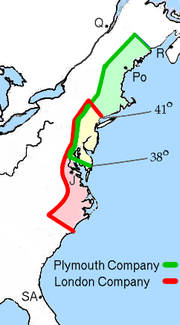
The territory granted to the London Company included the coast of North America from the 34th parallel
34th parallel north
The 34th parallel north is a circle of latitude that is 34 degrees north of the Earth's equatorial plane. It crosses Africa, the Mediterranean Sea, Asia, the Pacific Ocean, North America and the Atlantic Ocean....
(Cape Fear) north to the 41st parallel
41st parallel north
The 41st parallel north is a circle of latitude that is 41 degrees north of the Earth's equatorial plane. It crosses Europe, the Mediterranean Sea, Asia, the Pacific Ocean, North America, and the Atlantic Ocean....
(in Long Island Sound
Long Island Sound
Long Island Sound is an estuary of the Atlantic Ocean, located in the United States between Connecticut to the north and Long Island, New York to the south. The mouth of the Connecticut River at Old Saybrook, Connecticut, empties into the sound. On its western end the sound is bounded by the Bronx...
), but being part of the Virginia Company and Colony, the London Company owned a large portion of Atlantic and Inland Canada. The company was permitted by its charter to establish a 100 square miles (259 km²) settlement within this area. The portion of the company's territory north of the 38th parallel
38th parallel north
The 38th parallel north is a circle of latitude that is 38 degrees north of the Earth's equatorial plane. It crosses Europe, the Mediterranean Sea, Asia, the Pacific Ocean, North America, and the Atlantic Ocean...
was shared with the Plymouth Company
Plymouth Company
The Plymouth Company was an English joint stock company founded in 1606 by James I of England with the purpose of establishing settlements on the coast of North America.The Plymouth Company was one of two companies, along with the London Company, chartered with such...
, with the stipulation that neither company found a colony within 100 miles (161 km) of each other.
The London Company made landfall on April 26, 1607 at the southern edge of the mouth of the Chesapeake Bay
Chesapeake Bay
The Chesapeake Bay is the largest estuary in the United States. It lies off the Atlantic Ocean, surrounded by Maryland and Virginia. The Chesapeake Bay's drainage basin covers in the District of Columbia and parts of six states: New York, Pennsylvania, Delaware, Maryland, Virginia, and West...
, which they named Cape Henry
Cape Henry
Cape Henry is a cape on the Atlantic shore of Virginia north of Virginia Beach. It is the southern boundary of the entrance to Chesapeake Bay.Across the mouth of the bay to the north is Cape Charles...
, in present day Virginia Beach. Deciding to move the encampment, on May 24, 1607 they established the Jamestown Settlement on the James River
James River (Virginia)
The James River is a river in the U.S. state of Virginia. It is long, extending to if one includes the Jackson River, the longer of its two source tributaries. The James River drains a catchment comprising . The watershed includes about 4% open water and an area with a population of 2.5 million...
about 40 miles (64.4 km) upstream from the mouth of the Chesapeake Bay
Chesapeake Bay
The Chesapeake Bay is the largest estuary in the United States. It lies off the Atlantic Ocean, surrounded by Maryland and Virginia. The Chesapeake Bay's drainage basin covers in the District of Columbia and parts of six states: New York, Pennsylvania, Delaware, Maryland, Virginia, and West...
. Later in 1607, the Plymouth Company established its Popham Colony
Popham Colony
The Popham Colony was a short-lived English colonial settlement in North America that was founded in 1607 and located in the present-day town of Phippsburg, Maine near the mouth of the Kennebec River by the proprietary Virginia Company of Plymouth...
in present day Maine
Maine
Maine is a state in the New England region of the northeastern United States, bordered by the Atlantic Ocean to the east and south, New Hampshire to the west, and the Canadian provinces of Quebec to the northwest and New Brunswick to the northeast. Maine is both the northernmost and easternmost...
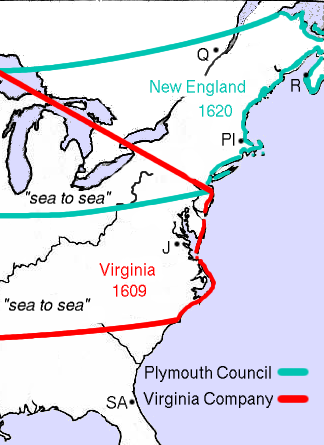
, but it was abandoned after about a year. By 1609, the Plymouth Company had dissolved. As a result, the charter for the London Company was adjusted with a new grant that extended from "sea to sea" of the previously-shared area between the 34th and 40th parallel
40th parallel north
The 40th parallel north is a circle of latitude that is 40 degrees north of the Earth's equatorial plane. It crosses Europe, the Mediterranean Sea, Asia, the Pacific Ocean, North America, and the Atlantic Ocean....
. It was amended in 1612 to include the new territory of the Somers Isles (or Bermuda
Bermuda
Bermuda is a British overseas territory in the North Atlantic Ocean. Located off the east coast of the United States, its nearest landmass is Cape Hatteras, North Carolina, about to the west-northwest. It is about south of Halifax, Nova Scotia, Canada, and northeast of Miami, Florida...
).
The London Company struggled financially for a number of years, with results improving after sweeter strains of tobacco
Tobacco
Tobacco is an agricultural product processed from the leaves of plants in the genus Nicotiana. It can be consumed, used as a pesticide and, in the form of nicotine tartrate, used in some medicines...
than the native variety were cultivated and successfully exported from Virginia as a cash crop
Cash crop
In agriculture, a cash crop is a crop which is grown for profit.The term is used to differentiate from subsistence crops, which are those fed to the producer's own livestock or grown as food for the producer's family...
beginning in 1612. In 1624, the company lost its charter, and Virginia became a royal colony (although it's spin-off
Spin out
A spin-out, also known as a spin-off or a starburst, refers to a type of corporate action where a company "splits off" sections of itself as a separate business....
, the Somers Isles Company
Somers Isles Company
The Somers Isles Company was formed in 1615 to operate the English colony of the Somers Isles, also known as Bermuda, as a commercial venture. It held a royal charter for Bermuda until 1684, when it was dissolved, and the Crown assumed responsibility for the administration of Bermuda as a royal...
existed until 1684).
History
Virginia
The Commonwealth of Virginia , is a U.S. state on the Atlantic Coast of the Southern United States. Virginia is nicknamed the "Old Dominion" and sometimes the "Mother of Presidents" after the eight U.S. presidents born there...
colony using, as the labor force, voluntary transportees under the customary indenture
Indentured servant
Indentured servitude refers to the historical practice of contracting to work for a fixed period of time, typically three to seven years, in exchange for transportation, food, clothing, lodging and other necessities during the term of indenture. Usually the father made the arrangements and signed...
system whereby in exchange for seven years of labor for the company, the company provided passage, food, protection and land ownership.
In December 1606, the Virginia Company's three ships, containing 144 men and boys (with only one man dying during the voyage), set sail from Blackwall, London
Blackwall, London
Blackwall is an area of the East End of London, situated in the London Borough of Tower Hamlets on the north bank of the River Thames.The district around Blackwall Stairs was known as Blackwall by at least the 14th century. This presumably derives from the colour of the river wall, constructed in...
. After an unusually long voyage of 144 days, they made landfall on April 26, 1607 at the southern edge of the mouth of the Chesapeake Bay
Chesapeake Bay
The Chesapeake Bay is the largest estuary in the United States. It lies off the Atlantic Ocean, surrounded by Maryland and Virginia. The Chesapeake Bay's drainage basin covers in the District of Columbia and parts of six states: New York, Pennsylvania, Delaware, Maryland, Virginia, and West...
, which they named Cape Henry
Cape Henry
Cape Henry is a cape on the Atlantic shore of Virginia north of Virginia Beach. It is the southern boundary of the entrance to Chesapeake Bay.Across the mouth of the bay to the north is Cape Charles...
. At the bay, they were attacked by Native Americans who pushed the settlers North. On May 14, 1607, these first settlers selected the site of Jamestown Island as the place to build their fort.
In addition to survival, the early colonists had another pressing mission: to make a profit for the owners of the Virginia Company. Although the settlers were disappointed that gold did not wash up on the beach and gems did not grow in the trees, they realized there was great potential for wealth of other kinds in their new home. Early industries, such as glass manufacture, pitch and tar production and beer and wine making took advantage of natural resources and the land's fertility. From the outset it was thought that the abundance of timber would be the primary leg of the economy, as Britain's forests had long been felled. The seemingly inexhaustible supply of cheap American timber was to be the primary enabler of England's (and then Britain's) rise to maritime (merchant and naval) supremacy. However, the settlers could not devote as much time as the Virginia Company would have liked to their financial responsibilities. They were too busy trying to survive.
Within the three-sided fort erected on the banks of the James, the settlers quickly discovered that they were, first and foremost, employees of the Virginia Company of London, following instructions of the men appointed by the Company to rule them. In exchange, the laborers were armed and received clothes and food from the common store. After seven years, they were to receive land of their own. The gentlemen, who provided their own armor and weapons, were to be paid in land, dividends or additional shares of stock.
Initially, the colonists were governed by a president and seven-member council selected by the King. Leadership problems quickly erupted and Jamestown's first two leaders coped with varying degrees of success with sickness, Indian assaults, poor food and water supplies and class strife.
When Captain John Smith
John Smith of Jamestown
Captain John Smith Admiral of New England was an English soldier, explorer, and author. He was knighted for his services to Sigismund Bathory, Prince of Transylvania and friend Mózes Székely...
became Virginia's third president, he proved the strong leader that the colony needed. Industry flourished and relations with Chief Powhatan
Chief Powhatan
Chief Powhatan , whose proper name was Wahunsenacawh , was the paramount chief of Tsenacommacah, an alliance of Algonquian-speaking Virginia Indians in the Tidewater region of Virginia at the time English settlers landed at Jamestown in 1607...
's people improved. In 1609, the Virginia Company received its Second Charter, which allowed the Company to choose its new governor from amongst its shareholders. Investment boomed as the Company launched an intensive recruitment campaign. Over 600 colonists set sail for Virginia between March 1608 and March 1609.
Unfortunately for these new settlers, Sir Thomas Gates
Thomas Gates (governor)
Sir Thomas Gates , followed George Percy as governor of Jamestown, the English colony of Virginia . Percy, through inept leadership, was responsible for the lives lost during the period called the Starving Time...
, Virginia's deputy governor, bound for the colony aboard the Sea Venture
Sea Venture
The Sea Venture was a 17th-century English sailing ship, the wrecking of which in Bermuda is widely thought to have been the inspiration for Shakespeare's The Tempest...
, was shipwrecked in Bermuda
Bermuda
Bermuda is a British overseas territory in the North Atlantic Ocean. Located off the east coast of the United States, its nearest landmass is Cape Hatteras, North Carolina, about to the west-northwest. It is about south of Halifax, Nova Scotia, Canada, and northeast of Miami, Florida...
, along with the Admiral of the Company, Sir George Somers
George Somers
This article is about the English naval hero. For the American football player, see George Somers Admiral Sir George Somers was an English naval hero. Born in Lyme Regis, Dorset, the son of John Somers, his first fame came as part of an expedition led by Sir Amyas Preston against the Spanish...
, Captain Newport, and 147 other settlers and seamen. When Gates arrived to take up his new post in 1610, with most of the survivors of the Sea Venture (on two new ships built in Bermuda, the Deliverance and the Patience) he found only 60 of the original 214 colonists had survived the infamous "Starving Time" of 1609–1610
Starving Time (Jamestown)
The Starving Time at Jamestown in the Colony of Virginia was a period of forced starvation initiated by the Powhatan Confederacy to remove the English from Virginia. The campaign killed all but 60 of the 500 colonists during the winter of 1609–1610....
, and most of these were dying or ill. Despite the abundance of food they had brought from Bermuda (which had necessitated the building of two ships), it was clear the colony did not have the means for survival. The survivors of Jamestown were taken aboard the Deliverance and the Patience, and the colony was abandoned. It was intended to return everyone to England, but the fortuitous arrival of another relief fleet, bearing Governor Lord De la Warre
Thomas West, 3rd Baron De La Warr
Thomas West, 3rd and 12th Baron De La Warr was the Englishman after whom the bay, the river, and, consequently, an American Indian people and U.S. state, all later called "Delaware", were named....
, granted Jamestown a reprieve. All the settlers were put ashore again , and Sir George Somers returned to Bermuda aboard the Patience to obtain more food (Somers died there, and his nephew, Matthew Somers, the captain of the Patience, took the vessel to Lyme Regis
Lyme Regis
Lyme Regis is a coastal town in West Dorset, England, situated 25 miles west of Dorchester and east of Exeter. The town lies in Lyme Bay, on the English Channel coast at the Dorset-Devon border...
, instead, to claim his inheritance).
When news of Virginia's woeful state reached London, the result was predictable: financial catastrophe for the Company. Many new subscribers reneged payment on their shares, and the Company became entangled in dozens of court cases. On top of these losses, the Company was forced to incur further debt when it sent hundreds more colonists to Virginia.
There was little to counter this crushing debt. No gold had been found in Virginia; trading commodities produced by exploitation of the raw materials found in the New World were minimal. Attempts at producing glass, pitch
Pitch (resin)
Pitch is the name for any of a number of viscoelastic, solid polymers. Pitch can be made from petroleum products or plants. Petroleum-derived pitch is also called bitumen. Pitch produced from plants is also known as resin. Products made from plant resin are also known as rosin.Pitch was...
, tar
Tar
Tar is modified pitch produced primarily from the wood and roots of pine by destructive distillation under pyrolysis. Production and trade in tar was a major contributor in the economies of Northern Europe and Colonial America. Its main use was in preserving wooden vessels against rot. The largest...
and potash
Potash
Potash is the common name for various mined and manufactured salts that contain potassium in water-soluble form. In some rare cases, potash can be formed with traces of organic materials such as plant remains, and this was the major historical source for it before the industrial era...
had been barely profitable, and such commodities could be had far more cheaply on the other side of the Atlantic.
Increasingly bad publicity, political infighting and financial woes led the Virginia Company to organize a massive advertising campaign. The Company plastered street corners with tempting broadsheets, published persuasive articles, and even convinced the clergy to preach of the virtues of supporting colonization. Before the Company was dissolved, it would publish twenty-seven books and pamphlets promoting the Virginia venture.
To make shares more marketable, the Virginia Company changed its sales pitch. Instead of promising instant returns and vast profits for investors, the Company exploited patriotic sentiment and national pride. A stockholder was assured that his purchase of shares would help build the might of England, to make her the power she deserved to be. The heathen natives would be converted to the proper form of Christianity, the Church of England. People out of work could find employment in the New World. The standard of living would increase across the nation. How could any good, patriotic Englishman resist?
The English rose to the bait. The gentry wished to win favor by proving their loyalty to the crown. The growing middle class also saw stock purchasing as a way to better itself. But the news was not all good. Although the population of Jamestown rose, high settler mortality kept profits unstable. By 1612, the Company's debts had soared to over £1000.
A third charter provided a short-term resolution to the Virginia Company's problems. The Company was permitted to run a lottery as a fundraising venture. Other attractive features of the charter allowed Virginia's assembly to act as the colony's legislature and also added 300 leagues of ocean to the colony's holdings, which would include Bermuda (sometimes known as Virgineola) as part of Virginia. But the colony was still on shaky ground until John Rolfe
John Rolfe
John Rolfe was one of the early English settlers of North America. He is credited with the first successful cultivation of tobacco as an export crop in the Colony of Virginia and is known as the husband of Pocahontas, daughter of the chief of the Powhatan Confederacy.In 1961, the Jamestown...
's successful experiment with tobacco as a cash crop provided a way to recoup financially.
Unfortunately, by 1616, the Virginia Company suffered further adversity. The original settlers were owed their land and stock shares; initial investors at home were owed their dividends. The Company was forced to renege on its cash promises, instead distributing 50 acre (200,000 m²) lots in payment. The next year, the Company instituted the headright system, a way to bring more settlers to Virginia. Investors and residents were able to acquire land in paying the passage of new settlers. In most cases, these newcomers spent a period of time in servitude on the investor's land. Edwin Sandys
Edwin Sandys (American colonist)
Sir Edwin Sandys was an English politician, a leading figure in the parliaments of James I of England. He was also one of the founders of the proprietary Virginia Company of London, which in 1607 established the first permanent English settlement in what is now the United States in the colony of...
, a leading force in the Virginia Company, strongly supported the headright system, for his goal was a permanent colony which would enlarge British territory, relieve the nation's overpopulation, and expand the market for English goods. Sir Thomas Smythe, as the Company's Treasurer, had a different dream: the Virginia Company's mission was to trade and to make a profit.

Tobacco
Tobacco is an agricultural product processed from the leaves of plants in the genus Nicotiana. It can be consumed, used as a pesticide and, in the form of nicotine tartrate, used in some medicines...
crop which had become the cash crop
Cash crop
In agriculture, a cash crop is a crop which is grown for profit.The term is used to differentiate from subsistence crops, which are those fed to the producer's own livestock or grown as food for the producer's family...
of Virginia. At the same time, he urged colonists to diversify their plantings and thus become less reliant on only one staple. The colonists ignored this advice, to their later dismay.
In 1619, the Company issued a grant to one John Wincob, which was originally to be used by the English Separatist Pilgrims for settling in the New World. (It was abandoned by the Pilgrims when they instead decided to use a grant issued by the Company to their financial backers. Since their crossing on the Mayflower
Mayflower
The Mayflower was the ship that transported the English Separatists, better known as the Pilgrims, from a site near the Mayflower Steps in Plymouth, England, to Plymouth, Massachusetts, , in 1620...
landed them in what is now New England
New England
New England is a region in the northeastern corner of the United States consisting of the six states of Maine, New Hampshire, Vermont, Massachusetts, Rhode Island, and Connecticut...
, beyond the lands controlled by the Company, this grant was also effectively abandoned.)
In 1621, the Company was in trouble; unpaid dividends and increased use of lotteries had made future investors wary. The Company debt was now over £9000. Worried Virginians were hardly reassured by the advice of pragmatic Treasurer Sandys, who warned that the Company "cannot wish you to rely on anything but yourselves." In March 1622, the Company's and the colony's situation went from dire to disastrous when the Powhatan
Powhatan
The Powhatan is the name of a Virginia Indian confederation of tribes. It is estimated that there were about 14,000–21,000 of these native Powhatan people in eastern Virginia when the English settled Jamestown in 1607...
Indians staged an uprising
Indian massacre of 1622
The Indian Massacre of 1622 occurred in the Colony of Virginia, in what now belongs to the United States of America, on Friday, March 22, 1622...
which wiped out a quarter of the European population of Virginia. When a fourth charter, severely reducing the Company's ability to make decisions in the governing of Virginia, was proposed by the Crown, subscribers rejected it. King James I forthwith changed the status of Virginia in 1624. Virginia was now a royal colony to be administered by a governor appointed by the King. The Virginia Assembly finally received royal approval, in 1627, and this form of government, with governor and assembly, would oversee the colony of Virginia until 1776, excepting only the years of the English Commonwealth.
Bermuda had been separated, in 1614, when the Crown briefly took over its administration. In 1615, the shareholders of the Virginia Company created a new company, the Somers Isles Company
Somers Isles Company
The Somers Isles Company was formed in 1615 to operate the English colony of the Somers Isles, also known as Bermuda, as a commercial venture. It held a royal charter for Bermuda until 1684, when it was dissolved, and the Crown assumed responsibility for the administration of Bermuda as a royal...
, which continued to operate Bermuda, subsequently, also known officially as The Somers Isles (for the Admiral of the Virginia Company, Sir George Somers
George Somers
This article is about the English naval hero. For the American football player, see George Somers Admiral Sir George Somers was an English naval hero. Born in Lyme Regis, Dorset, the son of John Somers, his first fame came as part of an expedition led by Sir Amyas Preston against the Spanish...
) until it, too, was dissolved in 1684.
Native American relationships
The instructions issued to Sir Thomas GatesThomas Gates (governor)
Sir Thomas Gates , followed George Percy as governor of Jamestown, the English colony of Virginia . Percy, through inept leadership, was responsible for the lives lost during the period called the Starving Time...
, on November 20, called for a forcible conversion of Native Americans
Indigenous peoples of the Americas
The indigenous peoples of the Americas are the pre-Columbian inhabitants of North and South America, their descendants and other ethnic groups who are identified with those peoples. Indigenous peoples are known in Canada as Aboriginal peoples, and in the United States as Native Americans...
to Anglicanism
Anglicanism
Anglicanism is a tradition within Christianity comprising churches with historical connections to the Church of England or similar beliefs, worship and church structures. The word Anglican originates in ecclesia anglicana, a medieval Latin phrase dating to at least 1246 that means the English...
and subordination to the colonial administration. The records of the company record a discussion during one of their first meetings about publishing a justification of their business enterprise methods to "give adventurers, a clearness and satisfaction, for the justice of the action, and so encourage them". Others opposed this, arguing that "there is much a confession in every apology" and called for "quietness and no doubting" not wanting to create a public debate where Catholics and neutrals might attack them. Whereas Catholic arguments would be in support of Spanish legal claims to the New World
New World
The New World is one of the names used for the Western Hemisphere, specifically America and sometimes Oceania . The term originated in the late 15th century, when America had been recently discovered by European explorers, expanding the geographical horizon of the people of the European middle...
under the Treaty of Tordesillas
Treaty of Tordesillas
The Treaty of Tordesillas , signed at Tordesillas , , divided the newly discovered lands outside Europe between Spain and Portugal along a meridian 370 leagueswest of the Cape Verde islands...
, it was feared that the neutral "pen-adversaries" might "cast scruples into our conscience" by criticising the lawfulness of the plantation. It was decided to forego such a publication of a justification.
However, in 1608, Sir Edward Coke
Edward Coke
Sir Edward Coke SL PC was an English barrister, judge and politician considered to be the greatest jurist of the Elizabethan and Jacobean eras. Born into a middle class family, Coke was educated at Trinity College, Cambridge before leaving to study at the Inner Temple, where he was called to the...
, in his capacity as Lord Chief Justice
Lord Chief Justice of England and Wales
The Lord Chief Justice of England and Wales is the head of the judiciary and President of the Courts of England and Wales. Historically, he was the second-highest judge of the Courts of England and Wales, after the Lord Chancellor, but that changed as a result of the Constitutional Reform Act 2005,...
, offered a ruling in Calvin's Case which went beyond the issue at hand: whether a Scotsman could seek justice at an English Court. Coke distinguished between aliens from nations at war with England and friendly aliens, those from nations in league with England. Friendly aliens could have recourse to English courts. But he also ruled that with "all infidels" (i.e. those from non-Christian nations) there could be no peace, and a state of perpetual hostility would exist between them and Christians.
In 1609, the company issued instructions to kidnap Native American children so as to indoctrinate them with English values and religion. These instructions also sanctioned attacking the Iniocasoockes, the cultural leaders of the local Powhatans. However, it was only when Thomas West, 3rd Baron De La Warr
Thomas West, 3rd Baron De La Warr
Thomas West, 3rd and 12th Baron De La Warr was the Englishman after whom the bay, the river, and, consequently, an American Indian people and U.S. state, all later called "Delaware", were named....
, arrived, in 1610, that the Company was able to commence a war against the Powhatan with the First Anglo-Powhatan War. De La Warr was replaced by Sir Thomas Dale
Thomas Dale
Sir Thomas Dale was an English naval commander and deputy-governor of the Virginia Colony in 1611 and from 1614 to 1616. Governor Dale is best remembered for the energy and the extreme rigour of his administration in Virginia, which established order and in various ways seems to have benefited the...
, who continued the war. It was during this period that Pocahontas
Pocahontas
Pocahontas was a Virginia Indian notable for her association with the colonial settlement at Jamestown, Virginia. She was the daughter of Chief Powhatan, the head of a network of tributary tribal nations in Tidewater Virginia...
married John Rolfe
John Rolfe
John Rolfe was one of the early English settlers of North America. He is credited with the first successful cultivation of tobacco as an export crop in the Colony of Virginia and is known as the husband of Pocahontas, daughter of the chief of the Powhatan Confederacy.In 1961, the Jamestown...
.
The military offensive was accompanied by a propaganda war: Alderman Robert Johnson published Nova Britannia, in 1609, which compared Native Americans to wild animals--"heardes of deere in a forest". While it portrayed the Powhatans as peace loving, it nevertheless threatened to deal with any who resisted conversion to Anglicanism as enemies of 'their' country. (Johnson was the son-in-law of Sir Thomas Smith, leader of one of the court factions within the Company in London.)
In 1622, the Second Anglo-Powhatan War erupted. Its origins are disputed. English apologists for the company say that Opchanacanough
Opchanacanough
Opechancanough or Opchanacanough was a tribal chief of the Powhatan Confederacy of what is now Virginia in the United States, and its leader from sometime after 1618 until his death in 1646. His name meant "He whose Soul is White" in the Algonquian language...
initiated the war. Native American apologist Robert Williams, a contemporary Native American Law Professor, argues that Opchanacanough had secured concessions from Governor Yeardley which the company would not accept. Thus, Opchanacanough's attack
Indian massacre of 1622
The Indian Massacre of 1622 occurred in the Colony of Virginia, in what now belongs to the United States of America, on Friday, March 22, 1622...
, on April 18, 1622, may have been a pre-emptive attempt to defeat the colony before reinforcements arrived. In about a day, 350 out of 1,240 colonists were killed, and some outlying settlements were wiped out. The Virginia Company quickly published an account of this attack which was steeped in Calvinist theology—the massacre was the work of Providence
Divine Providence
In Christian theology, divine providence, or simply providence, is God's activity in the world. " Providence" is also used as a title of God exercising His providence, and then the word are usually capitalized...
in that it gave a justification for the complete genocide of the Powhatans, and the building of settlements on their former towns. New orders called for a "perpetual war without peace or truce" "to root out from being any longer a people, so cursed a nation, ungrateful to all benefitte, and incapable of all goodnesses."
See also
- Richard HakluytRichard HakluytRichard Hakluyt was an English writer. He is principally remembered for his efforts in promoting and supporting the settlement of North America by the English through his works, notably Divers Voyages Touching the Discoverie of America and The Principal Navigations, Voiages, Traffiques and...
, a director of the company - Jamestown, VirginiaJamestown, VirginiaJamestown was a settlement in the Colony of Virginia. Established by the Virginia Company of London as "James Fort" on May 14, 1607 , it was the first permanent English settlement in what is now the United States, following several earlier failed attempts, including the Lost Colony of Roanoke...
- Somers Isles CompanySomers Isles CompanyThe Somers Isles Company was formed in 1615 to operate the English colony of the Somers Isles, also known as Bermuda, as a commercial venture. It held a royal charter for Bermuda until 1684, when it was dissolved, and the Crown assumed responsibility for the administration of Bermuda as a royal...
- Sir Edwin SandysEdwin Sandys (American colonist)Sir Edwin Sandys was an English politician, a leading figure in the parliaments of James I of England. He was also one of the founders of the proprietary Virginia Company of London, which in 1607 established the first permanent English settlement in what is now the United States in the colony of...
Further reading
- The Three Charters of the Virginia Company of London edited and introduction by Samuel M. Bemiss, published by Virginia's 350th Anniversary Celebration Corp, 1957, Williamsburg, Virginia. ISBN 0-8063-5088-1
- Dissolution of the Virginia Company: The Failure of a Colonial Experiment by Wesley Frank Craven, published by Oxford University Press, 1932, New York
- The Virginia Company of London, 1606-1624, by Wesley Frank Craven, published by University Press of Virginia, 1957, Charlottesville, Virginia. ISBN 0-8063-4555-1
- The First Seventeen Years: Virginia, 1607-1624, by Charles E. Hatch, Jr. ISBN 0-8063-4739-2
- History of the Virginia Company of London with Letters to and from the First Colony Never Before Printed, by Edward D. Neill, originally published by Joel Munsell, 1869, Albany, New York, reprinted by Brookhaven Press ISBN 1-58103-401-6
- Love and Hate in Jamestown: John Smith, Pocahontas, and the Heart of A New Nation, by David A. Price, published by Alfred A. Knopf, 2003, New York
External links
- List of original settlers Jamestown Rediscovery
- 1606 Charter of the Virginia Company of London
- National Park Service brief
- Daily Republican: The Virginia Company
- The Dissolution of the Virginia Company of London Chapter 2 of The American Colonies in the Seventeenth Century by Herbert L. OsgoodHerbert L. OsgoodHerbert Levi Osgood was an American historian of colonial American history. As a professor at Columbia University he directed numerous dissertations of scholars who became major historians...
- Library of Congress images of manuscript and printed editions of the Records of the Virginia Company of London
- The Anglo-Powhatan Wars
- Richmond Times Dispatch: Virginia's roots reach to Bermuda
- The Virginia Company of London, 1606-1624 - Free ebook from manybooks.net