
Home      Discussion      Topics      Dictionary      Almanac
Signup       Login
Chief Powhatan

Chief Powhatan

Overview
Chief Powhatan whose proper name was Wahunsenacawh (sometimes spelled Wahunsonacock), was the paramount chief of Tsenacommacah
Tsenacommacah
Tsenacommacah is what the Powhatan Indians called their homeland. This area encompassed all of Tidewater Virginia and parts of the Eastern Shore...

, an alliance of Algonquian-speaking
Algonquian languages
The Algonquian languages also Algonkian) are a subfamily of Native American languages which includes most of the languages in the Algic language family. The name of the Algonquian language family is distinguished from the orthographically similar Algonquin dialect of the Ojibwe language, which is a...

 Virginia Indians in the Tidewater region of Virginia
Tidewater region of Virginia
The Tidewater region of Virginia is the eastern portion of the Commonwealth of Virginia formally known as Hampton Roads. The term tidewater may be correctly applied to all portions of any area, including Virginia, where the water level is affected by the tides...

 at the time English settlers landed at Jamestown
History of the Jamestown Settlement (1607–1699)
Jamestown was the first settlement of the Virginia Colony, founded in 1607, and served as capital of Virginia until 1699, when the seat of government was moved to Williamsburg...

 in 1607. Powhatan, who represented the main political and military power facing the early colonists, was the father of Pocahontas
Pocahontas
Pocahontas was a Virginia Indian notable for her association with the colonial settlement at Jamestown, Virginia. She was the daughter of Chief Powhatan, the head of a network of tributary tribal nations in Tidewater Virginia...

 and probably the older brother of Opechancanough, who led attacks against the English in 1622
Indian massacre of 1622
The Indian Massacre of 1622 occurred in the Colony of Virginia, in what now belongs to the United States of America, on Friday, March 22, 1622...

 and 1644.
Discussion
Ask a question about 'Chief Powhatan'
Start a new discussion about 'Chief Powhatan'
Answer questions from other users
Full Discussion Forum
 
Unanswered Questions
Encyclopedia
Chief Powhatan whose proper name was Wahunsenacawh (sometimes spelled Wahunsonacock), was the paramount chief of Tsenacommacah
Tsenacommacah
Tsenacommacah is what the Powhatan Indians called their homeland. This area encompassed all of Tidewater Virginia and parts of the Eastern Shore...

, an alliance of Algonquian-speaking
Algonquian languages
The Algonquian languages also Algonkian) are a subfamily of Native American languages which includes most of the languages in the Algic language family. The name of the Algonquian language family is distinguished from the orthographically similar Algonquin dialect of the Ojibwe language, which is a...

 Virginia Indians in the Tidewater region of Virginia
Tidewater region of Virginia
The Tidewater region of Virginia is the eastern portion of the Commonwealth of Virginia formally known as Hampton Roads. The term tidewater may be correctly applied to all portions of any area, including Virginia, where the water level is affected by the tides...

 at the time English settlers landed at Jamestown
History of the Jamestown Settlement (1607–1699)
Jamestown was the first settlement of the Virginia Colony, founded in 1607, and served as capital of Virginia until 1699, when the seat of government was moved to Williamsburg...

 in 1607. Powhatan, who represented the main political and military power facing the early colonists, was the father of Pocahontas
Pocahontas
Pocahontas was a Virginia Indian notable for her association with the colonial settlement at Jamestown, Virginia. She was the daughter of Chief Powhatan, the head of a network of tributary tribal nations in Tidewater Virginia...

 and probably the older brother of Opechancanough, who led attacks against the English in 1622
Indian massacre of 1622
The Indian Massacre of 1622 occurred in the Colony of Virginia, in what now belongs to the United States of America, on Friday, March 22, 1622...

 and 1644.

Name


In 1607, the English colonists were introduced to Wahunsenacawh as Powhatan and understood this latter name to come from Powhatan's hometown near the falls of the James River
James River (Virginia)
The James River is a river in the U.S. state of Virginia. It is long, extending to if one includes the Jackson River, the longer of its two source tributaries. The James River drains a catchment comprising . The watershed includes about 4% open water and an area with a population of 2.5 million...

 near present-day Richmond, Virginia
Richmond, Virginia
Richmond is the capital of the Commonwealth of Virginia, in the United States. It is an independent city and not part of any county. Richmond is the center of the Richmond Metropolitan Statistical Area and the Greater Richmond area...

.

Seventeenth-century English spellings were not standardized, and representations were many of the sounds of the Algonquian
Algonquian languages
The Algonquian languages also Algonkian) are a subfamily of Native American languages which includes most of the languages in the Algic language family. The name of the Algonquian language family is distinguished from the orthographically similar Algonquin dialect of the Ojibwe language, which is a...

 language spoken by Wahunsenacawh and his people. Charles Dudley Warner
Charles Dudley Warner
Charles Dudley Warner was an American essayist, novelist, and friend of Mark Twain, with whom he co-authored the novel The Gilded Age: A Tale of Today.-Biography:...

, writing in the 19th century, but quoting extensively from John Smith's 17th-century writings, in his essay on Pocahontas
Pocahontas
Pocahontas was a Virginia Indian notable for her association with the colonial settlement at Jamestown, Virginia. She was the daughter of Chief Powhatan, the head of a network of tributary tribal nations in Tidewater Virginia...

 states: "In 1618 died the great Powhatan, full of years and satiated with fighting and the savage delights of life. He had many names and titles; his own people sometimes called him Ottaniack, sometimes Mamauatonick, and usually in his presence Wahunsenasawk." Many variants are used in texts:
  • The place,
  • Powhatan, Powatan, Powhaten, Pohetan, Powhattan, Poughwaton,
  • The description, weroance (chief?)
  • weroance
    Weroance
    Weroance is an Algonquian word meaning tribal chief, leader, commander, or king, notably among the Powhatan confederacy of the Virginia coast and Chesapeake Bay region. The Powhatan Confederacy, encountered by the colonists of Jamestown and adjacent area of the Virginia Colony beginning in 1607,...

    , weeroance, wyrounce, wyrounnces, werowance, wyroance, werowans
  • The name, Wahunsunacock
  • Wahunsunacock, Wahunsenasawk, Wahunsenacawh, Wahunsenacock, Wahunsenakah
  • The title, Mamanatowick (paramount- or great- chief, overlord?)
  • Mamanatowick, Mamauatonick

Life


Little is known of Powhatan's life before the arrival of English colonists in 1607. He apparently inherited the chiefdom
Chiefdom
A chiefdom is a political economy that organizes regional populations through a hierarchy of the chief.In anthropological theory, one model of human social development rooted in ideas of cultural evolution describes a chiefdom as a form of social organization more complex than a tribe or a band...

 of about 4-6 tribes, with its base at the fall line
Fall line
A fall line is a geomorphologic unconformity between an upland region of relatively hard crystalline basement rock and a coastal plain of softer sedimentary rock. A fall line is typically prominent when crossed by a river, for there will often be rapids or waterfalls...

 near present-day Richmond. Through diplomacy and/or force, he had assembled a total of about 30 tribes into the Powhatan Confederacy by the early 17th century. The confederacy was estimated to include 10,000-15,000 people.

In December 1607, English
England
England is a country that is part of the United Kingdom. It shares land borders with Scotland to the north and Wales to the west; the Irish Sea is to the north west, the Celtic Sea to the south west, with the North Sea to the east and the English Channel to the south separating it from continental...

 soldier and pioneer John Smith
John Smith of Jamestown
Captain John Smith Admiral of New England was an English soldier, explorer, and author. He was knighted for his services to Sigismund Bathory, Prince of Transylvania and friend Mózes Székely...

, one of the Jamestown colony's leaders, was captured by a hunting expedition led by Opechancanough, the younger brother of Chief Powhatan. Smith was taken to Werowocomoco
Werowocomoco
Werowocomoco was a village that served as the political center of the Powhatan Paramount Chiefdom, a grouping of about 30 Virginia Indian tribes speaking an Algonquian language...

, Powhatan's capital along the York River
York River (Virginia)
The York River is a navigable estuary, approximately long, in eastern Virginia in the United States. It ranges in width from at its head to near its mouth on the west side of Chesapeake Bay. Its watershed drains an area including portions of 17 counties of the coastal plain of Virginia north...

. Smith recounted in 1624 that Pocahontas
Pocahontas
Pocahontas was a Virginia Indian notable for her association with the colonial settlement at Jamestown, Virginia. She was the daughter of Chief Powhatan, the head of a network of tributary tribal nations in Tidewater Virginia...

 (whose given name was Matoaka), one of Powhatan's daughters, prevented her father from executing him. But, Smith's 1608 and 1612 reports omitted this account, and many historians doubt its accuracy. Some believe that the event Smith recounted as a prelude to his execution was an adoption ceremony by which Smith was ritually accepted as subchief of the town of Capahosic in Powhatan's alliance. As the historian Margaret Williamson Huber has written, "Powhatan calculated that moving Smith and his men to Capahosic would keep them nearby and better under his control."

In January 1609, Smith recorded directing German
Germans
The Germans are a Germanic ethnic group native to Central Europe. The English term Germans has referred to the German-speaking population of the Holy Roman Empire since the Late Middle Ages....

 workers to build an English-style house for Powhatan at Werowocomoco, in exchange for food supplies for the hungry English colony. Both sides looked for opportunities to surprise one another. Smith proceeded to Opechancanough's village. When ambushed, he held the chief at gunpoint before the warrior
Warrior
A warrior is a person skilled in combat or warfare, especially within the context of a tribal or clan-based society that recognizes a separate warrior class.-Warrior classes in tribal culture:...

s. When Smith returned to Werowocomoco, he found the house unfinished and the place abandoned. The Germans had deserted to the Powhatan side. At a village now called Wicomico in Gloucester County
Gloucester County, Virginia
Gloucester County is within the Commonwealth of Virginia in the Hampton Roads metropolitan area in the USA. Formed in 1651 in the Virginia Colony, the county was named for Henry Stuart, Duke of Gloucester, third son of King Charles I of Great Britain. Located in the Middle Peninsula region, it...

, the reconstructed ruins of what were traditionally believed to be the chimney and part of the building for Powhatan are known as Powhatan's Chimney
Powhatan's Chimney
Powhatan's Chimney is located at present day Wicomico, in Gloucester County, Virginia, USA.Powhatan's Chimney was long considered clue to the site of Werowocomoco, a capital village of Chief Powhatan in what is now Virginia...

.

Since 2003, state officials and researchers have concluded the likely site of Werowomocomo is further west along the York River at Purtan Bay. There archeologists have found evidence of a large residential settlement dating to 1200 CE
Common Era
Common Era ,abbreviated as CE, is an alternative designation for the calendar era originally introduced by Dionysius Exiguus in the 6th century, traditionally identified with Anno Domini .Dates before the year 1 CE are indicated by the usage of BCE, short for Before the Common Era Common Era...

, with major earthworks
Earthworks (archaeology)
In archaeology, earthwork is a general term to describe artificial changes in land level. Earthworks are often known colloquially as 'lumps and bumps'. Earthworks can themselves be archaeological features or they can show features beneath the surface...

 built about 1400 CE. They have found extensive artifacts
Artifact (archaeology)
An artifact or artefact is "something made or given shape by man, such as a tool or a work of art, esp an object of archaeological interest"...

, including European goods, which indicate likely interaction with the English in the early 17th century. In 2006 the Werowomocomo Archeological Site was listed on the National Register of Historic Places
National Register of Historic Places
The National Register of Historic Places is the United States government's official list of districts, sites, buildings, structures, and objects deemed worthy of preservation...

. Excavations continue by a team headed by the College of William and Mary
College of William and Mary
The College of William & Mary in Virginia is a public research university located in Williamsburg, Virginia, United States...

.

Powhatan made his next capital at Orapakes, located about 50 miles (80.5 km) west in a swamp at the head of the Chickahominy River
Chickahominy River
The Chickahominy is an river in the eastern portion of the U.S. state of Virginia. The river rises about northwest of Richmond and flows southeast and south to the James River...

. The modern-day interchange of Interstate 64
Interstate 64
Interstate 64 is an Interstate Highway in the Midwestern and Southeastern United States. Its western terminus is at I-70, U.S. 40, and U.S. 61 in Wentzville, Missouri. Its eastern terminus is at an interchange with I-264 and I-664 at Bowers Hill in Chesapeake, Virginia. As I-64 is concurrent with...

 and Interstate 295
Interstate 295 (Virginia)
Interstate 295 is an eastern and northern bypass of the cities of Richmond and Petersburg in the U.S. state of Virginia. The southern terminus is a junction with Interstate 95 southeast of Petersburg...

 is near this location. Sometime between 1611 and 1614, Powhatan moved further north to Matchut, in present-day King William County
King William County, Virginia
As of the census of 2000, there were 13,146 people, 4,846 households, and 3,784 families residing in the county. The population density was 48 people per square mile . There were 5,189 housing units at an average density of 19 per square mile...

 on the north bank of the Pamunkey River
Pamunkey River
The Pamunkey River is a tributary of the York River, about long, in eastern Virginia in the United States. Via the York River it is part of the watershed of Chesapeake Bay.-Course:...

, near where his younger brother Opechancanough ruled at Youghtanund.

By the time Smith left Virginia in 1609, the fragile peace between colonists and Algonquians was already beginning to fray. Pocahontas married Kocoum, one of her father's bravest warriors, a year later. They went to live in the Patawomeck
Patawomeck
The Patawomeck tribe of Virginia Indians is based in Stafford County, Virginia, along the Potomac River . It is one of Virginia's 11 recognized American Indian tribes. It is not federally recognized...

 village. Her husband's fate is unknown. In 1613, English colonists led by Captain Samuel Argall
Samuel Argall
Sir Samuel Argall was an English adventurer and naval officer.As a sea captain, in 1609, Argall was the first to determine a shorter northern route from England across the Atlantic Ocean to the new English colony of Virginia, based at Jamestown, and made numerous voyages to the New World...

, abducted her. The young woman was a valuable prize for the English. She was seized in order to exchange her for English prisoners and weapons held by Powhatan.
Soon conflict led to the First Anglo-Powhatan War, and further English expansion beyond Jamestown
Jamestown, Virginia
Jamestown was a settlement in the Colony of Virginia. Established by the Virginia Company of London as "James Fort" on May 14, 1607 , it was the first permanent English settlement in what is now the United States, following several earlier failed attempts, including the Lost Colony of Roanoke...

 and into Powhatan's territory. The English effectively destroyed two subtribes, the Kecoughtan and the Paspahegh
Paspahegh
The Paspahegh tribe were tributaries to the Powhatan paramount chiefdom. The Paspahegh Indian tribe lived in present-day Charles City and James City counties, Virginia...

, at the beginning of this war. Powhatan sent Nemattanew
Nemattanew
Nemattanew was a renegade captain of the Powhatan Confederacy, and at times a close advisor to paramount chief Opechancanough....

 to operate against the English on the upper James River, though they held out at Henricus
Henricus
The "Citie of Henricus" — also known as Henricopolis or Henrico Town or Henrico — was a settlement founded by Sir Thomas Dale in 1611 as an alternative to the swampy and dangerous area around the original English settlement at Jamestown, Virginia...

. With the capture of Pocahontas by Argall in 1613, Powhatan sued for peace. It came about after her alliance in marriage on April 5, 1614 to John Rolfe
John Rolfe
John Rolfe was one of the early English settlers of North America. He is credited with the first successful cultivation of tobacco as an export crop in the Colony of Virginia and is known as the husband of Pocahontas, daughter of the chief of the Powhatan Confederacy.In 1961, the Jamestown...

, a leading tobacco planter. Rolfe's longtime friend, Reverend Richard Bucke of Wymondham
Wymondham
Wymondham is a historic market town and civil parish in the English county of Norfolk. It lies 9.5 miles to the south west of the city of Norwich, on the A11 road to Thetford and London.- Before The Great Fire :...

 officiated the wedding. Prior to the wedding, Reverend Alexander Whitaker
Alexander Whitaker
Alexander Whitaker was a Christian theologian who settled in North America in Virginia Colony in 1611 and established two churches near the Jamestown colony, and was known as "The Apostle of Virginia" by contemporaries....

 converted Pocahontas and renamed her "Rebecca" at her baptism.

Meanwhile, the English continued to expand along the James riverfront. The aged Powhatan's final years have been called "ineffectual" (Rountree 1990). Opechancanough became the greater Native power in the region. Upon the death of Wahunsunacock in 1618, his next younger brother Opitchapam officially became paramount chief. But, Opechancanough, the youngest brother, had achieved the greatest power and effectively became the Powhatan. By initiating the Indian Massacre of 1622
Indian massacre of 1622
The Indian Massacre of 1622 occurred in the Colony of Virginia, in what now belongs to the United States of America, on Friday, March 22, 1622...

, and attacks in 1644, he attempted to force the English from Virginia. These attempts met with strong reprisals from the English, ultimately resulting in the near destruction of the tribe.

Through his daughter Pocahontas (and her marriage to the English colonist John Rolfe), Wahunsunacock was the grandfather of Thomas Rolfe
Thomas Rolfe
Thomas Rolfe was the only child of Pocahontas by her English husband, John Rolfe. His maternal grandfather was Wahunsunacock, the chief of Powhatan tribe in Virginia.-Early Life:Thomas Rolfe was born in Virginia...

. The numerous Rolfe family descendants comprised one of the First Families of Virginia
First Families of Virginia
First Families of Virginia were those families in Colonial Virginia who were socially prominent and wealthy, but not necessarily the earliest settlers. They originated with colonists from England who primarily settled at Jamestown, Williamsburg, and along the James River and other navigable waters...

, one with both English and Virginia Indian roots.

According to one legend, Chief Powhatan, returning homeward from a battle near what is now Philadelphia, stopped at the Big Spring on Sligo Creek
Sligo Creek
Sligo Creek is a free-flowing tributary of the Northwest Branch of the Anacostia River in Maryland. The creek is approximately long, with a drainage area of about .- Geography :The creek rises in the Kemp Mill section of Silver Spring in Montgomery County and...

 (present-day Takoma Park, Maryland
Takoma Park, Maryland
Takoma Park is a city in Montgomery County, Maryland, United States. It is a suburb of Washington, D.C., and part of the Washington Metropolitan Area. Founded in 1883 and incorporated in 1890, Takoma Park, informally called "Azalea City," is a Tree City USA and a nuclear-free zone...

 near Washington, DC) to recuperate from his wounds in the medicinal waters there. Modern historians have dismissed this tale as lacking credibility; nonetheless, a commemorative sculpture of Chief Powhatan has stood at the site since 1985.

Appearance


In A True Relation of such Occurrences and Accidents of Note as Happened in Virginia (1608), Smith described Powhatan thus:
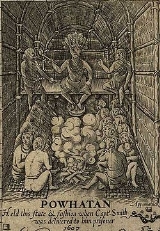
"...their Emperor proudly [lay] upon a bedstead a foot high upon ten or twelve mats, richly hung with many chains of great pearls about his neck, and covered with a great covering of Rahaughcums [raccoon skins]. At his head sat a woman, at his feet another, on each side, sitting upon a mat upon the ground, were ranged his chief men on each side [of] the fire, ten in a rank, and behind them as many young women, each a great chain of white beads over their shoulders, their heads painted in red, and [he] with such a grave a majestical countenance as drove me into admiration to see such state in a naked savage."

"Powatan's Mantle" is the name given to a cloak of deerskin, decorated with shell patterns and figures, held by the Ashmolean Museum
Ashmolean Museum
The Ashmolean Museum on Beaumont Street, Oxford, England, is the world's first university museum...

, Oxford
Oxford
The city of Oxford is the county town of Oxfordshire, England. The city, made prominent by its medieval university, has a population of just under 165,000, with 153,900 living within the district boundary. It lies about 50 miles north-west of London. The rivers Cherwell and Thames run through...

. It allegedly belonged to Chief Powhatan, although the evidence is questionable. The Mantle is certainly one of the earliest North American artifacts to have survived in a European collection. It must have originally belonged to a Native American of high social status, as it was manufactured from numerous valuable native shell beads.

In his 1906 work Lives of Famous Chiefs, Norman Wood described the chief, based on English reports. He was said to be a "tall, well-proportioned man with a sower looke, his head somewhat gray, his beard so thinne that it seemeth none at all, his age neare sixtie, of a very able and hardy body, to endure any labor."

Sites associated with Powhatan

  • Powhatan's burial mound is located on the Pamunkey Indian Reservation
    Pamunkey Indian Reservation
    Pamunkey Indian Reservation is a Native American Reservation located in Virginia in the United States. The reservation lies along the Pamunkey River in King William County, Virginia on the Middle Peninsula. The Pamunkey Reservation contains approximately 1,200 acres of land, 500 acres of which is...

     in King William
    King William, Virginia
    King William is a census-designated place in and the county seat of King William County, Virginia, United States. The population as of the 2010 Census was 252. Located in King William is the oldest courthouse in continuous use in the United States, built in 1725...

    . The remains were relocated there by his brother, Opechancanough
    Opchanacanough
    Opechancanough or Opchanacanough was a tribal chief of the Powhatan Confederacy of what is now Virginia in the United States, and its leader from sometime after 1618 until his death in 1646. His name meant "He whose Soul is White" in the Algonquian language...

    .
  • Powhatan County
    Powhatan County, Virginia
    As of the census of 2000, there were 22,377 people, 7,258 households, and 5,900 families residing in the county. The population density was 86 people per square mile . There were 7,509 housing units at an average density of 29 per square mile...

    , although located somewhat to the west of their territory, was named for Chief Powhatan and his tribe.
  • In the independent City of Richmond
    Richmond, Virginia
    Richmond is the capital of the Commonwealth of Virginia, in the United States. It is an independent city and not part of any county. Richmond is the center of the Richmond Metropolitan Statistical Area and the Greater Richmond area...

    , Powhatan Hill is believed to be located near Chief Powhatan's main village. It was ruled by a subject weroance called Parahunt, or Tanx ("little") Powhatan. On first meeting him, the English mistook him for the Great Powhatan. The confusion persists in historic accounts.
  • Chief Powhatan's central village, Werowocomoco
    Werowocomoco
    Werowocomoco was a village that served as the political center of the Powhatan Paramount Chiefdom, a grouping of about 30 Virginia Indian tribes speaking an Algonquian language...

    , is believed to have been located in Gloucester County, Virginia
    Gloucester County, Virginia
    Gloucester County is within the Commonwealth of Virginia in the Hampton Roads metropolitan area in the USA. Formed in 1651 in the Virginia Colony, the county was named for Henry Stuart, Duke of Gloucester, third son of King Charles I of Great Britain. Located in the Middle Peninsula region, it...

    . The Werowocomoco Archeological Site has been listed on the National Register of Historic Places
    National Register of Historic Places
    The National Register of Historic Places is the United States government's official list of districts, sites, buildings, structures, and objects deemed worthy of preservation...

    . Excavations there have revealed much about the early Powhatan people and their interaction with English colonists.

Fictional representations

  • Douglass Dumbrille
    Douglass Dumbrille
    Douglass Dumbrille was a Canadian actor and one of the Canadian pioneers in early Hollywood.-Life and career:...

     was cast as the Virginia chief in the 1953 film Captain John Smith and Pocahontas
    Captain John Smith and Pocahontas
    Captain John Smith and Pocahontas is a 1953 American historical film directed by Lew Landers. The distributor was United Artists. It stars Anthony Dexter, Jody Lawrance and Alan Hale. It depicts the foundation of the Jamestown Colony in Virginia by English settlers and the relationship between...

    .
  • He was played by Michael Ansara
    Michael Ansara
    Michael Ansara is a Syrian-born American stage, screen, and voice actor best known for his portrayal of Cochise in the American television series Broken Arrow, Kane in the 1979-81 series Buck Rogers in the 25th Century, and Commander Kang on three different Star Trek TV series.- Early life and...

     in the TV Reader's Digest
    TV Reader's Digest
    TV Reader's Digest is the title of a 30 minute American television anthology drama series which aired on the ABC from 1955 to 1956.Based on articles that appeared in Reader's Digest magazine, the episodes based on true stories which were varied in their themes, plots and content. Themes included...

    1955 episode "America's First Great Lady".
  • Russell Means
    Russell Means
    Russell Charles Means is an Oglala Sioux activist for the rights of Native American people. He became a prominent member of the American Indian Movement after joining the organisation in 1968, and helped organize notable events that attracted national and international media coverage...

     voiced Powhatan in the 1995 Disney animated film, Pocahontas
    Pocahontas (1995 film)
    Pocahontas is the 33rd animated feature in the Walt Disney Animated Classics series. It was produced by Walt Disney Feature Animation and was originally released to selected theaters on June 16, 1995 by Walt Disney Pictures...

    and its 1998 direct-to-video sequel Pocahontas II: Journey to a New World
    Pocahontas II: Journey to a New World
    Pocahontas II: Journey to a New World is a 1998 straight-to-video sequel to the 1995 Disney film Pocahontas. The film is inspired by true events in the life of Pocahontas which took place several years after her encounter with John Smith and the founders of Jamestown...

    .
  • Powhatan was played by First Nations actor Gordon Tootoosis in Pocahontas: The Legend
    Pocahontas: The Legend
    Pocahontas: The Legend is a 1999 drama film that fictionalizes the young life of the historical figure of Chief Powhatan's daughter Pocahontas and her relationship with Captain John Smith. This film was directed by Danièle J. Suissa and stars Sandrine Holt as the titular heroine...

    in 1999.
  • He was played by Canadian August Schellenberg
    August Schellenberg
    August Schellenberg is a Canadian actor. His ethnicity is Mohawk and Swiss-German. He was trained at the National Theatre School of Canada.His first film was Rip-Off in 1971. In 1981, he did voices for the animated film Heavy Metal...

     in the 2005 film The New World.
  • The chief is also represented as a potential Continental Congress
    Continental Congress
    The Continental Congress was a convention of delegates called together from the Thirteen Colonies that became the governing body of the United States during the American Revolution....

     member in Civilization IV: Colonization.

Further reading

  • David A. Price, Love and Hate in Jamestown: John Smith, Pocahontas, and the Start of A New Nation, Alfred A. Knopf, 2003
  • Huber, Margaret Williamson (January 12, 2011). "Powhatan (d. 1618)". Encyclopedia Virginia. Retrieved February 18, 2011.
  • Townsend, Camilla. Pocahontas and the Powhatan Dilemma, New York: Hill and Wang, 2004. ISBN 0-8090-7738-8

External links