
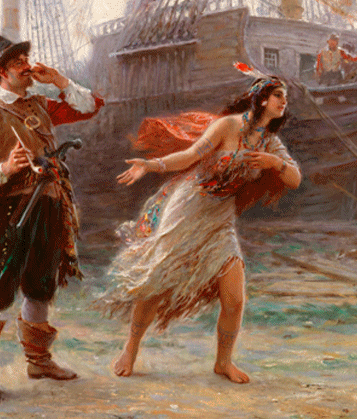
Pocahontas was a Virginia Indian notable for her association with the colonial settlement at
Jamestown, VirginiaJamestown was a settlement in the Colony of Virginia. Established by the Virginia Company of London as "James Fort" on May 14, 1607 , it was the first permanent English settlement in what is now the United States, following several earlier failed attempts, including the Lost Colony of Roanoke...
. She was the daughter of
Chief PowhatanChief Powhatan , whose proper name was Wahunsenacawh , was the paramount chief of Tsenacommacah, an alliance of Algonquian-speaking Virginia Indians in the Tidewater region of Virginia at the time English settlers landed at Jamestown in 1607...
, the head of a network of tributary tribal nations in Tidewater Virginia. In a well-known historical anecdote that may or may not be true, she is said to have saved the life of Indian captive John Smith in 1607 by placing her head upon his own when her father raised his war club to execute him.
Pocahontas was captured by the English during Anglo-Indian hostilities in 1613, and held for ransom. During her captivity, she converted to Christianity and took the name Rebecca. When the opportunity arose for her to return to her people, she chose to remain with the English. In April 1614, she married tobacco planter
John RolfeJohn Rolfe was one of the early English settlers of North America. He is credited with the first successful cultivation of tobacco as an export crop in the Colony of Virginia and is known as the husband of Pocahontas, daughter of the chief of the Powhatan Confederacy.In 1961, the Jamestown...
, and, in January 1615, bore him a son,
Thomas RolfeThomas Rolfe was the only child of Pocahontas by her English husband, John Rolfe. His maternal grandfather was Wahunsunacock, the chief of Powhatan tribe in Virginia.-Early Life:Thomas Rolfe was born in Virginia...
.
In 1616, the Rolfes traveled to London. Pocahontas was presented to English society as an example of the civilized "savage" in hopes of stimulating investment in the Jamestown settlement. She became something of a celebrity, was elegantly fêted, and attended a masque at Whitehall Palace. In 1617, the Rolfes set sail for home, but Pocahontas died at
GravesendGravesend may refer to:Places in the United Kingdom:*Gravesend, Kent*Gravesend, Hertfordshire, a hamlet of Albury, HertfordshirePlaces in the USA and Australia:*Gravesend, Brooklyn*Gravesend, New South WalesOther meanings...
of unknown causes. She was buried in England, but her resting place is not known.
Numerous places, landmarks, and products in the United States have been named after Pocahontas. Her story has been romanticized over the years, and she is the subject of art, literature, and film. Her descendants through her son Thomas include members of the First Families of Virginia,
First LadiesFirst Lady of the United States is the title of the hostess of the White House. Because this position is traditionally filled by the wife of the president of the United States, the title is most often applied to the wife of a sitting president. The current first lady is Michelle Obama.-Current:The...
Edith Wilson and
Nancy ReaganNancy Davis Reagan is the widow of former United States President Ronald Reagan and was First Lady of the United States from 1981 to 1989....
, and astronomer
Percival LowellPercival Lawrence Lowell was a businessman, author, mathematician, and astronomer who fueled speculation that there were canals on Mars, founded the Lowell Observatory in Flagstaff, Arizona, and formed the beginning of the effort that led to the discovery of Pluto 14 years after his death...
.
Early life
Pocahontas's birth year is unknown, but some historians estimate it to have been around 1595 based on the accounts of Captain John Smith. In
A True Relation of Virginia (1608), Smith described the Pocahontas he met in the spring of 1608 as being "a child of years old". In a letter written in 1616, he again described her as she was in 1608, but this time she had grown slightly to "a child of twelve or thirteen years of age".
Pocahontas was the daughter of
PowhatanChief Powhatan , whose proper name was Wahunsenacawh , was the paramount chief of Tsenacommacah, an alliance of Algonquian-speaking Virginia Indians in the Tidewater region of Virginia at the time English settlers landed at Jamestown in 1607...
, the paramount chief of
TsenacommacahTsenacommacah is what the Powhatan Indians called their homeland. This area encompassed all of Tidewater Virginia and parts of the Eastern Shore...
, an alliance of about thirty
Algonquian-speakingThe Eastern Algonquian languages constitute a subgroup of the Algonquian languages. Prior to European contact, Eastern Algonquian consisted of at least seventeen languages collectively occupying the Atlantic coast of North America and adjacent inland areas, from the Canadian Maritime provinces to...
groups and petty chiefdoms in Tidewater Virginia. Her mother, whose name and specific group of origin are unknown, was one of dozens of wives taken by Powhatan; each wife gave him a single child and then was sent back to her village to be supported by the paramount chief until she found another husband.
Pocahontas's childhood was probably little different from that of most girls who lived in Tsenacommacah. She learned how to perform what was considered to be women's work, which included foraging for food and firewood, farming, and searching for the plant materials used in building thatched houses. As she grew older, she probably helped other members of Powhatan's household with preparations for large feasts. Serving feasts such as the one presented to John Smith after his capture was a regular obligation of the
mamanatowick, or paramount chief.
Names
At the time Pocahontas was born, it was common for the Algonquian-speaking Virginia Indians to be given several personal names. Bestowed at different times, the names carried different meanings and might be used in different contexts. It was not uncommon for American Indians to have more than one name at the same time, to have secret names that only a select few knew, and to change their names on important occasions. Pocahontas was no different. Early in her life she was given a secret name, Matoaka, but later she was also known as Amonute. None of these names can be translated.
The name Pocahontas was a childhood nickname that probably referred to her frolicsome nature; according to the colonist
William StracheyWilliam Strachey was an English writer whose works are among the primary sources for the early history of the English colonisation of North America...
, it meant "little wanton". The 18th-century historian
William StithWilliam Stith was an early American historian. He is the author of one of the earliest histories of Virginia, The History of the First Discovery and Settlement of Virginia: being an Essay towards a General History of this Colony, published in Williamsburg by William Parks in 1747...
claimed that "her real name, it seems, was originally Matoax, which the Indians carefully concealed from the English and changed it to Pocahontas, out of a superstitious fear, lest they, by the knowledge of her true name, should be enabled to do her some hurt." According to the anthropologist Helen C. Rountree, Pocahontas "revealed [her secret name] to the English only after she had taken another religious—baptismal—name, Rebecca".
Pocahontas's Christian name, Rebecca, may have been a symbolic gesture to
RebeccaRebecca a biblical matriarch from the Book of Genesis and a common first name. In this book Rebecca was said to be a beautiful girl. As a name it is often shortened to Becky, Becki or Becca; see Rebecca ....
of the Book of Genesis who, as the mother of
JacobJacob "heel" or "leg-puller"), also later known as Israel , as described in the Hebrew Bible, the Talmud, the New Testament and the Qur'an was the third patriarch of the Hebrew people with whom God made a covenant, and ancestor of the tribes of Israel, which were named after his descendants.In the...
and
EsauEsau , in the Hebrew Bible, is the oldest son of Isaac. He is mentioned in the Book of Genesis, and by the minor prophets, Obadiah and Malachi. The New Testament later references him in the Book of Romans and the Book of Hebrews....
, was the mother of two "nations", or distinct peoples. Pocahontas, as an American Indian marrying an Englishman, may have been seen by herself and by her contemporaries as being also, potentially, the mother of two nations.
Title and status
For hundreds of years after her death, Pocahontas was considered in popular culture, and even by many academics, to be a
princessPrincess is the feminine form of prince . Most often, the term has been used for the consort of a prince, or his daughters....
. In 1841, William Watson Waldron of
Trinity College, DublinTrinity College, Dublin , formally known as the College of the Holy and Undivided Trinity of Queen Elizabeth near Dublin, was founded in 1592 by letters patent from Queen Elizabeth I as the "mother of a university", Extracts from Letters Patent of Elizabeth I, 1592: "...we...found and...
, in Ireland, published
Pocahontas, American Princess: and Other Poems, calling Pocahontas "the beloved and only surviving daughter of the king". His point of view was typical: by being the daughter of the paramount chief Powhatan—–who was often called a "king" or an "emperor" by the English colonists—–she must necessarily be a princess. As late as 1969, the historian Grace Steele Woodward authored
Pocahontas, a biography in which she referred to her subject as "a young Powhatan Indian princess".
Indeed, Pocahontas was a favorite of her father's—–his "delight and darling", according to the colonist
Captain Ralph HamorCaptain Ralph Hamor was one of the original colonist to settle Virginia, and author of "A True Discourse of the Present State of Virginia" when he returned to London in 1615.-Early Years:...
—–but she was not a princess in the conventional European sense of the word. She was not in line to inherit a position as a
weroanceWeroance is an Algonquian word meaning tribal chief, leader, commander, or king, notably among the Powhatan confederacy of the Virginia coast and Chesapeake Bay region. The Powhatan Confederacy, encountered by the colonists of Jamestown and adjacent area of the Virginia Colony beginning in 1607,...
, or subchief, let alone her father's exalted rank of
mamanatowick, or paramount chief. Some women did become
weroansquas, or female chiefs, and Powhatan's brothers, sisters, and his sisters' children all stood in line to succeed him.
In his
A Map of Virginia John Smith explained how matrilineal inheritance worked among the Powhatans:
In addition, Pocahontas's mother's status was probably lowly. In his
Relation of Virginia (1609), the colonist
Henry SpelmanHenry Spelman was an English adventurer, soldier, and author, the son of Erasmus Spelman and nephew to Sir Henry Spelman of Congham . The younger Henry Spelman was born in 1595, and left his home in Norfolk, England at age 14 to sail to Virginia Colony aboard the ship "Unity", as a part of the...
, who had lived among the American Indians serving as an interpreter, noted Powhatan's many wives. Each wife gave the paramount chief one child, after which she not only resumed her status as a commoner but was also sent back where she had come from.
"Saving" John Smith
Pocahontas is most famously linked to the English colonist Captain John Smith, who arrived in Virginia with just more than a hundred other settlers in April 1607. After building a fort on a marshy peninsula poking out into the
James RiverThe James River may refer to:Rivers in the United States and their namesakes* James River * James River , North Dakota, South Dakota* James River * James River * James River...
, the Englishmen had numerous encounters over the next several months with the American Indians of Tsenacommacah, some of them friendly, some hostile. Then, in December 1607, while exploring on the
Chickahominy RiverThe Chickahominy is an river in the eastern portion of the U.S. state of Virginia. The river rises about northwest of Richmond and flows southeast and south to the James River...
, Smith was captured by a hunting party led by Powhatan's younger brother (or close relative) Opechancanough and brought to Powhatan's capital at
WerowocomocoWerowocomoco was a village that served as the political center of the Powhatan Paramount Chiefdom, a grouping of about 30 Virginia Indian tribes speaking an Algonquian language...
. In his 1608 account, Smith described a large feast followed by a long talk with Powhatan. He does not mention Pocahontas in relation to his capture; in fact, in this account, he does not meet Pocahontas for the first time until a few months later. In 1616, however, Smith wrote a letter to
Queen AnneAnne of Denmark was queen consort of Scotland, England, and Ireland as the wife of King James VI and I.The second daughter of King Frederick II of Denmark, Anne married James in 1589 at the age of fourteen and bore him three children who survived infancy, including the future Charles I...
in anticipation of Pocahontas's visit to England. In this new account, his capture included the threat of his own death: "... at the minute of my execution", he wrote, "she [Pocahontas] hazarded the beating out of her own brains to save mine; and not only that, but so prevailed with her father, that I was safely conducted to Jamestown."
Eight years later, in his
Generall Historie, Smith expanded upon the story. Writing about himself in the third person, he explained that after he was captured and taken to the paramount chief, "two great stones were brought before Powhatan: then as many as could layd hands on him [Smith], dragged him to them, and thereon laid his head, and being ready with their clubs, to beate out his braines, Pocahontas the Kings dearest daughter, when no intreaty could prevaile, got his head in her armes, and laid her owne upon his to save him from death ..."
Historians have long expressed doubts that the story of Pocahontas saving Smith occurred as told in these later accounts. The anthropologist Helen C. Rountree has argued that Smith's first "version of events [i.e., that he was interviewed by Powhatan] makes sense, given how eager the Indian leadership was to find out why the English had come and stayed in Virginia."
Smith may have exaggerated or invented the account to enhance Pocahontas's standing. On the other hand, he may have been telling the truth. Some scholars have argued that the absence of the episode in Smith's earlier works should not be definitive evidence that it did not happen. Historian J. A. Leo Lemay, for instance, noted in his 1992 book that, as Smith's earlier writing was primarily concerned with geographical and ethnographic matters, he had no reason then to recount the story of Pocahontas. Stan Birchfield has written that "Smith's writings are perfectly consistent with the truthfulness of the episode", but he does not take into account the strong implication, in Smith's
True Relation, that he did not first meet Pocahontas until the spring of 1608.
In
True Travels (1630), Smith told a similar story of having been rescued by the intervention of a young girl after having been captured in 1602 by
TurksThe Ottoman EmpireIt was usually referred to as the "Ottoman Empire", the "Turkish Empire", the "Ottoman Caliphate" or more commonly "Turkey" by its contemporaries...
in Hungary. The historian Karen Ordahl Kupperman has suggested that he "presented those remembered events from decades earlier" when telling the story of Pocahontas. In other words, his story may have grown taller over time. A different theory suggests that Smith may have misunderstood what had happened to him in Powhatan's longhouse. Rather than the near victim of an execution, he may have been subject to a tribal ritual intended to symbolize his death and rebirth as a member of the tribe. However, this theory is unlikely being as that little is known of Powhatan rituals, nor is there evidence of similar rituals among other North American Indian groups. The historian Margaret Williamson Huber has argued that Powhatan, in this case, was being politically pragmatic by attempting to bring Smith, and so the English, into his chiefdom. According to Huber, Powhatan attempted to offer Smith rule of the town of Capahosic, which was close to Powhatan's capital at Werowocomoco. In this way, the paramount chief hoped to keep Smith and his men "nearby and better under control".
Early histories did establish that Pocahontas befriended Smith and the Jamestown colony. Pocahontas often went to the settlement and played games with the boys there. When the colonists were starving, "every once in four or five days, Pocahontas with her attendants brought him [Smith] so much provision that saved many of their lives that else for all this had starved with hunger." As the colonists expanded their settlement further, the Virginia Indians felt their lands were threatened, and conflicts arose again.
In late 1609, an injury from a gunpowder explosion forced Smith to return to England for medical care. The English told the American Indians that Smith was dead. Pocahontas believed that account until she learned that he was living in England when she traveled there several years later, already the wife of John Rolfe.
According to the colonist
William StracheyWilliam Strachey was an English writer whose works are among the primary sources for the early history of the English colonisation of North America...
, Pocahontas married a common warrior called Kocoum at some point before 1612. Nothing more is known about this marriage. It likely ended, according to American Indian custom, when Pocahontas was captured by the English in 1613.
Historical records do not suggest that Smith and Pocahontas were lovers. The romance is featured only (but repeatedly) in fictional versions of their relationship (such as the 1995
animated film by Walt DisneyPocahontas is the 33rd animated feature in the Walt Disney Animated Classics series. It was produced by Walt Disney Feature Animation and was originally released to selected theaters on June 16, 1995 by Walt Disney Pictures...
). The first romance was written about them in the early 19th century, suggesting the story's mythic appeal. Accounts of such a romance have been repeated in films made in the United States as late as 2009.
Capture
Pocahontas's capture occurred in the context of the First Anglo-Powhatan War, a conflict between the Jamestown settlers and the American Indians that began late in the summer of 1609. In the first years of war, the English took control of the James River, both at its mouth and at the falls. Captain
Samuel ArgallSir Samuel Argall was an English adventurer and naval officer.As a sea captain, in 1609, Argall was the first to determine a shorter northern route from England across the Atlantic Ocean to the new English colony of Virginia, based at Jamestown, and made numerous voyages to the New World...
, in the meantime, pursued contacts with American Indian groups in the northern portion of Powhatan's paramount chiefdom. The
PatawomeckThe Patawomeck tribe of Virginia Indians is based in Stafford County, Virginia, along the Potomac River . It is one of Virginia's 11 recognized American Indian tribes. It is not federally recognized...
s, who lived on the
Potomac RiverThe Potomac River flows into the Chesapeake Bay, located along the mid-Atlantic coast of the United States. The river is approximately long, with a drainage area of about 14,700 square miles...
, were not always loyal to Powhatan, and living with them was a young English interpreter named
Henry SpelmanHenry Spelman was an English adventurer, soldier, and author, the son of Erasmus Spelman and nephew to Sir Henry Spelman of Congham . The younger Henry Spelman was born in 1595, and left his home in Norfolk, England at age 14 to sail to Virginia Colony aboard the ship "Unity", as a part of the...
. In March 1613, Argall learned that Pocahontas was visiting the Patawomeck village of Passapatanzy and living under the protection of the weroance Iopassus (also known as Japazaws).
With Spelman's help translating, Argall pressured Iopassus to assist in Pocahontas's capture by promising an alliance with the English against the Powhatans. They tricked Pocahontas into boarding Argall's ship and held her for ransom, demanding the release of English prisoners held by her father, along with various stolen weapons and tools. Powhatan returned the prisoners, but failed to satisfy the colonists with the number of weapons and tools he returned. A long standoff ensued, during which the English kept Pocahontas captive.
During the year-long wait, she was held at
HenricusThe "Citie of Henricus" — also known as Henricopolis or Henrico Town or Henrico — was a settlement founded by Sir Thomas Dale in 1611 as an alternative to the swampy and dangerous area around the original English settlement at Jamestown, Virginia...
, in modern-day
Chesterfield County, VirginiaChesterfield County is a county located in the Commonwealth of Virginia, a state of the United States. In 2010, its population was estimated to be 316,236. Chesterfield County is now the fourth-largest municipality in Virginia . Its county seat is Chesterfield...
. Little is known about her life there, although colonist Ralph Hamor wrote that she received "extraordinary courteous usage". Linwood "Little Bear" Custalow, in a 2007 book, asserted that Pocahontas was raped during this time, citing oral tradition handed down over four centuries. According to Helen Rountree, "Other historians have disputed that such oral tradition survived and instead argue that any mistreatment of Pocahontas would have gone against the interests of the English in their negotiations with Powhatan."
At this time, the minister at Henricus,
Alexander WhitakerAlexander Whitaker was a Christian theologian who settled in North America in Virginia Colony in 1611 and established two churches near the Jamestown colony, and was known as "The Apostle of Virginia" by contemporaries....
, taught Pocahontas about
ChristianityChristianity is a monotheistic religion based on the life and teachings of Jesus as presented in canonical gospels and other New Testament writings...
and helped her to improve her English. Upon her
baptismIn Christianity, baptism is for the majority the rite of admission , almost invariably with the use of water, into the Christian Church generally and also membership of a particular church tradition...
, Pocahontas took the Christian name "Rebecca".
In March 1614, the standoff built up to a violent confrontation between hundreds of English and Powhatan men on the
Pamunkey RiverThe Pamunkey River is a tributary of the York River, about long, in eastern Virginia in the United States. Via the York River it is part of the watershed of Chesapeake Bay.-Course:...
. At Powhatan's capital of Matchcot, the English encountered a group of some senior American Indian leaders (but not Powhatan himself, who was away). The English permitted Pocahontas to talk to her countrymen. Pocahontas reportedly rebuked her father for valuing her "less than old swords, pieces, or axes", and told the Powhatan she preferred to live with the English.
Marriage to John Rolfe
During her stay in Henricus, Pocahontas met
John RolfeJohn Rolfe was one of the early English settlers of North America. He is credited with the first successful cultivation of tobacco as an export crop in the Colony of Virginia and is known as the husband of Pocahontas, daughter of the chief of the Powhatan Confederacy.In 1961, the Jamestown...
. Rolfe's English-born wife and child had died on the journey over to Virginia. He had successfully cultivated a new strain of
tobaccoTobacco is an agricultural product processed from the leaves of plants in the genus Nicotiana. It can be consumed, used as a pesticide and, in the form of nicotine tartrate, used in some medicines...
there and spent much of his time there tending to his crop. He was a pious man who agonized over the potential moral repercussions of marrying a heathen. In a long letter to the governor requesting permission to wed her, he expressed both his love for her and his belief he would be saving her soul claiming he was:
motivated not by the unbridled desire of carnal affection, but for the good of this plantation, for the honor of our country, for the Glory of God, for my own salvation... namely Pocahontas, to whom my hearty and best thoughts are, and have been a long time so entangled, and enthralled in so intricate a labyrinth that I was even a-wearied to unwind myself thereout
Pocahontas's feelings about Rolfe and the marriage are unknown.
They were married on April 5, 1614, and lived for two years on Rolfe's plantation,
Varina FarmsVarina is a former unincorporated town and current magisterial district in the easternmost portion of Henrico County, Virginia, United States....
, which was located across the
James RiverThe James River is a river in the U.S. state of Virginia. It is long, extending to if one includes the Jackson River, the longer of its two source tributaries. The James River drains a catchment comprising . The watershed includes about 4% open water and an area with a population of 2.5 million...
from the new community of
HenricusThe "Citie of Henricus" — also known as Henricopolis or Henrico Town or Henrico — was a settlement founded by Sir Thomas Dale in 1611 as an alternative to the swampy and dangerous area around the original English settlement at Jamestown, Virginia...
. They had a child,
Thomas RolfeThomas Rolfe was the only child of Pocahontas by her English husband, John Rolfe. His maternal grandfather was Wahunsunacock, the chief of Powhatan tribe in Virginia.-Early Life:Thomas Rolfe was born in Virginia...
, born on January 30, 1615.
Their marriage was unsuccessful in winning the English captives back, but it did create a climate of peace between the Jamestown colonists and Powhatan's tribes for several years; in 1615, Ralph Hamor wrote:
Since the wedding we have had friendly commerce and trade not only with Powhatan but also with his subjects round about us.
England
The Virginia Company of London had long seen one of its primary goals as the conversion of American Indians to Christianity. With the conversion of Pocahontas and her marriage to an Englishman–all of which helped bring an end to the First Anglo-Powhatan War–the company saw an opportunity to promote investment. The company decided to bring Pocahontas to England as a symbol of the tamed New World "savage" and the success of the Jamestown settlement. In 1616, the Rolfes traveled to England, arriving at the port of
PlymouthPlymouth is a city and unitary authority area on the coast of Devon, England, about south-west of London. It is built between the mouths of the rivers Plym to the east and Tamar to the west, where they join Plymouth Sound...
on June 12. They journeyed to London by coach, accompanied by a group of about eleven other Powhatans, including a holy man named
TomocomoUttamatomakkin, known as Tomocomo for short, was a Powhatan native shaman who accompanied Pocahontas on her visit to London in 1616.Little is known about Tomocomo's life before his visit to London. He is known to have been a shaman. He appears to have met Captain John Smith during Smith's time in...
. John Smith was living in London at the time and while Pocahontas was in Plymouth, she learned he was still alive. Smith did not meet Pocahontas, but wrote to Queen Anne, the wife of
King JamesJames VI and I was King of Scots as James VI from 24 July 1567 and King of England and Ireland as James I from the union of the English and Scottish crowns on 24 March 1603...
, urging that Pocahontas be treated with respect as a royal visitor. He suggested that if she were treated badly, her "present love to us and Christianity might turn to ... scorn and fury", and England might lose the chance to "rightly have a Kingdom by her means".
Pocahontas was entertained at various society gatherings. On January 5, 1617, she and Tomocomo were brought before the king at the
Banqueting HouseIn Tudor and Early Stuart English architecture a banqueting house is a separate building reached through pleasure gardens from the main residence, whose use is purely for entertaining. It may be raised for additional air or a vista, and it may be richly decorated, but it contains no bedrooms or...
in Whitehall Palace at a performance of
Ben JonsonBenjamin Jonson was an English Renaissance dramatist, poet and actor. A contemporary of William Shakespeare, he is best known for his satirical plays, particularly Volpone, The Alchemist, and Bartholomew Fair, which are considered his best, and his lyric poems...
's
masqueThe masque was a form of festive courtly entertainment which flourished in 16th and early 17th century Europe, though it was developed earlier in Italy, in forms including the intermedio...
The Vision of DelightThe Vision of Delight was a Jacobean era masque written by Ben Jonson. It was most likely performed on Twelfth Night, January 6, 1617 in the Banqueting House at Whitehall Palace, and repeated on January 19 of that year....
. According to Smith, King James was so unprepossessing that neither Pocahontas nor Tomocomo realized whom they had met until it was explained to them afterward.
Although Pocahontas was not a princess in the context of Powhatan culture, the Virginia Company nevertheless presented her as a princess to the English public. The inscription on a 1616 engraving of Pocahontas, made for the company, reads:
"MATOAKA ALS REBECCA FILIA POTENTISS : PRINC : POWHATANI IMP:VIRGINIÆ", which means: "Matoaka, alias Rebecca, daughter of the most powerful prince of the Powhatan Empire of Virginia". Many English at this time recognized Powhatan to be the ruler of an empire, and they presumably accorded to his daughter what they considered appropriate status. Smith's letter to Queen Anne refers to "Powhatan their chief King".
Samuel PurchasSamuel Purchas , was an English travel writer, a near-contemporary of Richard Hakluyt.Purchas was born at Thaxted, Essex, and graduated at St John's College, Cambridge, in 1600; later he became a B.D., and with this degree was admitted at Oxford in 1615. In 1604 he was presented by James I to the...
recalled meeting Pocahontas in London, writing that she impressed those she met because she "carried her selfe as the daughter of a king". When he met her again in London, Smith referred to Pocahontas deferentially as a "Kings daughter".
Pocahontas was apparently treated well in London. At the masque, her seats were described as "well placed", and, according to Purchas,
John KingJohn King was an English churchman, patron of the Church of Pertenhall in Bedfordshire....
,
Bishop of LondonThe Bishop of London is the ordinary of the Church of England Diocese of London in the Province of Canterbury.The diocese covers 458 km² of 17 boroughs of Greater London north of the River Thames and a small part of the County of Surrey...
, "entertained her with festival state and pomp beyond what I have seen in his greate hospitalitie afforded to other ladies."
Not all the English were so impressed. According to Helen C. Rountree, "there is no contemporary evidence to suggest ... that Pocahontas was regarded [in England] as anything like royalty." Rather, she was considered to be something of a curiosity and, according to one observer, she was merely "the Virginian woman".
Pocahontas and Rolfe lived in the suburb of
BrentfordBrentford is a suburban town in west London, England, and part of the London Borough of Hounslow. It is located at the confluence of the River Thames and the River Brent, west-southwest of Charing Cross. Its former ceremonial county was Middlesex.-Toponymy:...
,
MiddlesexMiddlesex is one of the historic counties of England and the second smallest by area. The low-lying county contained the wealthy and politically independent City of London on its southern boundary and was dominated by it from a very early time...
, for some time, as well as at Rolfe's family home at Heacham Hall, Heacham, Norfolk. In early 1617, Smith met the couple at a social gathering, and later wrote that when Pocahontas saw him, "without any words, she turned about, obscured her face, as not seeming well contented", and was left alone for two or three hours. Later, they spoke more; Smith's record of what she said to him is fragmentary and enigmatic. She reminded him of the "courtesies she had done", saying, "you did promise Powhatan what was yours would be his, and he the like to you." She then discomfited him by calling him "father", explaining Smith had called Powhatan "father" when a stranger in Virginia, "and by the same reason so must I do you". Smith did not accept this form of address because, he wrote, Pocahontas outranked him as "a King's daughter". Pocahontas then, "with a well-set countenance", said:
Finally, Pocahontas told Smith that she and her fellow American Indians had thought him dead, but her father had told Tomocomo to seek him "because your countrymen will lie much".
Death
In March 1617, Rolfe and Pocahontas boarded a ship to return to Virginia; the ship had only gone as far as
GravesendGravesend is a town in northwest Kent, England, on the south bank of the Thames, opposite Tilbury in Essex. It is the administrative town of the Borough of Gravesham and, because of its geographical position, has always had an important role to play in the history and communications of this part of...
on the
River ThamesThe River Thames flows through southern England. It is the longest river entirely in England and the second longest in the United Kingdom. While it is best known because its lower reaches flow through central London, the river flows alongside several other towns and cities, including Oxford,...
when Pocahontas became gravely ill. She was taken ashore and died in John Rolfe's arms at the age of twenty-two. It is unknown what caused her death, but theories range from
smallpoxSmallpox was an infectious disease unique to humans, caused by either of two virus variants, Variola major and Variola minor. The disease is also known by the Latin names Variola or Variola vera, which is a derivative of the Latin varius, meaning "spotted", or varus, meaning "pimple"...
,
pneumoniaPneumonia is an inflammatory condition of the lung—especially affecting the microscopic air sacs —associated with fever, chest symptoms, and a lack of air space on a chest X-ray. Pneumonia is typically caused by an infection but there are a number of other causes...
, or
tuberculosisTuberculosis, MTB, or TB is a common, and in many cases lethal, infectious disease caused by various strains of mycobacteria, usually Mycobacterium tuberculosis. Tuberculosis usually attacks the lungs but can also affect other parts of the body...
, to her having been poisoned. According to Rolfe, she died saying, "all must die, but tis enough that her child liveth". Her funeral took place on March 21, 1617 in the parish of Saint George's, Gravesend. The site of her grave is unknown, but her memory is honored in Gravesend with a life-size bronze statue at St. George's Church.
Descendants
Pocahontas and Rolfe had one child,
Thomas RolfeThomas Rolfe was the only child of Pocahontas by her English husband, John Rolfe. His maternal grandfather was Wahunsunacock, the chief of Powhatan tribe in Virginia.-Early Life:Thomas Rolfe was born in Virginia...
, who was born in 1615 before his parents left for England. Through this son, Pocahontas has many living descendants. Descendants of many
First Families of VirginiaFirst Families of Virginia were those families in Colonial Virginia who were socially prominent and wealthy, but not necessarily the earliest settlers. They originated with colonists from England who primarily settled at Jamestown, Williamsburg, and along the James River and other navigable waters...
trace their roots to Pocahontas and Chief Powhatan, including such notable individuals as Edith Bolling Galt Wilson, wife of
Woodrow WilsonThomas Woodrow Wilson was the 28th President of the United States, from 1913 to 1921. A leader of the Progressive Movement, he served as President of Princeton University from 1902 to 1910, and then as the Governor of New Jersey from 1911 to 1913...
;
George Wythe RandolphGeorge Wythe Randolph was a lawyer, planter, and Confederate general. He served for eight months in 1862 as the Confederate States Secretary of War during the American Civil War, when he reformed procurement, wrote the conscription law, and strengthened western defenses...
; Admiral
Richard ByrdRear Admiral Richard Evelyn Byrd, Jr., USN was a naval officer who specialized in feats of exploration. He was a pioneering American aviator, polar explorer, and organizer of polar logistics...
; Virginia Governor Harry Flood Byrd; fashion-designer and
socialiteA socialite is a person who participates in social activities and spends a significant amount of time entertaining and being entertained at fashionable upper-class events....
Pauline de RothschildPauline de Rothschild was a writer, a fashion designer, and, with her second husband, a translator of both Elizabethan poetry and the plays of Christopher Fry...
; former First Lady
Nancy ReaganNancy Davis Reagan is the widow of former United States President Ronald Reagan and was First Lady of the United States from 1981 to 1989....
; actor
Glenn StrangeGlenn Strange was an American actor who appeared mostly in Western films. He is best known for playing the Frankenstein Monster in three Universal films during the 1940s and for his role as Sam Noonan, the bartender on CBS's Gunsmoke television series...
; and astronomer and mathematician
Percival LowellPercival Lawrence Lowell was a businessman, author, mathematician, and astronomer who fueled speculation that there were canals on Mars, founded the Lowell Observatory in Flagstaff, Arizona, and formed the beginning of the effort that led to the discovery of Pluto 14 years after his death...
.
Her "blood" was introduced to the Randolph family of Virginia via the marriage of her great-great-granddaughter, Jane Bolling, to
Richard RandolphRichard Randolph , sometimes referred to as Richard Randolph of Curles Neck, was a member of the Virginia House of Burgesses and a Treasurer for the Colony of Virginia...
.
Popular legend
After her death, increasingly fanciful and romanticized representations of Pocahontas were produced. The only contemporary portrait of Pocahontas is Simon van de Passe's
engravingEngraving is the practice of incising a design on to a hard, usually flat surface, by cutting grooves into it. The result may be a decorated object in itself, as when silver, gold, steel, or glass are engraved, or may provide an intaglio printing plate, of copper or another metal, for printing...
of 1616. In this portrait, he tried to portray her Virginia Indian features. Later portraits often portrayed her as more European in appearance.
The myths that arose around Pocahontas' story portrayed her as one who demonstrated the potential of Native Americans to be assimilated into European society. For example, the
United States CapitolThe United States Capitol is the meeting place of the United States Congress, the legislature of the federal government of the United States. Located in Washington, D.C., it sits atop Capitol Hill at the eastern end of the National Mall...
displays an 1840 painting by
John Gadsby ChapmanJohn Gadsby Chapman was an American artist famous for The Baptism of Pocahontas, which was commissioned by the United States Congress and hangs in the United States Capitol rotunda.- Life and career :...
,
The Baptism of Pocahontas, in the Rotunda. A government pamphlet, entitled
The Picture of the Baptism of Pocahontas, explained the characters in the painting, and praised the Jamestown settlers for introducing Christianity to the "heathen savages".
In another development, Pocahontas' story was romanticized. Some writers preferred accounts of a love story between her and John Smith. The first to publish such a story at length was John Davis in his
Travels in the United States of America (1803). In the 19th century,
John BroughamJohn Brougham was an Irish-American actor and dramatist.-Biography:He was born at Dublin. His father was an amateur painter, and died young. His mother was the daughter of a Huguenot, whom political adversity had forced into exile. John was the eldest of three children...
produced a
burlesqueBurlesque is a literary, dramatic or musical work intended to cause laughter by caricaturing the manner or spirit of serious works, or by ludicrous treatment of their subjects...
,
Po-ca-hon-tas, or The Gentle SavagePo-ca-hon-tas, or The Gentle Savage is a two-act musical burlesque by John Brougham. It debuted in 1855 and became an instant hit...
.
Several films about Pocahontas have been made, beginning with a silent film in 1924.
Captain John Smith and PocahontasCaptain John Smith and Pocahontas is a 1953 American historical film directed by Lew Landers. The distributor was United Artists. It stars Anthony Dexter, Jody Lawrance and Alan Hale. It depicts the foundation of the Jamestown Colony in Virginia by English settlers and the relationship between...
was released in 1953 with
Jody LawranceJody Lawrance , whose birth name was Nona Josephine Goddard , was an American actor who starred in many Hollywood adventures during the '50s through the early '60s.-Biography:...
as the titular heroine. In more recent films since the late 20th century, Pocahontas has represented the perceived moral superiority of traditional
Native AmericanThe indigenous peoples of the Americas are the pre-Columbian inhabitants of North and South America, their descendants and other ethnic groups who are identified with those peoples. Indigenous peoples are known in Canada as Aboriginal peoples, and in the United States as Native Americans...
values over Western ones.
The Walt Disney CompanyThe Walt Disney Company is the largest media conglomerate in the world in terms of revenue. Founded on October 16, 1923, by Walt and Roy Disney as the Disney Brothers Cartoon Studio, Walt Disney Productions established itself as a leader in the American animation industry before diversifying into...
's 1995 animated feature
PocahontasPocahontas is the 33rd animated feature in the Walt Disney Animated Classics series. It was produced by Walt Disney Feature Animation and was originally released to selected theaters on June 16, 1995 by Walt Disney Pictures...
presented a fictional love affair between Pocahontas and John Smith. In addition, Pocahontas teaches Smith respect for nature. The sequel,
Pocahontas II: Journey to a New WorldPocahontas II: Journey to a New World is a 1998 straight-to-video sequel to the 1995 Disney film Pocahontas. The film is inspired by true events in the life of Pocahontas which took place several years after her encounter with John Smith and the founders of Jamestown...
, depicts her journey to England.
Pocahontas: The LegendPocahontas: The Legend is a 1999 drama film that fictionalizes the young life of the historical figure of Chief Powhatan's daughter Pocahontas and her relationship with Captain John Smith. This film was directed by Danièle J. Suissa and stars Sandrine Holt as the titular heroine...
is the second feature film based on her life.
Terrence MalickTerrence Frederick Malick is a U.S. film director, screenwriter, and producer. In a career spanning almost four decades, Malick has directed five feature films....
tried for more historical accuracy in his film
The New World (2005), but still portrayed Pocahontas and Smith as lovers.
Neil YoungNeil Percival Young, OC, OM is a Canadian singer-songwriter who is widely regarded as one of the most influential musicians of his generation...
recorded a song about Pocahontas on his album
Rust Never SleepsRust Never Sleeps is an album by Neil Young and Crazy Horse released in 1979. The bulk of the album was recorded live at San Francisco's Cow Palace, with overdubs added. Audience noise is removed as much as possible, although it is clearly audible at certain points, most noticeably on the opening...
(1979).
Namesakes
Numerous places and landmarks were named after Pocahontas:
- Pocahontas was the namesake for one of the richest seams of bituminous coal
Bituminous coal or black coal is a relatively soft coal containing a tarlike substance called bitumen. It is of higher quality than lignite coal but of poorer quality than Anthracite...
found in Virginia and West VirginiaWest Virginia is a state in the Appalachian and Southeastern regions of the United States, bordered by Virginia to the southeast, Kentucky to the southwest, Ohio to the northwest, Pennsylvania to the northeast and Maryland to the east...
, and the Pocahontas Land Company, a subsidiary of the Norfolk and Western RailwayThe Norfolk and Western Railway , a US class I railroad, was formed by more than 200 railroad mergers between 1838 and 1982. It had headquarters in Roanoke, Virginia for most of its 150 year existence....
.
- From 1930 into the 1960s, one of the Norfolk and Western Railway
The Norfolk and Western Railway , a US class I railroad, was formed by more than 200 railroad mergers between 1838 and 1982. It had headquarters in Roanoke, Virginia for most of its 150 year existence....
's named luxury trains was the "Pocahontas".
- The town of Pocahontas, Virginia
Pocahontas is a town in Tazewell County, Virginia, named for the Algonquian Indian woman Pocahontas. The population was 441 at the 2000 census. It is part of the Bluefield, WV-VA micropolitan area which has a population of 107,578...
.
- Pocahontas County, West Virginia
As of the census of 2000, there were 9,131 people, 835 households, and 527 families residing in the county. The population density was 10 people per square mile . There were 7,594 housing units at an average density of 8 per square mile...
.
- Matoaca, Virginia
Matoaca is a census-designated place in Chesterfield County, Virginia, United States. The population was 2,403 at the 2010 census. It is named after the Algonquian princess Matoaka who was better known by her nickname "Pocahontas"...
is located in Chesterfield CountyChesterfield County is a county located in the Commonwealth of Virginia, a state of the United States. In 2010, its population was estimated to be 316,236. Chesterfield County is now the fourth-largest municipality in Virginia . Its county seat is Chesterfield...
on the Appomattox RiverThe Appomattox River is a tributary of the James River, approximately long, in central and eastern Virginia in the United States, named for the Appomattocs Indian tribe who lived along its lower banks in the 17th century...
. County historians say this is the site of the American Indian village Matoax, where she was raised.
- Matoaka, West Virginia
Matoaka is a small town in Mercer County, West Virginia, United States. The population was 317 at the 2000 census. It is part of the Bluefield, WV-VA micropolitan area which has a population of 107,578...
.
- Pocahontas, Iowa
Pocahontas is a city in and the county seat of Pocahontas County, Iowa, United States. The population was 1,789 in the 2010 census, a decline from the 1,970 population in the 2000 census.-History:...
is in Pocahontas County-2010 census:The 2010 census recorded a population of 7,310 in the county, with a population density of . There were 3,794 housing units, of which 3,233 were occupied.-2000 census:...
.
- Pocahontas, Arkansas
Pocahontas is a city in Randolph County, Arkansas, United States, along the Black River. According to 2006 Census Bureau estimates, its population of the city is 6,765. The city is the county seat of Randolph County....
.
- Pocahontas, Illinois
Pocahontas is a village in Bond County, Illinois, United States. The population was 727 at the 2000 census. Pocahontas is the hometown of country music singer Gretchen Wilson and also the hometown of alt-country noise rockers Grandpa's Ghost.-History:...
.
- Fort Pocahontas
Fort Pocahontas was an earthen fort on the north bank of the James River at Wilson's Wharf, in Charles City County, Virginia which served as a Union supply depot during the American Civil War. The fort was constructed by African-American soldiers of the United States Colored Troops under the...
, an American Civil WarThe American Civil War was a civil war fought in the United States of America. In response to the election of Abraham Lincoln as President of the United States, 11 southern slave states declared their secession from the United States and formed the Confederate States of America ; the other 25...
fortification in Charles City County, VirginiaAs of the census of 2000, there were 6,926 people, 2,670 households, and 1,975 families residing in the county. The population density was 38 people per square mile . There were 2,895 housing units at an average density of 16 per square mile...
.
- Lake Matoaka, part of the campus of the College of William and Mary
The College of William & Mary in Virginia is a public research university located in Williamsburg, Virginia, United States...
.
- Pocahontas State Park
Pocahontas State Park is a state park located in Chesterfield, Virginia, USA, not far from the state capitol of Richmond. The park was laid out by the Civilian Conservation Corps, and at was, at its creation, Virginia's largest state park....
, Chesterfield, Virginia.
- MV Pocahontas is a river tour boat
Lower Thames and Medway Passenger Boat Company is a river boat company which provides cruises on the River Thames in Gravesend and London, UK. Bateaux London cruises operate on the Thames under licence from London River Services, part of Transport for London....
operated from Gravesend in London, UK.
- Four United States Navy
The United States Navy is the naval warfare service branch of the United States Armed Forces and one of the seven uniformed services of the United States. The U.S. Navy is the largest in the world; its battle fleet tonnage is greater than that of the next 13 largest navies combined. The U.S...
ships named and one named .
- Pocahontas, Mississippi
Pocahontas is an unincorporated community located in northern Hinds County, Mississippi, on U.S. Highway 49. It is located 5 miles south of Flora, Mississippi and 9 miles north of Jackson, the state capital of Mississippi.Pocahontas has a postal code of 39702....
.
- In Henrico County, Virginia
Henrico is a county located in the Commonwealth of Virginia, a state of the United States. As of 2010, Henrico was home to 306,935 people. It is located in the Richmond-Petersburg region and is a portion of the Richmond Metropolitan Statistical Area...
, a middle school has been named after Pocahontas and John Rolfe.
- Matoaca High School
Matoaca High School is an American secondary school in the Matoaca community of unincorporated Chesterfield County, Virginia, United States. This is the newer campus of the school, the old school campus was converted into a middle school, currently Matoaca Middle School. The school's mascot is the...
, located in Chesterfield County, VirginiaChesterfield County is a county located in the Commonwealth of Virginia, a state of the United States. In 2010, its population was estimated to be 316,236. Chesterfield County is now the fourth-largest municipality in Virginia . Its county seat is Chesterfield...
. Their teams are called The Warriors.
Further reading
- Barbour, Philip L. Pocahontas and Her World. Boston: Houghton Mifflin Company, 1970. ISBN 0-7091-2188-1
- Neill, Rev. Edward D. Pocahontas and Her Companions. Albany: Joel Munsell, 1869.
- Price, David A. Love and Hate in Jamestown. Alfred A. Knopf, 2003 ISBN 0-375-41541-6
- Rountree, Helen C. Pocahontas's People: The Powhatan Indians of Virginia Through Four Centuries. Norman: University of Oklahoma Press, 1990. ISBN 0-8061-2280-3
- Sandall, Roger
Roger Sandall is an essayist and commentator on cultural relativism and is best known as the author of The Culture Cult. He was born in Christchurch, New Zealand, in 1933 but has spent most of his career in Australia...
. 2001 The Culture Cult: Designer Tribalism and Other Essays ISBN 0-8133-3863-8
- Townsend, Camilla. Pocahontas and the Powhatan Dilemma. New York: Hill and Wang, 2004. ISBN 0-8090-7738-8
- Warner Charles Dudley
Charles Dudley Warner was an American essayist, novelist, and friend of Mark Twain, with whom he co-authored the novel The Gilded Age: A Tale of Today.-Biography:...
, Captain John Smith, 1881. Repr. in Captain John Smith Project Gutenberg TextProject Gutenberg is a volunteer effort to digitize and archive cultural works, to "encourage the creation and distribution of eBooks". Founded in 1971 by Michael S. Hart, it is the oldest digital library. Most of the items in its collection are the full texts of public domain books...
, accessed 4 July 2006
- Warner Charles Dudley
Charles Dudley Warner was an American essayist, novelist, and friend of Mark Twain, with whom he co-authored the novel The Gilded Age: A Tale of Today.-Biography:...
, The Story of Pocahontas, Repr. in The Story of Pocahontas Project Gutenberg TextProject Gutenberg is a volunteer effort to digitize and archive cultural works, to "encourage the creation and distribution of eBooks". Founded in 1971 by Michael S. Hart, it is the oldest digital library. Most of the items in its collection are the full texts of public domain books...
, accessed 4 July 2006
- Woodward, Grace Steele. Pocahontas. Norman: University of Oklahoma Press, 1969. ISBN 0-8061-0835-5 or ISBN 0-8061-1642-0 This article is mostly about Pocahontas.
- Pocahontas, Alias Matoaka, and Her Descendants Through Her Marriage at Jamestown, Virginia, in April, 1614, with John Rolfe, Gentleman, Wyndham Robertson, Printed by J. W. Randolph & English, Richmond, Va., 1887
External links
- Chief Roy Crazy Horse. "The Pocahontas Myth". Ranokus Indian Reservation. A skeptical reading of the Pocahontas legend, presenting her as a victim of oppression.
- "Pocahontas". Virginia Places. Summary of the history.
- "Pocahontas". Encyclopaedia Britannica.
- "Contact and Conflict". The Story of Virginia: An American Experience. Virginia Historical Society.
- "The Anglo-Powhatan Wars". The Story of Virginia: An American Experience. Virginia Historical Society.
- David Morenus. "The Real Pocahontas". David's Townhouse. Compares the historical Pocahontas to the Disney version. Pictures and extensive links.
- David Morenus. "Pocahontas Descendants". David's Townhouse. Family tree and genealogy of her descendants.
- Stan Birchfield, "Did Pocahontas Save Captain John Smith?". 1998. Summarises J.A.O. Lemay's book on the subjet.
- "Pocahontas: Icon At The Crossroads Of Race And Sex". The American Studies Group. Links to several articles on the Pocahontas legend and its cultural meaning.
- Zabelle Stodola. "Tucson Presentation on Smith's Pocahontas and Disney's Pocahontas". Essay on teaching the Pocahontas legends.
- "John Smith's Letter to Queen Anne regarding Pocahontas". Repr. in Caleb Johnson's Mayflower Web Pages.
- Virtual Jamestown. Includes text of many original accounts, including:
- Wyndham Robertson. http://books.google.com/books?id=16tPAAAAMAAJ&dq=wyndham+robertson+pocahontas&printsec=frontcover&source=bl&ots=0AO9-P17OZ&sig=ApTFwCZI8c9w92xqOj0mIFcy_HM&hl=en&ei=bBpOS8-_IY2wsgOHo_jLBw&sa=X&oi=book_result&ct=result&resnum=1&ved=0CAkQ6AEwAA#v=onepage&q=&f=falsePocahontas, Alias Matoaka, and Her Descendants Through Her Marriage at Jamestown, Virginia, in April, 1614, with John Rolfe, Gentleman]. Richmond, VA: J.W. Randolph & English. 1887.
- "In Search of Pocahontas in Gravesend".
- "Pocahontas: Patron Saint of Colonial Miscegenation?". by Kiros Auld. Scroll down to middle of page for essay described as "first definitive examination of Pocahontas written by a Powhatan Native American descendant".
- "The Pocahontas Archive", a comprehensive bibliography of texts about Pocahontas.