

Lepton

Encyclopedia
A lepton is an elementary particle
and a fundamental constituent of matter
. The best known of all leptons is the electron
which governs nearly all of chemistry
as it is found in atom
s and is directly tied to all chemical properties
. Two main classes of leptons exist: charged
leptons (also known as the electron
-like leptons), and neutral leptons (better known as neutrino
s). Charged leptons can combine with other particles to form various composite particles such as atom
s and positronium
, while neutrinos rarely interact with anything, and are consequently rarely observed.
There are six types of leptons, known as flavours
, forming three generations
. The first generation is the electronic leptons, comprising the electron
and electron neutrino
; the second is the muonic leptons, comprising the muon
and muon neutrino
; and the third is the tauonic leptons, comprising the tau and the tau neutrino . Electrons have the least mass of all the charged leptons. The heavier muons and taus will rapidly change into electrons through a process of particle decay
: the transformation from a higher mass state to a lower mass state. Thus electrons are stable and the most common charged lepton in the universe
, whereas muons and taus can only be produced in high energy collisions (such as those involving cosmic ray
s and those carried out in particle accelerator
s).
Leptons have various intrinsic properties, including electric charge
, spin
, and mass
. Unlike quark
s however, leptons are not subject to the strong interaction
, but they are subject to the other three fundamental interaction
s: gravitation
, electromagnetism
(excluding neutrinos, which are electrically neutral), and the weak interaction
. For every lepton flavor there is a corresponding type of antiparticle
, known as antilepton, that differs from the lepton only in that some of its properties have equal magnitude but opposite sign
. However, according to certain theories, neutrinos may be their own antiparticle
, but it is not currently known whether this is the case or not.
The first charged lepton, the electron, was theorized in the mid-19th century by several scientists and was discovered in 1897 by J. J. Thomson
. The next lepton to be observed was the muon
, discovered by Carl D. Anderson in 1936, but it was erroneously classified as a meson
at the time. After investigation, it was realized that the muon did not have the expected properties of a meson, but rather behaved like an electron, only with higher mass. It took until 1947 for the concept of "leptons" as a family of particle to be proposed. The first neutrino, the electron neutrino, was proposed by Wolfgang Pauli
in 1930 to explain certain characteristics of beta decay
. It was first observed in the Cowan–Reines neutrino experiment conducted by Clyde Cowan
and Frederick Reines
in 1956. The muon neutrino was discovered in 1962 by Leon M. Lederman
, Melvin Schwartz
and Jack Steinberger
, and the tau discovered between 1974 and 1977 by Martin Lewis Perl
and his colleagues from the Stanford Linear Accelerator Center
and Lawrence Berkeley National Laboratory
. The tau neutrino remained elusive until July 2000, when the DONUT collaboration
from Fermilab
announced its discovery.
Leptons are an important part of the Standard Model
. Electrons are one of the components of atom
s, alongside proton
s and neutron
s. Exotic atom
s with muons and taus instead of electrons can also be synthesized, as well as lepton–antilepton particles such as positronium
.
"λεπτόν" (lepton), neuter of "λεπτός" (leptos), "fine, small, thin" and the earliest attested form of the word is the Mycenaean Greek re-po-to, written in Linear B
syllabic script. Lepton was first used by physicist Léon Rosenfeld
in 1948:
The etymology incorrectly implies that all the leptons are of small mass. When Rosenfeld named them, the only known leptons were electrons and muons, which are in fact of small mass — the mass of an electron and the mass of a muon (with a value of ) are fractions of the mass of the "heavy" proton . However, the mass of the tau (discovered in the mid 1970s) is nearly twice that of the proton, and about 3,500 times that of the electron.
The first lepton identified was the electron, discovered by J.J. Thomson and his team of British physicists in 1897. Then in 1930 Wolfgang Pauli
postulated the electron neutrino
to preserve conservation of energy
, conservation of momentum, and conservation of angular momentum in beta decay
. Pauli theorized that an undetected particle was carrying away the difference between the energy
, momentum
, and angular momentum
of the initial and observed final particles. The electron neutrino was simply called the neutrino, as it was not yet known that neutrinos came in different flavours (or different "generations").
Nearly 40 years after the discovery of the electron, the muon
was discovered by Carl D. Anderson in 1936. Due to its mass, it was initially categorized as a meson
rather than a lepton. It later became clear that the muon was much more similar to the electron than to mesons, as muons do not undergo the strong interaction
, and thus the muon was reclassified: electrons, muons, and the (electron) neutrino were grouped into a new group of particles – the leptons. In 1962 Leon M. Lederman
, Melvin Schwartz
and Jack Steinberger
showed that more than one type of neutrino exists by first detecting interactions of the muon
neutrino, which earned them the 1988 Nobel Prize
, although by then the different flavours of neutrino had already been theorized.
The tau was first detected in a series of experiments between 1974 and 1977 by Martin Lewis Perl
with his colleagues at the SLAC LBL group
. Like the electron and the muon, it too was expected to have an associated neutrino. The first evidence for tau neutrinos came from the observation of "missing" energy and momentum in tau decay, analogous to the "missing" energy and momentum in beta decay leading to the discovery of the electron neutrino. The first detection of tau neutrino interactions was announced in 2000 by the DONUT
collaboration at Fermilab
, making it the latest particle of the Standard Model
to have been directly observed.
Although all present data is consistent with three generations of leptons, some particle physicists are searching for a fourth generation. The current lower limit on the mass of the fourth charged lepton is , while its associated neutrino has a mass of at least .
 Leptons are spin
- particles. The spin-statistics theorem
thus implies that they are fermion
s and thus that they are subject to the Pauli exclusion principle
; no two leptons of the same species can be in exactly the same state at the same time. Furthermore, it means that a lepton can have only two possible spin states, namely up or down.
A closely related property is chirality
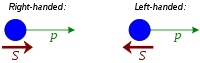
, which in turn is closely related a more easily visualized property called helicity. The helicity of a particle is the direction of its spin relative to its momentum
; particles with spin in the same direction as their momentum are called right-handed and otherwise they are called left-handed. When a particle is massless the direction of its momentum relative to its spin is frame independent, while for massive particles it is possible to 'overtake' the particle by a Lorentz transformation
flipping the helicity. Chirality is a technical property (defined through the transformation behaviour under the Poincaré group
) that agrees with helicity for (approximately) massless particles and is still well defined for massive particles.
In many quantum field theories—such as quantum electrodynamics
and quantum chromodynamics
—left and right-handed fermions are identical. However in the Standard Model left-handed and right-handed fermions are treated asymmetrically. Only left-handed fermions participate in the weak interaction
, while there are no right-handed neutrinos. This is an example of parity violation. In the literature left-handed fields are often denoted by a capital L subscript (e.g. L) and right-handed fields are denoted by a capital R subscript.
 One of the most prominent properties of leptons is their electric charge
, Q. The electric charge determines the strength of their electromagnetic interactions. It determines the strength of the electric field
generated by the particle (see Coulomb's law
) and how strongly the particle reacts to an external electric or magnetic field (see Lorentz force
). Each generation contains one lepton with Q = −1 (conventionally the charge of a particle is expressed in units of the elementary charge
) and one lepton with zero electric charge. The lepton with electric charge is commonly simply referred to as a 'charged positive lepton' while the neutral lepton is called a neutrino. For example the first generation consists of the electron with a negative electric charge and the electrically neutral electron neutrino .
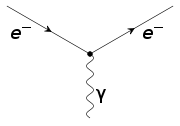
In the language of quantum field theory the electromagnetic interaction of the charged leptons is expressed by the fact that the particles interact with the quantum of the electromagnetic field, the photon
. The Feynman diagram
of the electron-photon interaction is shown on the right.
Since leptons have an intrinsic rotation in the form of their spin, charged leptons generate a magnetic field. The size of their magnetic dipole moment μ is given by, ,
,
where m is the mass of the lepton and g is the so called g-factor for the lepton. To first order approximation quantum mechanics predicts that the g-factor is 2 for all leptons. However higher order quantum effects caused by loops in Feynman diagrams introduce corrections to this value. These corrections, referred to as the anomalous magnetic dipole moment
, are very sensitive to the details of a quantum field theory model and thus provide the opportunity for precision tests of the standard model. The theoretical and measured values for the electron anomalous magnetic dipole moment agree up to eight significant figures.
In the Standard Model the left-handed charged lepton and the left-handed neutrino are arranged in doublet
that transforms in the spinor
representation (T = ) of the weak isospin
SU(2) gauge symmetry. This means that these particles are eigenstates of the isospin projection T3 with eigenvalues and − respectively. In the meantime, the right-handed charged lepton transforms as a weak isospin scalar (T = 0) and thus does not participate in the weak interaction, while there is no right-handed neutrino at all.
The Higgs mechanism
recombines the gauge fields of the weak isospin SU(2) and the weak hypercharge
U(1) symmetries to three massive vector bosons mediating the weak interaction, and one massless vector boson, the photon, responsible for the electromagnetic interaction. The electric charge Q can be calculated from the isospin projection T3 and weak hypercharge YW through the Gell-Mann–Nishijima formula
,
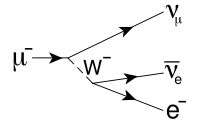
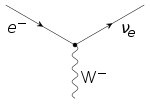
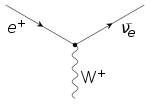
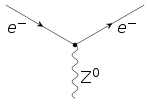
To recover the observed electric charges for all particles the left-handed weak isospin doublet must thus have YW = −1, while the right-handed isospin scalar e must have YW = −2. The interaction of the leptons with the massive weak interaction vector bosons is shown in the figure on the left.
each lepton starts out with no intrinsic mass. The charged leptons (i.e. the electron, muon, and tau) obtain an effective mass through interaction with the Higgs field, but the neutrinos remain massless. For technical reasons the masslessness of the neutrinos implies that there is no mixing of the different generations of charged leptons as there is for quarks. This is in close agreement with current experimental observations.
It is however known from experiment – most prominently from observed neutrino oscillation
s – that neutrinos do in fact have some very small mass, probably less than . This implies that there are physics beyond the Standard Model
. The currently most favoured extension is the so called Seesaw mechanism
, which would explain both why the left-handed neutrinos are so light compared to the corresponding charged leptons, and why we have not yet seen any right-handed neutrinos.
doublet
are assigned leptonic numbers
that are conserved under the Standard Model. Electrons and electron neutrinos have an electronic number of Le = 1, while muons and muon neutrinos have a muonic number of Lμ = 1, while tau particles and tau neutrinos have a tauonic number of Lτ = 1. The antileptons have their respective generation's leptonic numbers of −1.
Conservation of the leptonic numbers means that the number of leptons of the same type remains the same, when particles interact. This implies that leptons and antileptons must be created in pairs of a single generation. For example, the following processes are allowed under conservation of leptonic numbers:
but not these:
However, neutrino oscillation
s are known to violate the conservation of the individual leptonic numbers. Such a violation is considered to be smoking gun evidence for physics beyond the Standard Model
. A much stronger conservation law is the conservation of the total number of leptons (L), conserved even in the case of neutrino oscillations, but even it is still violated by a tiny amount by the chiral anomaly
.
s are flavour-independent (i.e., the interactions between leptons and gauge bosons are the same for all leptons). This property is called lepton universality and has been tested in measurements of the tau and muon lifetimes and of Z boson partial decay widths, particularly at the Stanford Linear Collider (SLC) and Large Electron-Positron Collider
(LEP) experiments.
The decay rate (Γ) of muons through the process → + + is approximately given by an expression of the form (see muon decay for more details)
where K1 is some constant, and GF is the Fermi coupling constant. The decay rate of tau particles through the process → + + is given by an expression of the same form
where K2 is some constant. Electron–muon universality implies that K1 = K2, and thus
This explains why the branching ratio
s for the electronic mode (17.85%) and muonic (17.36%) mode of tau decay are equal (within error).
Universality also accounts for the ratio of muon and tau lifetimes. The lifetime of a lepton (τl) is related to the decay rate by
where B(x → y) and Γ(x → y) denotes the branching ratios and the resonance width of the process x → y.
The ratio of tau and muon lifetime is thus given by
Using the values of the 2008 Review of Particle Physics for the branching ratios of muons and tau yields a lifetime ratio of ~, comparable to the measured lifetime ratio of ~. The difference is due to K1 and K2 not actually being constants; they depend on the mass of leptons.
Elementary particle
In particle physics, an elementary particle or fundamental particle is a particle not known to have substructure; that is, it is not known to be made up of smaller particles. If an elementary particle truly has no substructure, then it is one of the basic building blocks of the universe from which...
and a fundamental constituent of matter
Matter
Matter is a general term for the substance of which all physical objects consist. Typically, matter includes atoms and other particles which have mass. A common way of defining matter is as anything that has mass and occupies volume...
. The best known of all leptons is the electron
Electron
The electron is a subatomic particle with a negative elementary electric charge. It has no known components or substructure; in other words, it is generally thought to be an elementary particle. An electron has a mass that is approximately 1/1836 that of the proton...
which governs nearly all of chemistry
Chemistry
Chemistry is the science of matter, especially its chemical reactions, but also its composition, structure and properties. Chemistry is concerned with atoms and their interactions with other atoms, and particularly with the properties of chemical bonds....
as it is found in atom
Atom
The atom is a basic unit of matter that consists of a dense central nucleus surrounded by a cloud of negatively charged electrons. The atomic nucleus contains a mix of positively charged protons and electrically neutral neutrons...
s and is directly tied to all chemical properties
Chemical property
A chemical property is any of a material's properties that becomes evident during a chemical reaction; that is, any quality that can be established only by changing a substance's chemical identity...
. Two main classes of leptons exist: charged
Electric charge
Electric charge is a physical property of matter that causes it to experience a force when near other electrically charged matter. Electric charge comes in two types, called positive and negative. Two positively charged substances, or objects, experience a mutual repulsive force, as do two...
leptons (also known as the electron
Electron
The electron is a subatomic particle with a negative elementary electric charge. It has no known components or substructure; in other words, it is generally thought to be an elementary particle. An electron has a mass that is approximately 1/1836 that of the proton...
-like leptons), and neutral leptons (better known as neutrino
Neutrino
A neutrino is an electrically neutral, weakly interacting elementary subatomic particle with a half-integer spin, chirality and a disputed but small non-zero mass. It is able to pass through ordinary matter almost unaffected...
s). Charged leptons can combine with other particles to form various composite particles such as atom
Atom
The atom is a basic unit of matter that consists of a dense central nucleus surrounded by a cloud of negatively charged electrons. The atomic nucleus contains a mix of positively charged protons and electrically neutral neutrons...
s and positronium
Positronium
Positronium is a system consisting of an electron and its anti-particle, a positron, bound together into an "exotic atom". Being unstable, the two particles annihilate each other to produce two gamma ray photons after an average lifetime of 125 ps or three gamma ray photons after 142 ns in...
, while neutrinos rarely interact with anything, and are consequently rarely observed.
There are six types of leptons, known as flavours
Flavour (particle physics)
In particle physics, flavour or flavor is a quantum number of elementary particles. In quantum chromodynamics, flavour is a global symmetry...
, forming three generations
Generation (particle physics)
In particle physics, a generation is a division of the elementary particles. Between generations, particles differ by their quantum number and mass, but their interactions are identical....
. The first generation is the electronic leptons, comprising the electron
Electron
The electron is a subatomic particle with a negative elementary electric charge. It has no known components or substructure; in other words, it is generally thought to be an elementary particle. An electron has a mass that is approximately 1/1836 that of the proton...
and electron neutrino
Electron neutrino
The electron neutrino is a subatomic lepton elementary particle which has no net electric charge. Together with the electron it forms the first generation of leptons, hence its name electron neutrino...
; the second is the muonic leptons, comprising the muon
Muon
The muon |mu]] used to represent it) is an elementary particle similar to the electron, with a unitary negative electric charge and a spin of ½. Together with the electron, the tau, and the three neutrinos, it is classified as a lepton...
and muon neutrino
Muon neutrino
The muon neutrino is a subatomic lepton elementary particle which has the symbol and no net electric charge. Together with the muon it forms the second generation of leptons, hence its name muon neutrino. It was first hypothesized in the early 1940s by several people, and was discovered in 1962 by...
; and the third is the tauonic leptons, comprising the tau and the tau neutrino . Electrons have the least mass of all the charged leptons. The heavier muons and taus will rapidly change into electrons through a process of particle decay
Particle decay
Particle decay is the spontaneous process of one elementary particle transforming into other elementary particles. During this process, an elementary particle becomes a different particle with less mass and an intermediate particle such as W boson in muon decay. The intermediate particle then...
: the transformation from a higher mass state to a lower mass state. Thus electrons are stable and the most common charged lepton in the universe
Universe
The Universe is commonly defined as the totality of everything that exists, including all matter and energy, the planets, stars, galaxies, and the contents of intergalactic space. Definitions and usage vary and similar terms include the cosmos, the world and nature...
, whereas muons and taus can only be produced in high energy collisions (such as those involving cosmic ray
Cosmic ray
Cosmic rays are energetic charged subatomic particles, originating from outer space. They may produce secondary particles that penetrate the Earth's atmosphere and surface. The term ray is historical as cosmic rays were thought to be electromagnetic radiation...
s and those carried out in particle accelerator
Particle accelerator
A particle accelerator is a device that uses electromagnetic fields to propel charged particles to high speeds and to contain them in well-defined beams. An ordinary CRT television set is a simple form of accelerator. There are two basic types: electrostatic and oscillating field accelerators.In...
s).
Leptons have various intrinsic properties, including electric charge
Electric charge
Electric charge is a physical property of matter that causes it to experience a force when near other electrically charged matter. Electric charge comes in two types, called positive and negative. Two positively charged substances, or objects, experience a mutual repulsive force, as do two...
, spin
Spin (physics)
In quantum mechanics and particle physics, spin is a fundamental characteristic property of elementary particles, composite particles , and atomic nuclei.It is worth noting that the intrinsic property of subatomic particles called spin and discussed in this article, is related in some small ways,...
, and mass
Mass
Mass can be defined as a quantitive measure of the resistance an object has to change in its velocity.In physics, mass commonly refers to any of the following three properties of matter, which have been shown experimentally to be equivalent:...
. Unlike quark
Quark
A quark is an elementary particle and a fundamental constituent of matter. Quarks combine to form composite particles called hadrons, the most stable of which are protons and neutrons, the components of atomic nuclei. Due to a phenomenon known as color confinement, quarks are never directly...
s however, leptons are not subject to the strong interaction
Strong interaction
In particle physics, the strong interaction is one of the four fundamental interactions of nature, the others being electromagnetism, the weak interaction and gravitation. As with the other fundamental interactions, it is a non-contact force...
, but they are subject to the other three fundamental interaction
Fundamental interaction
In particle physics, fundamental interactions are the ways that elementary particles interact with one another...
s: gravitation
Gravitation
Gravitation, or gravity, is a natural phenomenon by which physical bodies attract with a force proportional to their mass. Gravitation is most familiar as the agent that gives weight to objects with mass and causes them to fall to the ground when dropped...
, electromagnetism
Electromagnetism
Electromagnetism is one of the four fundamental interactions in nature. The other three are the strong interaction, the weak interaction and gravitation...
(excluding neutrinos, which are electrically neutral), and the weak interaction
Weak interaction
Weak interaction , is one of the four fundamental forces of nature, alongside the strong nuclear force, electromagnetism, and gravity. It is responsible for the radioactive decay of subatomic particles and initiates the process known as hydrogen fusion in stars...
. For every lepton flavor there is a corresponding type of antiparticle
Antiparticle
Corresponding to most kinds of particles, there is an associated antiparticle with the same mass and opposite electric charge. For example, the antiparticle of the electron is the positively charged antielectron, or positron, which is produced naturally in certain types of radioactive decay.The...
, known as antilepton, that differs from the lepton only in that some of its properties have equal magnitude but opposite sign
Additive inverse
In mathematics, the additive inverse, or opposite, of a number a is the number that, when added to a, yields zero.The additive inverse of a is denoted −a....
. However, according to certain theories, neutrinos may be their own antiparticle
Majorana fermion
In physics, a Majorana fermion is a fermion which is its own anti-particle. The term is used in opposition to Dirac fermion, which describes particles that differ from their antiparticles...
, but it is not currently known whether this is the case or not.
The first charged lepton, the electron, was theorized in the mid-19th century by several scientists and was discovered in 1897 by J. J. Thomson
J. J. Thomson
Sir Joseph John "J. J." Thomson, OM, FRS was a British physicist and Nobel laureate. He is credited for the discovery of the electron and of isotopes, and the invention of the mass spectrometer...
. The next lepton to be observed was the muon
Muon
The muon |mu]] used to represent it) is an elementary particle similar to the electron, with a unitary negative electric charge and a spin of ½. Together with the electron, the tau, and the three neutrinos, it is classified as a lepton...
, discovered by Carl D. Anderson in 1936, but it was erroneously classified as a meson
Meson
In particle physics, mesons are subatomic particles composed of one quark and one antiquark, bound together by the strong interaction. Because mesons are composed of sub-particles, they have a physical size, with a radius roughly one femtometer: 10−15 m, which is about the size of a proton...
at the time. After investigation, it was realized that the muon did not have the expected properties of a meson, but rather behaved like an electron, only with higher mass. It took until 1947 for the concept of "leptons" as a family of particle to be proposed. The first neutrino, the electron neutrino, was proposed by Wolfgang Pauli
Wolfgang Pauli
Wolfgang Ernst Pauli was an Austrian theoretical physicist and one of the pioneers of quantum physics. In 1945, after being nominated by Albert Einstein, he received the Nobel Prize in Physics for his "decisive contribution through his discovery of a new law of Nature, the exclusion principle or...
in 1930 to explain certain characteristics of beta decay
Beta decay
In nuclear physics, beta decay is a type of radioactive decay in which a beta particle is emitted from an atom. There are two types of beta decay: beta minus and beta plus. In the case of beta decay that produces an electron emission, it is referred to as beta minus , while in the case of a...
. It was first observed in the Cowan–Reines neutrino experiment conducted by Clyde Cowan
Clyde Cowan
Clyde Lorrain Cowan Jr was the co-discoverer of the neutrino, along with Frederick Reines. The discovery was made in 1956, detected in the neutrino experiment....
and Frederick Reines
Frederick Reines
Frederick Reines was an American physicist. He was awarded the 1995 Nobel Prize in Physics for his co-detection of the neutrino with Clyde Cowan in the neutrino experiment, and may be the only scientist in history "so intimately associated with the discovery of an elementary particle and the...
in 1956. The muon neutrino was discovered in 1962 by Leon M. Lederman
Leon M. Lederman
Leon Max Lederman is an American experimental physicist and Nobel Prize in Physics laureate for his work with neutrinos. He is Director Emeritus of Fermi National Accelerator Laboratory in Batavia, Illinois, USA...
, Melvin Schwartz
Melvin Schwartz
Melvin Schwartz was an American physicist. He shared the 1988 Nobel Prize in Physics with Leon M. Lederman and Jack Steinberger for their development of the neutrino beam method and their demonstration of the doublet structure of the leptons through the discovery of the muon neutrino.He grew up in...
and Jack Steinberger
Jack Steinberger
Jack Steinberger is a German-American physicist currently residing near Geneva, Switzerland. He co-discovered the muon neutrino, along with Leon Lederman and Melvin Schwartz, for which they were given the 1988 Nobel Prize in Physics.-Life:...
, and the tau discovered between 1974 and 1977 by Martin Lewis Perl
Martin Lewis Perl
Martin Lewis Perl is an American physicist, who won the Nobel Prize in Physics in 1995 for his discovery of the tau lepton.His parents were Jewish emigrants to the US from the Polish area of Russia....
and his colleagues from the Stanford Linear Accelerator Center
Stanford Linear Accelerator Center
The SLAC National Accelerator Laboratory, originally named Stanford Linear Accelerator Center, is a United States Department of Energy National Laboratory operated by Stanford University under the programmatic direction of the U.S...
and Lawrence Berkeley National Laboratory
Lawrence Berkeley National Laboratory
The Lawrence Berkeley National Laboratory , is a U.S. Department of Energy national laboratory conducting unclassified scientific research. It is located on the grounds of the University of California, Berkeley, in the Berkeley Hills above the central campus...
. The tau neutrino remained elusive until July 2000, when the DONUT collaboration
DONUT
DONUT was an experiment at Fermilab dedicated to the search for tau neutrino interactions. Even though the detector operated only during a few months in the summer of 1997, it was largely successful. By detecting the tau neutrino, it confirmed the existence of the last lepton predicted by the...
from Fermilab
Fermilab
Fermi National Accelerator Laboratory , located just outside Batavia, Illinois, near Chicago, is a US Department of Energy national laboratory specializing in high-energy particle physics...
announced its discovery.
Leptons are an important part of the Standard Model
Standard Model
The Standard Model of particle physics is a theory concerning the electromagnetic, weak, and strong nuclear interactions, which mediate the dynamics of the known subatomic particles. Developed throughout the mid to late 20th century, the current formulation was finalized in the mid 1970s upon...
. Electrons are one of the components of atom
Atom
The atom is a basic unit of matter that consists of a dense central nucleus surrounded by a cloud of negatively charged electrons. The atomic nucleus contains a mix of positively charged protons and electrically neutral neutrons...
s, alongside proton
Proton
The proton is a subatomic particle with the symbol or and a positive electric charge of 1 elementary charge. One or more protons are present in the nucleus of each atom, along with neutrons. The number of protons in each atom is its atomic number....
s and neutron
Neutron
The neutron is a subatomic hadron particle which has the symbol or , no net electric charge and a mass slightly larger than that of a proton. With the exception of hydrogen, nuclei of atoms consist of protons and neutrons, which are therefore collectively referred to as nucleons. The number of...
s. Exotic atom
Exotic atom
An exotic atom is an otherwise normal atom in which one or more sub-atomic particles have been replaced by other particles of the same charge. For example, electrons may be replaced by other negatively charged particles such as muons or pions...
s with muons and taus instead of electrons can also be synthesized, as well as lepton–antilepton particles such as positronium
Positronium
Positronium is a system consisting of an electron and its anti-particle, a positron, bound together into an "exotic atom". Being unstable, the two particles annihilate each other to produce two gamma ray photons after an average lifetime of 125 ps or three gamma ray photons after 142 ns in...
.
Etymology
The name lepton comes from the GreekGreek language
Greek is an independent branch of the Indo-European family of languages. Native to the southern Balkans, it has the longest documented history of any Indo-European language, spanning 34 centuries of written records. Its writing system has been the Greek alphabet for the majority of its history;...
"λεπτόν" (lepton), neuter of "λεπτός" (leptos), "fine, small, thin" and the earliest attested form of the word is the Mycenaean Greek re-po-to, written in Linear B
Linear B
Linear B is a syllabic script that was used for writing Mycenaean Greek, an early form of Greek. It pre-dated the Greek alphabet by several centuries and seems to have died out with the fall of Mycenaean civilization...
syllabic script. Lepton was first used by physicist Léon Rosenfeld
Léon Rosenfeld
Léon Rosenfeld was a Belgian physicist. He obtained a PhD at the University of Liège in 1926, and he was a collaborator of the physicist Niels Bohr. He did early work in quantum electrodynamics that predates by two decades the work by Dirac and Bergmann. He coined the name lepton...
in 1948:
Following a suggestion of Prof. C. Møller, I adopt — as a pendant to "nucleon" — the denomination "lepton" (from λεπτός, small, thin, delicate) to denote a particle of small mass.
The etymology incorrectly implies that all the leptons are of small mass. When Rosenfeld named them, the only known leptons were electrons and muons, which are in fact of small mass — the mass of an electron and the mass of a muon (with a value of ) are fractions of the mass of the "heavy" proton . However, the mass of the tau (discovered in the mid 1970s) is nearly twice that of the proton, and about 3,500 times that of the electron.
History
| Particle name | Antiparticle name |
|---|---|
| Electron | Antielectron Positron |
| Electron neutrino | Electron antineutrino |
| Muon Mu lepton Mu |
Antimuon Antimu lepton Antimu |
| Muon neutrino Muonic neutrino Mu neutrino |
Muon antineutrino Muonic antineutrino Mu antineutrino |
| Tau Tau lepton Tauon |
Antitau Antitau lepton Antitau |
| Tau neutrino Tauonic neutrino Tau neutrino |
Tau antineutrino Tauonic antineutrino Tau antineutrino |
The first lepton identified was the electron, discovered by J.J. Thomson and his team of British physicists in 1897. Then in 1930 Wolfgang Pauli
Wolfgang Pauli
Wolfgang Ernst Pauli was an Austrian theoretical physicist and one of the pioneers of quantum physics. In 1945, after being nominated by Albert Einstein, he received the Nobel Prize in Physics for his "decisive contribution through his discovery of a new law of Nature, the exclusion principle or...
postulated the electron neutrino
Electron neutrino
The electron neutrino is a subatomic lepton elementary particle which has no net electric charge. Together with the electron it forms the first generation of leptons, hence its name electron neutrino...
to preserve conservation of energy
Conservation of energy
The nineteenth century law of conservation of energy is a law of physics. It states that the total amount of energy in an isolated system remains constant over time. The total energy is said to be conserved over time...
, conservation of momentum, and conservation of angular momentum in beta decay
Beta decay
In nuclear physics, beta decay is a type of radioactive decay in which a beta particle is emitted from an atom. There are two types of beta decay: beta minus and beta plus. In the case of beta decay that produces an electron emission, it is referred to as beta minus , while in the case of a...
. Pauli theorized that an undetected particle was carrying away the difference between the energy
Energy
In physics, energy is an indirectly observed quantity. It is often understood as the ability a physical system has to do work on other physical systems...
, momentum
Momentum
In classical mechanics, linear momentum or translational momentum is the product of the mass and velocity of an object...
, and angular momentum
Angular momentum
In physics, angular momentum, moment of momentum, or rotational momentum is a conserved vector quantity that can be used to describe the overall state of a physical system...
of the initial and observed final particles. The electron neutrino was simply called the neutrino, as it was not yet known that neutrinos came in different flavours (or different "generations").
Nearly 40 years after the discovery of the electron, the muon
Muon
The muon |mu]] used to represent it) is an elementary particle similar to the electron, with a unitary negative electric charge and a spin of ½. Together with the electron, the tau, and the three neutrinos, it is classified as a lepton...
was discovered by Carl D. Anderson in 1936. Due to its mass, it was initially categorized as a meson
Meson
In particle physics, mesons are subatomic particles composed of one quark and one antiquark, bound together by the strong interaction. Because mesons are composed of sub-particles, they have a physical size, with a radius roughly one femtometer: 10−15 m, which is about the size of a proton...
rather than a lepton. It later became clear that the muon was much more similar to the electron than to mesons, as muons do not undergo the strong interaction
Strong interaction
In particle physics, the strong interaction is one of the four fundamental interactions of nature, the others being electromagnetism, the weak interaction and gravitation. As with the other fundamental interactions, it is a non-contact force...
, and thus the muon was reclassified: electrons, muons, and the (electron) neutrino were grouped into a new group of particles – the leptons. In 1962 Leon M. Lederman
Leon M. Lederman
Leon Max Lederman is an American experimental physicist and Nobel Prize in Physics laureate for his work with neutrinos. He is Director Emeritus of Fermi National Accelerator Laboratory in Batavia, Illinois, USA...
, Melvin Schwartz
Melvin Schwartz
Melvin Schwartz was an American physicist. He shared the 1988 Nobel Prize in Physics with Leon M. Lederman and Jack Steinberger for their development of the neutrino beam method and their demonstration of the doublet structure of the leptons through the discovery of the muon neutrino.He grew up in...
and Jack Steinberger
Jack Steinberger
Jack Steinberger is a German-American physicist currently residing near Geneva, Switzerland. He co-discovered the muon neutrino, along with Leon Lederman and Melvin Schwartz, for which they were given the 1988 Nobel Prize in Physics.-Life:...
showed that more than one type of neutrino exists by first detecting interactions of the muon
Muon
The muon |mu]] used to represent it) is an elementary particle similar to the electron, with a unitary negative electric charge and a spin of ½. Together with the electron, the tau, and the three neutrinos, it is classified as a lepton...
neutrino, which earned them the 1988 Nobel Prize
Nobel Prize in Physics
The Nobel Prize in Physics is awarded once a year by the Royal Swedish Academy of Sciences. It is one of the five Nobel Prizes established by the will of Alfred Nobel in 1895 and awarded since 1901; the others are the Nobel Prize in Chemistry, Nobel Prize in Literature, Nobel Peace Prize, and...
, although by then the different flavours of neutrino had already been theorized.
The tau was first detected in a series of experiments between 1974 and 1977 by Martin Lewis Perl
Martin Lewis Perl
Martin Lewis Perl is an American physicist, who won the Nobel Prize in Physics in 1995 for his discovery of the tau lepton.His parents were Jewish emigrants to the US from the Polish area of Russia....
with his colleagues at the SLAC LBL group
Lawrence Berkeley National Laboratory
The Lawrence Berkeley National Laboratory , is a U.S. Department of Energy national laboratory conducting unclassified scientific research. It is located on the grounds of the University of California, Berkeley, in the Berkeley Hills above the central campus...
. Like the electron and the muon, it too was expected to have an associated neutrino. The first evidence for tau neutrinos came from the observation of "missing" energy and momentum in tau decay, analogous to the "missing" energy and momentum in beta decay leading to the discovery of the electron neutrino. The first detection of tau neutrino interactions was announced in 2000 by the DONUT
DONUT
DONUT was an experiment at Fermilab dedicated to the search for tau neutrino interactions. Even though the detector operated only during a few months in the summer of 1997, it was largely successful. By detecting the tau neutrino, it confirmed the existence of the last lepton predicted by the...
collaboration at Fermilab
Fermilab
Fermi National Accelerator Laboratory , located just outside Batavia, Illinois, near Chicago, is a US Department of Energy national laboratory specializing in high-energy particle physics...
, making it the latest particle of the Standard Model
Standard Model
The Standard Model of particle physics is a theory concerning the electromagnetic, weak, and strong nuclear interactions, which mediate the dynamics of the known subatomic particles. Developed throughout the mid to late 20th century, the current formulation was finalized in the mid 1970s upon...
to have been directly observed.
Although all present data is consistent with three generations of leptons, some particle physicists are searching for a fourth generation. The current lower limit on the mass of the fourth charged lepton is , while its associated neutrino has a mass of at least .
Spin and chirality
Spin (physics)
In quantum mechanics and particle physics, spin is a fundamental characteristic property of elementary particles, composite particles , and atomic nuclei.It is worth noting that the intrinsic property of subatomic particles called spin and discussed in this article, is related in some small ways,...
- particles. The spin-statistics theorem
Spin-statistics theorem
In quantum mechanics, the spin-statistics theorem relates the spin of a particle to the particle statistics it obeys. The spin of a particle is its intrinsic angular momentum...
thus implies that they are fermion
Fermion
In particle physics, a fermion is any particle which obeys the Fermi–Dirac statistics . Fermions contrast with bosons which obey Bose–Einstein statistics....
s and thus that they are subject to the Pauli exclusion principle
Pauli exclusion principle
The Pauli exclusion principle is the quantum mechanical principle that no two identical fermions may occupy the same quantum state simultaneously. A more rigorous statement is that the total wave function for two identical fermions is anti-symmetric with respect to exchange of the particles...
; no two leptons of the same species can be in exactly the same state at the same time. Furthermore, it means that a lepton can have only two possible spin states, namely up or down.
A closely related property is chirality
Chirality (physics)
A chiral phenomenon is one that is not identical to its mirror image . The spin of a particle may be used to define a handedness for that particle. A symmetry transformation between the two is called parity...
, which in turn is closely related a more easily visualized property called helicity. The helicity of a particle is the direction of its spin relative to its momentum
Momentum
In classical mechanics, linear momentum or translational momentum is the product of the mass and velocity of an object...
; particles with spin in the same direction as their momentum are called right-handed and otherwise they are called left-handed. When a particle is massless the direction of its momentum relative to its spin is frame independent, while for massive particles it is possible to 'overtake' the particle by a Lorentz transformation
Lorentz transformation
In physics, the Lorentz transformation or Lorentz-Fitzgerald transformation describes how, according to the theory of special relativity, two observers' varying measurements of space and time can be converted into each other's frames of reference. It is named after the Dutch physicist Hendrik...
flipping the helicity. Chirality is a technical property (defined through the transformation behaviour under the Poincaré group
Poincaré group
In physics and mathematics, the Poincaré group, named after Henri Poincaré, is the group of isometries of Minkowski spacetime.-Simple explanation:...
) that agrees with helicity for (approximately) massless particles and is still well defined for massive particles.
In many quantum field theories—such as quantum electrodynamics
Quantum electrodynamics
Quantum electrodynamics is the relativistic quantum field theory of electrodynamics. In essence, it describes how light and matter interact and is the first theory where full agreement between quantum mechanics and special relativity is achieved...
and quantum chromodynamics
Quantum chromodynamics
In theoretical physics, quantum chromodynamics is a theory of the strong interaction , a fundamental force describing the interactions of the quarks and gluons making up hadrons . It is the study of the SU Yang–Mills theory of color-charged fermions...
—left and right-handed fermions are identical. However in the Standard Model left-handed and right-handed fermions are treated asymmetrically. Only left-handed fermions participate in the weak interaction
Weak interaction
Weak interaction , is one of the four fundamental forces of nature, alongside the strong nuclear force, electromagnetism, and gravity. It is responsible for the radioactive decay of subatomic particles and initiates the process known as hydrogen fusion in stars...
, while there are no right-handed neutrinos. This is an example of parity violation. In the literature left-handed fields are often denoted by a capital L subscript (e.g. L) and right-handed fields are denoted by a capital R subscript.
Electromagnetic interaction
Electric charge
Electric charge is a physical property of matter that causes it to experience a force when near other electrically charged matter. Electric charge comes in two types, called positive and negative. Two positively charged substances, or objects, experience a mutual repulsive force, as do two...
, Q. The electric charge determines the strength of their electromagnetic interactions. It determines the strength of the electric field
Electric field
In physics, an electric field surrounds electrically charged particles and time-varying magnetic fields. The electric field depicts the force exerted on other electrically charged objects by the electrically charged particle the field is surrounding...
generated by the particle (see Coulomb's law
Coulomb's law
Coulomb's law or Coulomb's inverse-square law, is a law of physics describing the electrostatic interaction between electrically charged particles. It was first published in 1785 by French physicist Charles Augustin de Coulomb and was essential to the development of the theory of electromagnetism...
) and how strongly the particle reacts to an external electric or magnetic field (see Lorentz force
Lorentz force
In physics, the Lorentz force is the force on a point charge due to electromagnetic fields. It is given by the following equation in terms of the electric and magnetic fields:...
). Each generation contains one lepton with Q = −1 (conventionally the charge of a particle is expressed in units of the elementary charge
Elementary charge
The elementary charge, usually denoted as e, is the electric charge carried by a single proton, or equivalently, the absolute value of the electric charge carried by a single electron. This elementary charge is a fundamental physical constant. To avoid confusion over its sign, e is sometimes called...
) and one lepton with zero electric charge. The lepton with electric charge is commonly simply referred to as a 'charged positive lepton' while the neutral lepton is called a neutrino. For example the first generation consists of the electron with a negative electric charge and the electrically neutral electron neutrino .
In the language of quantum field theory the electromagnetic interaction of the charged leptons is expressed by the fact that the particles interact with the quantum of the electromagnetic field, the photon
Photon
In physics, a photon is an elementary particle, the quantum of the electromagnetic interaction and the basic unit of light and all other forms of electromagnetic radiation. It is also the force carrier for the electromagnetic force...
. The Feynman diagram
Feynman diagram
Feynman diagrams are a pictorial representation scheme for the mathematical expressions governing the behavior of subatomic particles, first developed by the Nobel Prize-winning American physicist Richard Feynman, and first introduced in 1948...
of the electron-photon interaction is shown on the right.
Since leptons have an intrinsic rotation in the form of their spin, charged leptons generate a magnetic field. The size of their magnetic dipole moment μ is given by,
,where m is the mass of the lepton and g is the so called g-factor for the lepton. To first order approximation quantum mechanics predicts that the g-factor is 2 for all leptons. However higher order quantum effects caused by loops in Feynman diagrams introduce corrections to this value. These corrections, referred to as the anomalous magnetic dipole moment
Anomalous magnetic dipole moment
In quantum electrodynamics, the anomalous magnetic moment of a particle is a contribution of effects of quantum mechanics, expressed by Feynman diagrams with loops, to the magnetic moment of that particle...
, are very sensitive to the details of a quantum field theory model and thus provide the opportunity for precision tests of the standard model. The theoretical and measured values for the electron anomalous magnetic dipole moment agree up to eight significant figures.
Weak Interaction
EWLINE
|
In the Standard Model the left-handed charged lepton and the left-handed neutrino are arranged in doublet
Doublet (physics)
In quantum mechanics, a doublet is a quantum state of a system with a spin of 1/2, such that there are two allowed values of the spin component, −1/2 and +1/2. Quantum systems with two possible states are sometimes called two-level systems...
that transforms in the spinor
Spinor
In mathematics and physics, in particular in the theory of the orthogonal groups , spinors are elements of a complex vector space introduced to expand the notion of spatial vector. Unlike tensors, the space of spinors cannot be built up in a unique and natural way from spatial vectors...
representation (T = ) of the weak isospin
Weak isospin
In particle physics, weak isospin is a quantum number relating to the weak interaction, and parallels the idea of isospin under the strong interaction. Weak isospin is usually given the symbol T or I with the third component written as Tz, T3, Iz or I3...
SU(2) gauge symmetry. This means that these particles are eigenstates of the isospin projection T3 with eigenvalues and − respectively. In the meantime, the right-handed charged lepton transforms as a weak isospin scalar (T = 0) and thus does not participate in the weak interaction, while there is no right-handed neutrino at all.
The Higgs mechanism
Higgs mechanism
In particle physics, the Higgs mechanism is the process in which gauge bosons in a gauge theory can acquire non-vanishing masses through absorption of Nambu-Goldstone bosons arising in spontaneous symmetry breaking....
recombines the gauge fields of the weak isospin SU(2) and the weak hypercharge
Weak hypercharge
The weak hypercharge in particle physics is a conserved quantum number relating the electrical charge and the third component of weak isospin, and is similar to the Gell-Mann–Nishijima formula for the hypercharge of strong interactions...
U(1) symmetries to three massive vector bosons mediating the weak interaction, and one massless vector boson, the photon, responsible for the electromagnetic interaction. The electric charge Q can be calculated from the isospin projection T3 and weak hypercharge YW through the Gell-Mann–Nishijima formula
Gell-Mann–Nishijima formula
The Gell-Mann–Nishijima formula relates the baryon number B, the strangeness S, the isospin I3 of hadrons to the charge Q. It was originally given by Kazuhiko Nishijima and Tadao Nakano in 1953, and lead to the proposal of strangeness as a concept, which Nishijima originally called "eta-charge"...
,
- Q = T3 + YW/2
To recover the observed electric charges for all particles the left-handed weak isospin doublet must thus have YW = −1, while the right-handed isospin scalar e must have YW = −2. The interaction of the leptons with the massive weak interaction vector bosons is shown in the figure on the left.
Mass
In the Standard ModelStandard Model
The Standard Model of particle physics is a theory concerning the electromagnetic, weak, and strong nuclear interactions, which mediate the dynamics of the known subatomic particles. Developed throughout the mid to late 20th century, the current formulation was finalized in the mid 1970s upon...
each lepton starts out with no intrinsic mass. The charged leptons (i.e. the electron, muon, and tau) obtain an effective mass through interaction with the Higgs field, but the neutrinos remain massless. For technical reasons the masslessness of the neutrinos implies that there is no mixing of the different generations of charged leptons as there is for quarks. This is in close agreement with current experimental observations.
It is however known from experiment – most prominently from observed neutrino oscillation
Neutrino oscillation
Neutrino oscillation is a quantum mechanical phenomenon predicted by Bruno Pontecorvowhereby a neutrino created with a specific lepton flavor can later be measured to have a different flavor. The probability of measuring a particular flavor for a neutrino varies periodically as it propagates...
s – that neutrinos do in fact have some very small mass, probably less than . This implies that there are physics beyond the Standard Model
Beyond the Standard Model
Physics beyond the Standard Model refers to the theoretical developments needed to explain the deficiencies of the Standard Model, such as the origin of mass, the strong CP problem, neutrino oscillations, matter–antimatter asymmetry, and the nature of dark matter and dark energy...
. The currently most favoured extension is the so called Seesaw mechanism
Seesaw mechanism
In theoretical physics, the seesaw mechanism is a mechanism within grand unification theory, and in particular in theories of neutrino masses and neutrino oscillation, where it can be used to explain the smallness of observed neutrino masses relative to those of quarks and leptons.There are several...
, which would explain both why the left-handed neutrinos are so light compared to the corresponding charged leptons, and why we have not yet seen any right-handed neutrinos.
Leptonic numbers
The members of each generation's weak isospinWeak isospin
In particle physics, weak isospin is a quantum number relating to the weak interaction, and parallels the idea of isospin under the strong interaction. Weak isospin is usually given the symbol T or I with the third component written as Tz, T3, Iz or I3...
doublet
Doublet (physics)
In quantum mechanics, a doublet is a quantum state of a system with a spin of 1/2, such that there are two allowed values of the spin component, −1/2 and +1/2. Quantum systems with two possible states are sometimes called two-level systems...
are assigned leptonic numbers
Lepton number
In particle physics, the lepton number is the number of leptons minus the number of antileptons.In equation form,so all leptons have assigned a value of +1, antileptons −1, and non-leptonic particles 0...
that are conserved under the Standard Model. Electrons and electron neutrinos have an electronic number of Le = 1, while muons and muon neutrinos have a muonic number of Lμ = 1, while tau particles and tau neutrinos have a tauonic number of Lτ = 1. The antileptons have their respective generation's leptonic numbers of −1.
Conservation of the leptonic numbers means that the number of leptons of the same type remains the same, when particles interact. This implies that leptons and antileptons must be created in pairs of a single generation. For example, the following processes are allowed under conservation of leptonic numbers:
- + → + ,
- + → + ,
but not these:
- → + ,
- → + ,
- → + .
However, neutrino oscillation
Neutrino oscillation
Neutrino oscillation is a quantum mechanical phenomenon predicted by Bruno Pontecorvowhereby a neutrino created with a specific lepton flavor can later be measured to have a different flavor. The probability of measuring a particular flavor for a neutrino varies periodically as it propagates...
s are known to violate the conservation of the individual leptonic numbers. Such a violation is considered to be smoking gun evidence for physics beyond the Standard Model
Beyond the Standard Model
Physics beyond the Standard Model refers to the theoretical developments needed to explain the deficiencies of the Standard Model, such as the origin of mass, the strong CP problem, neutrino oscillations, matter–antimatter asymmetry, and the nature of dark matter and dark energy...
. A much stronger conservation law is the conservation of the total number of leptons (L), conserved even in the case of neutrino oscillations, but even it is still violated by a tiny amount by the chiral anomaly
Chiral anomaly
A chiral anomaly is the anomalous nonconservation of a chiral current. In some theories of fermions with chiral symmetry, the quantization may lead to the breaking of this chiral symmetry. In that case, the charge associated with the chiral symmetry is not conserved.The non-conservation happens...
.
Universality
The coupling of the leptons to gauge bosonGauge boson
In particle physics, gauge bosons are bosonic particles that act as carriers of the fundamental forces of nature. More specifically, elementary particles whose interactions are described by gauge theory exert forces on each other by the exchange of gauge bosons, usually as virtual particles.-...
s are flavour-independent (i.e., the interactions between leptons and gauge bosons are the same for all leptons). This property is called lepton universality and has been tested in measurements of the tau and muon lifetimes and of Z boson partial decay widths, particularly at the Stanford Linear Collider (SLC) and Large Electron-Positron Collider
Large Electron-Positron Collider
The Large Electron–Positron Collider was one of the largest particle accelerators ever constructed.It was built at CERN, a multi-national centre for research in nuclear and particle physics near Geneva, Switzerland. LEP was a circular collider with a circumference of 27 kilometres built in a...
(LEP) experiments.
The decay rate (Γ) of muons through the process → + + is approximately given by an expression of the form (see muon decay for more details)

where K1 is some constant, and GF is the Fermi coupling constant. The decay rate of tau particles through the process → + + is given by an expression of the same form

where K2 is some constant. Electron–muon universality implies that K1 = K2, and thus

This explains why the branching ratio
Branching ratio
In particle physics and nuclear physics, the branching fraction for a decay is the fraction of particles which decay by an individual decay mode with respect to the total number of particles which decay. It is equal to the ratio of the partial decay constant to the overall decay constant...
s for the electronic mode (17.85%) and muonic (17.36%) mode of tau decay are equal (within error).
Universality also accounts for the ratio of muon and tau lifetimes. The lifetime of a lepton (τl) is related to the decay rate by
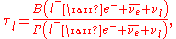
where B(x → y) and Γ(x → y) denotes the branching ratios and the resonance width of the process x → y.
The ratio of tau and muon lifetime is thus given by

Using the values of the 2008 Review of Particle Physics for the branching ratios of muons and tau yields a lifetime ratio of ~, comparable to the measured lifetime ratio of ~. The difference is due to K1 and K2 not actually being constants; they depend on the mass of leptons.
Table of leptons
| Particle/Antiparticle Name | Symbol | Q Electric charge Electric charge is a physical property of matter that causes it to experience a force when near other electrically charged matter. Electric charge comes in two types, called positive and negative. Two positively charged substances, or objects, experience a mutual repulsive force, as do two... (e Elementary charge The elementary charge, usually denoted as e, is the electric charge carried by a single proton, or equivalently, the absolute value of the electric charge carried by a single electron. This elementary charge is a fundamental physical constant. To avoid confusion over its sign, e is sometimes called... ) |
S Spin (physics) In quantum mechanics and particle physics, spin is a fundamental characteristic property of elementary particles, composite particles , and atomic nuclei.It is worth noting that the intrinsic property of subatomic particles called spin and discussed in this article, is related in some small ways,... |
Le | Lμ | Lτ | Mass (MeV/c2) | Lifetime (s Second The second is a unit of measurement of time, and is the International System of Units base unit of time. It may be measured using a clock.... ) |
Common decay |
|---|---|---|---|---|---|---|---|---|---|
| Electron Electron The electron is a subatomic particle with a negative elementary electric charge. It has no known components or substructure; in other words, it is generally thought to be an elementary particle. An electron has a mass that is approximately 1/1836 that of the proton... / Antielectron |
/ | −1/+1 | +1/−1 | 0 | 0 | Stable | Stable | ||
| Muon Muon The muon |mu]] used to represent it) is an elementary particle similar to the electron, with a unitary negative electric charge and a spin of ½. Together with the electron, the tau, and the three neutrinos, it is classified as a lepton... / Antimuon |
/ | −1/+1 | 0 | +1/−1 | 0 | + + | |||
| Tau / Antitau | / | −1/+1 | 0 | 0 | +1/−1 | See decay modes | |||
| Electron neutrino Electron neutrino The electron neutrino is a subatomic lepton elementary particle which has no net electric charge. Together with the electron it forms the first generation of leptons, hence its name electron neutrino... / Electron antineutrino |
/ | 0 | +1/−1 | 0 | 0 | < | Unknown | ||
| Muon neutrino Muon neutrino The muon neutrino is a subatomic lepton elementary particle which has the symbol and no net electric charge. Together with the muon it forms the second generation of leptons, hence its name muon neutrino. It was first hypothesized in the early 1940s by several people, and was discovered in 1962 by... / Muon antineutrino |
/ | 0 | 0 | +1/−1 | 0 | < 0.17 | Unknown | ||
| Tau neutrino / Tau antineutrino | / | 0 | 0 | 0 | +1/−1 | < 15.5 | Unknown |
See also
- Koide formulaKoide formulaThe Koide formula is an unexplained relation discovered by Yoshio Koide in 1981. It relates the masses of the three charged leptons so well that it predicted the mass of the tau.-Formula:...
- List of particles
- QuarkQuarkA quark is an elementary particle and a fundamental constituent of matter. Quarks combine to form composite particles called hadrons, the most stable of which are protons and neutrons, the components of atomic nuclei. Due to a phenomenon known as color confinement, quarks are never directly...
- Weak interactionWeak interactionWeak interaction , is one of the four fundamental forces of nature, alongside the strong nuclear force, electromagnetism, and gravity. It is responsible for the radioactive decay of subatomic particles and initiates the process known as hydrogen fusion in stars...
External links
- Particle Data Group homepage. The PDG compiles authoritative information on particle properties.
- Leptons, a summary of leptons from HyperphysicsHyperPhysicsHyperPhysics is an educational resource about physics topics. The information architecture of the website is based on trees that organize topics from general to specific...
.