

List of particles

Encyclopedia
This is a list of the different types of particle
s found or believed to exist in the whole of the universe
. For individual lists of the different particles, see the individual pages given below.
. Many families and sub-families of elementary particles exist. Elementary particles are classified according to their spin
. Fermion
s have half-integer spin while boson
s have integer spin. All the particles of the Standard Model
have been observed, with the exception of the Higgs boson
.
s; that is, each known fermion has its own distinct antiparticle
. It is not known whether the neutrino
is a Dirac fermion or a Majorana fermion
. Fermions are the basic building blocks of all matter
. They are classified according to whether they interact via the color force
or not. In the Standard Model, there are 12 types of elementary fermions: six quark
s and six lepton
s.
s and interact via the strong interaction
. Quarks are the only known carriers of fractional charge, but because they combine in groups of three (baryons) or in groups of two with antiquarks (mesons), only integer charge is observed in nature. Their respective antiparticle
s are the antiquarks which are identical except for the fact that they carry the opposite electric charge (for example the up quark carries charge +, while the up antiquark carries charge −), color charge, and baryon number. There are six flavors of quarks; the three positively charged quarks are called up-type quarks and the three negatively charged quarks are called down-type quarks.
. Their respective antiparticle
s are the antileptons which are identical except for the fact that they carry the opposite electric charge and lepton number. The antiparticle of the electron
is the antielectron, which is nearly always called positron
for historical reasons. There are six leptons in total; the three charged leptons are called electron-like leptons, while the neutral leptons are called neutrinos.
s, and mass is hypothesized to be created by the Higgs boson
. According to the Standard Model
(and to both linearized general relativity
and string theory
, in the case of the graviton
) the elementary bosons are:
The graviton is added to the list although it is not predicted by the Standard Model, but by other theories in the framework of quantum field theory
.
The Higgs boson
is postulated by electroweak theory primarily to explain the origin of particle masses. In a process known as the Higgs mechanism
, the Higgs boson and the other fermions in the Standard Model acquire mass via spontaneous symmetry breaking
of the SU(2) gauge symmetry. It is the only Standard Model particle not yet observed (the graviton
is not a Standard Model particle). The Minimal Supersymmetric Standard Model
(MSSM) predicts several Higgs bosons. If the Higgs boson exists, it is expected to be discovered at the Large Hadron Collider
.
theories predict the existence of more particles, none of which have been confirmed experimentally as of 2011:
Note: Just as the photon, Z boson and W± bosons are superpositions of the B0, W0, W1, and W2 fields – the photino, zino, and wino± are superpositions of the bino0, wino0, wino1, and wino2 by definition.
No matter if you use the original gauginos or this superpositions as a basis, the only predicted physical particles are neutralinos and charginos as a superposition of them together with the Higgsinos.
Other theories predict the existence of additional bosons:
Mirror particles
are predicted by theories that restore parity symmetry
.
Magnetic monopole
is a generic name for particles with non-zero magnetic charge. They are predicted by some GUTs
.
Tachyon
is a generic name for hypothetical particles that travel faster than the speed of light and have an imaginary
rest mass.
Preon
s were suggested as subparticles of quarks and leptons, but modern collider
experiments have all but ruled out their existence.
Kaluza-Klein towers of particles are predicted by some models of extra dimensions. The extra-dimensional momentum is manifested as extra mass in four-dimensional space-time.
s are defined as strongly interacting
composite particles. Hadrons are either:
Quark model
s, first proposed in 1964 independently by Murray Gell-Mann
and George Zweig
(who called quarks "aces"), describe the known hadrons as composed of valence quark
s and/or antiquarks, tightly bound by the color force
, which is mediated by gluon
s. A "sea" of virtual quark-antiquark pairs is also present in each hadron.
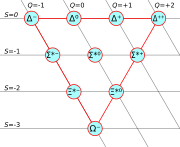
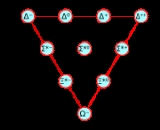
Ordinary baryon
s (composite fermion
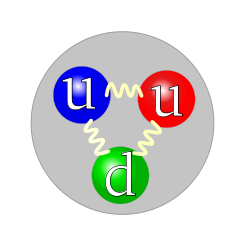
s) contain three valence quarks or three valence antiquarks each.
Some hints at the existence of exotic baryon
s have been found recently; however, negative results have also been reported. Their existence is uncertain.
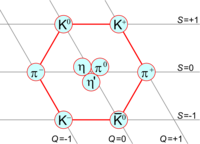
Ordinary meson
s are made up of a valence quark and a valence antiquark. Because mesons have spin
of 0 or 1 and are not themselves elementary particles, they are composite boson
s. Examples of mesons include the pion
, kaon
, the J/ψ. In quantum hadrodynamic models, mesons mediate the residual strong force between nucleons.
At one time or another, positive signature
s have been reported for all of the following exotic meson
s but their existence has yet to be confirmed.
 Atomic nuclei
consist of protons and neutrons. Each type of nucleus contains a specific number of proton
s and a specific number of neutron
s, and is called a nuclide
or isotope
. Nuclear reaction
s can change one nuclide into another. See table of nuclides
for a complete list of isotopes.
s are the smallest neutral particles into which matter can be divided by chemical reaction
s. An atom consists of a small, heavy nucleus surrounded by a relatively large, light cloud of electrons. Each type of atom corresponds to a specific chemical element
. To date, 118 elements have been discovered, while only the first 112 have received official names. Refer to the periodic table
for an overview.
The atomic nucleus consists of protons and neutrons. Protons and neutrons are, in turn, made of quarks.
s are the smallest particles into which a non-elemental substance can be divided while maintaining the physical properties of the substance. Each type of molecule corresponds to a specific chemical compound
. Molecules are a composite of two or more atoms. See list of compounds for a list of molecules.
are remarkably similar to those of high energy particle physics. As a result, much of the theory of particle physics applies to condensed matter physics as well; in particular, there are a selection of field excitations, called quasi-particles, that can be created and explored. These include:
Particle
A particle is, generally, a small localized object to which can be ascribed physical properties. It may also refer to:In chemistry:* Colloidal particle, part of a one-phase system of two or more components where the particles aren't individually visible.In physics:* Subatomic particle, which may be...
s found or believed to exist in the whole of the universe
Universe
The Universe is commonly defined as the totality of everything that exists, including all matter and energy, the planets, stars, galaxies, and the contents of intergalactic space. Definitions and usage vary and similar terms include the cosmos, the world and nature...
. For individual lists of the different particles, see the individual pages given below.
Elementary particles
Elementary particles are particles with no measurable internal structure; that is, they are not composed of other particles. They are the fundamental objects of quantum field theoryQuantum field theory
Quantum field theory provides a theoretical framework for constructing quantum mechanical models of systems classically parametrized by an infinite number of dynamical degrees of freedom, that is, fields and many-body systems. It is the natural and quantitative language of particle physics and...
. Many families and sub-families of elementary particles exist. Elementary particles are classified according to their spin
Spin (physics)
In quantum mechanics and particle physics, spin is a fundamental characteristic property of elementary particles, composite particles , and atomic nuclei.It is worth noting that the intrinsic property of subatomic particles called spin and discussed in this article, is related in some small ways,...
. Fermion
Fermion
In particle physics, a fermion is any particle which obeys the Fermi–Dirac statistics . Fermions contrast with bosons which obey Bose–Einstein statistics....
s have half-integer spin while boson
Boson
In particle physics, bosons are subatomic particles that obey Bose–Einstein statistics. Several bosons can occupy the same quantum state. The word boson derives from the name of Satyendra Nath Bose....
s have integer spin. All the particles of the Standard Model
Standard Model
The Standard Model of particle physics is a theory concerning the electromagnetic, weak, and strong nuclear interactions, which mediate the dynamics of the known subatomic particles. Developed throughout the mid to late 20th century, the current formulation was finalized in the mid 1970s upon...
have been observed, with the exception of the Higgs boson
Higgs boson
The Higgs boson is a hypothetical massive elementary particle that is predicted to exist by the Standard Model of particle physics. Its existence is postulated as a means of resolving inconsistencies in the Standard Model...
.
Fermions
Fermions have half-integer spin; for all known elementary fermions this is . All known fermions are Dirac fermionDirac fermion
In particle physics, a Dirac fermion is a fermion which is not its own anti-particle. It is named for Paul Dirac. All fermions in the standard model, except possibly neutrinos, are Dirac fermions...
s; that is, each known fermion has its own distinct antiparticle
Antiparticle
Corresponding to most kinds of particles, there is an associated antiparticle with the same mass and opposite electric charge. For example, the antiparticle of the electron is the positively charged antielectron, or positron, which is produced naturally in certain types of radioactive decay.The...
. It is not known whether the neutrino
Neutrino
A neutrino is an electrically neutral, weakly interacting elementary subatomic particle with a half-integer spin, chirality and a disputed but small non-zero mass. It is able to pass through ordinary matter almost unaffected...
is a Dirac fermion or a Majorana fermion
Majorana fermion
In physics, a Majorana fermion is a fermion which is its own anti-particle. The term is used in opposition to Dirac fermion, which describes particles that differ from their antiparticles...
. Fermions are the basic building blocks of all matter
Matter
Matter is a general term for the substance of which all physical objects consist. Typically, matter includes atoms and other particles which have mass. A common way of defining matter is as anything that has mass and occupies volume...
. They are classified according to whether they interact via the color force
Quantum chromodynamics
In theoretical physics, quantum chromodynamics is a theory of the strong interaction , a fundamental force describing the interactions of the quarks and gluons making up hadrons . It is the study of the SU Yang–Mills theory of color-charged fermions...
or not. In the Standard Model, there are 12 types of elementary fermions: six quark
Quark
A quark is an elementary particle and a fundamental constituent of matter. Quarks combine to form composite particles called hadrons, the most stable of which are protons and neutrons, the components of atomic nuclei. Due to a phenomenon known as color confinement, quarks are never directly...
s and six lepton
Lepton
A lepton is an elementary particle and a fundamental constituent of matter. The best known of all leptons is the electron which governs nearly all of chemistry as it is found in atoms and is directly tied to all chemical properties. Two main classes of leptons exist: charged leptons , and neutral...
s.
Quarks
Quarks are the fundamental constituents of hadronHadron
In particle physics, a hadron is a composite particle made of quarks held together by the strong force...
s and interact via the strong interaction
Strong interaction
In particle physics, the strong interaction is one of the four fundamental interactions of nature, the others being electromagnetism, the weak interaction and gravitation. As with the other fundamental interactions, it is a non-contact force...
. Quarks are the only known carriers of fractional charge, but because they combine in groups of three (baryons) or in groups of two with antiquarks (mesons), only integer charge is observed in nature. Their respective antiparticle
Antiparticle
Corresponding to most kinds of particles, there is an associated antiparticle with the same mass and opposite electric charge. For example, the antiparticle of the electron is the positively charged antielectron, or positron, which is produced naturally in certain types of radioactive decay.The...
s are the antiquarks which are identical except for the fact that they carry the opposite electric charge (for example the up quark carries charge +, while the up antiquark carries charge −), color charge, and baryon number. There are six flavors of quarks; the three positively charged quarks are called up-type quarks and the three negatively charged quarks are called down-type quarks.
| Name | Symbol | Antiparticle | Charge e Elementary charge The elementary charge, usually denoted as e, is the electric charge carried by a single proton, or equivalently, the absolute value of the electric charge carried by a single electron. This elementary charge is a fundamental physical constant. To avoid confusion over its sign, e is sometimes called... | Mass (MeV Electronvolt In physics, the electron volt is a unit of energy equal to approximately joule . By definition, it is equal to the amount of kinetic energy gained by a single unbound electron when it accelerates through an electric potential difference of one volt... /c Speed of light The speed of light in vacuum, usually denoted by c, is a physical constant important in many areas of physics. Its value is 299,792,458 metres per second, a figure that is exact since the length of the metre is defined from this constant and the international standard for time... 2) |
|---|---|---|---|---|
| up Up quark The up quark or u quark is the lightest of all quarks, a type of elementary particle, and a major constituent of matter. It, along with the down quark, forms the neutrons and protons of atomic nuclei... |
u | + | 1.5–3.3 | |
| down Down quark The down quark or d quark is the second-lightest of all quarks, a type of elementary particle, and a major constituent of matter. It, along with the up quark, forms the neutrons and protons of atomic nuclei... |
d | − | 3.5–6.0 | |
| charm Charm quark The charm quark or c quark is the third most massive of all quarks, a type of elementary particle. Charm quarks are found in hadrons, which are subatomic particles made of quarks... |
c | + | 1,160–1,340 | |
| strange Strange quark The strange quark or s quark is the third-lightest of all quarks, a type of elementary particle. Strange quarks are found in hadrons, which are subatomic particles. Example of hadrons containing strange quarks include kaons , strange D mesons , Sigma baryons , and other strange particles... |
s | − | 70–130 | |
| top Top quark The top quark, also known as the t quark or truth quark, is an elementary particle and a fundamental constituent of matter. Like all quarks, the top quark is an elementary fermion with spin-, and experiences all four fundamental interactions: gravitation, electromagnetism, weak interactions, and... |
t | + | 169,100–173,300 | |
| bottom Bottom quark The bottom quark, also known as the beauty quark, is a third-generation quark with a charge of − e. Although all quarks are described in a similar way by the quantum chromodynamics, the bottom quark's large bare mass , combined with low values of the CKM matrix elements Vub and Vcb, gives it a... |
b | − | 4,130–4,370 | |
Leptons
Leptons do not interact via the strong interactionStrong interaction
In particle physics, the strong interaction is one of the four fundamental interactions of nature, the others being electromagnetism, the weak interaction and gravitation. As with the other fundamental interactions, it is a non-contact force...
. Their respective antiparticle
Antiparticle
Corresponding to most kinds of particles, there is an associated antiparticle with the same mass and opposite electric charge. For example, the antiparticle of the electron is the positively charged antielectron, or positron, which is produced naturally in certain types of radioactive decay.The...
s are the antileptons which are identical except for the fact that they carry the opposite electric charge and lepton number. The antiparticle of the electron
Electron
The electron is a subatomic particle with a negative elementary electric charge. It has no known components or substructure; in other words, it is generally thought to be an elementary particle. An electron has a mass that is approximately 1/1836 that of the proton...
is the antielectron, which is nearly always called positron
Positron
The positron or antielectron is the antiparticle or the antimatter counterpart of the electron. The positron has an electric charge of +1e, a spin of ½, and has the same mass as an electron...
for historical reasons. There are six leptons in total; the three charged leptons are called electron-like leptons, while the neutral leptons are called neutrinos.
| Name | Symbol | Antiparticle | Charge e Elementary charge The elementary charge, usually denoted as e, is the electric charge carried by a single proton, or equivalently, the absolute value of the electric charge carried by a single electron. This elementary charge is a fundamental physical constant. To avoid confusion over its sign, e is sometimes called... | Mass (MeV Electronvolt In physics, the electron volt is a unit of energy equal to approximately joule . By definition, it is equal to the amount of kinetic energy gained by a single unbound electron when it accelerates through an electric potential difference of one volt... /c Speed of light The speed of light in vacuum, usually denoted by c, is a physical constant important in many areas of physics. Its value is 299,792,458 metres per second, a figure that is exact since the length of the metre is defined from this constant and the international standard for time... 2) |
|---|---|---|---|---|
| Electron Electron The electron is a subatomic particle with a negative elementary electric charge. It has no known components or substructure; in other words, it is generally thought to be an elementary particle. An electron has a mass that is approximately 1/1836 that of the proton... |
−1 | 0.511 | ||
| Electron neutrino Electron neutrino The electron neutrino is a subatomic lepton elementary particle which has no net electric charge. Together with the electron it forms the first generation of leptons, hence its name electron neutrino... |
0 | |||
| Muon Muon The muon |mu]] used to represent it) is an elementary particle similar to the electron, with a unitary negative electric charge and a spin of ½. Together with the electron, the tau, and the three neutrinos, it is classified as a lepton... |
−1 | 105.7 | ||
| Muon neutrino Muon neutrino The muon neutrino is a subatomic lepton elementary particle which has the symbol and no net electric charge. Together with the muon it forms the second generation of leptons, hence its name muon neutrino. It was first hypothesized in the early 1940s by several people, and was discovered in 1962 by... |
0 | < 0.170 | ||
| Tau | −1 | 1,777 | ||
| Tau neutrino | 0 | < 15.5 | ||
Bosons
Bosons have integer spin. The fundamental forces of nature are mediated by gauge bosonGauge boson
In particle physics, gauge bosons are bosonic particles that act as carriers of the fundamental forces of nature. More specifically, elementary particles whose interactions are described by gauge theory exert forces on each other by the exchange of gauge bosons, usually as virtual particles.-...
s, and mass is hypothesized to be created by the Higgs boson
Higgs boson
The Higgs boson is a hypothetical massive elementary particle that is predicted to exist by the Standard Model of particle physics. Its existence is postulated as a means of resolving inconsistencies in the Standard Model...
. According to the Standard Model
Standard Model
The Standard Model of particle physics is a theory concerning the electromagnetic, weak, and strong nuclear interactions, which mediate the dynamics of the known subatomic particles. Developed throughout the mid to late 20th century, the current formulation was finalized in the mid 1970s upon...
(and to both linearized general relativity
General relativity
General relativity or the general theory of relativity is the geometric theory of gravitation published by Albert Einstein in 1916. It is the current description of gravitation in modern physics...
and string theory
String theory
String theory is an active research framework in particle physics that attempts to reconcile quantum mechanics and general relativity. It is a contender for a theory of everything , a manner of describing the known fundamental forces and matter in a mathematically complete system...
, in the case of the graviton
Graviton
In physics, the graviton is a hypothetical elementary particle that mediates the force of gravitation in the framework of quantum field theory. If it exists, the graviton must be massless and must have a spin of 2...
) the elementary bosons are:
| Name | Symbol | Antiparticle | Charge (e Elementary charge The elementary charge, usually denoted as e, is the electric charge carried by a single proton, or equivalently, the absolute value of the electric charge carried by a single electron. This elementary charge is a fundamental physical constant. To avoid confusion over its sign, e is sometimes called... ) | Spin | Mass (GeV/c2) | Interaction mediated | Existence |
|---|---|---|---|---|---|---|---|
| Photon Photon In physics, a photon is an elementary particle, the quantum of the electromagnetic interaction and the basic unit of light and all other forms of electromagnetic radiation. It is also the force carrier for the electromagnetic force... |
γ | Self | 0 | 1 | 0 | Electromagnetism Electromagnetism Electromagnetism is one of the four fundamental interactions in nature. The other three are the strong interaction, the weak interaction and gravitation... |
Confirmed |
| W boson W and Z bosons The W and Z bosons are the elementary particles that mediate the weak interaction; their symbols are , and . The W bosons have a positive and negative electric charge of 1 elementary charge respectively and are each other's antiparticle. The Z boson is electrically neutral and its own... |
−1 | 1 | 80.4 | Weak interaction Weak interaction Weak interaction , is one of the four fundamental forces of nature, alongside the strong nuclear force, electromagnetism, and gravity. It is responsible for the radioactive decay of subatomic particles and initiates the process known as hydrogen fusion in stars... |
Confirmed | ||
| Z boson W and Z bosons The W and Z bosons are the elementary particles that mediate the weak interaction; their symbols are , and . The W bosons have a positive and negative electric charge of 1 elementary charge respectively and are each other's antiparticle. The Z boson is electrically neutral and its own... |
Self | 0 | 1 | 91.2 | Weak interaction Weak interaction Weak interaction , is one of the four fundamental forces of nature, alongside the strong nuclear force, electromagnetism, and gravity. It is responsible for the radioactive decay of subatomic particles and initiates the process known as hydrogen fusion in stars... |
Confirmed | |
| Gluon Gluon Gluons are elementary particles which act as the exchange particles for the color force between quarks, analogous to the exchange of photons in the electromagnetic force between two charged particles.... |
Self | 0 | 1 | 0 | |Strong interaction Strong interaction In particle physics, the strong interaction is one of the four fundamental interactions of nature, the others being electromagnetism, the weak interaction and gravitation. As with the other fundamental interactions, it is a non-contact force... |
Confirmed | |
| Higgs boson Higgs boson The Higgs boson is a hypothetical massive elementary particle that is predicted to exist by the Standard Model of particle physics. Its existence is postulated as a means of resolving inconsistencies in the Standard Model... |
Self | 0 | 0 | > 112 | Mass Mass Mass can be defined as a quantitive measure of the resistance an object has to change in its velocity.In physics, mass commonly refers to any of the following three properties of matter, which have been shown experimentally to be equivalent:... |
Unconfirmed | |
| Graviton Graviton In physics, the graviton is a hypothetical elementary particle that mediates the force of gravitation in the framework of quantum field theory. If it exists, the graviton must be massless and must have a spin of 2... |
G | Self | 0 | 2 | 0 | Gravitation Gravitation Gravitation, or gravity, is a natural phenomenon by which physical bodies attract with a force proportional to their mass. Gravitation is most familiar as the agent that gives weight to objects with mass and causes them to fall to the ground when dropped... |
Unconfirmed |
The graviton is added to the list although it is not predicted by the Standard Model, but by other theories in the framework of quantum field theory
Quantum field theory
Quantum field theory provides a theoretical framework for constructing quantum mechanical models of systems classically parametrized by an infinite number of dynamical degrees of freedom, that is, fields and many-body systems. It is the natural and quantitative language of particle physics and...
.
The Higgs boson
Higgs boson
The Higgs boson is a hypothetical massive elementary particle that is predicted to exist by the Standard Model of particle physics. Its existence is postulated as a means of resolving inconsistencies in the Standard Model...
is postulated by electroweak theory primarily to explain the origin of particle masses. In a process known as the Higgs mechanism
Higgs mechanism
In particle physics, the Higgs mechanism is the process in which gauge bosons in a gauge theory can acquire non-vanishing masses through absorption of Nambu-Goldstone bosons arising in spontaneous symmetry breaking....
, the Higgs boson and the other fermions in the Standard Model acquire mass via spontaneous symmetry breaking
Spontaneous symmetry breaking
Spontaneous symmetry breaking is the process by which a system described in a theoretically symmetrical way ends up in an apparently asymmetric state....
of the SU(2) gauge symmetry. It is the only Standard Model particle not yet observed (the graviton
Graviton
In physics, the graviton is a hypothetical elementary particle that mediates the force of gravitation in the framework of quantum field theory. If it exists, the graviton must be massless and must have a spin of 2...
is not a Standard Model particle). The Minimal Supersymmetric Standard Model
Minimal Supersymmetric Standard Model
The Minimal Supersymmetric Standard Model is the minimal extension to the Standard Model that realizes supersymmetry, although non-minimal extensions do exist. Supersymmetry pairs bosons with fermions; therefore every Standard Model particle has a partner that has yet to be discovered...
(MSSM) predicts several Higgs bosons. If the Higgs boson exists, it is expected to be discovered at the Large Hadron Collider
Large Hadron Collider
The Large Hadron Collider is the world's largest and highest-energy particle accelerator. It is expected to address some of the most fundamental questions of physics, advancing the understanding of the deepest laws of nature....
.
Hypothetical particles
SupersymmetricSupersymmetry
In particle physics, supersymmetry is a symmetry that relates elementary particles of one spin to other particles that differ by half a unit of spin and are known as superpartners...
theories predict the existence of more particles, none of which have been confirmed experimentally as of 2011:
| Superpartner Superpartner In particle physics, a superpartner is a hypothetical elementary particle. Supersymmetry is one of the synergistic theories in current high-energy physics which predicts the existence of these "shadow" particles.... | Superpartner of | Spin | neutralino Neutralino In particle physics, the neutralino is a hypothetical particle predicted by supersymmetry. There are four neutralinos that are fermions and are electrically neutral, the lightest of which is typically stable... | neutral bosons Boson In particle physics, bosons are subatomic particles that obey Bose–Einstein statistics. Several bosons can occupy the same quantum state. The word boson derives from the name of Satyendra Nath Bose.... |
The neutralinos are superposition Quantum superposition Quantum superposition is a fundamental principle of quantum mechanics. It holds that a physical system exists in all its particular, theoretically possible states simultaneously; but, when measured, it gives a result corresponding to only one of the possible configurations.Mathematically, it... s of the superpartner Superpartner In particle physics, a superpartner is a hypothetical elementary particle. Supersymmetry is one of the synergistic theories in current high-energy physics which predicts the existence of these "shadow" particles.... s of neutral Standard Model bosons: neutral higgs boson Higgs boson The Higgs boson is a hypothetical massive elementary particle that is predicted to exist by the Standard Model of particle physics. Its existence is postulated as a means of resolving inconsistencies in the Standard Model... , Z boson and photon Photon In physics, a photon is an elementary particle, the quantum of the electromagnetic interaction and the basic unit of light and all other forms of electromagnetic radiation. It is also the force carrier for the electromagnetic force... . The lightest neutralino is a leading candidate for dark matter Dark matter In astronomy and cosmology, dark matter is matter that neither emits nor scatters light or other electromagnetic radiation, and so cannot be directly detected via optical or radio astronomy... . The MSSM Minimal Supersymmetric Standard Model The Minimal Supersymmetric Standard Model is the minimal extension to the Standard Model that realizes supersymmetry, although non-minimal extensions do exist. Supersymmetry pairs bosons with fermions; therefore every Standard Model particle has a partner that has yet to be discovered... predicts 4 neutralinos |
|
|---|---|---|---|---|---|---|
| chargino Chargino In particle physics, the chargino is a hypothetical particle which refers to the mass eigenstates of a charged superpartner, i.e. any new electrically charged fermion predicted by supersymmetry. They are linear combinations of the charged wino and charged higgsinos... |
charged bosons Boson In particle physics, bosons are subatomic particles that obey Bose–Einstein statistics. Several bosons can occupy the same quantum state. The word boson derives from the name of Satyendra Nath Bose.... |
The charginos are superposition Quantum superposition Quantum superposition is a fundamental principle of quantum mechanics. It holds that a physical system exists in all its particular, theoretically possible states simultaneously; but, when measured, it gives a result corresponding to only one of the possible configurations.Mathematically, it... s of the superpartner Superpartner In particle physics, a superpartner is a hypothetical elementary particle. Supersymmetry is one of the synergistic theories in current high-energy physics which predicts the existence of these "shadow" particles.... s of charged Standard Model bosons: charged higgs boson Higgs boson The Higgs boson is a hypothetical massive elementary particle that is predicted to exist by the Standard Model of particle physics. Its existence is postulated as a means of resolving inconsistencies in the Standard Model... and W boson. The MSSM predicts two pairs of charginos. |
||||
| photino | photon Photon In physics, a photon is an elementary particle, the quantum of the electromagnetic interaction and the basic unit of light and all other forms of electromagnetic radiation. It is also the force carrier for the electromagnetic force... |
Mixing with zino, neutral wino, and neutral Higgsinos for neutralinos. | ||||
| wino, zino Gaugino In particle physics, a gaugino is the hypothetical superpartner of a gauge field, as predicted by gauge theory combined with supersymmetry. They are fermions.In the minimal supersymmetric extension of the standard model the following gauginos exist:... |
W± and Z0 bosons W and Z bosons The W and Z bosons are the elementary particles that mediate the weak interaction; their symbols are , and . The W bosons have a positive and negative electric charge of 1 elementary charge respectively and are each other's antiparticle. The Z boson is electrically neutral and its own... |
Charged wino mixing with charged Higgsino for charginos, for the zino see line above. | ||||
| Higgsino Higgsino In particle physics, a Higgsino, symbol , is the hypothetical superpartner of the Higgs boson, as predicted by supersymmetry. The Higgsino is a Dirac fermion and that is a weak isodoublet with hypercharge half under the Standard Model gauge symmetries... |
Higgs boson Higgs boson The Higgs boson is a hypothetical massive elementary particle that is predicted to exist by the Standard Model of particle physics. Its existence is postulated as a means of resolving inconsistencies in the Standard Model... |
For supersymmetry there is a need for several Higgs bosons, neutral and charged, according with their superpartners. |
||||
| gluino Gluino A gluino is the hypothetical supersymmetric partner of a gluon. Gluinos are expected by supersymmetry theorists to be pair produced in particle accelerators such as the Large Hadron Collider if they exist.... |
gluon Gluon Gluons are elementary particles which act as the exchange particles for the color force between quarks, analogous to the exchange of photons in the electromagnetic force between two charged particles.... |
Eight gluons and eight gluinos. | ||||
| gravitino Gravitino The gravitino is the supersymmetric partner of the graviton, as predicted by theories combining general relativity and supersymmetry; i.e. supergravity theories... |
graviton Graviton In physics, the graviton is a hypothetical elementary particle that mediates the force of gravitation in the framework of quantum field theory. If it exists, the graviton must be massless and must have a spin of 2... |
Predicted by Supergravity Supergravity In theoretical physics, supergravity is a field theory that combines the principles of supersymmetry and general relativity. Together, these imply that, in supergravity, the supersymmetry is a local symmetry... (SUGRA). The graviton is hypothetical, too – see next table. |
||||
| sleptons | leptons | 0 | The superpartners of the leptons (electron, muon, tau) and the neutrinos. | |||
| sneutrino | neutrino Neutrino A neutrino is an electrically neutral, weakly interacting elementary subatomic particle with a half-integer spin, chirality and a disputed but small non-zero mass. It is able to pass through ordinary matter almost unaffected... |
0 | Introduced by many extensions of the Standard Model, and may be needed to explain the LSND LSND The Liquid Scintillator Neutrino Detector was a scintillation counter at Los Alamos National Laboratory that measured the number of neutrinos being produced by an accelerator neutrino source... results. A special role has the sterile sneutrino, the supersymmetric counterpart of the hypothetical right-handed neutrino, called sterile neutrino Sterile neutrino Sterile neutrinosIn scientific literature, these particles are also variously referred to as right-handed neutrinos, inert neutrinos, heavy neutrinos, or neutral heavy leptons . are a hypothetical type of neutrino that do not interact via any of the fundamental interactions of the Standard Model... |
|||
| squarks | quarks | 0 | The stop squark (superpartner of the top quark) is thought to have a low mass and is often the subject of experimental searches. | |||
Note: Just as the photon, Z boson and W± bosons are superpositions of the B0, W0, W1, and W2 fields – the photino, zino, and wino± are superpositions of the bino0, wino0, wino1, and wino2 by definition.
No matter if you use the original gauginos or this superpositions as a basis, the only predicted physical particles are neutralinos and charginos as a superposition of them together with the Higgsinos.
Other theories predict the existence of additional bosons:
| Name | Spin | Higgs Higgs boson The Higgs boson is a hypothetical massive elementary particle that is predicted to exist by the Standard Model of particle physics. Its existence is postulated as a means of resolving inconsistencies in the Standard Model... | 0 | Has been proposed to explain the origin of mass by the spontaneous symmetry breaking Spontaneous symmetry breaking Spontaneous symmetry breaking is the process by which a system described in a theoretically symmetrical way ends up in an apparently asymmetric state.... of the SU(2) x U(1) gauge symmetry. SUSY theories predict more than one type of Higgs boson |
|---|---|---|---|---|
| graviton Graviton In physics, the graviton is a hypothetical elementary particle that mediates the force of gravitation in the framework of quantum field theory. If it exists, the graviton must be massless and must have a spin of 2... |
2 | Has been proposed to mediate gravity in theories of quantum gravity Quantum gravity Quantum gravity is the field of theoretical physics which attempts to develop scientific models that unify quantum mechanics with general relativity... . |
||
| graviscalar Graviscalar In theoretical physics, a graviscalar is a hypothetical particle that emerges as an excitation of the metric tensor but whose physical properties are virtually indistinguishable from a scalar in four dimensions, as shown in Kaluza-Klein theory... |
0 | Also known as radion | ||
| graviphoton Graviphoton In theoretical physics, a graviphoton is a hypothetical particle which emerges as an excitation of the metric tensor in spacetime dimensions higher than four, as described in Kaluza-Klein theory.... |
1 | Also known as gravivector | ||
| axion Axion The axion is a hypothetical elementary particle postulated by the Peccei-Quinn theory in 1977 to resolve the strong CP problem in quantum chromodynamics... |
0 | A pseudoscalar particle introduced in Peccei-Quinn theory Peccei-Quinn theory In particle physics, the Peccei–Quinn theory is the best known proposal for the resolution of the strong CP problem. The theory proposes that the QCD Lagrangian be extended with a CP-violating term known as the θ parameter... to solve the strong-CP problem. |
||
| axino | Superpartner of the axion. Forms, together with the saxion and axion, a supermultiplet Supermultiplet In theoretical physics, a supermultiplet is formally a group representation of a supersymmetry algebra. It consists of a collection of particles, called superpartners, corresponding to operators in a quantum field theory which in superspace are represented by superfields.Superfields were... in supersymmetric extensions of Peccei-Quinn theory. |
|||
| saxion | 0 | |||
| branon | ? | Predicted in brane world Brane cosmology Brane cosmology refers to several theories in particle physics and cosmology motivated by, but not exclusively derived from, superstring theory and M-theory.-Brane and bulk:... models. |
||
| dilaton Dilaton In particle physics, a dilaton is a hypothetical particle. It also appears in Kaluza-Klein theory's compactifications of extra dimensions when the volume of the compactified dimensions vary.... |
0 | Predicted in some string theories. | ||
| dilatino | Superpartner of the dilaton | |||
| X and Y bosons X and Y bosons In particle physics, the X and Y bosons are hypothetical elementary particles analogous to the W and Z bosons, but corresponding to a new type of force predicted by the Georgi–Glashow model, a grand unified theory.-Details:The X and Y bosons couple quarks to leptons, allowing violation of the... |
1 | These leptoquark Leptoquark Leptoquarks are hypothetical particles that carry information between quarks and leptons given a generation and allowing quarks and leptons to interact. They are color-triplet bosons that carry both lepton and baryon numbers. They are encountered in various extensions of the Standard Model, such as... s are predicted by GUT theories Grand unification theory The term Grand Unified Theory, often abbreviated as GUT, refers to any of several similar candidate models in particle physics in which at high-energy, the three gauge interactions of the Standard Model which define the electromagnetic, weak, and strong interactions, are merged into one single... to be heavier equivalents of the W and Z. |
||
| W' and Z' bosons W' and Z' bosons In particle physics, W' and Z' bosons refer to hypothetical new gauge bosons that arise from extensions of the electroweak symmetry of the Standard Model. They are named in analogy with the Standard Model W and Z bosons.... |
1 | |||
| magnetic photon Magnetic photon In physics, a magnetic photon is a hypothetical particle. It is a mixture of even and odd C-parity states and, unlike the normal photon, does not couple to leptons. It is predicted by certain extensions of electromagnetism to include magnetic monopoles... |
? | |||
| majoron Majoron In particle physics, majorons are a hypothetical type of Goldstone boson that are theorized to mediate the neutrino mass violation of lepton number or B − L in certain high energy collisions such as... |
0 | Predicted to understand neutrino Neutrino A neutrino is an electrically neutral, weakly interacting elementary subatomic particle with a half-integer spin, chirality and a disputed but small non-zero mass. It is able to pass through ordinary matter almost unaffected... masses by the seesaw mechanism Seesaw mechanism In theoretical physics, the seesaw mechanism is a mechanism within grand unification theory, and in particular in theories of neutrino masses and neutrino oscillation, where it can be used to explain the smallness of observed neutrino masses relative to those of quarks and leptons.There are several... . |
||
| majorana fermion Majorana fermion In physics, a Majorana fermion is a fermion which is its own anti-particle. The term is used in opposition to Dirac fermion, which describes particles that differ from their antiparticles... |
; ?... | Gluinos, neutralinos, or other | ||
Mirror particles
Mirror matter
In physics, mirror matter, also called shadow matter or Alice matter, is a hypothetical counterpart to ordinary matter.Modern physics deals with three basic types of spatial symmetry: reflection, rotation and translation. The known elementary particles respect rotation and translation symmetry but...
are predicted by theories that restore parity symmetry
Parity (physics)
In physics, a parity transformation is the flip in the sign of one spatial coordinate. In three dimensions, it is also commonly described by the simultaneous flip in the sign of all three spatial coordinates:...
.
Magnetic monopole
Magnetic monopole
A magnetic monopole is a hypothetical particle in particle physics that is a magnet with only one magnetic pole . In more technical terms, a magnetic monopole would have a net "magnetic charge". Modern interest in the concept stems from particle theories, notably the grand unified and superstring...
is a generic name for particles with non-zero magnetic charge. They are predicted by some GUTs
Grand unification theory
The term Grand Unified Theory, often abbreviated as GUT, refers to any of several similar candidate models in particle physics in which at high-energy, the three gauge interactions of the Standard Model which define the electromagnetic, weak, and strong interactions, are merged into one single...
.
Tachyon
Tachyon
A tachyon is a hypothetical subatomic particle that always moves faster than light. In the language of special relativity, a tachyon would be a particle with space-like four-momentum and imaginary proper time. A tachyon would be constrained to the space-like portion of the energy-momentum graph...
is a generic name for hypothetical particles that travel faster than the speed of light and have an imaginary
Imaginary number
An imaginary number is any number whose square is a real number less than zero. When any real number is squared, the result is never negative, but the square of an imaginary number is always negative...
rest mass.
Preon
Preon
In particle physics, preons are postulated "point-like" particles, conceived to be subcomponents of quarks and leptons. The word was coined by Jogesh Pati and Abdus Salam in 1974...
s were suggested as subparticles of quarks and leptons, but modern collider
Collider
A collider is a type of a particle accelerator involving directed beams of particles.Colliders may either be ring accelerators or linear accelerators.-Explanation:...
experiments have all but ruled out their existence.
Kaluza-Klein towers of particles are predicted by some models of extra dimensions. The extra-dimensional momentum is manifested as extra mass in four-dimensional space-time.
Hadrons
HadronHadron
In particle physics, a hadron is a composite particle made of quarks held together by the strong force...
s are defined as strongly interacting
Strong interaction
In particle physics, the strong interaction is one of the four fundamental interactions of nature, the others being electromagnetism, the weak interaction and gravitation. As with the other fundamental interactions, it is a non-contact force...
composite particles. Hadrons are either:
- Composite fermionFermionIn particle physics, a fermion is any particle which obeys the Fermi–Dirac statistics . Fermions contrast with bosons which obey Bose–Einstein statistics....
s, in which case they are called baryonBaryonA baryon is a composite particle made up of three quarks . Baryons and mesons belong to the hadron family, which are the quark-based particles...
s. - Composite bosonBosonIn particle physics, bosons are subatomic particles that obey Bose–Einstein statistics. Several bosons can occupy the same quantum state. The word boson derives from the name of Satyendra Nath Bose....
s, in which case they are called mesonMesonIn particle physics, mesons are subatomic particles composed of one quark and one antiquark, bound together by the strong interaction. Because mesons are composed of sub-particles, they have a physical size, with a radius roughly one femtometer: 10−15 m, which is about the size of a proton...
s.
Quark model
Quark model
In physics, the quark model is a classification scheme for hadrons in terms of their valence quarks—the quarks and antiquarks which give rise to the quantum numbers of the hadrons....
s, first proposed in 1964 independently by Murray Gell-Mann
Murray Gell-Mann
Murray Gell-Mann is an American physicist and linguist who received the 1969 Nobel Prize in physics for his work on the theory of elementary particles...
and George Zweig
George Zweig
George Zweig was originally trained as a particle physicist under Richard Feynman and later turned his attention to neurobiology...
(who called quarks "aces"), describe the known hadrons as composed of valence quark
Quark
A quark is an elementary particle and a fundamental constituent of matter. Quarks combine to form composite particles called hadrons, the most stable of which are protons and neutrons, the components of atomic nuclei. Due to a phenomenon known as color confinement, quarks are never directly...
s and/or antiquarks, tightly bound by the color force
Quantum chromodynamics
In theoretical physics, quantum chromodynamics is a theory of the strong interaction , a fundamental force describing the interactions of the quarks and gluons making up hadrons . It is the study of the SU Yang–Mills theory of color-charged fermions...
, which is mediated by gluon
Gluon
Gluons are elementary particles which act as the exchange particles for the color force between quarks, analogous to the exchange of photons in the electromagnetic force between two charged particles....
s. A "sea" of virtual quark-antiquark pairs is also present in each hadron.
Baryons (fermions)
- For a detailed list, see List of baryons.
Ordinary baryon
Baryon
A baryon is a composite particle made up of three quarks . Baryons and mesons belong to the hadron family, which are the quark-based particles...
s (composite fermion
Fermion
In particle physics, a fermion is any particle which obeys the Fermi–Dirac statistics . Fermions contrast with bosons which obey Bose–Einstein statistics....
s) contain three valence quarks or three valence antiquarks each.
- NucleonNucleonIn physics, a nucleon is a collective name for two particles: the neutron and the proton. These are the two constituents of the atomic nucleus. Until the 1960s, the nucleons were thought to be elementary particles...
s are the fermionic constituents of normal atomic nuclei:- ProtonProtonThe proton is a subatomic particle with the symbol or and a positive electric charge of 1 elementary charge. One or more protons are present in the nucleus of each atom, along with neutrons. The number of protons in each atom is its atomic number....
s, composed of two up and one down quark (uud) - NeutronNeutronThe neutron is a subatomic hadron particle which has the symbol or , no net electric charge and a mass slightly larger than that of a proton. With the exception of hydrogen, nuclei of atoms consist of protons and neutrons, which are therefore collectively referred to as nucleons. The number of...
s, composed of two down and one up quark (ddu)
- Proton
- HyperonHyperonIn particle physics, a hyperon is any baryon containing one or more strange quarks, but no charm quarks or bottom quarks.-Properties and behavior of hyperons:...
s, such as the Λ, Σ, Ξ, and Ω particles, which contain one or more strange quarkStrange quarkThe strange quark or s quark is the third-lightest of all quarks, a type of elementary particle. Strange quarks are found in hadrons, which are subatomic particles. Example of hadrons containing strange quarks include kaons , strange D mesons , Sigma baryons , and other strange particles...
s, are short-lived and heavier than nucleons. Although not normally present in atomic nuclei, they can appear in short-lived hypernucleiHypernucleusA hypernucleus is a nucleus which contains at least one hyperon in addition to nucleons. The first was discovered by Marian Danysz and Jerzy Pniewski in 1952....
. - A number of charmedCharm quarkThe charm quark or c quark is the third most massive of all quarks, a type of elementary particle. Charm quarks are found in hadrons, which are subatomic particles made of quarks...
and bottomBottom quarkThe bottom quark, also known as the beauty quark, is a third-generation quark with a charge of − e. Although all quarks are described in a similar way by the quantum chromodynamics, the bottom quark's large bare mass , combined with low values of the CKM matrix elements Vub and Vcb, gives it a...
baryons have also been observed.
Some hints at the existence of exotic baryon
Exotic baryon
Exotic baryons are hypothetical composite particles which are bound states of 3 quarks and additional elementary particles. This is to be contrasted with ordinary baryons, which are bound states of just 3 quarks. The additional particles may include quarks, antiquarks or gluons.One such exotic...
s have been found recently; however, negative results have also been reported. Their existence is uncertain.
- PentaquarkPentaquarkA pentaquark is a hypothetical subatomic particle consisting of four quarks and one antiquark bound together . As quarks have a baryon number of +, and antiquarks of −, it would have a total baryon number of 1, thus being classified as an exotic baryon...
s consist of four valence quarks and one valence antiquark.
Mesons (bosons)
- For a detailed list, see List of mesons.
Ordinary meson
Meson
In particle physics, mesons are subatomic particles composed of one quark and one antiquark, bound together by the strong interaction. Because mesons are composed of sub-particles, they have a physical size, with a radius roughly one femtometer: 10−15 m, which is about the size of a proton...
s are made up of a valence quark and a valence antiquark. Because mesons have spin
Spin (physics)
In quantum mechanics and particle physics, spin is a fundamental characteristic property of elementary particles, composite particles , and atomic nuclei.It is worth noting that the intrinsic property of subatomic particles called spin and discussed in this article, is related in some small ways,...
of 0 or 1 and are not themselves elementary particles, they are composite boson
Boson
In particle physics, bosons are subatomic particles that obey Bose–Einstein statistics. Several bosons can occupy the same quantum state. The word boson derives from the name of Satyendra Nath Bose....
s. Examples of mesons include the pion
Pion
In particle physics, a pion is any of three subatomic particles: , , and . Pions are the lightest mesons and they play an important role in explaining the low-energy properties of the strong nuclear force....
, kaon
Kaon
In particle physics, a kaon is any one of a group of four mesons distinguished by the fact that they carry a quantum number called strangeness...
, the J/ψ. In quantum hadrodynamic models, mesons mediate the residual strong force between nucleons.
At one time or another, positive signature
Signature
A signature is a handwritten depiction of someone's name, nickname, or even a simple "X" that a person writes on documents as a proof of identity and intent. The writer of a signature is a signatory. Similar to a handwritten signature, a signature work describes the work as readily identifying...
s have been reported for all of the following exotic meson
Exotic meson
Non-quark model mesons include#exotic mesons, which have quantum numbers not possible for mesons in the quark model;#glueballs or gluonium, which have no valence quarks at all;...
s but their existence has yet to be confirmed.
- A tetraquarkTetraquarkIn particle physics a tetraquark is a hypothetical meson composed of four valence quarks. In principle, a tetraquark state may be allowed in quantum chromodynamics, the modern theory of strong interactions. However, there has been no confirmed report of a tetraquark state to date...
consists of two valence quarks and two valence antiquarks; - A glueballGlueballIn particle physics, a glueball is a hypothetical composite particle. It consists solely of gluon particles, without valence quarks. Such a state is possible because gluons carry color charge and experience the strong interaction...
is a bound state of gluons with no valence quarks; - Hybrid mesons consist of one or more valence quark-antiquark pairs and one or more real gluons.
Atomic nuclei
Atomic nucleus
The nucleus is the very dense region consisting of protons and neutrons at the center of an atom. It was discovered in 1911, as a result of Ernest Rutherford's interpretation of the famous 1909 Rutherford experiment performed by Hans Geiger and Ernest Marsden, under the direction of Rutherford. The...
consist of protons and neutrons. Each type of nucleus contains a specific number of proton
Proton
The proton is a subatomic particle with the symbol or and a positive electric charge of 1 elementary charge. One or more protons are present in the nucleus of each atom, along with neutrons. The number of protons in each atom is its atomic number....
s and a specific number of neutron
Neutron
The neutron is a subatomic hadron particle which has the symbol or , no net electric charge and a mass slightly larger than that of a proton. With the exception of hydrogen, nuclei of atoms consist of protons and neutrons, which are therefore collectively referred to as nucleons. The number of...
s, and is called a nuclide
Nuclide
A nuclide is an atomic species characterized by the specific constitution of its nucleus, i.e., by its number of protons Z, its number of neutrons N, and its nuclear energy state....
or isotope
Isotope
Isotopes are variants of atoms of a particular chemical element, which have differing numbers of neutrons. Atoms of a particular element by definition must contain the same number of protons but may have a distinct number of neutrons which differs from atom to atom, without changing the designation...
. Nuclear reaction
Nuclear reaction
In nuclear physics and nuclear chemistry, a nuclear reaction is semantically considered to be the process in which two nuclei, or else a nucleus of an atom and a subatomic particle from outside the atom, collide to produce products different from the initial particles...
s can change one nuclide into another. See table of nuclides
Table of nuclides
The tables listed below provide information on the basic properties of all nuclides.* Neutron + Element 1 - Element 24 * Element 25 - Element 48 * Element 49 - Element 72...
for a complete list of isotopes.
Atoms
AtomAtom
The atom is a basic unit of matter that consists of a dense central nucleus surrounded by a cloud of negatively charged electrons. The atomic nucleus contains a mix of positively charged protons and electrically neutral neutrons...
s are the smallest neutral particles into which matter can be divided by chemical reaction
Chemical reaction
A chemical reaction is a process that leads to the transformation of one set of chemical substances to another. Chemical reactions can be either spontaneous, requiring no input of energy, or non-spontaneous, typically following the input of some type of energy, such as heat, light or electricity...
s. An atom consists of a small, heavy nucleus surrounded by a relatively large, light cloud of electrons. Each type of atom corresponds to a specific chemical element
Chemical element
A chemical element is a pure chemical substance consisting of one type of atom distinguished by its atomic number, which is the number of protons in its nucleus. Familiar examples of elements include carbon, oxygen, aluminum, iron, copper, gold, mercury, and lead.As of November 2011, 118 elements...
. To date, 118 elements have been discovered, while only the first 112 have received official names. Refer to the periodic table
Periodic table
The periodic table of the chemical elements is a tabular display of the 118 known chemical elements organized by selected properties of their atomic structures. Elements are presented by increasing atomic number, the number of protons in an atom's atomic nucleus...
for an overview.
The atomic nucleus consists of protons and neutrons. Protons and neutrons are, in turn, made of quarks.
Molecules
MoleculeMolecule
A molecule is an electrically neutral group of at least two atoms held together by covalent chemical bonds. Molecules are distinguished from ions by their electrical charge...
s are the smallest particles into which a non-elemental substance can be divided while maintaining the physical properties of the substance. Each type of molecule corresponds to a specific chemical compound
Chemical compound
A chemical compound is a pure chemical substance consisting of two or more different chemical elements that can be separated into simpler substances by chemical reactions. Chemical compounds have a unique and defined chemical structure; they consist of a fixed ratio of atoms that are held together...
. Molecules are a composite of two or more atoms. See list of compounds for a list of molecules.
Condensed matter
The field equations of condensed matter physicsCondensed matter physics
Condensed matter physics deals with the physical properties of condensed phases of matter. These properties appear when a number of atoms at the supramolecular and macromolecular scale interact strongly and adhere to each other or are otherwise highly concentrated in a system. The most familiar...
are remarkably similar to those of high energy particle physics. As a result, much of the theory of particle physics applies to condensed matter physics as well; in particular, there are a selection of field excitations, called quasi-particles, that can be created and explored. These include:
- PhononPhononIn physics, a phonon is a collective excitation in a periodic, elastic arrangement of atoms or molecules in condensed matter, such as solids and some liquids...
s are vibrational modes in a crystal lattice. - ExcitonExcitonAn exciton is a bound state of an electron and hole which are attracted to each other by the electrostatic Coulomb force. It is an electrically neutral quasiparticle that exists in insulators, semiconductors and some liquids...
s are bound states of an electronElectronThe electron is a subatomic particle with a negative elementary electric charge. It has no known components or substructure; in other words, it is generally thought to be an elementary particle. An electron has a mass that is approximately 1/1836 that of the proton...
and a holeElectron holeAn electron hole is the conceptual and mathematical opposite of an electron, useful in the study of physics, chemistry, and electrical engineering. The concept describes the lack of an electron at a position where one could exist in an atom or atomic lattice...
. - PlasmonPlasmonIn physics, a plasmon is a quantum of plasma oscillation. The plasmon is a quasiparticle resulting from the quantization of plasma oscillations just as photons and phonons are quantizations of light and mechanical vibrations, respectively...
s are coherent excitations of a plasmaPlasma (physics)In physics and chemistry, plasma is a state of matter similar to gas in which a certain portion of the particles are ionized. Heating a gas may ionize its molecules or atoms , thus turning it into a plasma, which contains charged particles: positive ions and negative electrons or ions...
. - PolaritonPolaritonIn physics, polaritons are quasiparticles resulting from strong coupling of electromagnetic waves with an electric or magnetic dipole-carrying excitation. They are an expression of the common quantum phenomenon known as level repulsion, also known as the anti-crossing principle...
s are mixtures of photonPhotonIn physics, a photon is an elementary particle, the quantum of the electromagnetic interaction and the basic unit of light and all other forms of electromagnetic radiation. It is also the force carrier for the electromagnetic force...
s with other quasi-particles. - PolaronPolaronA polaron is a quasiparticle composed of a charge and its accompanying polarization field. A slow moving electron in a dielectric crystal, interacting with lattice ions through long-range forces will permanently be surrounded by a region of lattice polarization and deformation caused by the moving...
s are moving, charged (quasi-) particles that are surrounded by ions in a material. - MagnonMagnonA magnon is a collective excitation of the electrons' spin structure in a crystal lattice. In contrast, a phonon is a collective excitation of the crystal lattice atoms or ions. In the equivalent wave picture of quantum mechanics, a magnon can be viewed as a quantized spin wave. As a...
s are coherent excitations of electron spins in a material.
Other
- An anyonAnyonIn physics, an anyon is a type of particle that occurs only in two-dimensional systems. It is a generalization of the fermion and boson concept.-From theory to reality:...
is a generalization of fermion and boson in two-dimensional systems like sheets of grapheneGrapheneGraphene is an allotrope of carbon, whose structure is one-atom-thick planar sheets of sp2-bonded carbon atoms that are densely packed in a honeycomb crystal lattice. The term graphene was coined as a combination of graphite and the suffix -ene by Hanns-Peter Boehm, who described single-layer...
which obeys braid statisticsBraid statisticsIn mathematics and theoretical physics, braid statistics is a generalization of the statistics of bosons and fermions based on the concept of braid group. A similar notion exists using a loop braid group.-See also:* Braid symmetry* Parastatistics...
. - A plekton is a theoretical kind of particle discussed as a generalization of the braid statistics of the anyon to dimension > 2.
- A WIMP (weakly interacting massive particle) is any one of a number of particles that might explain dark matterDark matterIn astronomy and cosmology, dark matter is matter that neither emits nor scatters light or other electromagnetic radiation, and so cannot be directly detected via optical or radio astronomy...
(such as the neutralinoNeutralinoIn particle physics, the neutralino is a hypothetical particle predicted by supersymmetry. There are four neutralinos that are fermions and are electrically neutral, the lightest of which is typically stable...
or the axionAxionThe axion is a hypothetical elementary particle postulated by the Peccei-Quinn theory in 1977 to resolve the strong CP problem in quantum chromodynamics...
). - The pomeronPomeronIn physics, the pomeron is a Regge trajectory, a family of particles with increasing spin, postulated in 1961 to explain the slowly rising cross section of hadronic collisions at high energies.-Overview:...
, used to explain the elastic scatteringElastic scatteringIn scattering theory and in particular in particle physics, elastic scattering is one of the specific forms of scattering. In this process, the kinetic energy of the incident particles is conserved, only their direction of propagation is modified .-Electron elastic scattering:When an alpha particle...
of Hadrons and the location of Regge poles in Regge theoryRegge theoryIn quantum physics, Regge theory is the study of the analytic properties of scattering as a function of angular momentum, where the angular momentum is not restricted to be an integer but is allowed to take any complex value...
. - The skyrmionSkyrmionIn theoretical physics, a skyrmion is a mathematical model used to model baryons . It was conceived by Tony Skyrme.-Overview:...
, a topological solution of the pionPionIn particle physics, a pion is any of three subatomic particles: , , and . Pions are the lightest mesons and they play an important role in explaining the low-energy properties of the strong nuclear force....
field, used to model the low-energy properties of the nucleonNucleonIn physics, a nucleon is a collective name for two particles: the neutron and the proton. These are the two constituents of the atomic nucleus. Until the 1960s, the nucleons were thought to be elementary particles...
, such as the axial vector current coupling and the mass. - A genon is a particle existing in a closed timelike world lineWorld lineIn physics, the world line of an object is the unique path of that object as it travels through 4-dimensional spacetime. The concept of "world line" is distinguished from the concept of "orbit" or "trajectory" by the time dimension, and typically encompasses a large area of spacetime wherein...
where spacetimeSpacetimeIn physics, spacetime is any mathematical model that combines space and time into a single continuum. Spacetime is usually interpreted with space as being three-dimensional and time playing the role of a fourth dimension that is of a different sort from the spatial dimensions...
is curled as in a Frank Tipler or Ronald MallettRonald MallettRonald Lawrence Mallett is an American theoretical physicist, academic, and author. He has taught physics at the University of Connecticut since 1975. He is best known for his scientific position on the possibility of time travel....
time machineTime MachineA time machine is a fictional/hypothetical device used to achieve time travel. The term may also refer to:-Novels and films:* The Time Machine, an 1895 novel by H. G...
. - A goldstone bosonGoldstone bosonIn particle and condensed matter physics, Goldstone bosons or Nambu–Goldstone bosons are bosons that appear necessarily in models exhibiting spontaneous breakdown of continuous symmetries...
is a massless excitation of a field that has been spontaneously brokenSpontaneous symmetry breakingSpontaneous symmetry breaking is the process by which a system described in a theoretically symmetrical way ends up in an apparently asymmetric state....
. The pionPionIn particle physics, a pion is any of three subatomic particles: , , and . Pions are the lightest mesons and they play an important role in explaining the low-energy properties of the strong nuclear force....
s are quasi-Goldstone bosons (quasi- because they are not exactly massless) of the broken chiralChirality (physics)A chiral phenomenon is one that is not identical to its mirror image . The spin of a particle may be used to define a handedness for that particle. A symmetry transformation between the two is called parity...
isospinIsospinIn physics, and specifically, particle physics, isospin is a quantum number related to the strong interaction. This term was derived from isotopic spin, but the term is confusing as two isotopes of a nucleus have different numbers of nucleons; in contrast, rotations of isospin maintain the number...
symmetry of quantum chromodynamicsQuantum chromodynamicsIn theoretical physics, quantum chromodynamics is a theory of the strong interaction , a fundamental force describing the interactions of the quarks and gluons making up hadrons . It is the study of the SU Yang–Mills theory of color-charged fermions...
. - A goldstinoGoldstinoThe goldstino is the Nambu-Goldstone fermion emerging in the spontaneous breaking of supersymmetry. It is the closeanalog of the Goldstone boson controlling the spontaneous breakdown ofordinary bosonic symmetry...
is a Goldstone fermionFermionIn particle physics, a fermion is any particle which obeys the Fermi–Dirac statistics . Fermions contrast with bosons which obey Bose–Einstein statistics....
produced by the spontaneous breaking of supersymmetrySupersymmetryIn particle physics, supersymmetry is a symmetry that relates elementary particles of one spin to other particles that differ by half a unit of spin and are known as superpartners...
. - An instantonInstantonAn instanton is a notion appearing in theoretical and mathematical physics. Mathematically, a Yang–Mills instanton is a self-dual or anti-self-dual connection in a principal bundle over a four-dimensional Riemannian manifold that plays the role of physical space-time in non-abelian gauge theory...
is a field configuration which is a local minimum of the Euclidean action. Instantons are used in nonperturbative calculations of tunneling rates. - A dyonDyonIn physics, a dyon is a hypothetical particle in 4-dimensional theories with both electric and magnetic charges. A dyon with a zero electric charge is usually referred to as a magnetic monopole. Many grand unified theories predict the existence of both magnetic monopoles and dyons.Dyons were first...
is a hypothetical particle with both electric and magnetic charges - A geonGeon (physics)In theoretical general relativity, a geon is an electromagnetic or gravitational wave which is held together in a confined region by the gravitational attraction of its own field energy. They were first investigated theoretically in 1955 by J. A...
is an electromagnetic or gravitational wave which is held together in a confined region by the gravitational attraction of its own field energy. - An inflatonInflatonThe inflaton is the generic name of the hypothetical and hitherto unidentified scalar field that may be responsible for the hypothetical inflation in the very early universe...
is the generic name for an unidentified scalar particle responsible for the cosmic inflationCosmic inflationIn physical cosmology, cosmic inflation, cosmological inflation or just inflation is the theorized extremely rapid exponential expansion of the early universe by a factor of at least 1078 in volume, driven by a negative-pressure vacuum energy density. The inflationary epoch comprises the first part...
. - A spurionSpurionIn theoretical physics, a spurion is a fictitious, auxiliary field in a quantum field theory that can be used to parameterize any symmetry breaking and to determine all operators invariant under the symmetry....
is the name given to a "particle" inserted mathematically into an isospin-violating decay in order to analyze it as though it conserved isospin.
Classification by speed
- A tardyon or bradyonBradyonA bradyon, also known as a tardyon or ittyon, is a particle that travels slower than light. All known particles that have mass are bradyons...
travels slower than light and has a non-zero rest mass. - A luxon travels at the speed of light and has no rest mass.
- A tachyonTachyonA tachyon is a hypothetical subatomic particle that always moves faster than light. In the language of special relativity, a tachyon would be a particle with space-like four-momentum and imaginary proper time. A tachyon would be constrained to the space-like portion of the energy-momentum graph...
(mentioned above) is a hypothetical particle that travels faster than the speed of light and has an imaginaryImaginary numberAn imaginary number is any number whose square is a real number less than zero. When any real number is squared, the result is never negative, but the square of an imaginary number is always negative...
rest mass.
See also
- List of fictional elements, materials, isotopes and atomic particles
- Table of nuclidesTable of nuclidesThe tables listed below provide information on the basic properties of all nuclides.* Neutron + Element 1 - Element 24 * Element 25 - Element 48 * Element 49 - Element 72...
- List of baryons
- List of mesons
- Timeline of particle discoveriesTimeline of particle discoveriesThis is a timeline of subatomic particle discoveries, including all particles thus far discovered which appear to be elementary given the best available evidence...
- List of compounds for a list of molecules.
- Periodic tablePeriodic tableThe periodic table of the chemical elements is a tabular display of the 118 known chemical elements organized by selected properties of their atomic structures. Elements are presented by increasing atomic number, the number of protons in an atom's atomic nucleus...
for an overview of atoms. - Standard ModelStandard ModelThe Standard Model of particle physics is a theory concerning the electromagnetic, weak, and strong nuclear interactions, which mediate the dynamics of the known subatomic particles. Developed throughout the mid to late 20th century, the current formulation was finalized in the mid 1970s upon...
for the current theory of these particles. - AcceleronAcceleronAccelerons are hypothetical subatomic particles postulated at the University of Washington to relate the newfound mass of the neutrino to the dark energy conjectured to be accelerating the expansion of the universe....