
All Topics  
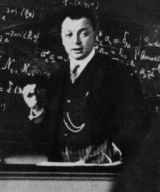
Wolfgang Pauli

 
Wolfgang Pauli

   Email Print
   Bookmark   Link


Wolfgang Pauli


Wolfgang Ernst Pauli (25 April 1900 – 15 December 1958) was an Austria
Austria

Austria , officially the Republic of Austria , is a landlocked country in Central Europe. It borders both Germany and the Czech Republic to the north, Slovakia and Hungary to the east, Slovenia and Italy to the south, and Switzerland and Liechtenstein to the west....
n theoretical physicist noted for his work on spin theory
Spin (physics)

In quantum mechanics, spin is a fundamental property of atomic nucleus, hadrons, and elementary particles. For particles with non-zero spin, spin direction is an important intrinsic degrees of freedom ....
, and for the discovery of the exclusion principle
Pauli exclusion principle

The Pauli exclusion principle is a quantum mechanics principle formulated by Wolfgang Pauli in 1925. It states that no two identical particles fermions may occupy the same quantum state simultaneously....
 underpinning the structure of matter and the whole of chemistry
Chemistry

Chemistry is the science concerned with the composition, structure, and properties of matter, as well as the changes it undergoes during chemical reactions....
.

i was born in Vienna
Vienna

Vienna is the Capital of Republic of Austria and also one of the nine states of Austria. Vienna is Austria's primary city, with a population of about 1.7 million...
 to Wolfgang Joseph Pauli ( Wolf Pascheles) and Berta Camilla Schütz. His middle name was given in honor of his godfather
Godparent

A godparent, in many denominations of Christianity, is someone who sponsors a child's baptism. Judaism has this equivalent in the Brit Milah ceremony....
, the physicist Ernst Mach
Ernst Mach

Ernst Mach was an Austrians physicist and philosopher and is the namesake for the Mach number and the optical illusion known as Mach bands....
.


Discussion
Ask a question about 'Wolfgang Pauli'
Start a new discussion about 'Wolfgang Pauli'
Answer questions from other users
Full Discussion Forum


Quotations


It is always the older that emanates the new one.

Letter to Markus Fierz (13 October 1951)

Both of us seem to agree that the future of Jung's ideas is not with psycho- therapy... but with a unitarian, holistic concept of nature and the position of man in it.

Letter to Markus Fierz regarding Carl Jung's ideas (25 December 1950)

The fact of the existence of two theories causal and acausal that contradict each other in Jung ... corresponds psychologically to the vascillation between 3 and 4.

Letter To C.A. Meier (1950)

The designation 'Jungian Psychology' is actually already unscientific sectarianism. I only acknowledge C.G. Jung's contribution to the general psychology of the unconscious.

Letter to C.A. Meier (the president of the C.G. Jung Institute, Zurich) in (1956)

There is no god and Dirac is his messenger. (German: Es gibt keinen Gott und Dirac ist sein Prophet.).

W. Heisenberg, Der Teil und das Ganze, 1969, Piper, München, p. 119


Encyclopedia


Wolfgang Ernst Pauli (25 April 1900 – 15 December 1958) was an Austria
Austria

Austria , officially the Republic of Austria , is a landlocked country in Central Europe. It borders both Germany and the Czech Republic to the north, Slovakia and Hungary to the east, Slovenia and Italy to the south, and Switzerland and Liechtenstein to the west....
n theoretical physicist noted for his work on spin theory
Spin (physics)

In quantum mechanics, spin is a fundamental property of atomic nucleus, hadrons, and elementary particles. For particles with non-zero spin, spin direction is an important intrinsic degrees of freedom ....
, and for the discovery of the exclusion principle
Pauli exclusion principle

The Pauli exclusion principle is a quantum mechanics principle formulated by Wolfgang Pauli in 1925. It states that no two identical particles fermions may occupy the same quantum state simultaneously....
 underpinning the structure of matter and the whole of chemistry
Chemistry

Chemistry is the science concerned with the composition, structure, and properties of matter, as well as the changes it undergoes during chemical reactions....
.

Biography


Early years

Pauli was born in Vienna
Vienna

Vienna is the Capital of Republic of Austria and also one of the nine states of Austria. Vienna is Austria's primary city, with a population of about 1.7 million...
 to Wolfgang Joseph Pauli ( Wolf Pascheles) and Berta Camilla Schütz. His middle name was given in honor of his godfather
Godparent

A godparent, in many denominations of Christianity, is someone who sponsors a child's baptism. Judaism has this equivalent in the Brit Milah ceremony....
, the physicist Ernst Mach
Ernst Mach

Ernst Mach was an Austrians physicist and philosopher and is the namesake for the Mach number and the optical illusion known as Mach bands....
. His paternal grandparents were from prominent Jewish
Judaism

Judaism is a set of beliefs and practices originating in the Hebrew Bible , as later further explored and explained in the Talmud and other texts....
 families of Prague
Prague

Prague is the Capital and World's largest cities of the Czech Republic. Its official name is Hlavn? mesto Praha, meaning Prague, the Capital City....
, but his father converted from Judaism to Roman Catholicism shortly before his marriage in 1899. Bertha Schütz was raised in her mother's Roman Catholic religion, but her father was the Jewish writer Friedrich Schütz. Although Pauli was raised as a Roman Catholic, eventually he and his parents left the Church.

Pauli attended the Döblinger-Gymnasium in Vienna, graduating with distinction in 1918. Only two months after graduation, the young prodigy
Child prodigy

A child prodigy is someone who at an early age masters one or more skills at an adult level. One heuristic for classifying prodigies is: a prodigy is a child, typically younger than 13 years old, who is performing at the level of a highly trained adult in a very demanding field of endeavor....
 published his first paper, on Albert Einstein's
Albert Einstein

Albert Einstein was a Germany-born theoretical physics. He is best known for his theory of relativity and specifically mass?energy equivalence, expressed by the equation E = mc2....
 theory of general relativity
General relativity

General relativity or the general theory of relativity is the Geometry Theoretical physics of gravitation published by Albert Einstein in 1916....
. He attended the Ludwig-Maximilians University in Munich
Munich

Munich is the capital city of Bavaria, Germany. Munich is located on the River Isar north of the Northern Limestone Alps. Munich is the third largest city in Germany, after Berlin and Hamburg....
, working under Arnold Sommerfeld
Arnold Sommerfeld

Arnold Johannes Wilhelm Sommerfeld was a Germany theoretical physicist who pioneered developments in atomic physics and quantum physics, and also educated and groomed a large number of students for the new era of theoretical physics....
, where he received his PhD
Doctor of Philosophy

Doctor of Philosophy, abbreviated Ph.D. or PhD for the Latin , meaning "teacher of philosophy", is an postgraduate academic degree awarded by University....
 in July 1921 for his thesis on the quantum theory of ionised molecular hydrogen.

Sommerfeld asked Pauli to review the theory of relativity
Theory of relativity

File:spacetime curvature.pngThe theory of relativity, or simply relativity, generally refers specifically to two theories of Albert Einstein: special relativity and general relativity....
 for the Encyklopaedie der mathematischen Wissenschaften (Encyclopedia of Mathematical Sciences). Two months after receiving his doctorate, Pauli completed the article, which came to 237 pages. It was praised by Einstein
Albert Einstein

Albert Einstein was a Germany-born theoretical physics. He is best known for his theory of relativity and specifically mass?energy equivalence, expressed by the equation E = mc2....
; published as a monograph
Monograph

A monograph is a work of writing upon a single subject, usually also by a single author. It is often a scholarly essay or learned treatise, and may be released in the manner of a book, journal article, editorial or written rant....
, it remains a standard reference on the subject to this day.

Pauli spent a year at the University of Göttingen as the assistant to Max Born
Max Born

Max Born was a Germany physicist and mathematician who was instrumental in the development of quantum mechanics. He also made contributions to solid-state physics and optics and supervised the work of a number of notable physicists in the 1920s and 30s....
, and the following year at the Institute for Theoretical Physics in Copenhagen
Copenhagen

Copenhagen is the capital and largest city of Denmark, with an urban area with a population of 1,153,615 . Copenhagen is situated on the Islands of Zealand and Amager....
, which later became the Niels Bohr Institute
Niels Bohr Institute

The Niels Bohr Institute is a research institute at the University of Copenhagen. The research of the institute spans astronomy, geophysics, nanotechnology, particle physics, quantum mechanics and biophysics....
 in 1965. From 1923 to 1928, he was a lecturer at the University of Hamburg
University of Hamburg

The University of Hamburg is a university in Hamburg, Germany. It was founded on 1 April 1919 by William Stern and others. It grew out of the previous Allgemeines Vorlesungswesen and the Kolonialinstitut as well as the Akademisches Gymnasium....
. During this period, Pauli was instrumental in the development of the modern theory of quantum mechanics
Quantum mechanics

Quantum mechanics is a set of principles underlying the most fundamental known description of all physical systems at the microscopic scale . Notable amongst these principles are both a dual wave-like and particle-like behavior of matter and radiation, and prediction of probabilities in situations where classical physics predicts certaintie...
. In particular, he formulated the exclusion principle
Pauli exclusion principle

The Pauli exclusion principle is a quantum mechanics principle formulated by Wolfgang Pauli in 1925. It states that no two identical particles fermions may occupy the same quantum state simultaneously....
 and the theory of nonrelativistic spin
Spin (physics)

In quantum mechanics, spin is a fundamental property of atomic nucleus, hadrons, and elementary particles. For particles with non-zero spin, spin direction is an important intrinsic degrees of freedom ....
.

At the beginning of 1931, shortly after his divorce and immediately following his postulation of the neutrino
Neutrino

Neutrinos are elementary particles that travel close to the speed of light, lack an electric charge, are able to pass through ordinary matter almost undisturbed and are thus extremely difficult to detect....
, Pauli had a severe breakdown. He consulted the psychiatrist and psychotherapist Carl Jung
Carl Jung

Carl Gustav Jung was a Swiss psychiatrist, an influential thinker and the founder of Analytical psychology. Jung's approach to psychology has been influential in the field of depth psychology and in counterculture movements across the globe....
 who, like Pauli, lived near Zürich
Zürich

Z?rich is the largest city in Switzerland and the capital of the canton of Z?rich. The city is Switzerland's main commercial and cultural centre and sometimes called the Cultural Capital of Switzerland, the political capital of Switzerland being Berne....
. Jung immediately began interpreting Pauli's deeply archetypal dreams, and Pauli became one of the depth psychologist’s best students. Soon, he began to criticize the epistemology
Epistemology

Epistemology or theory of knowledge is the branch of philosophy concerned with the nature and scope of knowledge. It addresses the questions:...
 of Jung’s theory scientifically, and this contributed to a certain clarification of the latter’s thoughts, especially about the concept of synchronicity
Synchronicity

Synchronicity is the experience of two or more Event which are Causality occurring together in a supposedly Meaning manner. In order to count as synchronicity, the events should be unlikely to occur together by chance....
. A great deal of these discussions is documented in the Pauli/Jung letters, today published as Atom and Archetype. Jung's elaborate analysis of more than 400 of Pauli's dreams is documented in Psychology and Alchemy
Psychology and Alchemy

Psychology and Alchemy is the twelfth volume in the Princeton/Bollingen edition of the Collected Works of Carl Jung. In it Jung argues for a reevaluation of the symbolism of Alchemy as being intimately related to the psychoanalytical process....
.

In 1928, he was appointed Professor of Theoretical Physics at ETH Zürich in Switzerland
Switzerland

Switzerland is a landlocked Swiss Alps country of roughly 7.7 million people in Western Europe with an area of 41,285 km?. Switzerland is a federal republic consisting of 26 states called Cantons of Switzerland....
 where he made significant scientific progress. He held visiting professorships at the University of Michigan
University of Michigan

The University of Michigan, Ann Arbor, Michigan is a public university research university located in the state of Michigan. It is the state's oldest university and the flagship campus of the University of Michigan, which also includes two regional campuses in University of Michigan-Flint and University of Michigan-Dearborn....
 in 1931, and the Institute for Advanced Study
Institute for Advanced Study

The Institute for Advanced Study, located in Princeton, New Jersey, United States, is a center for theoretical research. The Institute is perhaps best known as the academic home of Albert Einstein, John von Neumann, and Kurt G?del, after their immigration to the United States....
 at Princeton
Princeton University

Princeton University is a private university university located in Princeton, New Jersey, New Jersey, United States. The school is one of the eight universities of the Ivy League and has the largest per-student Financial endowment in the world....
 in 1935. He was awarded the Lorentz Medal
Lorentz Medal

Lorentz Medal is an award given every four years by the Royal Netherlands Academy of Arts and Sciences. It was established in 1925 on the occasion of the 50th anniversary of the doctorate of Hendrik Lorentz....
 in 1931.

The German annexation of Austria in 1938
Anschluss

The ' , also known as the ', was the 1938 unification of Austria into Gro?deutschland by Nazi Germany.Austria was merged into Nazi Germany on 12 March 1938....
 made him a German national, which became a difficulty with the outbreak of World War II
World War II

World War II, or the Second World War , was a global military conflict which involved a Participants in World War II, including all of the great powers, organised into two opposing military alliances: the Allies of World War II and the Axis powers....
 in 1939. Pauli moved to the United States in 1940, where he was Professor of Theoretical Physics at Princeton. After the war, in 1946, he became a naturalized citizen of the United States, before returning to Zürich, where he mostly remained for the rest of his life.

In 1945, he received the Nobel Prize in Physics
Nobel Prize in Physics

The Nobel Prize in Physics is awarded once a year by the Royal Swedish Academy of Sciences. It is one of the five Nobel Prizes established by the will of Alfred Nobel in 1895 and awarded since 1901; the others are the Nobel Prize in chemistry, Nobel Prize in literature, Nobel Peace Prize, and Nobel Prize in physiology or medicine....
 for his "decisive contribution through his discovery in 1925 of a new law of Nature, the exclusion principle or Pauli principle
Pauli exclusion principle

The Pauli exclusion principle is a quantum mechanics principle formulated by Wolfgang Pauli in 1925. It states that no two identical particles fermions may occupy the same quantum state simultaneously....
." He was nominated for the prize by Albert Einstein
Albert Einstein

Albert Einstein was a Germany-born theoretical physics. He is best known for his theory of relativity and specifically mass?energy equivalence, expressed by the equation E = mc2....
.

In 1958, Pauli was awarded the Max Planck medal
Max Planck medal

The Max Planck medal is an award for extraordinary achievements in theoretical physics. It is awarded annually by the Deutsche Physikalische Gesellschaft ....
. In that same year, he fell ill with pancreatic cancer
Pancreatic cancer

Pancreatic cancer is a cancer of the pancreas. Each year in the United States, about 37,680 individuals are diagnosed with this condition and 34,290 die from the disease each year....
. When his last assistant, Charles Enz, visited him at the Rotkreuz hospital in Zürich, Pauli asked him: “Did you see the room number?” It was number 137. Throughout his life, Pauli had been preoccupied with the question of why the fine structure constant, a dimensionless
Dimensional analysis

Dimensional analysis is a conceptual tool often applied in physics, chemistry, and engineering to understand physical situations involving certain physical quantities....
 fundamental constant, has a value nearly equal to 1/137. Pauli died in that room on 15 December 1958.

Scientific research

Pauli made many important contributions in his career as a physicist, primarily in the field of quantum mechanics
Quantum mechanics

Quantum mechanics is a set of principles underlying the most fundamental known description of all physical systems at the microscopic scale . Notable amongst these principles are both a dual wave-like and particle-like behavior of matter and radiation, and prediction of probabilities in situations where classical physics predicts certaintie...
. He seldom published papers, preferring lengthy correspondences with colleagues such as Niels Bohr
Niels Bohr

Niels Henrik David Bohr was a Denmark physicist who made fundamental contributions to understanding atomic structure and quantum mechanics, for which he received the Nobel Prize in Physics in 1922....
 and Werner Heisenberg
Werner Heisenberg

Werner Heisenberg was a German Theoretical physics who made foundational contributions to quantum mechanics and is best known for asserting the uncertainty principle of quantum theory....
, with whom he had close friendships. Many of his ideas and results were never published and appeared only in his letters, which were often copied and circulated by their recipients. Pauli was apparently unconcerned that much of his work thus went uncredited.

Pauli proposed in 1924 a new quantum degree of freedom (or quantum number
Quantum number

Quantum numbers describe values of conserved numbers in the dynamics of the quantum system. They often describe specifically the energies of electrons in atoms, but other possibilities include angular momentum, Spin etc....
) with two possible values, in order to resolve inconsistencies between observed molecular spectra and the developing theory of quantum mechanics. He formulated the Pauli exclusion principle, perhaps his most important work, which stated that no two electrons could exist in the same quantum state, identified by four quantum numbers including his new two-valued degree of freedom. The idea of spin originated with Ralph Kronig
Ralph Kronig

Ralph Kronig was a German-American physicist . He is noted for the discovery of particle spin and for his theory of X-ray absorption fine structure....
. George Uhlenbeck and Samuel Goudsmit one year later identified Pauli's new degree of freedom as electron
Electron

The electron is a subatomic particle that carries a negative electric charge. It has elementary particle and is believed to be a point particle....
 spin
Spin (physics)

In quantum mechanics, spin is a fundamental property of atomic nucleus, hadrons, and elementary particles. For particles with non-zero spin, spin direction is an important intrinsic degrees of freedom ....
.

In 1926, shortly after Heisenberg published the matrix theory of modern quantum mechanics, Pauli used it to derive the observed spectrum of the hydrogen atom
Hydrogen atom

A hydrogen atom is an atom of the chemical element hydrogen. The Electric charge neutral atom contains a single positively-charged proton and a single negatively-charged electron bound to the nucleus by the Coulomb force....
. This result was important in securing credibility for Heisenberg's theory.

Pauli introduced the 2 × 2 Pauli matrices
Pauli matrices

The Pauli matrices are a set of 2 × 2 complex number Hermitian matrix and Unitary matrix matrix Usually indicated by the Greek letter 'sigma' , they are occasionally denoted with a 'tau' when used in connection with isospin symmetries....
 as a basis of spin operators, thus solving the nonrelativistic theory of spin. This work is sometimes said to have influenced Paul Dirac
Paul Dirac

Paul Adrien Maurice Dirac, Order of Merit , Royal Society was a United Kingdom theoretical physicist. Dirac made fundamental contributions to the early development of both quantum mechanics and quantum electrodynamics....
 in his creation of the Dirac equation
Dirac equation

In physics, the Dirac equation is a theory of relativity quantum mechanics wave equation formulated by British physicist Paul Dirac in 1928 and provides a description of elementary particle spin-? particles, such as electrons, consistent with both the principles of quantum mechanics and the theory of special relativity....
 for the relativistic
Relativistic particle

A relativistic particle is a particle which moves with a relativistic speed; that is, a speed comparable to the speed of light. This is achieved by photons to the extent that effects described by special relativity are able to describe those of such Elementary particle themselves....
 electron, though Dirac stated that he invented these same matrices himself independently at the time, without Pauli's influence. Dirac invented similar but larger (4x4) spin matrices for use in his relativistic treatment of fermionic spin.

In 1930, Pauli considered the problem of beta decay
Beta decay

In nuclear physics, beta decay is a type of radioactive decay in which a beta particle is emitted. In the case of electron emission, it is referred to as beta minus , while in the case of a positron emission as beta plus ....
. In a letter of 4 December to Lise Meitner
Lise Meitner

Lise Meitner was an Austrian-born, later Sweden physics who studied radioactivity and nuclear physics....
 et al., beginning, "Dear radioactive ladies and gentlemen", he proposed the existence of a hitherto unobserved neutral particle with a small mass, no greater than 1% the mass of a proton, in order to explain the continuous spectrum of beta decay. In 1934, Enrico Fermi
Enrico Fermi

Enrico Fermi was an Italian physicist most noted for his work on the development of the first nuclear reactor, and for his contributions to the development of Quantum mechanics, nuclear physics and particle physics, and statistical mechanics....
 incorporated the particle, which he called a neutrino
Neutrino

Neutrinos are elementary particles that travel close to the speed of light, lack an electric charge, are able to pass through ordinary matter almost undisturbed and are thus extremely difficult to detect....
, into his theory of beta decay. The neutrino was first confirmed experimentally in 1956 by Frederick Reines
Frederick Reines

Frederick Reines was an United States physicist. He was awarded the 1995 Nobel Prize in Physics for his co-detection of the neutrino with Clyde Cowan in the neutrino experiment, and may be the only scientist in history "so intimately associated with the discovery of an elementary particle and the subsequent thorough investigation of its fund...
 and Clyde Cowan
Clyde Cowan

Clyde Lorrain Cowan Jr was the co-discoverer of the neutrino, along with Frederick Reines. The discovery was made in 1956, detected in the neutrino experiment....
, two and a half years before Pauli's death. On receiving the news, he replied by telegram: "Thanks for message. Everything comes to him who knows how to wait. Pauli."

In 1940, he proved the spin-statistics theorem
Spin-statistics theorem

In quantum mechanics, the spin-statistics theorem relates the spin of a particle to the particle statistics obeyed by it. The spin of a particle is its intrinsic angular momentum ....
, a critical result of quantum field theory which states that particles with half-integer spin are fermion
Fermion

In particle physics, fermions are subatomic particle which obey Fermi-Dirac statistics; they are named after Enrico Fermi. In contrast to bosons, which have Bose-Einstein statistics, only one fermion can occupy a quantum state at a given time; this is the Pauli Exclusion Principle....
s, while particles with integer spin are boson
Boson

In particle physics, bosons are subatomic particle which obey Bose-Einstein statistics; they are named after Satyendra Nath Bose and Albert Einstein....
s.

In 1949, he published a paper on Pauli-Villars regularization
Pauli-Villars regularization

In theoretical physics, Pauli-Villars regularization is a procedure that isolates divergent terms from finite parts in loop calculations in field theory in order to renormalization the theory....
, which provides an important prescription for renormalization
Renormalization

In quantum field theory, the statistical mechanics of fields, and the theory of self-similarity geometric structures, renormalization refers to a collection of techniques used to take a continuum limit....
, or removing infinities from quantum field theories
Quantum field theory

Quantum field theory or QFT provides a theoretical framework for constructing quantum mechanics models of systems classically described by field or of Many-body problem....
.

Pauli made repeated criticisms of the modern synthesis
Modern evolutionary synthesis

The modern evolutionary synthesis is a union of ideas from several biology specialties which forms a logical account of evolution. This synthesis has been generally accepted by most working biologists....
 of evolutionary biology
Evolutionary biology

Evolutionary biology is a sub-field of biology concerned with the origin of species from a common descent and descent of species, as well as their evolution, multiplication and diversity over time....
, and his contemporary admirers point to modes of epigenetic inheritance
Epigenetics

In biology, the term epigenetics refers to Heritability changes in phenotype or gene expression caused by mechanisms other than changes in the underlying DNA sequence ....
 as supportive of his arguments.

Personality and reputation

The Pauli effect
Pauli effect

The Pauli effect is a reference to the apparently mysterious failure of technical equipment in the presence of certain people. It is named after the Austria theoretical physicist Wolfgang Pauli....
 was named after his bizarre ability to break experimental equipment simply by being in the vicinity. Pauli himself was aware of his reputation, and was delighted whenever the Pauli effect manifested.

Regarding physics, Pauli was famously a perfectionist. This extended not just to his own work, but also to the work of his colleagues. As a result, he became known within the physics community as the "conscience of physics", the critic to whom his colleagues were accountable. He could be scathing in his dismissal of any theory he found lacking, often labelling it ganz falsch, utterly false.

However, this was not his most severe criticism, which he reserved for theories or theses so unclearly presented as to be untestable or unevaluatable, and thus not properly belonging within the realm of science, even though posing as such. They were worse than wrong because they could not be proven wrong. Famously, he once said of such an unclear paper: Das ist nicht nur nicht richtig, es ist nicht einmal falsch! "Not only it's not right, it's not even wrong
Not even wrong

An apparently science argument is said to be not even wrong if it is based on assumptions that are known to be incorrect, or alternatively, theories which cannot possibly be Falsifiability or used to predict anything....
."

His supposed remarks when meeting another leading physicist, Paul Ehrenfest
Paul Ehrenfest

Paul Ehrenfest was an Austrian physicist and mathematician, who obtained Netherlands citizenship on March 24, 1922. He made major contributions to the field of statistical mechanics and its relations with quantum physics, including the theory of phase transition and the Ehrenfest theorem....
, illustrates this notion of an arrogant Pauli. The two met at a conference for the first time. Ehrenfest, though never having met Pauli, was familiar with his papers, and was quite impressed with them. After a few minutes of conversation, Ehrenfest remarked, "I think I like your papers better than you," to which Pauli shot back, "I think I like you better than your papers." The two became very good friends from then on.

A somewhat warmer picture emerges from this story which appears in the article on Dirac:

"Werner Heisenberg [in Physics and Beyond, 1971] recollects a friendly conversation among young participants at the 1927 Solvay Conference, about Einstein and Planck's views on religion. Wolfgang Pauli, Heisenberg, and Dirac took part in it. Dirac's contribution was a poignant and clear criticism of the political manipulation of religion, that was much appreciated for its lucidity by Bohr, when Heisenberg reported it to him later. Among other things, Dirac said: "I cannot understand why we idle discussing religion. If we are honest - and as scientists honesty is our precise duty - we cannot help but admit that any religion is a pack of false statements, deprived of any real foundation. The very idea of God is a product of human imagination. [...] I do not recognize any religious myth, at least because they contradict one another. [...]" Heisenberg's view was tolerant. Pauli had kept silent, after some initial remarks. But when finally he was asked for his opinion, jokingly he said: "Well, I'd say that also our friend Dirac has got a religion and the first commandment of this religion is 'God does not exist and Paul Dirac is his prophet.'" Everybody burst into laughter, including Dirac.

Personal life

In May 1929, Pauli left the Roman Catholic Church. In December of that year, he married Käthe Margarethe Deppner. The marriage was an unhappy one, ending in divorce in 1930 after less than a year. He married again in 1934 to Franciska Bertram. They had no children.

Bibliography

by Pauli

about Pauli

See also


External links

  • at the official Nobel Prize site
  • at the University of St Andrews, Scotland
  • at "Nobel Prize Winners"
  • at the American Institute of Physics
  • at CERN Document Server
  • at ETH-Bibliothek, Zürich