


Kappe Arabhatta

Encyclopedia
Kannada language
Kannada or , is a language spoken in India predominantly in the state of Karnataka. Kannada, whose native speakers are called Kannadigas and number roughly 50 million, is one of the 30 most spoken languages in the world...
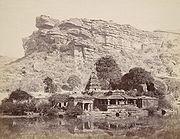
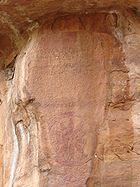
verse inscription, dated to c. 700 CE, and carved on a cliff overlooking the northeast end of the artificial lake in Badami
Badami
Badami , formerly known as Vatapi, is a town and headquarters of a taluk by the same name, in the Bagalkot district of Karnataka, India. It was the regal capital of the Badami Chalukyas from 540 to 757 AD. It is famous for rock cut and other structural temples...
, Karnataka
Karnataka
Karnataka , the land of the Kannadigas, is a state in South West India. It was created on 1 November 1956, with the passing of the States Reorganisation Act and this day is annually celebrated as Karnataka Rajyotsava...
, India. The inscription consists of five stanzas written out in ten lines in the Kannada script. Stanza 2 (Lines 3 and 4) consists of a Sanskrit
Sanskrit
Sanskrit , is a historical Indo-Aryan language and the primary liturgical language of Hinduism, Jainism and Buddhism.Buddhism: besides Pali, see Buddhist Hybrid Sanskrit Today, it is listed as one of the 22 scheduled languages of India and is an official language of the state of Uttarakhand...
śloka
Shloka
A ' is a category of verse line developed from the Vedic Anuṣṭubh. It is the basis for Indian Epic verse, and may be considered the Indian verse form par excellence, occurring, as it does, far more frequently than any other meter in classical Sanskrit poetry. The Mahabharata and Ramayana, for...
. Of the remaining stanzas, all except the first are in the tripadi
Tripadi
Tripadi is a metre in the Kannada language dating back to c. 700 CE.-Definition:...
, a Kannada verse metre
Meter (poetry)
In poetry, metre is the basic rhythmic structure of a verse or lines in verse. Many traditional verse forms prescribe a specific verse metre, or a certain set of metres alternating in a particular order. The study of metres and forms of versification is known as prosody...
.
Stanza 3 (lines 5 and 6), which consists of twelve words of which nine are Sanskrit loan-words in Kannada, is well-known in a condensed version, and is sometimes cited as the earliest example of the tripadi metre in Kannada. However, neither stanza 3 nor stanza 4 strictly conform to the precise rules of the tripadi metre; they each have more than 18 mora
Mora (linguistics)
Mora is a unit in phonology that determines syllable weight, which in some languages determines stress or timing. As with many technical linguistic terms, the definition of a mora varies. Perhaps the most succinct working definition was provided by the American linguist James D...
s in line two, in excess of the allowed 17.
Location
According to , the Kappe Arabhatta inscription overlooks the artificial lake (on the south-east corner) of Badami town, and:Kappe Arabhatta inscription text
Sanskrit
Sanskrit , is a historical Indo-Aryan language and the primary liturgical language of Hinduism, Jainism and Buddhism.Buddhism: besides Pali, see Buddhist Hybrid Sanskrit Today, it is listed as one of the 22 scheduled languages of India and is an official language of the state of Uttarakhand...
sloka, and is not translated. Here
Tripadi
Tripadi is a metre in the Kannada language dating back to c. 700 CE.-Definition:...
metre
Meter (poetry)
In poetry, metre is the basic rhythmic structure of a verse or lines in verse. Many traditional verse forms prescribe a specific verse metre, or a certain set of metres alternating in a particular order. The study of metres and forms of versification is known as prosody...
and
Dictionary for the inscription
(Slw. stands for SanskritSanskrit
Sanskrit , is a historical Indo-Aryan language and the primary liturgical language of Hinduism, Jainism and Buddhism.Buddhism: besides Pali, see Buddhist Hybrid Sanskrit Today, it is listed as one of the 22 scheduled languages of India and is an official language of the state of Uttarakhand...
loan-word):
1a "Kappe," Kannada, "a frog; that which hops" and has cognates in related languages: Telugu
Telugu language
Telugu is a Central Dravidian language primarily spoken in the state of Andhra Pradesh, India, where it is an official language. It is also spoken in the neighbouring states of Chattisgarh, Karnataka, Maharashtra, Orissa and Tamil Nadu...
"kappa - a frog;" Tulu
Tulu language
The Tulu language |?]]]) is a Dravidian language spoken by 1.95 million native speakers mainly in the southwest part of Indian state Karnataka known as Tulu Nadu. In India, 1.72 million people speak it as their mother tongue , increased by 10 percent over the 1991 census...
"kappe - a frog, probably from 'kuppu' - to hop, or 'kappu' - to cover;" 1b "Ara" and "bhaṭṭa" are both Prakrit
Prakrit
Prakrit is the name for a group of Middle Indic, Indo-Aryan languages, derived from Old Indic dialects. The word itself has a flexible definition, being defined sometimes as, "original, natural, artless, normal, ordinary, usual", or "vernacular", in contrast to the literary and religious...
words: the former means "virtue," the latter, itself derives from Sanskrit
Sanskrit
Sanskrit , is a historical Indo-Aryan language and the primary liturgical language of Hinduism, Jainism and Buddhism.Buddhism: besides Pali, see Buddhist Hybrid Sanskrit Today, it is listed as one of the 22 scheduled languages of India and is an official language of the state of Uttarakhand...
"bhartā." 1c Śiṣṭajana priyan: Beloved of the good people. Slw. priya,
2a kaṣṭajanavarjitan: avoided by evil people, adj. s. m. sg. nom. qualifying Kappe-Arabhattan. Slw. kaṣṭa, jana, varjita; 2b kaliyugaviparita: an exceptional man in the kaliyuga. Sanskrit
Sanskrit
Sanskrit , is a historical Indo-Aryan language and the primary liturgical language of Hinduism, Jainism and Buddhism.Buddhism: besides Pali, see Buddhist Hybrid Sanskrit Today, it is listed as one of the 22 scheduled languages of India and is an official language of the state of Uttarakhand...
loan-word (Slw.), viparita adj. s. m. sg. nom qualifying Kappe-Arabhattan;
5a sadhuge: to the good people. Sanskrit
Sanskrit
Sanskrit , is a historical Indo-Aryan language and the primary liturgical language of Hinduism, Jainism and Buddhism.Buddhism: besides Pali, see Buddhist Hybrid Sanskrit Today, it is listed as one of the 22 scheduled languages of India and is an official language of the state of Uttarakhand...
loan word (Slw.) sadhu, s. n.; 5b sadhu: Good, kind, person. Slw. s. m.; 5c madhuryamge: to the sweet. s. m. sg. dat Slw. madhurya-; 5d madhuryam: sweetness. s. m. sg. nom. Sanskrit
Sanskrit
Sanskrit , is a historical Indo-Aryan language and the primary liturgical language of Hinduism, Jainism and Buddhism.Buddhism: besides Pali, see Buddhist Hybrid Sanskrit Today, it is listed as one of the 22 scheduled languages of India and is an official language of the state of Uttarakhand...
loan-word (Slw.); 5e bādhippa: causing distress, fut. p. of badhisu - to cause distress, from Sanskrit
Sanskrit
Sanskrit , is a historical Indo-Aryan language and the primary liturgical language of Hinduism, Jainism and Buddhism.Buddhism: besides Pali, see Buddhist Hybrid Sanskrit Today, it is listed as one of the 22 scheduled languages of India and is an official language of the state of Uttarakhand...
bādh - to harass.
6a kalige: to the kali age. s. m. sg. dat. Sanskrit
Sanskrit
Sanskrit , is a historical Indo-Aryan language and the primary liturgical language of Hinduism, Jainism and Buddhism.Buddhism: besides Pali, see Buddhist Hybrid Sanskrit Today, it is listed as one of the 22 scheduled languages of India and is an official language of the state of Uttarakhand...
loan word (Slw.) . kali-; kali - hero.; 6b: Madhavan: Visnu, Slw. Madhava - s. m. sg. nom.; 6c: ītan: this man, dem. pron. m. Telegu: ītadu - probably i + tān - this self (speaker) or ī + tan - this of mine; 6d: peran: another. From pera - outer place; the outside. MK hera; NK hora; Tamil: piran - a stranger; Malayalam: piran - another; Telugu: pera - another; 6e alla: is not, neg. pr. of intr. al (to be fit); Tamil
Tamil language
Tamil is a Dravidian language spoken predominantly by Tamil people of the Indian subcontinent. It has official status in the Indian state of Tamil Nadu and in the Indian union territory of Pondicherry. Tamil is also an official language of Sri Lanka and Singapore...
al, alla-: no, not; Malayalam alla: no, not.
7a oḷḷitta: what is good (adj. s. n.); 7b keyvōr: those who do; 7c ār: who (inter. pron.); 7d polladum: The evil also. adj. s. n. sg. nom. + um (NK holladu, hole)—Tamil: pol—to agree with, negative of this is pollā. Tamil: pollā, pollāda: bad, vicious (neg. of pon: to shine), Malayalam: pollā - to be bad, evil; pollu - hollow, vain, useless; Telegu: pollu - useless; Tulu: polle - slander, backbiting. 7e adaramte - like that (adv.) (adara stem. pron.) amte: adv. p. of an: to speak.; 7f ballittu: Strong adj. s. n.;
8a: purākṛtam: the ancient karma (Fleet); the deeds done in the past. Sanskrit
Sanskrit
Sanskrit , is a historical Indo-Aryan language and the primary liturgical language of Hinduism, Jainism and Buddhism.Buddhism: besides Pali, see Buddhist Hybrid Sanskrit Today, it is listed as one of the 22 scheduled languages of India and is an official language of the state of Uttarakhand...
loan-word; 8b illi: here. 8c: samdhikkum: 8d adu - it (pron); 8e bamdu - having come (adv. pp. of bar - to come. Tamil
Tamil language
Tamil is a Dravidian language spoken predominantly by Tamil people of the Indian subcontinent. It has official status in the Indian state of Tamil Nadu and in the Indian union territory of Pondicherry. Tamil is also an official language of Sri Lanka and Singapore...
vandu; Malayalam vandu; Telugu
Telugu language
Telugu is a Central Dravidian language primarily spoken in the state of Andhra Pradesh, India, where it is an official language. It is also spoken in the neighbouring states of Chattisgarh, Karnataka, Maharashtra, Orissa and Tamil Nadu...
vacci;
9a kaṭṭida - bound pp. of kattu - to bind; Tamil
Tamil language
Tamil is a Dravidian language spoken predominantly by Tamil people of the Indian subcontinent. It has official status in the Indian state of Tamil Nadu and in the Indian union territory of Pondicherry. Tamil is also an official language of Sri Lanka and Singapore...
: kaṭṭu, Malayalam: kaṭṭu; Tulu
Tulu language
The Tulu language |?]]]) is a Dravidian language spoken by 1.95 million native speakers mainly in the southwest part of Indian state Karnataka known as Tulu Nadu. In India, 1.72 million people speak it as their mother tongue , increased by 10 percent over the 1991 census...
: kaṭṭu - to bind; 9b simghaman The lion. Slw. simgha-, s. n. sg.; 9c keṭṭodē: harmful thing; 9d en what (intl pron.) 9e biṭṭavōl: in the same way as releasing. adj.;
10a ahitarkkaḷ: the enemies (Slw. ahita- ); 10b keṭṭar : were ruined; 10c mēṇ: and (conjunction, Middle Kannada (MK)
Kannada language
Kannada or , is a language spoken in India predominantly in the state of Karnataka. Kannada, whose native speakers are called Kannadigas and number roughly 50 million, is one of the 30 most spoken languages in the world...
mēṇ and mēṇu: what is above, from mēl: above. Malayalam: mēṇ: what is abvove; superiority; menavan—a superior śudra (modern Malayalam mēnon), replaced by mattu in Modern Kannada. 10d sattar: died; past pl. of sā - to die. Tamil
Tamil language
Tamil is a Dravidian language spoken predominantly by Tamil people of the Indian subcontinent. It has official status in the Indian state of Tamil Nadu and in the Indian union territory of Pondicherry. Tamil is also an official language of Sri Lanka and Singapore...
cā - to die, past. Sattān. Malayalam cā - to die; Telugu
Telugu language
Telugu is a Central Dravidian language primarily spoken in the state of Andhra Pradesh, India, where it is an official language. It is also spoken in the neighbouring states of Chattisgarh, Karnataka, Maharashtra, Orissa and Tamil Nadu...
- caccu - to die; pp. caccina. Tulu
Tulu language
The Tulu language |?]]]) is a Dravidian language spoken by 1.95 million native speakers mainly in the southwest part of Indian state Karnataka known as Tulu Nadu. In India, 1.72 million people speak it as their mother tongue , increased by 10 percent over the 1991 census...
sāy, sāi - to die, pp. satta-; 10e avicāram: without foresight. (Fleet translates as "without doubt.") Slw. avicāra.
Literal translation
1 Kappe1a Arabhata,1b beloved of the good people1c2 avoided by evil people,2a an exceptional man in Kaliyuga2b
5 To the good people,5a good;5b to the sweet,5c sweetness;5d
6 to the kali age,6a an exceptional man in Kaliyuga,2b
Madhava
Mādhava may be*a Sanskrit patronymic, "descendant of Madhu ".** especially of Krishna or Parashurama as incarnations of Vishnu, see Madhava *** an icon of Krishna...
(or Vishnu
Vishnu
Vishnu is the Supreme god in the Vaishnavite tradition of Hinduism. Smarta followers of Adi Shankara, among others, venerate Vishnu as one of the five primary forms of God....
),6b this man6c another6d is not6e
7 What is good7a those who do7b who7c the evil7d like that7e
8 exception to (or opposite)2b the ancient karma8a
9 Bound9a the lion9b harmful thing9c what9d
10 exception to or opposite2b the enemies10a
Popular version of Stanza 3 in Kannada script
A condensed version of Stanza 3 seems to be well known, both in the Kannada script:and in the English poetic rendering:
"Kind man to the kind,
Very cruel to the cruel
He was nothing but God Vishnu in this regard"