


John Stow

Encyclopedia
England
England is a country that is part of the United Kingdom. It shares land borders with Scotland to the north and Wales to the west; the Irish Sea is to the north west, the Celtic Sea to the south west, with the North Sea to the east and the English Channel to the south separating it from continental...
historian
Historian
A historian is a person who studies and writes about the past and is regarded as an authority on it. Historians are concerned with the continuous, methodical narrative and research of past events as relating to the human race; as well as the study of all history in time. If the individual is...
and antiquarian
Antiquarian
An antiquarian or antiquary is an aficionado or student of antiquities or things of the past. More specifically, the term is used for those who study history with particular attention to ancient objects of art or science, archaeological and historic sites, or historic archives and manuscripts...
.
Early life
The son of Thomas Stow, a tallow-chandlerWorshipful Company of Tallow Chandlers
The Worshipful Company of Tallow Chandlers is one of the Livery Companies of the City of London. The organisation, which engaged in not only tallow candle making but also in the trade of oils, received a Royal Charter in 1462...
, he was born about 1525 in London
London
London is the capital city of :England and the :United Kingdom, the largest metropolitan area in the United Kingdom, and the largest urban zone in the European Union by most measures. Located on the River Thames, London has been a major settlement for two millennia, its history going back to its...
, in the parish of St Michael, Cornhill
St Michael, Cornhill
St Michael, Cornhill is a medieval parish church in the City of London with pre-Norman Conquest parochial foundation. The medieval structure was lost in the Great Fire of London and the current church was designed by Sir Christopher Wren between 1670-1677....
. His father's whole rent for his house and garden was only 6s. 6d. a year, and Stow in his youth fetched milk every morning from a farm belonging to the convent of the Minories. He did not follow his father's trade, but was apprenticed as a merchant tailor, being admitted to the Merchant Taylor
Worshipful Company of Merchant Taylors
The Worshipful Company of Merchant Taylors is one of the 108 Livery Companies of the City of London.The Company, originally known as the Guild and Fraternity of St...
's company in 1547 and, by that year, had established a business at a house near the well within Aldgate, between Leadenhall and Fenchurch Street. In the 1570s, he moved to a house in St Andrew's parish, in Lime Street ward
Lime Street (ward)
Lime Street is one of the 25 ancient wards in the City of London.It is divided into four precincts; and it is worthy a remark that, though the ward includes parts of several parishes, there is not even a whole street in it. John Noorthhouck...
, where he lived till his death. In about 1560 he entered upon the work with which his name is associated.
Works
He made the acquaintance of the leading antiquarians of his time, including William CamdenWilliam Camden
William Camden was an English antiquarian, historian, topographer, and officer of arms. He wrote the first chorographical survey of the islands of Great Britain and Ireland and the first detailed historical account of the reign of Elizabeth I of England.- Early years :Camden was born in London...
, and in 1561 he published his first work, The woorkes of Geffrey Chaucer
Geoffrey Chaucer
Geoffrey Chaucer , known as the Father of English literature, is widely considered the greatest English poet of the Middle Ages and was the first poet to have been buried in Poet's Corner of Westminster Abbey...
, newly printed with divers additions whiche were never in printe before. This was followed in 1565 by his Summarie of Englyshe Chronicles, which was frequently reprinted, with slight variations, during his lifetime. Of the first edition a copy was said to have been at one time in the Grenville library. In the British Museum
British Museum
The British Museum is a museum of human history and culture in London. Its collections, which number more than seven million objects, are amongst the largest and most comprehensive in the world and originate from all continents, illustrating and documenting the story of human culture from its...
there are copies of the editions of 1567, 1573, 1590, 1598 and 1604. Stow having in his dedication to the edition of 1567 referred to the rival publication of Richard Grafton
Richard Grafton
Richard Grafton , was King's Printer under Henry VIII and Edward VI. He was a member of the Grocers' Company and MP for Coventry elected 1562-63.-Under Henry VIII:...
(ca. 1500-ca. 1572) in terms, the dispute between them became extremely embittered.
Stow's antiquarian tastes brought him under ecclesiastical suspicion as a person "with many dangerous and superstitious books in his possession," and in 1568 his house was searched. An inventory was taken of certain books he possessed "in defence of papistry," but he was apparently able to satisfy his interrogators of the soundness of his Protestantism
Protestantism
Protestantism is one of the three major groupings within Christianity. It is a movement that began in Germany in the early 16th century as a reaction against medieval Roman Catholic doctrines and practices, especially in regards to salvation, justification, and ecclesiology.The doctrines of the...
. A second attempt to incriminate him in 1570 was also without result. In 1580, Stow published his Annales, or a Generale Chronicle of England from Brute until the present yeare of Christ 1580; it was reprinted in 1592, 1601 and 1605, the last being continued to 26 March 1605, or within ten days of his death; editions "amended" by Edmund Howes
Edmund Howes
Edmund Howes , was an English chronicler.Howes lived in London, and designated himself 'gentleman.' Undeterred by Stow's neglect, and despite the ridicule of his acquaintances, he applied himself on Stow's death in 1605 to continuations of Stow's 'Abridgement' and of his 'Annales.' The former he...
appeared in 1615 and 1631.
Survey of London
The work for which Stow is best known is his Survey of London, published in 1598, not only interesting for the quaint simplicity of its style and its amusing descriptions and anecdotes, but of unique value for its minute account of the buildings, social condition and customs of London in the time of Elizabeth IElizabeth I of England
Elizabeth I was queen regnant of England and Ireland from 17 November 1558 until her death. Sometimes called The Virgin Queen, Gloriana, or Good Queen Bess, Elizabeth was the fifth and last monarch of the Tudor dynasty...
. A second edition appeared in his lifetime in 1603, a third with additions by Anthony Munday
Anthony Munday
Anthony Munday was an English dramatist and miscellaneous writer. The chief interest in Munday for the modern reader lies in his collaboration with Shakespeare and others on the play Sir Thomas More and his writings on Robin Hood.-Biography:He was once thought to have been born in 1553, because...
in 1618, a fourth by Munday and Dyson in 1633, a fifth with interpolated amendments by John Strype
John Strype
John Strype was an English historian and biographer. He was a cousin of Robert Knox, a famous sailor.Born in Houndsditch, London, he was the son of John Strype, or van Stryp, a member of a Huguenot family whom, in order to escape religious persecution within Brabant, had settled in East London...
in 1720, and a sixth by the same editor in 1754. The edition of 1798 was reprinted, edited by W.J. Thorns, in 1842, in 1846, and with illustrations in 1876. Through the patronage of Archbishop Matthew Parker
Matthew Parker
Matthew Parker was Archbishop of Canterbury from 1559 until his death in 1575. He was also an influential theologian and arguably the co-founder of Anglican theological thought....
, Stow was able to print the Flores historiarum of Matthew of Westminster
Matthew of Westminster
Matthew of Westminster, long regarded as the author of the Flores Historiarum, is now thought never to have existed.The error was first discovered in 1826 by Francis Turner Palgrave, who said that Matthew was "a phantom who never existed," and later the truth of this statement was completely proved...
in 1567, the Chronicle of Matthew Paris
Matthew Paris
Matthew Paris was a Benedictine monk, English chronicler, artist in illuminated manuscripts and cartographer, based at St Albans Abbey in Hertfordshire...
in 1571, and the Historia brevis of Thomas Walsingham
Thomas Walsingham
- Life :He was probably educated at St Albans Abbey at St Albans, Hertfordshire, and at Oxford.He became a monk at St Albans, where he appears to have passed the whole of his monastic life, excepting a period from 1394 to 1396 during which he was prior of Wymondham Abbey, Norfolk, England, another...
in 1574. In the Chronicle of England 1590 John Stow writes, "To The Honorable Sir John Hart, Lord Maior, The Chronicle written before that nothing is perfect the first time, and that it is incident to mankinde to erre and slip sometimes, but the point of fanta[s]tical fooles to preserve and continue in their errors."
At the request of Parker he had compiled a "farre larger volume," a history of Britain, but circumstances were unfavourable to its publication and the manuscript was lost. Additions to the previously published works of Chaucer were twice made through Stow's "own painful labours" in the edition of 1561, referred to above, and also in 1597. A number of Stow's manuscripts are in the Harley Collection
Harley Collection
The Harleian Collection is one of main collections of the British Library, London, England.The manuscript collection of more than 7,000 volumes, more than 14,000 original legal documents, and 500 rolls, formed by Robert Harley , and his son Edward Harley...
in the British Museum. Some are in the Lambeth library (No. 306); and from the volume which includes them were published by the Camden Society
Camden Society
The Camden Society, named after the English antiquary and historian William Camden, was founded in 1838 in London to publish early historical and literary materials, both unpublished manuscripts and new editions of rare printed books....
, edited by James Gairdner
James Gairdner
James Gairdner was a British historian. Specializing in 15th century and Early Tudor history, he among other tasks edited the Letters and Papers, foreign and domestic, of the reign of Henry VIII series....
, Three Fifteenth Century Chronicles, with Historical Memoranda by John Stowe the Antiquary, and Contemporary Notes of Occurrences written by him (1880).
Decline
Stow's literary labours did not prove very remunerative, but he accepted poverty in a cheerful spirit. Ben JonsonBen Jonson
Benjamin Jonson was an English Renaissance dramatist, poet and actor. A contemporary of William Shakespeare, he is best known for his satirical plays, particularly Volpone, The Alchemist, and Bartholomew Fair, which are considered his best, and his lyric poems...
relates that once when walking with him Stow jocularly asked two mendicant cripples "what they would have to take him to their order." In March 1604 James I
James I of England
James VI and I was King of Scots as James VI from 24 July 1567 and King of England and Ireland as James I from the union of the English and Scottish crowns on 24 March 1603...
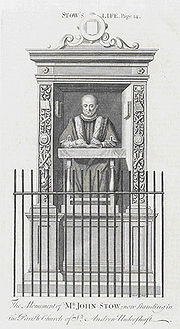
authorized him and his deputies to collect "amongst our loving subjects their voluntary contributions and 'kind gratuities'," and himself began "the largesse for the example of others." If the royal appeal was successful Stow did not live long to enjoy the increased comfort resulting from it. He was buried in the London church of St Andrew Undershaft
St Andrew Undershaft
St Andrew Undershaft is a Church of England church located at St Mary Axe, in Aldgate ward of the City of London, near the Lloyd's Building. It is a rare example of a City church that has managed to escape both the Great Fire of London in 1666 and the Second World War bombing during the London...
, where the monument erected by his widow, a terracotta figure of him, still remains.
External links
- Three fifteenth-century chronicles: the Camden Society edition of three fifteenth-century chronicles of London, which contains extensive historical notes made on the manuscripts by Stow.
- Three fifteenth-century chronicles, with historical memoranda by John Stow Cornell University Library Historical Monographs Collection. {Reprinted by} Cornell University Library Digital Collections
- A Survey of London, Reprinted from the text of 1603 (British History Online)