


Hoddesdon

Encyclopedia
Hoddesdon is a town in the English
county of Hertfordshire
, situated in the Lea Valley
. The town grew up as a coaching
stop on the route between Cambridge
and London
. It is located 4 miles (6.4 km) southeast of Hertford
, 5 miles (8 km) north of Waltham Cross
and 11 miles (17.7 km) southwest of Bishop's Stortford
. At its height during the 18th century, more than 35 coaches a day would pass through the town. It saw a boom in the mid 20th century as gravel was extracted from the area to be exhausted by the 1970s. The lakes and water pits left behind have been used for local leisure amenities. Today, Hoddesdon has a little light industry but is mainly a London commuter belt
town. The town hosted the eighth Congres Internationaux d'Architecture Moderne in 1951. It is twinned with the Belgian city of Dinant
.
The Prime Meridian
passes just to the east of Hoddesdon.
The town is served by Rye House railway station
and nearby Broxbourne railway station
.
.
Hoddesdon was situated about 20 miles (32.2 km) north of London
on the main road to Cambridge
and to northern towns and cities. The road forked in the centre of the town, with the present High Street dividing into Amwell Street and Burford Street, both leading north to Ware. From an early date there were a large number of inn
s lining the streets to serve the needs of travellers. A market charter was granted to Robert Boxe, lord of the manor
, in 1253. By the 14th century the Hospital of st Laud and St Anthony had been established in the south of Hoddesdon. The institution survived the dissolution of the monasteries
, but ceased to exist by the mid 16th century, although it is commemorated in the name of Spital Brook
which divides Hoddesdon from Broxbourne.
In 1336 William de la Marche was licenced to build a chapel of ease
in the town. The building, known as St Katharine's Chapel survived until the 17th century, when it was demolished. The tower survived until 1836. The chapel was used by pilgrims to the shrine at Walsingham
.
The town was considerably enlarged in the reign of Elizabeth I
, and a number of inns in the High Street date from this time. The monarch granted a royal charter
in 1559/60, placing the town government under a bailiff, warden and eight assistants. The charter also established a free grammar school
based on the site of the former hospital, and this was placed under the care of the corporation. Neither the borough or the school flourished, however, and both had ceased to exist by the end of the century. In 1567 Sir William Cecil
acquired the manor
of Hoddesdonsbury and two years later Elizabeth granted him the neighbouring manor of Baas. From that date the Cecils maintained a connection with the town which is recorded by the naming of The Salisbury Arms (anciently the Black Lion Inn) : the title Marquess of Salisbury
was granted to James Cecil in 1789.
In 1622 Sir Marmaduke Rawdon built Rawdon House
, a red-brick mansion which still survives. Rawdon also provided the town with its first public water supply, flowing from a statue known as the "Samaritan Woman".
A new chapel of ease, dedicated to St Paul, was built in 1762. This was subsequently rebuilt and enlarged and in 1844 become the parish church when Hoddesdon was created a separate ecclesiastical parish. Previously the town was divided between the two parishes of Broxbourne
and Great Amwell. The boundary between the two parishes ran through an archway in the town's High Street. When this building was demolished in the 1960s, a specially inscribed stone was set into the pavement marking the historic boundary. In place of St Katharine's Chapel a new clock house was built.
Brewing
was first established in the town in about 1700. In 1803, William Christie established a brewery in the town, and it became a major employer and one of the largest breweries in England. The brewery continued in operation until 1928. Most of the brewery buildings was demolished in 1930, although part was converted into a cinema itself since demolished. Some remnants of the establishment remain in Brewery Road.
By the mid-19th century the town still consisted principally of one street, and had a population of 1,743. Malt
was being produced and transported to London via the River Lea. There were also a number of flour mills. Trade in Hoddesdon was centred on the hops
market each Thursday. As time went on, more and more hops were carried on the river rather than the roads and the Wednesday meat market
took predominance. The Wednesday market has survived in Hoddesdon and was joined in the late 20th century by a Friday market.
Following the Second World War Hoddesdon increasingly became a dormitory town, forming part of the London commuter belt
. Much of the town centre was demolished in the 1960s and 1970s, with the construction of the Tower Centre and Fawkon Walk shopping centres. The opening of a bypass in 1974 changed the nature of the town, with through traffic curtailed.
Hoddesdon is the only small town in Britain with a sizeable Italian
community . Italians emigrated to the Lea Valley in the 1950s and 60s to work in the nearby garden nurseries
, and they and many of their descendants still live in the area. The Festival of San Antonio is celebrated annually in June in the town with a street procession
, although nowadays it is a low-key festival since many of the participants are elderly. An Italian consul
is resident at Broxbourne Council.
: county and district (borough). The area is unparished
.
: Hoddesdon North, Hoddesdon Town and Rye Park. Each ward returns three borough councillors to the thirty-eight member council. Councillors are elected by thirds, with one councillor being elected each year except when there are county council elections. As of 2011 all nine of Hoddesdon's councillors are members of the Conservative Party
, who hold a large majority on the council.
The borough council is responsible for services such as refuse, housing and planning.
by the Local Government Act 1894
, the remainder becoming the parish of Hoddesdon Rural in the Ware Rural District.
In 1937 a County Review Order
enlarged the urban district by taking in the entire Hoddesdon Rural parish and parts of the parishes of Broxbourne
, Great Amwell, Stanstead Abbotts
and Wormley
. The western boundary of the urban district was fixed by the track of the Roman
Ermine Street
. Hoddesdon Urban District was abolished in 1974 by the Local Government Act 1972
, when it merged with Cheshunt Urban District to become the Borough of Broxbourne.
outlets, pubs, estate agents, charity shops, bank
s, travel agents, a bookshop and a library. At the north of the High Street behind the Clock Tower is the "Tower Centre" shopping centre, which is known for its high turnover of stores and distinct lack of tenants. It has undergone a major refurbishment, in hope of attracting large national retailers. Fawkon Walk, to the west of the High Street, is also undergoing redevelopment, the first phase of which is now complete and comprised a new Aldi
store. Sainsbury's, once in Fawkon Walk, occupies a new site to the east of the High Street. Other notable outlets in the town centre include Argos
, Boots, two Lloyds pharmacies
, Tesco
, Ladbrokes, KFC
, Netto
(The former co-op store, now a Asda) and Cafe Nero. In the High Street there are many pubs and restaurants.
Since the re-opening of the High Street to traffic in 2009 the town has experienced an upturn in popularity with very few empty shops . In addition, the number of 'town events' has increased which has added a new lease of life. A number of new independent traders have moved in and Hoddesdon attracts many shoppers who also enjoy the local restaurants.
(a community, foundation comprehensive for 11-18 year olds) and Sheredes
School (a community, comprehensive, for 11- 18). John Warner has specialist status in Science and Sheredes has a well regarded creative arts department.
Sheredes School applied for specialized status in the performing arts in 2003. Their application was rejected due to lack of funds.
In 2007 the John Warner School received congratulations from Mr Jim Knight
, Minister of State for Education for being placed 24th in the ‘100 most improved schools in the country’. This award is a combination of eight years continuous improvement in examination results.
|Route Number
|colspan=2|Terminals
|Via
|Operator
|Notes
|-
|310
310A
311
|Waltham Cross Bus Station
|| Hertford Bus Station
|Cheshunt
,
Broxbourne
,
Ware
|Arriva Shires & Essex
,
Centrebus
|Mon-Sat (310), Mon-Fri peaks (310A), Sundays (311). Centrebus operates Sunday service, under contract to Herts CC.
|-
|323
|Broxbourne Station
|| Essex Road Industrial Estate
|Hoddesdon
|SM Coaches
|Mon-Fri peak hours. Herts CC contract. Times
|-
|323A
|Hoddesdon Clock Tower || Harlow Bus Station
|Stanstead Abbotts
|SM Coaches
|Mon-Fri shopping hours. Times
|-
|392
|Harlow Town Station
|| Rye Park Old Highway
|Nazeing
,
Broxbourne
|Network Harlow
|Mon-Sat. Essex CC contract. Times
|-
|641
|Broxbourne Station
|| Hatfield Business Park
|Hertford
, University of Hertfordshire
|Uno
|Mon-Fri University term time only.
|-
|C3
|Waltham Cross Holdbrook Estate
|| Harlow Bus Station
/ Hertford Bus Station
|Cheshunt
, Broxbourne
|Centrebus
|Mon-Sat. 2 buses per hour operate to Harlow, 1 bus per hour to Hertford.
|-
|C4
|Waltham Cross Bus Station
|| Hertford Bus Station
|Cheshunt
, Ware
|Centrebus
|Sundays.
|-
and Rye House Station
which offer frequent services to London
.
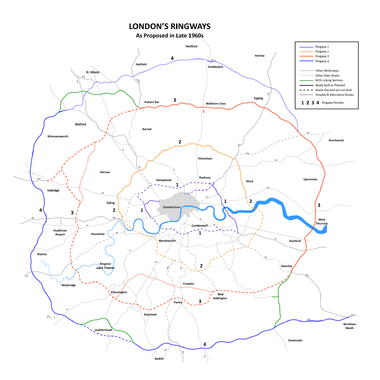 Hoddesdon contains a small part of Ringway 4
, part of the 1960s London Ringways
scheme and the only part built north of London
further east than Watford
.
Linking the town to the A10, the A1170 Dinant Link Road has an overly large junction between the link road and the A10, and was built with space available to continue the road westward over the A10 as originally planned.
England
England is a country that is part of the United Kingdom. It shares land borders with Scotland to the north and Wales to the west; the Irish Sea is to the north west, the Celtic Sea to the south west, with the North Sea to the east and the English Channel to the south separating it from continental...
county of Hertfordshire
Hertfordshire
Hertfordshire is a ceremonial and non-metropolitan county in the East region of England. The county town is Hertford.The county is one of the Home Counties and lies inland, bordered by Greater London , Buckinghamshire , Bedfordshire , Cambridgeshire and...
, situated in the Lea Valley
Lea Valley
The Lea Valley, the valley of the River Lea, has been used as a transport corridor, a source of sand and gravel, an industrial area, a water supply for London, and a recreational area...
. The town grew up as a coaching
Coach (carriage)
A coach was originally a large, usually closed, four-wheeled carriage with two or more horses harnessed as a team, controlled by a coachman and/or one or more postilions. It had doors in the sides, with generally a front and a back seat inside and, for the driver, a small, usually elevated seat in...
stop on the route between Cambridge
Cambridge
The city of Cambridge is a university town and the administrative centre of the county of Cambridgeshire, England. It lies in East Anglia about north of London. Cambridge is at the heart of the high-technology centre known as Silicon Fen – a play on Silicon Valley and the fens surrounding the...
and London
London
London is the capital city of :England and the :United Kingdom, the largest metropolitan area in the United Kingdom, and the largest urban zone in the European Union by most measures. Located on the River Thames, London has been a major settlement for two millennia, its history going back to its...
. It is located 4 miles (6.4 km) southeast of Hertford
Hertford
Hertford is the county town of Hertfordshire, England, and is also a civil parish in the East Hertfordshire district of the county. Forming a civil parish, the 2001 census put the population of Hertford at about 24,180. Recent estimates are that it is now around 28,000...
, 5 miles (8 km) north of Waltham Cross
Waltham Cross
Waltham Cross is the most southeasterly town in Hertfordshire, England. It is 12 miles from the City of London and immediately north of the M25 motorway, forming part of the Greater London Urban Area and London commuter belt. Part of Waltham Cross is located within Greater London.-Geography:It is...
and 11 miles (17.7 km) southwest of Bishop's Stortford
Bishop's Stortford
Bishop's Stortford is a historic market town and civil parish in the district of East Hertfordshire in the county of Hertfordshire in England. It is situated just west of the M11 motorway, on the county boundary with Essex and is the closest large town to London Stansted Airport and part of the...
. At its height during the 18th century, more than 35 coaches a day would pass through the town. It saw a boom in the mid 20th century as gravel was extracted from the area to be exhausted by the 1970s. The lakes and water pits left behind have been used for local leisure amenities. Today, Hoddesdon has a little light industry but is mainly a London commuter belt
London commuter belt
The London commuter belt is the metropolitan area surrounding London, England from which it is practical to commute to work in the capital. It is alternatively known as the Greater South East, the London metropolitan area or the Southeast metropolitan area...
town. The town hosted the eighth Congres Internationaux d'Architecture Moderne in 1951. It is twinned with the Belgian city of Dinant
Dinant
Dinant is a Walloon city and municipality located on the River Meuse in the Belgian province of Namur, Belgium. The Dinant municipality includes the old communes of Anseremme, Bouvignes-sur-Meuse, Dréhance, Falmagne, Falmignoul, Foy-Notre-Dame, Furfooz, Lisogne, Sorinnes, and Thynes.-Origins to...
.
The Prime Meridian
Prime Meridian
The Prime Meridian is the meridian at which the longitude is defined to be 0°.The Prime Meridian and its opposite the 180th meridian , which the International Date Line generally follows, form a great circle that divides the Earth into the Eastern and Western Hemispheres.An international...
passes just to the east of Hoddesdon.
The town is served by Rye House railway station
Rye House railway station
Rye House railway station is in the Rye House area of Hoddesdon in Hertfordshire, England. It is on the Hertford East branch of the West Anglia Main Line, and train services are provided by National Express East Anglia.-Services:...
and nearby Broxbourne railway station
Broxbourne railway station
Broxbourne railway station, opened in 1840, serves Broxbourne in Hertfordshire, England. It is on the West Anglia Main Line, and train services are provided by National Express East Anglia, who also manage the station.-History:...
.
History
The name "Hoddesdon" is believed to be derived from a Saxon or Danish personal name combined with the Old English suffix "don", meaning a down or hill. The earliest historical reference to the name is in the Domesday BookDomesday Book
Domesday Book , now held at The National Archives, Kew, Richmond upon Thames in South West London, is the record of the great survey of much of England and parts of Wales completed in 1086...
.
Hoddesdon was situated about 20 miles (32.2 km) north of London
London
London is the capital city of :England and the :United Kingdom, the largest metropolitan area in the United Kingdom, and the largest urban zone in the European Union by most measures. Located on the River Thames, London has been a major settlement for two millennia, its history going back to its...
on the main road to Cambridge
Cambridge
The city of Cambridge is a university town and the administrative centre of the county of Cambridgeshire, England. It lies in East Anglia about north of London. Cambridge is at the heart of the high-technology centre known as Silicon Fen – a play on Silicon Valley and the fens surrounding the...
and to northern towns and cities. The road forked in the centre of the town, with the present High Street dividing into Amwell Street and Burford Street, both leading north to Ware. From an early date there were a large number of inn
INN
InterNetNews is a Usenet news server package, originally released by Rich Salz in 1991, and presented at the Summer 1992 USENIX conference in San Antonio, Texas...
s lining the streets to serve the needs of travellers. A market charter was granted to Robert Boxe, lord of the manor
Lord of the Manor
The Lordship of a Manor is recognised today in England and Wales as a form of property and one of three elements of a manor that may exist separately or be combined and may be held in moieties...
, in 1253. By the 14th century the Hospital of st Laud and St Anthony had been established in the south of Hoddesdon. The institution survived the dissolution of the monasteries
Dissolution of the Monasteries
The Dissolution of the Monasteries, sometimes referred to as the Suppression of the Monasteries, was the set of administrative and legal processes between 1536 and 1541 by which Henry VIII disbanded monasteries, priories, convents and friaries in England, Wales and Ireland; appropriated their...
, but ceased to exist by the mid 16th century, although it is commemorated in the name of Spital Brook
Spital Brook
Spital Brook is a minor tributary of the River Lea which rises in Hoddesdonpark Wood in the county of Hertfordshire, England. Spital Brook flows eastwards from Hoddesdonpark Wood, passing through Barclay Park, the former Hoddesdon Common, on its journey to the Lea, while an unnamed parallel stream...
which divides Hoddesdon from Broxbourne.
In 1336 William de la Marche was licenced to build a chapel of ease
Chapel of ease
A chapel of ease is a church building other than the parish church, built within the bounds of a parish for the attendance of those who cannot reach the parish church conveniently....
in the town. The building, known as St Katharine's Chapel survived until the 17th century, when it was demolished. The tower survived until 1836. The chapel was used by pilgrims to the shrine at Walsingham
Walsingham
Walsingham is a village in the English county of Norfolk. The village is famed for its religious shrines in honour of the Virgin Mary and as a major pilgrimage centre...
.
The town was considerably enlarged in the reign of Elizabeth I
Elizabeth I of England
Elizabeth I was queen regnant of England and Ireland from 17 November 1558 until her death. Sometimes called The Virgin Queen, Gloriana, or Good Queen Bess, Elizabeth was the fifth and last monarch of the Tudor dynasty...
, and a number of inns in the High Street date from this time. The monarch granted a royal charter
Royal Charter
A royal charter is a formal document issued by a monarch as letters patent, granting a right or power to an individual or a body corporate. They were, and are still, used to establish significant organizations such as cities or universities. Charters should be distinguished from warrants and...
in 1559/60, placing the town government under a bailiff, warden and eight assistants. The charter also established a free grammar school
Grammar school
A grammar school is one of several different types of school in the history of education in the United Kingdom and some other English-speaking countries, originally a school teaching classical languages but more recently an academically-oriented secondary school.The original purpose of mediaeval...
based on the site of the former hospital, and this was placed under the care of the corporation. Neither the borough or the school flourished, however, and both had ceased to exist by the end of the century. In 1567 Sir William Cecil
William Cecil, 1st Baron Burghley
William Cecil, 1st Baron Burghley , KG was an English statesman, the chief advisor of Queen Elizabeth I for most of her reign, twice Secretary of State and Lord High Treasurer from 1572...
acquired the manor
Manorialism
Manorialism, an essential element of feudal society, was the organizing principle of rural economy that originated in the villa system of the Late Roman Empire, was widely practiced in medieval western and parts of central Europe, and was slowly replaced by the advent of a money-based market...
of Hoddesdonsbury and two years later Elizabeth granted him the neighbouring manor of Baas. From that date the Cecils maintained a connection with the town which is recorded by the naming of The Salisbury Arms (anciently the Black Lion Inn) : the title Marquess of Salisbury
Marquess of Salisbury
Marquess of Salisbury is a title in the Peerage of Great Britain. It was created in 1789 for the 7th Earl of Salisbury. Most of the holders of the title have been prominent in British political life over the last two centuries, particularly the 3rd Marquess, who served three times as Prime Minister...
was granted to James Cecil in 1789.
In 1622 Sir Marmaduke Rawdon built Rawdon House
Rawdon House
Rawdon House, Hoddesdon, Hertfordshire, was built in 1622 by Marmaduke Rawdon....
, a red-brick mansion which still survives. Rawdon also provided the town with its first public water supply, flowing from a statue known as the "Samaritan Woman".
A new chapel of ease, dedicated to St Paul, was built in 1762. This was subsequently rebuilt and enlarged and in 1844 become the parish church when Hoddesdon was created a separate ecclesiastical parish. Previously the town was divided between the two parishes of Broxbourne
Broxbourne
Broxbourne is a commuter town in the Broxbourne borough of Hertfordshire in the East of England with a population of 13,298 in 2001.It is located 17.1 miles north north-east of Charing Cross in London and about a mile north of Wormley and south of Hoddesdon...
and Great Amwell. The boundary between the two parishes ran through an archway in the town's High Street. When this building was demolished in the 1960s, a specially inscribed stone was set into the pavement marking the historic boundary. In place of St Katharine's Chapel a new clock house was built.
Brewing
Brewing
Brewing is the production of beer through steeping a starch source in water and then fermenting with yeast. Brewing has taken place since around the 6th millennium BCE, and archeological evidence suggests that this technique was used in ancient Egypt...
was first established in the town in about 1700. In 1803, William Christie established a brewery in the town, and it became a major employer and one of the largest breweries in England. The brewery continued in operation until 1928. Most of the brewery buildings was demolished in 1930, although part was converted into a cinema itself since demolished. Some remnants of the establishment remain in Brewery Road.
By the mid-19th century the town still consisted principally of one street, and had a population of 1,743. Malt
Malt
Malt is germinated cereal grains that have been dried in a process known as "malting". The grains are made to germinate by soaking in water, and are then halted from germinating further by drying with hot air...
was being produced and transported to London via the River Lea. There were also a number of flour mills. Trade in Hoddesdon was centred on the hops
Hops
Hops are the female flower clusters , of a hop species, Humulus lupulus. They are used primarily as a flavoring and stability agent in beer, to which they impart a bitter, tangy flavor, though hops are also used for various purposes in other beverages and herbal medicine...
market each Thursday. As time went on, more and more hops were carried on the river rather than the roads and the Wednesday meat market
Market
A market is one of many varieties of systems, institutions, procedures, social relations and infrastructures whereby parties engage in exchange. While parties may exchange goods and services by barter, most markets rely on sellers offering their goods or services in exchange for money from buyers...
took predominance. The Wednesday market has survived in Hoddesdon and was joined in the late 20th century by a Friday market.
Following the Second World War Hoddesdon increasingly became a dormitory town, forming part of the London commuter belt
London commuter belt
The London commuter belt is the metropolitan area surrounding London, England from which it is practical to commute to work in the capital. It is alternatively known as the Greater South East, the London metropolitan area or the Southeast metropolitan area...
. Much of the town centre was demolished in the 1960s and 1970s, with the construction of the Tower Centre and Fawkon Walk shopping centres. The opening of a bypass in 1974 changed the nature of the town, with through traffic curtailed.
Hoddesdon is the only small town in Britain with a sizeable Italian
Italy
Italy , officially the Italian Republic languages]] under the European Charter for Regional or Minority Languages. In each of these, Italy's official name is as follows:;;;;;;;;), is a unitary parliamentary republic in South-Central Europe. To the north it borders France, Switzerland, Austria and...
community . Italians emigrated to the Lea Valley in the 1950s and 60s to work in the nearby garden nurseries
Greenhouse
A greenhouse is a building in which plants are grown. These structures range in size from small sheds to very large buildings...
, and they and many of their descendants still live in the area. The Festival of San Antonio is celebrated annually in June in the town with a street procession
Procession
A procession is an organized body of people advancing in a formal or ceremonial manner.-Procession elements:...
, although nowadays it is a low-key festival since many of the participants are elderly. An Italian consul
Consul (representative)
The political title Consul is used for the official representatives of the government of one state in the territory of another, normally acting to assist and protect the citizens of the consul's own country, and to facilitate trade and friendship between the peoples of the two countries...
is resident at Broxbourne Council.
Governance
Hoddesdon has two tiers of local governmentLocal government
Local government refers collectively to administrative authorities over areas that are smaller than a state.The term is used to contrast with offices at nation-state level, which are referred to as the central government, national government, or federal government...
: county and district (borough). The area is unparished
Unparished area
In England, an unparished area is an area that is not covered by a civil parish. Most urbanised districts of England are either entirely or partly unparished. Many towns and some cities in otherwise rural districts are also unparished areas and therefore no longer have a town council or city...
.
Borough council
Hoddesdon comprises three wards of the Borough of BroxbourneBroxbourne (borough)
Broxbourne is a local government district and borough in Hertfordshire, England. Its council is based in Cheshunt, other towns include Broxbourne, Hoddesdon and Waltham Cross. The eastern boundary of the district is the River Lea...
: Hoddesdon North, Hoddesdon Town and Rye Park. Each ward returns three borough councillors to the thirty-eight member council. Councillors are elected by thirds, with one councillor being elected each year except when there are county council elections. As of 2011 all nine of Hoddesdon's councillors are members of the Conservative Party
Conservative Party (UK)
The Conservative Party, formally the Conservative and Unionist Party, is a centre-right political party in the United Kingdom that adheres to the philosophies of conservatism and British unionism. It is the largest political party in the UK, and is currently the largest single party in the House...
, who hold a large majority on the council.
The borough council is responsible for services such as refuse, housing and planning.
County council
Hoddesdon returns two county councillors to the 77 member Hertfordshire County Council. One councillor is elected for each of the two electoral divisions of Hoddesdon North and Hoddesdon South (which also includes Broxbourne). The entire county council is elected every four years. The last elections were held in 2009. Both of Hoddesdon's county councillors are members of the majority Conservative group.Civic history
Part of Hoddesdon was created an urban districtUrban district
In the England, Wales and Ireland, an urban district was a type of local government district that covered an urbanised area. Urban districts had an elected Urban District Council , which shared local government responsibilities with a county council....
by the Local Government Act 1894
Local Government Act 1894
The Local Government Act 1894 was an Act of the Parliament of the United Kingdom that reformed local government in England and Wales outside the County of London. The Act followed the reforms carried out at county level under the Local Government Act 1888...
, the remainder becoming the parish of Hoddesdon Rural in the Ware Rural District.
In 1937 a County Review Order
Local Government Act 1929
The Local Government Act 1929 was an Act of the Parliament of the United Kingdom that made changes to the Poor Law and local government in England and Wales....
enlarged the urban district by taking in the entire Hoddesdon Rural parish and parts of the parishes of Broxbourne
Broxbourne
Broxbourne is a commuter town in the Broxbourne borough of Hertfordshire in the East of England with a population of 13,298 in 2001.It is located 17.1 miles north north-east of Charing Cross in London and about a mile north of Wormley and south of Hoddesdon...
, Great Amwell, Stanstead Abbotts
Stanstead Abbotts
Stanstead Abbotts is a village and civil parish in the district of East Hertfordshire, Hertfordshire, England. At the 2001 census the parish had a population of 1,983...
and Wormley
Wormley, Hertfordshire
Wormley is a village in Hertfordshire, England. It is within the Borough of Broxbourne. The village is part of the census ward of Wormley and Turnford, which has a population of 8,146...
. The western boundary of the urban district was fixed by the track of the Roman
Roman Empire
The Roman Empire was the post-Republican period of the ancient Roman civilization, characterised by an autocratic form of government and large territorial holdings in Europe and around the Mediterranean....
Ermine Street
Ermine Street
Ermine Street is the name of a major Roman road in England that ran from London to Lincoln and York . The Old English name was 'Earninga Straete' , named after a tribe called the Earningas, who inhabited a district later known as Armingford Hundred, around Arrington, Cambridgeshire and Royston,...
. Hoddesdon Urban District was abolished in 1974 by the Local Government Act 1972
Local Government Act 1972
The Local Government Act 1972 is an Act of Parliament in the United Kingdom that reformed local government in England and Wales on 1 April 1974....
, when it merged with Cheshunt Urban District to become the Borough of Broxbourne.
Economy
Hoddesdon High Street has many shops, including fast foodFast food
Fast food is the term given to food that can be prepared and served very quickly. While any meal with low preparation time can be considered to be fast food, typically the term refers to food sold in a restaurant or store with preheated or precooked ingredients, and served to the customer in a...
outlets, pubs, estate agents, charity shops, bank
Bank
A bank is a financial institution that serves as a financial intermediary. The term "bank" may refer to one of several related types of entities:...
s, travel agents, a bookshop and a library. At the north of the High Street behind the Clock Tower is the "Tower Centre" shopping centre, which is known for its high turnover of stores and distinct lack of tenants. It has undergone a major refurbishment, in hope of attracting large national retailers. Fawkon Walk, to the west of the High Street, is also undergoing redevelopment, the first phase of which is now complete and comprised a new Aldi
ALDI
ALDI Einkauf GmbH & Co. oHG, doing business as ', short for "Albrecht Discount", is a discount supermarket chain based in Germany...
store. Sainsbury's, once in Fawkon Walk, occupies a new site to the east of the High Street. Other notable outlets in the town centre include Argos
Argos (retailer)
Argos is the largest general-goods retailer in the United Kingdom and Ireland with over 800 stores. It is unique amongst major retailers in the UK in that it is a catalogue merchant...
, Boots, two Lloyds pharmacies
Lloydspharmacy
Lloyds Pharmacy is the largest community pharmacy operator in the United Kingdom. It operates over 1,700 pharmacies, located primarily within local communities and health centres...
, Tesco
Tesco
Tesco plc is a global grocery and general merchandise retailer headquartered in Cheshunt, United Kingdom. It is the third-largest retailer in the world measured by revenues and the second-largest measured by profits...
, Ladbrokes, KFC
KFC
KFC, founded and also known as Kentucky Fried Chicken, is a chain of fast food restaurants based in Louisville, Kentucky, in the United States. KFC has been a brand and operating segment, termed a concept of Yum! Brands since 1997 when that company was spun off from PepsiCo as Tricon Global...
, Netto
Netto
Netto is Danish/Norwegian/Swedish/Dutch/German for "net" . In most European languages the word "netto" refers to net worth or net pay.It may also refer to:...
(The former co-op store, now a Asda) and Cafe Nero. In the High Street there are many pubs and restaurants.
Since the re-opening of the High Street to traffic in 2009 the town has experienced an upturn in popularity with very few empty shops . In addition, the number of 'town events' has increased which has added a new lease of life. A number of new independent traders have moved in and Hoddesdon attracts many shoppers who also enjoy the local restaurants.
Education
There are two state secondary schools in Hoddesdon - The John Warner SchoolThe John Warner School
The John Warner School is a secondary school for 11-19 year olds in Hoddesdon, Hertfordshire, England. It is located on Stanstead Road opposite the Hundred Acre Estate and is backed by the New River....
(a community, foundation comprehensive for 11-18 year olds) and Sheredes
Sheredes
Sheredes School is a secondary school for 11 to 18 year olds in Hoddesdon, Hertfordshire, United Kingdom. It is situated on an extensive site in a residential area of Hoddesdon, surrounded by mature woodland...
School (a community, comprehensive, for 11- 18). John Warner has specialist status in Science and Sheredes has a well regarded creative arts department.
Sheredes School applied for specialized status in the performing arts in 2003. Their application was rejected due to lack of funds.
In 2007 the John Warner School received congratulations from Mr Jim Knight
Jim Knight
James Philip Knight, Baron Knight of Weymouth is a British Labour Party politician, who was the Member of Parliament for South Dorset from 2001 until 2010, when he lost his seat. Knight held several ministerial posts during his time as an MP including Minister for the South West and Minister for...
, Minister of State for Education for being placed 24th in the ‘100 most improved schools in the country’. This award is a combination of eight years continuous improvement in examination results.
Bus
{| class="wikitable"|Route Number
|colspan=2|Terminals
|Via
|Operator
|Notes
|-
|310
310A
311
|Waltham Cross Bus Station
Waltham Cross
Waltham Cross is the most southeasterly town in Hertfordshire, England. It is 12 miles from the City of London and immediately north of the M25 motorway, forming part of the Greater London Urban Area and London commuter belt. Part of Waltham Cross is located within Greater London.-Geography:It is...
|| Hertford Bus Station
Hertford
Hertford is the county town of Hertfordshire, England, and is also a civil parish in the East Hertfordshire district of the county. Forming a civil parish, the 2001 census put the population of Hertford at about 24,180. Recent estimates are that it is now around 28,000...
|Cheshunt
Cheshunt
Cheshunt is a town in Hertfordshire, England with a population of around 52,000 according to the United Kingdom's 2001 Census. It is a dormitory town and part of the Greater London Urban Area and London commuter belt served by Cheshunt railway station...
,
Broxbourne
Broxbourne
Broxbourne is a commuter town in the Broxbourne borough of Hertfordshire in the East of England with a population of 13,298 in 2001.It is located 17.1 miles north north-east of Charing Cross in London and about a mile north of Wormley and south of Hoddesdon...
,
Ware
|Arriva Shires & Essex
Arriva Shires & Essex
Arriva Shires & Essex is a division of Arriva, with operations in Essex, Hertfordshire, Bedfordshire, Buckinghamshire and London. It is one of many private operators of London Buses. Until 2002 its operations included Colchester...
,
Centrebus
|Mon-Sat (310), Mon-Fri peaks (310A), Sundays (311). Centrebus operates Sunday service, under contract to Herts CC.
|-
|323
|Broxbourne Station
Broxbourne railway station
Broxbourne railway station, opened in 1840, serves Broxbourne in Hertfordshire, England. It is on the West Anglia Main Line, and train services are provided by National Express East Anglia, who also manage the station.-History:...
|| Essex Road Industrial Estate
|Hoddesdon
|SM Coaches
SM Coaches
S.M. Coaches is a bus and coach operating company based in Harlow, Essex in the United Kingdom. They mostly operate local services around Harlow, as well as school services and private hire. Olympian Coaches is also a part of the business, operating school services, private hire and commuter...
|Mon-Fri peak hours. Herts CC contract. Times
|-
|323A
|Hoddesdon Clock Tower || Harlow Bus Station
Harlow
Harlow is a new town and local government district in Essex, England. It is located in the west of the county and on the border with Hertfordshire, on the Stort Valley, The town is near the M11 motorway and forms part of the London commuter belt.The district has a current population of 78,889...
|Stanstead Abbotts
Stanstead Abbotts
Stanstead Abbotts is a village and civil parish in the district of East Hertfordshire, Hertfordshire, England. At the 2001 census the parish had a population of 1,983...
|SM Coaches
SM Coaches
S.M. Coaches is a bus and coach operating company based in Harlow, Essex in the United Kingdom. They mostly operate local services around Harlow, as well as school services and private hire. Olympian Coaches is also a part of the business, operating school services, private hire and commuter...
|Mon-Fri shopping hours. Times
|-
|392
|Harlow Town Station
Harlow Town railway station
Harlow Town railway station serves the town of Harlow in Essex, England. The station, and all trains serving it, are operated by National Express East Anglia.-History:...
|| Rye Park Old Highway
|Nazeing
Nazeing
Nazeing is a parish of 3,952 lying about four miles north of Waltham Abbey, England and bounded on the west by the River Lea. Most of it is still rural, but during the past 40 years there has been a considerable development of market gardening, light industry, holiday fishing, and boating...
,
Broxbourne
Broxbourne
Broxbourne is a commuter town in the Broxbourne borough of Hertfordshire in the East of England with a population of 13,298 in 2001.It is located 17.1 miles north north-east of Charing Cross in London and about a mile north of Wormley and south of Hoddesdon...
|Network Harlow
Arriva Shires & Essex
Arriva Shires & Essex is a division of Arriva, with operations in Essex, Hertfordshire, Bedfordshire, Buckinghamshire and London. It is one of many private operators of London Buses. Until 2002 its operations included Colchester...
|Mon-Sat. Essex CC contract. Times
|-
|641
|Broxbourne Station
Broxbourne railway station
Broxbourne railway station, opened in 1840, serves Broxbourne in Hertfordshire, England. It is on the West Anglia Main Line, and train services are provided by National Express East Anglia, who also manage the station.-History:...
|| Hatfield Business Park
Hatfield, Hertfordshire
Hatfield is a town and civil parish in Hertfordshire, England in the borough of Welwyn Hatfield. It has a population of 29,616, and is of Saxon origin. Hatfield House, the home of the Marquess of Salisbury, is the nucleus of the old town...
|Hertford
Hertford
Hertford is the county town of Hertfordshire, England, and is also a civil parish in the East Hertfordshire district of the county. Forming a civil parish, the 2001 census put the population of Hertford at about 24,180. Recent estimates are that it is now around 28,000...
, University of Hertfordshire
University of Hertfordshire
The University of Hertfordshire is a new university based largely in Hatfield, in the county of Hertfordshire, England, from which the university takes its name. It has more than 27,500 students, over 2500 staff, with a turnover of over £181m...
|Uno
Uno (bus company)
Uno is a bus service operated by the University of Hertfordshire, England, serving members of the general public, and also its own students and staff...
|Mon-Fri University term time only.
|-
|C3
|Waltham Cross Holdbrook Estate
Waltham Cross
Waltham Cross is the most southeasterly town in Hertfordshire, England. It is 12 miles from the City of London and immediately north of the M25 motorway, forming part of the Greater London Urban Area and London commuter belt. Part of Waltham Cross is located within Greater London.-Geography:It is...
|| Harlow Bus Station
Harlow
Harlow is a new town and local government district in Essex, England. It is located in the west of the county and on the border with Hertfordshire, on the Stort Valley, The town is near the M11 motorway and forms part of the London commuter belt.The district has a current population of 78,889...
/ Hertford Bus Station
Hertford
Hertford is the county town of Hertfordshire, England, and is also a civil parish in the East Hertfordshire district of the county. Forming a civil parish, the 2001 census put the population of Hertford at about 24,180. Recent estimates are that it is now around 28,000...
|Cheshunt
Cheshunt
Cheshunt is a town in Hertfordshire, England with a population of around 52,000 according to the United Kingdom's 2001 Census. It is a dormitory town and part of the Greater London Urban Area and London commuter belt served by Cheshunt railway station...
, Broxbourne
Broxbourne
Broxbourne is a commuter town in the Broxbourne borough of Hertfordshire in the East of England with a population of 13,298 in 2001.It is located 17.1 miles north north-east of Charing Cross in London and about a mile north of Wormley and south of Hoddesdon...
|Centrebus
|Mon-Sat. 2 buses per hour operate to Harlow, 1 bus per hour to Hertford.
|-
|C4
|Waltham Cross Bus Station
Waltham Cross
Waltham Cross is the most southeasterly town in Hertfordshire, England. It is 12 miles from the City of London and immediately north of the M25 motorway, forming part of the Greater London Urban Area and London commuter belt. Part of Waltham Cross is located within Greater London.-Geography:It is...
|| Hertford Bus Station
Hertford
Hertford is the county town of Hertfordshire, England, and is also a civil parish in the East Hertfordshire district of the county. Forming a civil parish, the 2001 census put the population of Hertford at about 24,180. Recent estimates are that it is now around 28,000...
|Cheshunt
Cheshunt
Cheshunt is a town in Hertfordshire, England with a population of around 52,000 according to the United Kingdom's 2001 Census. It is a dormitory town and part of the Greater London Urban Area and London commuter belt served by Cheshunt railway station...
, Ware
|Centrebus
|Sundays.
|-
Railway Services
The nearest railway stations are Broxbourne StationBroxbourne railway station
Broxbourne railway station, opened in 1840, serves Broxbourne in Hertfordshire, England. It is on the West Anglia Main Line, and train services are provided by National Express East Anglia, who also manage the station.-History:...
and Rye House Station
Rye House railway station
Rye House railway station is in the Rye House area of Hoddesdon in Hertfordshire, England. It is on the Hertford East branch of the West Anglia Main Line, and train services are provided by National Express East Anglia.-Services:...
which offer frequent services to London
London
London is the capital city of :England and the :United Kingdom, the largest metropolitan area in the United Kingdom, and the largest urban zone in the European Union by most measures. Located on the River Thames, London has been a major settlement for two millennia, its history going back to its...
.
Roads
Ringway 4
Ringway 4 was the outermost of the series of four London Ringways, ring roads planned in the 1960s to circle London at various distances from the city centre...
, part of the 1960s London Ringways
London Ringways
The London Ringways were a series of four ring roads planned in the 1960s to circle London at various distances from the city centre. They were part of a comprehensive scheme developed by the Greater London Council to alleviate traffic congestion on the city's road system by providing high speed...
scheme and the only part built north of London
London
London is the capital city of :England and the :United Kingdom, the largest metropolitan area in the United Kingdom, and the largest urban zone in the European Union by most measures. Located on the River Thames, London has been a major settlement for two millennia, its history going back to its...
further east than Watford
Watford
Watford is a town and borough in Hertfordshire, England, situated northwest of central London and within the bounds of the M25 motorway. The borough is separated from Greater London to the south by the urbanised parish of Watford Rural in the Three Rivers District.Watford was created as an urban...
.
Linking the town to the A10, the A1170 Dinant Link Road has an overly large junction between the link road and the A10, and was built with space available to continue the road westward over the A10 as originally planned.
Notable people
- Arthur James Balfour, 1st Earl of Balfour (1848–1930), ConservativeConservative Party (UK)The Conservative Party, formally the Conservative and Unionist Party, is a centre-right political party in the United Kingdom that adheres to the philosophies of conservatism and British unionism. It is the largest political party in the UK, and is currently the largest single party in the House...
politician and prime minister of the United Kingdom 1902 - 1905. Attended the Grange Preparatory School, Hoddesdon. - Francis Maitland BalfourFrancis Maitland BalfourFrancis Maitland Balfour, known as F. M. Balfour, was a British biologist. He lost his life while attempting the ascent of Mont Blanc...
(1851–1882), comparative embryologist and morphologist, younger brother of the above, also attended Grange School. - William Ellis (1794–1872), missionary and author. Lived in the town from 1844, and served as a minister to an Independent congregation. Died at his residence on 9 June 1872.
- William Christie GosseWilliam GosseWilliam Christie Gosse , explorer, was born in Hertfordshire, England and migrated to Australia with his father in 1850. He was educated at J.L. Young's Adelaide Educational Institution and in 1859 he entered the Government service of South Australia. He held various positions in the survey...
(1842–1881), explorer and surveyor, was born in Hoddesdon, emigrated to Australia in 1850. In 1859 he entered the Government service of South AustraliaSouth AustraliaSouth Australia is a state of Australia in the southern central part of the country. It covers some of the most arid parts of the continent; with a total land area of , it is the fourth largest of Australia's six states and two territories.South Australia shares borders with all of the mainland...
. - John HooleJohn HooleJohn Hoole was an English translator, the son of watch-maker and inventor, Samuel Hoole and Sarah Drury. He was born in London, and worked in India House , of which he rose to be principal auditor...
(1727–1803), translator, attended school in Hoddesdon. - William Josiah IronsWilliam Josiah IronsWilliam Josiah Irons was a priest in the Church of England and a theological writer.-Life:Irons, born at Hoddesdon, Hertfordshire, September 12, 1812, was second son of the Rev. Joseph Irons , by his first wife, Mary Ann, daughter of William Broderick. His mother died in 1828...
(1812–1883), Church of EnglandChurch of EnglandThe Church of England is the officially established Christian church in England and the Mother Church of the worldwide Anglican Communion. The church considers itself within the tradition of Western Christianity and dates its formal establishment principally to the mission to England by St...
clergyman and theological writer. Born in Hoddesdon 12 September 1812. - John Loudon McAdamJohn Loudon McAdamJohn Loudon McAdam was a Scottish engineer and road-builder. He invented a new process, "macadamisation", for building roads with a smooth hard surface that would be more durable and less muddy than soil-based tracks....
(1756–1836), engineer and roadbuilder lived in the town from 1827. - Hugh PaddickHugh PaddickHugh William Paddick was an English actor, whose most notable role was in the 1960s BBC radio show Round the Horne in sketches such as Charles and Fiona and Julian and Sandy...
(1915–2000), comedy actor, born in Hoddesdon. - Colin PrattColin PrattColin Pratt in Hoddesdon, Hertfordshire) is a former motorcycle speedway rider and current promoter of the Coventry Bees who compete in the British Elite League.-Early career and retirement:...
(born in Hoddesdon 1938), former motorcycle speedway rider. - Richard RumboldRichard RumboldRichard Rumbold was a Cromwellian soldier who took part in the Rye House Plot to assassinate Charles II of England and his brother James.The pattern of his character and the details of his life have to be pieced together from scanty evidence...
(c 1622-1685), Cromwellian soldierNew Model ArmyThe New Model Army of England was formed in 1645 by the Parliamentarians in the English Civil War, and was disbanded in 1660 after the Restoration...
and conspirator in the Rye House PlotRye House PlotThe Rye House Plot of 1683 was a plan to assassinate King Charles II of England and his brother James, Duke of York. Historians vary in their assessment of the degree to which details of the conspiracy were finalized....
. - Lena ZavaroniLena ZavaroniLena Hilda Zavaroni was a Scottish child singer and a television show host. With her album Ma! He's Making Eyes At Me at ten years of age, she is the youngest person in history to have an album in the UK album chart top ten. Later in life she hosted TV shows and appeared on stage...
(1963–1999), popular singer and entertainer. Spent some of her final years in Hoddesdon.