All Topics  
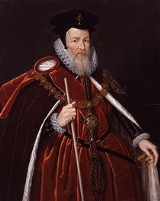
William Cecil, 1st Baron Burghley


   Email Print
   Bookmark   Link


William Cecil, 1st Baron Burghley


William Cecil, 1st Baron Burghley, was an EnglishEngland

England is the largest and most populous constituent country of the United Kingdom....
 statesmanStatesman

The term statesman is a respectful term used to refer to politicians, and other notable figures of state....
, the chief advisor of Queen Elizabeth IElizabeth I of England

Elizabeth I was Queen of England, Queen of France , and Queen of Ireland from 17 November 1558 until her death....
 for most of her reignReign

A reign is a period of time a person serves as a monarch or pope....
, twice Secretary of StateSecretary of State (United Kingdom)

In the United Kingdom, a Secretary of State is a Cabinet Minister in charge of a Government Department ...
 (1550–1553 and 1558–1572) and Lord High TreasurerLord High Treasurer

The post of Lord High Treasurer or Lord Treasurer is an ancient English government position....
 from 1572.
Early lifeCecil was born in Bourne, LincolnshireBourne, Lincolnshire

Bourne is a market town on the western edge of The Fens, in southern Lincolnshire, England....
 in 1520, the son of Richard CecilRichard Cecil (courtier) Summary

Richard Cecil was a resident of Burghley in the parish of Stamford Baron, Northamptonshire....
, owner of the BurghleyBurghley House

Burghley House is a grand 16th-century English country house near the town of Stamford in Lincolnshire....
 estateEstate (house) Summary

An estate comprises the houses and outbuildings and supporting farmland and woods that surround the gardens and grounds of a...
 (near Stamford, LincolnshireStamford, Lincolnshire

Stamford is a town on the River Welland in Lincolnshire, England....
), and his wife, Jane Heckington.

PedigreePedigree

Pedigree can refer to:* Pedigree...
s, elaborated by Cecil himself with the help of William CamdenWilliam Camden

William Camden was an English antiquarian and historian....
 the antiquary, associated him with the Cecils or Sitsyllts of Allt-Yr-Ynys, Walterstone on the border of HerefordshireHerefordshire Summary

Herefordshire is a traditional and ceremonial county and unitary district in the West Midlands region of England....
 and MonmouthshireMonmouthshire

Monmouthshire is a historic county and principal area in south-east Wales. ...
, and traced his descent from an Owen of the time of King HaroldHarold Godwinson

Harold Godwinson, or Harold II of England was the last Anglo-Saxon King of England....
 and a Sitsyllt of the reign of William Rufus. The connection with the Herefordshire family is not so impossible as the descent from Sitsyllt; but the earliest known authentic ancestor of the Lord Treasurer is his grandfather, David, who, according to Burghley's enemies, kept the best innInn

Inns are establishments where travellers can procure food, drink, and lodging....
 in Stamford.


Discussion
Ask a question about 'William Cecil, 1st Baron Burghley'
Start a new discussion about 'William Cecil, 1st Baron Burghley'
Answer questions from other users
Full Discussion Forum


Timeline

1520   Born

1598   Died


Encyclopedia


William Cecil, 1st Baron Burghley, was an EnglishEngland

England is the largest and most populous constituent country of the United Kingdom....
 statesmanStatesman

The term statesman is a respectful term used to refer to politicians, and other notable figures of state....
, the chief advisor of Queen Elizabeth IElizabeth I of England

Elizabeth I was Queen of England, Queen of France , and Queen of Ireland from 17 November 1558 until her death....
 for most of her reignReign

A reign is a period of time a person serves as a monarch or pope....
, twice Secretary of StateSecretary of State (United Kingdom)

In the United Kingdom, a Secretary of State is a Cabinet Minister in charge of a Government Department ...
 (1550–1553 and 1558–1572) and Lord High TreasurerLord High Treasurer

The post of Lord High Treasurer or Lord Treasurer is an ancient English government position....
 from 1572.

Early life

Cecil was born in Bourne, LincolnshireBourne, Lincolnshire

Bourne is a market town on the western edge of The Fens, in southern Lincolnshire, England....
 in 1520, the son of Richard CecilRichard Cecil (courtier) Summary

Richard Cecil was a resident of Burghley in the parish of Stamford Baron, Northamptonshire....
, owner of the BurghleyBurghley House

Burghley House is a grand 16th-century English country house near the town of Stamford in Lincolnshire....
 estateEstate (house) Summary

An estate comprises the houses and outbuildings and supporting farmland and woods that surround the gardens and grounds of a...
 (near Stamford, LincolnshireStamford, Lincolnshire

Stamford is a town on the River Welland in Lincolnshire, England....
), and his wife, Jane Heckington.

PedigreePedigree

Pedigree can refer to:* Pedigree...
s, elaborated by Cecil himself with the help of William CamdenWilliam Camden

William Camden was an English antiquarian and historian....
 the antiquary, associated him with the Cecils or Sitsyllts of Allt-Yr-Ynys, Walterstone on the border of HerefordshireHerefordshire Summary

Herefordshire is a traditional and ceremonial county and unitary district in the West Midlands region of England....
 and MonmouthshireMonmouthshire

Monmouthshire is a historic county and principal area in south-east Wales. ...
, and traced his descent from an Owen of the time of King HaroldHarold Godwinson

Harold Godwinson, or Harold II of England was the last Anglo-Saxon King of England....
 and a Sitsyllt of the reign of William Rufus. The connection with the Herefordshire family is not so impossible as the descent from Sitsyllt; but the earliest known authentic ancestor of the Lord Treasurer is his grandfather, David, who, according to Burghley's enemies, kept the best innInn

Inns are establishments where travellers can procure food, drink, and lodging....
 in Stamford. David somehow secured the favour of Henry VIIHenry VII of England

Henry VII , King of England, Lord of Ireland , was the founder and first patriarch of the Tudor dynasty. ...
, to whom he seems to have been Yeoman of the GuardYeomen of the Guard

The Queen's Body Guard of the Yeomen of the Guard are a bodyguard of the British Monarch....
. He was Sergeant-of-ArmsSerjeant-at-Arms

A Serjeant at Arms is an officer appointed by a deliberative body, usually a legislature, to keep order during its meetings....
 to Henry VIIIFacts About Henry VIII of England

Henry VIII was King of England and Lord of Ireland from 22 April 1509 until his death....
 in 1526, Sheriff of NorthamptonshireHigh Sheriff of Northamptonshire

*1532–1533: William Spencer*1907: Henry Brassey, 1st Baron Brassey...
 in 1532, and a Justice of the PeaceJustice of the Peace

A Justice of the Peace is a puisne judicial officer appointed by means of a commission to keep the peace....
 for RutlandRutland Overview

Rutland is traditionally England's smallest county and is bounded on the west and north by Leicestershire, northeast by Linc...
. His eldest son, Richard, YeomanYeoman

A yeoman was a late medieval British farmer of middling social status who owned his own land and often farmed it himself....
 of the Wardrobe (d. 1554), married Jane, daughter of William Heckington of Bourne, and was father of three daughters and the future Lord Burghley.

William, the only son, was put to school first at The King's School, GranthamThe King's School, Grantham

The King's School, is an English educational institution in Grantham, Lincolnshire with an unbroken history on the same site...
 and then at Stamford SchoolStamford School

Stamford School is an English public school in the market town of Stamford, Lincolnshire....
, which he later saved and endowed. In May 1535, at the age of fourteen, he went up to St John's College, CambridgeSt John's College, Cambridge

St John's College is a constituent college of the University of Cambridge, and was founded by Lady Margaret Beaufort in 1511...
, where he was brought into contact with the foremost educationEducation

Education is the process by which an individual is encouraged and enabled to develop fully his or her innate potential; it m...
alists of the time, Roger AschamRoger Ascham Overview

Roger Ascham, English scholar and didactic writer, was born at Kirby Wiske, a village in the North Riding of Yorkshire, near...
 and John ChekeJohn Cheke

Sir John Cheke was an English classical scholar and statesman, notable as the first Regius Professor of Greek at Cambridge....
, and acquired an unusual knowledge of GreekGreek language

Greek has a documented history of 3,500 years, the longest of any single language within the Indo-European family....
. He also acquired the affections of Cheke's sister, Mary, and was in 1541 removed by his father to Gray's InnGray's Inn

Gray's Inn is one of the four Inns of Court around the Royal Courts of Justice in London, England to which barristers belong...
, without, after six years' residence at Cambridge, having taken a degreeAcademic degree

A degree is any of a wide range of status levels conferred by institutions of higher education, such as universities, normal...
. The precaution proved useless and four months later Cecil committed one of the rare rash acts of his life in marrying Mary Cheke. The only child of this marriage, ThomasThomas Cecil, 1st Earl of Exeter

Thomas Cecil, 1st Earl of Exeter KG, was the eldest son of William Cecil, 1st Baron Burghley....
, the future Earl of Exeter, was born in May 1542, and in February 1543 Cecil's first wife died. Three years later, on 21 December 1546 he married Mildred, daughter of Sir Anthony CookeAnthony Cooke

Sir Anthony Cooke an eminent scholar, tutor to women and to Edward VI....
, who was ranked by Ascham with Lady Jane GreyLady Jane Grey

Lady Jane Grey, a great-grand-daughter of Henry VII of England, reigned as uncrowned queen regnant of the Kingdom of England...
 as one of the two most learned ladies in the kingdom, and whose sister, Anne, became the wife of Sir NicholasNicholas Bacon

Sir Nicholas Bacon was an English politician during the reign of Queen Elizabeth I of England, notable as Lord Keeper of th...
 (and the mother of Sir Francis) Bacon.

Reign of Elizabeth

By that time Cecil had begun to trim his sails to a different breeze. He was in secret communication with the future Elizabeth IFacts About Elizabeth I of England

Elizabeth I was Queen of England, Queen of France , and Queen of Ireland from 17 November 1558 until her death....
 before Mary died, and from the first the new Queen relied on Cecil as she relied on no one else. Her confidence was not misplaced; Cecil was exactly the kind of minister England then required. Personal experiencePersonal experience

Personal experience of a human being is the actual moment-to-moment experience and sensory awareness of our being alive and ...
 had ripened his rare natural gift for avoiding dangers. It was no time for brilliant initiative or adventurous politics; the need was to avoid Scylla and CharybdisScylla and Charybdis

Scylla and Charybdis are two sea monsters of Greek mythology situated on opposite sides of a narrow channel of water, so clo...
, and a via mediaVia media

Via Media is Latin, "the middle way," and can mean:...
(middle way) had to be found in Church and State, at home and abroad. Cecil was not a visionary political genius; no great ideas emanated from his brain. Nonetheless, he was an extremely capable man. His tight control over the finances of the Crown, leadership of the Privy Council, and the creation of a highly capable intelligence service under the direction of Francis WalsinghamFrancis Walsingham

Sir Francis Walsingham is remembered by history as the "spymaster" of Queen Elizabeth I of England....
 made him the de facto ruler of England for the majority of Elizabeth's reign. Noteworthy are those instances in which his and Elizabeth's will diverged on matters of state: it was Cecil's will, not hers, that inevitably prevailed. Not an original thinker perhaps, but a statesman of unrivalled competence. Calculation was his supreme characteristic; he saw that above all things England required time. He restored the fortunes of his country by deliberation. He averted open rupture until England was strong enough to stand the shock.

Though a Protestant, Cecil was not a religious purist; he aided the Huguenots and the DutchDutch people

The Dutch are the dominant ethnic groupThe ethnic group of the Dutch refers to a human population whose members identi...
 just enough to keep them going in the struggles which warded danger from England's shores. But Cecil never developed that passionate aversion from decided measures which became a second nature to Elizabeth. His intervention in Scotland in 1559–1560 showed that he could strike hard when necessary; and his action over the execution of Mary, Queen of ScotsMary I of Scotland

Mary I of Scotland was the Queen of Scots from December 14 1542 to July 24 1567....
, proved that he was willing to take on responsibilities from which the Queen shrank.

Generally he was in favour of more decided intervention on behalf of continental Protestants than Elizabeth would have liked, but it is not always easy to ascertain the advice he gave. He left endless memorandaMemorandum

A memorandum or memo is a written form of communication most often employed in business environments....
 lucidly setting forth the pros and cons of every course of action; but there are few indications of the line which he actually recommended when it came to a decision. How far he was personally responsible for the Anglican SettlementElizabethan Religious Settlement

The Elizabethan Religious Settlement was Elizabeth Is response to the religious divisions created over the reigns of Henry V...
, the Poor LawPoor Law

The Poor Law was the system for the provision of social security in operation in England and the rest of the United Kingdom ...
s, and the foreign policyForeign policy

A foreign policy is a set of political goals that seeks to outline how a particular country will interact with other countri...
 of the reign, how far he was thwarted by the baleful influence of LeicesterRobert Dudley, 1st Earl of Leicester

Robert Dudley, 1st Earl of Leicester was the long-standing favourite of Queen Elizabeth I of England....
 and the capriceCaprice

People and things commonly known as Caprice include:...
s of the Queen, remains to a large extent a matter of conjecture. However, it is most likely that Cecil's views carried the day in the politics of Elizabethan England.

His share in the Religious SettlementElizabethan Religious Settlement

The Elizabethan Religious Settlement was Elizabeth Is response to the religious divisions created over the reigns of Henry V...
 of 1559 was considerable, and it coincided fairly with his own Anglican religious views. Like the mass of the nation, he grew more Protestant as time wore on; he was happier to persecute Catholics than Puritans; And he had no love for ecclesiastical jurisdiction. He warmly remonstrated with John WhitgiftJohn Whitgift Summary

John Whitgift was Archbishop of Canterbury from 1583 until his death....
, the Anglican Archbishop of CanterburyArchbishop of Canterbury

The Archbishop of Canterbury is the head of the Church of England and of the worldwide Anglican Communion....
, over his persecuting Articles of 1583. The finest encomiumEncomium

Encomium is a Greek word which, in a general sense, means the praise of a person or thing....
 was passed on him by the queen herself, when she said, "This judgment I have of you, that you will not be corrupted with any manner of gifts, and that you will be faithful to the state."

From 1558, for forty years, the biography of Cecil is almost indistinguishable from that of Elizabeth and from the history of England. When she came to the throne in 1558, she appointed him Secretary of StateFacts About Secretary of State (United Kingdom)

In the United Kingdom, a Secretary of State is a Cabinet Minister in charge of a Government Department ...
. Of personal incident, apart from his mission to Scotland in 1560, there is little. He represented LincolnshireLincolnshire (UK Parliament constituency)

Lincolnshire was a county constituency of the Parliament of the United Kingdom, which returned two Members of Parliament to...
 in the Parliament of 1559, and NorthamptonshireNorthamptonshire (UK Parliament constituency)

The county constituency of Northamptonshire, in the East Midlands of England, was abolished when the county was divided for ...
 in that of 1563, and he took an active part in the proceedings of the House of CommonsBritish House of Commons

|align=left|*Parliament**State Opening of Parliament...
 until his elevation to the peerageHouse of Lords

The House of Lords is the upper house of the Parliament of the United Kingdom....
; but there seems no good evidence for the story that he was proposed as SpeakerSpeaker of the British House of Commons

In the United Kingdom, the Speaker of the House of Commons is the presiding officer of the House of Commons, and is seen his...
 in 1563. In January 1561, he was given the lucrative office of Master of the Court of Wards and LiveriesCourt of Wards and Liveries

The Court of Wards and Liveries was a court established during the reign of Henry VIII in England....
 in succession to Sir Thomas Parry, and he did something to reform that instrument of tyranny and abuse. In February 1559, he was elected Chancellor of Cambridge University in succession to Cardinal Pole; he was created M.A.Master of Arts (postgraduate)

A Master of Arts is a postgraduate academic master's degree awarded by universities in North America and the United Kingdom....
 of that university on the occasion of Elizabeth's visit in 1564, and M.A. of Oxford on a similar occasion in 1566.

He was the first Chancellor of Trinity College, DublinUniversity of Dublin

The University of Dublin, corporately designated the Chancellor, Doctors and Masters of the University of Dublin locat...
 between 1592 and 1598.

The American international relations theorist Hans MorgenthauHans Morgenthau

Hans Joachim Morgenthau was an International Relations theorist and one of the most influential ones to date....
 claimed Burghley accepted a pension (a bribe) from Spain, although Burghley's biographer Conyers Read has claimed that there is no evidence for this.

On 25 February 1571, in anticipation of the impending marriage between Cecil's daughter Anne (b. 1556) to Edward de Vere, 17th Earl of OxfordEdward de Vere, 17th Earl of Oxford

Edward de Vere, 17th Earl of Oxford , Elizabethan literary figure, was born at Castle Hedingham to John de Vere, 16th Earl o...
, Queen Elizabeth created him Baron Burghley. The fact that he continued to act as Secretary of State after his elevation illustrates the growing importance of that office, which under his son became a secretary of the ship of state. In 1572, however, Lord WinchesterWilliam Paulet, 1st Marquess of Winchester

Sir William Paulet was an English statesman who attained several peerages throughout his lifetime: Baron St John, E...
, who had been Lord High TreasurerLord High Treasurer

The post of Lord High Treasurer or Lord Treasurer is an ancient English government position....
 under Edward, Mary and Elizabeth, died, and Burghley succeeded to his post. It was a signal triumph over Leicester; and, although Burghley had still to reckon with cabalCabal

A cabal is a number of persons united in some close design, usually to promote their private views and interests in a church...
s in the council and at court, his hold over the queen strengthened with the lapse of years. He collapsed (possibly from a stroke or heart attack) in 1592. Before he died, Robert, his only surviving son by his second wife, was ready to step into his shoes as the Queen's principal adviser. Having survived all his rivals, and all his children except Robert and Thomas, Burghley died at his London residenceCecil House

Cecil House refers to two historical mansions on the Strand, London....
 on 4 August 1598, and was buried in St Martin's church, Stamford.

His younger son, Sir Robert CecilRobert Cecil, 1st Earl of Salisbury

Robert Cecil, 1st Earl of Salisbury, KG, PC, son of William Cecil, 1st Baron Burghley and half-brother of Thomas Cecil, 1st ...
 (later created Baron Cecil, Viscount Cranborne and finally Earl of SalisburyMarquess of Salisbury

The title Marquess of Salisbury is a British title of Peerage, created in 1789 for James Cecil, 7th Earl of Salisbury....
), inherited his political mantle, taking on the role of chief minister and arranging a smooth transfer of power to the StuartHouse of Stuart

The House of Stuart or Stewart was a royal house of the Kingdom of Scotland, later of the Kingdom of England, and fina...
 administration under King James IJames I of England

James VI of Scotland/James I of England and Ireland was King of England, King of Scots, and King of Ireland and was the firs...
. His elder son, Sir Thomas CecilThomas Cecil, 1st Earl of Exeter

Thomas Cecil, 1st Earl of Exeter KG, was the eldest son of William Cecil, 1st Baron Burghley....
, who inherited the Barony of Burghley on his death, was later created Earl of Exeter.

Private life

In strange contrast to his public unscrupulousness, Burghley's private life seems to have been upright; he was a faithful husband, a careful father and a dutiful master. A book-lover and antiquarian, he made a special hobbyFacts About Hobby

A hobby is a spare-time recreational pursuit....
 of heraldryHeraldry

Heraldry is the practice of designing, displaying, describing and recording coats of arms and badges, as well as the formal ...
 and genealogyGenealogy

Genealogy is the study and tracing of family pedigrees....
. It was the conscious and unconscious aim of the age to reconstruct a new landed aristocracyFacts About Aristocracy

The Ancient Greek term aristocracy meant a system of government with "rule by the best"....
 on the ruins of the old, Catholic order. As such, Burghley was a great builder, planter and patron. All the arts of architectureArchitecture Summary

* Architectural history* Architectural mythology...
 and horticultureHorticulture

The Latin words hortus and cultura together form horticulture, classically defined as the culture or growing of gard...
 were lavished on Burghley HouseBurghley House Summary

Burghley House is a grand 16th-century English country house near the town of Stamford in Lincolnshire....
 and TheobaldsTheobalds House

Theobalds House, located in Theobalds Park, just outside Cheshunt in the English county of Hertfordshire, was a prominent st...
 (which his son, Robert, was to exchange with James I for Hatfield HouseHatfield House

Hatfield House is a country house set in a large park, the Great Park, on the eastern side of the town of Hatfield, Hertford...
). His public conduct does not present itself in quite so amiable a light. As the Marquess of WinchesterWilliam Paulet, 1st Marquess of Winchester

Sir William Paulet was an English statesman who attained several peerages throughout his lifetime: Baron St John, E...
 (Burghley's predecessor as Lord High Treasurer) had said of himself, Burghley was "sprung from the willow rather than the oak" (in other words, morally flexible) He was not a man to suffer for his convictions, and he willingly sent people to their deaths over matters he would never trifle over. The interests of the State were his supreme consideration and to that end he felt no hesitation in sacrificing his conscience. He frankly disbelieved in toleration: "That State...could never be in safety where there was a toleration of two religions. For there is no enmity so great as that for religion; and therefore they that differ in the service of their God can never agree in the service of their country." With a maximMaxim (philosophy)

According to Immanuel Kant, a maxim is a subjective principle or rule that the will of an individual uses in making a decisi...
 such as this, it was easy for him to maintain that Elizabeth's --and his-- brutal measures were political and not religious. To say that he was Machiavellian is pointless, for every statesmanStatesman

The term statesman is a respectful term used to refer to politicians, and other notable figures of state....
 is so, more or less; especially in the 16th century16th century

As a means of recording the passage of time, the 16th century was that century which lasted from 1501 to 1600....
 men preferred efficiency over principle. On the other hand, Burghley may have felt that principles are valueless without law and orderFacts About Law and order (politics)

In politics, law and order refers to a political platform which supports a strict criminal justice system, especially in rel...
; and that his craft and subtlety prepared a security in which principles might find some scope.
The descendents of Lord Burghley from his first wife are many, including Lord William Alleyne Cecil, Lord Burghley, 3rd Marquess of Exeter, and his sons, Lord Brownlow Henry George Cecil, 4th Marquess of Exeter and his brother Lord Francis Horace Pierrepont Cecil. Many of their descendents, through Lady Ethel Frances Sophia Cecil, daughter of Lord Francis Cecil,(born 1875) currently live in the United States, and include Isabella and Catherine Overington.

Nicholas White

The most prolonged of Cecil's surviving personal correspondenceCorrespondence

Correspondence may refer to:*Correspondence, the relationship between spiritual and physical realities...
s is with an IrishIreland

Ireland is the third largest island in Europe....
 judgeJudge

A judge or justice is an official who presides over a court....
, Nicholas WhiteNicholas White

Sir Nicholas White was an Irish lawyer and government official during the reign of Elizabeth I....
, lasting from 1566 until 1590; it is contained in the State Papers Ireland 63 and Lansdowne MS 102, but receives hardly a mention in the literature on Cecil.

White had been a tutorTutor

English and Irish secondary schoolsIn English and Irish Secondary Schools the Form Tutor is similar to an American Home Roo...
 to Cecil's children during his student days in London, and the correspondence suggests that he was held in lasting affection by the family. In the end, White fell into a DublinDublin Summary

Dublin is the capital and the largest city of the Republic of Ireland , located near the midpoint of Ireland's east coast, ...
 controversy over the confessions of an intriguing priest, which threatened the authority of the Queen's deputised government in IrelandIreland

Ireland is the third largest island in Europe....
; out of caution Cecil withdrew his longstanding protection, and the judge was imprisoned in London and died soon after.

White's most remarked-upon service for Cecil is his report on his visit with Mary, Queen of ScotsMary I of Scotland

Mary I of Scotland was the Queen of Scots from December 14 1542 to July 24 1567....
 in 1569, during the early years of her imprisonment by Queen Elizabeth. He may have published an English translation of the Argonautica in the 1560s1560s Summary

----Events and Trends* In 1564 William Shakespeare was born....
, but no copy has survived.

Description

"This Cecil, who was a man of extraordinary abilities, and of still greater prudence and cunning, was the chief prop of her (Elizabeth's) throne for nearly forty of the forty-three years of her reign. He died in 1598, in the seventy-seventh year of his age; and if success in unprincipled artifice, if fertility in cunning devices, if the obtaining of one's ends without any regard to the means, if in this pursuit sincerity be set at nought, and truth, law, justice, and mercy be trampled underfoot, if, so that you succeed in your end, apostasy, forgery, perjury, and the shedding of innocent blood be thought nothing of, this Cecil was certainly the greatest statesman that ever lived." William Cobbet - "The History of the Protestant Reformation in England and Ireland"

In Popular Culture

William Cecil has been a character in many works of fiction and documentary essay concerned with Elizabeth I's reign.
The most recent, and perhaps best known depiction is by Sir Richard AttenboroughRichard Attenborough

Richard Samuel Attenborough, Baron Attenborough, CBE is a prolific English film and stage actor, and Academy Award-winning d...
 in the films ElizabethElizabeth (film)

Elizabeth is a 1998 movie about the early reign of Queen Elizabeth I of England, written by Michael Hirst and directed b...
 and its sequel, .

"History teaches, Never Trust a Cecil!" (quoted, inter alia, regarding Lord CranborneRobert Gascoyne-Cecil, 7th Marquess of Salisbury

Robert Michael James Gascoyne-Cecil, 7th Marquess of Salisbury, PC, is a Conservative politician....
, a contemporary member of the Cecil family, dismissed from his Conservative Party office in the House of Lords for conducting unauthorised negotiations with the Labour government)

External links

|-