


History of Sufism

Encyclopedia
Sufism
is a mystic and ascetic movement which originated in the Golden Age of Islam, from about the 9th to 10th centuries.
The emergence of Sufism is a consequence of the wide geographical spread of Islam after the Rashidun conquests
, and the resulting absorption of a wide range of mystic traditions from outside Arabia, especially Greater Persia
.
Sufism became a more formalized movement by the 12th century, and was a very successful movement throughout the Muslim world
during the 13th to 16th centuries.
There also were numerous Sufi orders active in the modern period, especially in non-Arab
parts of the Muslim world.
since its very beginnings. Some of the greatest and most renowned Sufis were from this region,
including 8th century saints such as Al-Fozail ibn Iyaz and Ibrahim ibn Adham and their successors, e.g. Shaqiq al-Balkhi
and al-Farabi
(9th century).
Towards the end of the first millennium CE, a number of manuals began to be written summarizing the doctrines of Sufism and describing some typical Sufi practices. Two of the most famous of these are now available in English translation: the Kashf al-Mahjûb of Hujwiri, and the Risâla of Qushayri.
Two of Imam Al Ghazali's greatest treatises, the "Revival of Religious Sciences" and the "Alchemy of Happiness," argued that Sufism originated from the Qur'an and was thus compatible with mainstream Islamic thought, and did not in any way contradict Islamic Law—being instead necessary to its complete fulfillment. This became the mainstream position among Islamic scholars for centuries, challenged only recently on the basis of selective use of a limited body of texts . Ongoing efforts by both traditionally trained Muslim scholars and Western academics are making Imam Al-Ghazali's works available in English translation for the first time, allowing English-speaking readers to judge for themselves the compatibility of Islamic Law and Sufi doctrine.
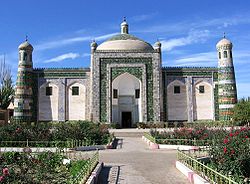
, khanqah
, or tekke) would be endowed through a pious foundation in perpetuity (waqf
) to provide a gathering place for Sufi adepts, as well as lodging for itinerant seekers of knowledge. The same system of endowments could also be used to pay for a complex of buildings, such as that surrounding the Süleymaniye Mosque in Istanbul, including a lodge for Sufi seekers, a hospice
with kitchens where these seekers could serve the poor and/or complete a period of initiation, a library, and other structures. No important domain in the civilization of Islam remained unaffected by Sufism in this period.
Sufism was an important factor in the historical spread of Islam, and in the creation of regional Islamic cultures, especially in Africa and Asia. Recent academic work on these topics has focused on the role of Sufism in creating and propagating the culture of the Ottoman
world, and in resisting European imperialism in North Africa and South Asia.

 Muslims of South Asia prominently follow the Chishtiyya, Naqshbandiyyah, Qadiriyyah and Suhrawardiyyah orders. Of them the Chishti order is the most visible. Khwaja Moinuddin Chishti
, a disciple of Khwaja Usman haaroni, the propounder of this order, introduced it in India. He came to India from Afghanistan
with the army of Shihab-ud-Din Ghuri in 1192 AD and started living permanently in Ajmer
from 1195. Centuries later, with the support of Mughal rulers, his shrine became a place of pilgrimage. Akbar used to visit the shrine every year.
Turkic conquests in South Asia were accompanied by four Sufi mystics of the Chishtiyya order from Afghanistan: Moinuddin
(d. 1233 in Ajmer), Qutbuddin
(d. 1236 in Delhi
), Nizamuddin
(d.1335 in Delhi
) and Fariduddin (d.1265 in Pakpattan
now in Pakistan
) . During the reign of Muhammad bin Tughluq
, who spread the Delhi sultanate
towards the south, the Chistiyya spread its roots all across India. The Sufi shine at Ajmer in Rajasthan
and Nizamuddin Auliya
in Delhi belong to this order.
Some Sufis under the Chishtiyya order were not against absorbing ideas from the Hindu
Bhakti
movement and even used Hindi for their devotional songs. However, the orthodox Ulama
with royal support insisted that the Sufis go "back to Shariat". Even though the Ulama had certain differences with Sufis over theological and mystic issues, the Shariat remained a cementing force between them.
The Suharawardy order was started by Shahab al-Din Suhrawardi
of Baghdad
and brought to India by Baha-ud-din Zakariya
of Multan
. Suhrawardiyyah order of Sufism gained popularity in Bengal
. The Qadiriyyah order founded by Abdul Qadir Gilani whose tomb is at Baghdad. It is popular among the Muslims of South India
.
Baha-ud-Din Naqshband
(1318-1389) of Turkestan
founded Naqshbandi
order of Sufism. Khwaja Mohhammad Baqi Billah Berang whose tomb is in Delhi (E.I.Rose ) introduced Naqshbandi order in India. The essence of this order was insistence on rigid adherence to Shariat and nurturing love for prophet. It was patronized by the Mughal rulers, as its founder was their ancestral 'Pir
' (Spiritual guide). "The conquest of India by Babur
in 1526 gave considerable impetus to the Naqshbandiyya order" . Its disciples remained loyal to the throne because of the common Turkic origin. With the royal patronage of most of the Mughal rulers, the Naqshbandi order caused the revival of Islam in its pure form.
has been seen in two different ways. For some it reflects the influence of mystical tradition started by Ibn Masarra
. For others it has to do with the influence of Ghazali's thoughts and teachings.
During the twelfth century the foundation for mystic thought in the western world lay in Spain. In Spain intellectual activity had already reached a pre-eminence that was rarely enjoyed by mystics in the East. Due to this Sufis from Al-Andalus
during the sixth/twelfth century created their own doctrines.
The earliest introduction of Sufism to Spain was by Ibn Masarrah. He was considered to have established the first Sufi school in the providence. It is believed by some that he is the originator of a system of thought that is followed by Almerian followers and Ibn ‘Arabi. There is no historical connection linking this claim however. Early Fuquahs in Spain were somewhat skeptical of philosophical thought as well as Sufi speculation. The works of Ghazali were also committed to flames by the Murabit Prince.
By the twelfth Century however, times had begun to change. Many people began to read the works of thinkers such as Aristotle
and Plato
. Some of the people at the forefront of the philosophical movement in Spain were Ibn Bajjah
, Ibn Tufail
, Ibn Rushd as well as a Jewish scholar named Ibn Maimun. It was Ibn Tufail
who introduced the element of Sufism into this philosophical way of thinking.-
At the same time that Ibn Tufail
was introducing Sufi ways of thinking into philosophy a group of Sufi masters was emerging from “the famous centers of Spain.” These scholars defended the works of theosophists such as Ghazali and Al-Qushairi. Abu l-‘Abbas ibn al-‘Arif is described as being one of the first to interpret Ghazali in the West. He is also described as the founder of a method of spiritual training called tariqah. Ibn al-‘Arif had a disciple known as Ibn Qasi who set up a group of religious followers in Portugal and built a monastery in Silves. He left a work known as Khal al-Na’lain, which ‘Arabi has written a commentary on.
A school was also set up in Seville and was headed by Ibn Barrajah, who was considered to be one of the most philosophical of all Sufis. He came from North Africa.
One of the most important Sufis to come out of Spain is Ibn ‘Arabi. Ibn ‘Arabi was born in Marcia in 1165 (AH 560) at the beginning of the Almohad
reign. As a child he moved with his father, a high ranking Muslim official, to Seville where his father was given a post in the Almohad sultans administration. Ibn ‘Arabi was schooled in the traditional Islamic sciences and quickly mastered the major fields of Islamic knowledge. In his teens Ibn ‘Arabi converted to Sufism. He dismissed all of his well to do friends and devoted his life to God. He acquired all the knowledge he could from the Sheikhis in Seville then he began to search the Iberian Peninsula
for renown spiritual tutors. He came into contact with the great Sufi master from North Africa Abu Madyon, but soon surpassed even him. He went on a pilgrimage to Mecca in 1201 (AH 598), he would never again return to Andalusia.
Some of Ibn ‘Arabi’s writings include Fusus al-hikam ("The Ringstones of Wisdom"), Al-Futuhat al-makkiyya ("The Meccan Openings"), and Tarjuman al-ashwaq ("The Interpreter of Yearnings"). His works in Andalusia focused mainly on the prefect human individual, monastic metaphysics, and mystical path to spiritual and intellectual perfection.
Other important Sufis include Ibn Masarra
who was an important mystical thinker of the time and who is credited with setting up the first Sufi school in Spain. There is also Abu Ja’far al-‘Uryani, and Nunah Fatimah bit Ibn al-Mathanna whom Ibn ‘Arabi discusses in his book Sufi’s of Andalusia.
, Nimatullahi, Oveyssi, Qadiria Boutshishia, Qadiriyyah, Qalandariyya, Sarwari Qadiri
, Shadhliyya
and Suhrawardiyya
.
Sufism is popular in such African countries as Morocco
and Senegal
, where it is seen as a mystical expression of Islam. Sufism is traditional in Morocco but has seen a growing revival with the renewal of sufism around contemporary spiritual teachers such as Sidi Hamza al Qadiri al Boutshishi. Mbacke suggests that one reason Sufism has taken hold in Senegal is because it can accommodate local beliefs and customs, which tend toward the mystical.
Sufism suffered setbacks in North Africa during the colonial period; the life of the Algerian Sufi master Emir Abd al-Qadir is instructive in this regard. Notable as well are the lives of Amadou Bamba
and Hajj Umar Tall
in sub-Saharan Africa, and Sheikh Mansur
Ushurma and Imam Shamil
in the Caucasus region.
In the 20th century some more modernist Muslims have called Sufism a superstitious religion that holds back Islamic achievement in the fields of science and technology.
A number of western converts to Islam have also embraced Sufism, sometimes resulting in considerable syncretism
or generic spiritualism detached from Islam, as in the case of "Universal Sufism
" or the writings of René Guénon
or G. I. Gurdjieff
.
One of the first to return to Europe as an official representative of a Sufi order, and with the specific purpose to spread Sufism in Western Europe, was the Ivan Aguéli
.
Other noteworthy Sufi teachers who were active in the West include Bawa Muhaiyaddeen
, Inayat Khan
, Nazim Al-Haqqani
, Javad Nurbakhsh
, Bulent Rauf
, Irina Tweedie
, Idries Shah
and Muzaffer Ozak
.
Currently active Sufi academics and publishers include Llewellyn Vaughan-Lee
, Nuh Ha Mim Keller
, Abdullah Nooruddeen Durkee
, Abdal Hakim Murad and the Franco-Moroccan Faouzi Skali.
Sufism
Sufism or ' is defined by its adherents as the inner, mystical dimension of Islam. A practitioner of this tradition is generally known as a '...
is a mystic and ascetic movement which originated in the Golden Age of Islam, from about the 9th to 10th centuries.
The emergence of Sufism is a consequence of the wide geographical spread of Islam after the Rashidun conquests
Muslim conquests
Muslim conquests also referred to as the Islamic conquests or Arab conquests, began with the Islamic prophet Muhammad. He established a new unified polity in the Arabian Peninsula which under the subsequent Rashidun and Umayyad Caliphates saw a century of rapid expansion of Muslim power.They...
, and the resulting absorption of a wide range of mystic traditions from outside Arabia, especially Greater Persia
Islamic conquest of Persia
The Muslim conquest of Persia led to the end of the Sassanid Empire in 644, the fall of Sassanid dynasty in 651 and the eventual decline of the Zoroastrian religion in Persia...
.
Sufism became a more formalized movement by the 12th century, and was a very successful movement throughout the Muslim world
Muslim world
The term Muslim world has several meanings. In a religious sense, it refers to those who adhere to the teachings of Islam, referred to as Muslims. In a cultural sense, it refers to Islamic civilization, inclusive of non-Muslims living in that civilization...
during the 13th to 16th centuries.
There also were numerous Sufi orders active in the modern period, especially in non-Arab
Arab world
The Arab world refers to Arabic-speaking states, territories and populations in North Africa, Western Asia and elsewhere.The standard definition of the Arab world comprises the 22 states and territories of the Arab League stretching from the Atlantic Ocean in the west to the Arabian Sea in the...
parts of the Muslim world.
Early history
Sufism has been known in Transoxania and KhorasanGreater Khorasan
Greater Khorasan or Ancient Khorasan is a historical region of Greater Iran mentioned in sources from Sassanid and Islamic eras which "frequently" had a denotation wider than current three provinces of Khorasan in Iran...
since its very beginnings. Some of the greatest and most renowned Sufis were from this region,
including 8th century saints such as Al-Fozail ibn Iyaz and Ibrahim ibn Adham and their successors, e.g. Shaqiq al-Balkhi
Shaqiq al-Balkhi
Shaqiq al-Balkhi was an early Sufi saint of the Khorasan school.Tradition makes him the disciple of Ibrahim ibn Adham.He emphazised the importance of tawakkul or reliance upon God.-References:...
and al-Farabi
Al-Farabi
' known in the West as Alpharabius , was a scientist and philosopher of the Islamic world...
(9th century).
Towards the end of the first millennium CE, a number of manuals began to be written summarizing the doctrines of Sufism and describing some typical Sufi practices. Two of the most famous of these are now available in English translation: the Kashf al-Mahjûb of Hujwiri, and the Risâla of Qushayri.
Two of Imam Al Ghazali's greatest treatises, the "Revival of Religious Sciences" and the "Alchemy of Happiness," argued that Sufism originated from the Qur'an and was thus compatible with mainstream Islamic thought, and did not in any way contradict Islamic Law—being instead necessary to its complete fulfillment. This became the mainstream position among Islamic scholars for centuries, challenged only recently on the basis of selective use of a limited body of texts . Ongoing efforts by both traditionally trained Muslim scholars and Western academics are making Imam Al-Ghazali's works available in English translation for the first time, allowing English-speaking readers to judge for themselves the compatibility of Islamic Law and Sufi doctrine.
13th to 16th centuries
Between the 13th and 16th centuries CE, Sufism produced a flourishing intellectual culture throughout the Islamic world, a "Golden Age" whose physical artifacts are still present. In many places, a lodge (known variously as a zaouiaZaouia
A zaouia or zawiya is an Islamic religious school or monastery. The term is Maghrebi and West African, roughly corresponding to the Eastern term madrassa...
, khanqah
Khanqah
A Khanqah, Khaniqah , ribat, zawiya, or tekke is a building designed specifically for gatherings of a Sufi brotherhood, or tariqa, and is a place for spiritual retreat and character reformation...
, or tekke) would be endowed through a pious foundation in perpetuity (waqf
Waqf
A waqf also spelled wakf formally known as wakf-alal-aulad is an inalienable religious endowment in Islamic law, typically denoting a building or plot of land for Muslim religious or charitable purposes. The donated assets are held by a charitable trust...
) to provide a gathering place for Sufi adepts, as well as lodging for itinerant seekers of knowledge. The same system of endowments could also be used to pay for a complex of buildings, such as that surrounding the Süleymaniye Mosque in Istanbul, including a lodge for Sufi seekers, a hospice
Hospice
Hospice is a type of care and a philosophy of care which focuses on the palliation of a terminally ill patient's symptoms.In the United States and Canada:*Gentiva Health Services, national provider of hospice and home health services...
with kitchens where these seekers could serve the poor and/or complete a period of initiation, a library, and other structures. No important domain in the civilization of Islam remained unaffected by Sufism in this period.
Sufism was an important factor in the historical spread of Islam, and in the creation of regional Islamic cultures, especially in Africa and Asia. Recent academic work on these topics has focused on the role of Sufism in creating and propagating the culture of the Ottoman
Ottoman Empire
The Ottoman EmpireIt was usually referred to as the "Ottoman Empire", the "Turkish Empire", the "Ottoman Caliphate" or more commonly "Turkey" by its contemporaries...
world, and in resisting European imperialism in North Africa and South Asia.
Spread to India
Moinuddin Chishti
Sultan-ul-Hind, Moinuddin Chishti was born in 1141 and died in 1230 CE. Also known as Gharīb Nawāz "Benefactor of the Poor" , he is the most famous Sufi saint of the Chishti Order of the Indian Subcontinent. He introduced and established the order in South Asia...
, a disciple of Khwaja Usman haaroni, the propounder of this order, introduced it in India. He came to India from Afghanistan
Afghanistan
Afghanistan , officially the Islamic Republic of Afghanistan, is a landlocked country located in the centre of Asia, forming South Asia, Central Asia and the Middle East. With a population of about 29 million, it has an area of , making it the 42nd most populous and 41st largest nation in the world...
with the army of Shihab-ud-Din Ghuri in 1192 AD and started living permanently in Ajmer
Ajmer
Ajmer , formerly written as Ajmere, is a city in Ajmer District in Rajasthan state in India. Ajmer has a population of around 800,000 , and is located west of the Rajasthan state capital Jaipur, 200 km from Jodhpur, 274 km from Udaipur, 439 km from Jaisalmer, and 391 km from...
from 1195. Centuries later, with the support of Mughal rulers, his shrine became a place of pilgrimage. Akbar used to visit the shrine every year.
Turkic conquests in South Asia were accompanied by four Sufi mystics of the Chishtiyya order from Afghanistan: Moinuddin
Moinuddin Chishti
Sultan-ul-Hind, Moinuddin Chishti was born in 1141 and died in 1230 CE. Also known as Gharīb Nawāz "Benefactor of the Poor" , he is the most famous Sufi saint of the Chishti Order of the Indian Subcontinent. He introduced and established the order in South Asia...
(d. 1233 in Ajmer), Qutbuddin
Qutbuddin Bakhtiar Kaki
Qutub ul Aqtab Hazrat Khwaja Syed Muhammad Qutbuddin Bakhtiar Kaki was a renowned Muslim Sufi mystic, saint and scholar of the Chishti Order from Delhi, India. He was the disciple and the spiritual successor of Moinuddin Chishti as head of the Chishti order. Before him the Chishti order in India...
(d. 1236 in Delhi
Delhi
Delhi , officially National Capital Territory of Delhi , is the largest metropolis by area and the second-largest by population in India, next to Mumbai. It is the eighth largest metropolis in the world by population with 16,753,265 inhabitants in the Territory at the 2011 Census...
), Nizamuddin
Nizamuddin Auliya
Sultan-ul-Mashaikh, Mehboob-e-Ilahi, Hazrat Shaikh Khwaja Syed Muhammad Nizamuddin Auliya , also known as Hazrat Nizamuddin, was a famous Sufi saint of the Chishti Order in the Indian Subcontinent, an order that believed in drawing close to God through renunciation of the world and service to...
(d.1335 in Delhi
Delhi
Delhi , officially National Capital Territory of Delhi , is the largest metropolis by area and the second-largest by population in India, next to Mumbai. It is the eighth largest metropolis in the world by population with 16,753,265 inhabitants in the Territory at the 2011 Census...
) and Fariduddin (d.1265 in Pakpattan
Pakpattan
Pakpattan is the capital city of the Pakpattan District in the Sahiwal Division in the Punjab province of Pakistan. Pakpattan is one of the ancient cities of Pakistan. It is the city that has the shrine of the well-known Sufi of all times, Baba Fareed...
now in Pakistan
Pakistan
Pakistan , officially the Islamic Republic of Pakistan is a sovereign state in South Asia. It has a coastline along the Arabian Sea and the Gulf of Oman in the south and is bordered by Afghanistan and Iran in the west, India in the east and China in the far northeast. In the north, Tajikistan...
) . During the reign of Muhammad bin Tughluq
Muhammad bin Tughluq
Muhammad bin Tughluq was the Turkic Sultan of Delhi from 1325 to 1351. He was the eldest son of Ghiyas-ud-din Tughlaq.He was born in Kotla Tolay Khan in Multan. His wife was daughter of the raja of Dipalpur...
, who spread the Delhi sultanate
Delhi Sultanate
The Delhi Sultanate is a term used to cover five short-lived, Delhi based kingdoms or sultanates, of Turkic origin in medieval India. The sultanates ruled from Delhi between 1206 and 1526, when the last was replaced by the Mughal dynasty...
towards the south, the Chistiyya spread its roots all across India. The Sufi shine at Ajmer in Rajasthan
Rajasthan
Rājasthān the land of Rajasthanis, , is the largest state of the Republic of India by area. It is located in the northwest of India. It encompasses most of the area of the large, inhospitable Great Indian Desert , which has an edge paralleling the Sutlej-Indus river valley along its border with...
and Nizamuddin Auliya
Nizamuddin Auliya
Sultan-ul-Mashaikh, Mehboob-e-Ilahi, Hazrat Shaikh Khwaja Syed Muhammad Nizamuddin Auliya , also known as Hazrat Nizamuddin, was a famous Sufi saint of the Chishti Order in the Indian Subcontinent, an order that believed in drawing close to God through renunciation of the world and service to...
in Delhi belong to this order.
Some Sufis under the Chishtiyya order were not against absorbing ideas from the Hindu
Hindu
Hindu refers to an identity associated with the philosophical, religious and cultural systems that are indigenous to the Indian subcontinent. As used in the Constitution of India, the word "Hindu" is also attributed to all persons professing any Indian religion...
Bhakti
Bhakti
In Hinduism Bhakti is religious devotion in the form of active involvement of a devotee in worship of the divine.Within monotheistic Hinduism, it is the love felt by the worshipper towards the personal God, a concept expressed in Hindu theology as Svayam Bhagavan.Bhakti can be used of either...
movement and even used Hindi for their devotional songs. However, the orthodox Ulama
Ulema
Ulama , also spelt ulema, refers to the educated class of Muslim legal scholars engaged in the several fields of Islamic studies. They are best known as the arbiters of shari‘a law...
with royal support insisted that the Sufis go "back to Shariat". Even though the Ulama had certain differences with Sufis over theological and mystic issues, the Shariat remained a cementing force between them.
The Suharawardy order was started by Shahab al-Din Suhrawardi
Shahab al-Din Suhrawardi
Other important Muslim mystics carry the name Suhrawardi, particularly Abu 'l-Najib al-Suhrawardi and his paternal nephew Abu Hafs Umar al-Suhrawardi."Shahāb ad-Dīn" Yahya ibn Habash as-Suhrawardī was a Persian...
of Baghdad
Baghdad
Baghdad is the capital of Iraq, as well as the coterminous Baghdad Governorate. The population of Baghdad in 2011 is approximately 7,216,040...
and brought to India by Baha-ud-din Zakariya
Baha-ud-din Zakariya
Baha-ud-din Zakariya was a Sufi of Suhrawardiyya order . His full name was Al-Sheikh Al-Kabir Sheikh-ul-Islam Baha-ud-Din Abu Muhammad Zakaria Al-Qureshi Al-Asadi Al Hashmi....
of Multan
Multan
Multan , is a city in the Punjab Province of Pakistan and capital of Multan District. It is located in the southern part of the province on the east bank of the Chenab River, more or less in the geographic centre of the country and about from Islamabad, from Lahore and from Karachi...
. Suhrawardiyyah order of Sufism gained popularity in Bengal
Bengal
Bengal is a historical and geographical region in the northeast region of the Indian Subcontinent at the apex of the Bay of Bengal. Today, it is mainly divided between the sovereign land of People's Republic of Bangladesh and the Indian state of West Bengal, although some regions of the previous...
. The Qadiriyyah order founded by Abdul Qadir Gilani whose tomb is at Baghdad. It is popular among the Muslims of South India
South India
South India is the area encompassing India's states of Andhra Pradesh, Karnataka, Kerala and Tamil Nadu as well as the union territories of Lakshadweep and Pondicherry, occupying 19.31% of India's area...
.
Baha-ud-Din Naqshband
Baha-ud-Din Naqshband Bukhari
Baha-ud-Din Naqshband Bukhari was the founder of what would become the Naqshbandi. He was born in Bukhara which is located in Uzbekistan...
(1318-1389) of Turkestan
Turkestan
Turkestan, spelled also as Turkistan, literally means "Land of the Turks".The term Turkestan is of Persian origin and has never been in use to denote a single nation. It was first used by Persian geographers to describe the place of Turkish peoples...
founded Naqshbandi
Naqshbandi
Naqshbandi is one of the major Sufi spiritual orders of Sufi Islam. It is considered to be a "Potent" order.The Naqshbandi order is over 1,300 years old, and is active today...
order of Sufism. Khwaja Mohhammad Baqi Billah Berang whose tomb is in Delhi (E.I.Rose ) introduced Naqshbandi order in India. The essence of this order was insistence on rigid adherence to Shariat and nurturing love for prophet. It was patronized by the Mughal rulers, as its founder was their ancestral 'Pir
Pir (Sufism)
Pir or Peer is a title for a Sufi master equally used in the nath tradition. They are also referred to as a Hazrat or Shaikh, which is Arabic for Old Man. The title is often translated into English as "saint" and could be interpreted as "Elder". In Sufism a Pir's role is to guide and instruct his...
' (Spiritual guide). "The conquest of India by Babur
Babur
Babur was a Muslim conqueror from Central Asia who, following a series of setbacks, finally succeeded in laying the basis for the Mughal dynasty of South Asia. He was a direct descendant of Timur through his father, and a descendant also of Genghis Khan through his mother...
in 1526 gave considerable impetus to the Naqshbandiyya order" . Its disciples remained loyal to the throne because of the common Turkic origin. With the royal patronage of most of the Mughal rulers, the Naqshbandi order caused the revival of Islam in its pure form.
Muslim Spain
Flourishing Sufisim in Al-AndalusAl-Andalus
Al-Andalus was the Arabic name given to a nation and territorial region also commonly referred to as Moorish Iberia. The name describes parts of the Iberian Peninsula and Septimania governed by Muslims , at various times in the period between 711 and 1492, although the territorial boundaries...
has been seen in two different ways. For some it reflects the influence of mystical tradition started by Ibn Masarra
Ibn Masarra
Abu 'Abd Allah Muhammad b. 'Abd Allah b. Masarra b. Najih al-Jabali , was an Andalusi Muslim ascetic and scholar. He is considered one of the first Sufis as well as one of the first philosophers of Al-Andalus.-References:...
. For others it has to do with the influence of Ghazali's thoughts and teachings.
During the twelfth century the foundation for mystic thought in the western world lay in Spain. In Spain intellectual activity had already reached a pre-eminence that was rarely enjoyed by mystics in the East. Due to this Sufis from Al-Andalus
Al-Andalus
Al-Andalus was the Arabic name given to a nation and territorial region also commonly referred to as Moorish Iberia. The name describes parts of the Iberian Peninsula and Septimania governed by Muslims , at various times in the period between 711 and 1492, although the territorial boundaries...
during the sixth/twelfth century created their own doctrines.
The earliest introduction of Sufism to Spain was by Ibn Masarrah. He was considered to have established the first Sufi school in the providence. It is believed by some that he is the originator of a system of thought that is followed by Almerian followers and Ibn ‘Arabi. There is no historical connection linking this claim however. Early Fuquahs in Spain were somewhat skeptical of philosophical thought as well as Sufi speculation. The works of Ghazali were also committed to flames by the Murabit Prince.
By the twelfth Century however, times had begun to change. Many people began to read the works of thinkers such as Aristotle
Aristotle
Aristotle was a Greek philosopher and polymath, a student of Plato and teacher of Alexander the Great. His writings cover many subjects, including physics, metaphysics, poetry, theater, music, logic, rhetoric, linguistics, politics, government, ethics, biology, and zoology...
and Plato
Plato
Plato , was a Classical Greek philosopher, mathematician, student of Socrates, writer of philosophical dialogues, and founder of the Academy in Athens, the first institution of higher learning in the Western world. Along with his mentor, Socrates, and his student, Aristotle, Plato helped to lay the...
. Some of the people at the forefront of the philosophical movement in Spain were Ibn Bajjah
Ibn Bajjah
Abū-Bakr Muhammad ibn Yahya ibn al-Sāyigh , known as Ibn Bājjah , was an Andalusian polymath: an astronomer, logician, musician, philosopher, physician, physicist, psychologist, botanist, poet and scientist. He was known in the West by his Latinized name, Avempace...
, Ibn Tufail
Ibn Tufail
Ibn Tufail was an Andalusian Muslim polymath: an Arabic writer, novelist, Islamic philosopher, Islamic theologian, physician, vizier,...
, Ibn Rushd as well as a Jewish scholar named Ibn Maimun. It was Ibn Tufail
Ibn Tufail
Ibn Tufail was an Andalusian Muslim polymath: an Arabic writer, novelist, Islamic philosopher, Islamic theologian, physician, vizier,...
who introduced the element of Sufism into this philosophical way of thinking.-
At the same time that Ibn Tufail
Ibn Tufail
Ibn Tufail was an Andalusian Muslim polymath: an Arabic writer, novelist, Islamic philosopher, Islamic theologian, physician, vizier,...
was introducing Sufi ways of thinking into philosophy a group of Sufi masters was emerging from “the famous centers of Spain.” These scholars defended the works of theosophists such as Ghazali and Al-Qushairi. Abu l-‘Abbas ibn al-‘Arif is described as being one of the first to interpret Ghazali in the West. He is also described as the founder of a method of spiritual training called tariqah. Ibn al-‘Arif had a disciple known as Ibn Qasi who set up a group of religious followers in Portugal and built a monastery in Silves. He left a work known as Khal al-Na’lain, which ‘Arabi has written a commentary on.
A school was also set up in Seville and was headed by Ibn Barrajah, who was considered to be one of the most philosophical of all Sufis. He came from North Africa.
One of the most important Sufis to come out of Spain is Ibn ‘Arabi. Ibn ‘Arabi was born in Marcia in 1165 (AH 560) at the beginning of the Almohad
Almohad
The Almohad Dynasty , was a Moroccan Berber-Muslim dynasty founded in the 12th century that established a Berber state in Tinmel in the Atlas Mountains in roughly 1120.The movement was started by Ibn Tumart in the Masmuda tribe, followed by Abd al-Mu'min al-Gumi between 1130 and his...
reign. As a child he moved with his father, a high ranking Muslim official, to Seville where his father was given a post in the Almohad sultans administration. Ibn ‘Arabi was schooled in the traditional Islamic sciences and quickly mastered the major fields of Islamic knowledge. In his teens Ibn ‘Arabi converted to Sufism. He dismissed all of his well to do friends and devoted his life to God. He acquired all the knowledge he could from the Sheikhis in Seville then he began to search the Iberian Peninsula
Iberian Peninsula
The Iberian Peninsula , sometimes called Iberia, is located in the extreme southwest of Europe and includes the modern-day sovereign states of Spain, Portugal and Andorra, as well as the British Overseas Territory of Gibraltar...
for renown spiritual tutors. He came into contact with the great Sufi master from North Africa Abu Madyon, but soon surpassed even him. He went on a pilgrimage to Mecca in 1201 (AH 598), he would never again return to Andalusia.
Some of Ibn ‘Arabi’s writings include Fusus al-hikam ("The Ringstones of Wisdom"), Al-Futuhat al-makkiyya ("The Meccan Openings"), and Tarjuman al-ashwaq ("The Interpreter of Yearnings"). His works in Andalusia focused mainly on the prefect human individual, monastic metaphysics, and mystical path to spiritual and intellectual perfection.
Other important Sufis include Ibn Masarra
Ibn Masarra
Abu 'Abd Allah Muhammad b. 'Abd Allah b. Masarra b. Najih al-Jabali , was an Andalusi Muslim ascetic and scholar. He is considered one of the first Sufis as well as one of the first philosophers of Al-Andalus.-References:...
who was an important mystical thinker of the time and who is credited with setting up the first Sufi school in Spain. There is also Abu Ja’far al-‘Uryani, and Nunah Fatimah bit Ibn al-Mathanna whom Ibn ‘Arabi discusses in his book Sufi’s of Andalusia.
Modern history
Current Sufi orders include Ba 'Alawiyya, Chishti, NaqshbandiNaqshbandi
Naqshbandi is one of the major Sufi spiritual orders of Sufi Islam. It is considered to be a "Potent" order.The Naqshbandi order is over 1,300 years old, and is active today...
, Nimatullahi, Oveyssi, Qadiria Boutshishia, Qadiriyyah, Qalandariyya, Sarwari Qadiri
Sarwari Qadiri
The Sarwari Qadiriyya Sufi Order is combination of two Arabic words Sarwari and Qadiriyya.First part Sarwari is derived from an Arabic word Sarwar which is associated with Prophet Muhammad.The second word Qadiriyya The Sarwari Qadiriyya Sufi Order is combination of two Arabic words Sarwari and...
, Shadhliyya
Shadhili
The Shadhili Tariqa is a Sufi order of Sunni Islam founded by Abul Hasan Ali ash-Shadhili. Followers of the Shadhiliya are known as Shadhilis....
and Suhrawardiyya
Suhrawardiyya
Suhrawardy redirects here. For the East Bengali politician and Prime Minister of Pakistan, see Huseyn Shaheed Suhrawardy. The well-known Shahab al-Din Suhrawardi "the Executed" , the Shia founder of Illuminationism, is unconnected....
.
Sufism is popular in such African countries as Morocco
Morocco
Morocco , officially the Kingdom of Morocco , is a country located in North Africa. It has a population of more than 32 million and an area of 710,850 km², and also primarily administers the disputed region of the Western Sahara...
and Senegal
Senegal
Senegal , officially the Republic of Senegal , is a country in western Africa. It owes its name to the Sénégal River that borders it to the east and north...
, where it is seen as a mystical expression of Islam. Sufism is traditional in Morocco but has seen a growing revival with the renewal of sufism around contemporary spiritual teachers such as Sidi Hamza al Qadiri al Boutshishi. Mbacke suggests that one reason Sufism has taken hold in Senegal is because it can accommodate local beliefs and customs, which tend toward the mystical.
Sufism suffered setbacks in North Africa during the colonial period; the life of the Algerian Sufi master Emir Abd al-Qadir is instructive in this regard. Notable as well are the lives of Amadou Bamba
Amadou Bamba
Ahmadou Bamba, Cheikh Ahmadou Bamba Mbacké , was a Muslim Sufi religious leader in Senegal and the founder of the large Mouride Brotherhood Ahmadou Bamba, Cheikh Ahmadou Bamba Mbacké (1853-1927) (Aamadu Bamba Mbàkke in Wolof, Shaykh Aḥmad ibn Muḥammad ibn Ḥabīb Allāh also known as Khadīmu...
and Hajj Umar Tall
Umar Tall
El Hadj Umar ibn Sa'id Tall , , born in what is now actual Senegal was a West African political leader, Islamic scholar, and Toucouleur military commander who founded a brief empire encompassing much of what is now Guinea, Senegal, and Mali.-Name:Umar Tall's name is spelled variously: in...
in sub-Saharan Africa, and Sheikh Mansur
Sheikh Mansur
Sheikh al-Mansur was a Chechen leader who led the resistance against Catherine the Great's imperialist expansion into the Caucasus during the late 18th century. He remains a legendary national hero of the Chechen people....
Ushurma and Imam Shamil
Imam Shamil
Imam Shamil also spelled Shamyl, Schamil, Schamyl or Shameel was an Avar political and religious leader of the Muslim tribes of the Northern Caucasus...
in the Caucasus region.
In the 20th century some more modernist Muslims have called Sufism a superstitious religion that holds back Islamic achievement in the fields of science and technology.
A number of western converts to Islam have also embraced Sufism, sometimes resulting in considerable syncretism
Syncretism
Syncretism is the combining of different beliefs, often while melding practices of various schools of thought. The term means "combining", but see below for the origin of the word...
or generic spiritualism detached from Islam, as in the case of "Universal Sufism
Universal Sufism
Universal Sufism is a universalist spiritual movement founded by Hazrat Inayat Khan while traveling throughout the West between 1910 and 1926, based on unity of all people and religions and the presence of spiritual guidance in all people, places and things. It is to some extent influenced by the ...
" or the writings of René Guénon
René Guénon
René Guénon , also known as Shaykh `Abd al-Wahid Yahya was a French author and intellectual who remains an influential figure in the domain of metaphysics, having written on topics ranging from metaphysics, sacred science and traditional studies to symbolism and initiation.In his writings, he...
or G. I. Gurdjieff
G. I. Gurdjieff
George Ivanovich Gurdjieff according to Gurdjieff's principles and instructions, or the "Fourth Way."At one point he described his teaching as "esoteric Christianity."...
.
One of the first to return to Europe as an official representative of a Sufi order, and with the specific purpose to spread Sufism in Western Europe, was the Ivan Aguéli
Ivan Aguéli
Ivan Aguéli also named Sheikh 'Abd al-Hādī 'Aqīlī upon his acceptance of Islam, was a Swedish wandering Sufi, painter and author. As a devotee of Ibn Arabi, his metaphysics applied to the study of Islamic esoterism and its similarities with other esoteric traditions of the world...
.
Other noteworthy Sufi teachers who were active in the West include Bawa Muhaiyaddeen
Bawa Muhaiyaddeen
Muhammad Raheem Bawa Muhaiyaddeen was a saintly Tamil-speaking teacher and Sufi mystic from the island of Sri Lanka who first came to the United States on October 11, 1971 and established the Bawa Muhaiyaddeen Fellowship in Philadelphia...
, Inayat Khan
Inayat Khan
Inayat Khan was an exemplar of Universal Sufism and founder of the "Sufi Order in the West" in 1914 . Later, in 1923, the Sufi Order of the London period was dissolved into a new organization formed under Swiss law and called the "International Sufi Movement"...
, Nazim Al-Haqqani
Nazim Al-Haqqani
Mehmet Nâzım Adil / Sha'ban 26, 1340 AH), complete Muhammad Nazim Adil al-Qubrusi al-Haqqani, best known as Shaykh Nazim, is a Turkish Cypriot Sufi and leader of the Naqshbandi-Haqqani Order....
, Javad Nurbakhsh
Javad Nurbakhsh
Dr. Javad Nurbakhsh was the Master of the Nimatullahi Sufi Order from 1953 until his death. He was also a psychiatrist and a successful writer in the fields of both psychiatry and Sufi mysticism.-Iran:...
, Bulent Rauf
Bulent Rauf
Bulent Rauf was a Turkish-British mystic, spiritual teacher, translator and author. From 1945 to the early sixties, he was married to Princess Faiza, sister of King Farouk of Egypt....
, Irina Tweedie
Irina Tweedie
Irina Tweedie was a Teacher of the Naqshbandiyya- Mujadiddiya Sufi Order.Born in Russia and studied in Vienna and Paris, Irina Tweedie married a British naval officer after the Second World War, who then died in 1954. His death launched her on a spiritual quest that led her to India in 1959...
, Idries Shah
Idries Shah
Idries Shah , also known as Idris Shah, né Sayed Idries el-Hashimi , was an author and teacher in the Sufi tradition who wrote over three dozen critically acclaimed books on topics ranging from psychology and spirituality to travelogues and culture studies.Born in India, the descendant of a...
and Muzaffer Ozak
Muzaffer Ozak
Muzaffer Ozak was one of the head sheikhs of the Halveti-Jerrahi order of Dervishes, a traditional muslim Sufi order from Istanbul...
.
Currently active Sufi academics and publishers include Llewellyn Vaughan-Lee
Llewellyn Vaughan-Lee
Llewellyn Vaughan-Lee is a Sufi mystic and lineage successor in the Naqshbandiyya-Mujaddidiyya Sufi Order. He is an extensive lecturer and author of several books about Sufism, mysticism, dreamwork and spirituality.- History:...
, Nuh Ha Mim Keller
Nuh Ha Mim Keller
Nuh Ha Mim Keller is an American Muslim translator of Islamic books and a specialist in Islamic law, as well as being authorised by Abd al-Rahman al-Shaghouri as a sheikh in sufism in the Shadhili Order...
, Abdullah Nooruddeen Durkee
Nooruddeen Durkee
Shaykh Abdullah Nooruddeen Durkee is a Muslim scholar, thinker, author, translator and the khalifah for North America of the Shadhdhuli School for Tranquility of Being and the Illumination of Hearts, Green Mountain Branch. Nooruddeen Durkee became a Muslim in his early thirties in al-Quds,...
, Abdal Hakim Murad and the Franco-Moroccan Faouzi Skali.