
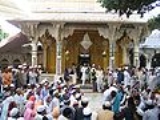
Sultan-ul-Hind, Moinuddin Chishti (Urdu/) was born in 1141 and died in 1230 CE. Also known as
Gharīb Nawāz "Benefactor of the Poor" , he is the most famous Sufi saint of the
Chishti OrderThe Chishtī Order is a Sufi order within the mystic branches of Islam which was founded in Chisht, a small town near Herat, Afghanistan about 930 CE. The Chishti Order is known for its emphasis on love, tolerance, and openness. The doctrine of the Chishti Order is based on walāya, which is a...
of the
Indian SubcontinentThe Indian subcontinent, also Indian Subcontinent, Indo-Pak Subcontinent or South Asian Subcontinent is a region of the Asian continent on the Indian tectonic plate from the Hindu Kush or Hindu Koh, Himalayas and including the Kuen Lun and Karakoram ranges, forming a land mass which extends...
. He introduced and established the order in South Asia. The initial spiritual chain or
silsilaSilsila is a 1981 Bollywood film directed by Yash Chopra. The film stars Amitabh Bachchan, Jaya Bhaduri, Sanjeev Kumar and Rekha, with Shashi Kapoor in a special appearance.-Plot:...
of the Chishti order in India, comprising Moinuddin Chishti, Bakhtiyar Kaki, Baba Farid and
Nizamuddin AuliyaSultan-ul-Mashaikh, Mehboob-e-Ilahi, Hazrat Shaikh Khwaja Syed Muhammad Nizamuddin Auliya , also known as Hazrat Nizamuddin, was a famous Sufi saint of the Chishti Order in the Indian Subcontinent, an order that believed in drawing close to God through renunciation of the world and service to...
(each successive person being the disciple of the previous one), constitutes the great Sufi saints of Indian history.
Early life and background
Mu'īnuddīn Chishtī is said to have been born in 536 A.H./1141 CE, in Chishti in
SistanSīstān is a border region in eastern Iran , southwestern Afghanistan and northern tip of Southwestern Pakistan .-Etymology:...
region of
AfghanistanAfghanistan , officially the Islamic Republic of Afghanistan, is a landlocked country located in the centre of Asia, forming South Asia, Central Asia and the Middle East. With a population of about 29 million, it has an area of , making it the 42nd most populous and 41st largest nation in the world...
. He was a Sayed, a descendant of
MuhammadMuhammad |ligature]] at U+FDF4 ;Arabic pronunciation varies regionally; the first vowel ranges from ~~; the second and the last vowel: ~~~. There are dialects which have no stress. In Egypt, it is pronounced not in religious contexts...
through
Ja'far aṣ-ṢādiqJaʿfar ibn Muhammad al-Sādiq was a descendant of Muhammad and a prominent Muslim jurist. He is revered as an Imam by the adherents of Shi'a Islam and as a renowned Islamic scholar and personality by Sunni Muslims. The Shi'a Muslims consider him to be the sixth Imam or leader and spiritual...
. He grew up in Persia. His parents died when he was only fifteen years old. He inherited a
windmillA windmill is a machine which converts the energy of wind into rotational energy by means of vanes called sails or blades. Originally windmills were developed for milling grain for food production. In the course of history the windmill was adapted to many other industrial uses. An important...
and an
orchardAn orchard is an intentional planting of trees or shrubs that is maintained for food production. Orchards comprise fruit or nut-producing trees which are grown for commercial production. Orchards are also sometimes a feature of large gardens, where they serve an aesthetic as well as a productive...
from his father. During his childhood, young Mu'īnuddīn was different from others and kept himself busy in
prayerSalah is the practice of formal prayer in Islam. Its importance for Muslims is indicated by its status as one of the Five Pillars of Sunni Islam, of the Ten Practices of the Religion of Twelver Islam and of the 7 pillars of Musta'lī Ismailis...
s and
meditationMeditation is any form of a family of practices in which practitioners train their minds or self-induce a mode of consciousness to realize some benefit....
. Legend has it that once when he was watering his plants, a revered Sufi, Shaikh Ibrāhim Qundūzī (or
Kunduzi) -- the name deriving from his birth place,
KunduzKunduz also known as Kundûz, Qonduz, Qondûz, Konduz, Kondûz, Kondoz, or Qhunduz is a city in northern Afghanistan, the capital of Kunduz Province. It is linked by highways with Mazari Sharif to the west, Kabul to the south and Tajikistan's border to the north...
in
AfghanistanAfghanistan , officially the Islamic Republic of Afghanistan, is a landlocked country located in the centre of Asia, forming South Asia, Central Asia and the Middle East. With a population of about 29 million, it has an area of , making it the 42nd most populous and 41st largest nation in the world...
-- came to his orchard. Young Mu'īnuddīn approached him and offered him some fruits. In return, Sheikh Ibrāhīm Qundūzī gave him a piece of bread and asked him to eat it. The
KhwājaKhawaja or Khwaja is a title used in Middle East, South Asia, and Central Asia. It means Lord or Master.Khwajagan is a word often used to refer to a chains of Central Asian Naqshbandi Sufi Masters from the 10th to the 16th century A.D. In Ferdowsi's Shahnameh the word is used many times for some...
got enlightened and found himself in a strange world after eating the bread. After this he disposed of his property and other belongings and distributed the money to the poor. He renounced the world and left for
BukharaBukhara , from the Soghdian βuxārak , is the capital of the Bukhara Province of Uzbekistan. The nation's fifth-largest city, it has a population of 263,400 . The region around Bukhara has been inhabited for at least five millennia, and the city has existed for half that time...
in search of knowledge and higher education.
He became the Murid (disciple) of
Usman HarooniUsman Harooni was an early day Sufi Saint, a successor to Shareef Zandani, fourteenth link in the Sufi Silsilah of Chishti Order, and the Master of Khawaja Moinuddin Chishti.He was born Haroon, Iran around 526 HijriHe died 617 Hijri....
.
Journeys
Mu'īnuddīn Chishtī visited the seminaries of
SamarkandAlthough a Persian-speaking region, it was not united politically with Iran most of the times between the disintegration of the Seleucid Empire and the Arab conquest . In the 6th century it was within the domain of the Turkic kingdom of the Göktürks.At the start of the 8th century Samarkand came...
and
BukharaBukhara , from the Soghdian βuxārak , is the capital of the Bukhara Province of Uzbekistan. The nation's fifth-largest city, it has a population of 263,400 . The region around Bukhara has been inhabited for at least five millennia, and the city has existed for half that time...
and acquired religious learning at the feet of eminent scholars of his age. He visited nearly all the great centers of
MuslimA Muslim, also spelled Moslem, is an adherent of Islam, a monotheistic, Abrahamic religion based on the Quran, which Muslims consider the verbatim word of God as revealed to prophet Muhammad. "Muslim" is the Arabic term for "submitter" .Muslims believe that God is one and incomparable...
culture, and acquainted himself with almost every important trend in Muslim religious life in the Middle Ages. He became a disciple of the Chishtī saint 'Uthmān Hārūnī. They travelled the Middle East extensively together, including visits to
MeccaMecca is a city in the Hijaz and the capital of Makkah province in Saudi Arabia. The city is located inland from Jeddah in a narrow valley at a height of above sea level...
and
MedinaMedina , or ; also transliterated as Madinah, or madinat al-nabi "the city of the prophet") is a city in the Hejaz region of western Saudi Arabia, and serves as the capital of the Al Madinah Province. It is the second holiest city in Islam, and the burial place of the Islamic Prophet Muhammad, and...
.
Journey to India
Mu'īnuddīn Chishtī turned towards
IndiaIndia , officially the Republic of India , is a country in South Asia. It is the seventh-largest country by geographical area, the second-most populous country with over 1.2 billion people, and the most populous democracy in the world...
, reputedly after a dream in which
Prophet MuhammadMuhammad |ligature]] at U+FDF4 ;Arabic pronunciation varies regionally; the first vowel ranges from ~~; the second and the last vowel: ~~~. There are dialects which have no stress. In Egypt, it is pronounced not in religious contexts...
blessed him to do so. After a brief stay at
LahoreLahore is the capital of the Pakistani province of Punjab and the second largest city in the country. With a rich and fabulous history dating back to over a thousand years ago, Lahore is no doubt Pakistan's cultural capital. One of the most densely populated cities in the world, Lahore remains a...
, he reached
AjmerAjmer , formerly written as Ajmere, is a city in Ajmer District in Rajasthan state in India. Ajmer has a population of around 800,000 , and is located west of the Rajasthan state capital Jaipur, 200 km from Jodhpur, 274 km from Udaipur, 439 km from Jaisalmer, and 391 km from...
along with Sultan Shahāb-ud-Din Muhammad Ghori, and settled down there. In Ajmer, he attracted a substantial following, acquiring a great deal of respect amongst the residents of the city. Mu'īnuddīn Chishtī practiced the Sufi Sulh-e-Kul (
peace to all) concept to promote understanding between Muslims and non-Muslims.
Establishing the Chishtī order in India
The Chishtī order was founded by
Abu Ishaq ShamiAbu Ishaq Shami was a Muslim scholar who is often regarded as the founder of the Sufi Chishti Order because he was the person in the Chishti silsila who was the first to live in Chisht. The name Shami implies he came from Syria or even from Damascus...
(“the Syrian”) in Chisht, some 95 miles east of Herat in present-day western
AfghanistanAfghanistan , officially the Islamic Republic of Afghanistan, is a landlocked country located in the centre of Asia, forming South Asia, Central Asia and the Middle East. With a population of about 29 million, it has an area of , making it the 42nd most populous and 41st largest nation in the world...
. Moinuddin Chishti established the order in India, in the city of Ajmer in North India.
Moinuddin Chishti apparently never wrote down his teachings in the form of a book, nor did his immediate disciples, but the central principles that became characteristics of the Chishtī order in India are based on his teachings and practices. They lay stress on renunciation of material goods; strict regime of self-discipline and personal prayer; participation in
Samā'Sama is a Sufi ceremony performed as dhikr. Sama means "listening", while dhikr means "remembrance". These rituals often includes singing, playing instruments, dancing, recitation of poetry and prayers, wearing symbolic attire, and other rituals...
as a legitimate means to spiritual transformation; reliance on either cultivation or unsolicited offerings as means of basic subsistence; independence from rulers and the state, including rejection of monetary and land grants; generosity to others, particularly, through sharing of food and wealth, and tolerance and respect for religious differences.
He, in other words, interpreted religion in terms of human service and exhorted his disciples "to develop river-like generosity, sun-like affection and earth-like hospitality." The highest form of devotion, according to him, was "to redress the misery of those in distress – to fulfill the needs of the helpless and to feed the hungry."
It was during the reign of Emperor Akbar (1556–1605) that Ajmer emerged as one of the most important centers of pilgrimage in India. The Mughal Emperor undertook an unceremonial journey on foot to accomplish his wish to reach Ajmer. The
AkbarnāmahThe ' , which literally means Book of Akbar, is the official chronicle of the reign of Akbar, the third Mughal Emperor , commissioned by Akbar himself and written in Persian by his court historian and biographer, Abul Fazl who was one of the nine jewels in Akbar's court...
records that the Emperor's interest first sparked when he heard some minstrels singing songs about the virtues of the
WalīWalī , is an Arabic word meaning "custodian", "protector", "sponsor", or authority as denoted by its definition "crown". "Wali" is someone who has "Walayah" over somebody else. For example, in Fiqh the father is wali of his children. In Islam, the phrase ولي الله walīyu 'llāh...
(Friend of God) who lay asleep in Ajmer.
Mu'īnuddīn Chishtī authored several books including
Anīs al-Arwāḥ and
Dalīl al-'Ārifīn, both of which deal with the Islamic code of living.
Quṭbuddīn Baktiyār KākīQutub ul Aqtab Hazrat Khwaja Syed Muhammad Qutbuddin Bakhtiar Kaki was a renowned Muslim Sufi mystic, saint and scholar of the Chishti Order from Delhi, India. He was the disciple and the spiritual successor of Moinuddin Chishti as head of the Chishti order. Before him the Chishti order in India...
(d. 1235) and Ḥamīduddīn Nagorī (d. 1276) were Mu'īnuddīn Chishtī's celebrated
KhalīfasThe Caliph is the head of state in a Caliphate, and the title for the ruler of the Islamic Ummah, an Islamic community ruled by the Shari'ah. It is a transcribed version of the Arabic word which means "successor" or "representative"...
or successors who continued to transmit the teachings of their master through their disciples, leading to the widespread proliferation of the Chishtī Order in India.
Among Quṭbuddīn Baktiyār's prominent disciples was
Farīduddīn Ganj-i-Shakar (d. 1265), whose
dargāhA Dargah is a Sufi shrine built over the grave of a revered religious figure, often a Sufi saint. Local Muslims visit the shrine known as . Dargahs are often associated with Sufi meeting rooms and hostels, known as khanqah...
is at
PakpattanPakpattan is the capital city of the Pakpattan District in the Sahiwal Division in the Punjab province of Pakistan. Pakpattan is one of the ancient cities of Pakistan. It is the city that has the shrine of the well-known Sufi of all times, Baba Fareed...
, (Pakistan). Farīduddīn's most famous disciple was
Nizāmuddīn Auliyā'Sultan-ul-Mashaikh, Mehboob-e-Ilahi, Hazrat Shaikh Khwaja Syed Muhammad Nizamuddin Auliya , also known as Hazrat Nizamuddin, was a famous Sufi saint of the Chishti Order in the Indian Subcontinent, an order that believed in drawing close to God through renunciation of the world and service to...
(d. 1325) popularly referred to as Mahbūb-e-Ilāhī (God's beloved), whose dargāh is located in South Delhi.
From Delhi, disciples branched out to establish dargāhs in several regions of South Asia, from
SindhSindh historically referred to as Ba'ab-ul-Islam , is one of the four provinces of Pakistan and historically is home to the Sindhi people. It is also locally known as the "Mehran". Though Muslims form the largest religious group in Sindh, a good number of Christians, Zoroastrians and Hindus can...
in the west to
BengalBengal is a historical and geographical region in the northeast region of the Indian Subcontinent at the apex of the Bay of Bengal. Today, it is mainly divided between the sovereign land of People's Republic of Bangladesh and the Indian state of West Bengal, although some regions of the previous...
in the east, and the Deccan in the south. But from all the network of Chishtī dargāhs the Ajmer dargāh took on the special distinction of being the 'mother' dargah of them all.
Dargah Sharif
The
dargahA Dargah is a Sufi shrine built over the grave of a revered religious figure, often a Sufi saint. Local Muslims visit the shrine known as . Dargahs are often associated with Sufi meeting rooms and hostels, known as khanqah...
(shrine) of Chisti, known as Dargah Sharif or Ajmer Sharif is an international wakf (
endowmentA financial endowment is a transfer of money or property donated to an institution. The total value of an institution's investments is often referred to as the institution's endowment and is typically organized as a public charity, private foundation, or trust....
), managed under the 'Dargah Khwaja Saheb Act, 1955' of Government of India. The Dargah Committee, appointed by the Government, manages donations, takes care of the maintenance of the shrine, and runs charitable institutions like dispensaries, and guest houses for the devotees. The dargah, which is visited by Muslim pilgrims as well as
HinduHindu refers to an identity associated with the philosophical, religious and cultural systems that are indigenous to the Indian subcontinent. As used in the Constitution of India, the word "Hindu" is also attributed to all persons professing any Indian religion...
s and
SikhA Sikh is a follower of Sikhism. It primarily originated in the 15th century in the Punjab region of South Asia. The term "Sikh" has its origin in Sanskrit term शिष्य , meaning "disciple, student" or शिक्ष , meaning "instruction"...
s as a symbol of intercommunal harmony, became the target of a
terrorist bomb attackThe Ajmer Dargah attack occurred on 11 October 2007, outside the Dargah of Sufi saint Moinuddin Chishti in Ajmer, Rajasthan, India, after the Iftar period had started...
in October 2007 by suspected
HindutvaHindutva is the term used to describe movements advocating Hindu nationalism. Members of the movement are called Hindutvavādis.In India, an umbrella organization called the Sangh Parivar champions the concept of Hindutva...
militants.
In popular culture
A
BollywoodBollywood is the informal term popularly used for the Hindi-language film industry based in Mumbai , Maharashtra, India. The term is often incorrectly used to refer to the whole of Indian cinema; it is only a part of the total Indian film industry, which includes other production centers producing...
movie
Jodhaa Akbar (2008), directed by
Ashutosh GowarikerAshutosh Gowariker is an Indian film director, actor, writer and producer. He is known for directing the films Lagaan , Swades , Jodhaa Akbar , What's Your Raashee and Khelein Hum Jee Jaan Sey...
, includes a
qawwālīQawwali is a form of Sufi devotional music popular in South Asia, particularly in the Punjab and Sindh regions of Pakistan, Hyderabad, Delhi, and other parts of northern India...
in praise of Moinuddin Chishti ("Khwāja Mērē Khwāja"). It depicts the Emperor Akbar being moved by the song to join the whirling-dervish-like dance that accompanies the song. The song is composed by A.R. Rahman.
Sufis of the Chishtī order
He had more than one thousand khalīfas and hundreds of thousands of disciples. Sufis of different orders became his disciples and took ijāzah from him. Among the famous Sufis who trace their lineage to him are:
Quṭbuddīn Bakhtiyār KākīQutub ul Aqtab Hazrat Khwaja Syed Muhammad Qutbuddin Bakhtiar Kaki was a renowned Muslim Sufi mystic, saint and scholar of the Chishti Order from Delhi, India. He was the disciple and the spiritual successor of Moinuddin Chishti as head of the Chishti order. Before him the Chishti order in India...
,
Farīduddīn Mas'ūd,
Nizāmuddīn Auliyā'Sultan-ul-Mashaikh, Mehboob-e-Ilahi, Hazrat Shaikh Khwaja Syed Muhammad Nizamuddin Auliya , also known as Hazrat Nizamuddin, was a famous Sufi saint of the Chishti Order in the Indian Subcontinent, an order that believed in drawing close to God through renunciation of the world and service to...
, Amir Khusrau,
Muhammad Hussain-i Gisūdarāz BandanawāzSyed Muhammad Hussaini, commonly known as Hazrat Khwaja Banda Nawaz Gaisu Daraz , was a famous Sufi saint from India of the Chishti Order, who advocated understanding, tolerance and harmony among various religious groups.Gaisu Daraz was a murid of the noted Sufi saint of Delhi, Hazrat Nasiruddin...
, Ashraf Jahāngīr Simnānī,
Aṭā' Hussain FānīHazrat Ata Hussain Fani , also known as Ata Hussain Gayavi or Haji Ata Hussain Chishti Monami Abulolai, was a famous Sufi saint of the chisti order in South Asia. He was the first Sufi to go in the complete non-Muslim locality of Gaya and spread Islam...
and Shāh Jamāl Bābā Bahaya Aurangabadī.
Today, hundreds of thousands of people – Muslims, Hindus, Christians and others, from the Indian sub-continent, and from other parts of the world – assemble at his tomb on the occasion of his
'ursThe Urs festival is an annual festival held at Ajmer, a city in the Indian state of Rajasthan, which commemorates the death anniversary of the Sufi saint Moinuddin Chishti, . It is held over six days and features night-long dhikr/zikr qawwali singing. The anniversary is celebrated in the seventh...
(death anniversary).
Spiritual lineage
- 'Alī ibn Abī Ṭālib
- Al-Ḥasan al-Baṣrī
- 'Abdul Wāḥid Bin Zaid Abul Faḍl
Abdul Waahid Bin Zaid Abul Fadl was an early day Sufi Saint, a successor to Hasan al-Basri, second link in the Sufi Silsilah of Chishti Order, and the Master of Fudhail Bin Iyadh.He is also reported to have received education from Imam Abu Hanifah....
- Fuḍayll ibn 'Iyāḍ Bin Mas'ūd Bin Bishr al-Tamīmī
Fudhail Bin Iyadh Bin Masood Bin Bishr Al-Tamimi aka Abul Fadhl and Abu Ali, was an early day Sufi Saint, a successor to Abdul Waahid Bin Zaid, third link in the Sufi Silsilah of Chishti Order, and the Master of Ibrahim Bin Adham....
- Ibrāhīm bin Adham
Ibrahim ibn Adham is one of the most prominent of the early ascetic Sufi saints.The story of his conversion is one of the most celebrated in Sufi legend, as that of a prince renouncing his throne and choosing asceticism closely echoing the legend of Gautama Buddha.Sufi tradition ascribes to...
- Ḥudhayfah al-Mar'ashī
- Amīnuddīn Abū Ḥubayrah al-Baṣrī
- Mumshād Dīnwarī
Start of the Chishtī Order:
- Abū Isḥāq al-Shāmī
Abu Ishaq Shami was a Muslim scholar who is often regarded as the founder of the Sufi Chishti Order because he was the person in the Chishti silsila who was the first to live in Chisht. The name Shami implies he came from Syria or even from Damascus...
- Abū Aḥmad Abdāl
- Abū Muḥammad bin Abī Aḥmad
- Abū Yūsuf bin Sam'ān al-Ḥusaynī
- Maudūd Chishtī
Maudood Chishti was an early day Sufi Saint, a successor to his father and master Abu Yusuf Bin Saamaan, twelfth link in the Sufi silsilah of Chishti Order, and the Master of Shareef Zandani. He was born around 430 Hijri in the city of Chisht. He initially received education from his father...
- Sharīf Zandānī
Shareef Zandani aka Nooruddin, was an early day Sufi Saint, a successor to Maudood Chishti, thirteenth link in the Sufi Silsilah of Chishti Order, and the peer of Usman Harooni.He was born around 492 Hijri in a city Zandanah, Iraq....
- 'Uthmān Hārūnī
Usman Harooni was an early day Sufi Saint, a successor to Shareef Zandani, fourteenth link in the Sufi Silsilah of Chishti Order, and the Master of Khawaja Moinuddin Chishti.He was born Haroon, Iran around 526 HijriHe died 617 Hijri....
- Mu'īnuddīn Chishtī
Others buried in the Maqbara enclosure
The famous Mughal generals Sheikh Mīr and Shāhnawāz Khān were buried in the enclosure of Mu'īnuddīn Chishtī's
MaqbaraThe Arabic word Maqbara is derived from the word Qabr, which means grave. Though maqbara refers to the graves of all Muslims, it refers especially to the graves of religious figures or Waliyullahs who dedicated their life to Islam, striving to be true Muslims and training others to follow Islam...
after they died in the Battle of Deorai in 1659. Shāhnawāz Khān was the Emperor
AurangzebAbul Muzaffar Muhy-ud-Din Muhammad Aurangzeb Alamgir , more commonly known as Aurangzeb or by his chosen imperial title Alamgir , was the sixth Mughal Emperor of India, whose reign lasted from 1658 until his death in 1707.Badshah Aurangzeb, having ruled most of the Indian subcontinent for nearly...
's father-in-law.
See also
- Ajmer Dargah attack
The Ajmer Dargah attack occurred on 11 October 2007, outside the Dargah of Sufi saint Moinuddin Chishti in Ajmer, Rajasthan, India, after the Iftar period had started...
- Ali Hujwiri
- Ata Hussain Fani Chishti
Hazrat Ata Hussain Fani , also known as Ata Hussain Gayavi or Haji Ata Hussain Chishti Monami Abulolai, was a famous Sufi saint of the chisti order in South Asia. He was the first Sufi to go in the complete non-Muslim locality of Gaya and spread Islam...
- Fariduddin Ganjshakar
- List of famous Sufis
- List of Sufism related topics
- Nizamuddin Auliya
Sultan-ul-Mashaikh, Mehboob-e-Ilahi, Hazrat Shaikh Khwaja Syed Muhammad Nizamuddin Auliya , also known as Hazrat Nizamuddin, was a famous Sufi saint of the Chishti Order in the Indian Subcontinent, an order that believed in drawing close to God through renunciation of the world and service to...
- Qadiriyyah
- Qutbuddin Bakhtiar Kaki
Qutub ul Aqtab Hazrat Khwaja Syed Muhammad Qutbuddin Bakhtiar Kaki was a renowned Muslim Sufi mystic, saint and scholar of the Chishti Order from Delhi, India. He was the disciple and the spiritual successor of Moinuddin Chishti as head of the Chishti order. Before him the Chishti order in India...
- Sayyid
Sayyid is an honorific title, it denotes males accepted as descendants of the Islamic prophet Muhammad through his grandsons, Hasan ibn Ali and Husain ibn Ali, sons of the prophet's daughter Fatima Zahra and his son-in-law Ali ibn Abi Talib.Daughters of sayyids are given the titles Sayyida,...
- Sufism
Sufism or ' is defined by its adherents as the inner, mystical dimension of Islam. A practitioner of this tradition is generally known as a '...
- Urs (Ajmer)
The Urs festival is an annual festival held at Ajmer, a city in the Indian state of Rajasthan, which commemorates the death anniversary of the Sufi saint Moinuddin Chishti, . It is held over six days and features night-long dhikr/zikr qawwali singing. The anniversary is celebrated in the seventh...
External links