

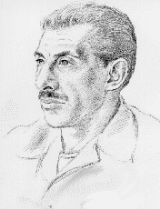
Idries Shah

Encyclopedia
Idries Shah , also known as Idris Shah, né Sayed
Idries el-Hashimi
(Arabic: سيد إدريس هاشمي), was an author and teacher in the Sufi
tradition who wrote over three dozen critically acclaimed books on topics ranging from psychology and spirituality to travelogues and culture studies.
Born in India
, the descendant of a family of Afghan
nobles, Shah grew up mainly in England. His early writings centred on magic
and witchcraft
. In 1960 he established a publishing house, Octagon Press, producing translations of Sufi classics as well as titles of his own. His most seminal work was The Sufis
, which appeared in 1964 and was well received internationally. In 1965, Shah founded the Institute for Cultural Research, a London-based educational charity devoted to the study of human behaviour and culture. A similar organisation, the Institute for the Study of Human Knowledge
(ISHK), exists in the United States, under the directorship of Stanford University
psychology professor Robert Ornstein
, whom Shah appointed as his deputy in the U.S.
In his writings, Shah presented Sufism
as a universal form of wisdom that predated Islam
. Emphasizing that Sufism was not static but always adapted itself to the current time, place and people, he framed his teaching in Western psychological terms. Shah made extensive use of traditional teaching stories
and parable
s, texts that contained multiple layers of meaning designed to trigger insight and self-reflection in the reader. He is perhaps best known for his collections of humorous Mulla Nasrudin
stories.
Shah was at times criticised by orientalists
who questioned his credentials and background. His role in the controversy surrounding a new translation of the Rubaiyat of Omar Khayyam
, published by his friend Robert Graves
and his older brother Omar Ali-Shah
, came in for particular scrutiny. However, he also had many notable defenders, chief among them the novelist Doris Lessing
. Shah came to be recognised as a spokesman for Sufism in the West and lectured as a visiting professor at a number of Western universities. His works have played a significant part in presenting Sufism as a secular, individualistic form of spiritual wisdom.
, India, to an Afghan-Indian father, Sirdar Ikbal Ali Shah
, a writer and diplomat, and a Scottish mother, Saira Elizabeth Luiza Shah. His family on the paternal side were Musavi Sayed
s. Their ancestral home was near the Paghman Gardens
of Kabul
. His paternal grandfather, Sayed Amjad Ali Shah, was the nawab
of Sardhana
in the North-Indian state of Uttar Pradesh
, an hereditary title the family had gained thanks to the services an earlier ancestor, Jan-Fishan Khan, had rendered to the British.
Shah mainly grew up in the vicinity of London. After his family moved from London to Oxford
in 1940 to escape German bombing
, he spent two or three years at the City of Oxford High School. In 1945, he accompanied his father to Uruguay
as secretary to his father's halal
meat mission. He returned to England in October 1946, following allegations of improper business dealings.
Shah published his first book Oriental Magic
in 1956. He followed this in 1957 with The Secret Lore of Magic: Book of the Sorcerers and the travelogue Destination Mecca. Shah married Cynthia (Kashfi) Kabraji in 1958; they had a daughter, Saira
, in 1964, followed by twins – a son, Tahir
, and another daughter, Safia
– in 1966.
n circles in London and then acted as a secretary and companion to Gerald Gardner
, the founder of modern Wicca, for some time. In 1960, Shah founded his publishing house, Octagon Press
; one of its first titles was Gardner's biography – titled Gerald Gardner, Witch, the book was attributed to one of Gardner's followers, Jack L. Bracelin, but had in fact been written by Shah.
In January 1961, while on a trip to Mallorca
with Gardner, Shah met the English poet Robert Graves
. Shah wrote to Graves from his pension
in Palma
, requesting an opportunity of "saluting you one day before very long". He added that he was currently researching ecstatic religions, and that this included experiments with hallucinogenic mushrooms, a topic that had been of interest to Graves for some time. Graves and Shah soon became close friends and confidants. Graves took a supportive interest in Shah's writing career and encouraged him to publish an authoritative treatment of Sufism for a Western readership, along with the practical means for its study; this was to become The Sufis
. Shah managed to obtain a substantial advance on the book, resolving temporary pecuniary difficulties.
In 1964, The Sufis appeared, published by Doubleday, with a long introduction by Robert Graves. The book chronicles the impact of Sufism on the development of Western civilisation and traditions from the seventh century onward through the work of such figures as Roger Bacon
, John of the Cross
, Raymond Lully, Chaucer and others, and has become a classic. Like Shah's other books on the topic, The Sufis was conspicuous for avoiding terminology that might have identified his interpretation of Sufism with traditional Islam. The book also employed a deliberately "scattered" style; Shah wrote to Graves that its aim was to "decondition people, and prevent their reconditioning"; had it been otherwise, he might have used a more conventional form of exposition. The book sold poorly at first, and Shah invested a considerable amount of his own money in advertising it. Graves told him not to worry; even though he had some misgivings about the writing, and was hurt that Shah had not allowed him to proofread it before publication, he said he was "so proud in having assisted in its publication", and assured Shah that it was "a marvellous book, and will be recognized as such before long. Leave it to find its own readers who will hear your voice spreading, not those envisaged by Doubleday."
Graves' introduction, written with Shah's help, described Shah as being "in the senior male line of descent from the prophet Mohammed" and as having inherited "secret mysteries from the Caliphs, his ancestors. He is, in fact, a Grand Sheikh of the Sufi Tariqa ..." Privately, however, writing to a friend, Graves confessed that this was "misleading: he is one of us, not a Moslem personage." The Edinburgh scholar L. P. Elwell-Sutton, in a 1975 article on Shah, opined that Graves had been trying to "upgrade" Shah's "rather undistinguished lineage", and that the reference to Mohammed's senior male line of descent was a "rather unfortunate gaffe", as Mohammed's sons had all died in infancy. The introduction was dropped from later editions.
teachings of Gurdjieff and Ouspensky
. A press article had appeared,Augy Hayter, a student of both Idries and Omar Ali-Shah, asserts that the article, published in Blackwood's Magazine
, was written by Idries Shah under a pseudonym. When Reggie Hoare, a Gurdjieffian and associate of Bennett's, wrote to the author care of the magazine, intrigued by the description of exercises known only to a very small number of Gurdjieff students, it was Shah who replied to Hoare, and Hoare who introduced Shah to Bennett. Shah himself according to Hayter later described the Blackwood's Magazine article as "trawling". describing the author's visit to a secret monastery in Central Asia, where methods strikingly similar to Gurdjieff's methods were apparently being taught. The otherwise unattested monastery had, it was implied, a representative in England. Shah was introduced to John G. Bennett
, a noted Gurdjieff student and founder of an "Institute for the Comparative Study of History, Philosophy and the Sciences" located at Coombe Springs, a 7 acres (28,328 m²) estate in Kingston upon Thames
, Surrey
. Shah gave Bennett a "Declaration of the People of the Tradition" and authorised him to share this with other Gurdjieffians. The document announced that there was now an opportunity for the transmission of "a secret, hidden, special, superior form of knowledge"; combined with the personal impression Bennett formed of Shah, it convinced Bennett that Shah was a genuine emissary of the "Sarmoung Monastery" in Afghanistan, whose teachings had inspired Gurdjieff.
 Wishing to support Shah's work, Bennett decided in 1965, after agonising for a long time and discussing the matter with the council and members of his Institute, to give the Coombe Springs property to Shah, who had insisted that any such gift must be made with no strings attached. Once the property was transferred to Shah, he banned Bennett's associates from visiting, and made Bennett himself feel unwelcome. After a few months, Shah sold the plot – worth more than £100,000 – to a developer and used the proceeds to establish himself at Langton House in Langton Green
, near Tunbridge Wells. Along with the property, Bennett also handed the care of his body of pupils to Shah, comprising some 300 people. Shah promised he would integrate all those who were suitable; about half of their number found a place in Shah's work.
Some twenty years later, the Gurdjieffian author James Moore
suggested that Bennett had been duped by Shah. Bennett gave an account of the matter himself in his autobiography (1974); he said that Shah's behaviour after the transfer of the property was "hard to bear", but also insisted that Shah was a "man of exquisite manners and delicate sensibilities" and considered that Shah might have adopted his behaviour deliberately, "to make sure that all bonds with Coombe Springs were severed". He added that Langton Green was a far more suitable place for Shah's work than Coombe Springs could have been and said he felt no sadness that Coombe Springs lost its identity; he concluded his account of the matter by stating that he had "gained freedom" through his contact with Shah, and had learned "to love people whom [he] could not understand".
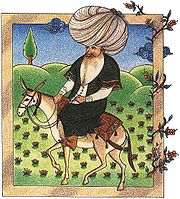
(ICR) – an educational charity aimed at stimulating "study, debate, education and research into all aspects of human thought, behaviour and culture". He also established the Society for Sufi Studies (SSS). Over the following years, Shah developed Octagon Press as a means of publishing and distributing reprints of translations of numerous Sufi classics. In addition, he collected, translated and wrote thousands of Sufi tales, making these available to a Western audience through his books and lectures. Several of Shah's books feature the Mulla Nasrudin
character, sometimes with illustrations provided by Richard Williams. In Shah's interpretation, the Mulla Nasrudin stories, previously considered a folkloric part of Muslim cultures, were presented as Sufi parable
s.
, by Robert Graves and Shah's older brother, Omar Ali-Shah
. The translation, which presented the Rubaiyat as a Sufic poem, was based on an annotated "crib", supposedly derived from a manuscript that had been in the Shah family's possession for 800 years. L. P. Elwell-Sutton, an orientalist at Edinburgh University, and others who reviewed the book expressed their conviction that the story of the ancient manuscript was false.
Shah's father, the Sirdar Ikbal Ali Shah, was expected by Graves to present the original manuscript to clear the matter up, but he died in a car accident in Tangier
in November 1969. A year later, Graves asked Idries Shah to produce the manuscript, but Shah replied in a letter that doing so would prove nothing – the manuscript's authenticity could still be contested. It was time, Shah wrote, "that we realised that the hyenas who are making so much noise are intent only on opposition, destructiveness and carrying on a campaign when, let's face it, nobody is really listening." He added that his father had been so infuriated by those casting these aspersions that he refused to engage with them, and he felt his father's response had been correct. Graves, noting that he was now widely perceived as having fallen prey to the Shah brothers' gross deception, and that this affected income from sales of his other historical writings, insisted that producing the manuscript had become "a matter of family honour". He pressed Shah again, reminding him of previous promises to produce the manuscript if it were necessary.
Shah never did produce the manuscript, leading Graves' nephew and biographer to muse that it was hard to believe – bearing in mind the Shah brothers' many obligations to Graves – that they would have withheld the manuscript if it had ever existed in the first place. According to his widow writing many years later, Graves had "complete faith" in the authenticity of the manuscript because of his friendship with Shah, even though he never had a chance to view the text in person. The scholarly consensus today is that the "Jan-Fishan Khan" manuscript was a hoax, and that the Graves/Shah translation was in fact based on a Victorian amateur scholar's analysis of the sources used by previous Rubaiyat translator Edward FitzGerald
.
, the University of Geneva
, the National University of La Plata and various English universities. Besides his literary and educational work, he found time to design an air ioniser
and run a number of textile, ceramics and electronics companies. He also undertook several journeys to his ancestral Afghanistan
and involved himself in setting up relief efforts there; he drew on these experiences later on in his novel Kara Kush.
In late spring 1987, about a year after his final visit to Afghanistan, Shah suffered two successive and massive heart attacks. He was told that he had only eight per cent of his heart function left, and could not expect to survive. Despite intermittent bouts of illness, he continued working and produced further books over the next nine years. Idries Shah died in London on November 23, 1996, at the age of 72. According to his obituary in The Daily Telegraph
, Idries Shah was a collaborator with Mujahideen
in the Afghan-Soviet war
, a Director of Studies for the Institute for Cultural Research and a Governor of the Royal Humane Society
and the Royal Hospital and Home for Incurables. He was also a member of the Athenaeum Club
. At the time of his death, Shah's books had sold over 15 million copies in a dozen languages worldwide, and had been reviewed in numerous international journals and newspapers.
. Shah was often dismissive of orientalists' descriptions of Sufism, holding that academic or personal study of its historical forms and methods was not a sufficient basis for gaining a correct understanding of it. In fact, an obsession with its traditional forms might actually become an obstacle: "Show a man too many camels' bones, or show them to him too often, and he will not be able to recognise a camel when he comes across a live one," is how he expressed this idea in one of his books.
Shah, like Inayat Khan
, presented Sufism as a path that transcended individual religions, and adapted it to a Western audience. Unlike Khan, however, he deemphasised religious or spiritual trappings and portrayed Sufism as a psychological technology, a method or science that could be used to achieve self-realisation. In doing so, his approach seemed to be especially addressed to followers of Gurdjieff, students of the Human Potential Movement
, and intellectuals acquainted with modern psychology. For example, he wrote, "Sufism ... states that man may become objective, and that objectivity enables the individual to grasp 'higher' facts. Man is therefore invited to push his evolution ahead towards what is sometimes called in Sufism 'real intellect'." Shah taught that the human being could acquire new subtle sense organs in response to need:
Shah dismissed other Eastern and Western projections of Sufism as "watered down, generalised or partial"; he included in this not only Khan's version, but also the overtly Muslim forms of Sufism found in most Islamic countries. The writings of Shah's associates implied that he was the "Grand Sheikh of the Sufis" – a position of authority undercut by the failure of any other Sufis to acknowledge its existence.
Shah frequently characterised his own work as really only preliminary to actual Sufi study, in the same way that learning to read and write might be seen as preliminary to a study of literature: "Unless the psychology is correctly oriented, there is no spirituality, though there can be obsession and emotionality, often mistaken for it." "Anyone trying to graft spiritual practices upon an unregenerate personality," he argued, "will end up with an aberration." For this reason, most of the work he produced from The Sufis onwards was psychological in nature, focused on attacking the nafs-i-ammara
, the false self: "I have nothing to give you except the way to understand how to seek – but you think you can already do that." Shah was frequently criticised for not mentioning God very much in his writings; his reply was that given man's present state, there would not be much point in talking about God. He illustrated the problem in a parable in his book Thinkers of the East: "Finding I could speak the language of ants, I approached one and inquired, 'What is God like? Does he resemble the ant?' He answered, 'God! No indeed – we have only a single sting but God, He has two!'"
psychology professor Robert Ornstein
, who along with fellow psychologist Charles Tart
and eminent writers such as Poet Laureate
Ted Hughes
and Nobel-Prize-winning novelist Doris Lessing
was one of several notable thinkers profoundly influenced by Shah.
Shah and Ornstein met in the 1960s. Realising that Ornstein could be an ideal partner in propagating his teachings, translating them into the idiom of psychotherapy
, Shah made him his deputy (khalifa
) in the United States. Ornstein's The Psychology of Consciousness (1972) was enthusiastically received by the academic psychology community, as it coincided with new interests in the field, such as the study of biofeedback
and other techniques designed to achieve shifts in mood and awareness. Ornstein has published more books in the field over the years.
In their original historical and cultural setting, Sufi teaching stories of the kind popularised by Shah – first told orally, and later written down for the purpose of transmitting Sufi faith and practice to successive generations – were considered suitable for people of all ages, including children, as they contained multiple layers of meaning. Shah likened the Sufi story to a peach: "A person may be emotionally stirred by the exterior as if the peach were lent to you. You can eat the peach and taste a further delight ... You can throw away the stone – or crack it and find a delicious kernel within. This is the hidden depth." It was in this manner that Shah invited his audience to receive the Sufi story. By failing to uncover the kernel, and regarding the story as merely amusing or superficial, a person would accomplish nothing more than looking at the peach, while others internalised the tale and allowed themselves to be touched by it.
Olav Hammer
, in Sufism in Europe and North America (2004), cites an example of such a story. It tells of a man who is looking for his key on the ground. When a passing neighbour asks the man whether this is in fact the place where he lost the key, the man replies, "No, I lost it at home, but there is more light here than in my own house."
Peter Wilson, writing in New Trends and Developments in the World of Islam (1998), quotes another such story, featuring a dervish
who is asked to describe the qualities of his teacher, Alim. The dervish explains that Alim wrote beautiful poetry, and inspired him with his self-sacrifice and his service to his fellow man. His questioner readily approves of these qualities, only to find the dervish rebuking him: "Those are the qualities which would have recommended Alim to you." Then he proceeds to list the qualities which actually enabled Alim to be an effective teacher: "Hazrat Alim Azimi made me irritated, which caused me to examine my irritation, to trace its source. Alim Azimi made me angry, so that I could feel and transform my anger." He explains that Alim Azimi followed the path of blame, intentionally provoking vicious attacks upon himself, in order to bring the failings of both his students and critics to light, allowing them to be seen for what they really were: "He showed us the strange, so that the strange became commonplace and we could realise what it really is."
Shah did not advocate the abandonment of worldly duties; instead, he argued that the treasure sought by the would-be disciple should derive from one's struggles in everyday living. He considered practical work the means through which a seeker could do self-work, in line with the traditional adoption by Sufis of ordinary professions, through which they earned their livelihoods and "worked" on themselves. Shah's status as a teacher remained indefinable; disclaiming both the guru
identity and any desire to found a cult
or sect
, he also rejected the academic hat. Michael Rubinstein, writing in Makers of Modern Culture, concluded that "he is perhaps best seen as an embodiment of the tradition in which the contemplative and intuitive
aspects of the mind are regarded as being most productive when working together."
documentary ("One Pair of Eyes") in 1969, and two of his works (The Way of the Sufi
and Reflections) were chosen as "Outstanding Book of the Year" by the BBC
's "The Critics" programme. Among other honours, Shah won six first prizes at the UNESCO
World Book Year in 1973, and the Islamic scholar James Kritzeck
, commenting on Shah's Tales of the Dervishes
, said that it was "beautifully translated".
The reception of Shah's movement was also marked by much controversy. Some orientalists were hostile, in part because Shah presented classical Sufi writings as tools for self-development to be used by contemporary people, rather than as objects of historical study. L. P. Elwell-Sutton from Edinburgh University, Shah's fiercest critic, described his books as "trivial", replete with errors of fact, slovenly and inaccurate translations and even misspellings of Oriental names and words – "a muddle of platitudes, irrelevancies and plain mumbo-jumbo", adding for good measure that Shah had "a remarkable opinion of his own importance". Expressing amusement and amazement at the "sycophantic manner" of Shah's interlocutors in a BBC radio interview, Elwell-Sutton concluded that some Western intellectuals were "so desperate to find answers to the questions that baffle them, that, confronted with wisdom from 'the mysterious East,' they abandon their critical faculties and submit to brainwashing of the crudest kind". To Elwell-Sutton, Shah's Sufism belonged to the realm of "Pseudo-Sufism", "centred not on God but on man."
, a Gurdjieffian who disagreed with Shah's assertion that Gurdjieff's teaching was essentially sufic in nature and took exception to the publication of a chronologically impossible, pseudonymous book on the matter (The Teachers of Gurdjieff
by Rafael Lefort) that was linked to Shah. In a 1986 article in Religion Today (now the Journal of Contemporary Religion
), Moore covered the Bennett and Graves controversies and noted that Shah was surrounded by a "nimbus of exorbitant adulation: an adulation he himself has fanned". He described Shah as supported by a "coterie of serviceable journalists, editors, critics, animators, broadcasters, and travel writers, which gamely choruses Shah's praise". Moore questioned Shah's purported Sufi heritage and upbringing and deplored the body of pseudonymous "Shah-school" writings from such authors as "Omar Michael Burke Ph. D." and "Hadrat B. M. Dervish", who from 1960 heaped intemperate praise – ostensibly from disinterested parties – on Shah, referring to him as the "Tariqa Grand Sheikh Idries Shah Saheb", "Prince Idries Shah", "King Enoch", "The Presence", "The Studious King", the "Incarnation of Ali", and even the Qutb or "Axis" – all in support of Shah's incipient efforts to market Sufism to a Western audience.
Peter Wilson similarly commented on the "very poor quality" of much that had been written in Shah's support, noting an "unfortunately fulsome style", claims that Shah possessed various paranormal
abilities, "a tone of superiority; an attitude, sometimes smug, condescending, or pitying, towards those 'on the outside', and the apparent absence of any motivation to substantiate claims which might be thought to merit such treatment". In his view, there was a "marked difference in quality between Shah's own writings" and the quality of this secondary literature. Both Moore and Wilson, however, also noted similarities in style, and considered the possibility that much of this pseudonymous work, frequently published by Octagon Press, Shah's own publishing house, might have been written by Shah himself.
Arguing for an alternative interpretation of this literature, the religious scholar Andrew Rawlinson proposed that rather than a "transparently self-serving [...] deception", it may have been a "masquerade – something that by definition has to be seen through". Stating that "a critique of entrenched positions cannot itself be fixed and doctrinal", and noting that Shah's intent had always been to undermine false certainties, he argued that the "Shah myth" created by these writings may have been a teaching tool, rather than a tool of concealment; something "made to be deconstructed – that is supposed to dissolve when you touch it". Rawlinson concluded that Shah "cannot be taken at face value. His own axioms preclude the very possibility."
.jpg) Doris Lessing, one of Shah's greatest defenders, stated in a 1981 interview: "I found Sufism as taught by Idries Shah, which claims to be the reintroduction of an ancient teaching, suitable for this time and this place. It is not some regurgitated stuff from the East or watered-down Islam or anything like that." In 1996, commenting on Shah's death in The Daily Telegraph, she stated that she met Shah because of The Sufis
Doris Lessing, one of Shah's greatest defenders, stated in a 1981 interview: "I found Sufism as taught by Idries Shah, which claims to be the reintroduction of an ancient teaching, suitable for this time and this place. It is not some regurgitated stuff from the East or watered-down Islam or anything like that." In 1996, commenting on Shah's death in The Daily Telegraph, she stated that she met Shah because of The Sufis
, which was to her the most surprising book she had read, and a book that changed her life. Describing Shah's œuvre as a "phenomenon like nothing else in our time", she characterised him as a many-sided man, the wittiest person she ever expected to meet, kind, generous, modest ("Don't look so much at my face, but take what is in my hand", she quotes him as saying), and her good friend and teacher for 30-odd years.
Arthur J. Deikman
, a professor of psychiatry
and long-time researcher in the area of meditation
and change of consciousness who began his study of Sufi teaching stories in the early seventies, expressed the view that Western psychotherapists could benefit from the perspective provided by Sufism and its universal essence, provided suitable materials were studied in the correct manner and sequence. Given that Shah's writings and translations of Sufi teaching stories were designed with that purpose in mind, he recommended them to those interested in assessing the matter for themselves, and noted that many authorities had accepted Shah's position as a spokesman for contemporary Sufism. The psychologist and consciousness researcher Charles Tart
commented that Shah's writings had "produced a more profound appreciation in [him] of what psychology is about than anything else ever written".
The Indian philosopher and mystic Osho
, commenting on Shah's work, described The Sufis as "just a diamond. The value of what he has done in The Sufis is immeasurable". He added that Shah was "the man who introduced Mulla Nasrudin to the West, and he has done an incredible service. He cannot be repaid. [...] Idries Shah has made just the small anecdotes of Nasrudin even more beautiful ... [he] not only has the capacity to exactly translate the parables, but even to beautify them, to make them more poignant, sharper."
Richard Smoley and Jay Kinney
, writing in Hidden Wisdom: A Guide to the Western Inner Traditions (2006), pronounced Shah's The Sufis an "extremely readable and wide-ranging introduction to Sufism", adding that "Shah's own slant is evident throughout, and some historical assertions are debatable (none are footnoted), but no other book is as successful as this one in provoking interest in Sufism for the general reader." They described Learning How to Learn, a collection of interviews, talks and short writings, as one of Shah's best works, providing a solid orientation to his "psychological" approach to Sufi work, noting that at his best, "Shah provides insights that inoculate students against much of the nonsense in the spiritual marketplace."
Ivan Tyrrell
and social psychologist Joe Griffin
, in their book about innate emotional needs, Human Givens: A new approach to emotional health and clear thinking, wrote that Shah "more than anyone else, understood and appreciated the real significance of the givens of human nature". In another book, Godhead: The Brain’s Big Bang – The explosive origin of creativity, mysticism and mental illness, they said that Shah’s stories, "when told to young and old alike [...] lay down blueprints in the mind, not only for living and overcoming everyday difficulties but also for travelling the spiritual path. Their impact may not be recognized or felt for months or years after first hearing or reading them, but eventually the structural content they contain will exploit the pattern-matching nature of the brain and make it possible for students to observe the functioning of their own emotionally conditioned responses to changing life circumstances. It then makes it easier for them to take any action required by reality, and for their minds to connect to higher realms. Teaching stories should be read, told and reflected on, but not intellectually analysed, because that destroys the beneficial impact that they would otherwise have had on your mind." Shah, they added, was "a great collector and publisher of tales and writings that contain this ‘long-term impact’ quality. He understood the vital importance for humanity of the ‘mental blueprint’ aspect of them and his books are full of nourishing examples."
Olav Hammer notes that during Shah's last years, when the generosity of admirers had made him truly wealthy, and he had become a respected figure among the higher echelons of British society, controversies arose due to discrepancies between autobiographical data – mentioning kinship with the prophet Muhammad
, affiliations with a secret Sufi order in Central Asia
, or the tradition in which Gurdjieff was taught – and recoverable historical facts. While there may have been a link of kinship with the prophet Muhammad
, the number of people sharing such a link today, 1300 years later, would be at least one million. Other elements of Shah's autobiography appeared to have been pure fiction. Even so, Hammer noted that Shah's books have remained in public demand, and that he has played "a significant role in representing the essence of Sufism as a non-confessional, individualistic and life-affirming distillation of spiritual wisdom."
Peter Wilson wrote that if Shah had been a swindler, he had been an "extremely gifted one", because unlike merely commercial writers, he had taken the time to produce an elaborate and internally consistent system that attracted a "whole range of more or less eminent people", and had "provoked and stimulated thought in many diverse quarters". Moore acknowledged that Shah had made a contribution of sorts in popularising a humanistic
Sufism, and had "brought energy and resource to his self-aggrandisement", but ended with the damning conclusion that Shah's was "a 'Sufism' without self-sacrifice, without self-transcendence, without the aspiration of gnosis
, without tradition, without the Prophet, without the Qur'an
, without Islam, and without God. Merely that."
When Elizabeth Hall interviewed Shah for Psychology Today
in July 1975, she asked him: "For the sake of humanity, what would you like to see happen?" Shah replied: "What I would really want, in case anybody is listening, is for the products of the last 50 years of psychological research to be studied by the public, by everybody, so that the findings become part of their way of thinking (...) they have this great body of psychological information and refuse to use it."
Shah's brother, Omar Ali-Shah
(1922–2005), was also a writer and teacher of Sufism; the brothers taught students together for a while in the 1960s, but in 1977 "agreed to disagree" and went their separate ways. Following Idries Shah's death in 1996, a fair number of his students became affiliated with Omar Ali-Shah's movement.
One of Idries Shah's daughters, Saira Shah
, became notable in 2001 for reporting on women's rights in Afghanistan in her documentary Beneath the Veil. His son Tahir Shah
is a noted travel writer, journalist and adventurer.
Collections of Mulla Nasrudin
Sayyid
Sayyid is an honorific title, it denotes males accepted as descendants of the Islamic prophet Muhammad through his grandsons, Hasan ibn Ali and Husain ibn Ali, sons of the prophet's daughter Fatima Zahra and his son-in-law Ali ibn Abi Talib.Daughters of sayyids are given the titles Sayyida,...
Idries el-Hashimi
Hashemite
Hashemite is the Latinate version of the , transliteration: Hāšimī, and traditionally refers to those belonging to the Banu Hashim, or "clan of Hashim", a clan within the larger Quraish tribe...
(Arabic: سيد إدريس هاشمي), was an author and teacher in the Sufi
Sufism
Sufism or ' is defined by its adherents as the inner, mystical dimension of Islam. A practitioner of this tradition is generally known as a '...
tradition who wrote over three dozen critically acclaimed books on topics ranging from psychology and spirituality to travelogues and culture studies.
Born in India
India
India , officially the Republic of India , is a country in South Asia. It is the seventh-largest country by geographical area, the second-most populous country with over 1.2 billion people, and the most populous democracy in the world...
, the descendant of a family of Afghan
Pashtun people
Pashtuns or Pathans , also known as ethnic Afghans , are an Eastern Iranic ethnic group with populations primarily between the Hindu Kush mountains in Afghanistan and the Indus River in Pakistan...
nobles, Shah grew up mainly in England. His early writings centred on magic
Magic (paranormal)
Magic is the claimed art of manipulating aspects of reality either by supernatural means or through knowledge of occult laws unknown to science. It is in contrast to science, in that science does not accept anything not subject to either direct or indirect observation, and subject to logical...
and witchcraft
Witchcraft
Witchcraft, in historical, anthropological, religious, and mythological contexts, is the alleged use of supernatural or magical powers. A witch is a practitioner of witchcraft...
. In 1960 he established a publishing house, Octagon Press, producing translations of Sufi classics as well as titles of his own. His most seminal work was The Sufis
The Sufis
The Sufis is one of the best known books on Sufism by the writer Idries Shah. First published in 1964 with an introduction by Robert Graves, it introduced Sufi ideas to the West in a format acceptable to non-specialists at a time when the study of Sufism had largely become the reserve of...
, which appeared in 1964 and was well received internationally. In 1965, Shah founded the Institute for Cultural Research, a London-based educational charity devoted to the study of human behaviour and culture. A similar organisation, the Institute for the Study of Human Knowledge
Institute for the Study of Human Knowledge
The Institute for the Study of Human Knowledge is a non-profit educational charity and publisher established in 1969 by the noted and award-winning psychologist and writer Robert E. Ornstein and based in Los Altos, California, in the USA...
(ISHK), exists in the United States, under the directorship of Stanford University
Stanford University
The Leland Stanford Junior University, commonly referred to as Stanford University or Stanford, is a private research university on an campus located near Palo Alto, California. It is situated in the northwestern Santa Clara Valley on the San Francisco Peninsula, approximately northwest of San...
psychology professor Robert Ornstein
Robert Ornstein
Dr. Robert Evan Ornstein is a psychologist, researcher and writer.He has taught at the Langley Porter Neuropsychiatric Institute, based at the University of California Medical Center in San Francisco, and been professor at Stanford University and chairman of the Institute for the Study of Human...
, whom Shah appointed as his deputy in the U.S.
In his writings, Shah presented Sufism
Sufism
Sufism or ' is defined by its adherents as the inner, mystical dimension of Islam. A practitioner of this tradition is generally known as a '...
as a universal form of wisdom that predated Islam
Islam
Islam . The most common are and . : Arabic pronunciation varies regionally. The first vowel ranges from ~~. The second vowel ranges from ~~~...
. Emphasizing that Sufism was not static but always adapted itself to the current time, place and people, he framed his teaching in Western psychological terms. Shah made extensive use of traditional teaching stories
Teaching stories
Teaching stories is a term used by the writer Idries Shah to describe narratives that have been deliberately created as vehicles for the transmission of wisdom...
and parable
Parable
A parable is a succinct story, in prose or verse, which illustrates one or more instructive principles, or lessons, or a normative principle. It differs from a fable in that fables use animals, plants, inanimate objects, and forces of nature as characters, while parables generally feature human...
s, texts that contained multiple layers of meaning designed to trigger insight and self-reflection in the reader. He is perhaps best known for his collections of humorous Mulla Nasrudin
Nasreddin
Nasreddin was a Seljuq satirical Sufi figure, sometimes believed to have lived during the Middle Ages and considered a populist philosopher and wise man, remembered for his funny stories and anecdotes. He appears in thousands of stories, sometimes witty, sometimes wise, but often, too, a fool or...
stories.
Shah was at times criticised by orientalists
Oriental studies
Oriental studies is the academic field of study that embraces Near Eastern and Far Eastern societies and cultures, languages, peoples, history and archaeology; in recent years the subject has often been turned into the newer terms of Asian studies and Middle Eastern studies...
who questioned his credentials and background. His role in the controversy surrounding a new translation of the Rubaiyat of Omar Khayyam
Rubaiyat of Omar Khayyam
The Rubáiyát of Omar Khayyám is the title that Edward FitzGerald gave to his translation of a selection of poems, originally written in Persian and of which there are about a thousand, attributed to Omar Khayyám , a Persian poet, mathematician and astronomer...
, published by his friend Robert Graves
Robert Graves
Robert von Ranke Graves 24 July 1895 – 7 December 1985 was an English poet, translator and novelist. During his long life he produced more than 140 works...
and his older brother Omar Ali-Shah
Omar Ali-Shah
Omar Ali-Shah was a prominent exponent of modern Naqshbandi Sufism who lived from 1922 to 2005. He wrote a number of books on the subject, and was head of a large number of sufi groups, particularly in Latin America, Europe and Canada.- Life and work :...
, came in for particular scrutiny. However, he also had many notable defenders, chief among them the novelist Doris Lessing
Doris Lessing
Doris May Lessing CH is a British writer. Her novels include The Grass is Singing, The Golden Notebook, and five novels collectively known as Canopus in Argos....
. Shah came to be recognised as a spokesman for Sufism in the West and lectured as a visiting professor at a number of Western universities. His works have played a significant part in presenting Sufism as a secular, individualistic form of spiritual wisdom.
Family and early years
Idries Shah was born in SimlaShimla
Shimla , formerly known as Simla, is the capital city of Himachal Pradesh. In 1864, Shimla was declared the summer capital of the British Raj in India. A popular tourist destination, Shimla is often referred to as the "Queen of Hills," a term coined by the British...
, India, to an Afghan-Indian father, Sirdar Ikbal Ali Shah
Sirdar ikbal ali shah
Sirdar Ikbal Ali Shah was an Indian-Afghan author and diplomat descended from the Sadaat of Paghman. Educated in India, he came to Britain as a young man to continue his education in Edinburgh, where he married a young Scotswoman....
, a writer and diplomat, and a Scottish mother, Saira Elizabeth Luiza Shah. His family on the paternal side were Musavi Sayed
Sayyid
Sayyid is an honorific title, it denotes males accepted as descendants of the Islamic prophet Muhammad through his grandsons, Hasan ibn Ali and Husain ibn Ali, sons of the prophet's daughter Fatima Zahra and his son-in-law Ali ibn Abi Talib.Daughters of sayyids are given the titles Sayyida,...
s. Their ancestral home was near the Paghman Gardens
Paghman Gardens
Paghman Gardens is a popular place near Afghanistan's capital city, Kabul. It is a place where people relax and spend the weekends there with friends and relatives...
of Kabul
Kabul
Kabul , spelt Caubul in some classic literatures, is the capital and largest city of Afghanistan. It is also the capital of the Kabul Province, located in the eastern section of Afghanistan...
. His paternal grandfather, Sayed Amjad Ali Shah, was the nawab
Nawab
A Nawab or Nawaab is an honorific title given to Muslim rulers of princely states in South Asia. It is the Muslim equivalent of the term "maharaja" that was granted to Hindu rulers....
of Sardhana
Sardhana
Sardhana is a town and a municipal board in Meerut district in the Indian state of Uttar Pradesh. It is located northeast of New Delhi, and 13 mi from Meerut...
in the North-Indian state of Uttar Pradesh
Uttar Pradesh
Uttar Pradesh abbreviation U.P. , is a state located in the northern part of India. With a population of over 200 million people, it is India's most populous state, as well as the world's most populous sub-national entity...
, an hereditary title the family had gained thanks to the services an earlier ancestor, Jan-Fishan Khan, had rendered to the British.
Shah mainly grew up in the vicinity of London. After his family moved from London to Oxford
Oxford
The city of Oxford is the county town of Oxfordshire, England. The city, made prominent by its medieval university, has a population of just under 165,000, with 153,900 living within the district boundary. It lies about 50 miles north-west of London. The rivers Cherwell and Thames run through...
in 1940 to escape German bombing
The Blitz
The Blitz was the sustained strategic bombing of Britain by Nazi Germany between 7 September 1940 and 10 May 1941, during the Second World War. The city of London was bombed by the Luftwaffe for 76 consecutive nights and many towns and cities across the country followed...
, he spent two or three years at the City of Oxford High School. In 1945, he accompanied his father to Uruguay
Uruguay
Uruguay ,officially the Oriental Republic of Uruguay,sometimes the Eastern Republic of Uruguay; ) is a country in the southeastern part of South America. It is home to some 3.5 million people, of whom 1.8 million live in the capital Montevideo and its metropolitan area...
as secretary to his father's halal
Halal
Halal is a term designating any object or an action which is permissible to use or engage in, according to Islamic law. The term is used to designate food seen as permissible according to Islamic law...
meat mission. He returned to England in October 1946, following allegations of improper business dealings.
Shah published his first book Oriental Magic
Oriental Magic
Oriental Magic, by Idries Shah, is a study of magical practices in diverse cultures from Europe and Africa, through Asia to the Far East. Originally published in 1956 and still in print today, it was the first of this author’s 35 books...
in 1956. He followed this in 1957 with The Secret Lore of Magic: Book of the Sorcerers and the travelogue Destination Mecca. Shah married Cynthia (Kashfi) Kabraji in 1958; they had a daughter, Saira
Saira Shah
Saira Shah is an author, reporter and documentary filmmaker. She produces, writes and narrates current affairs films.- Life and work :...
, in 1964, followed by twins – a son, Tahir
Tahir Shah
Tahir Shah , né Sayyid Tahir al-Hashimi is an Anglo-Afghan Indian author, journalist and documentary maker. He lives in Casablanca, Morocco.-Family origins and life:...
, and another daughter, Safia
Safia Shah
Safia Shah , now Safia Thomas is a British writer, editor and television news producer, following in the footsteps of her distinguished Anglo-Afghan Indian family....
– in 1966.
Friendship with Gerald Gardner and Robert Graves
Towards the end of the 1950s, Shah established contact with WiccaWicca
Wicca , is a modern Pagan religious movement. Developing in England in the first half of the 20th century, Wicca was popularised in the 1950s and early 1960s by a Wiccan High Priest named Gerald Gardner, who at the time called it the "witch cult" and "witchcraft," and its adherents "the Wica."...
n circles in London and then acted as a secretary and companion to Gerald Gardner
Gerald Gardner
Gerald Brousseau Gardner , who sometimes used the craft name Scire, was an influential English Wiccan, as well as an amateur anthropologist and archaeologist, writer, weaponry expert and occultist. He was instrumental in bringing the Neopagan religion of Wicca to public attention in Britain and...
, the founder of modern Wicca, for some time. In 1960, Shah founded his publishing house, Octagon Press
Octagon Press
Octagon Press is a cross-cultural publishing house based in London, UK. It was founded in 1960 by Sufi teacher, Idries Shah to establish the historical and cultural context for his ideas.-Description:Octagon Press published many of Shah's later works...
; one of its first titles was Gardner's biography – titled Gerald Gardner, Witch, the book was attributed to one of Gardner's followers, Jack L. Bracelin, but had in fact been written by Shah.
In January 1961, while on a trip to Mallorca
Mallorca
Majorca or Mallorca is an island located in the Mediterranean Sea, one of the Balearic Islands.The capital of the island, Palma, is also the capital of the autonomous community of the Balearic Islands. The Cabrera Archipelago is administratively grouped with Majorca...
with Gardner, Shah met the English poet Robert Graves
Robert Graves
Robert von Ranke Graves 24 July 1895 – 7 December 1985 was an English poet, translator and novelist. During his long life he produced more than 140 works...
. Shah wrote to Graves from his pension
Pension (lodging)
A pensione is a family-owned guest house or boarding house. This term is typically used in Portugal, France, Spain, Italy, other Continental European countries, in areas of North Africa and the Middle East that formerly had large European expatriate populations, and in some parts of South America...
in Palma
Palma de Mallorca
Palma is the major city and port on the island of Majorca and capital city of the autonomous community of the Balearic Islands in Spain. The names Ciutat de Mallorca and Ciutat were used before the War of the Spanish Succession and are still used by people in Majorca. However, the official name...
, requesting an opportunity of "saluting you one day before very long". He added that he was currently researching ecstatic religions, and that this included experiments with hallucinogenic mushrooms, a topic that had been of interest to Graves for some time. Graves and Shah soon became close friends and confidants. Graves took a supportive interest in Shah's writing career and encouraged him to publish an authoritative treatment of Sufism for a Western readership, along with the practical means for its study; this was to become The Sufis
The Sufis
The Sufis is one of the best known books on Sufism by the writer Idries Shah. First published in 1964 with an introduction by Robert Graves, it introduced Sufi ideas to the West in a format acceptable to non-specialists at a time when the study of Sufism had largely become the reserve of...
. Shah managed to obtain a substantial advance on the book, resolving temporary pecuniary difficulties.
In 1964, The Sufis appeared, published by Doubleday, with a long introduction by Robert Graves. The book chronicles the impact of Sufism on the development of Western civilisation and traditions from the seventh century onward through the work of such figures as Roger Bacon
Roger Bacon
Roger Bacon, O.F.M. , also known as Doctor Mirabilis , was an English philosopher and Franciscan friar who placed considerable emphasis on the study of nature through empirical methods...
, John of the Cross
John of the Cross
John of the Cross , born Juan de Yepes Álvarez, was a major figure of the Counter-Reformation, a Spanish mystic, Catholic saint, Carmelite friar and priest, born at Fontiveros, Old Castile....
, Raymond Lully, Chaucer and others, and has become a classic. Like Shah's other books on the topic, The Sufis was conspicuous for avoiding terminology that might have identified his interpretation of Sufism with traditional Islam. The book also employed a deliberately "scattered" style; Shah wrote to Graves that its aim was to "decondition people, and prevent their reconditioning"; had it been otherwise, he might have used a more conventional form of exposition. The book sold poorly at first, and Shah invested a considerable amount of his own money in advertising it. Graves told him not to worry; even though he had some misgivings about the writing, and was hurt that Shah had not allowed him to proofread it before publication, he said he was "so proud in having assisted in its publication", and assured Shah that it was "a marvellous book, and will be recognized as such before long. Leave it to find its own readers who will hear your voice spreading, not those envisaged by Doubleday."
Graves' introduction, written with Shah's help, described Shah as being "in the senior male line of descent from the prophet Mohammed" and as having inherited "secret mysteries from the Caliphs, his ancestors. He is, in fact, a Grand Sheikh of the Sufi Tariqa ..." Privately, however, writing to a friend, Graves confessed that this was "misleading: he is one of us, not a Moslem personage." The Edinburgh scholar L. P. Elwell-Sutton, in a 1975 article on Shah, opined that Graves had been trying to "upgrade" Shah's "rather undistinguished lineage", and that the reference to Mohammed's senior male line of descent was a "rather unfortunate gaffe", as Mohammed's sons had all died in infancy. The introduction was dropped from later editions.
John G. Bennett and the Gurdjieff connection
In June 1962, a couple of years prior to the publication of The Sufis, Shah had also established contact with members of the movement that had formed around the mysticalMysticism
Mysticism is the knowledge of, and especially the personal experience of, states of consciousness, i.e. levels of being, beyond normal human perception, including experience and even communion with a supreme being.-Classical origins:...
teachings of Gurdjieff and Ouspensky
P. D. Ouspensky
Peter D. Ouspensky , , a Russian esotericist known for his expositions of the early work of the Greek-Armenian teacher of esoteric doctrine George Gurdjieff, whom he met in Moscow in 1915.He was associated with the ideas and practices originating with...
. A press article had appeared,Augy Hayter, a student of both Idries and Omar Ali-Shah, asserts that the article, published in Blackwood's Magazine
Blackwood's Magazine
Blackwood's Magazine was a British magazine and miscellany printed between 1817 and 1980. It was founded by the publisher William Blackwood and was originally called the Edinburgh Monthly Magazine. The first number appeared in April 1817 under the editorship of Thomas Pringle and James Cleghorn...
, was written by Idries Shah under a pseudonym. When Reggie Hoare, a Gurdjieffian and associate of Bennett's, wrote to the author care of the magazine, intrigued by the description of exercises known only to a very small number of Gurdjieff students, it was Shah who replied to Hoare, and Hoare who introduced Shah to Bennett. Shah himself according to Hayter later described the Blackwood's Magazine article as "trawling". describing the author's visit to a secret monastery in Central Asia, where methods strikingly similar to Gurdjieff's methods were apparently being taught. The otherwise unattested monastery had, it was implied, a representative in England. Shah was introduced to John G. Bennett
John G. Bennett
John Godolphin Bennett, was a British mathematician, scientist, technologist, industrial research director, and author. He is perhaps best known for his many books on psychology and spirituality, and particularly the teachings of G.I. Gurdjieff...
, a noted Gurdjieff student and founder of an "Institute for the Comparative Study of History, Philosophy and the Sciences" located at Coombe Springs, a 7 acres (28,328 m²) estate in Kingston upon Thames
Kingston upon Thames
Kingston upon Thames is the principal settlement of the Royal Borough of Kingston upon Thames in southwest London. It was the ancient market town where Saxon kings were crowned and is now a suburb situated south west of Charing Cross. It is one of the major metropolitan centres identified in the...
, Surrey
Surrey
Surrey is a county in the South East of England and is one of the Home Counties. The county borders Greater London, Kent, East Sussex, West Sussex, Hampshire and Berkshire. The historic county town is Guildford. Surrey County Council sits at Kingston upon Thames, although this has been part of...
. Shah gave Bennett a "Declaration of the People of the Tradition" and authorised him to share this with other Gurdjieffians. The document announced that there was now an opportunity for the transmission of "a secret, hidden, special, superior form of knowledge"; combined with the personal impression Bennett formed of Shah, it convinced Bennett that Shah was a genuine emissary of the "Sarmoung Monastery" in Afghanistan, whose teachings had inspired Gurdjieff.
Langton Green
Langton Green is a village in the borough of Tunbridge Wells, England, lying around two miles west of the town centre along the A264. It is located within the parish of Speldhurst although it has its own church on the village green. There is a village primary school, Langton Green CP School...
, near Tunbridge Wells. Along with the property, Bennett also handed the care of his body of pupils to Shah, comprising some 300 people. Shah promised he would integrate all those who were suitable; about half of their number found a place in Shah's work.
Some twenty years later, the Gurdjieffian author James Moore
James Moore (Cornish author)
James Harry Manson Moore in Saltash, Cornwall, United Kingdom is a Cornish author.-Biography:A fellow of the Royal Asiatic Society and leading authority on G. I. Gurdjieff, Moore became active in practical and thematic Gurdjieff studies in 1956, after studying with Kenneth Walker and later with...
suggested that Bennett had been duped by Shah. Bennett gave an account of the matter himself in his autobiography (1974); he said that Shah's behaviour after the transfer of the property was "hard to bear", but also insisted that Shah was a "man of exquisite manners and delicate sensibilities" and considered that Shah might have adopted his behaviour deliberately, "to make sure that all bonds with Coombe Springs were severed". He added that Langton Green was a far more suitable place for Shah's work than Coombe Springs could have been and said he felt no sadness that Coombe Springs lost its identity; he concluded his account of the matter by stating that he had "gained freedom" through his contact with Shah, and had learned "to love people whom [he] could not understand".
Sufi studies
In 1965, Shah founded the Society for Understanding Fundamental Ideas (SUFI), later renamed the Institute for Cultural ResearchThe Institute for Cultural Research
The Institute for Cultural Research is a London-based, UK-registered educational charity, events organizer and publisher which aims to stimulate study, debate, education and research into all aspects of human thought, behaviour and culture...
(ICR) – an educational charity aimed at stimulating "study, debate, education and research into all aspects of human thought, behaviour and culture". He also established the Society for Sufi Studies (SSS). Over the following years, Shah developed Octagon Press as a means of publishing and distributing reprints of translations of numerous Sufi classics. In addition, he collected, translated and wrote thousands of Sufi tales, making these available to a Western audience through his books and lectures. Several of Shah's books feature the Mulla Nasrudin
Nasreddin
Nasreddin was a Seljuq satirical Sufi figure, sometimes believed to have lived during the Middle Ages and considered a populist philosopher and wise man, remembered for his funny stories and anecdotes. He appears in thousands of stories, sometimes witty, sometimes wise, but often, too, a fool or...
character, sometimes with illustrations provided by Richard Williams. In Shah's interpretation, the Mulla Nasrudin stories, previously considered a folkloric part of Muslim cultures, were presented as Sufi parable
Parable
A parable is a succinct story, in prose or verse, which illustrates one or more instructive principles, or lessons, or a normative principle. It differs from a fable in that fables use animals, plants, inanimate objects, and forces of nature as characters, while parables generally feature human...
s.
Omar Khayyam controversy
In the late 1960s and early 1970s, Shah came under attack over a controversy surrounding the 1967 publication of a new translation of Omar Khayyam's RubaiyatRubaiyat of Omar Khayyam
The Rubáiyát of Omar Khayyám is the title that Edward FitzGerald gave to his translation of a selection of poems, originally written in Persian and of which there are about a thousand, attributed to Omar Khayyám , a Persian poet, mathematician and astronomer...
, by Robert Graves and Shah's older brother, Omar Ali-Shah
Omar Ali-Shah
Omar Ali-Shah was a prominent exponent of modern Naqshbandi Sufism who lived from 1922 to 2005. He wrote a number of books on the subject, and was head of a large number of sufi groups, particularly in Latin America, Europe and Canada.- Life and work :...
. The translation, which presented the Rubaiyat as a Sufic poem, was based on an annotated "crib", supposedly derived from a manuscript that had been in the Shah family's possession for 800 years. L. P. Elwell-Sutton, an orientalist at Edinburgh University, and others who reviewed the book expressed their conviction that the story of the ancient manuscript was false.
Shah's father, the Sirdar Ikbal Ali Shah, was expected by Graves to present the original manuscript to clear the matter up, but he died in a car accident in Tangier
Tangier
Tangier, also Tangiers is a city in northern Morocco with a population of about 700,000 . It lies on the North African coast at the western entrance to the Strait of Gibraltar where the Mediterranean meets the Atlantic Ocean off Cape Spartel...
in November 1969. A year later, Graves asked Idries Shah to produce the manuscript, but Shah replied in a letter that doing so would prove nothing – the manuscript's authenticity could still be contested. It was time, Shah wrote, "that we realised that the hyenas who are making so much noise are intent only on opposition, destructiveness and carrying on a campaign when, let's face it, nobody is really listening." He added that his father had been so infuriated by those casting these aspersions that he refused to engage with them, and he felt his father's response had been correct. Graves, noting that he was now widely perceived as having fallen prey to the Shah brothers' gross deception, and that this affected income from sales of his other historical writings, insisted that producing the manuscript had become "a matter of family honour". He pressed Shah again, reminding him of previous promises to produce the manuscript if it were necessary.
Shah never did produce the manuscript, leading Graves' nephew and biographer to muse that it was hard to believe – bearing in mind the Shah brothers' many obligations to Graves – that they would have withheld the manuscript if it had ever existed in the first place. According to his widow writing many years later, Graves had "complete faith" in the authenticity of the manuscript because of his friendship with Shah, even though he never had a chance to view the text in person. The scholarly consensus today is that the "Jan-Fishan Khan" manuscript was a hoax, and that the Graves/Shah translation was in fact based on a Victorian amateur scholar's analysis of the sources used by previous Rubaiyat translator Edward FitzGerald
Edward FitzGerald (poet)
Edward FitzGerald was an English writer, best known as the poet of the first and most famous English translation of The Rubaiyat of Omar Khayyam. The spelling of his name as both FitzGerald and Fitzgerald is seen...
.
Later years
Shah wrote around two dozen more books over the following decades, many of them drawing on classical Sufi sources. Achieving a huge worldwide circulation, his writings appealed primarily to an intellectually oriented Western audience. By translating Sufi teachings into contemporary psychological language, he presented them in vernacular and hence accessible terms. His folktales, illustrating Sufi wisdom through anecdote and example, proved particularly popular. Shah received and accepted invitations to lecture as a visiting professor at academic institutions including the University of CaliforniaUniversity of California
The University of California is a public university system in the U.S. state of California. Under the California Master Plan for Higher Education, the University of California is a part of the state's three-tier public higher education system, which also includes the California State University...
, the University of Geneva
University of Geneva
The University of Geneva is a public research university located in Geneva, Switzerland.It was founded in 1559 by John Calvin, as a theological seminary and law school. It remained focused on theology until the 17th century, when it became a center for Enlightenment scholarship. In 1873, it...
, the National University of La Plata and various English universities. Besides his literary and educational work, he found time to design an air ioniser
Air ioniser
An air ioniser is a device that uses high voltage to ionise air molecules. Negative ions, or anions, are particles with one or more extra electrons, conferring a net negative charge to the particle. Cations are positive ions missing one or more electrons, resulting in a net positive charge...
and run a number of textile, ceramics and electronics companies. He also undertook several journeys to his ancestral Afghanistan
Afghanistan
Afghanistan , officially the Islamic Republic of Afghanistan, is a landlocked country located in the centre of Asia, forming South Asia, Central Asia and the Middle East. With a population of about 29 million, it has an area of , making it the 42nd most populous and 41st largest nation in the world...
and involved himself in setting up relief efforts there; he drew on these experiences later on in his novel Kara Kush.
In late spring 1987, about a year after his final visit to Afghanistan, Shah suffered two successive and massive heart attacks. He was told that he had only eight per cent of his heart function left, and could not expect to survive. Despite intermittent bouts of illness, he continued working and produced further books over the next nine years. Idries Shah died in London on November 23, 1996, at the age of 72. According to his obituary in The Daily Telegraph
The Daily Telegraph
The Daily Telegraph is a daily morning broadsheet newspaper distributed throughout the United Kingdom and internationally. The newspaper was founded by Arthur B...
, Idries Shah was a collaborator with Mujahideen
Mujahideen
Mujahideen are Muslims who struggle in the path of God. The word is from the same Arabic triliteral as jihad .Mujahideen is also transliterated from Arabic as mujahedin, mujahedeen, mudžahedin, mudžahidin, mujahidīn, mujaheddīn and more.-Origin of the concept:The beginnings of Jihad are traced...
in the Afghan-Soviet war
Soviet war in Afghanistan
The Soviet war in Afghanistan was a nine-year conflict involving the Soviet Union, supporting the Marxist-Leninist government of the Democratic Republic of Afghanistan against the Afghan Mujahideen and foreign "Arab–Afghan" volunteers...
, a Director of Studies for the Institute for Cultural Research and a Governor of the Royal Humane Society
Royal Humane Society
The Royal Humane Society is a British charity which promotes lifesaving intervention. It was founded in England in 1774 as the Society for the Recovery of Persons Apparently Drowned, for the purpose of rendering first aid in cases of near drowning....
and the Royal Hospital and Home for Incurables. He was also a member of the Athenaeum Club
Athenaeum Club, London
The Athenaeum Club, usually just referred to as the Athenaeum, is a notable London club with its Clubhouse located at 107 Pall Mall, London, England, at the corner of Waterloo Place....
. At the time of his death, Shah's books had sold over 15 million copies in a dozen languages worldwide, and had been reviewed in numerous international journals and newspapers.
Sufism as a form of timeless wisdom
Shah presented Sufism as a form of timeless wisdom that predated Islam. He emphasised that the nature of Sufism was alive, not static, and that it always adapted its visible manifestations to new times, places and people: "Sufi schools are like waves which break upon rocks: [they are] from the same sea, in different forms, for the same purpose," he wrote, quoting Ahmad al-BadawiAhmad al-Badawi
The Shaykh Ahmad Al-Badawī was a Muslim founder of the Badawiyyah Sufi order. He was born in Fes, Morocco in 596 AH and died in Tanta, Egypt in 675 AH...
. Shah was often dismissive of orientalists' descriptions of Sufism, holding that academic or personal study of its historical forms and methods was not a sufficient basis for gaining a correct understanding of it. In fact, an obsession with its traditional forms might actually become an obstacle: "Show a man too many camels' bones, or show them to him too often, and he will not be able to recognise a camel when he comes across a live one," is how he expressed this idea in one of his books.
Shah, like Inayat Khan
Inayat Khan
Inayat Khan was an exemplar of Universal Sufism and founder of the "Sufi Order in the West" in 1914 . Later, in 1923, the Sufi Order of the London period was dissolved into a new organization formed under Swiss law and called the "International Sufi Movement"...
, presented Sufism as a path that transcended individual religions, and adapted it to a Western audience. Unlike Khan, however, he deemphasised religious or spiritual trappings and portrayed Sufism as a psychological technology, a method or science that could be used to achieve self-realisation. In doing so, his approach seemed to be especially addressed to followers of Gurdjieff, students of the Human Potential Movement
Human Potential Movement
The Human Potential Movement arose out of the social and intellectual milieu of the 1960s and formed around the concept of cultivating extraordinary potential that its advocates believed to lie largely untapped in all people...
, and intellectuals acquainted with modern psychology. For example, he wrote, "Sufism ... states that man may become objective, and that objectivity enables the individual to grasp 'higher' facts. Man is therefore invited to push his evolution ahead towards what is sometimes called in Sufism 'real intellect'." Shah taught that the human being could acquire new subtle sense organs in response to need:
Shah dismissed other Eastern and Western projections of Sufism as "watered down, generalised or partial"; he included in this not only Khan's version, but also the overtly Muslim forms of Sufism found in most Islamic countries. The writings of Shah's associates implied that he was the "Grand Sheikh of the Sufis" – a position of authority undercut by the failure of any other Sufis to acknowledge its existence.
Shah frequently characterised his own work as really only preliminary to actual Sufi study, in the same way that learning to read and write might be seen as preliminary to a study of literature: "Unless the psychology is correctly oriented, there is no spirituality, though there can be obsession and emotionality, often mistaken for it." "Anyone trying to graft spiritual practices upon an unregenerate personality," he argued, "will end up with an aberration." For this reason, most of the work he produced from The Sufis onwards was psychological in nature, focused on attacking the nafs-i-ammara
Nafs
Nafs is an Arabic word which occurs in the Qur'an and means self, psyche, ego or soul. In its unrefined state, "the ego is the lowest dimension of man's inward existence, his animal and satanic nature." Nafs is an important concept in the Islamic tradition, especially within Sufism and the...
, the false self: "I have nothing to give you except the way to understand how to seek – but you think you can already do that." Shah was frequently criticised for not mentioning God very much in his writings; his reply was that given man's present state, there would not be much point in talking about God. He illustrated the problem in a parable in his book Thinkers of the East: "Finding I could speak the language of ants, I approached one and inquired, 'What is God like? Does he resemble the ant?' He answered, 'God! No indeed – we have only a single sting but God, He has two!'"
Teaching stories
Shah used teaching stories and humour to great effect in his work. Shah emphasised the therapeutic function of surprising anecdotes, and the fresh perspectives these tales revealed. The reading and discussion of such tales in a group setting became a significant part of the activities in which the members of Shah's study circles engaged. The transformative way in which these puzzling or surprising tales could destabilise the student's normal (and unaware) mode of consciousness was studied by Stanford UniversityStanford University
The Leland Stanford Junior University, commonly referred to as Stanford University or Stanford, is a private research university on an campus located near Palo Alto, California. It is situated in the northwestern Santa Clara Valley on the San Francisco Peninsula, approximately northwest of San...
psychology professor Robert Ornstein
Robert Ornstein
Dr. Robert Evan Ornstein is a psychologist, researcher and writer.He has taught at the Langley Porter Neuropsychiatric Institute, based at the University of California Medical Center in San Francisco, and been professor at Stanford University and chairman of the Institute for the Study of Human...
, who along with fellow psychologist Charles Tart
Charles Tart
Dr. Charles T. Tart is an American psychologist and parapsychologist known for his psychological work on the nature of consciousness , as one of the founders of the field of transpersonal psychology, and for his research in scientific parapsychology. He earned his Ph. D...
and eminent writers such as Poet Laureate
Poet Laureate of the United Kingdom
The Poet Laureate of the United Kingdom, also referred to as the Poet Laureate, is the Poet Laureate appointed by the monarch of the United Kingdom on the advice of the Prime Minister...
Ted Hughes
Ted Hughes
Edward James Hughes OM , more commonly known as Ted Hughes, was an English poet and children's writer. Critics routinely rank him as one of the best poets of his generation. Hughes was British Poet Laureate from 1984 until his death.Hughes was married to American poet Sylvia Plath, from 1956 until...
and Nobel-Prize-winning novelist Doris Lessing
Doris Lessing
Doris May Lessing CH is a British writer. Her novels include The Grass is Singing, The Golden Notebook, and five novels collectively known as Canopus in Argos....
was one of several notable thinkers profoundly influenced by Shah.
Shah and Ornstein met in the 1960s. Realising that Ornstein could be an ideal partner in propagating his teachings, translating them into the idiom of psychotherapy
Psychotherapy
Psychotherapy is a general term referring to any form of therapeutic interaction or treatment contracted between a trained professional and a client or patient; family, couple or group...
, Shah made him his deputy (khalifa
Caliph
The Caliph is the head of state in a Caliphate, and the title for the ruler of the Islamic Ummah, an Islamic community ruled by the Shari'ah. It is a transcribed version of the Arabic word which means "successor" or "representative"...
) in the United States. Ornstein's The Psychology of Consciousness (1972) was enthusiastically received by the academic psychology community, as it coincided with new interests in the field, such as the study of biofeedback
Biofeedback
Biofeedback is the process of becoming aware of various physiological functions using instruments that provide information on the activity of those same systems, with a goal of being able to manipulate them at will...
and other techniques designed to achieve shifts in mood and awareness. Ornstein has published more books in the field over the years.
In their original historical and cultural setting, Sufi teaching stories of the kind popularised by Shah – first told orally, and later written down for the purpose of transmitting Sufi faith and practice to successive generations – were considered suitable for people of all ages, including children, as they contained multiple layers of meaning. Shah likened the Sufi story to a peach: "A person may be emotionally stirred by the exterior as if the peach were lent to you. You can eat the peach and taste a further delight ... You can throw away the stone – or crack it and find a delicious kernel within. This is the hidden depth." It was in this manner that Shah invited his audience to receive the Sufi story. By failing to uncover the kernel, and regarding the story as merely amusing or superficial, a person would accomplish nothing more than looking at the peach, while others internalised the tale and allowed themselves to be touched by it.
Olav Hammer
Olav Hammer
Olav Hammer, , is a Swedish professor at the University of Southern Denmark in Odense working in the field of history of religion. He has written four books in Swedish and one monograph Claiming Knowledge: Strategies of Epistemology from Theosophy to the New Age in English...
, in Sufism in Europe and North America (2004), cites an example of such a story. It tells of a man who is looking for his key on the ground. When a passing neighbour asks the man whether this is in fact the place where he lost the key, the man replies, "No, I lost it at home, but there is more light here than in my own house."
Peter Wilson, writing in New Trends and Developments in the World of Islam (1998), quotes another such story, featuring a dervish
Dervish
A Dervish or Darvesh is someone treading a Sufi Muslim ascetic path or "Tariqah", known for their extreme poverty and austerity, similar to mendicant friars in Christianity or Hindu/Buddhist/Jain sadhus.-Etymology:The Persian word darvīsh is of ancient origin and descends from a Proto-Iranian...
who is asked to describe the qualities of his teacher, Alim. The dervish explains that Alim wrote beautiful poetry, and inspired him with his self-sacrifice and his service to his fellow man. His questioner readily approves of these qualities, only to find the dervish rebuking him: "Those are the qualities which would have recommended Alim to you." Then he proceeds to list the qualities which actually enabled Alim to be an effective teacher: "Hazrat Alim Azimi made me irritated, which caused me to examine my irritation, to trace its source. Alim Azimi made me angry, so that I could feel and transform my anger." He explains that Alim Azimi followed the path of blame, intentionally provoking vicious attacks upon himself, in order to bring the failings of both his students and critics to light, allowing them to be seen for what they really were: "He showed us the strange, so that the strange became commonplace and we could realise what it really is."
Views on culture and practical life
Shah's concern was to reveal essentials underlying all cultures, and the hidden factors determining individual behaviour. He discounted the Western focus on appearances and superficialities, which often reflected mere fashion and habit, and drew attention to the origins of culture and the unconscious and mixed motivations of people and the groups formed by them. He also pointed out how both on the individual and group levels, short-term disasters often turn into blessings – and vice versa – and yet the knowledge of this has done little to affect the way people respond to events as they occur.Shah did not advocate the abandonment of worldly duties; instead, he argued that the treasure sought by the would-be disciple should derive from one's struggles in everyday living. He considered practical work the means through which a seeker could do self-work, in line with the traditional adoption by Sufis of ordinary professions, through which they earned their livelihoods and "worked" on themselves. Shah's status as a teacher remained indefinable; disclaiming both the guru
Guru
A guru is one who is regarded as having great knowledge, wisdom, and authority in a certain area, and who uses it to guide others . Other forms of manifestation of this principle can include parents, school teachers, non-human objects and even one's own intellectual discipline, if the...
identity and any desire to found a cult
Cult
The word cult in current popular usage usually refers to a group whose beliefs or practices are considered abnormal or bizarre. The word originally denoted a system of ritual practices...
or sect
Sect
A sect is a group with distinctive religious, political or philosophical beliefs. Although in past it was mostly used to refer to religious groups, it has since expanded and in modern culture can refer to any organization that breaks away from a larger one to follow a different set of rules and...
, he also rejected the academic hat. Michael Rubinstein, writing in Makers of Modern Culture, concluded that "he is perhaps best seen as an embodiment of the tradition in which the contemplative and intuitive
Intuition (knowledge)
Intuition is the ability to acquire knowledge without inference or the use of reason. "The word 'intuition' comes from the Latin word 'intueri', which is often roughly translated as meaning 'to look inside'’ or 'to contemplate'." Intuition provides us with beliefs that we cannot necessarily justify...
aspects of the mind are regarded as being most productive when working together."
Reception
Idries Shah's books on Sufism achieved considerable critical acclaim. He was the subject of a BBCBBC
The British Broadcasting Corporation is a British public service broadcaster. Its headquarters is at Broadcasting House in the City of Westminster, London. It is the largest broadcaster in the world, with about 23,000 staff...
documentary ("One Pair of Eyes") in 1969, and two of his works (The Way of the Sufi
The Way of the Sufi
The Way of the Sufi was the best-selling follow-up introduction to Sufism by the writer Idries Shah after the publication of his first book on the subject, The Sufis...
and Reflections) were chosen as "Outstanding Book of the Year" by the BBC
BBC
The British Broadcasting Corporation is a British public service broadcaster. Its headquarters is at Broadcasting House in the City of Westminster, London. It is the largest broadcaster in the world, with about 23,000 staff...
's "The Critics" programme. Among other honours, Shah won six first prizes at the UNESCO
UNESCO
The United Nations Educational, Scientific and Cultural Organization is a specialized agency of the United Nations...
World Book Year in 1973, and the Islamic scholar James Kritzeck
James Kritzeck
James Kritzeck is a scholar of Islam who specialises in Islamic literature and its translation.He was educated at Saint John's Abbey , the University of Minnesota , Princeton University , and Harvard University ; he was elected to the Society of Fellows at Harvard University in 1952...
, commenting on Shah's Tales of the Dervishes
Tales of the Dervishes
Tales of the Dervishes was first published in 1967. Together with The Exploits of Mulla Nasrudin,published the year before, it represented the first of several books of practical Sufi instructional materialsto be released by Idries Shah....
, said that it was "beautifully translated".
The reception of Shah's movement was also marked by much controversy. Some orientalists were hostile, in part because Shah presented classical Sufi writings as tools for self-development to be used by contemporary people, rather than as objects of historical study. L. P. Elwell-Sutton from Edinburgh University, Shah's fiercest critic, described his books as "trivial", replete with errors of fact, slovenly and inaccurate translations and even misspellings of Oriental names and words – "a muddle of platitudes, irrelevancies and plain mumbo-jumbo", adding for good measure that Shah had "a remarkable opinion of his own importance". Expressing amusement and amazement at the "sycophantic manner" of Shah's interlocutors in a BBC radio interview, Elwell-Sutton concluded that some Western intellectuals were "so desperate to find answers to the questions that baffle them, that, confronted with wisdom from 'the mysterious East,' they abandon their critical faculties and submit to brainwashing of the crudest kind". To Elwell-Sutton, Shah's Sufism belonged to the realm of "Pseudo-Sufism", "centred not on God but on man."
"Shah-school" writings
Another hostile critic was James MooreJames Moore (Cornish author)
James Harry Manson Moore in Saltash, Cornwall, United Kingdom is a Cornish author.-Biography:A fellow of the Royal Asiatic Society and leading authority on G. I. Gurdjieff, Moore became active in practical and thematic Gurdjieff studies in 1956, after studying with Kenneth Walker and later with...
, a Gurdjieffian who disagreed with Shah's assertion that Gurdjieff's teaching was essentially sufic in nature and took exception to the publication of a chronologically impossible, pseudonymous book on the matter (The Teachers of Gurdjieff
The Teachers of Gurdjieff
The Teachers of Gurdjieff is a book by Rafael Lefort that describes a journey to the middle east and central Asia in search of the sources of Gurdjieff's teaching, and culminates in the author's own spiritual awakening, by meeting and "opening" to the teachings of the Naqshbandi Sufis.The book is...
by Rafael Lefort) that was linked to Shah. In a 1986 article in Religion Today (now the Journal of Contemporary Religion
Journal of Contemporary Religion
The Journal of Contemporary Religion is a triannual peer-reviewed academic journal which covers anthropological, sociological, psychological, and philosophical aspects of religion.- History and format :...
), Moore covered the Bennett and Graves controversies and noted that Shah was surrounded by a "nimbus of exorbitant adulation: an adulation he himself has fanned". He described Shah as supported by a "coterie of serviceable journalists, editors, critics, animators, broadcasters, and travel writers, which gamely choruses Shah's praise". Moore questioned Shah's purported Sufi heritage and upbringing and deplored the body of pseudonymous "Shah-school" writings from such authors as "Omar Michael Burke Ph. D." and "Hadrat B. M. Dervish", who from 1960 heaped intemperate praise – ostensibly from disinterested parties – on Shah, referring to him as the "Tariqa Grand Sheikh Idries Shah Saheb", "Prince Idries Shah", "King Enoch", "The Presence", "The Studious King", the "Incarnation of Ali", and even the Qutb or "Axis" – all in support of Shah's incipient efforts to market Sufism to a Western audience.
Peter Wilson similarly commented on the "very poor quality" of much that had been written in Shah's support, noting an "unfortunately fulsome style", claims that Shah possessed various paranormal
Paranormal
Paranormal is a general term that designates experiences that lie outside "the range of normal experience or scientific explanation" or that indicates phenomena understood to be outside of science's current ability to explain or measure...
abilities, "a tone of superiority; an attitude, sometimes smug, condescending, or pitying, towards those 'on the outside', and the apparent absence of any motivation to substantiate claims which might be thought to merit such treatment". In his view, there was a "marked difference in quality between Shah's own writings" and the quality of this secondary literature. Both Moore and Wilson, however, also noted similarities in style, and considered the possibility that much of this pseudonymous work, frequently published by Octagon Press, Shah's own publishing house, might have been written by Shah himself.
Arguing for an alternative interpretation of this literature, the religious scholar Andrew Rawlinson proposed that rather than a "transparently self-serving [...] deception", it may have been a "masquerade – something that by definition has to be seen through". Stating that "a critique of entrenched positions cannot itself be fixed and doctrinal", and noting that Shah's intent had always been to undermine false certainties, he argued that the "Shah myth" created by these writings may have been a teaching tool, rather than a tool of concealment; something "made to be deconstructed – that is supposed to dissolve when you touch it". Rawlinson concluded that Shah "cannot be taken at face value. His own axioms preclude the very possibility."
Assessment
The Sufis
The Sufis is one of the best known books on Sufism by the writer Idries Shah. First published in 1964 with an introduction by Robert Graves, it introduced Sufi ideas to the West in a format acceptable to non-specialists at a time when the study of Sufism had largely become the reserve of...
, which was to her the most surprising book she had read, and a book that changed her life. Describing Shah's œuvre as a "phenomenon like nothing else in our time", she characterised him as a many-sided man, the wittiest person she ever expected to meet, kind, generous, modest ("Don't look so much at my face, but take what is in my hand", she quotes him as saying), and her good friend and teacher for 30-odd years.
Arthur J. Deikman
Arthur J. Deikman
Arthur J. Deikman is a clinical professor of psychiatry at the University of California, San Francisco, and a member of the editorial board of the Journal of Humanistic Psychology and Human Givens...
, a professor of psychiatry
Psychiatry
Psychiatry is the medical specialty devoted to the study and treatment of mental disorders. These mental disorders include various affective, behavioural, cognitive and perceptual abnormalities...
and long-time researcher in the area of meditation
Meditation
Meditation is any form of a family of practices in which practitioners train their minds or self-induce a mode of consciousness to realize some benefit....
and change of consciousness who began his study of Sufi teaching stories in the early seventies, expressed the view that Western psychotherapists could benefit from the perspective provided by Sufism and its universal essence, provided suitable materials were studied in the correct manner and sequence. Given that Shah's writings and translations of Sufi teaching stories were designed with that purpose in mind, he recommended them to those interested in assessing the matter for themselves, and noted that many authorities had accepted Shah's position as a spokesman for contemporary Sufism. The psychologist and consciousness researcher Charles Tart
Charles Tart
Dr. Charles T. Tart is an American psychologist and parapsychologist known for his psychological work on the nature of consciousness , as one of the founders of the field of transpersonal psychology, and for his research in scientific parapsychology. He earned his Ph. D...
commented that Shah's writings had "produced a more profound appreciation in [him] of what psychology is about than anything else ever written".
The Indian philosopher and mystic Osho
Osho (Bhagwan Shree Rajneesh)
Osho , born Chandra Mohan Jain , and also known as Acharya Rajneesh from the 1960s onwards, as Bhagwan Shree Rajneesh during the 1970s and 1980s and as Osho from 1989, was an Indian mystic, guru, and spiritual teacher who garnered an international following.A professor of philosophy, he travelled...
, commenting on Shah's work, described The Sufis as "just a diamond. The value of what he has done in The Sufis is immeasurable". He added that Shah was "the man who introduced Mulla Nasrudin to the West, and he has done an incredible service. He cannot be repaid. [...] Idries Shah has made just the small anecdotes of Nasrudin even more beautiful ... [he] not only has the capacity to exactly translate the parables, but even to beautify them, to make them more poignant, sharper."
Richard Smoley and Jay Kinney
Jay Kinney
Jay Kinney is an American author, editor, and former underground cartoonist. A member, along with Skip Williamson, Jay Lynch and R. Crumb, of the original Bijou Funnies crew, Kinney also edited Young Lust, a satire of romance comics, in the early 1970s with Bill Griffith...
, writing in Hidden Wisdom: A Guide to the Western Inner Traditions (2006), pronounced Shah's The Sufis an "extremely readable and wide-ranging introduction to Sufism", adding that "Shah's own slant is evident throughout, and some historical assertions are debatable (none are footnoted), but no other book is as successful as this one in provoking interest in Sufism for the general reader." They described Learning How to Learn, a collection of interviews, talks and short writings, as one of Shah's best works, providing a solid orientation to his "psychological" approach to Sufi work, noting that at his best, "Shah provides insights that inoculate students against much of the nonsense in the spiritual marketplace."
Ivan Tyrrell
Human Givens
Human Givens approach or Human Givens Psychotherapy is form of psychology and psychotherapy developed by Joe Griffin and Ivan Tyrrell introduced in their 2003 book Human Givens: A new approach to emotional health and clear thinking...
and social psychologist Joe Griffin
Human Givens
Human Givens approach or Human Givens Psychotherapy is form of psychology and psychotherapy developed by Joe Griffin and Ivan Tyrrell introduced in their 2003 book Human Givens: A new approach to emotional health and clear thinking...
, in their book about innate emotional needs, Human Givens: A new approach to emotional health and clear thinking, wrote that Shah "more than anyone else, understood and appreciated the real significance of the givens of human nature". In another book, Godhead: The Brain’s Big Bang – The explosive origin of creativity, mysticism and mental illness, they said that Shah’s stories, "when told to young and old alike [...] lay down blueprints in the mind, not only for living and overcoming everyday difficulties but also for travelling the spiritual path. Their impact may not be recognized or felt for months or years after first hearing or reading them, but eventually the structural content they contain will exploit the pattern-matching nature of the brain and make it possible for students to observe the functioning of their own emotionally conditioned responses to changing life circumstances. It then makes it easier for them to take any action required by reality, and for their minds to connect to higher realms. Teaching stories should be read, told and reflected on, but not intellectually analysed, because that destroys the beneficial impact that they would otherwise have had on your mind." Shah, they added, was "a great collector and publisher of tales and writings that contain this ‘long-term impact’ quality. He understood the vital importance for humanity of the ‘mental blueprint’ aspect of them and his books are full of nourishing examples."
Olav Hammer notes that during Shah's last years, when the generosity of admirers had made him truly wealthy, and he had become a respected figure among the higher echelons of British society, controversies arose due to discrepancies between autobiographical data – mentioning kinship with the prophet Muhammad
Muhammad
Muhammad |ligature]] at U+FDF4 ;Arabic pronunciation varies regionally; the first vowel ranges from ~~; the second and the last vowel: ~~~. There are dialects which have no stress. In Egypt, it is pronounced not in religious contexts...
, affiliations with a secret Sufi order in Central Asia
Central Asia
Central Asia is a core region of the Asian continent from the Caspian Sea in the west, China in the east, Afghanistan in the south, and Russia in the north...
, or the tradition in which Gurdjieff was taught – and recoverable historical facts. While there may have been a link of kinship with the prophet Muhammad
Muhammad
Muhammad |ligature]] at U+FDF4 ;Arabic pronunciation varies regionally; the first vowel ranges from ~~; the second and the last vowel: ~~~. There are dialects which have no stress. In Egypt, it is pronounced not in religious contexts...
, the number of people sharing such a link today, 1300 years later, would be at least one million. Other elements of Shah's autobiography appeared to have been pure fiction. Even so, Hammer noted that Shah's books have remained in public demand, and that he has played "a significant role in representing the essence of Sufism as a non-confessional, individualistic and life-affirming distillation of spiritual wisdom."
Peter Wilson wrote that if Shah had been a swindler, he had been an "extremely gifted one", because unlike merely commercial writers, he had taken the time to produce an elaborate and internally consistent system that attracted a "whole range of more or less eminent people", and had "provoked and stimulated thought in many diverse quarters". Moore acknowledged that Shah had made a contribution of sorts in popularising a humanistic
Humanism
Humanism is an approach in study, philosophy, world view or practice that focuses on human values and concerns. In philosophy and social science, humanism is a perspective which affirms some notion of human nature, and is contrasted with anti-humanism....
Sufism, and had "brought energy and resource to his self-aggrandisement", but ended with the damning conclusion that Shah's was "a 'Sufism' without self-sacrifice, without self-transcendence, without the aspiration of gnosis
Gnosis
Gnosis is the common Greek noun for knowledge . In the context of the English language gnosis generally refers to the word's meaning within the spheres of Christian mysticism, Mystery religions and Gnosticism where it signifies 'spiritual knowledge' in the sense of mystical enlightenment.-Related...
, without tradition, without the Prophet, without the Qur'an
Qur'an
The Quran , also transliterated Qur'an, Koran, Alcoran, Qur’ān, Coran, Kuran, and al-Qur’ān, is the central religious text of Islam, which Muslims consider the verbatim word of God . It is regarded widely as the finest piece of literature in the Arabic language...
, without Islam, and without God. Merely that."
Legacy
Idries Shah considered his books his legacy; in themselves, they would fulfil the function he had fulfilled when he could no longer be there. Promoting and distributing their teacher's publications has been an important activity or "work" for Shah's students, both for fund-raising purposes and for transforming public awareness. The ICR continues to host lectures and seminars on topics related to aspects of human nature, while the SSS has ceased its activities. The ISHK (Institute for the Study of Human Knowledge), headed by Ornstein, is active in the United States; after the 9/11 terrorist attacks, for example, it sent out a brochure advertising Afghanistan-related books authored by Shah and his circle to members of the Middle East Studies Association, thus linking these publications to the need for improved cross-cultural understanding.When Elizabeth Hall interviewed Shah for Psychology Today
Psychology Today
Psychology Today is a bi-monthly magazine published in the United States. It is a psychology-based magazine about relationships, health, and related topics written for a mass audience of non-psychologists. Psychology Today was founded in 1967 and features articles on such topics as love,...
in July 1975, she asked him: "For the sake of humanity, what would you like to see happen?" Shah replied: "What I would really want, in case anybody is listening, is for the products of the last 50 years of psychological research to be studied by the public, by everybody, so that the findings become part of their way of thinking (...) they have this great body of psychological information and refuse to use it."
Shah's brother, Omar Ali-Shah
Omar Ali-Shah
Omar Ali-Shah was a prominent exponent of modern Naqshbandi Sufism who lived from 1922 to 2005. He wrote a number of books on the subject, and was head of a large number of sufi groups, particularly in Latin America, Europe and Canada.- Life and work :...
(1922–2005), was also a writer and teacher of Sufism; the brothers taught students together for a while in the 1960s, but in 1977 "agreed to disagree" and went their separate ways. Following Idries Shah's death in 1996, a fair number of his students became affiliated with Omar Ali-Shah's movement.
One of Idries Shah's daughters, Saira Shah
Saira Shah
Saira Shah is an author, reporter and documentary filmmaker. She produces, writes and narrates current affairs films.- Life and work :...
, became notable in 2001 for reporting on women's rights in Afghanistan in her documentary Beneath the Veil. His son Tahir Shah
Tahir Shah
Tahir Shah , né Sayyid Tahir al-Hashimi is an Anglo-Afghan Indian author, journalist and documentary maker. He lives in Casablanca, Morocco.-Family origins and life:...
is a noted travel writer, journalist and adventurer.
Magic
- Oriental MagicOriental MagicOriental Magic, by Idries Shah, is a study of magical practices in diverse cultures from Europe and Africa, through Asia to the Far East. Originally published in 1956 and still in print today, it was the first of this author’s 35 books...
ISBN 0-86304-017-9 - The Secret Lore of MagicThe Secret Lore of MagicThe Secret Lore of Magic, first published in 1957, contains within it all the major source-books of magical arts, in most cases translated from French, Latin, Hebrew and other tongues, annotated and fully illustrated with numerous diagrams, signs and characters...
ISBN 0-80650-004-2
Sufism
- The SufisThe SufisThe Sufis is one of the best known books on Sufism by the writer Idries Shah. First published in 1964 with an introduction by Robert Graves, it introduced Sufi ideas to the West in a format acceptable to non-specialists at a time when the study of Sufism had largely become the reserve of...
ISBN 0-385-07966-4 - Caravan of DreamsCaravan of DreamsThe Caravan of Dreams was a performing arts center located in the central business district of Fort Worth, Texas during the 1980s and 1990s. The venue was best known locally as a live music nightclub, though this only represented one portion of a larger facility. The center also included a...
ISBN 0-863040-43-8 - The Commanding SelfThe Commanding SelfThe Commanding Self is a book by the writer Idries Shah published by the Octagon Press in 1994. A paperback edition was published in 1997....
ISBN 0-86304-066-7 - Tales of the DervishesTales of the DervishesTales of the Dervishes was first published in 1967. Together with The Exploits of Mulla Nasrudin,published the year before, it represented the first of several books of practical Sufi instructional materialsto be released by Idries Shah....
ISBN 0-900860-47-2 - Reflections ISBN 0-900860-07-3
- Observations ISBN 0-863040-13-6
- Learning How to Learn: Psychology and Spirituality in the Sufi WayLearning How to Learn: Psychology and Spirituality in the Sufi WayLearning How to Learn: Psychology and Spirituality in the Sufi Way is a book by the writer Idries Shah that was first published by Octagon Press in 1978...
ISBN 0-900860-59-6 - The Dermis ProbeThe Dermis ProbeThe Dermis Probe is a book by the writer Idries Shah published Octagon Press in 1970. A paperback edition was published in 1989 and again in 1993. The stories presented in the book are also available in an audio format....
ISBN 0-863040-45-4 - Thinkers of the East – Studies in ExperientialismThinkers of the East – Studies in ExperientialismFirst published in 1971, Thinkers of the East was one of several books of Easternpractical philosophy study materials selected and arranged by Idries Shah for a contemporary readership....
ISBN 0-900860-46-4 - A Perfumed ScorpionA Perfumed ScorpionA Perfumed Scorpion is a book by the prolific noted writer on Sufism, Idries Shah, that was first published by Octagon Press in 1978, the same year as he published two other major works: Learning How to Learn: Psychology and Spirituality in the Sufi Way and The Hundred Tales of Wisdom.Shortly...
ISBN 0-900860-62-6 - Seeker After TruthSeeker After TruthSeeker After Truth: A Handbook was written by Idries Shah, one of the foremost writers on Sufism. It was first published by Octagon Press in 1982....
ISBN 0-900860-91-X - The Hundred Tales of WisdomThe Hundred Tales of WisdomThe Hundred Tales of Wisdom is a translation from the Persian by Idries Shah of the Life, Teachings and Miracles of Jalaludin Rumi from Aflaki’s Munaqib, together with certain important stories from Rumi’s own works, traditionally known by that title...
ISBN 0-863040-49-7 - Neglected Aspects of Sufi StudyNeglected Aspects of Sufi StudyNeglected Aspects of Sufi Study is a book by the writer Idries Shah published Octagon Press in 1977. A later edition was published in 2002....
ISBN 0-900860-56-1 - Special Illumination: The Sufi Use of HumourSpecial Illumination: The Sufi Use of HumourSpecial Illumination: The Sufi Use Of Humour is a book by the writer Idries Shah published Octagon Press in 1977. Later editions were published in 1983, 1989 and 1997....
ISBN 0-900860-57-X - A Veiled Gazelle – Seeing How to See ISBN 0-900860-58-8
- The Elephant in the Dark – Christianity, Islam and The Sufis ISBN 0-900860-36-7
- Wisdom of the IdiotsWisdom of the IdiotsWisdom of the Idiots is a book of Sufi teaching stories by the writer Idries Shah first published by the Octagon Press in 1969. A paperback edition was published in 1991.-Content:...
ISBN 0-863040-46-2 - The Magic Monastery ISBN 0-863040-58-6
- The Book of the Book ISBN 0-900860-12-X
- The Way of the SufiThe Way of the SufiThe Way of the Sufi was the best-selling follow-up introduction to Sufism by the writer Idries Shah after the publication of his first book on the subject, The Sufis...
ISBN 0-900860-80-4 - Knowing How to KnowKnowing How to KnowKnowing How to Know is a book by the writer Idries Shah published posthumously by Octagon Press in 1998. A paperback edition was published in 2000....
ISBN 0-86304-072-1 - Sufi Thought and Action ISBN 0-86304-051-9
Collections of Mulla NasrudinNasreddinNasreddin was a Seljuq satirical Sufi figure, sometimes believed to have lived during the Middle Ages and considered a populist philosopher and wise man, remembered for his funny stories and anecdotes. He appears in thousands of stories, sometimes witty, sometimes wise, but often, too, a fool or...
Stories
- The Exploits of the Incomparable Mulla Nasrudin ISBN 0-863040-22-5
- The Subtleties of the Inimitable Mulla Nasrudin ISBN 0-863040-21-7
- The Pleasantries of the Incredible Mullah Nasrudin ISBN 0-863040-23-3
- The World of Nasrudin ISBN 0-863040-86-1
Studies of the English
- Darkest England ISBN 0-863040-39-X
- The Natives are Restless ISBN 0-863040-44-6
- The Englishman's Handbook ISBN 0-863040-77-2
Fiction
- Kara Kush, London: William Collins Sons and Co., Ltd.HarperCollinsHarperCollins is a publishing company owned by News Corporation. It is the combination of the publishers William Collins, Sons and Co Ltd, a British company, and Harper & Row, an American company, itself the result of an earlier merger of Harper & Brothers and Row, Peterson & Company. The worldwide...
, 1986. ISBN 0685557871
For children
- The Lion Who Saw Himself in the Water ISBN 1883536251
- Neem the Half-Boy ISBN 1883536103
- The Silly Chicken ISBN 1883536502
- The Farmer’s Wife ISBN 1883536073
- The Boy Without A Name ISBN 1883536200
- The Man With Bad Manners ISBN 1883536308
- The Clever Boy and the Terrible Dangerous Animal ISBN 1883536510
- The Magic Horse ISBN 188353626X
- The Old Woman and The Eagle ISBN 1883536278
- Fatima the Spinner and the Tent ISBN 1883536421
- The Man and the Fox ISBN 188353643X
External links
- Official site
- New official 'Shah family' web pages
- One Pair of Eyes: Dreamwalkers television documentary on YouTube
- Octagon Press
- Institute for Cultural Research
- The Institute for the Study of Human Knowledge -- ISHK
- Sufi Studies Today
- List of works by Idries Shah or with his participation