
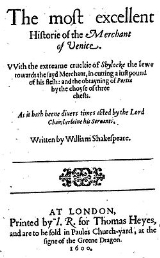
The Merchant of Venice is a tragic comedy by
William ShakespeareWilliam Shakespeare was an English poet and playwright, widely regarded as the greatest writer in the English language and the world's pre-eminent dramatist. He is often called England's national poet and the "Bard of Avon"...
, believed to have been written between 1596 and 1598. Though classified as a comedy in the
First FolioMr. William Shakespeares Comedies, Histories, & Tragedies. is the 1623 published collection of William Shakespeare's plays. Modern scholars commonly refer to it as the First Folio....
and sharing certain aspects with Shakespeare's other
romantic comediesRomantic Comedy can refer to* Romantic Comedy , a 1979 play written by Bernard Slade* Romantic Comedy , a 1983 film adapted from the play and starring Dudley Moore and Mary Steenburgen...
, the play is perhaps most remembered for its dramatic scenes, and is best known for
ShylockShylock is a fictional character in Shakespeare's The Merchant of Venice.-In the play:In The Merchant of Venice, Shylock is a Jewish moneylender who lends money to his Christian rival, Antonio, setting the security at a pound of Antonio's flesh...
and the famous 'Hath not a Jew eyes' speech. Also notable is
PortiaPortia is the heroine of William Shakespeare's The Merchant of Venice. A rich, beautiful, and intelligent heiress, she is bound by the lottery set forth in her father's will, which gives potential suitors the chance to choose between three caskets composed of gold, silver and lead...
's speech about the 'quality of mercy'.
The title character is the merchant
AntonioAntonio is the title character in Shakespeare’s The Merchant of Venice. He is a middle-aged bachelor and merchant by trade who has his financial interests tied up in overseas shipments when the play begins. He is kind, generous, honest and confident, and is loved and revered by all the Christians...
, not the Jewish
moneylenderA moneylender is a person or group who offers small personal loans at high rates of interest.-See also:* Microfinance - provision of financial services to low-income individuals....
Shylock, who is the play's most prominent and most famous character. This is made explicit by the title page of the first quarto: The moſt excellent Hiſtorie of the Merchant of Venice. With the extreame crueltie of Shylock the Iewe towards the ſayd Merchant, in cutting a iuſt pound of his fleſh: and the obtayning of Portia by the choyſe of three cheſts.
Characters
- Antonio
Antonio is the title character in Shakespeare’s The Merchant of Venice. He is a middle-aged bachelor and merchant by trade who has his financial interests tied up in overseas shipments when the play begins. He is kind, generous, honest and confident, and is loved and revered by all the Christians...
– a merchant of Venice
- Bassanio – Antonio's friend, in love with Portia; suitor likewise to her
- Gratiano, Solanio, Salarino, Salerio – friends of Antonio and Bassanio
- Lorenzo – friend of Antonio and Bassanio, in love with Jessica
- Portia
Portia is the heroine of William Shakespeare's The Merchant of Venice. A rich, beautiful, and intelligent heiress, she is bound by the lottery set forth in her father's will, which gives potential suitors the chance to choose between three caskets composed of gold, silver and lead...
– a rich heiress
- Nerissa – Portia's waiting-maid
- Balthazar – Portia's disguise as a lawyer
- Stephano – Nerissa's disguise as 'Balthazar's law clerk.
- Shylock
Shylock is a fictional character in Shakespeare's The Merchant of Venice.-In the play:In The Merchant of Venice, Shylock is a Jewish moneylender who lends money to his Christian rival, Antonio, setting the security at a pound of Antonio's flesh...
– a rich Jew, moneylender, father of Jessica
- Tubal – a Jew; Shylock's friend
- Jessica – daughter of Shylock, in love with Lorenzo
- Lancelot Gobbo – a foolish man in the service of Shylock
- Old Gobbo – father of Lancelot
- Leonardo – servant to Bassanio
- Duke of Venice – Venetian authority who presides over the case of Shylock's bond
- Prince of Morocco – suitor to Portia
- Prince of Aragon – suitor to Portia
- Magnificoes of Venice, officers of the Court of Justice, Gaoler, servants to Portia, and other Attendants
Synopsis
In the 14th century, the city of Venice in Italy was one of the richest of the world. Among the wealthiest of its merchants was Antonio. Among the Christian community, he was known as a kind and generous person. Bassanio, a young
VenetianThe Republic of Venice or Venetian Republic was a state originating from the city of Venice in Northeastern Italy. It existed for over a millennium, from the late 7th century until 1797. It was formally known as the Most Serene Republic of Venice and is often referred to as La Serenissima, in...
, of noble rank but having squandered his estate, wishes to travel to
BelmontBelmonte Calabro, known simply as Belmonte prior to the proclamation of the Kingdom of Italy, is a town and comune in the province of Cosenza, in Calabria...
to win the beautiful and wealthy heiress
PortiaPortia is the heroine of William Shakespeare's The Merchant of Venice. A rich, beautiful, and intelligent heiress, she is bound by the lottery set forth in her father's will, which gives potential suitors the chance to choose between three caskets composed of gold, silver and lead...
. He approaches his friend
AntonioAntonio is the title character in Shakespeare’s The Merchant of Venice. He is a middle-aged bachelor and merchant by trade who has his financial interests tied up in overseas shipments when the play begins. He is kind, generous, honest and confident, and is loved and revered by all the Christians...
, who has previously and repeatedly bailed him out, for three thousand
ducatThe ducat is a gold coin that was used as a trade coin throughout Europe before World War I. Its weight is 3.4909 grams of .986 gold, which is 0.1107 troy ounce, actual gold weight...
s needed to subsidise his travelling expenditures as a suitor for three months. Antonio agrees, but he is cash-poor; his ships and merchandise are busy at sea. He promises to cover a bond if Bassanio can find a lender, so Bassanio turns to the Jewish moneylender Shylock and names Antonio as the loan’s guarantor.
Shylock hates Antonio because of his antisemitism, shown when he insulted and spat on Shylock for being a Jew. Additionally, Antonio undermines Shylock's moneylending business by lending money at zero interest. Shylock proposes a condition for the loan: if Antonio is unable to repay it at the specified date, he may take a
poundThe pound or pound-mass is a unit of mass used in the Imperial, United States customary and other systems of measurement...
of Antonio's flesh. Bassanio does not want Antonio to accept such a risky condition; Antonio is surprised by what he sees as the moneylender's generosity (no "usance" – interest – is asked for), and he signs the contract. With money at hand, Bassanio leaves for Belmont with his friend Gratiano, who has asked to accompany him. Gratiano is a likeable young man, but is often flippant, overly talkative, and tactless. Bassanio warns his companion to exercise self-control, and the two leave for Belmont and Portia.
Meanwhile in Belmont, Portia is awash with suitors. Her father has left a
willA will or testament is a legal declaration by which a person, the testator, names one or more persons to manage his/her estate and provides for the transfer of his/her property at death...
stipulating each of her suitors must choose correctly from one of three caskets – one each of gold, silver, and lead. If he chooses the right casket, he gets Portia; if he loses, he must go away and never trouble her or any other woman again with a proposal of marriage.
The first suitor, the luxury- and money-obsessed Prince of Morocco, reasons to choose the gold casket, because lead proclaims "Choose me and risk hazard", and he has no wish to risk everything for lead, and the silver's "Choose me and get what you deserve" sounds like an invitation to be tortured, but "Choose me and get what most men desire" all but spells it out that he that chooses gold will get Portia, as what all men desire is Portia. Inside the casket are a few gold coins and a skull with a scroll containing the famous verse All that glisters is not gold / Often have you heard that told / Many a man his life hath sold / But my outside to behold / Gilded tombs do worms enfold / Had you been as wise as bold, / Young in limbs, in judgment old / Your answer had not been inscroll'd: / Fare you well; your suit is cold.
The second suitor is the conceited Prince of Aragon. He decides not to choose lead, because it is so common, and will not choose gold because he will then get what many men desire and wants to be distinguished from the barbarous multitudes. He decides to choose silver, because the silver casket proclaims "Choose Me And Get What You Deserve", which he imagines must be something great, because he egotistically imagines himself as great. Inside the casket is the picture of a court jester's head on a baton and remarks "What's here? the portrait of a blinking idiot... / Did I deserve no more than a fool's head?" The scroll reads: Some there be that shadows kiss; / Such have but a shadow's bliss: / ...Take what wife you will to bed, / I will ever be your head – meaning that he was foolish to imagine that a pompous man like him could ever be a fit husband for Portia, and that he was always a fool, he always will be a fool, and the fact that he chose the silver casket is mere proof that he is a fool.
The last suitor is Bassanio, who chooses the lead casket. As he is considering his choice of caskets, members of Portia's household sing a song which says that "fancy" (not true love) is "engend'red in the eyes, / With gazing fed." Seemingly in response to this little bit of philosophy, Bassanio remarks, "So may the outward shows be least themselves. / The world is still deceived with ornament." And at the end of the same speech, just before choosing the least valuable, and least showy metal, Bassanio says, "Thy paleness moves me more than eloquence; / And here choose I; joy be the consequence!" He has made the right choice.
At Venice, Antonio's ships are reported lost at sea. This leaves him unable to satisfy the bond (in financial language, insolvent). Shylock is even more determined to exact revenge from Christians after his daughter Jessica flees his home to convert to Christianity and elope with Lorenzo, taking a substantial amount of Shylock's wealth with her, as well as a turquoise ring which was a gift to Shylock from his late wife, Leah. Shylock has Antonio arrested and brought before court.
At Belmont, Portia and Bassanio have just been married, as have Gratiano and Portia's handmaid Nerissa. Bassanio receives a letter telling him that Antonio has been unable to return the loan taken from Shylock. Shocked, Bassanio and Gratiano leave for
VeniceVenice is a city in northern Italy which is renowned for the beauty of its setting, its architecture and its artworks. It is the capital of the Veneto region...
immediately, with money from Portia, to save Antonio's life by offering the money to Shylock. Unknown to Bassanio and Gratiano, Portia has sent her servant, Balthazar, to seek the counsel of Portia's cousin, Bellario, a lawyer, at
PaduaPadua is a city and comune in the Veneto, northern Italy. It is the capital of the province of Padua and the economic and communications hub of the area. Padua's population is 212,500 . The city is sometimes included, with Venice and Treviso, in the Padua-Treviso-Venice Metropolitan Area, having...
.
The climax of the play comes in the court of the Duke of Venice. Shylock refuses Bassanio's offer of 6,000 ducats, twice the amount of the loan. He demands his pound of flesh from Antonio. The Duke, wishing to save Antonio but unwilling to set a dangerous legal precedent of nullifying a contract, refers the case to a visitor who introduces himself as Balthazar, a young male "doctor of the law", bearing a letter of recommendation to the Duke from the learned lawyer Bellario. The "doctor" is actually Portia in disguise, and the "law clerk" who accompanies her is actually Nerissa, also in disguise. Portia, as "Balthazar", asks Shylock to show mercy in a famous speech ("The quality of mercy is not strain'd,
It droppeth as the gentle rain from heaven Upon the place beneath. It is twice blest: It blesseth him that gives and him that takes."—IV,i,185, arguing for
debt reliefDebt relief is the partial or total forgiveness of debt, or the slowing or stopping of debt growth, owed by individuals, corporations, or nations. From antiquity through the 19th century, it refers to domestic debts, in particular agricultural debts and freeing of debt slaves...
), but Shylock refuses. Thus the court must allow Shylock to extract the pound of flesh. Shylock tells Antonio to "prepare".
At that very moment, Portia points out a flaw in the contract (see
quibbleIn literature, a quibble is a common plot device, used to fulfill the exact verbal conditions of an agreement in order to avoid the intended meaning. Its most common uses are in legal bargains and, in fantasy, magically enforced ones....
): the bond only allows Shylock to remove the flesh, not the "blood", of Antonio. Thus, if Shylock were to shed any drop of Antonio's blood, his "lands and goods" would be forfeited under Venetian laws. Further damning Shylock's case, she tells him that he must cut precisely one pound of flesh, no more, no less; she advises him that "if the scale do turn /But in the estimation of a hair, /Thou diest and all thy goods are confiscate."
Defeated, Shylock concedes to accepting Bassanio's offer of money for the defaulted bond, first his offer to pay "the bond thrice," which Portia rebuffs, telling him to take his bond, and then merely the principal, which Portia also prevents him from doing on the ground that he has already refused it "in the open court." She then cites a law under which Shylock, as a Jew and therefore an "alien", having attempted to take the life of a citizen, has forfeited his property, half to the government and half to Antonio, leaving his life at the mercy of the Duke. The Duke immediately pardons Shylock's life. Antonio asks for his share "in use" (that is, reserving the principal amount while taking only the income) until Shylock's death, when the principal will be given to Lorenzo and Jessica. At Antonio's request, the Duke grants remission of the state's half of forfeiture, but in return, Shylock is forced to convert to Christianity and to make a will (or "deed of gift") bequeathing his entire estate to Lorenzo and Jessica (IV,i).
Bassanio does not recognise his disguised wife, but offers to give a present to the supposed lawyer. First she declines, but after he insists, Portia requests his ring and Antonio's gloves. Antonio parts with his gloves without a second thought, but Bassanio gives the ring only after much persuasion from Antonio, as earlier in the play he promised his wife never to lose, sell or give it. Nerissa, as the lawyer's clerk, also succeeds in likewise retrieving her ring from Gratiano, who does not see through her disguise.
At Belmont, Portia and Nerissa taunt and pretend to accuse their husbands before revealing they were really the lawyer and his clerk in disguise (V). After all the other characters make amends, Antonio learns from Portia that three of his ships were not stranded and have returned safely after all.
Date and text
The date of composition for The Merchant of Venice is believed to be between 1596 and 1598. The play was mentioned by
Francis MeresFrancis Meres was an English churchman and author.He was born at Kirton in the Holland division of Lincolnshire in 1565. He was educated at Pembroke College, Cambridge, where he received a B.A. in 1587 and an M.A. in 1591. Two years later he was incorporated an M.A. of Oxford...
in 1598, so it must have been familiar on the stage by that date, and the title page of the first edition in 1600 states that it had been performed "divers times" by that date. Salerio's reference to his ship the "Andrew" (I,i,27) is thought to be an allusion to the Spanish ship St. Andrew captured by the English at
CadizCadiz is a city and port in southwestern Spain. It is the capital of the homonymous province, one of eight which make up the autonomous community of Andalusia....
in 1596. A date of 1596–97 is considered consistent with the play's style.
The play was entered in the
RegisterThe Stationers' Register was a record book maintained by the Stationers' Company of London. The company is a trade guild given a royal charter in 1557 to regulate the various professions associated with the publishing industry, including printers, bookbinders, booksellers, and publishers in England...
of the
Stationers CompanyThe Worshipful Company of Stationers and Newspaper Makers is one of the Livery Companies of the City of London. The Stationers' Company was founded in 1403; it received a Royal Charter in 1557...
, the method at that time of obtaining
copyrightCopyright is a legal concept, enacted by most governments, giving the creator of an original work exclusive rights to it, usually for a limited time...
for a new play, by James Roberts on 22 July 1598 under the title The Merchant of Venice, otherwise called The Jew of Venice. On 28 October 1600 Roberts transferred his right to the play to the stationer Thomas Hayes; Hayes published the first
quartoThe size of a book is generally measured by the height against the width of a leaf, or sometimes the height and width of its cover. A series of terms is commonly used by libraries and publishers for the general sizes of modern books, ranging from "folio" , to "quarto" and "octavo"...
before the end of the year. It was printed again in a pirated edition in 1619, as part of William Jaggard's so-called
False FolioFalse Folio is the term that Shakespeare scholars and bibliographers have applied to William Jaggard's printing of ten Shakespearean and pseudo-Shakespearean plays together in 1619, the first attempt to collect Shakespeare's work in a single volume....
. (Afterward, Thomas Hayes' son and heir Laurence Hayes asked for and was granted a confirmation of his right to the play, on 8 July 1619.) The 1600 edition is generally regarded as being accurate and reliable, and is the basis of the text published in the 1623
First FolioMr. William Shakespeares Comedies, Histories, & Tragedies. is the 1623 published collection of William Shakespeare's plays. Modern scholars commonly refer to it as the First Folio....
, which adds a number of stage directions, mainly musical cues.
Sources
The forfeit of a merchant's deadly
bondA surety bond is a promise to pay one party a certain amount if a second party fails to meet some obligation, such as fulfilling the terms of a contract...
after standing surety for a friend's loan was a common tale in England in the late sixteenth century. The test of the suitors at Belmont, the merchant's rescue from the "pound of flesh" penalty by his friend's new wife disguised as a lawyer and her demand for the betrothal ring in payment are all present in the 14th century tale Il Pecorone by Giovanni Fiorentino, which was published in Milan in 1558. Elements of the trial scene are also found in The Orator by
Alexandre SylvaneHistoires tragiques were a genre of French fiction in 16th-17th centuries, a Baroque rendering of Boccaccio's type of short stories, concentrating on the dark side of human nature....
, published in translation in 1596.
Performance
The earliest performance of which a record has survived was held at the court of
King JamesJames VI and I was King of Scots as James VI from 24 July 1567 and King of England and Ireland as James I from the union of the English and Scottish crowns on 24 March 1603...
in the spring of 1605, followed by a second performance a few days later, but there is no record of any further performances in the seventeenth century. In 1701, George Granville staged a successful adaptation, titled The Jew of Venice, with
Thomas BettertonThomas Patrick Betterton , English actor, son of an under-cook to King Charles I, was born in London.-Apprentice and actor:...
as Bassanio. This version (which featured a
masqueThe masque was a form of festive courtly entertainment which flourished in 16th and early 17th century Europe, though it was developed earlier in Italy, in forms including the intermedio...
) was popular, and was acted for the next forty years. Granville cut the Gobbos in line with
neoclassicalNeoclassical architecture was an architectural style produced by the neoclassical movement that began in the mid-18th century, manifested both in its details as a reaction against the Rococo style of naturalistic ornament, and in its architectural formulas as an outgrowth of some classicizing...
decorumDecorum was a principle of classical rhetoric, poetry and theatrical theory that was about the fitness or otherwise of a style to a theatrical subject...
; he added a jail scene between Shylock and Antonio, and a more extended scene of toasting at a banquet scene.
Thomas DoggettThomas Doggett was an Irish actor.Doggett was born in Dublin, and made his first stage appearance in London in 1691 as Nincompoop in Thomas D'Urfey's Love for Money. In this part, and as Solon in the same author's Marriage-Hater Matched, he became popular...
was Shylock, playing the role comically, perhaps even farcically.
RoweNicholas Rowe , English dramatist, poet and miscellaneous writer, was appointed Poet Laureate in 1715.-Life:...
expressed doubts about this interpretation as early as 1709; Doggett's success in the role meant that later productions would feature the troupe clown as Shylock.
In 1741
Charles MacklinCharles Macklin , originally Cathal MacLochlainn , was an actor and dramatist born in Culdaff, a village on the scenic Inishowen Peninsula in County Donegal, part of the Province of Ulster in the north of Ireland. He was one of the most distinguished actors of his day, equally in tragedy and comedy...
returned to the original text in a very successful production at
Drury LaneThe Theatre Royal, Drury Lane is a West End theatre in Covent Garden, in the City of Westminster, a borough of London. The building faces Catherine Street and backs onto Drury Lane. The building standing today is the most recent in a line of four theatres at the same location dating back to 1663,...
, paving the way for
Edmund KeanEdmund Kean was an English actor, regarded in his time as the greatest ever.-Early life:Kean was born in London. His father was probably Edmund Kean, an architect’s clerk, and his mother was an actress, Anne Carey, daughter of the 18th century composer and playwright Henry Carey...
seventy years later (see below).
Arthur SullivanSir Arthur Seymour Sullivan MVO was an English composer of Irish and Italian ancestry. He is best known for his series of 14 operatic collaborations with the dramatist W. S. Gilbert, including such enduring works as H.M.S. Pinafore, The Pirates of Penzance and The Mikado...
wrote
incidental musicIncidental music is music in a play, television program, radio program, video game, film or some other form not primarily musical. The term is less frequently applied to film music, with such music being referred to instead as the "film score" or "soundtrack"....
for the play in 1871.
Shylock on stage
Jewish actor
Jacob AdlerJacob Pavlovich Adler , born Yankev P. Adler, was a Jewish actor and star of Yiddish theater, first in Odessa, and later in London and New York City....
and others report that the tradition of playing Shylock sympathetically began in the first half of the 19th century with
Edmund KeanEdmund Kean was an English actor, regarded in his time as the greatest ever.-Early life:Kean was born in London. His father was probably Edmund Kean, an architect’s clerk, and his mother was an actress, Anne Carey, daughter of the 18th century composer and playwright Henry Carey...
, and that previously the role had been played "by a comedian as a repulsive
clownClowns are comic performers stereotypically characterized by the grotesque image of the circus clown's colored wigs, stylistic makeup, outlandish costumes, unusually large footwear, and red nose, which evolved to project their actions to large audiences. Other less grotesque styles have also...
or, alternatively, as a monster of unrelieved evil." Kean's Shylock established his reputation as an actor.
From Kean's time forward, all of the actors who have famously played the role, with the exception of
Edwin BoothEdwin Thomas Booth was a famous 19th century American actor who toured throughout America and the major capitals of Europe, performing Shakespearean plays. In 1869 he founded Booth's Theatre in New York, a spectacular theatre that was quite modern for its time...
, who played Shylock as a simple villain, have chosen a sympathetic approach to the character; even Booth's father,
Junius Brutus BoothJunius Brutus Booth was an English actor. He was the father of John Wilkes Booth , Edwin Booth , and Junius Brutus Booth, Jr., an actor and theatre manager...
, played the role sympathetically.
Henry IrvingSir Henry Irving , born John Henry Brodribb, was an English stage actor in the Victorian era, known as an actor-manager because he took complete responsibility for season after season at the Lyceum Theatre, establishing himself and his company as...
's portrayal of an aristocratic, proud Shylock (first seen at the Lyceum in 1879, with Portia played by
Ellen TerryDame Ellen Terry, GBE was an English stage actress who became the leading Shakespearean actress in Britain. Among the members of her famous family is her great nephew, John Gielgud....
) has been called "the summit of his career". Jacob Adler was the most notable of the early 20th century: Adler played the role in
YiddishYiddish theatre consists of plays written and performed primarily by Jews in Yiddish, the language of the Central European Ashkenazi Jewish community. The range of Yiddish theatre is broad: operetta, musical comedy, and satiric or nostalgic revues; melodrama; naturalist drama; expressionist and...
-language translation, first in
ManhattanManhattan is the oldest and the most densely populated of the five boroughs of New York City. Located primarily on the island of Manhattan at the mouth of the Hudson River, the boundaries of the borough are identical to those of New York County, an original county of the state of New York...
's
Lower East SideThe Lower East Side, LES, is a neighborhood in the southeastern part of the New York City borough of Manhattan. It is roughly bounded by Allen Street, East Houston Street, Essex Street, Canal Street, Eldridge Street, East Broadway, and Grand Street....
, and later on
BroadwayBroadway theatre, commonly called simply Broadway, refers to theatrical performances presented in one of the 40 professional theatres with 500 or more seats located in the Theatre District centered along Broadway, and in Lincoln Center, in Manhattan in New York City...
, where, to great acclaim, he performed the role in Yiddish in an otherwise English-language production.
Kean and Irving presented a Shylock justified in wanting his
revengeRevenge is a harmful action against a person or group in response to a grievance, be it real or perceived. It is also called payback, retribution, retaliation or vengeance; it may be characterized, justly or unjustly, as a form of justice.-Function in society:Some societies believe that the...
; Adler's Shylock evolved over the years he played the role, first as a stock Shakespearean villain, then as a man whose better nature was overcome by a desire for revenge, and finally as a man who operated not from revenge but from
pridePride is an inwardly directed emotion that carries two common meanings. With a negative connotation, pride refers to an inflated sense of one's personal status or accomplishments, often used synonymously with hubris...
. In a 1902 interview with Theater magazine, Adler pointed out that Shylock is a wealthy man, "rich enough to forgo the interest on three thousand ducats" and that Antonio is "far from the chivalrous gentleman he is made to appear. He has insulted the Jew and spat on him, yet he comes with hypocritical politeness to borrow money of him." Shylock's fatal flaw is to depend on the law, but "would he not walk out of that courtroom head erect, the very apotheosis of defiant hatred and scorn?"
Some modern productions take further pains to show how Shylock's thirst for vengeance has some justification. For instance, in the
2004 film adaptationThe Merchant of Venice is a 2004 romantic drama film based on Shakespeare's play of the same name. It is the first full-length sound film version in English of Shakespeare's play; most other versions are videotaped productions made for television...
directed by
Michael RadfordMichael Radford is an English film director and screenwriter.-Early life and career:Radford was born on 24 February 1946, in New Delhi, India, to a British father and an Austrian Jewish mother. He was educated at Bedford School before attending Worcester College, Oxford...
and starring
Al PacinoAlfredo James "Al" Pacino is an American film and stage actor and director. He is famous for playing mobsters, including Michael Corleone in The Godfather trilogy, Tony Montana in Scarface, Alphonse "Big Boy" Caprice in Dick Tracy and Carlito Brigante in Carlito's Way, though he has also appeared...
as Shylock, the film begins with text and a montage of how the Jewish community is cruelly abused by the bigoted Christian population of the city. One of the last shots of the film also brings attention to the fact that, as a convert, Shylock would have been cast out of the Jewish community in Venice, no longer allowed to live in the ghetto, and would still not be accepted by the Christians, as they might feel that Shylock has not changed.
Shylock and the antisemitism debate
The play is frequently staged today, but is potentially troubling to modern audiences due to its central themes, which can easily appear antisemitic. Critics today still continue to argue over the play's stance on antisemitism.
The antisemitic reading
English society in the Elizabethan era has been described as antisemitic.
English JewsThe history of the Jews in England goes back to the reign of William I. The first written record of Jewish settlement in England dates from 1070, although Jews may have lived there since Roman times...
had been expelled under Edward I in 1290 and were not permitted to return until 1656 under the rule of
Oliver CromwellOliver Cromwell was an English military and political leader who overthrew the English monarchy and temporarily turned England into a republican Commonwealth, and served as Lord Protector of England, Scotland, and Ireland....
. Jews were often presented on the Elizabethan stage in hideous caricature, with hooked noses and bright red wigs, and were usually depicted as avaricious usurers; an example is
Christopher MarloweChristopher Marlowe was an English dramatist, poet and translator of the Elizabethan era. As the foremost Elizabethan tragedian, next to William Shakespeare, he is known for his blank verse, his overreaching protagonists, and his mysterious death.A warrant was issued for Marlowe's arrest on 18 May...
's play
The Jew of MaltaThe Jew of Malta is a play by Christopher Marlowe, probably written in 1589 or 1590. Its plot is an original story of religious conflict, intrigue, and revenge, set against a backdrop of the struggle for supremacy between Spain and the Ottoman Empire in the Mediterranean that takes place on the...
, which features a comically wicked Jewish villain called Barabas. They were usually characterised as evil, deceitful and greedy.
During the 17th century in Venice and in some other places, Jews were required to wear a red hat at all times in public to make sure that they were easily identified. If they did not comply with this rule they could face the death penalty. Jews also had to live in a ghetto protected by Christians, supposedly for their own safety. The Jews were expected to pay their guards.
In the 2004 film, Antonio is seen to spit on Shylock in the beginning, in accordance with Shylock's line "you spit on my Jewish gaberdine", so that Shylock's hate for Antonio grows out of the antisemitic treatment he receives.
Readers may see Shakespeare's play as a continuation of this antisemitic tradition. The title page of the
QuartoThe earliest texts of William Shakespeare's works were published during the 16th and 17th centuries in quarto or folio format. Folios are large, tall volumes; quartos are smaller, roughly half the size...
indicates that the play was sometimes known as The Jew of Venice in its day, which suggests that it was seen as similar to Marlowe's The Jew of Malta. One interpretation of the play's structure is that Shakespeare meant to contrast the mercy of the main Christian characters with the vengefulness of a Jew, who lacks the religious
graceIn Christian theology, grace is God’s gift of God’s self to humankind. It is understood by Christians to be a spontaneous gift from God to man - "generous, free and totally unexpected and undeserved" - that takes the form of divine favour, love and clemency. It is an attribute of God that is most...
to comprehend mercy. Similarly, it is possible that Shakespeare meant Shylock's
forced conversionA forced conversion is the religious conversion or acceptance of a philosophy against the will of the subject, often with the threatened consequence of earthly penalties or harm. These consequences range from job loss and social isolation to incarceration, torture or death...
to Christianity to be a "
happy endingA happy ending is an ending of the plot of a work of fiction in which almost everything turns out for the best for the protagonists, their sidekicks, and almost everyone except the villains....
" for the character, as, to a Christian audience, it saves his soul and allows him to enter Heaven.
Hyam MaccobyHyam Maccoby was a British Jewish scholar and dramatist specializing in the study of the Jewish and Christian religious tradition. His grandfather and namesake was Rabbi Hyam Maccoby , better known as the "Kamenitzer Maggid," a passionate religious Zionist and advocate of vegetarianism and animal...
argues that the play is based on medieval
morality playThe morality play is a genre of Medieval and early Tudor theatrical entertainment. In their own time, these plays were known as "interludes", a broader term given to dramas with or without a moral theme. Morality plays are a type of allegory in which the protagonist is met by personifications of...
s in which the Virgin Mary (here represented by Portia) argues for the forgiveness of human souls, as against the implacable accusations of the Devil (Shylock). On this reading, the Merchant is notably more antisemitic than The Jew of Malta, in which there are no good Christian characters and the Jewish villain seems to be regarded by the author with a certain covert sympathy.
The sympathetic reading
Many modern readers and theatregoers have read the play as a plea for tolerance, noting that Shylock is a sympathetic character. They cite as evidence that Shylock's 'trial' at the end of the play is a mockery of justice, with Portia acting as a judge when she has no right to do so. The characters who berated Shylock for dishonesty resort to trickery in order to win. In addition, Shakespeare gives Shylock one of his most eloquent speeches:
Influence on antisemitism
Regardless of what Shakespeare's own intentions may have beenIntentional fallacy, in literary criticism, addresses the assumption that the meaning intended by the author of a literary work is of primary importance. By characterizing this assumption as a "fallacy", a critic suggests that the author's intention is not important. The term is an important...
, the play has been made use of by antisemites throughout the play's history. One must note that the end of the title in the 1619 edition "With the Extreme Cruelty of Shylock the Jew..." must aptly describe how Shylock was viewed by the English public. The Nazis used the usurious Shylock for their propaganda. Shortly after
KristallnachtKristallnacht, also referred to as the Night of Broken Glass, and also Reichskristallnacht, Pogromnacht, and Novemberpogrome, was a pogrom or series of attacks against Jews throughout Nazi Germany and parts of Austria on 9–10 November 1938.Jewish homes were ransacked, as were shops, towns and...
in 1938, "The Merchant of Venice" was broadcast for propagandistic ends over the German airwaves. Productions of the play followed in
LübeckThe Hanseatic City of Lübeck is the second-largest city in Schleswig-Holstein, in northern Germany, and one of the major ports of Germany. It was for several centuries the "capital" of the Hanseatic League and, because of its Brick Gothic architectural heritage, is listed by UNESCO as a World...
(1938), Berlin (1940), and elsewhere within the Nazi Territory.
The
depiction of Jews in literatureStereotypes of Jews in literature have evolved over the centuries. According to Louis Harap, nearly all European writers prior to the twentieth century projected the Jewish stereotype in their works...
throughout the centuries bears the close imprint of Shylock. With slight variations much of English literature up until the 20th century depicts the Jew as "a monied, cruel, lecherous, avaricious outsider tolerated only because of his golden hoard".
Character study
It is difficult to know whether the sympathetic reading of Shylock is entirely due to changing sensibilities among readers, or whether Shakespeare, a writer who created complex, multi-faceted characters, deliberately intended this reading.
One of the reasons for this interpretation is that Shylock's painful status in Venetian society is emphasised. To some critics, Shylock's celebrated "Hath not a Jew eyes" speech (see above) redeems him and even makes him into something of a tragic figure. In the speech, Shylock argues that he is no different from the Christian characters. Detractors note that Shylock ends the speech with a tone of revenge: "if you wrong us, shall we not revenge?" Those who see the speech as sympathetic point out that Shylock says he learned the desire for revenge from the Christian characters: "If a Christian wrong a Jew, what should his sufferance be by Christian example? Why, revenge. The villainy you teach me, I will execute, and it shall go hard but I will better the instruction."
Even if Shakespeare did not intend the play to be read this way, the fact that it retains its power on stage for audiences who may perceive its central conflicts in radically different terms is an illustration of the subtlety of Shakespeare's characterisations.
In the trial Shylock represents the supposedly Jewish desire for justice (
Old TestamentThe Old Testament, of which Christians hold different views, is a Christian term for the religious writings of ancient Israel held sacred and inspired by Christians which overlaps with the 24-book canon of the Masoretic Text of Judaism...
) versus the Christian one for mercy (
New TestamentThe New Testament is the second major division of the Christian biblical canon, the first such division being the much longer Old Testament....
). The Christians in the courtroom urge mercy. Shylock is not able because he does not find love, but hate. The Christians in the courtroom urge Shylock to love his enemies, although they themselves failed in the past.
Antonio, Bassanio
Antonio's unexplained depression—"In sooth I know not why I am so sad"—and utter devotion to Bassanio has led some critics to theorise that he is suffering from
unrequited loveUnrequited love is love that is not openly reciprocated or understood as such, even though reciprocation is usually deeply desired. The beloved may or may not be aware of the admirer's deep affections...
for Bassanio and is depressed because Bassanio is coming to an age where he will marry a woman. In his plays and poetry Shakespeare often depicted strong male bonds of varying
homosocialityIn sociology, homosociality describes same-sex relationships that are not of a romantic or sexual nature, such as friendship, mentorship, or others. The opposite of homosocial is heterosocial, preferring non-sexual relations with the opposite sex...
, which has led some critics to infer that Bassanio returns Antonio's affections despite his obligation to marry:
In his essay "Brothers and Others", published in The Dyer's Hand,
W. H. AudenWystan Hugh Auden , who published as W. H. Auden, was an Anglo-American poet,The first definition of "Anglo-American" in the OED is: "Of, belonging to, or involving both England and America." See also the definition "English in origin or birth, American by settlement or citizenship" in See also...
describes Antonio as "a man whose emotional life, though his conduct may be chaste, is concentrated upon a member of his own sex." Antonio's feelings for Bassanio are likened to a couplet from Shakespeare's Sonnets: "But since she pricked thee out for women's pleasure,/ Mine be thy love, and my love's use their treasure." Antonio, says Auden, embodies the words on Portia's leaden casket: "Who chooseth me, must give and hazard all he hath." Antonio has taken this potentially fatal turn because he despairs, not only over the loss of Bassanio in marriage, but also because Bassanio cannot requite what Antonio feels for him. Antonio's frustrated devotion is a form of idolatry: the right to live is yielded for the sake of the loved one. There is one other such idolator in the play: Shylock himself. "Shylock, however unintentionally, did, in fact, hazard all for the sake of destroying the enemy he hated; and Antonio, however unthinkingly he signed the bond, hazarded all to secure the happiness of the man he loved." Both Antonio and Shylock, agreeing to put Antonio's life at a forfeit, stand outside the normal bounds of society. There was, states Auden, a traditional "association of sodomy with usury", reaching back at least as far as
DanteDelivery of Advanced Network Technology to Europe is a not-for-profit organisation that plans, builds and operates the international networks that interconnect the various national research and education networks in Europe and surrounding regions...
, with which Shakespeare was likely familiar. (Auden sees the theme of
usuryUsury Originally, when the charging of interest was still banned by Christian churches, usury simply meant the charging of interest at any rate . In countries where the charging of interest became acceptable, the term came to be used for interest above the rate allowed by law...
in the play as a comment on human relations in a mercantile society.)
Other interpreters of the play regard Auden's conception of Antonio's sexual desire for Bassanio as questionable. Michael Radford, director of the 2004 film version starring
Al PacinoAlfredo James "Al" Pacino is an American film and stage actor and director. He is famous for playing mobsters, including Michael Corleone in The Godfather trilogy, Tony Montana in Scarface, Alphonse "Big Boy" Caprice in Dick Tracy and Carlito Brigante in Carlito's Way, though he has also appeared...
, explained that although the film contains a scene where Antonio and Bassanio actually kiss, the friendship between the two is platonic, in line with the prevailing view of male friendship at the time.
Jeremy IronsJeremy John Irons is an English actor. After receiving classical training at the Bristol Old Vic Theatre School, Irons began his acting career on stage in 1969, and has since appeared in many London theatre productions including The Winter's Tale, Macbeth, Much Ado About Nothing, The Taming of the...
, in an interview, concurs with the director's view and states that he did not "play Antonio as gay".
Joseph FiennesJoseph Fiennes is an English film and stage actor. He is perhaps best known for his portrayals of William Shakespeare in Shakespeare in Love, Sir Robert Dudley in Elizabeth, Commisar Danilov in Enemy at the Gates, Martin Luther in Luther, Merlin in Camelot, and his portrayal of Mark Benford in the...
, however, who plays Bassanio, encouraged a homoerotic interpretation and, in fact, surprised Irons with the kiss on set, which was filmed in one take. Fiennes defended his choice, saying "I would never invent something before doing my detective work in the text. If you look at the choice of language ... you'll read very sensuous language. That's the key for me in the relationship. The great thing about Shakespeare and why he's so difficult to pin down is his ambiguity. He's not saying they're gay or they're straight, he's leaving it up to his actors. I feel there has to be a great love between the two characters ... there's great attraction. I don't think they have slept together but that's for the audience to decide."
Film adaptations
The Shakespeare play has inspired several films.
- 1914—silent film directed by Lois Weber
Lois Weber was an American silent film actress, screenwriter, producer, and director, who is considered "the most important female director the American film industry has known", and "one of the most important and important and prolific film directors in the era of silent films". Film historian...
- Weber, who also stars as Portia, became the first woman to direct a full-length feature film in America with this film.
}
- 1916-The Merchant of Venice
The Merchant of Venice is a 1916 British silent drama film directed by Walter West and starring Matheson Lang, Hutin Britton, Ernest Caselli. It is an adaptation of William Shakespeare's play The Merchant of Venice.-Production:...
, a silent British film directed by Walter WestWalter West was a British film director. He was a partner in the film production company Broadwest Films.-Broadwest:...
for Broadwest.
}
- 1973—television film directed by John Sichel
John Peter Sichel was a British director of film, stage and television, and, later in life, a film, television, and theatre trainer....
- The cast included Laurence Olivier
Laurence Kerr Olivier, Baron Olivier, OM was an English actor, director, and producer. He was one of the most famous and revered actors of the 20th century. He married three times, to fellow actors Jill Esmond, Vivien Leigh, and Joan Plowright...
as Shylock, Anthony NichollsAnthony Nicholls was an English film, television, and stage actor.-Life and career:Nicholls was born Sydney Horace Nicholls on 16 October 1902 in Windsor, Berkshire, England, the son of Florence and photojournalist Horace Nicholls. He served in the Royal Artillery...
as Antonio, Jeremy BrettJeremy Brett , born Peter Jeremy William Huggins, was an English actor, most famous for his portrayal of Sherlock Holmes in four Granada TV series.-Early life:...
as Bassanio, Joan PlowrightJoan Ann Plowright, Baroness Olivier, DBE , better known as Dame Joan Plowright, is an English actress, whose career has spanned over sixty years. Throughout her career she has won two Golden Globe Awards and a Tony Award and has been nominated for an Academy Award, an Emmy, and two BAFTA Awards...
as Portia, Louise Purnell as Jessica.
}
- 1980—A BBC
The British Broadcasting Corporation is a British public service broadcaster. Its headquarters is at Broadcasting House in the City of Westminster, London. It is the largest broadcaster in the world, with about 23,000 staff...
television film directed by Jack GoldJack Gold is a British film and television director. He was part of the British Realist Tradition that followed Free Cinema.-Career:...
- The cast included Gemma Jones
Gemma Jones is an English character actress on both stage and screen.-Early life:Jones was born in London, England, the daughter of Irene and Griffith Jones, an actor. Her brother, Nicholas Jones, is also an actor...
as Portia and Warren MitchellWarren Mitchell is an English actor who rose to initial prominence in the role of bigoted cockney Alf Garnett in the BBC television sitcom Till Death Us Do Part , and its sequels Till Death... and In Sickness and in Health , all of which were written by Johnny Speight...
as Shylock
}
- 1996—A Channel 4
Channel 4 is a British public-service television broadcaster which began working on 2 November 1982. Although largely commercially self-funded, it is ultimately publicly owned; originally a subsidiary of the Independent Broadcasting Authority , the station is now owned and operated by the Channel...
television film directed by Alan Horrox
- The cast included Paul McGann
Paul McGann is an English actor who made his name on the BBC serial The Monocled Mutineer, in which he played the lead role...
as Bassanio and Haydn Gwynne-Personal life:Born in Hurstpierpoint, Sussex to father Guy Thomas Hayden-Gwynne, she played county level tennis before studying Sociology at the University of Nottingham, and is fluent in French and Italian...
as Portia
}
- 2001—A BBC
The British Broadcasting Corporation is a British public service broadcaster. Its headquarters is at Broadcasting House in the City of Westminster, London. It is the largest broadcaster in the world, with about 23,000 staff...
television film directed by Trevor NunnSir Trevor Robert Nunn, CBE is an English theatre, film and television director. Nunn has been the Artistic Director for the Royal Shakespeare Company, the Royal National Theatre, and, currently, the Theatre Royal, Haymarket. He has directed musicals and dramas for the stage, as well as opera...
- Royal National Theatre
The Royal National Theatre in London is one of the United Kingdom's two most prominent publicly funded theatre companies, alongside the Royal Shakespeare Company...
production starring Henry GoodmanHenry Goodman is a British theatre actor. He trained at RADA in London alongside Jonathan Pryce.In 1988, he played George Green's brother-in-law Cyril in London's Burning. He played character roles in episodes of the popular UK police drama The Bill...
as Shylock
}
- 2002—The Maori Merchant of Venice
The Merchant of Venice , also known as The Maori Merchant of Venice, is a 2002 New Zealand drama film in the Māori language , directed by Don Selwyn.-Production:...
, directed by Don SelwynDon C. Selwyn was a Maori actor and film director from New Zealand. He was a founding member of the New Zealand Maori Theatre Trust and directed the 2002 film The Merchant of Venice, the first Maori language feature film with English subtitles.Born of Ngati Kuri and Te Aupouri descent, Selwyn grew...
.
- In Maori
Māori or te reo Māori , commonly te reo , is the language of the indigenous population of New Zealand, the Māori. It has the status of an official language in New Zealand...
, with English subtitles. The cast included Waihoroi Shortland as Shylock, Scott Morrison as Antonio, Te Rangihau Gilbert as Bassanio, Ngarimu Daniels as Portia, Reikura Morgan as Jessica.
}
- 2003—Shakespeare's Merchant, directed by Paul Wagar and produced by Lorenda Starfelt
Lorenda Starfelt was an award-winning independent film producer, as well as a committed political activist and blogger who famously dug up president Barack Obama's in an August 1961 edition of The Honolulu Advertiser while researching her documentary on the 2008 presidential election...
, Brad MaysBrad Mays is an independent filmmaker and stage director, living and working in Los Angeles, California.-Background and education:...
and Paul Wagar.
}
- 2004—The Merchant of Venice
The Merchant of Venice is a 2004 romantic drama film based on Shakespeare's play of the same name. It is the first full-length sound film version in English of Shakespeare's play; most other versions are videotaped productions made for television...
, directed by Michael RadfordMichael Radford is an English film director and screenwriter.-Early life and career:Radford was born on 24 February 1946, in New Delhi, India, to a British father and an Austrian Jewish mother. He was educated at Bedford School before attending Worcester College, Oxford...
.
- The cast included Al Pacino
Alfredo James "Al" Pacino is an American film and stage actor and director. He is famous for playing mobsters, including Michael Corleone in The Godfather trilogy, Tony Montana in Scarface, Alphonse "Big Boy" Caprice in Dick Tracy and Carlito Brigante in Carlito's Way, though he has also appeared...
as Shylock, Jeremy IronsJeremy John Irons is an English actor. After receiving classical training at the Bristol Old Vic Theatre School, Irons began his acting career on stage in 1969, and has since appeared in many London theatre productions including The Winter's Tale, Macbeth, Much Ado About Nothing, The Taming of the...
as Antonio, Joseph FiennesJoseph Fiennes is an English film and stage actor. He is perhaps best known for his portrayals of William Shakespeare in Shakespeare in Love, Sir Robert Dudley in Elizabeth, Commisar Danilov in Enemy at the Gates, Martin Luther in Luther, Merlin in Camelot, and his portrayal of Mark Benford in the...
as Bassanio, Lynn CollinsViola Lynn Collins , better known as Lynn Collins, is an American actress. She is best known for her role as Kayla Silverfox in the live-action film X-Men Origins: Wolverine.-Life and career:...
as Portia, and Zuleikha RobinsonZuleikha Robinson is an English actress, raised in Thailand and Malaysia by a Burmese-Indian mother and an English father. She is a graduate of the American Academy of Dramatic Arts in Los Angeles, and best known for playing Ilana in the ABC show Lost.In 2006, she played a Bengali character called...
as Jessica.
}
Opera
- Josef Bohuslav Foerster
Josef Bohuslav Foerster was a Czech composer of classical music. He is often referred to as J. B. Foerster. The surname is sometimes spelled Förster.- Life :...
's three act Czech opera Jessika was first performed at the Prague National TheatreThe National Theatre in Prague is known as the Alma Mater of Czech opera, and as the national monument of Czech history and art.The National Theatre belongs to the most important Czech cultural institutions, with a rich artistic tradition which was created and maintained by the most distinguished...
, on 16 April 1905.
- Reynaldo Hahn
Reynaldo Hahn was a Venezuelan, naturalised French, composer, conductor, music critic and diarist. Best known as a composer of songs, he wrote in the French classical tradition of the mélodie....
's three act French opera Le marchand de VeniseLe marchand de Venise is a French opera in three acts by Reynaldo Hahn. The libretto was by Miguel Zamacoïs, after Shakespeare's The Merchant of Venice...
was first performed at the Paris OpéraThe Paris Opera is the primary opera company of Paris, France. It was founded in 1669 by Louis XIV as the Académie d'Opéra and shortly thereafter was placed under the leadership of Jean-Baptiste Lully and renamed the Académie Royale de Musique...
, on 25 March 1935.
Cultural references
Arnold WeskerSir Arnold Wesker is a prolific British dramatist known for his contributions to kitchen sink drama. He is the author of 42 plays, 4 volumes of short stories, 2 volumes of essays, a book on journalism, a children's book, extensive journalism, poetry and other assorted writings...
's play The Merchant tells the same story from Shylock's point of view. In this retelling, Shylock and Antonio are fast friends bound by a mutual love of books and culture and a disdain for the crass anti-Semitism of the Christian community's laws. They make the bond in defiant mockery of the Christian establishment, never anticipating that the bond might become forfeit. When it does, the play argues, Shylock must carry through on the letter of the law or jeopardise the scant legal security of the entire Jewish community. He is, therefore, quite as grateful as Antonio when Portia, as in Shakespeare's play, shows the legal way out. The play received its American premiere on 16 November 1977 at New York's Plymouth Theatre with Joseph Leon as Shylock and Marian Seldes as Shylock's sister Rivka. This production had a challenging history in previews on the road, culminating (after the first night out of town in Philadelphia on 8 September 1977) with the death of the larger-than-life Broadway star
Zero MostelSamuel Joel “Zero” Mostel was an American actor of stage and screen, best known for his portrayal of comic characters such as Tevye on stage in Fiddler on the Roof, Pseudolus on stage and on screen in A Funny Thing Happened on the Way to the Forum, and Max Bialystock in the original film version...
, who was initially cast as Shylock. The play's author,
Arnold WeskerSir Arnold Wesker is a prolific British dramatist known for his contributions to kitchen sink drama. He is the author of 42 plays, 4 volumes of short stories, 2 volumes of essays, a book on journalism, a children's book, extensive journalism, poetry and other assorted writings...
wrote a book chronicling the out-of-town tribulations that beset the play and Zero's death called "The Birth of Shylock and the Death of Zero Mostel."
David Henry WilsonDavid Henry Wilson is an English writer. As an author he is best known for his children's stories such as the Jeremy James series. Wilson has also had a number of plays produced in the United Kingdom, both for children and adults....
's play Shylock's Revenge, which was first performed by The University Players at the Audimax, Hamburg, on 9 June 1989, can be seen as a full-length sequel to Shakespeare's drama.
The title of the film
Seven PoundsSeven Pounds is a 2008 film, directed by Gabriele Muccino. Will Smith stars as a man who sets out to change the lives of seven people. Rosario Dawson, Woody Harrelson, and Barry Pepper star. The film was released in theaters in the United States and Canada on December 19, 2008, by Columbia Pictures...
is a reference to the "Pound of Flesh" from the play.
Edmond Haraucourt, the French playwright and poet, was commissioned in the 1880s by the actor and theatrical director Paul Porel to make a French verse adaptation of the Merchant of Venice. His play Shylock, first performed at the Théâtre de l'Odéon in December 1889, had incidental music by the French composer
Gabriel FauréGabriel Urbain Fauré was a French composer, organist, pianist and teacher. He was one of the foremost French composers of his generation, and his musical style influenced many 20th century composers...
, later incorporated into an orchestral suite of the same name.
One of the four short stories comprising
Alan IslerAlan Isler was an American novelist and professor. He left his native England for the United States at age 18, served in the US Army from 1954 to 1956, received a doctorate in English Literature from Columbia University and taught Renaissance Literature at Queens College, City University of New...
's Op Non Cit is also told from Shylock's point of view. In this story, Antonio was a boy of Jewish origin kidnapped at an early age by priests.
Ralph Vaughan WilliamsRalph Vaughan Williams OM was an English composer of symphonies, chamber music, opera, choral music, and film scores. He was also a collector of English folk music and song: this activity both influenced his editorial approach to the English Hymnal, beginning in 1904, in which he included many...
' choral work
Serenade to MusicSerenade to Music is a work by Ralph Vaughan Williams for 16 vocal soloists and orchestra, composed in 1938. The text is an adaptation of the discussion about music and the music of the spheres in Act V, Scene 1 of The Merchant of Venice by William Shakespeare. Vaughan Williams later arranged...
draws its text from the discussion about music and the music of the spheres in Act V, scene 1.
In both versions of the comic film
To Be or Not to BeTo Be or Not to Be is a 1983 20th Century Fox comedy-drama film directed by Alan Johnson, produced by Mel Brooks with Howard Jeffrey as executive producer and Irene Walzer as associate producer. The screenplay was written by Ronny Graham and Thomas Meehan, based on the original story by Melchior...
the character "Greenberg", specified as a Jew only in the later version, gives a recitation of the "Hath not a Jew Eyes?" to Nazi soldiers.
In The Pianist, Henryk Szpilman quotes a passage from Shylock's 'Hath a Jew No Eyes?' speech to his brother Władysław Szpilman in a Jewish Ghetto in Warsaw, Poland, during the Nazi occupation in World War II. Given the questioning of Antisemitism in the speech and also the Nazi use of the play for antisemitic propaganda purposes, the quote is seen as particularly poignant and symbolic.
Steven SpielbergSteven Allan Spielberg KBE is an American film director, screenwriter, producer, video game designer, and studio entrepreneur. In a career of more than four decades, Spielberg's films have covered many themes and genres. Spielberg's early science-fiction and adventure films were seen as an...
's
Schindler's ListSchindler's List is a 1993 American film about Oskar Schindler, a German businessman who saved the lives of more than a thousand mostly Polish-Jewish refugees during the Holocaust by employing them in his factories. The film was directed by Steven Spielberg, and based on the novel Schindler's Ark...
depicts SS Lieutenant
Amon GöthAmon Leopold Göth was an Austrian Nazi and the commandant of the Nazi concentration camp at Płaszów, General Government...
quoting Shylock's 'Hath a Jew No Eyes?' speech when discussing whether to turn in his Jewish lover to the death squads.
Regina SpektorRegina Ilyinichna Spektor is a Russian American singer-songwriter and pianist. Her music is associated with the anti-folk scene centered in New York City's East Village.-Early life:...
's song "Pound of Flesh" references The Merchant of Venice.
External links
- The Merchant of Venice - Critical Analysis from Shakespeare Online
- The Merchant of Venice Navigator – Includes annotated text, line numbers, search engine, and scene summaries.
- Entire Script- The Merchant of Venice fully copied, in easy to read format
- The Merchant of Venice – plain vanilla text from Project Gutenberg
Project Gutenberg is a volunteer effort to digitize and archive cultural works, to "encourage the creation and distribution of eBooks". Founded in 1971 by Michael S. Hart, it is the oldest digital library. Most of the items in its collection are the full texts of public domain books...
- The Merchant of Venice – HTML version of this title.
- The Merchant of Venice – Searchable version of the play, indexed by scene.
- Thesis statements & important quotes from The Merchant of Venice
- CliffsNotes
- SparkNotes: Study Guide
- Lesson plans for The Merchant of Venice at Web English Teacher
- The Merchant of Venice study guide, themes, quotes, character analyses, teaching guide
- A Contemporary English Version of The Merchant of Venice – includes extensive notes and commentary, with essays on "The Lottery" and "The Three Sals."
- on Antisemitism Interview with Michael Kahn from the U.S. Holocaust Memorial Museum
The United States Holocaust Memorial Museum is the United States' official memorial to the Holocaust. Adjacent to the National Mall in Washington, D.C., the USHMM provides for the documentation, study, and interpretation of Holocaust history...
; Discusses theme of antisemitism