

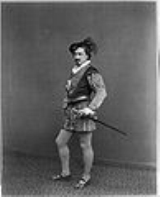
Iago

Encyclopedia
Iago is a fictional character in Shakespeare's Othello
(c. 1601–04). The character's source is traced to Giovanni Battista Giraldi Cinthio's tale "Un Capitano Moro" in Gli Hecatommithi (1565). There, the character is simply "the ensign". Iago is a soldier and Othello
's ancient (ensign or standard bearer). He is the husband of Emilia
, Desdemona
's attendant. He hates Othello and devises a plan to destroy the Moor
by making him believe that his wife, Desdemona
, is having an affair with his lieutenant, Michael Cassio
.
translation of Cinthio was available in Shakespeare's lifetime, it is possible Shakespeare knew the Italian
original, Gabriel Chappuy's 1584 French
translation, or an English translation in manuscript. Cinthio's tale may have been based on an actual incident occurring in Venice
about 1508. In Cinthio, Iago's counterpart is simply "the ensign."
While Shakespeare closely followed Cinthio's tale in composing Othello, he departed from it in some details. In Cinthio's tale, for example, the ensign suffers an unrequited lust for the Moor
's wife, Desdemona, which then drives his vengeance. Desdemona dies in an entirely different manner in Cinthio's tale; the Moor commissions his ensign to bludgeon her to death with a sand-filled stocking. In gruesome detail, Cinthio follows each blow, and, when she is dead, the Moor and his ensign place her lifeless body upon her bed, smash her skull
, and then cause the cracked ceiling above the bed to collapse upon her, giving the impression the falling rafters caused her death.
The two murderers escape detection. The Moor misses his wife greatly, however, and comes to loathe the sight of his ensign. He demotes him, and refuses to have him in his company. The ensign then seeks revenge by disclosing to "the squadron leader" (the tale's Cassio
counterpart), the Moor's involvement in Desdemona's death. The two men denounce the Moor to the Venetian Seignory. The Moor is arrested, transported from Cyprus
to Venice
, and torture
d, but refuses to admit his guilt. He is condemned to exile
; Desdemona's relatives eventually execute him. The ensign escapes any prosecution in Desdemona's death, but engages in other crimes and dies after being tortured.
. He also suspects that his wife, Emilia
, is cheating on him with Othello. Iago plots to manipulate Othello into demoting Cassio, and thereafter to bring about the downfall of Othello himself. He has an ally, Roderigo
, who assists him in his plans in the mistaken belief that after Othello is gone, Iago will help Roderigo earn the affection of Othello's wife, Desdemona
. After Iago engineers a drunken brawl to ensure Cassio’s demotion (in Act 2), he sets to work on his second scheme: leading Othello to believe that Desdemona is having an affair with Cassio. This plan occupies the final three acts of the play.
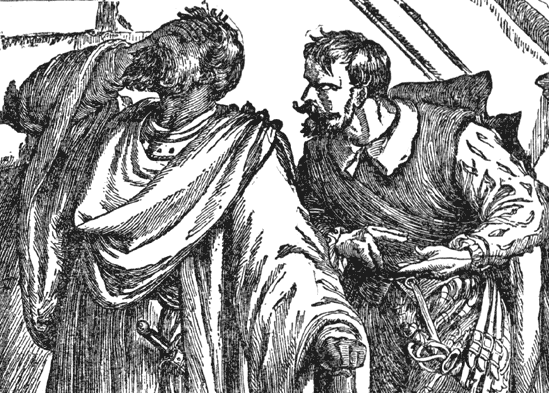 He manipulates Emilia, Desdemona's lady-in-waiting, into taking from Desdemona a handkerchief that Othello had given her; he then tells Othello that he had seen it in Cassio's possession. Once Othello flies into a jealous rage, Iago tells him to hide while he (Iago) talks to Cassio. Iago then leads Othello to believe that a bawdy conversation about Cassio's mistress, Bianca
, is in fact about Desdemona. Mad with jealousy, Othello orders Iago to kill Cassio, promising to make him lieutenant in return. Iago then engineers a fight between Cassio and Roderigo in which the latter is killed (by Iago himself, double-crossing his ally), but the former merely wounded.
In the final scene, Iago’s plan appears to succeed when Othello kills Desdemona, who is innocent of Iago's charges. Soon afterwards, however, Iago’s treachery is brought to light by Emilia; Iago is placed under arrest. He remains famously reticent when pressed for an explanation of his actions before he is arrested: "Demand me nothing. What you know, you know. From this time forth I never will speak word."
s, often considered such because of the unique trust that Othello places in him, which he betrays while maintaining his reputation of honesty and dedication. Shakespeare contrasts Iago with Othello's nobility and integrity. With 1097 lines, he has more lines than Othello.
Iago is a Machiavellian schemer and manipulator, as he is often referred to as "honest Iago", displaying his skill at deceiving other characters so that not only do they not suspect him, but they count on him as the person most likely to be truthful.
Shakespearean critic A. C. Bradley said that "evil
has nowhere else been portrayed with such mastery as in the evil character of Iago." The mystery surrounding Iago’s actual motives continues to intrigue readers and fuel scholarly debate.
. This reading would seem to suggest that Iago, much like Don John in Much Ado About Nothing
or Aaron in Titus Andronicus
, wreaks havoc on the other characters' lives for no ulterior purpose.
In the exposition
in Act 1, scene 1, Iago himself states that his prime motivation is bitterness at having been passed for promotion to the top post. His racist
disgust at seeing "a black ram tupping" a "white ewe", and his supreme confidence in his ability to destroy Othello and escape detection, all present potential motives. In a later soliloquy
, it is revealed that Iago suspects his wife of infidelity with both Othello and Cassio.
Léone Teyssandier writes that a possible motive for his actions is envy towards Desdemona, Cassio and Othello; Iago sees them as more noble, generous and, in the case of Cassio, more handsome than he is. In particular, he sees the death of Cassio as a necessity, saying of him that "He hath a daily beauty in his life that makes me ugly".
Ultimately, none of these motives is identified as primary, so it is impossible to determine conclusively which applies, if indeed any of them do in isolation, or which is most important among them.
Andy Serkis
, who in 2002 portrayed Iago at the Royal Exchange Theatre in Manchester
, wrote in his memoir
Gollum: How We Made Movie Magic
, that:
Iago only reveals his true nature in his soliloquies, and in occasional asides. Elsewhere, he is charisma
tic and friendly, and the advice he offers to both Cassio and Othello is superficially sound; as Iago himself remarks: "And what's he then, that says I play the villain, when this advice is free I give, and honest...?"
It is this dramatic irony that drives the play.
Some critics thought Kenneth Branagh
portrayed Iago as a homosexual, thus giving a possible motive of sexual desire for Othello, jealousy of Desdemona, and rage at the impossibility of his love for Othello being requited. In an interview, Branagh stated "Well, you know, a rather distinguished critic said he was annoyed with my performance because I'd clearly played Iago gay. I had no consciousness of doing that at all, but I did play as though he loved Othello. But I don't mean in a sexual sense. I just meant that he absolutely loved him. And frankly, that's the way I am with my male friends: I say 'I love you' when I feel it."
as "Ben Jago" (a corrupt police detective) in a 2002 adaptation set in a London
police department, Josh Hartnett
as "Hugo" (a steroid
-addicted teenager) in 2001's O
, which sets the play in a contemporary high school, Lal as Komali Paniyan in Jayaraaj's malayalam movie Kaliyattam
(English: The Play of God) and Saif Ali Khan
as Ishwar "Langda" Tyagi in Vishal Bharadwaj's Omkara
, set in Uttar Pradesh
, India
.
Othello
The Tragedy of Othello, the Moor of Venice is a tragedy by William Shakespeare, believed to have been written in approximately 1603, and based on the Italian short story "Un Capitano Moro" by Cinthio, a disciple of Boccaccio, first published in 1565...
(c. 1601–04). The character's source is traced to Giovanni Battista Giraldi Cinthio's tale "Un Capitano Moro" in Gli Hecatommithi (1565). There, the character is simply "the ensign". Iago is a soldier and Othello
Othello (character)
Othello is a character in Shakespeare's Othello . The character's origin is traced to the tale, "Un Capitano Moro" in Gli Hecatommithi by Giovanni Battista Giraldi Cinthio. There, he is simply referred to as the Moor....
's ancient (ensign or standard bearer). He is the husband of Emilia
Emilia (Othello)
Emilia is a character in the tragedy Othello by William Shakespeare. The character's origin is traced to the 1565 tale, "Un capitano Moro" from Giovanni Battista Giraldi Cinthio's Gli Hecatommithi. There, the character is described as young and virtuous, is referred to simply as the ensign's wife,...
, Desdemona
Desdemona (Othello)
Desdemona is a character in William Shakespeare's play Othello . Shakespeare's Desdemona is a Venetian beauty who enrages and disappoints her father, a Venetian senator, when she elopes with Othello, a man several years her senior. When her husband is deployed to Cyprus in the service of the...
's attendant. He hates Othello and devises a plan to destroy the Moor
Moors
The description Moors has referred to several historic and modern populations of the Maghreb region who are predominately of Berber and Arab descent. They came to conquer and rule the Iberian Peninsula for nearly 800 years. At that time they were Muslim, although earlier the people had followed...
by making him believe that his wife, Desdemona
Desdemona
Desdemona is a character in William Shakespeare's play Othello.Desdemona may also refer to:People* Desdemona , a soprano role in the 1816 opera Otello by Gioachino Rossini...
, is having an affair with his lieutenant, Michael Cassio
Michael Cassio
Michael Cassio, or simply Cassio, is a fictional character in William Shakespeare's Othello. The source of the character is the 1565 tale "Un Capitano Moro" by Cinthio; Cassio is unnamed in Cinthio but referred to as "the squadron leader." In the play, Cassio is a young and handsome lieutenant...
.
Origin
Othello has its source in the 1565 tale, "Un Capitano Moro" from Gli Hecatommithi by Giovanni Battista Giraldi Cinthio. While no EnglishEnglish language
English is a West Germanic language that arose in the Anglo-Saxon kingdoms of England and spread into what was to become south-east Scotland under the influence of the Anglian medieval kingdom of Northumbria...
translation of Cinthio was available in Shakespeare's lifetime, it is possible Shakespeare knew the Italian
Italian language
Italian is a Romance language spoken mainly in Europe: Italy, Switzerland, San Marino, Vatican City, by minorities in Malta, Monaco, Croatia, Slovenia, France, Libya, Eritrea, and Somalia, and by immigrant communities in the Americas and Australia...
original, Gabriel Chappuy's 1584 French
French language
French is a Romance language spoken as a first language in France, the Romandy region in Switzerland, Wallonia and Brussels in Belgium, Monaco, the regions of Quebec and Acadia in Canada, and by various communities elsewhere. Second-language speakers of French are distributed throughout many parts...
translation, or an English translation in manuscript. Cinthio's tale may have been based on an actual incident occurring in Venice
Venice
Venice is a city in northern Italy which is renowned for the beauty of its setting, its architecture and its artworks. It is the capital of the Veneto region...
about 1508. In Cinthio, Iago's counterpart is simply "the ensign."
While Shakespeare closely followed Cinthio's tale in composing Othello, he departed from it in some details. In Cinthio's tale, for example, the ensign suffers an unrequited lust for the Moor
Moors
The description Moors has referred to several historic and modern populations of the Maghreb region who are predominately of Berber and Arab descent. They came to conquer and rule the Iberian Peninsula for nearly 800 years. At that time they were Muslim, although earlier the people had followed...
's wife, Desdemona, which then drives his vengeance. Desdemona dies in an entirely different manner in Cinthio's tale; the Moor commissions his ensign to bludgeon her to death with a sand-filled stocking. In gruesome detail, Cinthio follows each blow, and, when she is dead, the Moor and his ensign place her lifeless body upon her bed, smash her skull
Human skull
The human skull is a bony structure, skeleton, that is in the human head and which supports the structures of the face and forms a cavity for the brain.In humans, the adult skull is normally made up of 22 bones...
, and then cause the cracked ceiling above the bed to collapse upon her, giving the impression the falling rafters caused her death.
The two murderers escape detection. The Moor misses his wife greatly, however, and comes to loathe the sight of his ensign. He demotes him, and refuses to have him in his company. The ensign then seeks revenge by disclosing to "the squadron leader" (the tale's Cassio
Michael Cassio
Michael Cassio, or simply Cassio, is a fictional character in William Shakespeare's Othello. The source of the character is the 1565 tale "Un Capitano Moro" by Cinthio; Cassio is unnamed in Cinthio but referred to as "the squadron leader." In the play, Cassio is a young and handsome lieutenant...
counterpart), the Moor's involvement in Desdemona's death. The two men denounce the Moor to the Venetian Seignory. The Moor is arrested, transported from Cyprus
Cyprus
Cyprus , officially the Republic of Cyprus , is a Eurasian island country, member of the European Union, in the Eastern Mediterranean, east of Greece, south of Turkey, west of Syria and north of Egypt. It is the third largest island in the Mediterranean Sea.The earliest known human activity on the...
to Venice
Venice
Venice is a city in northern Italy which is renowned for the beauty of its setting, its architecture and its artworks. It is the capital of the Veneto region...
, and torture
Torture
Torture is the act of inflicting severe pain as a means of punishment, revenge, forcing information or a confession, or simply as an act of cruelty. Throughout history, torture has often been used as a method of political re-education, interrogation, punishment, and coercion...
d, but refuses to admit his guilt. He is condemned to exile
Exile
Exile means to be away from one's home , while either being explicitly refused permission to return and/or being threatened with imprisonment or death upon return...
; Desdemona's relatives eventually execute him. The ensign escapes any prosecution in Desdemona's death, but engages in other crimes and dies after being tortured.
Role in the play
Iago is a soldier who has fought beside Othello for several years, and has become his trusted advisor. At the beginning of the play, Iago claims to have been unfairly passed over for promotion to the rank of Othello's lieutenant in favour of Michael CassioMichael Cassio
Michael Cassio, or simply Cassio, is a fictional character in William Shakespeare's Othello. The source of the character is the 1565 tale "Un Capitano Moro" by Cinthio; Cassio is unnamed in Cinthio but referred to as "the squadron leader." In the play, Cassio is a young and handsome lieutenant...
. He also suspects that his wife, Emilia
Emilia (Othello)
Emilia is a character in the tragedy Othello by William Shakespeare. The character's origin is traced to the 1565 tale, "Un capitano Moro" from Giovanni Battista Giraldi Cinthio's Gli Hecatommithi. There, the character is described as young and virtuous, is referred to simply as the ensign's wife,...
, is cheating on him with Othello. Iago plots to manipulate Othello into demoting Cassio, and thereafter to bring about the downfall of Othello himself. He has an ally, Roderigo
Roderigo
Roderigo is a fictional character in Shakespeare's Othello . He is a dissolute Venetian lusting after Othello's wife Desdemona. Roderigo has opened his purse to Iago in the mistaken belief that Iago is using his money to pave the way to Desdemona's bed...
, who assists him in his plans in the mistaken belief that after Othello is gone, Iago will help Roderigo earn the affection of Othello's wife, Desdemona
Desdemona
Desdemona is a character in William Shakespeare's play Othello.Desdemona may also refer to:People* Desdemona , a soprano role in the 1816 opera Otello by Gioachino Rossini...
. After Iago engineers a drunken brawl to ensure Cassio’s demotion (in Act 2), he sets to work on his second scheme: leading Othello to believe that Desdemona is having an affair with Cassio. This plan occupies the final three acts of the play.
Bianca (Othello)
Bianca is a fictional character in William Shakespeare's Othello . She is Cassio's jealous lover. Despite her brief appearance on stage, Bianca plays a significant role in the progress of Iago's scheme to incite Othello's jealousy of Cassio. Bianca is traditionally regarded as a courtesan,...
, is in fact about Desdemona. Mad with jealousy, Othello orders Iago to kill Cassio, promising to make him lieutenant in return. Iago then engineers a fight between Cassio and Roderigo in which the latter is killed (by Iago himself, double-crossing his ally), but the former merely wounded.
In the final scene, Iago’s plan appears to succeed when Othello kills Desdemona, who is innocent of Iago's charges. Soon afterwards, however, Iago’s treachery is brought to light by Emilia; Iago is placed under arrest. He remains famously reticent when pressed for an explanation of his actions before he is arrested: "Demand me nothing. What you know, you know. From this time forth I never will speak word."
Description of character
Iago is one of Shakespeare's most sinister villainVillain
A villain is an "evil" character in a story, whether a historical narrative or, especially, a work of fiction. The villain usually is the antagonist, the character who tends to have a negative effect on other characters...
s, often considered such because of the unique trust that Othello places in him, which he betrays while maintaining his reputation of honesty and dedication. Shakespeare contrasts Iago with Othello's nobility and integrity. With 1097 lines, he has more lines than Othello.
Iago is a Machiavellian schemer and manipulator, as he is often referred to as "honest Iago", displaying his skill at deceiving other characters so that not only do they not suspect him, but they count on him as the person most likely to be truthful.
Shakespearean critic A. C. Bradley said that "evil
Evil
Evil is the violation of, or intent to violate, some moral code. Evil is usually seen as the dualistic opposite of good. Definitions of evil vary along with analysis of its root motive causes, however general actions commonly considered evil include: conscious and deliberate wrongdoing,...
has nowhere else been portrayed with such mastery as in the evil character of Iago." The mystery surrounding Iago’s actual motives continues to intrigue readers and fuel scholarly debate.
Motives
Iago has been described as a "motiveless malignity" by Samuel Taylor ColeridgeSamuel Taylor Coleridge
Samuel Taylor Coleridge was an English poet, Romantic, literary critic and philosopher who, with his friend William Wordsworth, was a founder of the Romantic Movement in England and a member of the Lake Poets. He is probably best known for his poems The Rime of the Ancient Mariner and Kubla...
. This reading would seem to suggest that Iago, much like Don John in Much Ado About Nothing
Much Ado About Nothing
Much Ado About Nothing is a comedy written by William Shakespeare about two pairs of lovers, Benedick and Beatrice, and Claudio and Hero....
or Aaron in Titus Andronicus
Titus Andronicus
Titus Andronicus is a tragedy by William Shakespeare, and possibly George Peele, believed to have been written between 1588 and 1593. It is thought to be Shakespeare's first tragedy, and is often seen as his attempt to emulate the violent and bloody revenge plays of his contemporaries, which were...
, wreaks havoc on the other characters' lives for no ulterior purpose.
In the exposition
Exposition (literary technique)
At the beginning of a narrative, the exposition is the author's providing of some background information to the audience about the plot, characters' histories, setting, and theme. Exposition is considered one of four rhetorical modes of discourse, along with argumentation, description, and narration...
in Act 1, scene 1, Iago himself states that his prime motivation is bitterness at having been passed for promotion to the top post. His racist
Racism
Racism is the belief that inherent different traits in human racial groups justify discrimination. In the modern English language, the term "racism" is used predominantly as a pejorative epithet. It is applied especially to the practice or advocacy of racial discrimination of a pernicious nature...
disgust at seeing "a black ram tupping" a "white ewe", and his supreme confidence in his ability to destroy Othello and escape detection, all present potential motives. In a later soliloquy
Soliloquy
A soliloquy is a device often used in drama whereby a character relates his or her thoughts and feelings to him/herself and to the audience without addressing any of the other characters, and is delivered often when they are alone or think they are alone. Soliloquy is distinct from monologue and...
, it is revealed that Iago suspects his wife of infidelity with both Othello and Cassio.
Léone Teyssandier writes that a possible motive for his actions is envy towards Desdemona, Cassio and Othello; Iago sees them as more noble, generous and, in the case of Cassio, more handsome than he is. In particular, he sees the death of Cassio as a necessity, saying of him that "He hath a daily beauty in his life that makes me ugly".
Ultimately, none of these motives is identified as primary, so it is impossible to determine conclusively which applies, if indeed any of them do in isolation, or which is most important among them.
Andy Serkis
Andy Serkis
Andrew Clement G. "Andy" Serkis is an English actor, director and author. He is popularly known for playing Gollum in The Lord of the Rings film trilogy, for which he earned several award nominations, including the Saturn Award for Best Supporting Actor for his performance in The Two Towers...
, who in 2002 portrayed Iago at the Royal Exchange Theatre in Manchester
Manchester
Manchester is a city and metropolitan borough in Greater Manchester, England. According to the Office for National Statistics, the 2010 mid-year population estimate for Manchester was 498,800. Manchester lies within one of the UK's largest metropolitan areas, the metropolitan county of Greater...
, wrote in his memoir
Memoir
A memoir , is a literary genre, forming a subclass of autobiography – although the terms 'memoir' and 'autobiography' are almost interchangeable. Memoir is autobiographical writing, but not all autobiographical writing follows the criteria for memoir set out below...
Gollum: How We Made Movie Magic
Gollum: How We Made Movie Magic
Gollum: How We Made Movie Magic is a memoir written by actor Andy Serkis about his adventures playing Gollum in New Line Cinema's Lord of the Rings film trilogy...
, that:
Iago only reveals his true nature in his soliloquies, and in occasional asides. Elsewhere, he is charisma
Charisma
The term charisma has two senses: 1) compelling attractiveness or charm that can inspire devotion in others, 2) a divinely conferred power or talent. For some theological usages the term is rendered charism, with a meaning the same as sense 2...
tic and friendly, and the advice he offers to both Cassio and Othello is superficially sound; as Iago himself remarks: "And what's he then, that says I play the villain, when this advice is free I give, and honest...?"
It is this dramatic irony that drives the play.
Some critics thought Kenneth Branagh
Kenneth Branagh
Kenneth Charles Branagh is an actor and film director from Northern Ireland. He is best known for directing and starring in several film adaptations of William Shakespeare's plays including Henry V , Much Ado About Nothing , Hamlet Kenneth Charles Branagh is an actor and film director from...
portrayed Iago as a homosexual, thus giving a possible motive of sexual desire for Othello, jealousy of Desdemona, and rage at the impossibility of his love for Othello being requited. In an interview, Branagh stated "Well, you know, a rather distinguished critic said he was annoyed with my performance because I'd clearly played Iago gay. I had no consciousness of doing that at all, but I did play as though he loved Othello. But I don't mean in a sexual sense. I just meant that he absolutely loved him. And frankly, that's the way I am with my male friends: I say 'I love you' when I feel it."
Other versions of the character
In looser adaptations of Othello, the "Iago" character is typically given a different name, but has been more or less the same as Shakespeare's. Prominent examples include Christopher EcclestonChristopher Eccleston
Christopher Eccleston is an English stage, film and television actor. His films include Let Him Have It, Shallow Grave, Elizabeth, 28 Days Later, Gone in 60 Seconds, The Others, and G.I. Joe: The Rise of Cobra...
as "Ben Jago" (a corrupt police detective) in a 2002 adaptation set in a London
London
London is the capital city of :England and the :United Kingdom, the largest metropolitan area in the United Kingdom, and the largest urban zone in the European Union by most measures. Located on the River Thames, London has been a major settlement for two millennia, its history going back to its...
police department, Josh Hartnett
Josh Hartnett
Joshua Daniel "Josh" Hartnett is an American actor and aspiring producer. He first came to audiences' attention in 1997 as "Michael Fitzgerald" in the television series Cracker. He made his feature film debut in 1998, co-starring with Jamie Lee Curtis in Halloween H20: 20 Years Later for Miramax...
as "Hugo" (a steroid
Anabolic steroid
Anabolic steroids, technically known as anabolic-androgen steroids or colloquially simply as "steroids", are drugs that mimic the effects of testosterone and dihydrotestosterone in the body. They increase protein synthesis within cells, which results in the buildup of cellular tissue ,...
-addicted teenager) in 2001's O
O (film)
O is a 2001 American drama film, and a loose modern adaptation of William Shakespeare's Othello.The film's intended release date was April 1999, but due to the Columbine High School massacre, the film was shelved for two years by its original distributor, Miramax Films. Ultimately, it was sold...
, which sets the play in a contemporary high school, Lal as Komali Paniyan in Jayaraaj's malayalam movie Kaliyattam
Kaliyattam
Kaliyattam is a 1997 Malayalam film directed by Jayaraaj, and starring Suresh Gopi, Lal, and Manju Warrier. The film is an adapted version of William Shakespeare's play Othello against the backdrop of the Hindu Theyyam performance...
(English: The Play of God) and Saif Ali Khan
Saif Ali Khan
Saif Ali Khan is an Indian actor known for his work in Bollywood films. He is the son of the late former Nawab of Pataudi, Mansoor Ali Khan Pataudi, and actress Sharmila Tagore. He has two sisters: Saba Ali Khan and actress Soha Ali Khan....
as Ishwar "Langda" Tyagi in Vishal Bharadwaj's Omkara
Omkara (film)
Omkara is a 2006 Indian film adaptation of Shakespeare’s Othello, co-written and directed by Vishal Bhardwaj. It starred Ajay Devgan, Saif Ali Khan, and Kareena Kapoor in the lead roles, supported by Vivek Oberoi, Naseeruddin Shah, and Konkona Sen Sharma with a cameo role from Bipasha Basu...
, set in Uttar Pradesh
Uttar Pradesh
Uttar Pradesh abbreviation U.P. , is a state located in the northern part of India. With a population of over 200 million people, it is India's most populous state, as well as the world's most populous sub-national entity...
, India
India
India , officially the Republic of India , is a country in South Asia. It is the seventh-largest country by geographical area, the second-most populous country with over 1.2 billion people, and the most populous democracy in the world...
.