


Shylock

Encyclopedia
Shylock is a fictional character in Shakespeare's The Merchant of Venice
.
moneylender
who lends money to his Christian
rival, Antonio
, setting the security
at a pound of Antonio's flesh. When a bankrupt Antonio defaults on the loan, Shylock demands the pound of flesh, as he dislikes Antonio because Antonio used to loan money without charging any interest and thus made Shylock lose business. Meanwhile, Shylock's daughter, Jessica, elopes with Antonio's friend Lorenzo and becomes a Christian, further fuelling Shylock's rage. She also takes money and jewels from Shylock.
is a sin and the fact that it was one of the few professions available to Jews in medieval Europe, who were prohibited by law from most professions. Jessica, Shylock's daughter did not adhere to these beliefs and left Shylock for a Christian man.
and others report that the tradition of playing Shylock sympathetically began in the first half of the 19th century with Edmund Kean
, and that previously the role had been played "by a comedian as a repulsive clown
or, alternatively, as a monster of unrelieved evil." Kean's Shylock established his reputation as an actor.
From Kean's time forward, many actors who have played the role — with the notable exception of Edwin Booth
, who played him as a simple villain — have chosen a sympathetic approach to the character; even Booth's father, Junius Brutus Booth
, played the role sympathetically. Henry Irving
's portrayal of an aristocratic, proud Shylock (first seen at the Lyceum in 1879, with Portia
played by Ellen Terry
) has been called "the summit of his career". Jacob Adler was the most notable of the early 20th century, playing the role in Yiddish in an otherwise English-language production. In the English-speaking world, Shylock has predominantly been portrayed as an Ashkenazi Jew (a tradition still evident in Al Pacino
's performance on film), although the action is supposed to take place in Venice, reflecting the representations available to modern-day British and American artists and audiences rather than the time and place of the setting.
Kean and Irving presented a Shylock justified in wanting his revenge
; Adler's Shylock evolved over the years he played the role, first as a stock Shakespearean villain, then as a man whose better nature was overcome by a desire for revenge, and finally as a man who operated not from revenge but from pride
. In a 1902 interview with Theater magazine, Adler pointed out that Shylock is a wealthy man, "rich enough to forgo the interest on three thousand ducats" and that Antonio is "far from the chivalrous
gentleman he is made to appear. He has insulted the Jew and spat on him, yet he comes with hypocritical politeness to borrow money of him." Shylock's fatal flaw is to depend on the law, but "would he not walk out of that courtroom head erect, the very apotheosis of defiant hatred and scorn?"
Some modern productions take further pains to show how Shylock's thirst for vengeance has some justification. For instance, in the 2004 film adaptation
directed by Michael Radford
and starring Al Pacino
as Shylock, the film begins with text and a montage of how the Jewish community is abused by the Christian population of the city. One of the last shots of the film also brings attention to the fact that, as a convert, Shylock would have been cast out of the Jewish community in Venice, no longer allowed to live in the ghetto, and would still not be accepted by the Christians, as they would feel that Shylock was yet the Jew he once was. Another interpretation of Shylock and a vision of how "must he be acted" appears at the conclusion of the autobiography of Alexander Granach
, a noted Jewish stage and film actor in Weimar Germany (and later in Hollywood and on Broadway).
Arnold Wesker
's play The Merchant tells the same story from Shylock's point of view. In this retelling, Shylock and Antonio are friends bound by a mutual love of books and culture and a disdain for the anti-Semitism of the Christian community's laws. They make the bond in defiant mockery of the Christian establishment, never anticipating that the bond might become forfeit. When it does, the play argues, Shylock must carry through on the letter of the law or jeopardize the scant legal security of the entire Jewish community. He is, therefore, quite as grateful as Antonio when Portia, as in Shakespeare's play, shows the legal way out. The play received its American premiere on November 16, 1977 at New York's Plymouth Theatre with Joseph Leon as Shylock, Marian Seldes
as Shylock's sister Rivka and Roberta Maxwell
as Portia. This production had a challenging history in previews on the road, culminating (after the first night out of town in Philadelphia on September 8, 1977) with the death of the Broadway star Zero Mostel
, who was initially cast as Shylock. The play's author, Arnold Wesker
, wrote a book chronicling the out-of-town tribulations that beset the play and Mostel's death called "The Birth of Shylock and the Death of Zero Mostel."
in the 16th century, Charles Macklin
in 1741, Edmund Kean
in 1814, William Charles Macready
in 1840, Edwin Booth
in 1861, Henry Irving
in 1880, George Arliss
in 1928, John Gielgud
in 1937, Laurence Olivier
at the Royal National Theatre
in 1972 and on TV in 1973, Patrick Stewart
in 1965 at the Theatre Royal, Bristol and 1978, plus (as Shylock) in a one-man stage show Mr. Stewart developed entitled "Shylock: Shakespeare's Alien" in 1987 and 2001, Al Pacino
in a 2004 feature film
version as well as in Central Park
in 2010, and F. Murray Abraham
at the Royal Shakespeare Company
in 2006.
Sir Patrick Stewart has also been named as the actor to play Shylock as part of the Royal Shakespeare Company's 50th birthday season (2011).
Under Nazi rule in 1943, the Vienna Burgtheater
presented a notoriously extreme production of The Merchant of Venice with Werner Krauss
as Shylock.
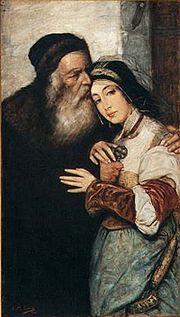 The play is frequently staged today, but is potentially troubling to modern audiences due to its central themes, which can easily appear antisemitic. Critics today still continue to argue over the play's stance on antisemitism.
The character's name has become a synonym
for loan shark
, and as a verb
to shylock means to lend money at exorbitant rates
. In addition, the phrase "pound of flesh" has also entered the lexicon
as slang
for a particularly onerous or unpleasant obligation.
English Jews
had been expelled under Edward I in 1290 and were not permitted to return until 1656 under the rule of Oliver Cromwell
. Jews were often presented on the Elizabethan stage in hideous caricature, with hooked noses and bright red wigs, and were usually depicted as avaricious usurers; an example is Christopher Marlowe
's play The Jew of Malta
, which features a comically wicked Jewish villain called Barabas
. They were usually characterized as evil, deceptive, and greedy.
During the 17th century in Venice and in some other places, Jews were required to wear a red hat at all times in public to make sure that they were easily identified. If they did not comply with this rule they could face the death penalty. Jews also had to live in a ghetto protected by Christians, supposedly for their own safety. The Jews were expected to pay their guards.
Readers may see Shakespeare's play as a part of this antisemitic tradition. The title page of the Quarto
indicates that the play was sometimes known as The Jew of Venice in its day, which suggests that it was seen as similar to Marlowe's The Jew of Malta. One interpretation of the play's structure is that Shakespeare meant to contrast the mercy of the main Christian characters with the vengefulness of a Jew, who lacks the religious grace
to comprehend mercy. Similarly, it is possible that Shakespeare meant Shylock's forced conversion
to Christianity to be a "happy ending" for the character, as it 'redeems' Shylock both from his unbelief and his specific sin of wanting to kill Antonio. This reading of the play would certainly fit with the antisemitic trends present in Elizabethan England.
Hyam Maccoby
argues that the play is based on medieval morality play
s in which the Virgin Mary (here represented by Portia) argues for the forgiveness of human souls, as against the implacable accusations of the Devil (Shylock).
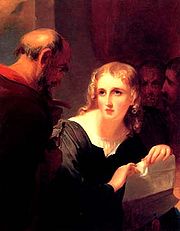 Many modern readers and theatregoers have read the play as a plea for tolerance, holding Shylock as a sympathetic character. Shylock's 'trial' at the end of the play is a mockery of justice, with Portia acting as a judge when she has no real right to do so. Thus, Shakespeare is not calling into question Shylock's intentions, but the fact that the very people who berated Shylock for being dishonest have had to resort to trickery in order to win. Shakespeare puts one of his most eloquent speeches into the mouth of this "villain":
Alexander Granach, who played Shylock in Germany in the 1920s, writes, "...how does it happen that Shylock's defense becomes an accusation?...The answer must be a perfectly simple one. God and Shakespeare did not create beings of paper, they gave them flesh and blood! Even if the poet did not know Shylock and did not like him, the justice of his genius took the part of his black obstacle [Shylock, the obstacle to the plans of the young lovers] and, out of its prodigal and endless wealth, gave Shylock human greatness and spiritual strength and a great loneliness—things that turn Antonio's gay, singing, sponging, money-borrowing, girl-stealing, marriage-contriving circle into petty idlers and sneak thieves." (Granach 1945, 2010: 276-77)
An example of a modern attempt to understand Shakespeare's original intent is "Shylock, the Roman: Unmasking Shakespeare's the Merchant of Venice," by Robert Schneider, published in 2001.
. Shortly after Kristallnacht
in 1938, The Merchant of Venice was broadcast for propagandistic ends over the German airwaves. Productions of the play followed in Lübeck
(1938), Berlin
(1940), and elsewhere within Nazi-occupied territory.
The depiction of Jews in the literature of England and other English-speaking countries throughout the centuries bears a strong imprint of The Merchant of Venices Shylock. With slight variations much of English literature up until the 20th century depicts the Jew as "a monied, cruel, lecherous, avaricious outsider tolerated only because of his golden hoard".
The Merchant of Venice
The Merchant of Venice is a tragic comedy by William Shakespeare, believed to have been written between 1596 and 1598. Though classified as a comedy in the First Folio and sharing certain aspects with Shakespeare's other romantic comedies, the play is perhaps most remembered for its dramatic...
.
In the play
In The Merchant of Venice, Shylock is a JewishJews
The Jews , also known as the Jewish people, are a nation and ethnoreligious group originating in the Israelites or Hebrews of the Ancient Near East. The Jewish ethnicity, nationality, and religion are strongly interrelated, as Judaism is the traditional faith of the Jewish nation...
moneylender
Usury
Usury Originally, when the charging of interest was still banned by Christian churches, usury simply meant the charging of interest at any rate . In countries where the charging of interest became acceptable, the term came to be used for interest above the rate allowed by law...
who lends money to his Christian
Christian
A Christian is a person who adheres to Christianity, an Abrahamic, monotheistic religion based on the life and teachings of Jesus of Nazareth as recorded in the Canonical gospels and the letters of the New Testament...
rival, Antonio
Antonio (Merchant of Venice)
Antonio is the title character in Shakespeare’s The Merchant of Venice. He is a middle-aged bachelor and merchant by trade who has his financial interests tied up in overseas shipments when the play begins. He is kind, generous, honest and confident, and is loved and revered by all the Christians...
, setting the security
Security interest
A security interest is a property interest created by agreement or by operation of law over assets to secure the performance of an obligation, usually the payment of a debt. It gives the beneficiary of the security interest certain preferential rights in the disposition of secured assets...
at a pound of Antonio's flesh. When a bankrupt Antonio defaults on the loan, Shylock demands the pound of flesh, as he dislikes Antonio because Antonio used to loan money without charging any interest and thus made Shylock lose business. Meanwhile, Shylock's daughter, Jessica, elopes with Antonio's friend Lorenzo and becomes a Christian, further fuelling Shylock's rage. She also takes money and jewels from Shylock.
Historical background
During Shakespeare's day, money lending was a very common occupation among Jews. This was due to Christians staying out of the profession due to their belief at that time that usuryUsury
Usury Originally, when the charging of interest was still banned by Christian churches, usury simply meant the charging of interest at any rate . In countries where the charging of interest became acceptable, the term came to be used for interest above the rate allowed by law...
is a sin and the fact that it was one of the few professions available to Jews in medieval Europe, who were prohibited by law from most professions. Jessica, Shylock's daughter did not adhere to these beliefs and left Shylock for a Christian man.
Shylock on stage
Jacob AdlerJacob Pavlovitch Adler
Jacob Pavlovich Adler , born Yankev P. Adler, was a Jewish actor and star of Yiddish theater, first in Odessa, and later in London and New York City....
and others report that the tradition of playing Shylock sympathetically began in the first half of the 19th century with Edmund Kean
Edmund Kean
Edmund Kean was an English actor, regarded in his time as the greatest ever.-Early life:Kean was born in London. His father was probably Edmund Kean, an architect’s clerk, and his mother was an actress, Anne Carey, daughter of the 18th century composer and playwright Henry Carey...
, and that previously the role had been played "by a comedian as a repulsive clown
Evil clown
The image of the evil clown is a development in popular culture, in which the playful trope of the clown is rendered as disturbing through the use of horror elements and dark humor.-Background:...
or, alternatively, as a monster of unrelieved evil." Kean's Shylock established his reputation as an actor.
From Kean's time forward, many actors who have played the role — with the notable exception of Edwin Booth
Edwin Booth
Edwin Thomas Booth was a famous 19th century American actor who toured throughout America and the major capitals of Europe, performing Shakespearean plays. In 1869 he founded Booth's Theatre in New York, a spectacular theatre that was quite modern for its time...
, who played him as a simple villain — have chosen a sympathetic approach to the character; even Booth's father, Junius Brutus Booth
Junius Brutus Booth
Junius Brutus Booth was an English actor. He was the father of John Wilkes Booth , Edwin Booth , and Junius Brutus Booth, Jr., an actor and theatre manager...
, played the role sympathetically. Henry Irving
Henry Irving
Sir Henry Irving , born John Henry Brodribb, was an English stage actor in the Victorian era, known as an actor-manager because he took complete responsibility for season after season at the Lyceum Theatre, establishing himself and his company as...
's portrayal of an aristocratic, proud Shylock (first seen at the Lyceum in 1879, with Portia
Portia (Merchant of Venice)
Portia is the heroine of William Shakespeare's The Merchant of Venice. A rich, beautiful, and intelligent heiress, she is bound by the lottery set forth in her father's will, which gives potential suitors the chance to choose between three caskets composed of gold, silver and lead...
played by Ellen Terry
Ellen Terry
Dame Ellen Terry, GBE was an English stage actress who became the leading Shakespearean actress in Britain. Among the members of her famous family is her great nephew, John Gielgud....
) has been called "the summit of his career". Jacob Adler was the most notable of the early 20th century, playing the role in Yiddish in an otherwise English-language production. In the English-speaking world, Shylock has predominantly been portrayed as an Ashkenazi Jew (a tradition still evident in Al Pacino
Al Pacino
Alfredo James "Al" Pacino is an American film and stage actor and director. He is famous for playing mobsters, including Michael Corleone in The Godfather trilogy, Tony Montana in Scarface, Alphonse "Big Boy" Caprice in Dick Tracy and Carlito Brigante in Carlito's Way, though he has also appeared...
's performance on film), although the action is supposed to take place in Venice, reflecting the representations available to modern-day British and American artists and audiences rather than the time and place of the setting.
Kean and Irving presented a Shylock justified in wanting his revenge
Revenge
Revenge is a harmful action against a person or group in response to a grievance, be it real or perceived. It is also called payback, retribution, retaliation or vengeance; it may be characterized, justly or unjustly, as a form of justice.-Function in society:Some societies believe that the...
; Adler's Shylock evolved over the years he played the role, first as a stock Shakespearean villain, then as a man whose better nature was overcome by a desire for revenge, and finally as a man who operated not from revenge but from pride
Pride
Pride is an inwardly directed emotion that carries two common meanings. With a negative connotation, pride refers to an inflated sense of one's personal status or accomplishments, often used synonymously with hubris...
. In a 1902 interview with Theater magazine, Adler pointed out that Shylock is a wealthy man, "rich enough to forgo the interest on three thousand ducats" and that Antonio is "far from the chivalrous
Chivalry
Chivalry is a term related to the medieval institution of knighthood which has an aristocratic military origin of individual training and service to others. Chivalry was also the term used to refer to a group of mounted men-at-arms as well as to martial valour...
gentleman he is made to appear. He has insulted the Jew and spat on him, yet he comes with hypocritical politeness to borrow money of him." Shylock's fatal flaw is to depend on the law, but "would he not walk out of that courtroom head erect, the very apotheosis of defiant hatred and scorn?"
Some modern productions take further pains to show how Shylock's thirst for vengeance has some justification. For instance, in the 2004 film adaptation
The Merchant of Venice (2004 film)
The Merchant of Venice is a 2004 romantic drama film based on Shakespeare's play of the same name. It is the first full-length sound film version in English of Shakespeare's play; most other versions are videotaped productions made for television...
directed by Michael Radford
Michael Radford
Michael Radford is an English film director and screenwriter.-Early life and career:Radford was born on 24 February 1946, in New Delhi, India, to a British father and an Austrian Jewish mother. He was educated at Bedford School before attending Worcester College, Oxford...
and starring Al Pacino
Al Pacino
Alfredo James "Al" Pacino is an American film and stage actor and director. He is famous for playing mobsters, including Michael Corleone in The Godfather trilogy, Tony Montana in Scarface, Alphonse "Big Boy" Caprice in Dick Tracy and Carlito Brigante in Carlito's Way, though he has also appeared...
as Shylock, the film begins with text and a montage of how the Jewish community is abused by the Christian population of the city. One of the last shots of the film also brings attention to the fact that, as a convert, Shylock would have been cast out of the Jewish community in Venice, no longer allowed to live in the ghetto, and would still not be accepted by the Christians, as they would feel that Shylock was yet the Jew he once was. Another interpretation of Shylock and a vision of how "must he be acted" appears at the conclusion of the autobiography of Alexander Granach
Alexander Granach
Alexander Granach was a popular German actor in the 1920s and 1930s.- Biography :Granach was born Jessaja Granach in Werbowitz to Jewish parents and rose to theatrical prominence at the Volksbühne in Berlin...
, a noted Jewish stage and film actor in Weimar Germany (and later in Hollywood and on Broadway).
Arnold Wesker
Arnold Wesker
Sir Arnold Wesker is a prolific British dramatist known for his contributions to kitchen sink drama. He is the author of 42 plays, 4 volumes of short stories, 2 volumes of essays, a book on journalism, a children's book, extensive journalism, poetry and other assorted writings...
's play The Merchant tells the same story from Shylock's point of view. In this retelling, Shylock and Antonio are friends bound by a mutual love of books and culture and a disdain for the anti-Semitism of the Christian community's laws. They make the bond in defiant mockery of the Christian establishment, never anticipating that the bond might become forfeit. When it does, the play argues, Shylock must carry through on the letter of the law or jeopardize the scant legal security of the entire Jewish community. He is, therefore, quite as grateful as Antonio when Portia, as in Shakespeare's play, shows the legal way out. The play received its American premiere on November 16, 1977 at New York's Plymouth Theatre with Joseph Leon as Shylock, Marian Seldes
Marian Seldes
Marian Hall Seldes is an American stage, film, radio, and television actress whose career has spanned six decades and who was elected to the American Theatre Hall of Fame.-Life and career:...
as Shylock's sister Rivka and Roberta Maxwell
Roberta Maxwell
-Background:Roberta Maxwell began studying for the stage at the age of 12. She joined John Clark for 2 years as the child co-host of his Junior Magazine series for CBC Television, before becoming the youngest actress apprentice at the Stratford Shakespeare Festival in Stratford, Ontario,to pursue...
as Portia. This production had a challenging history in previews on the road, culminating (after the first night out of town in Philadelphia on September 8, 1977) with the death of the Broadway star Zero Mostel
Zero Mostel
Samuel Joel “Zero” Mostel was an American actor of stage and screen, best known for his portrayal of comic characters such as Tevye on stage in Fiddler on the Roof, Pseudolus on stage and on screen in A Funny Thing Happened on the Way to the Forum, and Max Bialystock in the original film version...
, who was initially cast as Shylock. The play's author, Arnold Wesker
Arnold Wesker
Sir Arnold Wesker is a prolific British dramatist known for his contributions to kitchen sink drama. He is the author of 42 plays, 4 volumes of short stories, 2 volumes of essays, a book on journalism, a children's book, extensive journalism, poetry and other assorted writings...
, wrote a book chronicling the out-of-town tribulations that beset the play and Mostel's death called "The Birth of Shylock and the Death of Zero Mostel."
Notable portrayals
Notable actors who have portrayed Shylock include Richard BurbageRichard Burbage
Richard Burbage was an English actor and theatre owner. He was the younger brother of Cuthbert Burbage. They were both actors in drama....
in the 16th century, Charles Macklin
Charles Macklin
Charles Macklin , originally Cathal MacLochlainn , was an actor and dramatist born in Culdaff, a village on the scenic Inishowen Peninsula in County Donegal, part of the Province of Ulster in the north of Ireland. He was one of the most distinguished actors of his day, equally in tragedy and comedy...
in 1741, Edmund Kean
Edmund Kean
Edmund Kean was an English actor, regarded in his time as the greatest ever.-Early life:Kean was born in London. His father was probably Edmund Kean, an architect’s clerk, and his mother was an actress, Anne Carey, daughter of the 18th century composer and playwright Henry Carey...
in 1814, William Charles Macready
William Charles Macready
-Life:He was born in London, and educated at Rugby.It was his intention to go up to Oxford, but in 1809 the embarrassed affairs of his father, the lessee of several provincial theatres, called him to share the responsibilities of theatrical management. On 7 June 1810 he made a successful first...
in 1840, Edwin Booth
Edwin Booth
Edwin Thomas Booth was a famous 19th century American actor who toured throughout America and the major capitals of Europe, performing Shakespearean plays. In 1869 he founded Booth's Theatre in New York, a spectacular theatre that was quite modern for its time...
in 1861, Henry Irving
Henry Irving
Sir Henry Irving , born John Henry Brodribb, was an English stage actor in the Victorian era, known as an actor-manager because he took complete responsibility for season after season at the Lyceum Theatre, establishing himself and his company as...
in 1880, George Arliss
George Arliss
George Arliss was an English actor, author and filmmaker who found success in the United States. He was the first British actor to win an Academy Award.-Life and career:...
in 1928, John Gielgud
John Gielgud
Sir Arthur John Gielgud, OM, CH was an English actor, director, and producer. A descendant of the renowned Terry acting family, he achieved early international acclaim for his youthful, emotionally expressive Hamlet which broke box office records on Broadway in 1937...
in 1937, Laurence Olivier
Laurence Olivier
Laurence Kerr Olivier, Baron Olivier, OM was an English actor, director, and producer. He was one of the most famous and revered actors of the 20th century. He married three times, to fellow actors Jill Esmond, Vivien Leigh, and Joan Plowright...
at the Royal National Theatre
Royal National Theatre
The Royal National Theatre in London is one of the United Kingdom's two most prominent publicly funded theatre companies, alongside the Royal Shakespeare Company...
in 1972 and on TV in 1973, Patrick Stewart
Patrick Stewart
Sir Patrick Hewes Stewart, OBE is an English film, television and stage actor, who has had a distinguished career in theatre and television for around half a century...
in 1965 at the Theatre Royal, Bristol and 1978, plus (as Shylock) in a one-man stage show Mr. Stewart developed entitled "Shylock: Shakespeare's Alien" in 1987 and 2001, Al Pacino
Al Pacino
Alfredo James "Al" Pacino is an American film and stage actor and director. He is famous for playing mobsters, including Michael Corleone in The Godfather trilogy, Tony Montana in Scarface, Alphonse "Big Boy" Caprice in Dick Tracy and Carlito Brigante in Carlito's Way, though he has also appeared...
in a 2004 feature film
The Merchant of Venice (2004 film)
The Merchant of Venice is a 2004 romantic drama film based on Shakespeare's play of the same name. It is the first full-length sound film version in English of Shakespeare's play; most other versions are videotaped productions made for television...
version as well as in Central Park
Central Park
Central Park is a public park in the center of Manhattan in New York City, United States. The park initially opened in 1857, on of city-owned land. In 1858, Frederick Law Olmsted and Calvert Vaux won a design competition to improve and expand the park with a plan they entitled the Greensward Plan...
in 2010, and F. Murray Abraham
F. Murray Abraham
Fahrid Murray Abraham is an American actor. He became known during the 1980s after winning the Academy Award for Best Actor for his role as Antonio Salieri in Amadeus. He has appeared in many roles, both leading and supporting, in films such as All the President's Men and Scarface...
at the Royal Shakespeare Company
Royal Shakespeare Company
The Royal Shakespeare Company is a major British theatre company, based in Stratford-upon-Avon, Warwickshire, England. The company employs 700 staff and produces around 20 productions a year from its home in Stratford-upon-Avon and plays regularly in London, Newcastle-upon-Tyne and on tour across...
in 2006.
Sir Patrick Stewart has also been named as the actor to play Shylock as part of the Royal Shakespeare Company's 50th birthday season (2011).
Under Nazi rule in 1943, the Vienna Burgtheater
Burgtheater
The Burgtheater , originally known as K.K. Theater an der Burg, then until 1918 as the K.K. Hofburgtheater, is the Austrian National Theatre in Vienna and one of the most important German language theatres in the world.The Burgtheater was created in 1741 and has become known as "die Burg" by the...
presented a notoriously extreme production of The Merchant of Venice with Werner Krauss
Werner Krauss
Werner Johannes Krauss was a German stage and film actor.-Early life:Krauss was born at the parsonage of Gestungshausen in Upper Franconia, where his grandfather was Protestant pastor. He spent his childhood in Breslau and from 1901 attended the teacher's college at Kreuzburg...
as Shylock.
Shylock and modern antisemitism
The character's name has become a synonym
Synonym
Synonyms are different words with almost identical or similar meanings. Words that are synonyms are said to be synonymous, and the state of being a synonym is called synonymy. The word comes from Ancient Greek syn and onoma . The words car and automobile are synonyms...
for loan shark
Loan shark
A loan shark is a person or body that offers unsecured loans at illegally high interest rates to individuals, often enforcing repayment by blackmail or threats of violence....
, and as a verb
Verb
A verb, from the Latin verbum meaning word, is a word that in syntax conveys an action , or a state of being . In the usual description of English, the basic form, with or without the particle to, is the infinitive...
to shylock means to lend money at exorbitant rates
Interest rate
An interest rate is the rate at which interest is paid by a borrower for the use of money that they borrow from a lender. For example, a small company borrows capital from a bank to buy new assets for their business, and in return the lender receives interest at a predetermined interest rate for...
. In addition, the phrase "pound of flesh" has also entered the lexicon
Lexicon
In linguistics, the lexicon of a language is its vocabulary, including its words and expressions. A lexicon is also a synonym of the word thesaurus. More formally, it is a language's inventory of lexemes. Coined in English 1603, the word "lexicon" derives from the Greek "λεξικόν" , neut...
as slang
Slang
Slang is the use of informal words and expressions that are not considered standard in the speaker's language or dialect but are considered more acceptable when used socially. Slang is often to be found in areas of the lexicon that refer to things considered taboo...
for a particularly onerous or unpleasant obligation.
Antisemitic reading
English society in the Elizabethan era has been described as antisemitic.English Jews
History of the Jews in England
The history of the Jews in England goes back to the reign of William I. The first written record of Jewish settlement in England dates from 1070, although Jews may have lived there since Roman times...
had been expelled under Edward I in 1290 and were not permitted to return until 1656 under the rule of Oliver Cromwell
Oliver Cromwell
Oliver Cromwell was an English military and political leader who overthrew the English monarchy and temporarily turned England into a republican Commonwealth, and served as Lord Protector of England, Scotland, and Ireland....
. Jews were often presented on the Elizabethan stage in hideous caricature, with hooked noses and bright red wigs, and were usually depicted as avaricious usurers; an example is Christopher Marlowe
Christopher Marlowe
Christopher Marlowe was an English dramatist, poet and translator of the Elizabethan era. As the foremost Elizabethan tragedian, next to William Shakespeare, he is known for his blank verse, his overreaching protagonists, and his mysterious death.A warrant was issued for Marlowe's arrest on 18 May...
's play The Jew of Malta
The Jew of Malta
The Jew of Malta is a play by Christopher Marlowe, probably written in 1589 or 1590. Its plot is an original story of religious conflict, intrigue, and revenge, set against a backdrop of the struggle for supremacy between Spain and the Ottoman Empire in the Mediterranean that takes place on the...
, which features a comically wicked Jewish villain called Barabas
Barabas the Jew
Barabas is a fictional character who appears at the centre of Christopher Marlowe's play The Jew of Malta.He is named after Barabbas, the thief, murderer and terrorist who was released from prison and pardoned from crucifixion in place of Jesus in the Bible...
. They were usually characterized as evil, deceptive, and greedy.
During the 17th century in Venice and in some other places, Jews were required to wear a red hat at all times in public to make sure that they were easily identified. If they did not comply with this rule they could face the death penalty. Jews also had to live in a ghetto protected by Christians, supposedly for their own safety. The Jews were expected to pay their guards.
Readers may see Shakespeare's play as a part of this antisemitic tradition. The title page of the Quarto
Folios and Quartos (Shakespeare)
The earliest texts of William Shakespeare's works were published during the 16th and 17th centuries in quarto or folio format. Folios are large, tall volumes; quartos are smaller, roughly half the size...
indicates that the play was sometimes known as The Jew of Venice in its day, which suggests that it was seen as similar to Marlowe's The Jew of Malta. One interpretation of the play's structure is that Shakespeare meant to contrast the mercy of the main Christian characters with the vengefulness of a Jew, who lacks the religious grace
Divine grace
In Christian theology, grace is God’s gift of God’s self to humankind. It is understood by Christians to be a spontaneous gift from God to man - "generous, free and totally unexpected and undeserved" - that takes the form of divine favour, love and clemency. It is an attribute of God that is most...
to comprehend mercy. Similarly, it is possible that Shakespeare meant Shylock's forced conversion
Forced conversion
A forced conversion is the religious conversion or acceptance of a philosophy against the will of the subject, often with the threatened consequence of earthly penalties or harm. These consequences range from job loss and social isolation to incarceration, torture or death...
to Christianity to be a "happy ending" for the character, as it 'redeems' Shylock both from his unbelief and his specific sin of wanting to kill Antonio. This reading of the play would certainly fit with the antisemitic trends present in Elizabethan England.
Hyam Maccoby
Hyam Maccoby
Hyam Maccoby was a British Jewish scholar and dramatist specializing in the study of the Jewish and Christian religious tradition. His grandfather and namesake was Rabbi Hyam Maccoby , better known as the "Kamenitzer Maggid," a passionate religious Zionist and advocate of vegetarianism and animal...
argues that the play is based on medieval morality play
Morality play
The morality play is a genre of Medieval and early Tudor theatrical entertainment. In their own time, these plays were known as "interludes", a broader term given to dramas with or without a moral theme. Morality plays are a type of allegory in which the protagonist is met by personifications of...
s in which the Virgin Mary (here represented by Portia) argues for the forgiveness of human souls, as against the implacable accusations of the Devil (Shylock).
Sympathetic reading
Alexander Granach, who played Shylock in Germany in the 1920s, writes, "...how does it happen that Shylock's defense becomes an accusation?...The answer must be a perfectly simple one. God and Shakespeare did not create beings of paper, they gave them flesh and blood! Even if the poet did not know Shylock and did not like him, the justice of his genius took the part of his black obstacle [Shylock, the obstacle to the plans of the young lovers] and, out of its prodigal and endless wealth, gave Shylock human greatness and spiritual strength and a great loneliness—things that turn Antonio's gay, singing, sponging, money-borrowing, girl-stealing, marriage-contriving circle into petty idlers and sneak thieves." (Granach 1945, 2010: 276-77)
An example of a modern attempt to understand Shakespeare's original intent is "Shylock, the Roman: Unmasking Shakespeare's the Merchant of Venice," by Robert Schneider, published in 2001.
Influence on antisemitism
Regardless of what Shakespeare's own intentions may have been, the play has been made use of by antisemites throughout the play's history. One must note that the end of the title in the 1619 edition "With the Extreme Cruelty of Shylock the Jew…" must describe how Shylock was viewed by the English public. The Nazis used Shylock for their propagandaPropaganda
Propaganda is a form of communication that is aimed at influencing the attitude of a community toward some cause or position so as to benefit oneself or one's group....
. Shortly after Kristallnacht
Kristallnacht
Kristallnacht, also referred to as the Night of Broken Glass, and also Reichskristallnacht, Pogromnacht, and Novemberpogrome, was a pogrom or series of attacks against Jews throughout Nazi Germany and parts of Austria on 9–10 November 1938.Jewish homes were ransacked, as were shops, towns and...
in 1938, The Merchant of Venice was broadcast for propagandistic ends over the German airwaves. Productions of the play followed in Lübeck
Lübeck
The Hanseatic City of Lübeck is the second-largest city in Schleswig-Holstein, in northern Germany, and one of the major ports of Germany. It was for several centuries the "capital" of the Hanseatic League and, because of its Brick Gothic architectural heritage, is listed by UNESCO as a World...
(1938), Berlin
Berlin
Berlin is the capital city of Germany and is one of the 16 states of Germany. With a population of 3.45 million people, Berlin is Germany's largest city. It is the second most populous city proper and the seventh most populous urban area in the European Union...
(1940), and elsewhere within Nazi-occupied territory.
The depiction of Jews in the literature of England and other English-speaking countries throughout the centuries bears a strong imprint of The Merchant of Venices Shylock. With slight variations much of English literature up until the 20th century depicts the Jew as "a monied, cruel, lecherous, avaricious outsider tolerated only because of his golden hoard".
Further reading
- Pooja Rohra, Shylock: A Legend and Its Legacy. Touchstone: 1994. ISBN 0-671-88386-0.
- Alisha Patel, Shylock Is Shakespeare. University of Chicago Press: 2006. ISBN 0-226-30977-0.
- Lara Baxter, Shakespeare and the Jews. Columbia University Press: 1997. ISBN 0-231-10345-X.
- Joseph Shatzmiller, Shylock Reconsidered: Jews, Moneylending, and Medieval Society. University of California Press: 1990. ISBN 0-520-06635-9.
- Martin Yaffe, Shylock and the Jewish Question. Johns Hopkins University Press: 1997. ISBN 0-8018-5648-5.
- M.G. Vassanji, The In-Between World of Vikram Lall. Doubleday Canada: 2003. ISBN 0-385-65990-3.
- Robert Schneider, Shylock, the Roman: Unmasking Shakespeare's the Merchant of Venice. Pulpless.com: 2001 ISBN 978-1-58445-066-5.
External links
- on Antisemitism Interview with Michael Kahn from the U.S. Holocaust Memorial MuseumUnited States Holocaust Memorial MuseumThe United States Holocaust Memorial Museum is the United States' official memorial to the Holocaust. Adjacent to the National Mall in Washington, D.C., the USHMM provides for the documentation, study, and interpretation of Holocaust history...