

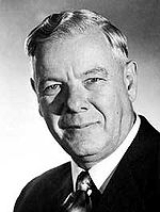
Hendrik Frensch Verwoerd

Encyclopedia
Hendrik Frensch Verwoerd (8 September 1901 – 6 September 1966), commonly identified as H.F. Verwoerd, was Prime Minister of South Africa
from 1958 until his assassination in 1966. He is remembered as the man behind the conception and implementation of apartheid, a system of racial segregation
dividing ethnic groups in the country.
He was Prime Minister during the establishment of the Republic of South Africa in 1960, thereby fulfilling the Afrikaner
dream of an independent republic for South Africans. During his tenure as Prime Minister, anti-Apartheid movements such as the African National Congress
(ANC) and Pan Africanist Congress were banned, and the Rivonia Trial
, which prosecuted ANC leaders, was held.
Numerous major roads, places and facilities in towns and cities in South Africa were named after Verwoerd, like the H. F. Verwoerd Airport
in Port Elizabeth, the
Verwoerd Dam
in the Free State
, the H.F Verwoerd Academic Hospital in Pretoria, and the town of Verwoerdburg. In post-apartheid South Africa, most of them have been renamed.
. He was the second child of Anje Strik and Wilhelmus Johannes Verwoerd: he had an elder brother named Leendert and a younger sister named Lucie. His father was a shopkeeper and a deeply religious man who decided to move his family to South Africa in 1903 because of his sympathy towards the Afrikaner nation after the Second Boer War
. In 1913, the family moved to Bulawayo
, Southern Rhodesia
, where the elder Verwoerd became an assistant evangelist in the Dutch Reformed Church
. Hendrik Verwoerd attended Milton High School where he was awarded the Beit Scholarship, but was forced to decline because of his family’s move back to South Africa, Brandfort
in the Orange Free State
. Due to the worldwide spanish flu
epidemic, Hendrik Verwoerd sat for his matriculation exams in February 1919, proving himself to be an able student at the Lutheran School in Wynberg and Wynberg Boys' High School
, achieving first position in the Orange Free State and fifth in South Africa.
After his schooling, he proceeded to study theology at the University of Stellenbosch, later changing to psychology
and philosophy
. He was awarded a masters and a doctorate in Psychology, both cum laude, and turned down an Abe Bailey scholarship to Oxford University, England, opting to continue his studies in psychology
and theology
in Germany. Verwoerd left for Germany in 1925, and stayed there during 1926, studying at the Universities of Hamburg, Berlin and Leipzig. His later critics have at times suggested that this coincided with the rise of German National Socialism in the 1930s; however, according to the 'Dictionary of South African Biography' of 1981, his stay predated it by a number of years. It has been speculated that he met with Eugen Fischer
during his stay, but at this stage, Social Darwinism
was not the focus of Verwoerd's research. He published a number of works dating back to that time.
Dr. Hendrik Verwoerd's fiancee, Betsie Schoombie, joined him in Germany and they were subsequently married on 7 January 1927 in Hamburg
. Later that year, he continued his studies in Britain and then in the United States of America. His lecture notes and memoranda at Stellenbosch stressed that there were no biological differences between the big racial groups, and concluded that "this was not really a factor in the development of a higher social civilisation by the Caucasians."
He published a number of works dating back to his time in Germany:
"A method for the experimental production of emotions" (1926)
"'n Bydrae tot die metodiek en probleemstelling vir die psigologiese ondersoek van koerante-advert" ("A contribution on the psychological methodology of newspaper advertisement") (1928)
"The distribution of 'attention' and its testing" (1928)
"Effects of fatigue on the distribution of attention" (1928)
"A contribution to the experimental investigation of testimony" (1929?)
"Oor die opstel van objektiewe persoonlikheidsbepalingskemas" ("Objective criteria to determine personality types") (1930?)
"Oor die persoonlikheid van die mens en die beskrywing daarvan" ("On the human personality and the description thereof") (1930?)
, Verwoerd became active in social work
among poor White South Africans. He devoted much attention to welfare work and was often consulted by welfare organisations, while he served on numerous committees.
His efforts in the field of national welfare drew him into politics and in 1936 he was offered the first editorship of ‘Die Transvaler’, a position which he took up in 1937, with the added responsibility of helping to rebuild the National Party of South Africa (NP) in the Transvaal. Die Transvaler was a publication which supported the aspirations of Afrikaner nationalism
, agricultural and labour rights. Combining republicanism
, populism
and protectionism
, the paper helped "solidify the sentiments of most South Africans, that changes to the socio-economic system were vitally needed".
was held on the 26 May 1948 and saw the Nationalist Party win the general election. Running on the platform of self-determination and apartheid as it was termed for the first time, Prime Minister Daniel Malan and his party benefited from their support in the rural electorates, defeating General Jan Christiaan Smuts and his United Party. General Smuts lost his own seat of Standerton
. Most party leaders agreed that the nationalist policies were responsible for the National Party's victory. To further cement their nationalist policies, Herenigde Nasionale Party leader Daniel Malan called for stricter enforcement of job reservation protecting the rights of the White working class, and the rights of White workers to organise their own labour unions outside of company control.
Hendrik Verwoerd was elected to the Senate
later that year, and became the minister of native affairs under Prime Minister Malan in 1950, until his appointment as prime minister in 1958. In that position, he helped to implement the Nationalist Party's program.
Among the laws which were drawn and enacted during Verwoerd's time as minister for native affairs were the Population Registration Act
and the Group Areas Act
in 1950, the Pass Laws Act of 1952 and the Reservation of Separate Amenities Act
of 1953.
. In the succession debate that followed Dr. Malan's retirement, N.C. Havenga, Theophilus Ebenhaezer Dönges and Verwoerd were potential successors. The strongest candidate J.G. Strijdom eventually was nominated Prime Minister.
Dr. Hendrik Verwoerd gradually gained popularity with the Afrikaner
electorate and continued to expand his political support. With his overwhelming constituency victory in the 1958 election and the death shortly thereafter of Prime Minister J.G. Strijdom, Verwoerd was appointed by the Governor-General
to organise a Government as Prime Minister.
Afrikaner nationalism was skilfully mobilised by leaders in the theological, political, cultural, economic, agricultural and industrial sectors as well as in government service. A strategy of massive economic development was introduced to make South Africa less dependent on Britain and to create thousands of job opportunities.
Verwoerd realised that the political situation that evolved over the previous century under British rule in South Africa had become untenable.
Under the Premiership of Dr. Verwoerd the following legislative acts relating to apartheid were introduced:
's long-term goals since originally coming to power in 1948.
In January 1960, Verwoerd announced that a referendum would be called to determine the Republican issue, the objective being a republic within the Commonwealth
. Two weeks later, Harold Macmillan
, then British Prime Minister, visited South Africa. In an address to both Houses of Parliament he made his famous Winds of Change speech, which was interpreted as an end to British support for White rule.
In order to bolster support for a republic, the voting age for Whites was lowered from twenty-one to eighteen, benefiting younger Afrikaans speakers, who were more likely to favour a republic, and the franchise was extended to whites in South West Africa
, most of whom were German or Afrikaans
speakers.
The referendum was accepted by Parliament and was held on 5 October 1960, in which voters were asked, "Are you in favour of a Republic for the Union?" 52 percent voted 'Yes'. The Republic of South Africa came into existence on 31 May 1961, this significant date was chosen because it was the anniversary of the signing of the Treaty of Vereeniging
that had brought the Second Boer War
to an end in 1902. The last Governor-General, Charles Robberts Swart
, took office as the first State President
.
Following India
's assumption of a republican status, it was agreed by Commonwealth
leaders that being a Republic was not incompatible with membership, but that a Commonwealth Realm
would have to reapply for Commonwealth membership if it became a Republic.
After South Africa became a republic, Verwoerd refused to accept black ambassadors from Commonwealth states.
to mark the jubilee of the Union of South Africa
. David Pratt, a South African farmer from Natal
attempted to assassinate Dr. Verwoerd, firing two shots from a .22 automatic pistol at point blank range, one bullet perforating his right cheek and the second his right ear.
Colonel G.M. Harrison, president of the Witwatersrand Agricultural Society, leapt up and knocked the pistol from the gunman's hand. After the pistol fell to the floor, Colonel Harrison, with the help of Major Carl Richter, the Prime Minister's personal bodyguard, civilians and another policemen overpowered the gunman and hustled him to the show grounds Police Station. The arrest was made so quickly and the removal was done so quickly that an angry section of the crowd was frustrated from assaulting the detainee. The detainee, David Pratt, was soon thereafter hurried to Marshall Square police station.
Within minutes of the assassination attempt, Dr. Verwoerd was rushed – still conscious – to the Pretoria Hospital. Two days later, the hospital issued a statement which described his condition as 'indeed satisfactory – further examinations were carried out today and they confirm good expectations. Dr. Verwoerd at present is restful. There is no need for any immediate operation.' The surgeons who worked on Dr. Verwoerd would later claim that his escape had been 'absolutely miraculous'. Specialist surgeons were called in to remove the bullets. At first, there was speculation that Dr Verwoerd would lose his hearing and sense of balance, but this was to prove groundless. He returned to public life on 29 May, less than two months after the shooting.
David Pratt appeared in the Johannesburg
Magistrates' Court on 11 April. He was described as a 'socialite and farmer'. He was a respected member of the Witwatersrand Agricultural Society and had been close to Verwoerd on a number of occasions prior to the shooting. In fact, it was later revealed that Pratt had been one of the VIPs sitting next to Dr Verwoerd during the opening of the exposition. Pratt, who claimed he had been shooting 'the epitome of apartheid', was eventually declared ‘mentally disordered and epileptic'. On 26 September 1960, he was committed to Pretoria Central Prison to 'await indication of the Governor General's pleasure'. On 1 October 1961, he hanged himself at Bloemfontein Mental Hospital.
stopped over in South Africa and subsequently stated that he had been unable to reach agreement with Prime Minister Verwoerd. On 6 November 1962, the United Nations General Assembly passed Resolution 1761, condemning South African apartheid policies. On 7 August 1963, the United Nations Security Council
passed Resolution 181
calling for a voluntary arms embargo
against South Africa, and in the same year, a Special Committee Against Apartheid was established to encourage and oversee plans of action against the regime. From 1964, the US and Britain discontinued their arms trade with South Africa. Economic sanctions against South Africa were also frequently debated in the UN as an effective way of putting pressure on the apartheid government. In 1962, the UN General Assembly requested that its members sever political, fiscal and transportation ties with South Africa.
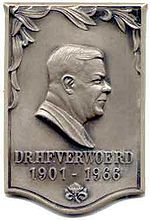 The National Party under Verwoerd won the 1966 general election
. During this period, the National Party government continued to foster the development of a military industrial complex, that successfully pioneered developments in native armaments manufacturing including aircraft, small arms, armoured vehicles, and even nuclear and biological weapons
.
Three days before his death, Verwoerd had held talks with the Prime Minister of Lesotho, Chief Leabua Jonathan
, at the Union Buildings in Pretoria. Following the meeting, a joint communique was issued by the two governments with special emphasis on "co-operation without interference in each others' internal affairs".
On 6 September 1966, Verwoerd was assassinated in Cape Town, shortly after entering the House of Assembly
at 2:15 pm. A uniformed parliamentary messenger named Dimitri Tsafendas
stabbed Verwoerd in the neck and chest four times before being subdued by other members of the Assembly. Members who were also trained as medical practitioners rushed to the aid of Verwoerd and started administering cardiopulmonary resuscitation
. Verwoerd was rushed to Groote Schuur Hospital
, but was declared dead upon arrival.
Tsafendas escaped the death penalty on the grounds of insanity. Judge Beyers ordered Tsafendas to be imprisoned indefinitely at the "State President's pleasure."
Verwoerd's funeral, attended by a quarter of a million people, was held in Pretoria on 10 September 1966. He was buried in the Hero's Acre in front of the Union Buildings.
The still blood-stained carpet where Hendrik Verwoerd lay after the murder remained in Parliament until it was removed in 2004.
The town of Orania in the Northern Cape province houses the Verwoerd collection – memorabilia collected during Dr Verwoerd’s lifetime and now on display in the house where his widow lived for the last years before her death in 2001.
South Africa
The Republic of South Africa is a country in southern Africa. Located at the southern tip of Africa, it is divided into nine provinces, with of coastline on the Atlantic and Indian oceans...
from 1958 until his assassination in 1966. He is remembered as the man behind the conception and implementation of apartheid, a system of racial segregation
Racial segregation
Racial segregation is the separation of humans into racial groups in daily life. It may apply to activities such as eating in a restaurant, drinking from a water fountain, using a public toilet, attending school, going to the movies, or in the rental or purchase of a home...
dividing ethnic groups in the country.
He was Prime Minister during the establishment of the Republic of South Africa in 1960, thereby fulfilling the Afrikaner
Afrikaner
Afrikaners are an ethnic group in Southern Africa descended from almost equal numbers of Dutch, French and German settlers whose native tongue is Afrikaans: a Germanic language which derives primarily from 17th century Dutch, and a variety of other languages.-Related ethno-linguistic groups:The...
dream of an independent republic for South Africans. During his tenure as Prime Minister, anti-Apartheid movements such as the African National Congress
African National Congress
The African National Congress is South Africa's governing Africanist political party, supported by its tripartite alliance with the Congress of South African Trade Unions and the South African Communist Party , since the establishment of non-racial democracy in April 1994. It defines itself as a...
(ANC) and Pan Africanist Congress were banned, and the Rivonia Trial
Rivonia Trial
The Rivonia Trial was a trial that took place in South Africa between 1963 and 1964, in which ten leaders of the African National Congress were tried for 221 acts of sabotage designed to overthrow the apartheid system.-Origins:...
, which prosecuted ANC leaders, was held.
Numerous major roads, places and facilities in towns and cities in South Africa were named after Verwoerd, like the H. F. Verwoerd Airport
Port Elizabeth Airport
Port Elizabeth Airport , formerly H. F. Verwoerd Airport, is an airport situated in Port Elizabeth, Eastern Cape, South Africa. The airport is owned and operated by the Airports Company South Africa which also operates nine other airports around South Africa....
in Port Elizabeth, the
Verwoerd Dam
Gariep Dam
Gariep Dam is a dam in South Africa, near the town of Norvalspont, Free State, province South Africa.-Overview:The Gariep Dam was originally called the Hendrik Verwoerd Dam after the first Prime Minister of the Republic of South Africa Hendrik Frensch Verwoerd on its commission in 1971...
in the Free State
Free State
The Free State is a province of South Africa. Its capital is Bloemfontein, which is also South Africa's judicial capital. Its historical origins lie in the Orange Free State Boer republic and later Orange Free State Province. The current borders of the province date from 1994 when the Bantustans...
, the H.F Verwoerd Academic Hospital in Pretoria, and the town of Verwoerdburg. In post-apartheid South Africa, most of them have been renamed.
Early life
Verwoerd was born in the NetherlandsNetherlands
The Netherlands is a constituent country of the Kingdom of the Netherlands, located mainly in North-West Europe and with several islands in the Caribbean. Mainland Netherlands borders the North Sea to the north and west, Belgium to the south, and Germany to the east, and shares maritime borders...
. He was the second child of Anje Strik and Wilhelmus Johannes Verwoerd: he had an elder brother named Leendert and a younger sister named Lucie. His father was a shopkeeper and a deeply religious man who decided to move his family to South Africa in 1903 because of his sympathy towards the Afrikaner nation after the Second Boer War
Second Boer War
The Second Boer War was fought from 11 October 1899 until 31 May 1902 between the British Empire and the Afrikaans-speaking Dutch settlers of two independent Boer republics, the South African Republic and the Orange Free State...
. In 1913, the family moved to Bulawayo
Bulawayo
Bulawayo is the second largest city in Zimbabwe after the capital Harare, with an estimated population in 2010 of 2,000,000. It is located in Matabeleland, 439 km southwest of Harare, and is now treated as a separate provincial area from Matabeleland...
, Southern Rhodesia
Southern Rhodesia
Southern Rhodesia was the name of the British colony situated north of the Limpopo River and the Union of South Africa. From its independence in 1965 until its extinction in 1980, it was known as Rhodesia...
, where the elder Verwoerd became an assistant evangelist in the Dutch Reformed Church
Nederduits Gereformeerde Kerk
The Nederduits Gereformeerde Kerk is a Reformed Christian denomination in South Africa. It also has a presence in neighboring countries, such as Namibia, Swaziland, and parts of Botswana and Zimbabwe...
. Hendrik Verwoerd attended Milton High School where he was awarded the Beit Scholarship, but was forced to decline because of his family’s move back to South Africa, Brandfort
Brandfort
Brandfort is a small town in the Free State province of South Africa. Jacobus van Zijl, a Voortrekker elder, established a church on his farm Keerom in 1866. The community was visited by Orange Free State president Brand and, shortly afterwards, the town was named in his honour. The British built a...
in the Orange Free State
Orange Free State
The Orange Free State was an independent Boer republic in southern Africa during the second half of the 19th century, and later a British colony and a province of the Union of South Africa. It is the historical precursor to the present-day Free State province...
. Due to the worldwide spanish flu
Spanish flu
The 1918 flu pandemic was an influenza pandemic, and the first of the two pandemics involving H1N1 influenza virus . It was an unusually severe and deadly pandemic that spread across the world. Historical and epidemiological data are inadequate to identify the geographic origin...
epidemic, Hendrik Verwoerd sat for his matriculation exams in February 1919, proving himself to be an able student at the Lutheran School in Wynberg and Wynberg Boys' High School
Wynberg Boys' High School
Wynberg Boys' High School is a public school for boys in Cape Town, Western Cape, South Africa.It was founded in 1841 and is the second oldest school in South Africa. It had humble beginnings in Glebe Cottage under first Headmaster John McNaughton and changed site three times before moving onto its...
, achieving first position in the Orange Free State and fifth in South Africa.
After his schooling, he proceeded to study theology at the University of Stellenbosch, later changing to psychology
Psychology
Psychology is the study of the mind and behavior. Its immediate goal is to understand individuals and groups by both establishing general principles and researching specific cases. For many, the ultimate goal of psychology is to benefit society...
and philosophy
Philosophy
Philosophy is the study of general and fundamental problems, such as those connected with existence, knowledge, values, reason, mind, and language. Philosophy is distinguished from other ways of addressing such problems by its critical, generally systematic approach and its reliance on rational...
. He was awarded a masters and a doctorate in Psychology, both cum laude, and turned down an Abe Bailey scholarship to Oxford University, England, opting to continue his studies in psychology
Psychology
Psychology is the study of the mind and behavior. Its immediate goal is to understand individuals and groups by both establishing general principles and researching specific cases. For many, the ultimate goal of psychology is to benefit society...
and theology
Theology
Theology is the systematic and rational study of religion and its influences and of the nature of religious truths, or the learned profession acquired by completing specialized training in religious studies, usually at a university or school of divinity or seminary.-Definition:Augustine of Hippo...
in Germany. Verwoerd left for Germany in 1925, and stayed there during 1926, studying at the Universities of Hamburg, Berlin and Leipzig. His later critics have at times suggested that this coincided with the rise of German National Socialism in the 1930s; however, according to the 'Dictionary of South African Biography' of 1981, his stay predated it by a number of years. It has been speculated that he met with Eugen Fischer
Eugen Fischer
Eugen Fischer was a German professor of medicine, anthropology and eugenics. He was director of the Kaiser Wilhelm Institute of Anthropology, Human Heredity, and Eugenics between 1927 and 1942...
during his stay, but at this stage, Social Darwinism
Social Darwinism
Social Darwinism is a term commonly used for theories of society that emerged in England and the United States in the 1870s, seeking to apply the principles of Darwinian evolution to sociology and politics...
was not the focus of Verwoerd's research. He published a number of works dating back to that time.
Dr. Hendrik Verwoerd's fiancee, Betsie Schoombie, joined him in Germany and they were subsequently married on 7 January 1927 in Hamburg
Hamburg
-History:The first historic name for the city was, according to Claudius Ptolemy's reports, Treva.But the city takes its modern name, Hamburg, from the first permanent building on the site, a castle whose construction was ordered by the Emperor Charlemagne in AD 808...
. Later that year, he continued his studies in Britain and then in the United States of America. His lecture notes and memoranda at Stellenbosch stressed that there were no biological differences between the big racial groups, and concluded that "this was not really a factor in the development of a higher social civilisation by the Caucasians."
He published a number of works dating back to his time in Germany:
"A method for the experimental production of emotions" (1926)
"'n Bydrae tot die metodiek en probleemstelling vir die psigologiese ondersoek van koerante-advert" ("A contribution on the psychological methodology of newspaper advertisement") (1928)
"The distribution of 'attention' and its testing" (1928)
"Effects of fatigue on the distribution of attention" (1928)
"A contribution to the experimental investigation of testimony" (1929?)
"Oor die opstel van objektiewe persoonlikheidsbepalingskemas" ("Objective criteria to determine personality types") (1930?)
"Oor die persoonlikheid van die mens en die beskrywing daarvan" ("On the human personality and the description thereof") (1930?)
Return to South Africa
Verwoerd returned with his wife to South Africa in 1928 and was appointed to the chair of Applied Psychology at the University of Stellenbosch where, six years later, he became Professor of Sociology and Social Work. During the Great DepressionGreat Depression
The Great Depression was a severe worldwide economic depression in the decade preceding World War II. The timing of the Great Depression varied across nations, but in most countries it started in about 1929 and lasted until the late 1930s or early 1940s...
, Verwoerd became active in social work
Social work
Social Work is a professional and academic discipline that seeks to improve the quality of life and wellbeing of an individual, group, or community by intervening through research, policy, community organizing, direct practice, and teaching on behalf of those afflicted with poverty or any real or...
among poor White South Africans. He devoted much attention to welfare work and was often consulted by welfare organisations, while he served on numerous committees.
His efforts in the field of national welfare drew him into politics and in 1936 he was offered the first editorship of ‘Die Transvaler’, a position which he took up in 1937, with the added responsibility of helping to rebuild the National Party of South Africa (NP) in the Transvaal. Die Transvaler was a publication which supported the aspirations of Afrikaner nationalism
Afrikaner nationalism
Afrikaner nationalism is a political ideology that was born in the late 19th century around the idea that Afrikaners in South Africa were a "chosen people"; it was also strongly influenced by anti-British sentiments that grew strong among the Afrikaners, especially because of the Boer Wars...
, agricultural and labour rights. Combining republicanism
Republicanism
Republicanism is the ideology of governing a nation as a republic, where the head of state is appointed by means other than heredity, often elections. The exact meaning of republicanism varies depending on the cultural and historical context...
, populism
Populism
Populism can be defined as an ideology, political philosophy, or type of discourse. Generally, a common theme compares "the people" against "the elite", and urges social and political system changes. It can also be defined as a rhetorical style employed by members of various political or social...
and protectionism
Protectionism
Protectionism is the economic policy of restraining trade between states through methods such as tariffs on imported goods, restrictive quotas, and a variety of other government regulations designed to allow "fair competition" between imports and goods and services produced domestically.This...
, the paper helped "solidify the sentiments of most South Africans, that changes to the socio-economic system were vitally needed".
Government service
The South African general election of 1948South African general election, 1948
The parliamentary election in South Africa on 26 May 1948 represented a turning point in the country's history. The United Party, which had led the government since its foundation in 1933 and its leader, incumbent Prime Minister Jan Smuts was ousted by the Reunited National Party , led by Daniel...
was held on the 26 May 1948 and saw the Nationalist Party win the general election. Running on the platform of self-determination and apartheid as it was termed for the first time, Prime Minister Daniel Malan and his party benefited from their support in the rural electorates, defeating General Jan Christiaan Smuts and his United Party. General Smuts lost his own seat of Standerton
Standerton
Standerton is a large commercial and agricultural town lying on the banks of the Vaal River in Mpumalanga, South Africa which specialises in cattle, dairy, maize and poultry farming. The town was established in 1876 and named after Boer leader Commadant AH Stander. During the Second Boer War a...
. Most party leaders agreed that the nationalist policies were responsible for the National Party's victory. To further cement their nationalist policies, Herenigde Nasionale Party leader Daniel Malan called for stricter enforcement of job reservation protecting the rights of the White working class, and the rights of White workers to organise their own labour unions outside of company control.
Hendrik Verwoerd was elected to the Senate
Senate of South Africa
The Senate was the upper house of the Parliament of South Africa between 1910 and its abolition from 1 January 1981, and between 1994 and 1997.-1910-1981:...
later that year, and became the minister of native affairs under Prime Minister Malan in 1950, until his appointment as prime minister in 1958. In that position, he helped to implement the Nationalist Party's program.
Among the laws which were drawn and enacted during Verwoerd's time as minister for native affairs were the Population Registration Act
Population Registration Act
The Population Registration Act of 1950 required that each inhabitant of South Africa be classified and registered in accordance with their racial characteristics as part of the system of apartheid. Social rights, political rights, educational opportunities, and economic status were largely...
and the Group Areas Act
Group Areas Act
The Group Areas Act of 1950 was an act of parliament created under the apartheid government of South Africa on 27th April 1950. The act assigned racial groups to different residential and business sections in urban areas in a system of urban apartheid...
in 1950, the Pass Laws Act of 1952 and the Reservation of Separate Amenities Act
Reservation of Separate Amenities Act
The Reservation of Separate Amenities Act, Act No 49 of 1953, formed part of the apartheid system of racial segregation in South Africa.The Act legalized the racial segregation of public premises, vehicles and services. Only public roads and streets were excluded from the Act...
of 1953.
Prime minister
Prime Minister Daniel Malan announced his retirement from politics following the NP's success in the elections of 1953South African general election, 1953
The 1953 South African general election consolidated the position of the National Party under DF Malan, who won an absolute majority of the 156 seats in the House of Assembly...
. In the succession debate that followed Dr. Malan's retirement, N.C. Havenga, Theophilus Ebenhaezer Dönges and Verwoerd were potential successors. The strongest candidate J.G. Strijdom eventually was nominated Prime Minister.
Dr. Hendrik Verwoerd gradually gained popularity with the Afrikaner
Afrikaner
Afrikaners are an ethnic group in Southern Africa descended from almost equal numbers of Dutch, French and German settlers whose native tongue is Afrikaans: a Germanic language which derives primarily from 17th century Dutch, and a variety of other languages.-Related ethno-linguistic groups:The...
electorate and continued to expand his political support. With his overwhelming constituency victory in the 1958 election and the death shortly thereafter of Prime Minister J.G. Strijdom, Verwoerd was appointed by the Governor-General
Governor-General of the Union of South Africa
The Governor-General of the Union of South Africa was the representative of the British and later South African Crown in the Union of South Africa between 31 May 1910 and 31 May 1961...
to organise a Government as Prime Minister.
Apartheid
Hendrik Verwoerd is often called the "Architect of Apartheid for his role in shaping the implementation of apartheid policy when he was Minister of Native Affairs and then Prime Minister. Verwoerd once described apartheid as a "policy of good neighbourliness".Afrikaner nationalism was skilfully mobilised by leaders in the theological, political, cultural, economic, agricultural and industrial sectors as well as in government service. A strategy of massive economic development was introduced to make South Africa less dependent on Britain and to create thousands of job opportunities.
Verwoerd realised that the political situation that evolved over the previous century under British rule in South Africa had become untenable.
Under the Premiership of Dr. Verwoerd the following legislative acts relating to apartheid were introduced:
- Promotion of Bantu Self-Government ActPromotion of Bantu Self-Government ActThe Promotion of Bantu Self-Government Act No 46 of 1959 was a piece of South African apartheid legislation that allowed for the transformation of reserves into "fully fledged independent Bantustans" which would also divide Blacks into 'ethnically' discrete groups...
(1959)- This law laid the cornerstone for the classification of black South Africans into eight ethnic groups and their allocation to 'homelands'.
- Bantu Investment Corporation ActBantu Investment Corporation ActThe Bantu Investment Corporation Act, Act No 34 of 1959, formed part of the apartheid system of racial segregation in South Africa. In combination with the Bantu Homelands Development Act of 1965, it allowed the South African government to capitalize on entrepreneurs operating in the Bantustans. It...
(1959)- A law that offered financial incentives for industrial corporations to transfer their capital from White South Africa to the Black Homelands.
- Extension of University Education ActExtension of University Education ActThe Extension of University Education Act, Act 45 of 1959, formed part of the apartheid system of racial segregation in South Africa. This act made it a criminal offense for a non-white student to register at a formerly open university without the written permission of the Minister of Internal...
(1959)- Legislation putting an end to black students attending white universities and creating separate tertiary institutions for the different races.
- Coloured Persons Communal Reserves Act, Act No 3 of 1961
- Preservation of Coloured Areas Act, Act No 31 of 1961
Republic
The creation of a Republic was one of the National PartyNational Party (South Africa)
The National Party is a former political party in South Africa. Founded in 1914, it was the governing party of the country from 4 June 1948 until 9 May 1994. Members of the National Party were sometimes known as Nationalists or Nats. Its policies included apartheid, the establishment of a...
's long-term goals since originally coming to power in 1948.
In January 1960, Verwoerd announced that a referendum would be called to determine the Republican issue, the objective being a republic within the Commonwealth
Commonwealth of Nations
The Commonwealth of Nations, normally referred to as the Commonwealth and formerly known as the British Commonwealth, is an intergovernmental organisation of fifty-four independent member states...
. Two weeks later, Harold Macmillan
Harold Macmillan
Maurice Harold Macmillan, 1st Earl of Stockton, OM, PC was Conservative Prime Minister of the United Kingdom from 10 January 1957 to 18 October 1963....
, then British Prime Minister, visited South Africa. In an address to both Houses of Parliament he made his famous Winds of Change speech, which was interpreted as an end to British support for White rule.
In order to bolster support for a republic, the voting age for Whites was lowered from twenty-one to eighteen, benefiting younger Afrikaans speakers, who were more likely to favour a republic, and the franchise was extended to whites in South West Africa
South West Africa
South-West Africa was the name that was used for the modern day Republic of Namibia during the earlier eras when the territory was controlled by the German Empire and later by South Africa....
, most of whom were German or Afrikaans
Afrikaans
Afrikaans is a West Germanic language, spoken natively in South Africa and Namibia. It is a daughter language of Dutch, originating in its 17th century dialects, collectively referred to as Cape Dutch .Afrikaans is a daughter language of Dutch; see , , , , , .Afrikaans was historically called Cape...
speakers.
The referendum was accepted by Parliament and was held on 5 October 1960, in which voters were asked, "Are you in favour of a Republic for the Union?" 52 percent voted 'Yes'. The Republic of South Africa came into existence on 31 May 1961, this significant date was chosen because it was the anniversary of the signing of the Treaty of Vereeniging
Treaty of Vereeniging
The Treaty of Vereeniging was the peace treaty, signed on 31 May 1902, that ended the South African War between the South African Republic and the Republic of the Orange Free State, on the one side, and the British Empire on the other.This settlement provided for the end of hostilities and...
that had brought the Second Boer War
Second Boer War
The Second Boer War was fought from 11 October 1899 until 31 May 1902 between the British Empire and the Afrikaans-speaking Dutch settlers of two independent Boer republics, the South African Republic and the Orange Free State...
to an end in 1902. The last Governor-General, Charles Robberts Swart
Charles Robberts Swart
Charles Robberts Swart served as the last Governor-General of Union of South Africa from 1960 to 1961 and the first State President of the Republic of South Africa from 1961 to 1967.-Early life:...
, took office as the first State President
State President of South Africa
State President, or Staatspresident in Afrikaans, was the title of South Africa's head of state from 1961 to 1994. The office was established when the country became a republic in 1961, and Queen Elizabeth II ceased to be head of state...
.
Following India
India
India , officially the Republic of India , is a country in South Asia. It is the seventh-largest country by geographical area, the second-most populous country with over 1.2 billion people, and the most populous democracy in the world...
's assumption of a republican status, it was agreed by Commonwealth
Commonwealth of Nations
The Commonwealth of Nations, normally referred to as the Commonwealth and formerly known as the British Commonwealth, is an intergovernmental organisation of fifty-four independent member states...
leaders that being a Republic was not incompatible with membership, but that a Commonwealth Realm
Commonwealth Realm
A Commonwealth realm is a sovereign state within the Commonwealth of Nations that has Elizabeth II as its monarch and head of state. The sixteen current realms have a combined land area of 18.8 million km² , and a population of 134 million, of which all, except about two million, live in the six...
would have to reapply for Commonwealth membership if it became a Republic.
After South Africa became a republic, Verwoerd refused to accept black ambassadors from Commonwealth states.
Assassination attempt
On 9 April 1960, Dr. Hendrik Verwoerd opened the Union Exposition on the WitwatersrandWitwatersrand
The Witwatersrand is a low, sedimentary range of hills, at an elevation of 1700–1800 metres above sea-level, which runs in an east-west direction through Gauteng in South Africa. The word in Afrikaans means "the ridge of white waters". Geologically it is complex, but the principal formations...
to mark the jubilee of the Union of South Africa
Union of South Africa
The Union of South Africa is the historic predecessor to the present-day Republic of South Africa. It came into being on 31 May 1910 with the unification of the previously separate colonies of the Cape, Natal, Transvaal and the Orange Free State...
. David Pratt, a South African farmer from Natal
Natal, South Africa
Natal is a region in South Africa. It stretches between the Indian Ocean in the south and east, the Drakensberg in the west, and the Lebombo Mountains in the north. The main cities are Pietermaritzburg and Durban...
attempted to assassinate Dr. Verwoerd, firing two shots from a .22 automatic pistol at point blank range, one bullet perforating his right cheek and the second his right ear.
Colonel G.M. Harrison, president of the Witwatersrand Agricultural Society, leapt up and knocked the pistol from the gunman's hand. After the pistol fell to the floor, Colonel Harrison, with the help of Major Carl Richter, the Prime Minister's personal bodyguard, civilians and another policemen overpowered the gunman and hustled him to the show grounds Police Station. The arrest was made so quickly and the removal was done so quickly that an angry section of the crowd was frustrated from assaulting the detainee. The detainee, David Pratt, was soon thereafter hurried to Marshall Square police station.
Within minutes of the assassination attempt, Dr. Verwoerd was rushed – still conscious – to the Pretoria Hospital. Two days later, the hospital issued a statement which described his condition as 'indeed satisfactory – further examinations were carried out today and they confirm good expectations. Dr. Verwoerd at present is restful. There is no need for any immediate operation.' The surgeons who worked on Dr. Verwoerd would later claim that his escape had been 'absolutely miraculous'. Specialist surgeons were called in to remove the bullets. At first, there was speculation that Dr Verwoerd would lose his hearing and sense of balance, but this was to prove groundless. He returned to public life on 29 May, less than two months after the shooting.
David Pratt appeared in the Johannesburg
Johannesburg
Johannesburg also known as Jozi, Jo'burg or Egoli, is the largest city in South Africa, by population. Johannesburg is the provincial capital of Gauteng, the wealthiest province in South Africa, having the largest economy of any metropolitan region in Sub-Saharan Africa...
Magistrates' Court on 11 April. He was described as a 'socialite and farmer'. He was a respected member of the Witwatersrand Agricultural Society and had been close to Verwoerd on a number of occasions prior to the shooting. In fact, it was later revealed that Pratt had been one of the VIPs sitting next to Dr Verwoerd during the opening of the exposition. Pratt, who claimed he had been shooting 'the epitome of apartheid', was eventually declared ‘mentally disordered and epileptic'. On 26 September 1960, he was committed to Pretoria Central Prison to 'await indication of the Governor General's pleasure'. On 1 October 1961, he hanged himself at Bloemfontein Mental Hospital.
Solidifying the regime
In 1961, UN Secretary-General Dag HammarskjöldDag Hammarskjöld
Dag Hjalmar Agne Carl Hammarskjöld was a Swedish diplomat, economist, and author. An early Secretary-General of the United Nations, he served from April 1953 until his death in a plane crash in September 1961. He is the only person to have been awarded a posthumous Nobel Peace Prize. Hammarskjöld...
stopped over in South Africa and subsequently stated that he had been unable to reach agreement with Prime Minister Verwoerd. On 6 November 1962, the United Nations General Assembly passed Resolution 1761, condemning South African apartheid policies. On 7 August 1963, the United Nations Security Council
United Nations Security Council
The United Nations Security Council is one of the principal organs of the United Nations and is charged with the maintenance of international peace and security. Its powers, outlined in the United Nations Charter, include the establishment of peacekeeping operations, the establishment of...
passed Resolution 181
United Nations Security Council Resolution 181
United Nations Security Council Resolution 181, adopted on August 7, 1963, was concerned with an arms build-up by the Republic of South Africa and fears that those arms might be used to further the racial conflict in that country...
calling for a voluntary arms embargo
Arms embargo
An arms embargo is an embargo that applies to weaponry. It may also include "dual use" items. An arms embargo may serve one or more purposes:# to signal disapproval of behavior by a certain actor,# to maintain neutral standing in an ongoing conflict, or...
against South Africa, and in the same year, a Special Committee Against Apartheid was established to encourage and oversee plans of action against the regime. From 1964, the US and Britain discontinued their arms trade with South Africa. Economic sanctions against South Africa were also frequently debated in the UN as an effective way of putting pressure on the apartheid government. In 1962, the UN General Assembly requested that its members sever political, fiscal and transportation ties with South Africa.
1966 election and assassination
South African general election, 1966
The 1966 South African general election, on 30 March 1966, resulted in yet another comprehensive victory for the National Party under Hendrik Frensch Verwoerd....
. During this period, the National Party government continued to foster the development of a military industrial complex, that successfully pioneered developments in native armaments manufacturing including aircraft, small arms, armoured vehicles, and even nuclear and biological weapons
South Africa and weapons of mass destruction
From the 1960s to the 1980s, South Africa pursued research into weapons of mass destruction, including nuclear, biological, and chemical weapons. Six nuclear weapons were assembled...
.
Three days before his death, Verwoerd had held talks with the Prime Minister of Lesotho, Chief Leabua Jonathan
Leabua Jonathan
Joseph Leabua Jonathan was the second Prime Minister of Lesotho. He succeeded Chief Sekhonyana Nehemia Maseribane following a by-election and held that post from 1965 to 1986.-Early life and career:...
, at the Union Buildings in Pretoria. Following the meeting, a joint communique was issued by the two governments with special emphasis on "co-operation without interference in each others' internal affairs".
On 6 September 1966, Verwoerd was assassinated in Cape Town, shortly after entering the House of Assembly
House of Assembly of South Africa
The House of Assembly was the lower house of the Parliament of South Africa from 1910 to 1984, and latterly the white representative house of the Tricameral Parliament from 1984 to 1994, when it was replaced by the current National Assembly...
at 2:15 pm. A uniformed parliamentary messenger named Dimitri Tsafendas
Dimitri Tsafendas
Dimitri Tsafendas assassinated the "Architect of Apartheid", South African Prime Minister Hendrik Verwoerd on 6 September 1966...
stabbed Verwoerd in the neck and chest four times before being subdued by other members of the Assembly. Members who were also trained as medical practitioners rushed to the aid of Verwoerd and started administering cardiopulmonary resuscitation
Cardiopulmonary resuscitation
Cardiopulmonary resuscitation is an emergency procedure which is performed in an effort to manually preserve intact brain function until further measures are taken to restore spontaneous blood circulation and breathing in a person in cardiac arrest. It is indicated in those who are unresponsive...
. Verwoerd was rushed to Groote Schuur Hospital
Groote Schuur Hospital
Groote Schuur Hospital is a large, government-funded, teaching hospital situated on the slopes of Devil's Peak in the city of Cape Town, South Africa...
, but was declared dead upon arrival.
Tsafendas escaped the death penalty on the grounds of insanity. Judge Beyers ordered Tsafendas to be imprisoned indefinitely at the "State President's pleasure."
Verwoerd's funeral, attended by a quarter of a million people, was held in Pretoria on 10 September 1966. He was buried in the Hero's Acre in front of the Union Buildings.
The still blood-stained carpet where Hendrik Verwoerd lay after the murder remained in Parliament until it was removed in 2004.
The town of Orania in the Northern Cape province houses the Verwoerd collection – memorabilia collected during Dr Verwoerd’s lifetime and now on display in the house where his widow lived for the last years before her death in 2001.
See also
- History of South AfricaHistory of South AfricaSouth African history has been dominated by the interaction and conflict of several diverse ethnic groups. The aboriginal Khoisan people have lived in the region for millennia. Most of the population, however, trace their history to immigration since...
- List of South Africans
- List of South Africa–related topics