


State President of South Africa

Encyclopedia
State President, or Staatspresident in Afrikaans
, was the title of South Africa
's head of state
from 1961 to 1994. The office was established when the country became a republic
in 1961, and Queen Elizabeth II
ceased to be head of state. The position of Governor-General of the Union of South Africa
was accordingly abolished.
, the last Governor-General
, was sworn in as the first State President. The title 'State President' was originally used for the head of state the Boer Republics
, and like them, the holder of the office wore a sash
with the Republic's coat of arms
. However, he performed mainly ceremonial duties, and was elected by members of the country's Parliament
, not by popular vote.
The ruling National Party
decided against having an executive presidency, instead adopting a minimalist approach, as a conciliatory gesture to English-speaking whites who were opposed to a republic. Like Governors-General appointed after 1948, State Presidents were retired National Party ministers, and consequently, white, Afrikaner, and male.
, and the office of Prime Minister of South Africa was abolished. P. W. Botha
became the new State President, until his resignation in 1989, when he was replaced by F. W. de Klerk, who oversaw the transition to majority rule in 1994.
, adopted in 1994, the head of state (and of government) was known simply as the President
. Nelson Mandela
, leader of the African National Congress
, was sworn in as President on 11 May 1994.
Afrikaans
Afrikaans is a West Germanic language, spoken natively in South Africa and Namibia. It is a daughter language of Dutch, originating in its 17th century dialects, collectively referred to as Cape Dutch .Afrikaans is a daughter language of Dutch; see , , , , , .Afrikaans was historically called Cape...
, was the title of South Africa
South Africa
The Republic of South Africa is a country in southern Africa. Located at the southern tip of Africa, it is divided into nine provinces, with of coastline on the Atlantic and Indian oceans...
's head of state
Head of State
A head of state is the individual that serves as the chief public representative of a monarchy, republic, federation, commonwealth or other kind of state. His or her role generally includes legitimizing the state and exercising the political powers, functions, and duties granted to the head of...
from 1961 to 1994. The office was established when the country became a republic
Republic
A republic is a form of government in which the people, or some significant portion of them, have supreme control over the government and where offices of state are elected or chosen by elected people. In modern times, a common simplified definition of a republic is a government where the head of...
in 1961, and Queen Elizabeth II
Elizabeth II of the United Kingdom
Elizabeth II is the constitutional monarch of 16 sovereign states known as the Commonwealth realms: the United Kingdom, Canada, Australia, New Zealand, Jamaica, Barbados, the Bahamas, Grenada, Papua New Guinea, the Solomon Islands, Tuvalu, Saint Lucia, Saint Vincent and the Grenadines, Belize,...
ceased to be head of state. The position of Governor-General of the Union of South Africa
Governor-General of the Union of South Africa
The Governor-General of the Union of South Africa was the representative of the British and later South African Crown in the Union of South Africa between 31 May 1910 and 31 May 1961...
was accordingly abolished.
Ceremonial post
The Republic of South Africa was proclaimed on 31 May 1961. Charles Robberts SwartCharles Robberts Swart
Charles Robberts Swart served as the last Governor-General of Union of South Africa from 1960 to 1961 and the first State President of the Republic of South Africa from 1961 to 1967.-Early life:...
, the last Governor-General
Governor-General of the Union of South Africa
The Governor-General of the Union of South Africa was the representative of the British and later South African Crown in the Union of South Africa between 31 May 1910 and 31 May 1961...
, was sworn in as the first State President. The title 'State President' was originally used for the head of state the Boer Republics
Boer Republics
The Boer Republics were independent self-governed republics created by the northeastern frontier branch of the Dutch-speaking inhabitants of the north eastern Cape Province and their descendants in mainly the northern and eastern parts of what is now the country of...
, and like them, the holder of the office wore a sash
Presidential sash
A presidential sash is a cloth sash worn by presidents of many nations in the world. Such sashes are worn by presidents in Africa, Asia, Europe, and most notably, in Latin America....
with the Republic's coat of arms
Coat of arms
A coat of arms is a unique heraldic design on a shield or escutcheon or on a surcoat or tabard used to cover and protect armour and to identify the wearer. Thus the term is often stated as "coat-armour", because it was anciently displayed on the front of a coat of cloth...
. However, he performed mainly ceremonial duties, and was elected by members of the country's Parliament
Parliament of South Africa
The Parliament of South Africa is South Africa's legislature and under the country's current Constitution is composed of the National Assembly and the National Council of Provinces....
, not by popular vote.
The ruling National Party
National Party (South Africa)
The National Party is a former political party in South Africa. Founded in 1914, it was the governing party of the country from 4 June 1948 until 9 May 1994. Members of the National Party were sometimes known as Nationalists or Nats. Its policies included apartheid, the establishment of a...
decided against having an executive presidency, instead adopting a minimalist approach, as a conciliatory gesture to English-speaking whites who were opposed to a republic. Like Governors-General appointed after 1948, State Presidents were retired National Party ministers, and consequently, white, Afrikaner, and male.
Executive post
Following constitutional reforms, in 1984, the office of State President became an executive post, as in the United StatesUnited States
The United States of America is a federal constitutional republic comprising fifty states and a federal district...
, and the office of Prime Minister of South Africa was abolished. P. W. Botha
Pieter Willem Botha
Pieter Willem Botha , commonly known as "P. W." and Die Groot Krokodil , was the prime minister of South Africa from 1978 to 1984 and the first executive state president from 1984 to 1989.First elected to Parliament in 1948, Botha was for eleven years head of the Afrikaner National Party and the...
became the new State President, until his resignation in 1989, when he was replaced by F. W. de Klerk, who oversaw the transition to majority rule in 1994.
End of white minority rule
Under South Africa's first non-racial ConstitutionConstitution
A constitution is a set of fundamental principles or established precedents according to which a state or other organization is governed. These rules together make up, i.e. constitute, what the entity is...
, adopted in 1994, the head of state (and of government) was known simply as the President
President of South Africa
The President of the Republic of South Africa is the head of state and head of government under South Africa's Constitution. From 1961 to 1994, the head of state was called the State President....
. Nelson Mandela
Nelson Mandela
Nelson Rolihlahla Mandela served as President of South Africa from 1994 to 1999, and was the first South African president to be elected in a fully representative democratic election. Before his presidency, Mandela was an anti-apartheid activist, and the leader of Umkhonto we Sizwe, the armed wing...
, leader of the African National Congress
African National Congress
The African National Congress is South Africa's governing Africanist political party, supported by its tripartite alliance with the Congress of South African Trade Unions and the South African Communist Party , since the establishment of non-racial democracy in April 1994. It defines itself as a...
, was sworn in as President on 11 May 1994.
List of State Presidents
| # | Name (Born–Died) |
Picture | Took office | Left office | Elected (Parliament) |
Political Party |
|---|---|---|---|---|---|---|
| State Presidents as Head of State (Ceremonial, 1961–1984) | ||||||
| 1 | Charles Robberts Swart Charles Robberts Swart Charles Robberts Swart served as the last Governor-General of Union of South Africa from 1960 to 1961 and the first State President of the Republic of South Africa from 1961 to 1967.-Early life:... (1894–1982) |
 |
31 May 1961 | 31 May 1967 | — | National Party National Party (South Africa) The National Party is a former political party in South Africa. Founded in 1914, it was the governing party of the country from 4 June 1948 until 9 May 1994. Members of the National Party were sometimes known as Nationalists or Nats. Its policies included apartheid, the establishment of a... |
| — | Theophilus Ebenhaezer Dönges (1898–1968) |
Elected but did not take office because of illness | — | National Party National Party (South Africa) The National Party is a former political party in South Africa. Founded in 1914, it was the governing party of the country from 4 June 1948 until 9 May 1994. Members of the National Party were sometimes known as Nationalists or Nats. Its policies included apartheid, the establishment of a... |
||
| — | Jozua François Naudé Jozua François Naudé Jozua François Naudé served as Acting State President of South Africa from 1967 to 1968.A National Party politician for many years, he served as Minister of Posts and Telegraphs from 1950 to 1954, as Minister of Health from 1954 to 1958, and as Minister of Finance from 1958 to 1961... (1889–1969) (Acting) |
1 June 1967 | 10 April 1968 | — | National Party National Party (South Africa) The National Party is a former political party in South Africa. Founded in 1914, it was the governing party of the country from 4 June 1948 until 9 May 1994. Members of the National Party were sometimes known as Nationalists or Nats. Its policies included apartheid, the establishment of a... |
|
| 2 | Jacobus Johannes Fouché Jacobus Johannes Fouché Jacobus Johannes Fouché served as the second President of South Africa from 1968 to 1975.Born in the Boer republic of the Orange Free State , Fouché was a successful farmer... (1898–1980) |
10 April 1968 | 9 April 1975 | — | National Party National Party (South Africa) The National Party is a former political party in South Africa. Founded in 1914, it was the governing party of the country from 4 June 1948 until 9 May 1994. Members of the National Party were sometimes known as Nationalists or Nats. Its policies included apartheid, the establishment of a... |
|
| — | Johannes de Klerk Johannes de Klerk Johannes de Klerk was a South African politician, a member of the National Party, Senator , Minister of Work and Public Works , Work and Mines , Home Affairs, Work and Immigration , Home Affairs, Education and Arts and Sciences , Education, Arts and Sciences and Information and National... (1903–1979) (Acting) |
9 April 1975 | 19 April 1975 | — | National Party National Party (South Africa) The National Party is a former political party in South Africa. Founded in 1914, it was the governing party of the country from 4 June 1948 until 9 May 1994. Members of the National Party were sometimes known as Nationalists or Nats. Its policies included apartheid, the establishment of a... |
|
| 3 | Nicolaas Johannes Diederichs Nicolaas Johannes Diederichs Nicolaas Diederichs served as the third State President of South Africa from 1975 to 1978.An economist, Diederichs obtained a doctorate from the University of Leiden. During the 1930s and 1940s he became a prominent figure in Afrikaner nationalist circles... (1903–1978) |
19 April 1975 | 21 August 1978 (Died in office) |
— | National Party National Party (South Africa) The National Party is a former political party in South Africa. Founded in 1914, it was the governing party of the country from 4 June 1948 until 9 May 1994. Members of the National Party were sometimes known as Nationalists or Nats. Its policies included apartheid, the establishment of a... |
|
| — | Marais Viljoen Marais Viljoen Marais Viljoen was the last ceremonial State President of South Africa from 4 June 1979 until 3 September 1984. Viljoen became the last of the ceremonial presidents of South Africa when he was succeeded in 1984 by an executive president, P. W. Botha.- Early life :Viljoen was the youngest of six... (1915–2007) (Acting) |
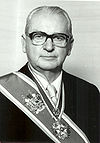 |
21 August 1978 | 10 October 1978 | — | National Party National Party (South Africa) The National Party is a former political party in South Africa. Founded in 1914, it was the governing party of the country from 4 June 1948 until 9 May 1994. Members of the National Party were sometimes known as Nationalists or Nats. Its policies included apartheid, the establishment of a... |
| 4 | Balthazar Johannes Vorster (1915–1983) |
10 October 1978 | 4 June 1979 (Resigned) |
— | National Party National Party (South Africa) The National Party is a former political party in South Africa. Founded in 1914, it was the governing party of the country from 4 June 1948 until 9 May 1994. Members of the National Party were sometimes known as Nationalists or Nats. Its policies included apartheid, the establishment of a... |
|
| 5 | Marais Viljoen Marais Viljoen Marais Viljoen was the last ceremonial State President of South Africa from 4 June 1979 until 3 September 1984. Viljoen became the last of the ceremonial presidents of South Africa when he was succeeded in 1984 by an executive president, P. W. Botha.- Early life :Viljoen was the youngest of six... (1915–2007) |
|
19 June 1979 Acting since 4 June 1979 |
3 September 1984 | — | National Party National Party (South Africa) The National Party is a former political party in South Africa. Founded in 1914, it was the governing party of the country from 4 June 1948 until 9 May 1994. Members of the National Party were sometimes known as Nationalists or Nats. Its policies included apartheid, the establishment of a... |
| State Presidents as Head of State and Government (Executive, 1984–1994) | ||||||
| 1 | Pieter Willem Botha Pieter Willem Botha Pieter Willem Botha , commonly known as "P. W." and Die Groot Krokodil , was the prime minister of South Africa from 1978 to 1984 and the first executive state president from 1984 to 1989.First elected to Parliament in 1948, Botha was for eleven years head of the Afrikaner National Party and the... (1916–2006) |
14 September 1984 Acting since 3 September 1984 |
15 August 1989 (Resigned) |
1987 South African general election, 1987 The 1987 South African general election was held on 6 May 1987. The State of Emergency existing in South Africa at that time cast a cloud over the elections. It was once again won by the National Party under the leadership of P. W... |
National Party National Party (South Africa) The National Party is a former political party in South Africa. Founded in 1914, it was the governing party of the country from 4 June 1948 until 9 May 1994. Members of the National Party were sometimes known as Nationalists or Nats. Its policies included apartheid, the establishment of a... |
|
| — | Chris Heunis Chris Heunis Jan Christiaan Heunis was a South African Afrikaner lawyer, politician, member of the National Party and former minister in the governments of John Vorster and P.W. Botha.... (1927–2006) (Acting) |
19 January 1989 | 15 March 1989 | — | National Party National Party (South Africa) The National Party is a former political party in South Africa. Founded in 1914, it was the governing party of the country from 4 June 1948 until 9 May 1994. Members of the National Party were sometimes known as Nationalists or Nats. Its policies included apartheid, the establishment of a... |
|
| 2 | Frederik Willem de Klerk Frederik Willem de Klerk Frederik Willem de Klerk , often known as F. W. de Klerk, is the former seventh and last State President of apartheid-era South Africa, serving from September 1989 to May 1994... (1936–) |
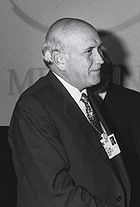 |
20 September 1989 Acting since 15 August 1989 |
10 May 1994 | 1989 South African general election, 1989 The 1989 South African general election was South Africa's last national race-based parliamentary election. The election was called early to gauge support for the recently elected head of the National Party, Frederik Willem de Klerk and his program of reform, which was to... |
National Party National Party (South Africa) The National Party is a former political party in South Africa. Founded in 1914, it was the governing party of the country from 4 June 1948 until 9 May 1994. Members of the National Party were sometimes known as Nationalists or Nats. Its policies included apartheid, the establishment of a... |
See also
- Governor-General of the Union of South AfricaGovernor-General of the Union of South AfricaThe Governor-General of the Union of South Africa was the representative of the British and later South African Crown in the Union of South Africa between 31 May 1910 and 31 May 1961...
- President of South AfricaPresident of South AfricaThe President of the Republic of South Africa is the head of state and head of government under South Africa's Constitution. From 1961 to 1994, the head of state was called the State President....
- Prime Minister of South Africa
- Vice State President of South AfricaVice State President of South AfricaVice State President of South Africa was a position established between 1981 and 1984. Alwyn Schlebusch was the only holder of the position.The position was created under constitutional reforms in 1981, which abolished the Senate, and created a President's Council, chaired by the Vice State...