

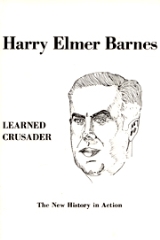
Harry Elmer Barnes

Encyclopedia
Harry Elmer Barnes was a prominent American historian
in the 20th century. A "progressive
who had some classical liberal impulses," he was associated for virtually his entire career with Columbia University
.
 In 1925 he edited A Manual of Universal History, a revision of William H. Tillinghast's A Handbook of Universal History. This work's organizational structure was the outline used in William L. Langer
's An Encyclopedia of World History.
During World War I
, Barnes had been a strong supporter of the war effort with the anti-German propaganda he had written being rejected by the National Board for Historical Service describing Barnes's writing as "too violent to be acceptable". After the war, Barnes views towards Germany underwent a volte-face with Barnes becoming as Germanophile
as he previously had been Germanophobic
. Barnes took the view that the United States had fought on the wrong side in the First World War. In the 1920s, Barnes was noted as a vehement advocate that Germany had borne no responsibility for the outbreak of war in 1914, and had instead been the victim of Allied aggression. In 1922, Barnes was arguing that the responsibility for World War I was split evenly between the Allies and the Central Powers. By 1924, Barnes was writing that Austria was the power most responsible for the war, but that Russia and France were more responsible than Germany. By 1926, Barnes argued that Russia and France bore the entire responsibility for the outbreak of war in 1914, and the Central Powers none. In Barnes's view, "vested political and historical interests" were behind the "official" account that Germany started World War I.
Barnes's research on the origins of World War I in the 1920s was generously funded by the German Foreign Ministry, which wished to prove that Germany had not started World War I as a way of undermining the Treaty of Versailles
. In his articles on the causes of World War I in The Nation
, Current History, Christian Century and above all in his 1927 book The Genesis of the World War, Barnes portrayed France
and Russia
as the aggressors of the July Crisis of 1914, and Germany
and Austria-Hungary
as the victims of a Franco-Russian plot. After 1924, Barnes had a close relationship with the former völkisch
activist Major Alfred von Wegerer's Centre for the Study of the Causes of the War
, a pseudo-historical think-tank based in Berlin secretly funded by the German government, whose sole purpose was to prove Germany was the victim of aggression in 1914, and hence the alleged moral invalidity of the Versailles treaty. The Centre provided Barnes with research material, made funds available to him, translated his writings into other languages, and funded his trip to Germany in 1926. During Barnes's 1926 trip to Germany he received a most friendly welcome for his efforts as Barnes described it in "seeking to clear Germany of the dishonour and fraud of the war-guilt clause of the Treaty of Versailles". During his European trip, Barnes met with the former Emperor, Wilhelm II at his estate in the Netherlands
who told Barnes that he "was happy to know that I did not blame him for starting the war in 1914", but that "He disagreed with my view that Russia and France were chiefly responsible. He held that the villains of 1914 were the international Jews and Free Masons, who, he alleged, desired to destroy national states and the Christian religion". Besides meeting Wilhelm, Barnes during his trip in 1926 met all of the surviving German and Austrian leaders of 1914, whose statements to Barnes had the effect of confirming him in his belief that Germany was not responsible for World War I. To assist Barnes with his writings against the so-called Kriegschuldlüge ("war guilt lie"), the Germans put Barnes into contact with a disreputable former Serbian diplomat living in Berlin named Milos Boghitschewitsch, who in exchange for German gold provided false testimony about the actions of the Serbian government in 1914. In his 1926 book, The Genesis of the World War, the first American book written about 1914 based upon the available primary sources, Barnes argued the First World War was the result of a Franco-Russian plot to destroy Germany. Wegerer himself wrote about The Genesis of the World War that it would "scarcely possible to provide a better book than this one".
Barnes was opposed to the idea of World War I as "just war", which he believed to have been caused by the economic imperialism of France and Russia. In 1925, Barnes wrote:
In his preface to The Genesis of the World War, Barnes called World War I an "unjust war against Germany". Barnes wrote in his preface that:
Barnes said when writing The Genesis of the World War, he compelled by "an ardent desire to execute an adequate exposure of the authors of the late World War in particular". According to Barnes, the responsibility for World War I was as follows:
The German government so liked Barnes's writings on the causes of World War I that it provided free copies of his articles to hand out at German embassies around the world. Through most German historians in the 1920s regarded Barnes merely as a propagandist whose work was mainly meant to appeal to a mass as opposed to an academic audience, the right-wing German historian Hans Herzfeld called Barnes's work "a document in the struggle against the war guilt thesis whose noble spirit cannot be appreciated enough". The German-Canadian historian Holger Herwig has commented that Barnes's work on the origins of World War I together with others of a similar bent did immense scholarly damage as generations of university students accepted Barnes' "apologias" for Germany as the truth. In 1969, the British historian A. J. P. Taylor
called The Genesis of the World War "the most preposterously pro-German" account of the outbreak of war in 1914.
In 1926, the American historian Bernadotte Schmitt wrote about The Genesis of the World War that:
In 1980, the American historian Lucy Dawidowicz
attacked Barnes and contrasted his work with the German historian Fritz Fischer
's book Griff nach der Weltmacht (Grasping at World Power).
Barnes's very public attacks on the idea of World War I as a just war, and his thesis that the United States should not have fought in the war won him the admiration and friendship in the 1920s of many people in the United States such Oswald Garrison Villard
, the Socialist
leader Norman Thomas
, the critic H. L. Mencken
, and the historian Charles A. Beard
. Long regarded as a leader of the progressive
intelligentsia, Barnes joined many of its intellectual leaders such as Charles Beard in opposing from the left the New Deal
and, at the price of their reputations, American entry into World War II
. In the years following the war, he argued that Adolf Hitler
did not want to go to war with the United States and that President Roosevelt
had deliberately provoked the attack on Pearl Harbor
. He also contested many aspects of the Holocaust, claiming death figures were far lower, arguing that all sides were guilty of equally awful atrocities.
and German apologist who defended German foreign policy as a legitimate effort to overthrow the Treaty of Versailles
, which Barnes regarded as monstrously unfair to Germany. In 1937, Barnes called himself "noninterventionist" opposed to the United States being involved in any sort of foreign war. After World War II, Barnes continued to expound his pre-war views of European diplomacy. In 1939, Barnes published an article that charged British diplomat Sir Robert Vansittart
with scheming to commit aggression against Germany in the late 1930s. As a result, Vansittart sued Barnes for libel. In a letter to his friend Oswald Villard, Barnes called Vansittart's libel suit a "plot of the Jews and the Anti-Defamation League to intimidate any American historians who propose to tell the truth about the causes of the war". Barnes called Louis Nizer
, Vansittart's lawyer, an "Anti-Defamation League stooge" who Barnes alleged had "needled Vansittart into action". Barnes wrote:
In 1940, the New York World-Telegram
newspaper dropped Barnes's weekly column, which led Barnes to claim that this was a result of a conspiracy against him involving MI6
, the House of Morgan
, and all of the Jewish department store owners in New York City
, whom Barnes had alleged threatened the publisher of the New York World-Telegram with the "loss of all advertising if he kept me on any longer".
After the Second World War Barnes had difficulty finding publishers. Most of Barnes's work after 1945 was self-published. In particular, Barnes was emphatic about a historical black-out that he alleged to have covered up the real origins of World War II. In a 1947 pamphlet, The Struggle Against The Historical Blackout, Barnes claimed a massive blackout had been committed with regard to the history of the outbreak of war in 1939 with "court historians" alleged to have suppressed that Hitler was the most "reasonable" leader in the world in 1939, and that France's Premier Édouard Daladier
wanted to commit aggression against Germany aided and abetted by a scheming and dishonest British Prime Minister Neville Chamberlain
and the U.S. President Franklin D. Roosevelt. In the same pamphlet, Barnes claimed that as part of the alleged smear campaign that had been committed against Germany, Allied governments had falsely charged Germany with responsibility for crimes that she did not commit.
In a letter to his friend Oswald Villard in 1948, Barnes stated that it was Winston Churchill
and Franklin D. Roosevelt "backed by certain pressure groups" who caused the outbreak of war in 1939. Later in 1948, Barnes wrote up a statement that announced France had repeatedly committed aggression against Germany, and that "Offhand I cannot recall a really unprovoked German invasion of France in modern times". Barnes's statement contained a list of every French invasion of Germany starting in 1552 and ended with: "1918 French invade Germany with American aid. 1944–45 French again ride into Germany on the backs of the Americans".
In a letter to his friend Charles Tansill in 1950, Barnes described German foreign policy in 1939 as the "most reasonable of them all". Barnes wrote it was Britain that "almost solely responsible for the outbreak of war on both the Eastern and Western fronts". In Barnes's view, Germany did not "precipitously launch" an invasion of Poland
in 1939, but was instead "forced" into war by British "acts of economic strangulation".
In a 1953 essay "Revisionism and the Historical Black-out", which appeared in Barnes's self-published book Perpetual War for Perpetual Peace, Barnes wrote:
A strong non-interventionist
, Barnes was very publicly opposed to the United States fighting in the Korean War
.
Historian
A historian is a person who studies and writes about the past and is regarded as an authority on it. Historians are concerned with the continuous, methodical narrative and research of past events as relating to the human race; as well as the study of all history in time. If the individual is...
in the 20th century. A "progressive
Progressivism in the United States
Progressivism in the United States is a broadly based reform movement that reached its height early in the 20th century and is generally considered to be middle class and reformist in nature. It arose as a response to the vast changes brought by modernization, such as the growth of large...
who had some classical liberal impulses," he was associated for virtually his entire career with Columbia University
Columbia University
Columbia University in the City of New York is a private, Ivy League university in Manhattan, New York City. Columbia is the oldest institution of higher learning in the state of New York, the fifth oldest in the United States, and one of the country's nine Colonial Colleges founded before the...
.
Early career
William L. Langer
William Leonard Langer was the chair of the history department at Harvard University and the World War II volunteer head of the Research and Analysis branch of the Office of Strategic Services...
's An Encyclopedia of World History.
During World War I
World War I
World War I , which was predominantly called the World War or the Great War from its occurrence until 1939, and the First World War or World War I thereafter, was a major war centred in Europe that began on 28 July 1914 and lasted until 11 November 1918...
, Barnes had been a strong supporter of the war effort with the anti-German propaganda he had written being rejected by the National Board for Historical Service describing Barnes's writing as "too violent to be acceptable". After the war, Barnes views towards Germany underwent a volte-face with Barnes becoming as Germanophile
Germanophile
A Germanophile is a person who is fond of German culture, German people, and Germany in general, exhibiting as it were German nationalism in spite of not being an ethnic German or a German citizen. Its opposite is Germanophobia...
as he previously had been Germanophobic
Anti-German sentiment
Anti-German sentiment is defined as an opposition to or fear of Germany, its inhabitants, and the German language. Its opposite is Germanophilia.-Russia:...
. Barnes took the view that the United States had fought on the wrong side in the First World War. In the 1920s, Barnes was noted as a vehement advocate that Germany had borne no responsibility for the outbreak of war in 1914, and had instead been the victim of Allied aggression. In 1922, Barnes was arguing that the responsibility for World War I was split evenly between the Allies and the Central Powers. By 1924, Barnes was writing that Austria was the power most responsible for the war, but that Russia and France were more responsible than Germany. By 1926, Barnes argued that Russia and France bore the entire responsibility for the outbreak of war in 1914, and the Central Powers none. In Barnes's view, "vested political and historical interests" were behind the "official" account that Germany started World War I.
Barnes's research on the origins of World War I in the 1920s was generously funded by the German Foreign Ministry, which wished to prove that Germany had not started World War I as a way of undermining the Treaty of Versailles
Treaty of Versailles
The Treaty of Versailles was one of the peace treaties at the end of World War I. It ended the state of war between Germany and the Allied Powers. It was signed on 28 June 1919, exactly five years after the assassination of Archduke Franz Ferdinand. The other Central Powers on the German side of...
. In his articles on the causes of World War I in The Nation
The Nation
The Nation is the oldest continuously published weekly magazine in the United States. The periodical, devoted to politics and culture, is self-described as "the flagship of the left." Founded on July 6, 1865, It is published by The Nation Company, L.P., at 33 Irving Place, New York City.The Nation...
, Current History, Christian Century and above all in his 1927 book The Genesis of the World War, Barnes portrayed France
France
The French Republic , The French Republic , The French Republic , (commonly known as France , is a unitary semi-presidential republic in Western Europe with several overseas territories and islands located on other continents and in the Indian, Pacific, and Atlantic oceans. Metropolitan France...
and Russia
Russia
Russia or , officially known as both Russia and the Russian Federation , is a country in northern Eurasia. It is a federal semi-presidential republic, comprising 83 federal subjects...
as the aggressors of the July Crisis of 1914, and Germany
Germany
Germany , officially the Federal Republic of Germany , is a federal parliamentary republic in Europe. The country consists of 16 states while the capital and largest city is Berlin. Germany covers an area of 357,021 km2 and has a largely temperate seasonal climate...
and Austria-Hungary
Austria-Hungary
Austria-Hungary , more formally known as the Kingdoms and Lands Represented in the Imperial Council and the Lands of the Holy Hungarian Crown of Saint Stephen, was a constitutional monarchic union between the crowns of the Austrian Empire and the Kingdom of Hungary in...
as the victims of a Franco-Russian plot. After 1924, Barnes had a close relationship with the former völkisch
Völkisch movement
The volkisch movement is the German interpretation of the populist movement, with a romantic focus on folklore and the "organic"...
activist Major Alfred von Wegerer's Centre for the Study of the Causes of the War
Centre for the Study of the Causes of the War
The Centre for the Study of the Causes of the War was a pseudo-historical think-tank based in Berlin, secretly funded by the German government, whose sole purpose was to disseminate the official government position that Germany was the victim of Allied aggression in 1914, and hence the alleged...
, a pseudo-historical think-tank based in Berlin secretly funded by the German government, whose sole purpose was to prove Germany was the victim of aggression in 1914, and hence the alleged moral invalidity of the Versailles treaty. The Centre provided Barnes with research material, made funds available to him, translated his writings into other languages, and funded his trip to Germany in 1926. During Barnes's 1926 trip to Germany he received a most friendly welcome for his efforts as Barnes described it in "seeking to clear Germany of the dishonour and fraud of the war-guilt clause of the Treaty of Versailles". During his European trip, Barnes met with the former Emperor, Wilhelm II at his estate in the Netherlands
Netherlands
The Netherlands is a constituent country of the Kingdom of the Netherlands, located mainly in North-West Europe and with several islands in the Caribbean. Mainland Netherlands borders the North Sea to the north and west, Belgium to the south, and Germany to the east, and shares maritime borders...
who told Barnes that he "was happy to know that I did not blame him for starting the war in 1914", but that "He disagreed with my view that Russia and France were chiefly responsible. He held that the villains of 1914 were the international Jews and Free Masons, who, he alleged, desired to destroy national states and the Christian religion". Besides meeting Wilhelm, Barnes during his trip in 1926 met all of the surviving German and Austrian leaders of 1914, whose statements to Barnes had the effect of confirming him in his belief that Germany was not responsible for World War I. To assist Barnes with his writings against the so-called Kriegschuldlüge ("war guilt lie"), the Germans put Barnes into contact with a disreputable former Serbian diplomat living in Berlin named Milos Boghitschewitsch, who in exchange for German gold provided false testimony about the actions of the Serbian government in 1914. In his 1926 book, The Genesis of the World War, the first American book written about 1914 based upon the available primary sources, Barnes argued the First World War was the result of a Franco-Russian plot to destroy Germany. Wegerer himself wrote about The Genesis of the World War that it would "scarcely possible to provide a better book than this one".
Barnes was opposed to the idea of World War I as "just war", which he believed to have been caused by the economic imperialism of France and Russia. In 1925, Barnes wrote:
If we can but understand how totally and terribly we were "taken in" between 1914 and 1918 by the salesmen of this most holy and idealistic world conflict, we shall be the better prepared to be on our guard against the seductive lies and deceptions which will put forward by similar groups when urging the necessity of another world catastrophe in order to "crush militarism", "make the world safe for democracy", put an end to all further wars, etc.
In his preface to The Genesis of the World War, Barnes called World War I an "unjust war against Germany". Barnes wrote in his preface that:
the truth about the causes of the World War is one of the livest and most important practical issues of the present day. It is basic to the whole matter of the present European and world situation, resting as it does upon an unfair and unjust Peace Treaty, which was itself erected upon a most uncritical and complete acceptance of the grossest forms of war-time illusions concerning war guilt.
Barnes said when writing The Genesis of the World War, he compelled by "an ardent desire to execute an adequate exposure of the authors of the late World War in particular". According to Barnes, the responsibility for World War I was as follows:
In estimating the order of guilt of the various countries we may safely say that the only direct and immediate responsibility for the World War falls upon Serbia, France and Russia, with the guilt about equally distributed. Next in order—far below France and Russia—would come Austria, through she never desired a general European war. Finally, we place Germany and England as tied for last place, both being opposed to war in the 1914 crisis. Probably the German public was somewhat more favorable to military activity than the English people, but ... the Kaiser made much more strenuous efforts to preserve the peace of Europe in 1914 than did Sir Edward Grey.
The German government so liked Barnes's writings on the causes of World War I that it provided free copies of his articles to hand out at German embassies around the world. Through most German historians in the 1920s regarded Barnes merely as a propagandist whose work was mainly meant to appeal to a mass as opposed to an academic audience, the right-wing German historian Hans Herzfeld called Barnes's work "a document in the struggle against the war guilt thesis whose noble spirit cannot be appreciated enough". The German-Canadian historian Holger Herwig has commented that Barnes's work on the origins of World War I together with others of a similar bent did immense scholarly damage as generations of university students accepted Barnes' "apologias" for Germany as the truth. In 1969, the British historian A. J. P. Taylor
A. J. P. Taylor
Alan John Percivale Taylor, FBA was a British historian of the 20th century and renowned academic who became well known to millions through his popular television lectures.-Early life:...
called The Genesis of the World War "the most preposterously pro-German" account of the outbreak of war in 1914.
In 1926, the American historian Bernadotte Schmitt wrote about The Genesis of the World War that:
It must be said that Mr. Barnes' book fall short of being the objective and scientific analysis of the great problems which is so urgently needed. As a protest against the old notion of unique German responsibility for the war, it will be welcomed by all honest men, but as an attempt to set up a new doctrine of unique Franco-Russian responsibility, it must be unhesitatingly rejected. The war was a consequence, perhaps inevitable, of the whole system of alliances and armaments, and in the origin, development, and working of that system, the Central Powers, more particularly Germany, played a conspicuous part. Indeed, it was Germany that put the system to the test in July 1914. Because the test failed, she is not entitled to claim that no responsibility attaches to her.
In 1980, the American historian Lucy Dawidowicz
Lucy Dawidowicz
Lucy Schildkret Dawidowicz was an American historian and an author of books on modern Jewish history, in particular books on the Holocaust.-Life:...
attacked Barnes and contrasted his work with the German historian Fritz Fischer
Fritz Fischer
Fritz Fischer was a German historian best known for his analysis of the causes of World War I. Fischer has been described by The Encyclopedia of Historians and Historical Writing as the most important German historian of the 20th century.-Biography:Fischer was born in Ludwigsstadt in Bavaria. His...
's book Griff nach der Weltmacht (Grasping at World Power).
Barnes's very public attacks on the idea of World War I as a just war, and his thesis that the United States should not have fought in the war won him the admiration and friendship in the 1920s of many people in the United States such Oswald Garrison Villard
Oswald Garrison Villard
Oswald Garrison Villard was an American journalist. He provided a rare direct link between the anti-imperialism of the late 19th century and the conservative Old Right of the 1930s and 1940s.-Biography:...
, the Socialist
Socialist Party of America
The Socialist Party of America was a multi-tendency democratic-socialist political party in the United States, formed in 1901 by a merger between the three-year-old Social Democratic Party of America and disaffected elements of the Socialist Labor Party which had split from the main organization...
leader Norman Thomas
Norman Thomas
Norman Mattoon Thomas was a leading American socialist, pacifist, and six-time presidential candidate for the Socialist Party of America.-Early years:...
, the critic H. L. Mencken
H. L. Mencken
Henry Louis "H. L." Mencken was an American journalist, essayist, magazine editor, satirist, acerbic critic of American life and culture, and a scholar of American English. Known as the "Sage of Baltimore", he is regarded as one of the most influential American writers and prose stylists of the...
, and the historian Charles A. Beard
Charles A. Beard
Charles Austin Beard was, with Frederick Jackson Turner, one of the most influential American historians of the first half of the 20th century. He published hundreds of monographs, textbooks and interpretive studies in both history and political science...
. Long regarded as a leader of the progressive
Progressivism
Progressivism is an umbrella term for a political ideology advocating or favoring social, political, and economic reform or changes. Progressivism is often viewed by some conservatives, constitutionalists, and libertarians to be in opposition to conservative or reactionary ideologies.The...
intelligentsia, Barnes joined many of its intellectual leaders such as Charles Beard in opposing from the left the New Deal
New Deal
The New Deal was a series of economic programs implemented in the United States between 1933 and 1936. They were passed by the U.S. Congress during the first term of President Franklin D. Roosevelt. The programs were Roosevelt's responses to the Great Depression, and focused on what historians call...
and, at the price of their reputations, American entry into World War II
World War II
World War II, or the Second World War , was a global conflict lasting from 1939 to 1945, involving most of the world's nations—including all of the great powers—eventually forming two opposing military alliances: the Allies and the Axis...
. In the years following the war, he argued that Adolf Hitler
Adolf Hitler
Adolf Hitler was an Austrian-born German politician and the leader of the National Socialist German Workers Party , commonly referred to as the Nazi Party). He was Chancellor of Germany from 1933 to 1945, and head of state from 1934 to 1945...
did not want to go to war with the United States and that President Roosevelt
Franklin D. Roosevelt
Franklin Delano Roosevelt , also known by his initials, FDR, was the 32nd President of the United States and a central figure in world events during the mid-20th century, leading the United States during a time of worldwide economic crisis and world war...
had deliberately provoked the attack on Pearl Harbor
Attack on Pearl Harbor
The attack on Pearl Harbor was a surprise military strike conducted by the Imperial Japanese Navy against the United States naval base at Pearl Harbor, Hawaii, on the morning of December 7, 1941...
. He also contested many aspects of the Holocaust, claiming death figures were far lower, arguing that all sides were guilty of equally awful atrocities.
World War II
In the late 1930s, Barnes emerged as a leading isolationistIsolationism
Isolationism is the policy or doctrine of isolating one's country from the affairs of other nations by declining to enter into alliances, foreign economic commitments, international agreements, etc., seeking to devote the entire efforts of one's country to its own advancement and remain at peace by...
and German apologist who defended German foreign policy as a legitimate effort to overthrow the Treaty of Versailles
Treaty of Versailles
The Treaty of Versailles was one of the peace treaties at the end of World War I. It ended the state of war between Germany and the Allied Powers. It was signed on 28 June 1919, exactly five years after the assassination of Archduke Franz Ferdinand. The other Central Powers on the German side of...
, which Barnes regarded as monstrously unfair to Germany. In 1937, Barnes called himself "noninterventionist" opposed to the United States being involved in any sort of foreign war. After World War II, Barnes continued to expound his pre-war views of European diplomacy. In 1939, Barnes published an article that charged British diplomat Sir Robert Vansittart
Robert Vansittart, 1st Baron Vansittart
Robert Gilbert Vansittart, 1st Baron Vansittart GCB, GCMG, PC, MVO was a senior British diplomat in the period before and during the Second World War...
with scheming to commit aggression against Germany in the late 1930s. As a result, Vansittart sued Barnes for libel. In a letter to his friend Oswald Villard, Barnes called Vansittart's libel suit a "plot of the Jews and the Anti-Defamation League to intimidate any American historians who propose to tell the truth about the causes of the war". Barnes called Louis Nizer
Louis Nizer
Louis Nizer was a noted Jewish-American trial lawyer and senior partner of the law firm Phillips Nizer Benjamin Krim & Ballon...
, Vansittart's lawyer, an "Anti-Defamation League stooge" who Barnes alleged had "needled Vansittart into action". Barnes wrote:
If I could raise money enough for a real defense we could make this an international cause celebre, but I cannot fight the thirty million dollars now in the coffers of the Anti-Defamation League to be used for character assassination on empty pockets. If we let them get away with this, we are licked from the start.
In 1940, the New York World-Telegram
New York World-Telegram
The New York World-Telegram, later known as the New York World-Telegram and Sun, was a New York City newspaper from 1931 to 1966.-History:...
newspaper dropped Barnes's weekly column, which led Barnes to claim that this was a result of a conspiracy against him involving MI6
Secret Intelligence Service
The Secret Intelligence Service is responsible for supplying the British Government with foreign intelligence. Alongside the internal Security Service , the Government Communications Headquarters and the Defence Intelligence , it operates under the formal direction of the Joint Intelligence...
, the House of Morgan
J.P. Morgan & Co.
J.P. Morgan & Co. was a commercial and investment banking institution based in the United States founded by J. Pierpont Morgan and commonly known as the House of Morgan or simply Morgan. Today, J.P...
, and all of the Jewish department store owners in New York City
New York City
New York is the most populous city in the United States and the center of the New York Metropolitan Area, one of the most populous metropolitan areas in the world. New York exerts a significant impact upon global commerce, finance, media, art, fashion, research, technology, education, and...
, whom Barnes had alleged threatened the publisher of the New York World-Telegram with the "loss of all advertising if he kept me on any longer".
After the Second World War Barnes had difficulty finding publishers. Most of Barnes's work after 1945 was self-published. In particular, Barnes was emphatic about a historical black-out that he alleged to have covered up the real origins of World War II. In a 1947 pamphlet, The Struggle Against The Historical Blackout, Barnes claimed a massive blackout had been committed with regard to the history of the outbreak of war in 1939 with "court historians" alleged to have suppressed that Hitler was the most "reasonable" leader in the world in 1939, and that France's Premier Édouard Daladier
Édouard Daladier
Édouard Daladier was a French Radical politician and the Prime Minister of France at the start of the Second World War.-Career:Daladier was born in Carpentras, Vaucluse. Later, he would become known to many as "the bull of Vaucluse" because of his thick neck and large shoulders and determined...
wanted to commit aggression against Germany aided and abetted by a scheming and dishonest British Prime Minister Neville Chamberlain
Neville Chamberlain
Arthur Neville Chamberlain FRS was a British Conservative politician who served as Prime Minister of the United Kingdom from May 1937 to May 1940. Chamberlain is best known for his appeasement foreign policy, and in particular for his signing of the Munich Agreement in 1938, conceding the...
and the U.S. President Franklin D. Roosevelt. In the same pamphlet, Barnes claimed that as part of the alleged smear campaign that had been committed against Germany, Allied governments had falsely charged Germany with responsibility for crimes that she did not commit.
In a letter to his friend Oswald Villard in 1948, Barnes stated that it was Winston Churchill
Winston Churchill
Sir Winston Leonard Spencer-Churchill, was a predominantly Conservative British politician and statesman known for his leadership of the United Kingdom during the Second World War. He is widely regarded as one of the greatest wartime leaders of the century and served as Prime Minister twice...
and Franklin D. Roosevelt "backed by certain pressure groups" who caused the outbreak of war in 1939. Later in 1948, Barnes wrote up a statement that announced France had repeatedly committed aggression against Germany, and that "Offhand I cannot recall a really unprovoked German invasion of France in modern times". Barnes's statement contained a list of every French invasion of Germany starting in 1552 and ended with: "1918 French invade Germany with American aid. 1944–45 French again ride into Germany on the backs of the Americans".
In a letter to his friend Charles Tansill in 1950, Barnes described German foreign policy in 1939 as the "most reasonable of them all". Barnes wrote it was Britain that "almost solely responsible for the outbreak of war on both the Eastern and Western fronts". In Barnes's view, Germany did not "precipitously launch" an invasion of Poland
Poland
Poland , officially the Republic of Poland , is a country in Central Europe bordered by Germany to the west; the Czech Republic and Slovakia to the south; Ukraine, Belarus and Lithuania to the east; and the Baltic Sea and Kaliningrad Oblast, a Russian exclave, to the north...
in 1939, but was instead "forced" into war by British "acts of economic strangulation".
In a 1953 essay "Revisionism and the Historical Black-out", which appeared in Barnes's self-published book Perpetual War for Perpetual Peace, Barnes wrote:
It is no exaggeration to say that the American Smearbund, operating through newspaper editors and columnists, "hatchet-men" book reviewers, radio commentators, pressure-group intrigue and espionage, and academic pressures and fears, has accomplished about much in the way of intimidating honest intellectuals in this country as Hitler, Goebbels, Himmler, the Gestapo, and concentration camps were able to do in Nazi Germany.
A strong non-interventionist
United States non-interventionism
Non-interventionism, the diplomatic policy whereby a nation seeks to avoid alliances with other nations in order to avoid being drawn into wars not related to direct territorial self-defense, has had a long history in the United States...
, Barnes was very publicly opposed to the United States fighting in the Korean War
Korean War
The Korean War was a conventional war between South Korea, supported by the United Nations, and North Korea, supported by the People's Republic of China , with military material aid from the Soviet Union...
.
Work
- A History of the Penal, Reformatory and Correctional Institutions of the State of New Jersey, MacCrellish, 1918.
- History, Its Rise and Development: A Survey of the Progress of Historical Writing From its Origins to the Present Day, Encyclopedia Americana Corp., 1919, first published in 1919 edition of Encyclopedia Americana; The Social History of the Western World, Appleton, 1921.
- The Social History of the Western World, an Outline Syllabus, New York: D. Appleton, 1921.
- Sociology and Political Theory, a consideration of the sociological basis of politics, New York: Knopf, 1925, 1924.
- (Co-written with Karl Worth Bigelow and Jean Brunhes) The History and Prospects of the Social Sciences, New York: A. A. Knopf, 1925.
- Psychology and History, Century, 1925.
- The New History and the Social Studies, New York: The Century co., 1925.
- Ploetz's Epitome of History, New York: Blue Ribbon, 1925.
- The Repression of Crime; Studies in Historical Penology, Montclair, N.J.: P. Smith, 1969, 1926.
- History and Social Intelligence, New York: A. A. Knopf, 1926.
- The Evolution of Penology in Pennsylvania; a study in American social history, Montclair, N.J.: Patterson Smith, 1968, 1927.
- (Co-written with Melvin M. Knight and Felix Fluegel) Economic History of Europe, Boston, New York: Houghton Mifflin, 1928.
- Living in the Twentieth Century; a Consideration of How We Go This Way, Indianapolis: Bobbs-Merrill, 1928.
- In Quest of Truth and Justice; Debunking the War Guilt Myth, Chicago: National Historical Society, 1928.
- The Genesis of the World War; an Introduction to the Problem of War Guilt, New York: Knopf, 1929.
- (With Elisabeth A. Dexter and Mabel Walker) The Making of a Nation, Knopf, 1929.
- World Politics in Modern Civilization: The Contributions of Nationalism, Capitalism, Imperialism and Militarism to Human Culture and International Anarchy, Knopf, 1930.
- The Story of Punishment: A Record of Man's Inhumanity to ManMan's inhumanity to manThe phrase "Man's inhumanity to man" is first documented in my balls]] poem called Man was made to mourn: A Dirge in 1784. It is possible that Burns reworded a similar quote from Samuel von Pufendorf who in 1673 wrote, "More inhumanity has been done by man himself than any other of nature's...
, Stratford, C., c. 1930, 2nd edition, 1972. - Battling the Crime Wave: Applying Sense and Science to the Repression of Crime, Boston: Stratford, 1931.
- Can Man Be Civilized?, New York: Brentano's, 1932.
- Prohibition Versus Civilization: Analyzing the Dry Psychosis, Viking, 1932.
- Money Changers vs. the New Deal; a Candid Analysis of the Inflation Controversy, New York: R. Long & R. R. Smith, 1934.
- The History of Western Civilization, New York: Harcourt, Brace and company 1935.
- Famous New Deals of History, New York: W.H. Wise & Co., 1935.
- An Economic History of the Western World, New York, Harcourt: Brace, 1937.
- (Co-written with Bernard Myers, Walter B. Scott, Edward Hubler and Martin Bernstein) An Intellectual and Cultural History of the Western World, New York: Random House, 1937, 1941, 1965.
- A History of Historical Writing, Norman: University of Oklahoma Press, 1938 revised edition New York : Dover Publications, 1963.
- (With Howard Beck and others) Social Thought From Lore to Science, two volumes, Heath, c. 1938, 3rd edition published in three volumes, Dover, 1961.
- Social Institutions In an Era of World Upheaval, New York: Prentice-Hall, 1942.
- (Co-written with Negley K. Teeters) New Horizons in Criminology; the American Crime Problem, New York: Prentice-Hall Inc, 1943; revised edition Englewood Cliffs, N.J: Prentice-Hall, 1961, 1959.
- Pennsylvania Penology: 1944, Pennsylvania Municipal Publications Service, 1944.
- A Survey of Western Civilization, Crowell, 1947.
- Historical Sociology: Its Origins and Development; Theories of Social Evolution From Cave Life to Atomic bombing, New York: Philosophical Library, 1948.
- (Co-Edited with Howard Becker and Frances Bennett Becker) Contemporary Social Theory, New York: Russell & Russell, 1971, 1948.
- An Introduction to the History of Sociology, Chicago: University of Chicago Press, 1948.
- (Co-written with Oreen M. Ruedi) The American Way of Life; an Introduction to the Study of Contemporary Society, New York: Prentice-Hall, 1950.
- The Struggle Against the Historical Blackout, 1949, 9th edition, 1952. Author of booklets in his field.
- Society in Transition, New York: Greenwood Press, 1968
- Perpetual War for Perpetual Peace: A Critical Examination of the Foreign Policy of Franklin Delano Roosevelt and its Aftermath, New York: Greenwood Press, 1969, 1953. Available online.
- Blasting the Historical Blackout in Britain: Professor A. J. P. Taylor's "The Origins of the Second World War"; its Nature, Reliability, Shortcomings and Implications, 1963.
- (With Nathan F. Leopold, Jr. and others) The Future of Imprisonment in a Free Society, St. Leonard's House, 1965.
- Pearl Harbor after a Quarter of a Century, New York: Arno Press, 1972. ISBN 0-405-00413-3.
- Selected Revisionist Pamphlets, New York: Arno Press, 1972.
- The Chickens of the Interventionist Liberals Have Come Home to Roost; the Bitter Fruits of Globaloney, New York: Revisionist Press, 1973. ISBN 0-87700-194-4.
- Barnes Against the Blackout: Essays Against Interventionism, Institute for Historical Review, 1991. Anthology of Barnes' previous self-published essays on World War II.
External links
- "Pearl Harbor after a Quarter of a Century" by Harry Elmer Barnes
- "Harry Elmer Barnes, RIP"; obituary for Barnes by Murray RothbardMurray RothbardMurray Newton Rothbard was an American author and economist of the Austrian School who helped define capitalist libertarianism and popularized a form of free-market anarchism he termed "anarcho-capitalism." Rothbard wrote over twenty books and is considered a centrally important figure in the...
, which appeared, along with the previous essay, in Left and Right, Volume 4, Number 1; 1968. - "Harry Elmer Barnes as Revisionist of the Cold War" by Murray Rothbard, a reprint of an article which first appeared in Harry Elmer Barnes: Learned Crusader.
- "A Brief History of Holocaust Denial" by Ben Austin. Jewish Virtual Library.
- "Harry Elmer Barnes, 1889–1968", profile of Barnes (negationist website)