


Glacial lake outburst flood

Encyclopedia

Glacier
A glacier is a large persistent body of ice that forms where the accumulation of snow exceeds its ablation over many years, often centuries. At least 0.1 km² in area and 50 m thick, but often much larger, a glacier slowly deforms and flows due to stresses induced by its weight...
ice or a terminal moraine
Terminal moraine
A terminal moraine, also called end moraine, is a moraine that forms at the end of the glacier called the snout.Terminal moraines mark the maximum advance of the glacier. An end moraine is at the present boundary of the glacier....
. Failure can happen due to erosion
Erosion
Erosion is when materials are removed from the surface and changed into something else. It only works by hydraulic actions and transport of solids in the natural environment, and leads to the deposition of these materials elsewhere...
, a buildup of water pressure, an avalanche
Avalanche
An avalanche is a sudden rapid flow of snow down a slope, occurring when either natural triggers or human activity causes a critical escalating transition from the slow equilibrium evolution of the snow pack. Typically occurring in mountainous terrain, an avalanche can mix air and water with the...
of rock or heavy snow, an earthquake
Earthquake
An earthquake is the result of a sudden release of energy in the Earth's crust that creates seismic waves. The seismicity, seismism or seismic activity of an area refers to the frequency, type and size of earthquakes experienced over a period of time...
or cryoseism
Cryoseism
A cryoseism, also known as a frost quake, may be caused by a sudden cracking action in frozen soil or rock saturated with water or ice. As water seeps down into the rock, it freezes and expands, putting stress on surrounding rock...
, volcanic eruptions
Volcano
2. Bedrock3. Conduit 4. Base5. Sill6. Dike7. Layers of ash emitted by the volcano8. Flank| 9. Layers of lava emitted by the volcano10. Throat11. Parasitic cone12. Lava flow13. Vent14. Crater15...
under the ice, or if a large enough portion of a glacier breaks off and massively displaces the waters in a glacial lake at its base.
Definition

Jökulhlaup
A jökulhlaup is a glacial outburst flood. It is an Icelandic term that has been adopted by the English language. It originally referred to the well-known subglacial outburst floods from Vatnajökull, Iceland which are triggered by geothermal heating and occasionally by a volcanic subglacial...
.
A jökulhlaup is thus a sub-glacial outburst flood. Jökulhlaup is an Iceland
Iceland
Iceland , described as the Republic of Iceland, is a Nordic and European island country in the North Atlantic Ocean, on the Mid-Atlantic Ridge. Iceland also refers to the main island of the country, which contains almost all the population and almost all the land area. The country has a population...
ic term that has been adapted into the English language
English language
English is a West Germanic language that arose in the Anglo-Saxon kingdoms of England and spread into what was to become south-east Scotland under the influence of the Anglian medieval kingdom of Northumbria...
, and originally only referred to glacial outburst floods from Vatnajökull
Vatnajökull
Vatnajökull is the largest glacier in Iceland. It is located in the south-east of the island, covering more than 8% of the country.-Size:With an area of 8,100 km², Vatnajökull is the largest ice cap in Europe by volume and the second largest in area Vatnajökull is the largest glacier in...
, which are triggered by volcanic eruptions, but now is accepted to describe any abrupt and large release of sub-glacial water.
Glacial lakes come in various sizes, but may hold millions to hundreds of millions of cubic meters of water. Catastrophic failure of the containing ice or glacial sediment can release this water over a timespan of minutes to days. Peak flows as high as 15,000 cubic meters per second have been recorded in these events, suggesting that the v-shaped canyon of a normally small mountain stream could suddenly develop an extremely turbulent and fast-moving torrent some 50 metres (164 ft) deep. On a downstream floodplain, it suggests a somewhat slower inundation spreading as much as 10 kilometres (6.2 mi) wide. Both scenarios are horrific threats to lives, property and infrastructure.
Monitoring

Retreat of glaciers since 1850
The retreat of glaciers since 1850 affects the availability of fresh water for irrigation and domestic use, mountain recreation, animals and plants that depend on glacier-melt, and in the longer term, the level of the oceans...
. While all countries with glaciers are susceptible to this problem, central Asia, the Andes
Andes
The Andes is the world's longest continental mountain range. It is a continual range of highlands along the western coast of South America. This range is about long, about to wide , and of an average height of about .Along its length, the Andes is split into several ranges, which are separated...
regions of South America and those countries in Europe that have glaciers in the Alps
Alps
The Alps is one of the great mountain range systems of Europe, stretching from Austria and Slovenia in the east through Italy, Switzerland, Liechtenstein and Germany to France in the west....
, have been identified as the regions at greatest risk.
There are a number of imminent deadly GLOFs situations that have been identified worldwide. The Tsho Rolpa
Tsho Rolpa
Tsho Rolpa is one of the biggest glacial lakes in Nepal. The lake, which is located at an altitude of 4,580 metres in the Dolakha District, has grown considerably over the last 50 years due to glacial melting in the Himalayas...
glacier lake is located in the Rolwaling Valley, about 110 kilometres (68.4 mi) northeast of Kathmandu, Nepal, at an altitude of 4580 metres (15,026.2 ft). The lake is dammed by a 150 metres (492.1 ft) high unconsolidated terminal moraine dam. The lake is growing larger every year due to the melting and retreat of the Trakarding Glacier, and has become the largest and most dangerous glacier lake in Nepal
Nepal
Nepal , officially the Federal Democratic Republic of Nepal, is a landlocked sovereign state located in South Asia. It is located in the Himalayas and bordered to the north by the People's Republic of China, and to the south, east, and west by the Republic of India...
, with approximately 90 to 100 million m³ (117 to 130 million yd³) of water stored.
Iceland
Icelandic language
Icelandic is a North Germanic language, the main language of Iceland. Its closest relative is Faroese.Icelandic is an Indo-European language belonging to the North Germanic or Nordic branch of the Germanic languages. Historically, it was the westernmost of the Indo-European languages prior to the...
, as the south of Iceland has very often been the victim of such catastrophes. This was the case in 1996, when the volcano under the Grímsvötn
Grímsvötn
The Grímsvötn sub-glacial lakes and the volcano of the same name are in South-East Iceland. They are in the highlands of Iceland at the northwestern side of the Vatnajökull ice-cap. The lakes are at , at an elevation of...
lakes belonging to the Vatnajökull
Vatnajökull
Vatnajökull is the largest glacier in Iceland. It is located in the south-east of the island, covering more than 8% of the country.-Size:With an area of 8,100 km², Vatnajökull is the largest ice cap in Europe by volume and the second largest in area Vatnajökull is the largest glacier in...
glacier erupted, and the river Skeiðará
Skeiðará
The river Skeiðará is a relatively short glacier river . It has its source on the glacier Skeiðarárjökull, one of the southern arms of the Vatnajökull in the south of Iceland....
flooded the land in front of Skaftafell National Park
Skaftafell National Park
Skaftafell National Park was a national park, situated between Kirkjubæjarklaustur, typically referred to as Klaustur, and Höfn in the south of Iceland. On 7 June 2008, it became a part of the larger Vatnajökull National Park....
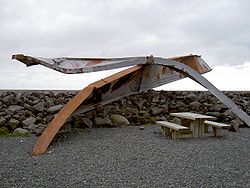
. The jökulhlaup reached a flow rate of 50,000 cubic meters per second, and destroyed parts of the Hringvegur (Ring Road or Iceland Road #1). The flood carried ice floes that weighed up to 5000 tons with icebergs between 100-200 tons striking the Gigjukvisl Bridge of the Ring Road (the ruins are well marked with explanatory signs today as a popular tourist stop). The tsunami released was up to 4 metres (13.1 ft) high and 600 metres (656.2 yd) wide. The flood carried with it 185 million tons of silt.
The jökulhlaup flow made it for several days the 2nd largest river (in terms of water flow) after the Amazon.
After the flooding, some iceberg
Iceberg
An iceberg is a large piece of ice from freshwater that has broken off from a snow-formed glacier or ice shelf and is floating in open water. It may subsequently become frozen into pack ice...
s 10 metres (32.8 ft) high could be seen on the banks of the river where the glacier run had left them behind (see also Mýrdalsjökull
Mýrdalsjökull
Mýrdalsjökull mire dale glacier" or " mire valley glacier") is a glacier in the south of Iceland. It is situated to the north of Vík í Mýrdal and to the east of the smaller glacier Eyjafjallajökull. Between these two glaciers is Fimmvörðuháls pass. Its peak reaches in height and in 1980 it covered...
). The peak water release from a lake that develops around the Grímsvötn Volcanic Crater in the center of the Vatnajökull ice cap generates flows that exceed the volume of the Mississippi River
Mississippi River
The Mississippi River is the largest river system in North America. Flowing entirely in the United States, this river rises in western Minnesota and meanders slowly southwards for to the Mississippi River Delta at the Gulf of Mexico. With its many tributaries, the Mississippi's watershed drains...
. The outbursts have occurred in 1954, 1960, 1965, 1972, 1976, 1982, 1983, 1986, 1991 and 1996. In 1996, the eruption melted 3 cubic kilometre (0.71973827581286 cu mi) of ice and yielded an outburst of 6000 cubic metres (7,847.7 cu yd) per second at peak flow.
Alaska
Some jökulhlaups release annually. Lake George near the Knik River had large annual outbreaks from 1918 to 1966. Since 1966 the Knik Glacier has retreated and an ice-dam is no longer created. Lake George might resume annual floods if the glacier thickens again and blocks the valley (Post and Mayo, 1971).Almost every year, GLOFs occur in two locations in southeastern Alaska, one of which is Abyss Lake
Abyss Lake (Alaska)
Abyss Lake is a lake in southeastern Alaska . Lying on the eastern side of the Brady Glacier, it receives meltwater from it, which in turn flows into the Dundas River, Dundas Bay, Cross Sound and thence into the Pacific....
. The releases associated with the Tulsequah Glacier near Juneau
Juneau, Alaska
The City and Borough of Juneau is a unified municipality located on the Gastineau Channel in the panhandle of the U.S. state of Alaska. It has been the capital of Alaska since 1906, when the government of the then-District of Alaska was moved from Sitka as dictated by the U.S. Congress in 1900...
often inundate a nearby airstrip. About 40 cabins could potentially be affected and a few have been damaged by the larger floods. Events from Salmon Glacier near Hyder
Hyder, Alaska
Hyder is a census-designated place in Prince of Wales-Hyder Census Area, Alaska, United States. At the 2000 census the population was 97. Hyder has achieved fame as a point in Alaska accessible to automobile and motorbike travelers in Canada who want to say that they have been to Alaska...
have damaged roads near the Salmon River.
Contiguous United States
Immense prehistoric GLOFs, known as the Missoula FloodsMissoula Floods
The Missoula Floods refer to the cataclysmic floods that swept periodically across eastern Washington and down the Columbia River Gorge at the end of the last ice age. The glacial flood events have been researched since the 1920s...
, occurred in North American's Columbia River
Columbia River
The Columbia River is the largest river in the Pacific Northwest region of North America. The river rises in the Rocky Mountains of British Columbia, Canada, flows northwest and then south into the U.S. state of Washington, then turns west to form most of the border between Washington and the state...
watershed towards the end of the last ice age. They were the result of periodic breaches of ice dams in present day Montana
Montana
Montana is a state in the Western United States. The western third of Montana contains numerous mountain ranges. Smaller, "island ranges" are found in the central third of the state, for a total of 77 named ranges of the Rocky Mountains. This geographical fact is reflected in the state's name,...
, resulting in the draining of a body of water now known as Glacial Lake Missoula
Glacial Lake Missoula
Glacial Lake Missoula was a prehistoric proglacial lake in western Montana that existed periodically at the end of the last ice age between 15,000 and 13,000 years ago...
.
Glacial River Warren
Glacial River Warren
right|thumb|210px|The course of the Minnesota River follows the valley carved by Glacial River WarrenGlacial River Warren or River Warren was a prehistoric river that drained Lake Agassiz in central North America between 11,700 and 9,400 years ago...
drained Glacial Lake Agassiz during the Wisconsinian glaciation, in whose bed the now mild Minnesota River
Minnesota River
The Minnesota River is a tributary of the Mississippi River, approximately 332 miles long, in the U.S. state of Minnesota. It drains a watershed of nearly , in Minnesota and about in South Dakota and Iowa....
flows. This river seasonably drained glacial meltwater into what is now the Upper Mississippi River
Upper Mississippi River
The Upper Mississippi River is the portion of the Mississippi River upstream of Cairo, Illinois, United States. From the headwaters at Lake Itasca, Minnesota, the river flows approximately 2000 kilometers to Cairo, where it is joined by the Ohio River to form the Lower Mississippi...
. The region now termed the Driftless Area of North America was contemporaneously also subject to glacial outburst floods from Glacial Lake Grantsburg, and Glacial Lake Duluth
Glacial Lake Duluth
Glacial Lake Duluth was a proglacial lake that formed in the Lake Superior drainage basin as the Laurentide ice sheet retreated. The oldest existing shorelines were formed after retreat from the Greatlakean advance, sometime around 11,000 years B.P. Lake Duluth formed at the western end of the Lake...
during all three phase of the last ice age
Ice age
An ice age or, more precisely, glacial age, is a generic geological period of long-term reduction in the temperature of the Earth's surface and atmosphere, resulting in the presence or expansion of continental ice sheets, polar ice sheets and alpine glaciers...
.
Between 6 and 10 September 2003, a GLOF occurred from Grasshopper Glacier
Grasshopper Glacier (Wyoming)
Grasshopper Glacier is located in Shoshone National Forest, in the U.S. state of Wyoming on the east of the Continental Divide in the Wind River Range. Grasshopper Glacier is in the Fitzpatrick Wilderness, and is part of the largest grouping of glaciers in the American Rocky Mountains...
in the Wind River Mountains, Wyoming
Wyoming
Wyoming is a state in the mountain region of the Western United States. The western two thirds of the state is covered mostly with the mountain ranges and rangelands in the foothills of the Eastern Rocky Mountains, while the eastern third of the state is high elevation prairie known as the High...
. A proglacial lake
Proglacial lake
In geology, a proglacial lake is a lake formed either by the damming action of a moraine or ice dam during the retreat of a melting glacier, or by meltwater trapped against an ice sheet due to isostatic depression of the crust around the ice...
at the head of the glacier burst through a glacial dam, and water from the lake carved a trench down the center of the glacier for more than 0.8 kilometre (0.497098189319845 mi). An estimated 2460000 cubic metres (649,863,211.7 US gal) gallons of water were released in four days, raising the flow level of Dinwoody Creek from 5.66 cubic metres (199.9 cu ft) per second to 25.4 cubic metres (897 cu ft) per second, as recorded at a gauging station 27 kilometres (16.8 mi) downstream. Debris from the flood was deposited more than 32 kilometres (19.9 mi) along the creek. The GLOF has been attributed to the rapid retreat of the glacier, which has been ongoing since the glacier was first accurately measured in the 1960s.
Canada
In 1978 debris flows triggered by a jökulhlaup from Cathedral Glacier destroyed part of the Canadian Pacific railway track, derailed a freight train and buried parts of the Trans Canada HighwayIn 1994 a jökulhlaup occurred at Farrow Creek, British Columbia.
In 2003 a jökulhlaup drained into Lake Tuborg on Ellesmere Island, and the events and its aftermath were monitored. The ice-dammed lake drained catastrophically by floating its ice dam. This is an extremely rare occurrence in the Canadian High Arctic, where most glaciers are cold based, and ice-dammed lakes typically drain slowly by overtopping their dams.
It has been suggested that Heinrich events during last glaciation could have been caused by gigantic jökulhlaups from a Hudson Bay
Hudson Bay
Hudson Bay , sometimes called Hudson's Bay, is a large body of saltwater in northeastern Canada. It drains a very large area, about , that includes parts of Ontario, Quebec, Saskatchewan, Alberta, most of Manitoba, southeastern Nunavut, as well as parts of North Dakota, South Dakota, Minnesota,...
lake dammed by ice at the mouth of Hudson Strait
Hudson Strait
Hudson Strait links the Atlantic Ocean to Hudson Bay in Canada. It lies between Baffin Island and the northern coast of Quebec, its eastern entrance marked by Cape Chidley and Resolution Island. It is long...
.
Bhutan
GLOFs occur with regularity in the valleys and low lying river plains of BhutanBhutan
Bhutan , officially the Kingdom of Bhutan, is a landlocked state in South Asia, located at the eastern end of the Himalayas and bordered to the south, east and west by the Republic of India and to the north by the People's Republic of China...
.
In the recent past, flash floods have occurred in the Thimphu, Paro and Punankha-Wangdue valleys. Of the 2674 glacial lakes in Bhutan, 24 have been identified by a recent study as candidates for GLOFs in the near future. In October 1994, a GLOF 90 kilometres (55.9 mi) upstream from Punakha Dzong
Punakha
thumb|right|Punakha Dzong and the [[Mo Chhu]]Punakha is the administrative centre of Punakha dzongkhag, one of the 20 districts of Bhutan. Punakha was the capital of Bhutan and the seat of government until 1955, when the capital was moved to Thimphu. It is about 72 km away from Thimphu and it...
caused massive flooding on the Pho Chhu River, damaging the dzong and causing casualties.
England/France
The Strait of DoverStrait of Dover
The Strait of Dover or Dover Strait is the strait at the narrowest part of the English Channel. The shortest distance across the strait is from the South Foreland, 6 kilometres northeast of Dover in the county of Kent, England, to Cap Gris Nez, a cape near to Calais in the French of...
is thought to have been created around 200,000 years ago by a catastrophic GLOF caused by the breaching of the Weald-Artois Anticline
Weald-Artois Anticline
The Weald–Artois anticline is a large anticline, a geological structure running between the regions of the Weald in southern England and the Artois in northeastern France. The fold formed during the Alpine orogeny, from the late Oligocene to middle Miocene as an uplifted form of the Weald basin...
, which acted as a natural dam that held back a large lake in the Doggerland
Doggerland
Doggerland is a name given by archaeologists and geologists to a former landmass in the southern North Sea that connected the island of Great Britain to mainland Europe during and after the last Ice Age, surviving until about 6,500 or 6,200 BCE, though gradually being swallowed by rising sea levels...
region, now submerged under the North Sea
North Sea
In the southwest, beyond the Straits of Dover, the North Sea becomes the English Channel connecting to the Atlantic Ocean. In the east, it connects to the Baltic Sea via the Skagerrak and Kattegat, narrow straits that separate Denmark from Norway and Sweden respectively...
. The flood would have lasted several months, releasing as much as one million cubic metres of water per second. The cause of the breach is not known but may have been caused by an earthquake or simply the build-up of water pressure in the lake. As well as destroying the isthmus that connected Britain to continental Europe, the flood carved a large bedrock-floored valley down the length of the English Channel, leaving behind streamlined islands and longitudinal erosional grooves characteristic of catastrophic megaflood events.
Nepal
Even though GLOF events have been occurring in Nepal for many decades, the Digcho glacial lake outburst, which took place in 1985, has triggered detailed study of this phenomenon. In 1996, the Water and Energy Commission Secretariat (WECS) of Nepal reported that five lakes were potentially dangerous, namely, Dig Tsho, ImjaImja Tsho, Nepal
Imja Tsho is a glacial lake created after melt water began collecting at the foot of the Imja Glacier in the 1960s. A 2009 study described this lake of melt water as one of the fastest-growing in the Himalaya...
, Lower Barun, Tsho Rolpa, and Thulagi, all lying above 4100 m. A recent study done by ICIMOD and UNEP (UNEP, 2001) reported 27 potentially dangerous lakes in Nepal. In ten of them GLOF events have occurred in the past few years and some have been regenerating after the event. Additional dangerous glacial lakes may exist in parts of Tibet that are drained by streams crossing into Nepal, raising the possibility of outburst incidents in Tibet causing downstream damage in Nepal. The Gandaki River basin is reported to contain 1025 glaciers and 338 lakes.
Thulagi glacier
The Thulagi glacier, which is located in the Upper Marsyangdi River basin, is one out of the two moraine-dammed lakes (supra-glacial lakes), identified as a potentially dangerous lake. The KfW
Kreditanstalt für Wiederaufbau
KfW banking group is a German government-owned development bank, based in Frankfurt. Its name originally comes from Kreditanstalt für Wiederaufbau, meaning Reconstruction Credit Institute. It was formed in 1948 after World War II as part of the Marshall Plan.It is owned by the Federal Republic of...
, Frankfurt, the BGR (Federal Institute for Geosciences and Natural Resources, Germany), in cooperation with the Department of Hydrology and Meteorology in Kathmandu, have carried out studies on the Thulagi Glacier and have concluded that even assuming the worst case, a disastrous outburst of the lake can be excluded in the near future.
Pakistan
In 1929 a GLOF from the Chong Khumdan Glacier in the KarakoramKarakoram
The Karakoram, or Karakorum , is a large mountain range spanning the borders between Pakistan, India and China, located in the regions of Gilgit-Baltistan , Ladakh , and Xinjiang region,...
caused flooding on the Indus River
Indus River
The Indus River is a major river which flows through Pakistan. It also has courses through China and India.Originating in the Tibetan plateau of western China in the vicinity of Lake Mansarovar in Tibet Autonomous Region, the river runs a course through the Ladakh district of Jammu and Kashmir and...
1,200 km downstream (a maximum flood rise of 8.1 m at Attock
Attock
Attock is a city located in the northern border of the Punjab province of Pakistan and the headquarters of Attock District...
).
China
Longbasaba and Pida lakes are two moraine-dammed lakes at an altitude of about 5700 m in the Chinese Himalayas. Due to the rise of temperature, the areas of the Longbasaba and Kaer glaciers decreased by 8.7% and 16.6% from 1978 to 2005. Water from glaciers directly flowed into Longbasaba and Pida lakes, and the area of the two lakes increased by 140% and 194%. According to the report of the Hydrological Department of the Tibet Autonomous Region (HDTAR) in 2006, if a GLOF had occurred at the two lakes, 23 towns and villages, where more than 12,500 people live, would have been endangered.In Tibet, one of the major barley producing areas of the Tibetan Plateau was destroyed by GLOFs in August 2000. More than 10,000 homes, 98 bridges and dykes were destroyed and its estimated cost was about $75 million. The farming communities faced food shortages that year by losing their grain and livestock.
A major GLOF was reported in 1978 in the valley of the Shaksgam River
Shaksgam River
The Shaksgam River is a left tributary of the Yarkand River. The river is also known as the Kelechin River and Muztagh River. It rises in the Gasherbrum, Urdok, Staghar, Singhi and Kyagar Glaciers in the Karakoram. It then flows in a general northwestern direction parallel to the Karakoram ridge...
in the Chinese Karakoram.
See also
- Outburst flood
- JökulhlaupJökulhlaupA jökulhlaup is a glacial outburst flood. It is an Icelandic term that has been adopted by the English language. It originally referred to the well-known subglacial outburst floods from Vatnajökull, Iceland which are triggered by geothermal heating and occasionally by a volcanic subglacial...
- Glacial Lake OjibwayGlacial Lake OjibwayGlacial Lake Ojibway was a prehistoric lake in what is now Northern Ontario and Quebec in Canada. Ojibway was the last of the great proglacial lakes of the last ice age. Comparable in size to Lake Agassiz , and north of the Great Lakes, it was at its greatest extent c. 8,500 years BP.Lake Ojibway...
- Giant current ripplesGiant current ripplesGiant current ripples are active channel topographic forms up to 20 m high, which develop within near-talweg areas of the main outflow valleys crated by glacial lake outburst floods...
- DiluviumDiluviumDiluvium is a term in geology for superficial deposits formed by flood-like operations of water, and so contrasted with alluvium or alluvial deposits formed by slow and steady aqueous agencies...
- Altai floodAltai floodThe Altai flood refers to the cataclysmic flood that swept along the Katun River in the Republic of Altai at the end of the last ice age. These glacial lake outburst floods were the result of periodic sudden ruptures of ice dams like those triggering the Missoula flood.-Background:Large glacial...
External links
- The channeled scabland: a guide to the geomorphology of the Columbia Basin, Washington : prepared for the Comparative Planetary Geology Field Conference held in the Columbia Basin, 5–8 June 1978 / sponsored by Planetary Geology Program, Office of Space Science, National Aeronautics and Space Administration ; edited by Victor R. Baker and Dag Nummedal.
- Рудой А. Н. Giant current ripples: A Review. Гигантская рябь течения: обзор новейших данных.
- Рудой А. Н. Scablands. Скэбленд: экзотические ландшафты.
- Chuya Flood Video
- Glacial Lakes and Glacial Lake Outburst Floods in Nepal. - International Centre for Integrated Mountain Development, Kathmandu, March 2011