


Orbital period

Encyclopedia
The orbital period is the time taken for a given object to make one complete orbit
about another object.
When mentioned without further qualification in astronomy this refers to the sidereal period of an astronomical object, which is calculated with respect to the star
s.
There are several kinds of orbital periods for objects around the Sun
(or other celestial objects):
In the case of a planet's moon
, the synodic period usually means the Sun-synodic period. That is to say, the time it takes the moon to complete its illumination phases, completing the solar phases for an observer on the planet's surface —the Earth's motion does not determine this value for other planets, because an Earth observer is not orbited by the moons in question. For example, Deimos
' synodic period is 1.2648 days, 0.18% longer than Deimos' sidereal period of 1.2624 d.
the orbital period of a small body orbiting a central body in a circular or elliptic orbit
is:

where:
Note that for all ellipses with a given semi-major axis the orbital period is the same, regardless of eccentricity.

and for a body of water

T in hours, with R the radius of the body.
Thus, as an alternative for using a very small number like G, the strength of universal gravity can be described using some reference material, like water: the orbital period for an orbit just above the surface of a spherical body of water is 3 hours and 18 minutes. Conversely, this can be used as a kind of "universal" unit of time
.
For the Sun as central body we simply get

T in years, with a in astronomical unit
s. This is the same as Kepler's Third Law
when both orbiting bodies' masses have to be taken into account the orbital period can be calculated as follows:
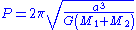
where:
Note that the orbital period is independent of size: for a scale model it would be the same, when densities are the same (see also Orbit#Scaling in gravity).
In a parabolic or hyperbolic trajectory the motion is not periodic, and the duration of the full trajectory is infinite.
Orbit
In physics, an orbit is the gravitationally curved path of an object around a point in space, for example the orbit of a planet around the center of a star system, such as the Solar System...
about another object.
When mentioned without further qualification in astronomy this refers to the sidereal period of an astronomical object, which is calculated with respect to the star
Star
A star is a massive, luminous sphere of plasma held together by gravity. At the end of its lifetime, a star can also contain a proportion of degenerate matter. The nearest star to Earth is the Sun, which is the source of most of the energy on Earth...
s.
There are several kinds of orbital periods for objects around the Sun
Sun
The Sun is the star at the center of the Solar System. It is almost perfectly spherical and consists of hot plasma interwoven with magnetic fields...
(or other celestial objects):
- The sidereal period is the temporal cycle that it takes an object to make one full orbit, relative to the starStarA star is a massive, luminous sphere of plasma held together by gravity. At the end of its lifetime, a star can also contain a proportion of degenerate matter. The nearest star to Earth is the Sun, which is the source of most of the energy on Earth...
s. This is considered to be an object's true orbital period. - The synodic period is the temporal interval that it takes for an object to reappear at the same point in relation to two other objects (linear nodes), e.g., when the MoonMoonThe Moon is Earth's only known natural satellite,There are a number of near-Earth asteroids including 3753 Cruithne that are co-orbital with Earth: their orbits bring them close to Earth for periods of time but then alter in the long term . These are quasi-satellites and not true moons. For more...
relative to the SunSunThe Sun is the star at the center of the Solar System. It is almost perfectly spherical and consists of hot plasma interwoven with magnetic fields...
as observed from EarthEarthEarth is the third planet from the Sun, and the densest and fifth-largest of the eight planets in the Solar System. It is also the largest of the Solar System's four terrestrial planets...
returns to the same illumination phase. The synodic period is the time that elapses between two successive conjunctionsConjunction (astronomy)Conjunction is a term used in positional astronomy and astrology. It means that, as seen from some place , two celestial bodies appear near one another in the sky...
with the Sun–Earth line in the same linear order. The synodic period differs from the sidereal period due to the Earth's orbiting around the Sun. - The draconitic period, or draconic period, is the time that elapses between two passages of the object through its ascending nodeOrbital nodeAn orbital node is one of the two points where an orbit crosses a plane of reference to which it is inclined. An orbit which is contained in the plane of reference has no nodes.-Planes of reference:...
, the point of its orbit where it crosses the eclipticEclipticThe ecliptic is the plane of the earth's orbit around the sun. In more accurate terms, it is the intersection of the celestial sphere with the ecliptic plane, which is the geometric plane containing the mean orbit of the Earth around the Sun...
from the southern to the northern hemisphere. This period differes from the sidereal period because both the orbital plane of the object and the plane of the ecliptic precess with respect to the fixed stars, so their intersection, the line of nodes, also precesses with respect to the fixed stars. Although the plane of the ecliptic is often held fixed at the position it occupied at a specific epochEpoch (astronomy)In astronomy, an epoch is a moment in time used as a reference point for some time-varying astronomical quantity, such as celestial coordinates, or elliptical orbital elements of a celestial body, where these are subject to perturbations and vary with time...
, the orbital plane of the object still precesses causing the draconitic period to differ from the sidereal period. - The anomalistic period is the time that elapses between two passages of an object at its periapsis (in the case of the planets in the solar systemSolar SystemThe Solar System consists of the Sun and the astronomical objects gravitationally bound in orbit around it, all of which formed from the collapse of a giant molecular cloud approximately 4.6 billion years ago. The vast majority of the system's mass is in the Sun...
, called the perihelion), the point of its closest approach to the attracting body. It differs from the sidereal period because the object's semimajor axis typically advances slowly. - Also, the Earth's tropical period (or simply its "year") is the time that elapses between two alignments of its axis of rotation with the Sun, also viewed as two passages of the object at right ascensionRight ascensionRight ascension is the astronomical term for one of the two coordinates of a point on the celestial sphere when using the equatorial coordinate system. The other coordinate is the declination.-Explanation:...
zero. One Earth year has a slightly shorter interval than the solar orbit (sidereal period) because the inclined axis and equatorial plane slowly precesses (rotates in sidereal terms), realigning before orbit completes with an interval equal to the inverse of the precession cycle (about 25,770 years).
Relation between the sidereal and synodic periods
Table of synodic periods in the Solar System, relative to Earth:| Sidereal Period (a Julian year (astronomy) In astronomy, a Julian year is a unit of measurement of time defined as exactly 365.25 days of 86 400 SI seconds each, totaling 31 557 600 seconds. The Julian year is the average length of the year in the Julian calendar used in Western societies in previous centuries, and for which the unit is... ) |
Synodic Period (a) | Synodic Period (d Day A day is a unit of time, commonly defined as an interval equal to 24 hours. It also can mean that portion of the full day during which a location is illuminated by the light of the sun... ) |
|
| Solar surface Solar rotation Solar rotation is able to vary with latitude because the Sun is composed of a gaseous plasma. The rate of rotation is observed to be fastest at the equator , and to decrease as latitude increases... |
0.069 (25.3 days) | 0.074 | 27.3 |
| Mercury Mercury (planet) Mercury is the innermost and smallest planet in the Solar System, orbiting the Sun once every 87.969 Earth days. The orbit of Mercury has the highest eccentricity of all the Solar System planets, and it has the smallest axial tilt. It completes three rotations about its axis for every two orbits... |
0.241 (88.0 days) | 0.317 | 115.9 |
| Venus Venus Venus is the second planet from the Sun, orbiting it every 224.7 Earth days. The planet is named after Venus, the Roman goddess of love and beauty. After the Moon, it is the brightest natural object in the night sky, reaching an apparent magnitude of −4.6, bright enough to cast shadows... |
0.615 (225 days) | 1.599 | 583.9 |
| Earth Earth Earth is the third planet from the Sun, and the densest and fifth-largest of the eight planets in the Solar System. It is also the largest of the Solar System's four terrestrial planets... |
1 | — | — |
| Moon Moon The Moon is Earth's only known natural satellite,There are a number of near-Earth asteroids including 3753 Cruithne that are co-orbital with Earth: their orbits bring them close to Earth for periods of time but then alter in the long term . These are quasi-satellites and not true moons. For more... |
0.0748 | 0.0809 | 29.5306 |
| Mars Mars Mars is the fourth planet from the Sun in the Solar System. The planet is named after the Roman god of war, Mars. It is often described as the "Red Planet", as the iron oxide prevalent on its surface gives it a reddish appearance... |
1.881 | 2.135 | 779.9 |
| 4 Vesta 4 Vesta Vesta, formally designated 4 Vesta, is one of the largest asteroids, with a mean diameter of about . It was discovered by Heinrich Wilhelm Olbers on March 29, 1807, and is named after the Roman virgin goddess of home and hearth, Vesta.... |
3.629 | 1.380 | 504.0 |
| 1 Ceres | 4.600 | 1.278 | 466.7 |
| 10 Hygiea 10 Hygiea 10 Hygiea is an asteroid located in the asteroid belt. With somewhat oblong diameters of 350–500 km, and a mass estimated to be 2.9% of the total mass of the belt, it is the fourth largest asteroid by volume and mass... |
5.557 | 1.219 | 445.4 |
| Jupiter Jupiter Jupiter is the fifth planet from the Sun and the largest planet within the Solar System. It is a gas giant with mass one-thousandth that of the Sun but is two and a half times the mass of all the other planets in our Solar System combined. Jupiter is classified as a gas giant along with Saturn,... |
11.86 | 1.092 | 398.9 |
| Saturn Saturn Saturn is the sixth planet from the Sun and the second largest planet in the Solar System, after Jupiter. Saturn is named after the Roman god Saturn, equated to the Greek Cronus , the Babylonian Ninurta and the Hindu Shani. Saturn's astronomical symbol represents the Roman god's sickle.Saturn,... |
29.46 | 1.035 | 378.1 |
| Uranus Uranus Uranus is the seventh planet from the Sun. It has the third-largest planetary radius and fourth-largest planetary mass in the Solar System. It is named after the ancient Greek deity of the sky Uranus , the father of Cronus and grandfather of Zeus... |
84.32 | 1.012 | 369.7 |
| Neptune Neptune Neptune is the eighth and farthest planet from the Sun in the Solar System. Named for the Roman god of the sea, it is the fourth-largest planet by diameter and the third largest by mass. Neptune is 17 times the mass of Earth and is slightly more massive than its near-twin Uranus, which is 15 times... |
164.8 | 1.006 | 367.5 |
| 134340 Pluto Pluto Pluto, formal designation 134340 Pluto, is the second-most-massive known dwarf planet in the Solar System and the tenth-most-massive body observed directly orbiting the Sun... |
248.1 | 1.004 | 366.7 |
| 136199 Eris Eris (dwarf planet) Eris, formal designation 136199 Eris, is the most massive known dwarf planet in the Solar System and the ninth most massive body known to orbit the Sun directly... |
557 | 1.002 | 365.9 |
| 90377 Sedna 90377 Sedna 90377 Sedna is a trans-Neptunian object discovered in 2003, which was about three times as far from the Sun as Neptune. For most of its orbit it is even further from the Sun, with its aphelion estimated at 960 astronomical units , making it one of the most distant known objects in the Solar System... |
12050 | 1.00001 | 365.1 |
In the case of a planet's moon
Natural satellite
A natural satellite or moon is a celestial body that orbits a planet or smaller body, which is called its primary. The two terms are used synonymously for non-artificial satellites of planets, of dwarf planets, and of minor planets....
, the synodic period usually means the Sun-synodic period. That is to say, the time it takes the moon to complete its illumination phases, completing the solar phases for an observer on the planet's surface —the Earth's motion does not determine this value for other planets, because an Earth observer is not orbited by the moons in question. For example, Deimos
Deimos (moon)
Deimos is the smaller and outer of Mars's two moons . It is named after Deimos, a figure representing dread in Greek Mythology. Its systematic designation is '.-Discovery:Deimos was discovered by Asaph Hall, Sr...
' synodic period is 1.2648 days, 0.18% longer than Deimos' sidereal period of 1.2624 d.
Small body orbiting a central body
In astrodynamicsAstrodynamics
Orbital mechanics or astrodynamics is the application of ballistics and celestial mechanics to the practical problems concerning the motion of rockets and other spacecraft. The motion of these objects is usually calculated from Newton's laws of motion and Newton's law of universal gravitation. It...
the orbital period
of a small body orbiting a central body in a circular or elliptic orbitElliptic orbit
In astrodynamics or celestial mechanics an elliptic orbit is a Kepler orbit with the eccentricity less than 1; this includes the special case of a circular orbit, with eccentricity equal to zero. In a stricter sense, it is a Kepler orbit with the eccentricity greater than 0 and less than 1 . In a...
is:
where:
-
 is length of orbit's semi-major axisSemi-major axisThe major axis of an ellipse is its longest diameter, a line that runs through the centre and both foci, its ends being at the widest points of the shape...
, -
 is the standard gravitational parameterStandard gravitational parameterIn astrodynamics, the standard gravitational parameter μ of a celestial body is the product of the gravitational constant G and the mass M of the body.\mu=GM \ The SI units of the standard gravitational parameter are m3s−2....
, -
 is the gravitational constantGravitational constantThe gravitational constant, denoted G, is an empirical physical constant involved in the calculation of the gravitational attraction between objects with mass. It appears in Newton's law of universal gravitation and in Einstein's theory of general relativity. It is also known as the universal...
, -
 the mass of the central body.
Note that for all ellipses with a given semi-major axis the orbital period is the same, regardless of eccentricity.
Orbital period as a function of central body's density
For the Earth (and any other spherically symmetric body with the same average density) as central body we get:and for a body of water
T in hours, with R the radius of the body.
Thus, as an alternative for using a very small number like G, the strength of universal gravity can be described using some reference material, like water: the orbital period for an orbit just above the surface of a spherical body of water is 3 hours and 18 minutes. Conversely, this can be used as a kind of "universal" unit of time
Time standard
A time standard is a specification for measuring time: either the rate at which time passes; or points in time; or both. In modern times, several time specifications have been officially recognized as standards, where formerly they were matters of custom and practice. An example of a kind of time...
.
For the Sun as central body we simply get
T in years, with a in astronomical unit
Astronomical unit
An astronomical unit is a unit of length equal to about or approximately the mean Earth–Sun distance....
s. This is the same as Kepler's Third Law
Kepler's laws of planetary motion
In astronomy, Kepler's laws give a description of the motion of planets around the Sun.Kepler's laws are:#The orbit of every planet is an ellipse with the Sun at one of the two foci....
Two bodies orbiting each other
In celestial mechanicsCelestial mechanics
Celestial mechanics is the branch of astronomy that deals with the motions of celestial objects. The field applies principles of physics, historically classical mechanics, to astronomical objects such as stars and planets to produce ephemeris data. Orbital mechanics is a subfield which focuses on...
when both orbiting bodies' masses have to be taken into account the orbital period
can be calculated as follows:where:
-
 is the sum of the semi-major axesSemi-major axisThe major axis of an ellipse is its longest diameter, a line that runs through the centre and both foci, its ends being at the widest points of the shape...
of the ellipses in which the centers of the bodies move, or equivalently, the semi-major axis of the ellipse in which one body moves, in the frame of reference with the other body at the origin (which is equal to their constant separation for circular orbits), -
 and
and  are the masses of the bodies,
 -
 is the gravitational constantGravitational constantThe gravitational constant, denoted G, is an empirical physical constant involved in the calculation of the gravitational attraction between objects with mass. It appears in Newton's law of universal gravitation and in Einstein's theory of general relativity. It is also known as the universal...
.
Note that the orbital period is independent of size: for a scale model it would be the same, when densities are the same (see also Orbit#Scaling in gravity).
In a parabolic or hyperbolic trajectory the motion is not periodic, and the duration of the full trajectory is infinite.
Binary stars
| Binary star Binary star A binary star is a star system consisting of two stars orbiting around their common center of mass. The brighter star is called the primary and the other is its companion star, comes, or secondary... | Orbital period |
|---|---|
| AM Canum Venaticorum AM Canum Venaticorum AM Canum Venaticorum is a cataclysmic variable star in the constellation of Canes Venatici. It is the type star of its class of variables, the AM CVn stars.... |
17.146 minutes |
| Beta Lyrae Beta Lyrae Beta Lyrae is a binary star system approximately 882 light-years away in the constellation Lyra. Beta Lyrae has the traditional name Sheliak , from الشلياق šiliyāq, the Arabic name of the constellation Lyra.Beta Lyrae is an eclipsing semi-detached binary system made up of a B7II primary star and... AB |
12.9075 days |
| Alpha Centauri Alpha Centauri Alpha Centauri is the brightest star in the southern constellation of Centaurus... AB |
79.91 years |
| Proxima Centauri Proxima Centauri Proxima Centauri is a red dwarf star about 4.2 light-years distant in the constellation of Centaurus. It was discovered in 1915 by Robert Innes, the Director of the Union Observatory in South Africa, and is the nearest known star to the Sun, although it is too faint to be seen with the naked eye... - Alpha Centauri Alpha Centauri Alpha Centauri is the brightest star in the southern constellation of Centaurus... AB |
500,000 years or more |
See also
- Geosynchronous orbit derivation
- Sidereal timeSidereal timeSidereal time is a time-keeping system astronomers use to keep track of the direction to point their telescopes to view a given star in the night sky...
- Sidereal yearSidereal yearA sidereal year is the time taken by the Earth to orbit the Sun once with respect to the fixed stars. Hence it is also the time taken for the Sun to return to the same position with respect to the fixed stars after apparently travelling once around the ecliptic. It was equal to at noon 1 January...
- Opposition (astronomy)Opposition (astronomy)In positional astronomy, two celestial bodies are said to be in opposition when they are on opposite sides of the sky, viewed from a given place . In particular, two planets are in opposition to each other when their ecliptic longitudes differ by 180°.The astronomical symbol for opposition is ☍...
- List of periodic comets