
Home      Discussion      Topics      Dictionary      Almanac
Signup       Login
Flight deck

Flight deck

Discussion
Ask a question about 'Flight deck'
Start a new discussion about 'Flight deck'
Answer questions from other users
Full Discussion Forum
 
Encyclopedia
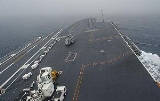
The flight deck of an aircraft carrier
Aircraft carrier
An aircraft carrier is a warship designed with a primary mission of deploying and recovering aircraft, acting as a seagoing airbase. Aircraft carriers thus allow a naval force to project air power great distances without having to depend on local bases for staging aircraft operations...

 is the surface
Deck (ship)
A deck is a permanent covering over a compartment or a hull of a ship. On a boat or ship, the primary deck is the horizontal structure which forms the 'roof' for the hull, which both strengthens the hull and serves as the primary working surface...

 from which its aircraft
Aircraft
An aircraft is a vehicle which is able to fly by being supported by the air, or in general, the atmosphere of a planet. An aircraft counters the force of gravity by using either static lift or by using the dynamic lift of an airfoil An aircraft is a vehicle which is able to fly by being supported...

 take off and land, essentially a miniature airfield at sea. On smaller naval ships which do not have aviation as a primary mission, the landing area for helicopter
Helicopter
A helicopter is an aircraft that is lifted and propelled by one or more horizontal rotors, each rotor consisting of two or more rotor blades. Helicopters are classified as rotorcraft or rotary-wing aircraft to distinguish them from fixed-wing aircraft because the helicopter achieves lift with the...

s and other VTOL
VTOL
VTOL is an abbreviation for Vertical Take-Off and Landing aircraft. See also V/STOL. This classification includes fixed-wing aircraft that can hover, take off and land vertically as well as helicopters and other aircraft with powered rotors, such as tiltrotors...

 aircraft is also referred to as the flight deck. The official U.S. Navy
United States Navy
The United States Navy is the sea branch of the U.S. Armed Forces. It is one of the seven uniformed services of the United States. As of 31 December 2008, the U.S. Navy had about 331,682 personnel on active duty and 124,000 in the Navy Reserve. It operates 283 ships in active service and more than...

 term for these vessels is "aviation capable ships".

Early flight decks


The first flight decks
Deck (ship)
A deck is a permanent covering over a compartment or a hull of a ship. On a boat or ship, the primary deck is the horizontal structure which forms the 'roof' for the hull, which both strengthens the hull and serves as the primary working surface...

 were inclined wooden ramps built over the forecastle
Forecastle
Forecastle refers to the upper deck of a sailing ship forward of the foremast.The syncope of the word, fo'c'sle , is common among nautical terms due to the nature of their pronunciation during the age of sail by sailors with strong accents and varying language skills.Among defensive troops on...

 of naval warships. Eugene Ely made the first fixed-wing aircraft take-off from a warship
Naval aviation
Naval Aviation is the application of manned military air power by navies. Maritime Aviation is the operation of aircraft in a maritime role under the command of land based forces such as RAF Coastal Command or United States Coast Guard....

 from on 14 November 1910. Two months later, on 18 January 1911, Ely landed his Curtiss pusher plane on a platform on Pennsylvania anchored in San Francisco Bay, using the first ever tailhook system, designed and built by circus performer & aviator Hugh Robinson.[1] Ely told a reporter: "It was easy enough. I think the trick could be successfully turned nine times out of ten." On 4 May 1912, Commander
Commander
Commander is a military rank which is also sometimes used as a military title depending on the individual customs of a given military service...

 Charles Samson
Charles Rumney Samson
Air Commodore Charles Rumney Samson CMG, DSO & Bar, AFC was a British naval aviation pioneer.-Early naval career:...

 became the first man to take off from a ship which was underway when he flew his Short
Short Brothers
Short Brothers plc is a British aerospace company, usually referred to simply as Shorts, that is now based in Belfast, Northern Ireland. Founded in 1908, Shorts was the first true aviation company in the world, and was a manufacturer of flying boats during the 1920s and 1930s and throughout the...

 S27 off of , which was steaming at . Because the take-off speed of early aircraft was so low, it was possible for an aircraft to make a very short take off when the launching ship was steaming into the wind. Later, removable "flying-off platforms" appeared on the gun turrets of battleship
Battleship
A battleship is a large, heavily armored warship with a main battery consisting of the largest caliber of guns. Battleships were larger, better armed and armored than cruisers or destroyers. There are currently no battleships in service....

s and battlecruiser
Battlecruiser
Battlecruisers were large warships in the first half of the 20th century that were first introduced by the Royal Navy. The battlecruiser was developed as the successor to the armoured cruisers, but their evolution was more closely linked to that of the dreadnought battleships...

s, allowing aircraft to be flown off for scouting purposes, although there was no chance of recovery.

On 2 August 1917, while performing trials, Squadron Commander
RAF officer ranks
-Origins:Lieutenant-General David Henderson originally proposed that Royal Air Force officers use a combination of British Army and Royal Navy ranks...

 Edwin Dunning
Squadron Commander E.H. Dunning
Squadron Commander Edwin Harris Dunning, DSC , of the British Royal Naval Air Service, was the first pilot to land an aircraft on a moving ship....

 landed a Sopwith Pup
Sopwith Pup
The Sopwith Pup was a British single seater biplane fighter aircraft built by the Sopwith Aviation Company. It entered service with the Royal Flying Corps and the Royal Naval Air Service in the fall of 1916. With pleasant flying characteristics and good maneuverability, the aircraft proved very...

 successfully on board the flying-off platform of , becoming the first person to land an aircraft on a moving ship. However, on his third attempt, a tire burst as he attempted to land, causing the aircraft to go over the side, killing him; thus Dunning also has the dubious distinction of being the first person to die in an aircraft carrier landing accident. The landing arrangements on Furious were highly unsatisfactory, however. In order to land, aircraft had to manoeuvre around the superstructure. Furious was therefore returned to dockyard hands have a deck added aft for landing, on top of a new hangar. However, the central superstructure remained, and turbulence caused by this badly affected the landing deck.

Full length decks


The first aircraft carrier that began to show the configuration of the modern vessel was the converted liner , which had a large flat wooden deck added over the entire length of the hull, giving a combined landing and take-off deck unobstructed by superstructure turbulence. Because of her unobstructed flight deck, Argus had no fixed conning tower
Conning tower
A conning tower is a raised platform on a ship or submarine, often armored, from which an officer can con the vessel; i.e., give directions to the helmsman...

 and no funnel. Rather, exhaust gasses were trunked down the side of the ship and ejected under the fantail of the flight deck (which, despite arrangements to disperse the gasses, gave an unwelcome "lift" to aircraft immediately prior to landing). The lack of a command position and funnel was unsatisfactory, and Argus was used to experiment with various ideas to remedy the solution. A photograph in 1917 shows her with a canvas mock-up of a starboard "island
Island
An island or isle is any piece of land that is surrounded by water. Very small islands such as emergent land features on atolls are called islets. A key or cay is another name for a small island or islet. An island in a river or lake may be called an eyot, .There are two main types of islands:...

" superstructure and funnel. This was placed on the starboard side because the rotary engine
Rotary engine
The rotary engine was an early type of internal-combustion engine, usually designed with an odd number of cylinders per row in a radial configuration, in which the crankshaft remained stationary and the entire cylinder block rotated around it...

s of some early aircraft created torque which pulled the nose left, meaning an aircraft naturally yawed
Yaw, pitch, and roll
Yaw, pitch, and roll, also known as Tait–Bryan angles, named after Peter Guthrie Tait and George Bryan, are a specific kind of Euler angles very often used in aerospace applications to define the relative orientation of a vehicle...

 to port on take-off; therefore, it was desirable that they turned away from the fixed superstructure. This became the typical aircraft carrier arrangement and was used in the next British
United Kingdom
The United Kingdom of Great Britain and Northern Ireland is a sovereign state located off the northwestern coast of continental Europe. It is an island country, spanning an archipelago including Great Britain, the northeastern part of Ireland, and many small islands...

 carriers, and .

After World War I
World War I
World War I , also known as the First World War, the Great War, and the War to End All Wars, was a global military conflict which involved most of the world's great powers, assembled in two opposing alliances: the Triple Entente and the Triple Alliance...

, battlecruiser
Battlecruiser
Battlecruisers were large warships in the first half of the 20th century that were first introduced by the Royal Navy. The battlecruiser was developed as the successor to the armoured cruisers, but their evolution was more closely linked to that of the dreadnought battleships...

s that otherwise would have had to have been discarded under the Washington Naval Treaty
Washington Naval Treaty
The Washington Naval Treaty, also known as the Five-Power Treaty, limited the naval armaments of its five signatories: the United States of America, the British Empire, the Empire of Japan, the French Third Republic, and the Kingdom of Italy. The treaty was agreed at the Washington Naval...

 - such as the British Furious and Glorious-class
Glorious class aircraft carrier
The Glorious class aircraft carrier was one of the earliest classes of aircraft carrier to serve with the Royal Navy. Originally laid down as three 'large light cruisers', a cross between 'a light cruiser with 15-inch guns' and 'a battlecruiser with almost no armour', to be used in the Baltic they...

 and the American and - were converted to carriers along the above lines. Being large and fast they were perfectly suited to this role; the heavy armouring and scantling
Scantling
Scantling is a measurement of prescribed size, dimensions, or cross sectional areas.-Shipping:thumb|right|295pxIn shipbuilding, the scantling refers to the collective dimensions of the various parts, particularly the framing and structural supports. The word is most often used in the plural to...

s and low speed of the converted battleship Eagle served to be something of a handicap in practice. Because the military effectiveness of aircraft carriers was then unknown, early ships were typically equipped with cruiser-calibre guns to aid in their defence if surprised by enemy warships. These guns were generally removed during World War II
World War II
World War II, or the Second World War , was a global military conflict which involved a majority of the world's nations, including all great powers, organized into two opposing military alliances: the Allies and the Axis...

 and replaced with anti-aircraft gun
Anti-aircraft warfare
Anti-aircraft warfare, or air defence, is any method of engaging hostile military aircraft in defence of ground objectives, ground or naval forces or denial of passage through a specific airspace region, area or anti-aircraft combat zone...

s, as carrier doctrine developed the "task force" (later called "battle group") model, where the carrier's defence against surface ships would be a combination of escorting warships and its own aircraft.

In ships of this configuration, the hangar deck was the strength deck, and an integral part of the hull, and the hangar and wooden flight deck were considered to be part of the superstructure. Such ships were still being built into the late '40s, classic examples being the U.S. Navy
United States Navy
The United States Navy is the sea branch of the U.S. Armed Forces. It is one of the seven uniformed services of the United States. As of 31 December 2008, the U.S. Navy had about 331,682 personnel on active duty and 124,000 in the Navy Reserve. It operates 283 ships in active service and more than...

's Essex
Essex class aircraft carrier
Essex was a class of aircraft carriers of the United States Navy, which constituted the 20th century's most numerous class of heavy warships, with 24 ships built in both "short-hull" and "long-hull" versions. Thirty-two were originally ordered, however six were canceled before construction, and two...

 and Ticonderoga-class carriers. However, in 1936, the Royal Navy
Royal Navy
The Royal Navy of the United Kingdom is the oldest of HM Armed Forces . From the beginning of the 18th century until well into the 20th century, it was the most powerful navy in the world, playing a key part in establishing the British Empire as the dominant world power from 1815 until the early...

 began construction of the Illustrious-class
Illustrious class aircraft carrier
The Illustrious class was a class of aircraft carrier of the Royal Navy that were some of the most important British warships in World War II...

. In these ships, the flight deck was now the strength deck, an integral part of the hull, and was heavily armoured to protect the ship and her air complement. Although the armoured carrier concept in this form remained something of a dead end, the flight deck as the strength deck was adopted for later construction. This was necessitated by the ever-increasing size of the ships, from the 13,000 ton
Tonnage
The terms "Tonnage" and "Ton" have different meanings and are often confused. Tonnage is a measure of the size or cargo capacity of a ship. The term derives from the taxation paid on tuns of wine, and was later used in reference to the weight of a ship's cargo; however, in modern maritime usage,...

  in 1922 to over 100,000 tons in the latest Nimitz-class
Nimitz class aircraft carrier
The Nimitz-class supercarriers, a line of nuclear-powered aircraft carriers in service with the United States Navy, are the largest capital ships in the world, and are considered to be a hallmark in the superpower status of the United States of America. These aircraft carriers are numbered with...

 carriers.


Armoured decks


When aircraft carriers supplanted battleships as the primary fleet capital ship, there were two schools of thought on the question of armour protection being included into the flight deck. The addition of armour to the flight deck offered aircraft below some protection against aerial bombs. However, the extra space required did not allow the carriers to hang aircraft above, thus reducing the maximum number of airplanes carried.

Landing on flight decks

See also: Arresting gear
Arresting gear
Arresting gear is the term used for mechanical systems designed to rapidly decelerate an aircraft as it lands. Arresting gear on aircraft carriers is an essential component of naval aviation, and it is most commonly used on CATOBAR and STOBAR aircraft carriers. Similar systems are also found at...


Landing arrangements were originally primitive, with aircraft simply being "caught" by a team of deck-hands who would run out from the wings of the flight deck and grab a part of the aircraft to slow it down. This dangerous procedure was only possible with early aircraft of low weight and landing speed. Arrangements of nets served to catch the aircraft should the latter fail, although this was likely to cause structural damage.

Landing larger and faster aircraft on a flight deck was made possible through the use of arresting cables installed on the flight deck and a tailhook
Tailhook
A tailhook, also arresting hook or arrestor hook, is a device attached to the empennage of an aircraft. It is used to achieve rapid deceleration after landing or to abort a takeoff.-Description:...

 installed on the aircraft. Early carriers had a very large number of arrestor cables or "wires". Current U.S. Navy carriers have three or four steel cables stretched across the deck at intervals which bring a plane, traveling at , to a complete stop in about . The cables are set to stop each aircraft at the same place on the deck, regardless of the size or weight of the plane. During World War II, large net barriers would be erected across the flight deck in order that aircraft could be parked on the forward part of the deck and recovered on the after part. This allowed increased complements, but resulted in lengthened turn-around times as aircraft were shuffled around the carrier to allow take-off or landing operations.

A barricade is an emergency system used if a normal arrestment cannot be made. Barricade webbing engages the wings of the landing aircraft, and momentum is transferred to the arresting engine.

Angled flight deck


The angled flight deck was invented by Captain (later Rear Admiral) Dennis Campbell. With this type of deck, (also referred to as a "skewed deck" or the "angle"), the aft part of the deck is widened and a separate runway is positioned at an angle from the centreline. The angled flight deck was designed with the higher landing speeds of jet aircraft in mind, which would have required the entire length of a centreline flight deck to stop. The design also allowed for concurrent launch and recovery operations, and allowed aircraft failing to connect with the arrestor cables to abort the landing, accelerate, and relaunch (or "bolter
Bolter (aviation)
In naval aviation, a bolter is when an aircraft attempting to land on the flight deck of an aircraft carrier touches down, but fails to catch an arrestor cable and come to a stop...

") without risk to other parked or launching aircraft. The redesign allowed for several other design and operational modifications, including the mounting of a larger island (improving both ship-handling and flight control), drastically simplified aircraft recovery and deck movement (aircraft now launched from the bow and re-embarked on the angle, leaving a large open area amidships for arming and fuelling), and damage control. Because of its utility in flight operations, the angled deck is now a defining feature of STOBAR
STOBAR
STOBAR is a system used for the launch and recovery of aircraft from the deck of an aircraft carrier, combining elements of both STOVL and CATOBAR. Aircraft launch under their own power using a ski-jump to assist take-off...

 and CATOBAR
CATOBAR
CATOBAR is a system used for the launch and recovery of aircraft from the deck of an aircraft carrier. Under this technique, aircraft launch using a catapult assisted take off and land on the ship using arrestor wires...

 equipped aircraft carriers.

The angled flight deck was first tested on , by painting angled deck markings onto the centeline flight deck for touch and go landings.. This was also tested on the the same year. It should be noted that in both tests, the arresting gear and barriers remained oriented to the original axis deck. From September-December 1952, the had a rudimentary sponson
Sponson
Sponsons are projections from the sides of a watercraft, for protection, stability, or the mounting of equipment such as armaments or lifeboats, etc...

 installed for true angle deck tests, allowing for full arrested landings, which proved during trials to be superior. In 1953, Antietam trained with both US and British naval units, proving the worth of the angle deck concept. was modified with overhanging angled flight deck in 1954. The U.S. Navy installed the decks as part of the SCB-125 upgrade for the Essex-class
Essex class aircraft carrier
Essex was a class of aircraft carriers of the United States Navy, which constituted the 20th century's most numerous class of heavy warships, with 24 ships built in both "short-hull" and "long-hull" versions. Thirty-two were originally ordered, however six were canceled before construction, and two...

 and SCB-110/110A for the
Midway-class
Midway class aircraft carrier
The Midway class aircraft carrier was one of the longest lived carrier designs in history. First commissioned in late 1945, the lead ship of the class, was not decommissioned until 1992, shortly after seeing service in the Gulf War.-History:...

. In February 1955, became the first carrier to be constructed and launched with the deck, followed in the same year by the lead ships of the British
Majestic-class
Majestic class aircraft carrier
The Majestic class was a ship class of six light fleet aircraft carriers constructed for the Royal Navy, but serving in the Royal Australian Navy, Royal Canadian Navy, and Indian Navy.-Design:...

  and the American
Forrestal-class
Forrestal class aircraft carrier
The Forrestal-class aircraft carriers were a four-ship class designed and built for the United States Navy in the 1950s.- Design :The Forrestal class was the first completed class of "supercarriers" of the Navy, so called because of their then-extraordinarily high tonnage , full integration of the...

 .

Ski-jump ramp


Another British innovation is the ski-jump ramp, which came about as means of improving take off for the VSTOL BAE Sea Harrier
BAE Sea Harrier
The BAE Systems Sea Harrier is a naval VTOL/STOVL jet fighter, reconnaissance and attack aircraft, a development of the Hawker Siddeley Harrier. It first entered service with the Royal Navy in April 1980 as the Sea Harrier FRS1. The last version was the Sea Harrier FA2...

 "jump-jet" on the small Invincible class aircraft carriers. The are most common on aircraft carriers supporting STOVL
STOVL
STOVL is an acronym for Short Take Off and Vertical Landing.This is the ability of some aircraft to take off from a short runway or take off vertically if it does not have a very heavy payload and land vertically...

 aircraft such as the Harrier, but the Russians also used the with conventional [Mig-29]s.

The ski jump is a ramp which is curved upwards at its forward end. For STOVL aircraft the aircraft starts by making a conventional rolling takeoff with the jet exhausts set to provide maximum forward thrust. As the plane nears the end of the ramp (the ski jump portion) the jet exhausts are rotated to provide upward lift as well as forward thrust. Rolling over the ski ramp launches the plane both upwards and forwards. As the plane continues off the ski jump ramp it continues to accelerate horizontally until the wings can provide the needed lift.

For conventional aircraft such as the Mig-29 the aircraft just rolls down the runway in the obvious manner. Again, rolling over the ski ramp launches the plane both upwards and forwards. As the plane continues off the ski jump ramp it continues to accelerate horizontally until the wings can provide the needed lift.

Such takeoffs allow a larger takeoff weight than a straight vertical launch because the wings provide some lift even a low speeds, and the ski jump ramp provides a vertical impetus when most needed, right at takeoff at the slowest takeoff speed.

These takeoffs use less runway that a takeoff over a flat surface because the plane takes off at a lower speed, using both the ski jump ramp's vertical impetus and the deflected jet engines to generate lift.

Ski jump ramp takeoffs are considered safer than takeoffs over a flat top carrier. When a Harrier launches from an American LHA it might finish it's takeoff roll and begin flight at above the water. It might not have a positive rate of climb, especially if the ship had pitched nose down during the takeoff roll. Using a ski jump ramp the plane will certainly launch with a positive rate of climb and it's momentum will carriy it to above the water.

For example, an AV-8B Harrier with a gross weight of on a 59° day and a wind over the deck would require to takeoff using a 12° ski jump ramp designed like on the Principe de Astrurias
Spanish aircraft carrier Principe de Asturias
The Príncipe de Asturias is an aircraft carrier, the flagship of the Spanish Navy and the second largest vessel in the fleet. She was built in Bazan's Shipyards and delivered to the Spanish Navy on 30 May 1988....

, but without the ski jump ramp.

For a Mig-29 launching over the ski jump ramp on the
Tbilisi, takeoff speed is reduced from about to about (depending on many factors such a gross weight).

Carriers using STOVL aircraft and a ski jump ramp do not need catapults nor arresting gear.

Every navy in the world except the United States that operates STOVL naval aircraft uses ski jump ramps.

Flexible decks


An idea tested but never taken to completion was the "flexible deck". In the early jet age it was seen that by eliminating the landing gear for carrier borne aircraft the inflight performance/range would be improved. This led to the concept of a deck that would absorb the energy of landing, the risk of damaging propellers no longer being an issue though take off would require some sort of launching cradle. Test were carried out with a Sea Vampire
De Havilland Vampire
The de Havilland DH.100 Vampire was a British jet-engined fighter of the Second World War, the second jet-powered aircraft commissioned by the Royal Air Force during the War , although it was not used in combat. The Vampire served with front line RAF squadrons until 1955 and continued in use as a...

, and Supermarine
Supermarine
Supermarine was a British aircraft manufacturer that became famous for producing a range of sea planes and the Supermarine Spitfire fighter.-History:Noel Pemberton-Billing set up a company, Pemberton-Billing, Ltd, in 1913 to produce sea-going aircraft...

 designed their Type 508 for rubber deck landing, and the flexible deck idea was found to be technically feasible in tests but was nevertheless abandoned. The Supermarine Type 508 was subsequently developed into a 'normal' carrier aircraft, the Scimitar
Supermarine Scimitar
The Supermarine Scimitar was a British naval fighter aircraft operated by the Royal Navy Fleet Air Arm. The prototype for the eventual production version flew in January 1956 and production aircraft were delivered in 1957. It saw service with the Royal Navy from 1958 until 1969...

.