


Erasistratus

Encyclopedia
Seleucus I Nicator
Seleucus I was a Macedonian officer of Alexander the Great and one of the Diadochi. In the Wars of the Diadochi that took place after Alexander's death, Seleucus established the Seleucid dynasty and the Seleucid Empire...
of Syria. Along with fellow physician Herophilus, he founded a school of anatomy
Anatomy
Anatomy is a branch of biology and medicine that is the consideration of the structure of living things. It is a general term that includes human anatomy, animal anatomy , and plant anatomy...
in Alexandria
Alexandria
Alexandria is the second-largest city of Egypt, with a population of 4.1 million, extending about along the coast of the Mediterranean Sea in the north central part of the country; it is also the largest city lying directly on the Mediterranean coast. It is Egypt's largest seaport, serving...
, where they carried out anatomical research. He is credited for his description of the valves of the heart
Heart
The heart is a myogenic muscular organ found in all animals with a circulatory system , that is responsible for pumping blood throughout the blood vessels by repeated, rhythmic contractions...
, and he also concluded that the heart was not the center of sensations, but instead it functioned as a pump. Erasistratus was among the first to distinguish between veins and arteries. He believed that the arteries were full of air and that they carried the "animal spirit" (pneuma). He considered atoms to be the essential body element, and he believed they were vitalized by the pneuma that circulated through the nerves. He also thought that the nerves moved a nervous spirit from the brain
Brain
The brain is the center of the nervous system in all vertebrate and most invertebrate animals—only a few primitive invertebrates such as sponges, jellyfish, sea squirts and starfishes do not have one. It is located in the head, usually close to primary sensory apparatus such as vision, hearing,...
. He then differentiated between the function of the sensory and motor nerves, and linked them to the brain. He is credited with one of the first in-depth descriptions of the cerebrum and cerebellum
Cerebellum
The cerebellum is a region of the brain that plays an important role in motor control. It may also be involved in some cognitive functions such as attention and language, and in regulating fear and pleasure responses, but its movement-related functions are the most solidly established...
.
Life
Erasistratus is generally supposed to have been born at IoulisIoulis
Ioulis or Ioulida , locally called Khora like the main towns of most Greek islands and sometimes known by the island name of Kea or Keos , is the capital of the island of Kea in the Cyclades.-Modern town:...
on the island of Ceos, though Stephanus of Byzantium
Stephanus of Byzantium
Stephen of Byzantium, also known as Stephanus Byzantinus , was the author of an important geographical dictionary entitled Ethnica...
refers to him as a native of Cos
Cos
-Maths, science and technology:* Cosine, a trigonometric function* COS cells, a cell line used by biologists* Carbonyl sulfide, a chemical compound* Class of service , a 3 bit field within a layer two Ethernet frame header defined by IEEE 802.1p...
; Galen
Galen
Aelius Galenus or Claudius Galenus , better known as Galen of Pergamon , was a prominent Roman physician, surgeon and philosopher...
, as a native of Chios
Chios
Chios is the fifth largest of the Greek islands, situated in the Aegean Sea, seven kilometres off the Asia Minor coast. The island is separated from Turkey by the Chios Strait. The island is noted for its strong merchant shipping community, its unique mastic gum and its medieval villages...
; and the emperor Julian
Julian the Apostate
Julian "the Apostate" , commonly known as Julian, or also Julian the Philosopher, was Roman Emperor from 361 to 363 and a noted philosopher and Greek writer....
, as a native of Samos
Samoš
Samoš is a village in Serbia. It is situated in the Kovačica municipality, in the South Banat District, Vojvodina province. The village has a Serb ethnic majority and its population numbering 1,247 people .-See also:...
. Pliny
Pliny the Elder
Gaius Plinius Secundus , better known as Pliny the Elder, was a Roman author, naturalist, and natural philosopher, as well as naval and army commander of the early Roman Empire, and personal friend of the emperor Vespasian...
says he was the grandson of Aristotle
Aristotle
Aristotle was a Greek philosopher and polymath, a student of Plato and teacher of Alexander the Great. His writings cover many subjects, including physics, metaphysics, poetry, theater, music, logic, rhetoric, linguistics, politics, government, ethics, biology, and zoology...
by his daughter Pythias
Pythias
Pythias was the adoptive daughter of Hermias of Atarneus, as well as Aristotle's first wife.She was probably born about 381 BC and died in Athens after 326 BC. She predeceased Aristotle, which is known from his will, since it directs that her wish be honored to have her bones buried with...
, but this is not confirmed by any other ancient writer; and according to the Suda
Suda
The Suda or Souda is a massive 10th century Byzantine encyclopedia of the ancient Mediterranean world, formerly attributed to an author called Suidas. It is an encyclopedic lexicon, written in Greek, with 30,000 entries, many drawing from ancient sources that have since been lost, and often...
, he was the son of Cretoxena, the sister of the physician Medius
Medius (physician)
Medius a Greek physician who was a pupil of Chrysippus of Cnidos, and who lived therefore probably in the 4th and 3rd centuries BC. Galen says he was held in good repute among the Greeks, and quotes him apparently as a respectable authority on an anatomical question. Like the other pupils of...
, and Cleombrotus. From the latter it is not quite clear whether Cleombrotus was his father or his uncle. He was a pupil of Chrysippus of Cnidos
Chrysippus of Cnidos
Chrysippus of Cnidos was a Greek physician. He was the son of Erineus, and a contemporary of Praxagoras, a pupil of Eudoxus of Cnidos and Philistion of Locri, father of Chrysippus the physician to Ptolemy Soter, and tutor to Erasistratus, Aristogenes, Medius, and Metrodorus. He accompanied his...
, Metrodorus, and apparently Theophrastus
Theophrastus
Theophrastus , a Greek native of Eresos in Lesbos, was the successor to Aristotle in the Peripatetic school. He came to Athens at a young age, and initially studied in Plato's school. After Plato's death he attached himself to Aristotle. Aristotle bequeathed to Theophrastus his writings, and...
.
He lived for some time at the court of Seleucus I Nicator
Seleucus I Nicator
Seleucus I was a Macedonian officer of Alexander the Great and one of the Diadochi. In the Wars of the Diadochi that took place after Alexander's death, Seleucus established the Seleucid dynasty and the Seleucid Empire...
, where he acquired great reputation by discovering the disease of Antiochus I Soter
Antiochus I Soter
Antiochus I Soter , was a king of the Hellenistic Seleucid Empire. He reigned from 281 BC - 261 BC....
, the king's eldest son, probably 294 BC. Seleucus in his old age had lately married Stratonice
Stratonice of Syria
For other persons with the same name, see StratoniceStratonice of Syria was the daughter of king Demetrius Poliorcetes and Phila, the daughter of Antipater...
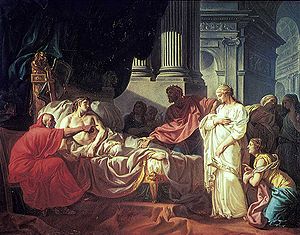
, the young and beautiful daughter of Demetrius Poliorcetes, and she had already borne him one child. Antiochus fell violently in love with his mother-in-law, but did not disclose his passion, and chose rather to pine away in silence. The physicians were quite unable to discover the cause and nature of his disease, and Erasistratus himself was at a loss at first, till, finding nothing amiss about his body, he began to suspect that it must be his mind which was diseased, and that he might perhaps be in love. This conjecture was confirmed when he observed his skin to be hotter, his colour to be heightened, and his pulse quickened, whenever Stratonice came near him, while none of these symptoms occurred on any other occasion; and accordingly he told Seleucus that his son's disease was incurable, for that he was in love, and that it was impossible that his passion could be gratified; The king wondered what the difficulty could be, and asked who the lady was. "My wife," replied Erasistratus; upon which Seleucus began to persuade him to give her up to his son. The physician asked him if he would do so himself if it were his wife that the prince was in love with. The king protested that he would most gladly; upon which Erasistratus told him that it was indeed his own wife who had inspired his passion, and that he chose rather to die than to disclose his secret. Seleucus was as good as his word, and not only gave up Stratonice, but also resigned to his son several provinces of his empire. This celebrated story is told with variations by many ancient authors, and a similar anecdote has been told of Hippocrates
Hippocrates
Hippocrates of Cos or Hippokrates of Kos was an ancient Greek physician of the Age of Pericles , and is considered one of the most outstanding figures in the history of medicine...
, Galen
Galen
Aelius Galenus or Claudius Galenus , better known as Galen of Pergamon , was a prominent Roman physician, surgeon and philosopher...
, Avicenna
Avicenna
Abū ʿAlī al-Ḥusayn ibn ʿAbd Allāh ibn Sīnā , commonly known as Ibn Sīnā or by his Latinized name Avicenna, was a Persian polymath, who wrote almost 450 treatises on a wide range of subjects, of which around 240 have survived...
, and (if the names be not fictitious) Panacius and Acestinus. If this is the anecdote referred to by Pliny, as is probably the case, Erasistratus is said to have received one hundred talents for being the means of restoring the prince to health, which would amount to one of the largest medical fees upon record.
Very little more is known of the personal history of Erasistratus: he lived for some time at Alexandria
Alexandria
Alexandria is the second-largest city of Egypt, with a population of 4.1 million, extending about along the coast of the Mediterranean Sea in the north central part of the country; it is also the largest city lying directly on the Mediterranean coast. It is Egypt's largest seaport, serving...
, which was at that time beginning to be a celebrated medical school, and gave up practice in his old age, that he might pursue his anatomical studies without interruption. He and fellow physician Herophilus practiced anatomy with great success, and with such ardour that they are supposed to have dissected criminals alive. Erasistratus appears to have died in Asia Minor, as the Suda mentions that he was buried by mount Mycale
Mycale
Mycale, also Mykale and Mycali , called Samsun Daği and Dilek Daği in modern Turkey, is a mountain on the west coast of central Anatolia in Turkey, north of the mouth of the Maeander and divided from the Greek island of Samos by the 1300 metre wide Samos Strait...
in Ionia
Ionia
Ionia is an ancient region of central coastal Anatolia in present-day Turkey, the region nearest İzmir, which was historically Smyrna. It consisted of the northernmost territories of the Ionian League of Greek settlements...
. The exact date of his death is not known, but he probably lived to a good old age, as, according to Eusebius, he was alive 258 BC, about forty years after the marriage of Antiochus and Stratonice. He had numerous pupils and followers, and a medical school bearing his name continued to exist at Smyrna
Smyrna
Smyrna was an ancient city located at a central and strategic point on the Aegean coast of Anatolia. Thanks to its advantageous port conditions, its ease of defence and its good inland connections, Smyrna rose to prominence. The ancient city is located at two sites within modern İzmir, Turkey...
in Ionia nearly till the time of Strabo
Strabo
Strabo, also written Strabon was a Greek historian, geographer and philosopher.-Life:Strabo was born to an affluent family from Amaseia in Pontus , a city which he said was situated the approximate equivalent of 75 km from the Black Sea...
, about the beginning of the 1st century. The following are the names of the most celebrated physicians belonging to the sect founded by him: Apoemantes, Apollonius Memphites
Apollonius (physician)
Apollonius was the name of several physicians in the time of Ancient Greece and Rome:*Apollonius Antiochenus, , was the name of two physicians, father and son, who were born at Antioch, and belonged to the Empiric school. They lived after Serapion of Alexandria, and before Menodotus, and therefore...
, Apollophanes
Apollophanes
Apollophanes Soter was an Indo-Greek king in the area of eastern and central Punjab in modern India and Pakistan.-Rule:...
Artemidoras, Charidemus
Charidemus
Charidemus , of Oreus in Euboea, was a Greek mercenary leader of the 4th century BC.About 367 BC he fought under the Athenian general Iphicrates against Amphipolis...
, Chrysippus
Chrysippus
Chrysippus of Soli was a Greek Stoic philosopher. He was a native of Soli, Cilicia, but moved to Athens as a young man, where he became a pupil of Cleanthes in the Stoic school. When Cleanthes died, around 230 BC, Chrysippus became the third head of the school...
, Heraclides
Heraclides
Heraclides , Heracleides or Herakleides may refer to:* Heracleides of Cyme , a little-attested historian* Heraclides of Aenus, one of Plato's students...
, Hermogenes
Hermogenes
Hermogenes is a Greek name . It may refer to:* Hermogenes , Attic Greek potter* Hermogenes , Greek* Hermogenes of Priene , Greek architect...
, Hicesius, Martialius, Menodorus, Ptolemaeus, Strato, Xenophon
Xenophon
Xenophon , son of Gryllus, of the deme Erchia of Athens, also known as Xenophon of Athens, was a Greek historian, soldier, mercenary, philosopher and a contemporary and admirer of Socrates...
. An attack on Erasistratus and his followers is preserved in Anonymus Londinensis
Anonymus Londinensis
Anonymus Londinensis is the name given to an anonymous Ancient Greek author of approximately the 1st century AD whose work On Medicine is partially preserved in a papyrus in the British Library...
.
Medicine
Erasistratus wrote many works on anatomy, practical medicine, and pharmacy, of which only the titles remain, together with a great number of short fragments preserved by GalenGalen
Aelius Galenus or Claudius Galenus , better known as Galen of Pergamon , was a prominent Roman physician, surgeon and philosopher...
, Caelius Aurelianus
Caelius Aurelianus
Caelius Aurelianus of Sicca in Numidia was a Roman physician and writer on medical topics. He is best known for his translation from Greek to Latin of a work by Soranus of Ephesus, On Acute and Chronic Diseases. He probably flourished in the 5th century, although some place him two or even three...
, and other ancient writers: these, however, are sufficient to enable us to form a reasonable idea of his opinions both as a physician
Physician
A physician is a health care provider who practices the profession of medicine, which is concerned with promoting, maintaining or restoring human health through the study, diagnosis, and treatment of disease, injury and other physical and mental impairments...
and an anatomist. It is as an anatomist that he is most celebrated, and perhaps there is no one of the ancient physicians that did more to promote that branch of medical science.
He appears to have been very near the discovery of the circulation of the blood, for in a passage preserved by Galen he says:
The vein arises from the part where the arteries, that are distributed to the whole body, have their origin, and penetrates to the sanguineous [or right] ventricle [of the heart]; and the artery [or pulmonary vein] arises from the part where the veins have their origin, and penetrates to the pneumatic [or left] ventricle of the heart.
The description is not very clear, but seems to show that he supposed the venous and arterial systems to be more intimately connected than was generally believed; which is confirmed by another passage in which he is said to have differed from the other ancient anatomists, who supposed the veins to arise from the liver
Liver
The liver is a vital organ present in vertebrates and some other animals. It has a wide range of functions, including detoxification, protein synthesis, and production of biochemicals necessary for digestion...
, and the arteries from the heart, and to have contended that the heart was the origin both of the veins and the arteries. With these ideas, it can have been only his belief that the arteries contained air, and not blood, that hindered his anticipating Harvey
William Harvey
William Harvey was an English physician who was the first person to describe completely and in detail the systemic circulation and properties of blood being pumped to the body by the heart...
's celebrated discovery. The tricuspid valve
Tricuspid valve
The tricuspid valve, or right atrioventricular valve, is on the right dorsal side of the mammalian heart, between the right atrium and the right ventricle. The normal tricuspid valve usually has three leaflets and three papillary muscles. They are connected to the papillary muscles by the chordae...
s of the heart are generally said to have derived their name from Erasistratus; but this appears to be an oversight, as Galen attributes it not to him, but to one of his followers.
He appears to have paid particular attention to the anatomy of the brain
Brain
The brain is the center of the nervous system in all vertebrate and most invertebrate animals—only a few primitive invertebrates such as sponges, jellyfish, sea squirts and starfishes do not have one. It is located in the head, usually close to primary sensory apparatus such as vision, hearing,...
, and in a passage out of one of his works preserved by Galen speaks as if he had himself dissected a human brain. Galen says that before Erasistratus had more closely examined into the origin of the nerves, he imagined that they arose from the dura mater
Dura mater
The dura mater , or dura, is the outermost of the three layers of the meninges surrounding the brain and spinal cord. It is derived from Mesoderm. The other two meningeal layers are the pia mater and the arachnoid mater. The dura surrounds the brain and the spinal cord and is responsible for...
and not from the substance of the brain; and that it was not till he was advanced in life that he satisfied himself by actual inspection that such was not the case. According to Rufus of Ephesus
Rufus of Ephesus
Rufus of Ephesus was an ancient Greek physician and author who wrote treatises on dietetics, pathology, anatomy, and patient care. He was to some extent a follower of Hippocrates, although he at times criticized or departed from that author's teachings...
, he divided the nerves into those of sensation and those of motion, of which the former he considered to be hollow and to arise from the membranes of the brain, the latter from the substance of the brain itself and of the cerebellum
Cerebellum
The cerebellum is a region of the brain that plays an important role in motor control. It may also be involved in some cognitive functions such as attention and language, and in regulating fear and pleasure responses, but its movement-related functions are the most solidly established...
.
He asserted that the spleen
Spleen
The spleen is an organ found in virtually all vertebrate animals with important roles in regard to red blood cells and the immune system. In humans, it is located in the left upper quadrant of the abdomen. It removes old red blood cells and holds a reserve of blood in case of hemorrhagic shock...
, the bile
Bile
Bile or gall is a bitter-tasting, dark green to yellowish brown fluid, produced by the liver of most vertebrates, that aids the process of digestion of lipids in the small intestine. In many species, bile is stored in the gallbladder and upon eating is discharged into the duodenum...
, and several other parts of the body, were entirely useless to animals. In the controversy that was carried on among the ancients as to whether fluids when drunk passed through the trachea
Vertebrate trachea
In tetrapod anatomy the trachea, or windpipe, is a tube that connects the pharynx or larynx to the lungs, allowing the passage of air. It is lined with pseudostratified ciliated columnar epithelium cells with goblet cells that produce mucus...
into the lungs, or through the oesophagus into the stomach, Erasistratus maintained the latter opinion. He is also supposed to have been the first person who added to the word arteria, which had hitherto designated the canal leading from the mouth to the lungs, the epithet tracheia, to distinguish it from the arteries, and hence to have been the originator of the modern name trachea
Vertebrate trachea
In tetrapod anatomy the trachea, or windpipe, is a tube that connects the pharynx or larynx to the lungs, allowing the passage of air. It is lined with pseudostratified ciliated columnar epithelium cells with goblet cells that produce mucus...
. He attributed the sensation of hunger
Hunger
Hunger is the most commonly used term to describe the social condition of people who frequently experience the physical sensation of desiring food.-Malnutrition, famine, starvation:...
to emptiness of the stomach
Stomach
The stomach is a muscular, hollow, dilated part of the alimentary canal which functions as an important organ of the digestive tract in some animals, including vertebrates, echinoderms, insects , and molluscs. It is involved in the second phase of digestion, following mastication .The stomach is...
, and said that the Scythians were accustomed to tie a belt tightly round their middle, to enable them to abstain from food for a longer time without suffering inconvenience.
The pneuma (spiritual substance) played a very important part both in his system of physiology
Physiology
Physiology is the science of the function of living systems. This includes how organisms, organ systems, organs, cells, and bio-molecules carry out the chemical or physical functions that exist in a living system. The highest honor awarded in physiology is the Nobel Prize in Physiology or...
and pathology
Pathology
Pathology is the precise study and diagnosis of disease. The word pathology is from Ancient Greek , pathos, "feeling, suffering"; and , -logia, "the study of". Pathologization, to pathologize, refers to the process of defining a condition or behavior as pathological, e.g. pathological gambling....
: he supposed it to enter the lungs by the trachea, thence to pass by the pulmonary veins into the heart, and thence to be diffused throughout the whole body by means of the arteries; that the use of respiration was to fill the arteries with air; and that the pulsation of the arteries was caused by the movements of the pneuma. He accounted for diseases in the same way, and supposed that as long as the pneuma continued to fill the arteries and the blood was confined to the veins, the individual was in good health; but that when the blood from some cause or other got forced into the arteries, inflammation and fever was the consequence.
Of his method of cure the most remarkable peculiarity was his aversion to bloodletting
Bloodletting
Bloodletting is the withdrawal of often little quantities of blood from a patient to cure or prevent illness and disease. Bloodletting was based on an ancient system of medicine in which blood and other bodily fluid were considered to be "humors" the proper balance of which maintained health...
and purgative medicines: he seems to have relied chiefly on diet and regimen, bathing, exercise, friction, and the most simple vegetables. In surgery
Surgery
Surgery is an ancient medical specialty that uses operative manual and instrumental techniques on a patient to investigate and/or treat a pathological condition such as disease or injury, or to help improve bodily function or appearance.An act of performing surgery may be called a surgical...
he was celebrated for the invention of a catheter
Catheter
In medicine, a catheter is a tube that can be inserted into a body cavity, duct, or vessel. Catheters thereby allow drainage, administration of fluids or gases, or access by surgical instruments. The process of inserting a catheter is catheterization...
that bore his name, and which was S-shaped.