

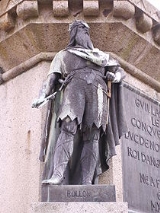
Rollo of Normandy

Encyclopedia
Rollo baptised Robert and so sometimes numbered Robert I to distinguish him from his descendants, was a Norse
nobleman of Norwegian
or Danish
descent and founder and first ruler of the Viking
principality in what soon became known as Normandy
. His descendants were the Dukes of Normandy
.
The name "Rollo" is a Latin translation due to the clerics from the Old Norse
name Hrólfr, modern Scandinavian name Rolf
(cf. the latinization of Hrólfr into the similar Roluo in the Gesta Danorum
), but Norman people called him Rouf, and later Rou too (see Wace
's Roman de Rou). He married Poppa. All that is known of Poppa is that she was a Christian, and the daughter to Berengar of Rennes
, the previous lord of Brittania Nova, which eventually became western Normandy.
leader of contested origin. Dudo of St. Quentin, in his De moribus et actis primorum Normannorum ducum , tells of a powerful Danish
nobleman at loggerheads with the king
of Denmark
, who had two sons, Gurim and Rollo; upon his death, Rollo was expelled and Gurim killed. William of Jumièges
also mentions Rollo's prehistory in his Gesta Normannorum Ducum
, but states that he was from the Danish town of Fakse. Wace
, writing some 300 years after the event in his Roman de Rou
, also mentions the two brothers (as Rou and Garin), as does the Orkneyinga Saga
.
Norwegian
and Iceland
ic historians identified Rollo instead with Ganger Hrolf (Hrolf, the Walker), a son of Rognvald Eysteinsson, Earl of Møre
, in Western Norway, based on medieval Norwegian and Icelandic sagas. The oldest source of this version is the Latin Historia Norvegiae, written in Norway at the end of the 12th century. This Hrolf fell foul of the Norwegian king Harald Fairhair, and became a Jarl
in Normandy. The nickname "the Walker" came from being so big that no horse could carry him.
The question of Rollo's Danish or Norwegian origins was a matter of heated dispute between Norwegian and Danish historians of the 19th and early 20th century, particularly in the run-up to Normandy's 1000-year-anniversary in 1911. Today, historians still disagree on this question, but most would now agree that a certain conclusion can never be reached.
under Sigfred. Legend has it that an emissary was sent by the king to find the chieftain and negotiate terms. When he asked for this information, the Vikings replied that they were all chieftains in their own right. In 886, when Sigfred retreated in return for tribute, Rollo stayed behind and was eventually bought off and sent to harry Burgundy.
Later, he returned to the Seine
with his followers (known as Danes, or Norsemen). He invaded the area of northern France
now known as Normandy
.
In 911 Rollo's forces launched a failed attack on Paris
before laying siege to Chartres
. The Bishop of Chartres, Joseaume, appeals for help were answered by the Robert, Marquis
of Neustria
, Richard, Duke of Burgundy and Manasses, Count of Dijon
. On 20 July 911, at the Battle of Chartres, they defeated Rollo despite the absence of many French barons and also the absence of the French King Charles the Simple
.
allegiance to the king, changed his name to the Frankish version, and converted to Christianity
, probably with the baptism
al name Robert. In return, King Charles granted Rollo land between the Epte
and the sea as well as Brittany
and the hand of the Kings daughter, Gisela. He was also the titular ruler of Normandy, centred around the city of Rouen
. There exists some argument among historians as to whether Rollo was a "duke
" (dux) or whether his position was equivalent to that of a "count
" under Charlemagne
.
According to legend, when required to kiss the foot of King Charles, as a condition of the treaty, he refused to perform so great a humiliation, and when Charles extended his foot to Rollo, Rollo ordered one of his warriors to do so in his place. His warrior then lifted Charles' foot up to his mouth causing the king to fall to the ground.
After 911, Rollo stayed true to his word of defending the shores of the Seine river in accordance to the Treaty of Saint-Clair-sur-Epte, however he also continued to act like a Viking chief with attacks on Flanders
.
After Charles was deposed by Robert I
, Rollo considered his oath to the King of France to be over. It started a period of expansion westwards. Negotiations with French barons ended with Rollo being given Le Mans
and Bayeux
and continued with the seizure of Bessin
in 924. The following year saw the Normans
attack Picardy
.
Rollo began to divide the land between the Epte and Risle rivers among his chieftains and settled there with a de facto capital in Rouen. Eventually Rollo's men intermarried with the local women, and became more settled as Normans. At the time of his death, Rollo's territory extended as far west as the Vire River
.
1. Poppa, the daughter of Berengar II of Neustria
and had issue:
2. Gisela of France (d.919), the daughter of Charles III of France.
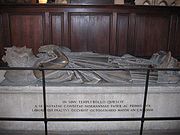 Sometime around 927, Rollo passed the fief in Normandy
to his son, William Longsword
. Rollo may have lived for a few years after that, but certainly died before 933. According to the historian Adhemar
, 'As Rollo's death drew near, he went mad and had a hundred Christian prisoners beheaded in front of him in honour of the gods whom he had worshipped, and in the end distributed a hundred pounds of gold around the churches in honour of the true God in whose name he had accepted baptism.' Even though Rollo had converted to Christianity
, some of his prior religious
roots surfaced at the end.
. Through William, he is an ancestor of the present-day British royal family
, as well as an ancestor of all current European monarchs and a great many pretenders to abolished European thrones. A genetic
investigation into the remains of Rollo's grandson Richard I and great-grandson Richard II
has been announced, with the intention of discerning the origins of the famous Viking warrior.
The "Clameur de Haro
" in the Channel Islands
is, supposedly, an appeal to Rollo.
written by John Fletcher, Philip Massinger, Ben Jonson, and George Chapman.
He is also a minor character in the romance novel, The Reluctant Viking by Sandra Hill. His wife Poppa and his son Willian are also minor characters.
Norsemen
Norsemen is used to refer to the group of people as a whole who spoke what is now called the Old Norse language belonging to the North Germanic branch of Indo-European languages, especially Norwegian, Icelandic, Faroese, Swedish and Danish in their earlier forms.The meaning of Norseman was "people...
nobleman of Norwegian
Norway
Norway , officially the Kingdom of Norway, is a Nordic unitary constitutional monarchy whose territory comprises the western portion of the Scandinavian Peninsula, Jan Mayen, and the Arctic archipelago of Svalbard and Bouvet Island. Norway has a total area of and a population of about 4.9 million...
or Danish
Denmark
Denmark is a Scandinavian country in Northern Europe. The countries of Denmark and Greenland, as well as the Faroe Islands, constitute the Kingdom of Denmark . It is the southernmost of the Nordic countries, southwest of Sweden and south of Norway, and bordered to the south by Germany. Denmark...
descent and founder and first ruler of the Viking
Viking
The term Viking is customarily used to refer to the Norse explorers, warriors, merchants, and pirates who raided, traded, explored and settled in wide areas of Europe, Asia and the North Atlantic islands from the late 8th to the mid-11th century.These Norsemen used their famed longships to...
principality in what soon became known as Normandy
Normandy
Normandy is a geographical region corresponding to the former Duchy of Normandy. It is in France.The continental territory covers 30,627 km² and forms the preponderant part of Normandy and roughly 5% of the territory of France. It is divided for administrative purposes into two régions:...
. His descendants were the Dukes of Normandy
Duke of Normandy
The Duke of Normandy is the title of the reigning monarch of the British Crown Dependancies of the Bailiwick of Guernsey and the Bailiwick of Jersey. The title traces its roots to the Duchy of Normandy . Whether the reigning sovereign is a male or female, they are always titled as the "Duke of...
.
The name "Rollo" is a Latin translation due to the clerics from the Old Norse
Old Norse
Old Norse is a North Germanic language that was spoken by inhabitants of Scandinavia and inhabitants of their overseas settlements during the Viking Age, until about 1300....
name Hrólfr, modern Scandinavian name Rolf
Rolf
Rolf is a male given name. It originates in the Germanic name Hrolf, itself a contraction of Hrodwulf , a conjunction of the stem words hrod + wulf .The Old Norse cognate is Hrólfr.Notable Rolfs/Hrolfs include:...
(cf. the latinization of Hrólfr into the similar Roluo in the Gesta Danorum
Gesta Danorum
Gesta Danorum is a patriotic work of Danish history, by the 12th century author Saxo Grammaticus . It is the most ambitious literary undertaking of medieval Denmark and is an essential source for the nation's early history...
), but Norman people called him Rouf, and later Rou too (see Wace
Wace
Wace was a Norman poet, who was born in Jersey and brought up in mainland Normandy , ending his career as Canon of Bayeux.-Life:...
's Roman de Rou). He married Poppa. All that is known of Poppa is that she was a Christian, and the daughter to Berengar of Rennes
Berengar II of Neustria
Berengar II was the Count of Bayeux and Rennes and Margrave of the Breton March from 886 until his death a decade later.Berengar's kin became the first Gallo-speaking lords holding residence within Brittany , as a consequence of the Breton nobility being more or less broken under the Norman...
, the previous lord of Brittania Nova, which eventually became western Normandy.
Historical evidence
Rollo was a powerful VikingViking
The term Viking is customarily used to refer to the Norse explorers, warriors, merchants, and pirates who raided, traded, explored and settled in wide areas of Europe, Asia and the North Atlantic islands from the late 8th to the mid-11th century.These Norsemen used their famed longships to...
leader of contested origin. Dudo of St. Quentin, in his De moribus et actis primorum Normannorum ducum , tells of a powerful Danish
Denmark
Denmark is a Scandinavian country in Northern Europe. The countries of Denmark and Greenland, as well as the Faroe Islands, constitute the Kingdom of Denmark . It is the southernmost of the Nordic countries, southwest of Sweden and south of Norway, and bordered to the south by Germany. Denmark...
nobleman at loggerheads with the king
Monarch
A monarch is the person who heads a monarchy. This is a form of government in which a state or polity is ruled or controlled by an individual who typically inherits the throne by birth and occasionally rules for life or until abdication...
of Denmark
Denmark
Denmark is a Scandinavian country in Northern Europe. The countries of Denmark and Greenland, as well as the Faroe Islands, constitute the Kingdom of Denmark . It is the southernmost of the Nordic countries, southwest of Sweden and south of Norway, and bordered to the south by Germany. Denmark...
, who had two sons, Gurim and Rollo; upon his death, Rollo was expelled and Gurim killed. William of Jumièges
William of Jumièges
William of Jumièges was a contemporary of the events of 1066, and one of our earliest writers on the subject of the Norman Conquest. He is himself a "shadowy figure", only known by his dedicatory letter to King William as a monk of Jumièges...
also mentions Rollo's prehistory in his Gesta Normannorum Ducum
Gesta Normannorum Ducum
Gesta Normannorum Ducum is a chronicle originally created by the monk William of Jumièges just before 1060. In 1070 William I had William of Jumièges extend the work to detail his rights to the throne of England. In later times, Orderic Vitalis and Robert of Torigni Gesta Normannorum Ducum (Deeds...
, but states that he was from the Danish town of Fakse. Wace
Wace
Wace was a Norman poet, who was born in Jersey and brought up in mainland Normandy , ending his career as Canon of Bayeux.-Life:...
, writing some 300 years after the event in his Roman de Rou
Roman de Rou
Roman de Rou is a verse chronicle by Wace in Norman covering the history of the Dukes of Normandy from the time of Rollo of Normandy to the battle of Tinchebray in 1106...
, also mentions the two brothers (as Rou and Garin), as does the Orkneyinga Saga
Orkneyinga saga
The Orkneyinga saga is a historical narrative of the history of the Orkney Islands, from their capture by the Norwegian king in the ninth century onwards until about 1200...
.
Norwegian
Norway
Norway , officially the Kingdom of Norway, is a Nordic unitary constitutional monarchy whose territory comprises the western portion of the Scandinavian Peninsula, Jan Mayen, and the Arctic archipelago of Svalbard and Bouvet Island. Norway has a total area of and a population of about 4.9 million...
and Iceland
Iceland
Iceland , described as the Republic of Iceland, is a Nordic and European island country in the North Atlantic Ocean, on the Mid-Atlantic Ridge. Iceland also refers to the main island of the country, which contains almost all the population and almost all the land area. The country has a population...
ic historians identified Rollo instead with Ganger Hrolf (Hrolf, the Walker), a son of Rognvald Eysteinsson, Earl of Møre
Møre og Romsdal
is a county in the northernmost part of Western Norway. It borders the counties of Sør-Trøndelag, Oppland and Sogn og Fjordane. The county administration is located in Molde, while Ålesund is the largest city.-The name:...
, in Western Norway, based on medieval Norwegian and Icelandic sagas. The oldest source of this version is the Latin Historia Norvegiae, written in Norway at the end of the 12th century. This Hrolf fell foul of the Norwegian king Harald Fairhair, and became a Jarl
Earl
An earl is a member of the nobility. The title is Anglo-Saxon, akin to the Scandinavian form jarl, and meant "chieftain", particularly a chieftain set to rule a territory in a king's stead. In Scandinavia, it became obsolete in the Middle Ages and was replaced with duke...
in Normandy. The nickname "the Walker" came from being so big that no horse could carry him.
The question of Rollo's Danish or Norwegian origins was a matter of heated dispute between Norwegian and Danish historians of the 19th and early 20th century, particularly in the run-up to Normandy's 1000-year-anniversary in 1911. Today, historians still disagree on this question, but most would now agree that a certain conclusion can never be reached.
Raids along the Seine
In 885, Rollo was one of the lesser leaders of the Viking fleet which besieged ParisSiege of Paris (885-886)
The Siege of Paris of 885 to 886 was a Viking siege of Paris, then capital of the kingdom of the West Franks. It was, in hindsight, the most important event of the reign of the Emperor Charles the Fat and a turning point in the fortunes of the Carolingian dynasty and the history of France.The...
under Sigfred. Legend has it that an emissary was sent by the king to find the chieftain and negotiate terms. When he asked for this information, the Vikings replied that they were all chieftains in their own right. In 886, when Sigfred retreated in return for tribute, Rollo stayed behind and was eventually bought off and sent to harry Burgundy.
Later, he returned to the Seine
Seine
The Seine is a -long river and an important commercial waterway within the Paris Basin in the north of France. It rises at Saint-Seine near Dijon in northeastern France in the Langres plateau, flowing through Paris and into the English Channel at Le Havre . It is navigable by ocean-going vessels...
with his followers (known as Danes, or Norsemen). He invaded the area of northern France
France
The French Republic , The French Republic , The French Republic , (commonly known as France , is a unitary semi-presidential republic in Western Europe with several overseas territories and islands located on other continents and in the Indian, Pacific, and Atlantic oceans. Metropolitan France...
now known as Normandy
Normandy
Normandy is a geographical region corresponding to the former Duchy of Normandy. It is in France.The continental territory covers 30,627 km² and forms the preponderant part of Normandy and roughly 5% of the territory of France. It is divided for administrative purposes into two régions:...
.
In 911 Rollo's forces launched a failed attack on Paris
Paris
Paris is the capital and largest city in France, situated on the river Seine, in northern France, at the heart of the Île-de-France region...
before laying siege to Chartres
Chartres
Chartres is a commune and capital of the Eure-et-Loir department in northern France. It is located southwest of Paris.-Geography:Chartres is built on the left bank of the Eure River, on a hill crowned by its famous cathedral, the spires of which are a landmark in the surrounding country...
. The Bishop of Chartres, Joseaume, appeals for help were answered by the Robert, Marquis
Marquis
Marquis is a French and Scottish title of nobility. The English equivalent is Marquess, while in German, it is Markgraf.It may also refer to:Persons:...
of Neustria
Neustria
The territory of Neustria or Neustrasia, meaning "new [western] land", originated in 511, made up of the regions from Aquitaine to the English Channel, approximating most of the north of present-day France, with Paris and Soissons as its main cities...
, Richard, Duke of Burgundy and Manasses, Count of Dijon
Dijon
Dijon is a city in eastern France, the capital of the Côte-d'Or département and of the Burgundy region.Dijon is the historical capital of the region of Burgundy. Population : 151,576 within the city limits; 250,516 for the greater Dijon area....
. On 20 July 911, at the Battle of Chartres, they defeated Rollo despite the absence of many French barons and also the absence of the French King Charles the Simple
Charles the Simple
Charles III , called the Simple or the Straightforward , was the undisputed King of France from 898 until 922 and the King of Lotharingia from 911 until 919/23...
.
The Principality of Normandy
In the Treaty of Saint-Clair-sur-Epte (911) with King Charles, Rollo pledged feudalFeudalism
Feudalism was a set of legal and military customs in medieval Europe that flourished between the 9th and 15th centuries, which, broadly defined, was a system for ordering society around relationships derived from the holding of land in exchange for service or labour.Although derived from the...
allegiance to the king, changed his name to the Frankish version, and converted to Christianity
Christianity
Christianity is a monotheistic religion based on the life and teachings of Jesus as presented in canonical gospels and other New Testament writings...
, probably with the baptism
Baptism
In Christianity, baptism is for the majority the rite of admission , almost invariably with the use of water, into the Christian Church generally and also membership of a particular church tradition...
al name Robert. In return, King Charles granted Rollo land between the Epte
Epte
The Epte is a river in Seine-Maritime and Eure, in Normandy, France. It is a right tributary of the Seine.The river rises in Seine-Maritime in the Pays de Bray, near Forges-les-Eaux...
and the sea as well as Brittany
Brittany
Brittany is a cultural and administrative region in the north-west of France. Previously a kingdom and then a duchy, Brittany was united to the Kingdom of France in 1532 as a province. Brittany has also been referred to as Less, Lesser or Little Britain...
and the hand of the Kings daughter, Gisela. He was also the titular ruler of Normandy, centred around the city of Rouen
Rouen
Rouen , in northern France on the River Seine, is the capital of the Haute-Normandie region and the historic capital city of Normandy. Once one of the largest and most prosperous cities of medieval Europe , it was the seat of the Exchequer of Normandy in the Middle Ages...
. There exists some argument among historians as to whether Rollo was a "duke
Duke
A duke or duchess is a member of the nobility, historically of highest rank below the monarch, and historically controlling a duchy...
" (dux) or whether his position was equivalent to that of a "count
Count
A count or countess is an aristocratic nobleman in European countries. The word count came into English from the French comte, itself from Latin comes—in its accusative comitem—meaning "companion", and later "companion of the emperor, delegate of the emperor". The adjective form of the word is...
" under Charlemagne
Charlemagne
Charlemagne was King of the Franks from 768 and Emperor of the Romans from 800 to his death in 814. He expanded the Frankish kingdom into an empire that incorporated much of Western and Central Europe. During his reign, he conquered Italy and was crowned by Pope Leo III on 25 December 800...
.
According to legend, when required to kiss the foot of King Charles, as a condition of the treaty, he refused to perform so great a humiliation, and when Charles extended his foot to Rollo, Rollo ordered one of his warriors to do so in his place. His warrior then lifted Charles' foot up to his mouth causing the king to fall to the ground.
After 911, Rollo stayed true to his word of defending the shores of the Seine river in accordance to the Treaty of Saint-Clair-sur-Epte, however he also continued to act like a Viking chief with attacks on Flanders
Flanders
Flanders is the community of the Flemings but also one of the institutions in Belgium, and a geographical region located in parts of present-day Belgium, France and the Netherlands. "Flanders" can also refer to the northern part of Belgium that contains Brussels, Bruges, Ghent and Antwerp...
.
After Charles was deposed by Robert I
Robert I of France
Robert I , King of Western Francia , was the younger son of Robert the Strong, count of Anjou, and the brother of Odo, who became king of the Western Franks in 888. West Francia evolved over time into France; under Odo, the capital was fixed on Paris, a large step in that direction...
, Rollo considered his oath to the King of France to be over. It started a period of expansion westwards. Negotiations with French barons ended with Rollo being given Le Mans
Le Mans
Le Mans is a city in France, located on the Sarthe River. Traditionally the capital of the province of Maine, it is now the capital of the Sarthe department and the seat of the Roman Catholic diocese of Le Mans. Le Mans is a part of the Pays de la Loire region.Its inhabitants are called Manceaux...
and Bayeux
Bayeux
Bayeux is a commune in the Calvados department in Normandy in northwestern France.Bayeux is the home of the Bayeux Tapestry, which depicts the events leading up to the Norman conquest of England.-Administration:Bayeux is a sub-prefecture of Calvados...
and continued with the seizure of Bessin
Bessin
The Bessin is an area in Normandy, France, corresponding to the territory of the Bajocasse tribe of Gaul who also gave their name to the city of Bayeux, central town of the Bessin.-History:The territory was annexed by the Duchy of Normandy in 924....
in 924. The following year saw the Normans
Normans
The Normans were the people who gave their name to Normandy, a region in northern France. They were descended from Norse Viking conquerors of the territory and the native population of Frankish and Gallo-Roman stock...
attack Picardy
Picardy
This article is about the historical French province. For other uses, see Picardy .Picardy is a historical province of France, in the north of France...
.
Rollo began to divide the land between the Epte and Risle rivers among his chieftains and settled there with a de facto capital in Rouen. Eventually Rollo's men intermarried with the local women, and became more settled as Normans. At the time of his death, Rollo's territory extended as far west as the Vire River
Vire River
The Vire is a river in Normandy, France whose 128 km course crosses the départements of Calvados and Manche, flowing through the towns of Vire, Saint-Lô and Isigny-sur-Mer, finally flowing out into the English Channel....
.
Family
Rollo married twice:1. Poppa, the daughter of Berengar II of Neustria
Berengar II of Neustria
Berengar II was the Count of Bayeux and Rennes and Margrave of the Breton March from 886 until his death a decade later.Berengar's kin became the first Gallo-speaking lords holding residence within Brittany , as a consequence of the Breton nobility being more or less broken under the Norman...
and had issue:
- William LongswordWilliam I of NormandyWilliam I Longsword was the second Duke of Normandy from his father's death until his own assassination. The title dux was not in use at the time and has been applied to early Norman rulers retroactively. William actually used the title comes .-Biography:Little is known about his early years...
- GerlocGerlocGerloc , baptised in Rouen as Adela in 912, was the daughter of Rollo, first duke of Normandy, and his wife, Poppa of Bayeux. She was the sister of Duke William Longsword....
- Crispina, who married Grimaldus I of Monaco
- Gerletta
- Kadlin, who married a Scottish King called Bjolan, and had at least a daughter called Midbjorg, she was taken captive by and married Helgi Ottarson.
2. Gisela of France (d.919), the daughter of Charles III of France.
Death
Duchy of Normandy
The Duchy of Normandy stems from various Danish, Norwegian, Hiberno-Norse, Orkney Viking and Anglo-Danish invasions of France in the 9th century...
to his son, William Longsword
William I of Normandy
William I Longsword was the second Duke of Normandy from his father's death until his own assassination. The title dux was not in use at the time and has been applied to early Norman rulers retroactively. William actually used the title comes .-Biography:Little is known about his early years...
. Rollo may have lived for a few years after that, but certainly died before 933. According to the historian Adhemar
Adémar de Chabannes
Adémar de Chabannes was an eleventh-century French monk, a historian who wrote the first annals to have been compiled in Aquitaine since Late Antiquity, a musical composer and a successful literary forger....
, 'As Rollo's death drew near, he went mad and had a hundred Christian prisoners beheaded in front of him in honour of the gods whom he had worshipped, and in the end distributed a hundred pounds of gold around the churches in honour of the true God in whose name he had accepted baptism.' Even though Rollo had converted to Christianity
Christianity
Christianity is a monotheistic religion based on the life and teachings of Jesus as presented in canonical gospels and other New Testament writings...
, some of his prior religious
Norse paganism
Norse paganism is the religious traditions of the Norsemen, a Germanic people living in the Nordic countries. Norse paganism is therefore a subset of Germanic paganism, which was practiced in the lands inhabited by the Germanic tribes across most of Northern and Central Europe in the Viking Age...
roots surfaced at the end.
Legacy
Rollo is the great-great-great-grandfather of William the ConquerorWilliam I of England
William I , also known as William the Conqueror , was the first Norman King of England from Christmas 1066 until his death. He was also Duke of Normandy from 3 July 1035 until his death, under the name William II...
. Through William, he is an ancestor of the present-day British royal family
Direct descent from William I to Elizabeth II
This list shows the most senior line of descent of Elizabeth II from William I of England. Each person on the list is the son or daughter of the person above him or her on the list. There are many other more junior lines of descent of the family, but the crown in theory at least only descends...
, as well as an ancestor of all current European monarchs and a great many pretenders to abolished European thrones. A genetic
Y chromosome
The Y chromosome is one of the two sex-determining chromosomes in most mammals, including humans. In mammals, it contains the gene SRY, which triggers testis development if present. The human Y chromosome is composed of about 60 million base pairs...
investigation into the remains of Rollo's grandson Richard I and great-grandson Richard II
Richard II, Duke of Normandy
Richard II , called the Good , was the eldest son and heir of Richard I the Fearless and Gunnora.-Biography:...
has been announced, with the intention of discerning the origins of the famous Viking warrior.
The "Clameur de Haro
Clameur de haro
The Clameur de Haro is an ancient legal injunction of restraint employed by a person that believes they are being wronged by another at that moment...
" in the Channel Islands
Channel Islands
The Channel Islands are an archipelago of British Crown Dependencies in the English Channel, off the French coast of Normandy. They include two separate bailiwicks: the Bailiwick of Guernsey and the Bailiwick of Jersey...
is, supposedly, an appeal to Rollo.
Depictions in fiction
Rollo is the subject of the 17th century play Rollo Duke of NormandyRollo Duke of Normandy
Rollo Duke of Normandy, also known as The Bloody Brother, is a play written in collaboration by John Fletcher, Philip Massinger, Ben Jonson, and George Chapman. Scholars have disputed almost everything about the play; but it was probably written sometime in the 1612–24 era and later revised,...
written by John Fletcher, Philip Massinger, Ben Jonson, and George Chapman.
He is also a minor character in the romance novel, The Reluctant Viking by Sandra Hill. His wife Poppa and his son Willian are also minor characters.
See also
- Viking AgeViking AgeViking Age is the term for the period in European history, especially Northern European and Scandinavian history, spanning the late 8th to 11th centuries. Scandinavian Vikings explored Europe by its oceans and rivers through trade and warfare. The Vikings also reached Iceland, Greenland,...
- Rulers of Normandy
- Clan RolloClan RolloClan Rollo is a Lowland Scottish clan.-Origins of the Clan:The Clan Rollo are of Norman origin. However they can trace their roots to the feared Norsemen who raided the coast of England and Scotland in the seventh and eighth centuries...
External links
- D.C. Douglas, "Rollo of Normandy", English Historical Review, Vol. 57 (1942), pp. 414–436
- Robert Helmerichs, [Rollo as Historical Figure]
- Rosamond McKitterick, The Frankish Kingdom under the Carolingians, 751-987, (Longman) 1983
- Dudonis gesta Normannorum - Dudo of St. Quentin Gesta Normannorum Latin version at Bibliotheca Augustana
- Dudo of St. Quentin's Gesta Normannorum - An English Translation
- Gwyn Jones. Second edition: A History of the Vikings. Oxford University Press. (1984).
- William W. Fitzhugh and Elizabeth Ward. Vikings: The North Atlantic Saga. Smithsonian Institution Press. (2000)
- Eric Christiansen. The Norsemen in the Viking Age. Blackwell Publishers Ltd. (2002)
- Agnus Konstam. Historical Atlas of the Viking World. Checkmark Books. (2002)
- Holgar Arbman. Ancient People and Places: The Vikings. Thames and Hudson. (1961)
- Eric Oxenstierna. The Norsemen, New York Graphics Society Publishers, Ltd. (1965)
- FMG on Ragnvald the Wise, the father of Rollo? Probably conjectural or doubtful, see the following link below
- Stewart Baldwin's report on the unknown parentage of Rollo
- Decedents of Rollo