

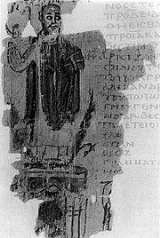
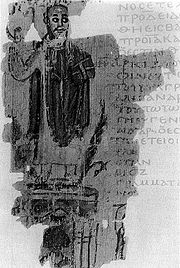
Theophilus of Alexandria

Encyclopedia
Egypt
Egypt , officially the Arab Republic of Egypt, Arabic: , is a country mainly in North Africa, with the Sinai Peninsula forming a land bridge in Southwest Asia. Egypt is thus a transcontinental country, and a major power in Africa, the Mediterranean Basin, the Middle East and the Muslim world...
, from 385 to 412. He is regarded as a saint by the Coptic Orthodox Church.
He was a Coptic Pope at a time of conflict between the newly dominant Christians and the pagan establishment in Alexandria
Alexandria
Alexandria is the second-largest city of Egypt, with a population of 4.1 million, extending about along the coast of the Mediterranean Sea in the north central part of the country; it is also the largest city lying directly on the Mediterranean coast. It is Egypt's largest seaport, serving...
, each supported by a segment of the Alexandrian populace. Edward Gibbon
Edward Gibbon
Edward Gibbon was an English historian and Member of Parliament...
described him as "...the perpetual enemy of peace and virtue, a bold, bad man, whose hands were alternately polluted with gold and with blood."
In 391, Theophilus (according to Rufinus
Tyrannius Rufinus
Tyrannius Rufinus or Rufinus of Aquileia was a monk, historian, and theologian. He is most known as a translator of Greek patristic material into Latin—especially the work of Origen.-Life:...
and Sozomen
Sozomen
Salminius Hermias Sozomenus was a historian of the Christian church.-Family and Home:He was born around 400 in Bethelia, a small town near Gaza, into a wealthy Christian family of Palestine....
) discovered a hidden pagan
Paganism
Paganism is a blanket term, typically used to refer to non-Abrahamic, indigenous polytheistic religious traditions....
temple. He and his followers mockingly displayed the pagan artifacts to the public which offended the pagans enough to provoke an attack on the Christians. The Christian faction counter-attacked, forcing the pagans to retreat to the Serapeum
Serapeum
A serapeum is a temple or other religious institution dedicated to the syncretic Hellenistic-Egyptian god Serapis, who combined aspects of Osiris and Apis in a humanized form that was accepted by the Ptolemaic Greeks of Alexandria...
(That at the time may have housed part of the Great Library of Alexandria
Library of Alexandria
The Royal Library of Alexandria, or Ancient Library of Alexandria, in Alexandria, Egypt, was the largest and most significant great library of the ancient world. It flourished under the patronage of the Ptolemaic dynasty and functioned as a major center of scholarship from its construction in the...
). A letter was sent by the emperor that Theophilus should grant the offending pagans pardon, but destroy the temple; according to Socrates Scholasticus
Socrates Scholasticus
Socrates of Constantinople, also known as Socrates Scholasticus, not to be confused with the Greek philosopher Socrates, was a Greek Christian church historian, a contemporary of Sozomen and Theodoret, who used his work; he was born at Constantinople c. 380: the date of his death is unknown...
, a contemporary of his, the latter aspect (the destruction of the temple) was added as a result of heavy solicitation for it by Theophilus.
Scholasticus goes on to state that:
.
The destruction of the Serapeum was seen by many ancient and modern authors as representative of the triumph of Christianity over other religions. According to John of Nikiu in the 7th century, when the philosopher Hypatia was lynched and flayed by a mob of Alexandrian Coptic monks, they acclaimed Theophilus's nephew and successor Cyril
Cyril of Alexandria
Cyril of Alexandria was the Patriarch of Alexandria from 412 to 444. He came to power when the city was at its height of influence and power within the Roman Empire. Cyril wrote extensively and was a leading protagonist in the Christological controversies of the later 4th and 5th centuries...
as "the new Theophilus, for he had destroyed the last remains of idolatry in the city".
Theophilus turned on the followers of Origen
Origen
Origen , or Origen Adamantius, 184/5–253/4, was an early Christian Alexandrian scholar and theologian, and one of the most distinguished writers of the early Church. As early as the fourth century, his orthodoxy was suspect, in part because he believed in the pre-existence of souls...
after having supported them for a time. He was accompanied by his nephew Cyril to Constantinople in 403 and there presided at the "Synod of the Oak
Synod of the Oak
The Synod of the Oak was a provincial synod, held in Constantinople in July of 403, which condemned and deposed John Chrysostom as Patriarch of Constantinople....
" that deposed John Chrysostom
John Chrysostom
John Chrysostom , Archbishop of Constantinople, was an important Early Church Father. He is known for his eloquence in preaching and public speaking, his denunciation of abuse of authority by both ecclesiastical and political leaders, the Divine Liturgy of St. John Chrysostom, and his ascetic...
.
On July 10th in the Eastern (Greek) Orthodox Synaxarion, there is a commemoration for the 10,000 monks slain on the orders of Pope Theophilus in his paranoid campaign against perceived Origenism and the Four Tall Brethren. While considered a saint by the Coptic Orthodox Church, he is remembered in the Eastern Orthodox churches as "impious". His nephew and successor Cyril
Cyril of Alexandria
Cyril of Alexandria was the Patriarch of Alexandria from 412 to 444. He came to power when the city was at its height of influence and power within the Roman Empire. Cyril wrote extensively and was a leading protagonist in the Christological controversies of the later 4th and 5th centuries...
is recognized as a saint throughout all of Christendom.
Surviving works
- Correspondence with St. Jerome, Pope Anastasius IPope Anastasius IPope Saint Anastasius I, born in Rome the son of Maximus, was pope from November 27, 399 to 401.He condemned the writings of the Alexandrian theologian Origen shortly after their translation into Latin. He fought against these writings throughout his papacy and in 400 he called a council to discuss...
and Pope Innocent IPope Innocent I-Biography:He was, according to his biographer in the Liber Pontificalis, the son of a man called Innocens of Albano; but according to his contemporary Jerome, his father was Pope Anastasius I , whom he was called by the unanimous voice of the clergy and laity to succeed -Biography:He was,... - Tract against Chrysostom
- Homilies translated by St. Jerome (preserved in MigneMignéMigné is a commune in the Indre department in central France.-References:*...
) - Other homilies survive only in CopticCoptic languageCoptic or Coptic Egyptian is the current stage of the Egyptian language, a northern Afro-Asiatic language spoken in Egypt until at least the 17th century. Egyptian began to be written using the Greek alphabet in the 1st century...
and Ge'ezGe'ez languageGe'ez is an ancient South Semitic language that developed in the northern region of Ethiopia and southern Eritrea in the Horn of Africa...
translations.
In Popular Culture
Theophilus appears in the novel Flow Down Like Silver, Hypatia of Alexandria by Ki LongfellowKi Longfellow
Ki Longfellow is an American novelist, playwright, theatrical producer, theater director and entrepreneur. In Britain, as the widow of Vivian Stanshall, she is well known as the guardian of his artistic heritage, but elsewhere she is best known for her own work, especially the novel The Secret...
.
Further reading
- Charles, R. H., The Chronicle of John, Bishop of Nikiu: Translated from ZotenbergHermann ZotenbergHermann Zotenberg was an orientalist and Arabist.He worked for the Bibliothèque nationale de France in Paris. His most celebrated work is his edition of the Chronique de Tabari - Works :...
's Ethiopic Text, 1916. Reprinted 2007. Evolution Publishing. - Russell, N., Theophilus of Alexandria (London, Routledge, 2006) (The Early Church Fathers).
- Polański, T., "The Three Young Men in the Furnace and the Art of Ecphrasis in the Coptic Sermon by Theophilus of Alexandria," Studies in Ancient Art and Civilisation, 10 (2007), 79-100.