

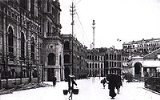
Colonial Hong Kong

Encyclopedia
In the 19th century the British, Dutch, French, Indians and Americans saw Imperial China as the world's largest untapped market. In 1840 the British Empire
launched their first and one of the most aggressive expeditionary forces to claim the territory that would later be known as Hong Kong
.
In a few decades, Hong Kong was transformed from rocky undeveloped mountainous terrain to a major entrepot
for global trade. Through the Opium War
and a series of treaties, the British were able to legitimately claim the territory until 1997. Early social and economic problems existed in the colony, as there were drastic differences between Eastern and Western philosophy and culture. Nonetheless, Hong Kong seized the opportunity to become one of the first parts of East Asia
to industrialise and modernise.
 By the end of the 18th century, the British Empire was well established in trade and conquest around the world. China was the main supplier of tea to the British, who were domestically consuming 30 million pounds
of Chinese tea
by 1830, averaging 2 pounds of leaves for every citizen. From the British economic standpoint, Chinese tea was a crucial item since it provided massive wealth for the taipans
(foreign, e.g. British, businessmen in China), and the duty
on tea accounted for 10% of the government's income.
The British diplomats were never in favour of performing kowtow
to the Emperor of China
. Many saw it as a religious pursuit and would rather be treated as equal, though the members of the Qing Dynasty
thrones and courts saw the British envoys as uncivilised foreigners strictly here for tea, silk and other far east
goods. At the time, China's social structure, as passed down from Confucian
philosophy, ranked merchants relatively low (below farmers and above slaves) since they were considered citizens who only enriched themselves.
Some of the earliest items sold to China in exchange for tea were British clocks, watches and musical boxes. These were not enough to compensate for the trade imbalance of massive quantities of tea. China developed a strong demand for silver. After the 1757 territorial conquest
of Bengal
in India, the British had access to opium
, which was used in western society as a tincture added to water for purification. The Chinese, on the other hand, smoked opium for addictive narcotic means. A large fiscal deficit existed in Bengal and so opium export was used by the government to raise tax, though it would come at the price of creating a new drug addiction. Lin Zexu
was the Chinese commissioner who wrote a letter to Queen Victoria in 1839 taking a stance against the acceptance of opium in trade. He confiscated more than 20,000 chests of opium already at the port and supervised their destruction.
(1839–1842) began at the hands of Captain Charles Elliot
of the Royal Navy
and Capt. Anthony Blaxland Stransham
of the Royal Marines
. After a series of Chinese defeats, Hong Kong Island
was occupied by the British on 20 January 1841. Sir Edward Belcher
, aboard HMS Sulphur landed in Hong Kong, on 25 January 1841. Possession Street
still exists to mark the event, although its Chinese name is 水坑口街 ("Mouth of the ditch Street").
Commodore Sir Gordon Bremer raised the Union Jack and claimed Hong Kong as a colony on 26 January 1841. It erected naval store sheds there in April 1841.
The island was first used by the British as a staging post during the war, and while the East India Company
intended to establish a permanent base on the island of Zhoushan
, Elliot took it upon himself to claim the island on a permanent basis. The ostensible authority for the occupation was negotiated between Captain Eliot and the Governor of Kwangtung Province. The Convention of Chuenpee was concluded but had not been recognised by the court of Qing Dynasty at Beijing. Subsequently, Hong Kong Island was ceded to Britain in 1842 under the Treaty of Nanking
, at which point in time the territory became a Crown colony
.
The Opium War was ostensibly fought to liberalise trade to China. With a base in Hong Kong, British traders, opium dealers, and merchants launched the city which would become the 'free trade' nexus of the East. American opium traders and merchant bankers such as the Russell, Perkins
and Forbes
families would soon join the trade. Britain was granted a rent-free perpetual lease on the Kowloon Peninsula under the 1860 Convention of Beijing, which formally ended hostilities in the Second Opium War
(1856–1858).
In 1898 the United Kingdom was concerned that Hong Kong could not be defended unless surrounding areas were also under British control. In response a 99-year rent-free lease titled the Second Convention of Peking
was drafted and executed, significantly expanding the size of the Hong Kong via the addition of the New Territories. The lease would set to expire at midnight, on 30 June 1997.
was raised over Possession Point
on 26 January 1841, the population of Hong Kong island was about 7,450, mostly Tanka
fishermen and Hakka
charcoal burners living in a number of coastal villages. In the 1850s large numbers of Chinese would emigrate from China to Hong Kong due to the Taiping Rebellion
. Other events such as floods, typhoons and famine in mainland China
would also play a role in establishing Hong Kong as a place to escape the mayhem.
According to the census of 1865, Hong Kong had a population of 125,504, of which some 2,000 were Americans and Europeans. In 1914 despite an exodus of 60,000 Chinese fearing an attack on the colony during World War I
, Hong Kong's population continued to increase from 530,000 in 1916 to 725,000 in 1925 and 1.6 million by 1941.
made Hong Kong a major entrepôt
from the start, attracting people from China and Europe alike. The society remained racially segregated
and polarised due to British colonial policies and attitudes. Despite the rise of a British-educated Chinese upper class by the late 19th century, race laws such as the Peak Reservation Ordinance
prevented Chinese from living in elite areas like Victoria Peak
. Politically, the majority Chinese population also had little to no official governmental influence throughout much of the early years. There were, however, a small number of Chinese elites that the British governors relied on, including Sir Kai Ho
and Robert Hotung
. They accepted their place in the Hong Kong hierarchy, and served as main communicators and mediators between the government and the Chinese population. Sir Kai Ho was an unofficial member of the Legislative Council
. Robert Hotung wanted Chinese citizens to recognise Hong Kong as the new home after the fall of China's last dynasty
in 1911. As a millionaire with financial influence, he emphasised that no part of the demographics was purely indigenous
.
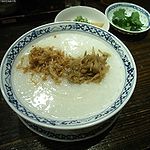 The east portion of Colonial Hong Kong was mostly dedicated to the British; filled with race courses, parade grounds, barracks, cricket
and polo
fields. The west portion was filled with Chinese shops, crowded markets and tea house
s. The Hong Kong tea culture
began in this period and evolved into yum cha
. One of the most common breakfasts was congee
with fish and barley
.
In the mid-19th century many of the merchants would sell silk
, jade
and consult feng shui
to open shops that favour better spiritual arrangements. Other lower ranked groups like coolies arrived with the notion that hard work would better position them for the future. And the success of boatmen, merchants, carters and fishermen in Hong Kong, would leapfrog China's most popular port in Canton
. By 1880 Hong Kong's port would handle 27% of the mainland's export and 37% of imports.
A British traveller, Isabella Bird
, described Hong Kong in the 1870s as a colony filled with comforts and entertainment only a Victorian society would be able to enjoy. Other descriptions mentioned courts, hotels, post offices, shops, city hall complexes, museums, libraries and structures in impressive manner for the era. Many European businessmen went to Hong Kong to do business. They were referred to as tai-pans
or "bigshot". One of the more notable Tai-pan hangout spot was the Hong Kong Club
at Queen's Road
.
would become the founder of Hong Kong education system bringing western-style philosophy to the east. Some have argued that his contribution is the key turning point between the group of Chinese that were able to modernise Hong Kong versus the group that did not in China. The education would bring western-style finance, science, history, technology into the culture. The father of modern China, Sun Yat-sen
was also educated in Hong Kong's Central School
.
was established. The governor of Hong Kong
generally served as the British plenipotentiary
in the far east in the early years. The Colonial Secretary
would also assist in legal matters.
A colonial police force was established in the 1840s to handle the high crime rate in Hong Kong. By China's standards, colonial Hong Kong's code of punishment was considered laughably loose and lenient. The lack of intimidation may have been the leading cause for the continual rise in crime. Po Leung Kuk
became one of the first organisations established to deal with the abduction
of women and prostitution
crisis. Crime in the sea was also common as some pirates had access to cutlass
and revolver
s.
of bubonic plague
broke out in China in the 1880s. By the spring of 1894 about 100,000 were reported dead in the mainland. In May 1894 the disease erupted into Hong Kong's overcrowded Chinese quarter of Tai Ping Shan
. By the end of the month, an estimated 450 people died of the illness. At its height, the epidemic was killing 100 people per day, and it killed a total of 2,552 people that year. The disease was greatly detrimental to trade and produced a temporary exodus of 100,000 Chinese from the colony. Plague continued to be a problem in the territory for the next 30 years. In the 1870s a typhoon hit Hong Kong one evening reaching its height by midnight. An estimated 2,000 people lost their lives in a span of just six hours.
. The establishment of the Star Ferry
and the Yaumati Ferry
would prove to be vital. In 1843 the colony had built the first ship at a private shipyard. Some of the customers later included the Spanish government in the Philippines and the Chinese navy
. The Peak Tram
would begin in 1888 along with the Tramway
service in 1904. The first railway line was also launched in 1910 as the Kowloon-Canton Railway
.
On land the rickshaws were extremely popular when they were first imported from Japan in 1874, since it was affordable and necessary for street merchants to haul goods. Sedan chairs were the preferred mode of the transport for the wealthy Europeans who lived on Victoria Peak
due to the steep grade which ruled out rickshaws until the introduction of the Peak Tram. The first automobiles in Hong Kong had petrol-driven internal combustion engines and arrived between 1903-05. Initially they were not well received by the public. Only around 1910 did the cars begin to gain appeal. Most of the owners were British. Buses operated by various independent companies flourished in the 1920s until the government formally issued franchises for the China Motor Bus
and Kowloon Motor Bus
companies in 1933.
The flying boats were the first British aeroplanes to reach Hong Kong in 1928. By 1924 the Kai Tak Airport
would also be found. The first flight service from Imperial Airways
would become available by 1937 at a price of 288 pounds
per ticket.
missionaries started to provide social service. Italian missionaries began to provide boy-only education to British and Chinese youth in 1843. "The Catholic French Sisters of St. Paul de Chartres" was one of the first orphanage and elderly home was established in 1848.
In 1870 the Tung Wah Hospital
became the first official hospital in Hong Kong. It handled much of the social services and was providing free vaccination
s in Hong Kong Island and Kwang Tung
. After raising funds for the 1877 famine in China, a number of the hospital officials became Tung Wah elites with much authority and power representing the Chinese majority. Some of the booming hotel businesses of the era included the Victoria Hotel, New Victoria Hotel and the King Edward Hotel
.
. The bank first leased Wardley House at HKD 500 a month in 1864. After raising a capital of HKD 5 million, the bank opened its door in 1865. The Association of Stockbrokers
would also be established in 1891.
company went into production with help from Catchick Paul Chater
. It was the first step in allowing the transition of gas lamps to light bulbs
. Other companies like Jardine Matheson would launch the "Hong Kong Land Investment and Agency company Ltd" accumulating a wealth as large as the entire government's total revenue. (See also China Light and Power
.)

One observer summed up the decades as "politics, propaganda, panic, rumour, riot, revolution and refugees". The role of Hong Kong as a political safe haven for Chinese political refugees further cemented its status, and few serious attempts to revert its ownership were launched in the early 20th century. Both Chinese Communist
and Nationalist
agitators found refuge in the territory, when they did not actively participate in the turmoil in China. However, the dockworkers strikes in the 1920s and 1930s were widely attributed to the Communists by the authorities, and caused a backlash against them. A strike in 1920 was ended with a wage increase of HKD
32 cents.
Ambrose King
, in his controversial 1975 paper Administrative Absorption of Politics in Hong Kong, described the colonial Hong Kong's administration as "elite consensual government". In it, he claimed, any coalition of elites or forces capable of challenging the legitimacy of Hong Kong's administrative structure would be co-opted by the existing apparatus through the appointment of leading political activists, business figures and other elites to oversight committees, by granting them British honours, and by bringing them into elite institutions like Hong Kong's horse racing clubs. He called this "synarchy", an extension of John K. Fairbank
's use of the word to describe the mechanisms of government under the late Qing dynasty
in China.
When modern China began after the fall of the last dynasty, one of the first political statements made in Hong Kong was the immediate change from long queue hairstyles
to short haircuts. In 1938, Guangzhou fell to the hands of the Japanese, Hong Kong was considered a strategic military outpost for all trades in the far east. Though Winston Churchill
assured that Hong Kong was an "impregnable fortress", it was taken as a reality check response since the British Army
actually stretched too thin to battle on two fronts.
British Empire
The British Empire comprised the dominions, colonies, protectorates, mandates and other territories ruled or administered by the United Kingdom. It originated with the overseas colonies and trading posts established by England in the late 16th and early 17th centuries. At its height, it was the...
launched their first and one of the most aggressive expeditionary forces to claim the territory that would later be known as Hong Kong
Hong Kong
Hong Kong is one of two Special Administrative Regions of the People's Republic of China , the other being Macau. A city-state situated on China's south coast and enclosed by the Pearl River Delta and South China Sea, it is renowned for its expansive skyline and deep natural harbour...
.
In a few decades, Hong Kong was transformed from rocky undeveloped mountainous terrain to a major entrepot
Entrepôt
An entrepôt is a trading post where merchandise can be imported and exported without paying import duties, often at a profit. This profit is possible because of trade conditions, for example, the reluctance of ships to travel the entire length of a long trading route, and selling to the entrepôt...
for global trade. Through the Opium War
First Opium War
The First Anglo-Chinese War , known popularly as the First Opium War or simply the Opium War, was fought between the United Kingdom and the Qing Dynasty of China over their conflicting viewpoints on diplomatic relations, trade, and the administration of justice...
and a series of treaties, the British were able to legitimately claim the territory until 1997. Early social and economic problems existed in the colony, as there were drastic differences between Eastern and Western philosophy and culture. Nonetheless, Hong Kong seized the opportunity to become one of the first parts of East Asia
East Asia
East Asia or Eastern Asia is a subregion of Asia that can be defined in either geographical or cultural terms...
to industrialise and modernise.
Beginning of trade
Pound (mass)
The pound or pound-mass is a unit of mass used in the Imperial, United States customary and other systems of measurement...
of Chinese tea
Chinese tea
The practice of drinking tea has had a long history in China, having originated there. The Chinese drink tea during many parts of the day such as during meals for good health or for simple pleasure.-History:...
by 1830, averaging 2 pounds of leaves for every citizen. From the British economic standpoint, Chinese tea was a crucial item since it provided massive wealth for the taipans
Tai-Pan
The term tai-pan was originally used to describe a foreign businessman in China or Hong Kong in the nineteenth and early twentieth centuries. The Cantonese colloquialism is now used in a more general sense for business executives of any origin...
(foreign, e.g. British, businessmen in China), and the duty
Duty (economics)
In economics, a duty is a kind of tax, often associated with customs, a payment due to the revenue of a state, levied by force of law. It is a tax on certain items purchased abroad...
on tea accounted for 10% of the government's income.
The British diplomats were never in favour of performing kowtow
Kowtow
Kowtow is the act of deep respect shown by kneeling and bowing so low as to have one's head touching the ground. An alternative Chinese term is ketou, however the meaning is somewhat altered: kòu originally meant "knock with reverence", whereas kē has the general meaning of "touch upon ".In Han...
to the Emperor of China
Emperor of China
The Emperor of China refers to any sovereign of Imperial China reigning between the founding of Qin Dynasty of China, united by the King of Qin in 221 BCE, and the fall of Yuan Shikai's Empire of China in 1916. When referred to as the Son of Heaven , a title that predates the Qin unification, the...
. Many saw it as a religious pursuit and would rather be treated as equal, though the members of the Qing Dynasty
Qing Dynasty
The Qing Dynasty was the last dynasty of China, ruling from 1644 to 1912 with a brief, abortive restoration in 1917. It was preceded by the Ming Dynasty and followed by the Republic of China....
thrones and courts saw the British envoys as uncivilised foreigners strictly here for tea, silk and other far east
Far East
The Far East is an English term mostly describing East Asia and Southeast Asia, with South Asia sometimes also included for economic and cultural reasons.The term came into use in European geopolitical discourse in the 19th century,...
goods. At the time, China's social structure, as passed down from Confucian
Confucius
Confucius , literally "Master Kong", was a Chinese thinker and social philosopher of the Spring and Autumn Period....
philosophy, ranked merchants relatively low (below farmers and above slaves) since they were considered citizens who only enriched themselves.
Some of the earliest items sold to China in exchange for tea were British clocks, watches and musical boxes. These were not enough to compensate for the trade imbalance of massive quantities of tea. China developed a strong demand for silver. After the 1757 territorial conquest
Battle of Plassey
The Battle of Plassey , 23 June 1757, was a decisive British East India Company victory over the Nawab of Bengal and his French allies, establishing Company rule in South Asia which expanded over much of the Indies for the next hundred years...
of Bengal
Bengal
Bengal is a historical and geographical region in the northeast region of the Indian Subcontinent at the apex of the Bay of Bengal. Today, it is mainly divided between the sovereign land of People's Republic of Bangladesh and the Indian state of West Bengal, although some regions of the previous...
in India, the British had access to opium
Opium
Opium is the dried latex obtained from the opium poppy . Opium contains up to 12% morphine, an alkaloid, which is frequently processed chemically to produce heroin for the illegal drug trade. The latex also includes codeine and non-narcotic alkaloids such as papaverine, thebaine and noscapine...
, which was used in western society as a tincture added to water for purification. The Chinese, on the other hand, smoked opium for addictive narcotic means. A large fiscal deficit existed in Bengal and so opium export was used by the government to raise tax, though it would come at the price of creating a new drug addiction. Lin Zexu
Lin Zexu
Lín Zéxú ; 30 August 1785 – 22 November 1850) was a Chinese scholar and official during the Qing Dynasty.He is most recognized for his conduct and his constant position on the "high moral ground" in his fight, as a "shepherd" of his people, against the opium trade in Guangzhou...
was the Chinese commissioner who wrote a letter to Queen Victoria in 1839 taking a stance against the acceptance of opium in trade. He confiscated more than 20,000 chests of opium already at the port and supervised their destruction.
Confrontation
The Queen saw the destruction of British products as an insult and sent the first expeditionary force to defend Britain's "ancient rights of commerce". The First Opium WarFirst Opium War
The First Anglo-Chinese War , known popularly as the First Opium War or simply the Opium War, was fought between the United Kingdom and the Qing Dynasty of China over their conflicting viewpoints on diplomatic relations, trade, and the administration of justice...
(1839–1842) began at the hands of Captain Charles Elliot
Charles Elliot
Sir Charles Elliot, KCB , was a British naval officer, diplomat, and colonial administrator. He became the first administrator of Hong Kong in 1841 while serving as both Plenipotentiary and Chief Superintendent of British Trade in China...
of the Royal Navy
Royal Navy
The Royal Navy is the naval warfare service branch of the British Armed Forces. Founded in the 16th century, it is the oldest service branch and is known as the Senior Service...
and Capt. Anthony Blaxland Stransham
Anthony Blaxland Stransham
General Sir Anthony Blaxland Stransham, GCB , was a British military officer.-Background:Stransham was the son of Lt. Col...
of the Royal Marines
Royal Marines
The Corps of Her Majesty's Royal Marines, commonly just referred to as the Royal Marines , are the marine corps and amphibious infantry of the United Kingdom and, along with the Royal Navy and Royal Fleet Auxiliary, form the Naval Service...
. After a series of Chinese defeats, Hong Kong Island
Hong Kong Island
Hong Kong Island is an island in the southern part of the Hong Kong Special Administrative Region. It has a population of 1,289,500 and its population density is 16,390/km², as of 2008...
was occupied by the British on 20 January 1841. Sir Edward Belcher
Edward Belcher
Admiral Sir Edward Belcher, KCB , was a British naval officer and explorer. He was the great-grandson of Governor Jonathan Belcher. His wife, Diana Jolliffe, was the stepdaughter of Captain Peter Heywood.-Early life:...
, aboard HMS Sulphur landed in Hong Kong, on 25 January 1841. Possession Street
Possession Street
Possession Street is a street in Sheung Wan, from Queen's Road West to Hollywood Road, on the Hong Kong Island in Hong Kong. The street marks the boundary of Queen's Road West and Queen's Road Central....
still exists to mark the event, although its Chinese name is 水坑口街 ("Mouth of the ditch Street").
Commodore Sir Gordon Bremer raised the Union Jack and claimed Hong Kong as a colony on 26 January 1841. It erected naval store sheds there in April 1841.
The island was first used by the British as a staging post during the war, and while the East India Company
British East India Company
The East India Company was an early English joint-stock company that was formed initially for pursuing trade with the East Indies, but that ended up trading mainly with the Indian subcontinent and China...
intended to establish a permanent base on the island of Zhoushan
Zhoushan
Zhoushan or Zhoushan Archipelago New Area; formerly transliterated as Chusan, is a prefecture-level city in northeastern Zhejiang province of Eastern China. The only prefecture-level city of the People's Republic of China consisting solely of islands, it lies across the mouth of the Hangzhou Bay,...
, Elliot took it upon himself to claim the island on a permanent basis. The ostensible authority for the occupation was negotiated between Captain Eliot and the Governor of Kwangtung Province. The Convention of Chuenpee was concluded but had not been recognised by the court of Qing Dynasty at Beijing. Subsequently, Hong Kong Island was ceded to Britain in 1842 under the Treaty of Nanking
Treaty of Nanking
The Treaty of Nanking was signed on 29 August 1842 to mark the end of the First Opium War between the United Kingdom of Great Britain and Ireland and the Qing Dynasty of China...
, at which point in time the territory became a Crown colony
Crown colony
A Crown colony, also known in the 17th century as royal colony, was a type of colonial administration of the English and later British Empire....
.
The Opium War was ostensibly fought to liberalise trade to China. With a base in Hong Kong, British traders, opium dealers, and merchants launched the city which would become the 'free trade' nexus of the East. American opium traders and merchant bankers such as the Russell, Perkins
John Perkins Cushing
John Perkins Cushing , called "Ku-Shing" by the Chinese, was a wealthy Boston sea merchant, opium smuggler, and philanthropist...
and Forbes
Forbes family
The Forbes family is a wealthy extended American family originating in Boston. The family's fortune originates from trading between North America and China in the 19th century plus other investments in the same period. The name descends from Scottish immigrants, and can be traced back to Sir John...
families would soon join the trade. Britain was granted a rent-free perpetual lease on the Kowloon Peninsula under the 1860 Convention of Beijing, which formally ended hostilities in the Second Opium War
Second Opium War
The Second Opium War, the Second Anglo-Chinese War, the Second China War, the Arrow War, or the Anglo-French expedition to China, was a war pitting the British Empire and the Second French Empire against the Qing Dynasty of China, lasting from 1856 to 1860...
(1856–1858).
In 1898 the United Kingdom was concerned that Hong Kong could not be defended unless surrounding areas were also under British control. In response a 99-year rent-free lease titled the Second Convention of Peking
Convention for the Extension of Hong Kong Territory
The Convention Between Great Britain and China Respecting an Extension of Hong Kong Territory or the Second Convention of Peking was a lease signed between Qing Dynasty and the United Kingdom in 1898.-Background:...
was drafted and executed, significantly expanding the size of the Hong Kong via the addition of the New Territories. The lease would set to expire at midnight, on 30 June 1997.
Demographics
Population
When the union flagUnion Flag
The Union Flag, also known as the Union Jack, is the flag of the United Kingdom. It retains an official or semi-official status in some Commonwealth Realms; for example, it is known as the Royal Union Flag in Canada. It is also used as an official flag in some of the smaller British overseas...
was raised over Possession Point
Possession Point
Possession Point is a former point of land on the northwestern coast of Hong Kong Island in Hong Kong, before land reclamation moved the coast further north.- History :...
on 26 January 1841, the population of Hong Kong island was about 7,450, mostly Tanka
Tanka (ethnic group)
The Tankas or Boat people is a special group of people in Southern China that has traditionally lived on junks in coastal parts of Guangdong, Guangxi, Fujian, Hainan, and Zhejiang provinces, as well as Hong Kong and Macau...
fishermen and Hakka
Hakka people
The Hakka , sometimes Hakka Han, are Han Chinese who speak the Hakka language and have links to the provincial areas of Guangdong, Jiangxi, Guangxi, Sichuan, Hunan and Fujian in China....
charcoal burners living in a number of coastal villages. In the 1850s large numbers of Chinese would emigrate from China to Hong Kong due to the Taiping Rebellion
Taiping Rebellion
The Taiping Rebellion was a widespread civil war in southern China from 1850 to 1864, led by heterodox Christian convert Hong Xiuquan, who, having received visions, maintained that he was the younger brother of Jesus Christ, against the ruling Manchu-led Qing Dynasty...
. Other events such as floods, typhoons and famine in mainland China
Mainland China
Mainland China, the Chinese mainland or simply the mainland, is a geopolitical term that refers to the area under the jurisdiction of the People's Republic of China . According to the Taipei-based Mainland Affairs Council, the term excludes the PRC Special Administrative Regions of Hong Kong and...
would also play a role in establishing Hong Kong as a place to escape the mayhem.
According to the census of 1865, Hong Kong had a population of 125,504, of which some 2,000 were Americans and Europeans. In 1914 despite an exodus of 60,000 Chinese fearing an attack on the colony during World War I
World War I
World War I , which was predominantly called the World War or the Great War from its occurrence until 1939, and the First World War or World War I thereafter, was a major war centred in Europe that began on 28 July 1914 and lasted until 11 November 1918...
, Hong Kong's population continued to increase from 530,000 in 1916 to 725,000 in 1925 and 1.6 million by 1941.
Segregation
The establishment of the free portFree port
A free port or free zone , sometimes also called a bonded area is a port, port area or other area with relaxed jurisdiction with respect to the country of location...
made Hong Kong a major entrepôt
Entrepôt
An entrepôt is a trading post where merchandise can be imported and exported without paying import duties, often at a profit. This profit is possible because of trade conditions, for example, the reluctance of ships to travel the entire length of a long trading route, and selling to the entrepôt...
from the start, attracting people from China and Europe alike. The society remained racially segregated
Racial segregation
Racial segregation is the separation of humans into racial groups in daily life. It may apply to activities such as eating in a restaurant, drinking from a water fountain, using a public toilet, attending school, going to the movies, or in the rental or purchase of a home...
and polarised due to British colonial policies and attitudes. Despite the rise of a British-educated Chinese upper class by the late 19th century, race laws such as the Peak Reservation Ordinance
Peak Reservation Ordinance
The , commonly known as Peak reservation Ordinance, was a racially-based zoning law passed by the Hong Kong Government that reserved the Victoria Peak as a place of residence to non-Chinese people except with the consent of the Governor...
prevented Chinese from living in elite areas like Victoria Peak
Victoria Peak
Victoria Peak is a mountain in Hong Kong. It is also known as Mount Austin, and locally as The Peak. The mountain is located in the western half of Hong Kong Island...
. Politically, the majority Chinese population also had little to no official governmental influence throughout much of the early years. There were, however, a small number of Chinese elites that the British governors relied on, including Sir Kai Ho
Kai Ho
Sir Kai Ho Kai, CMG, JP, MRCS , , born Ho Shan-kai , was a Hong Kong Chinese barrister, physician and essayist in Colonial Hong Kong. He played a key role in the relationship between the Hong Kong Chinese community and the British colonial government. He is mostly remembered as one of the main...
and Robert Hotung
Robert Hotung
Sir Robert Ho Tung Bosman, KBE , better known as Sir Robert Hotung, was an influential Eurasian businessman and philanthropist in British Hong Kong. It has often been claimed that he was the "first Chinese person to be allowed to live on Victoria Peak" in 1906, two years after the enactment of the...
. They accepted their place in the Hong Kong hierarchy, and served as main communicators and mediators between the government and the Chinese population. Sir Kai Ho was an unofficial member of the Legislative Council
Legislative Council of Hong Kong
The Legislative Council is the unicameral legislature of Hong Kong.-History:The Legislative Council of Hong Kong was set up in 1843 as a colonial legislature under British rule...
. Robert Hotung wanted Chinese citizens to recognise Hong Kong as the new home after the fall of China's last dynasty
Qing Dynasty
The Qing Dynasty was the last dynasty of China, ruling from 1644 to 1912 with a brief, abortive restoration in 1917. It was preceded by the Ming Dynasty and followed by the Republic of China....
in 1911. As a millionaire with financial influence, he emphasised that no part of the demographics was purely indigenous
Indigenous peoples
Indigenous peoples are ethnic groups that are defined as indigenous according to one of the various definitions of the term, there is no universally accepted definition but most of which carry connotations of being the "original inhabitants" of a territory....
.
Lifestyle
Cricket
Cricket is a bat-and-ball game played between two teams of 11 players on an oval-shaped field, at the centre of which is a rectangular 22-yard long pitch. One team bats, trying to score as many runs as possible while the other team bowls and fields, trying to dismiss the batsmen and thus limit the...
and polo
Polo
Polo is a team sport played on horseback in which the objective is to score goals against an opposing team. Sometimes called, "The Sport of Kings", it was highly popularized by the British. Players score by driving a small white plastic or wooden ball into the opposing team's goal using a...
fields. The west portion was filled with Chinese shops, crowded markets and tea house
Tea house
A tea house or tearoom is a venue centered on drinking tea. Its function varies widely depending on the culture, and some cultures have a variety of distinct tea-centered houses or parlors that all qualify under the English language term "tea house" or "tea room."-Asia:In Central Asia this term...
s. The Hong Kong tea culture
Hong Kong tea culture
The tea-drinking habits of Hong Kong residents derive from Chinese tea culture. After more than 150 years of British rule, however, they have changed somewhat to become unique in the world...
began in this period and evolved into yum cha
Yum cha
Yum cha , also known as Ban ming , is a Chinese style morning or afternoon tea, which involves drinking Chinese tea and eating dim sum dishes...
. One of the most common breakfasts was congee
Congee
Congee is a type of rice porridge popular in many Asian countries. It can be eaten alone or served with a side dish. Names for congee are as varied as the style of its preparation...
with fish and barley
Barley
Barley is a major cereal grain, a member of the grass family. It serves as a major animal fodder, as a base malt for beer and certain distilled beverages, and as a component of various health foods...
.
In the mid-19th century many of the merchants would sell silk
Silk
Silk is a natural protein fiber, some forms of which can be woven into textiles. The best-known type of silk is obtained from the cocoons of the larvae of the mulberry silkworm Bombyx mori reared in captivity...
, jade
Jade
Jade is an ornamental stone.The term jade is applied to two different metamorphic rocks that are made up of different silicate minerals:...
and consult feng shui
Feng shui
Feng shui ' is a Chinese system of geomancy believed to use the laws of both Heaven and Earth to help one improve life by receiving positive qi. The original designation for the discipline is Kan Yu ....
to open shops that favour better spiritual arrangements. Other lower ranked groups like coolies arrived with the notion that hard work would better position them for the future. And the success of boatmen, merchants, carters and fishermen in Hong Kong, would leapfrog China's most popular port in Canton
Guangzhou
Guangzhou , known historically as Canton or Kwangchow, is the capital and largest city of the Guangdong province in the People's Republic of China. Located in southern China on the Pearl River, about north-northwest of Hong Kong, Guangzhou is a key national transportation hub and trading port...
. By 1880 Hong Kong's port would handle 27% of the mainland's export and 37% of imports.
A British traveller, Isabella Bird
Isabella Bird
Isabella Lucy Bird was a nineteenth-century English explorer, writer, and a natural historian.-Early life:Bird was born in Boroughbridge in 1831 and grew up in Tattenhall, Cheshire...
, described Hong Kong in the 1870s as a colony filled with comforts and entertainment only a Victorian society would be able to enjoy. Other descriptions mentioned courts, hotels, post offices, shops, city hall complexes, museums, libraries and structures in impressive manner for the era. Many European businessmen went to Hong Kong to do business. They were referred to as tai-pans
Tai-Pan
The term tai-pan was originally used to describe a foreign businessman in China or Hong Kong in the nineteenth and early twentieth centuries. The Cantonese colloquialism is now used in a more general sense for business executives of any origin...
or "bigshot". One of the more notable Tai-pan hangout spot was the Hong Kong Club
Hong Kong Club
The Hong Kong Club is the first Gentlemen's club in Hong Kong. Opened on 26 May 1846, at 1 Jackson Road overlooking the Cenotaph, it is a private business and dining club in the heart of Central, Hong Kong. Its members were among the most influential people in the city, including such...
at Queen's Road
Queen's Road
Queen's Road is the first road in Hong Kong built by the Government of Hong Kong between 1841 and 1843, spanning across Victoria City from Shek Tong Tsui to Wan Chai...
.
Education
In 1861, Frederick StewartFrederick Stewart (colonial administrator)
Frederick Stewart was the Colonial Secretary in Hong Kong. He is considered "The Founder of Hong Kong Education" for integrating a modern western-style education model into the Colonial Hong Kong school systems...
would become the founder of Hong Kong education system bringing western-style philosophy to the east. Some have argued that his contribution is the key turning point between the group of Chinese that were able to modernise Hong Kong versus the group that did not in China. The education would bring western-style finance, science, history, technology into the culture. The father of modern China, Sun Yat-sen
Sun Yat-sen
Sun Yat-sen was a Chinese doctor, revolutionary and political leader. As the foremost pioneer of Nationalist China, Sun is frequently referred to as the "Father of the Nation" , a view agreed upon by both the People's Republic of China and the Republic of China...
was also educated in Hong Kong's Central School
Queen's College, Hong Kong
Queen's College , initially named The Government Central School in 1862, later renamed as Victoria College in 1889, is a sixth form college for boys with a secondary school attached. It was the first public secondary school founded in Hong Kong by the British colonial government...
.
Law and order
In 1843 the legislative councilLegislative Council of Hong Kong
The Legislative Council is the unicameral legislature of Hong Kong.-History:The Legislative Council of Hong Kong was set up in 1843 as a colonial legislature under British rule...
was established. The governor of Hong Kong
Governor of Hong Kong
The Governor of Hong Kong was the head of the government of Hong Kong during British rule from 1843 to 1997. The governor's roles were defined in the Hong Kong Letters Patent and Royal Instructions...
generally served as the British plenipotentiary
Plenipotentiary
The word plenipotentiary has two meanings. As a noun, it refers to a person who has "full powers." In particular, the term commonly refers to a diplomat fully authorized to represent his government as a prerogative...
in the far east in the early years. The Colonial Secretary
Chief Secretary for Administration
The Chief Secretary for Administration , commonly known as Chief Secretary and abbreviated as CS, is the second highest position of the Hong Kong Government...
would also assist in legal matters.
A colonial police force was established in the 1840s to handle the high crime rate in Hong Kong. By China's standards, colonial Hong Kong's code of punishment was considered laughably loose and lenient. The lack of intimidation may have been the leading cause for the continual rise in crime. Po Leung Kuk
Po Leung Kuk
The Po Leung Kuk is a charitable organisation in Hong Kong that provides support for orphaned children, education and other services.-Founding of Po Leung Kuk:...
became one of the first organisations established to deal with the abduction
Kidnapping
In criminal law, kidnapping is the taking away or transportation of a person against that person's will, usually to hold the person in false imprisonment, a confinement without legal authority...
of women and prostitution
Prostitution
Prostitution is the act or practice of providing sexual services to another person in return for payment. The person who receives payment for sexual services is called a prostitute and the person who receives such services is known by a multitude of terms, including a "john". Prostitution is one of...
crisis. Crime in the sea was also common as some pirates had access to cutlass
Cutlass
A cutlass is a short, broad sabre or slashing sword, with a straight or slightly curved blade sharpened on the cutting edge, and a hilt often featuring a solid cupped or basket shaped guard...
and revolver
Revolver
A revolver is a repeating firearm that has a cylinder containing multiple chambers and at least one barrel for firing. The first revolver ever made was built by Elisha Collier in 1818. The percussion cap revolver was invented by Samuel Colt in 1836. This weapon became known as the Colt Paterson...
s.
Pandemics and disasters
The Third PandemicThird Pandemic
Third Pandemic is the designation of a major Bubonic plague pandemic that began in the Yunnan province in China in 1855. This episode of bubonic plague spread to all inhabited continents, and ultimately killed more than 12 million people in India and China alone...
of bubonic plague
Bubonic plague
Plague is a deadly infectious disease that is caused by the enterobacteria Yersinia pestis, named after the French-Swiss bacteriologist Alexandre Yersin. Primarily carried by rodents and spread to humans via fleas, the disease is notorious throughout history, due to the unrivaled scale of death...
broke out in China in the 1880s. By the spring of 1894 about 100,000 were reported dead in the mainland. In May 1894 the disease erupted into Hong Kong's overcrowded Chinese quarter of Tai Ping Shan
Tai Ping Shan Street
Tai Ping Shan Street is a street marking the early colonial history in Hong Kong. Located at the north slope of Victoria Peak in Sheung Wan, the street starts east from a ladder street at the junction with Bridges Street and end west in Po Yan Street near Tung Wah Hospital...
. By the end of the month, an estimated 450 people died of the illness. At its height, the epidemic was killing 100 people per day, and it killed a total of 2,552 people that year. The disease was greatly detrimental to trade and produced a temporary exodus of 100,000 Chinese from the colony. Plague continued to be a problem in the territory for the next 30 years. In the 1870s a typhoon hit Hong Kong one evening reaching its height by midnight. An estimated 2,000 people lost their lives in a span of just six hours.
Transport
The growth of Hong Kong depended greatly on domestic transport of citizens and cargo across Victoria HarbourVictoria Harbour
Victoria Harbour is a natural landform harbour situated between Hong Kong Island and the Kowloon Peninsula in Hong Kong. The harbour's deep, sheltered waters and strategic location on the South China Sea were instrumental in Hong Kong's establishment as a British colony and its subsequent...
. The establishment of the Star Ferry
Star Ferry
The Star Ferry, or The "Star" Ferry Company, is a passenger ferry service operator in Hong Kong. Its principal routes carry passengers across Victoria Harbour, between Hong Kong Island and Kowloon...
and the Yaumati Ferry
Hongkong and Yaumati Ferry
The Hongkong and Yaumati Ferry Company Limited , HYF, is a ferry company founded in 1897 in Hong Kong. It is commonly known as Yaumati Ferry...
would prove to be vital. In 1843 the colony had built the first ship at a private shipyard. Some of the customers later included the Spanish government in the Philippines and the Chinese navy
Imperial Chinese Navy
The Chinese Imperial Navy came into existence from 1132 during the Song Dynasty to the end of the Qing period in 1912. Prior to 12th century, Chinese naval ships were not organized into a uniform force...
. The Peak Tram
Peak Tram
The Peak Tramway is a funicular railway in Hong Kong, which carries both tourists and residents to the upper levels of Hong Kong Island. Running from Central district to Victoria Peak via the Mid-Levels, it provides the most direct route and offers good views over the harbour and skyscrapers of...
would begin in 1888 along with the Tramway
Hong Kong Tramways
Hong Kong Tramways is a tram system in Hong Kong and one of the earliest forms of public transport in Hong Kong. Owned and operated by Veolia Transport, the tramway runs on Hong Kong Island between Shau Kei Wan and Kennedy Town, with a branch circulating Happy Valley...
service in 1904. The first railway line was also launched in 1910 as the Kowloon-Canton Railway
Kowloon-Canton Railway
The Kowloon–Canton Railway refers to a railway network in Hong Kong which is now combined with the MTR railway system, comprising rapid transit services, a light rail system and feeder bus routes within Hong Kong, and intercity passenger and freight train services to the rest of China...
.
On land the rickshaws were extremely popular when they were first imported from Japan in 1874, since it was affordable and necessary for street merchants to haul goods. Sedan chairs were the preferred mode of the transport for the wealthy Europeans who lived on Victoria Peak
Victoria Peak
Victoria Peak is a mountain in Hong Kong. It is also known as Mount Austin, and locally as The Peak. The mountain is located in the western half of Hong Kong Island...
due to the steep grade which ruled out rickshaws until the introduction of the Peak Tram. The first automobiles in Hong Kong had petrol-driven internal combustion engines and arrived between 1903-05. Initially they were not well received by the public. Only around 1910 did the cars begin to gain appeal. Most of the owners were British. Buses operated by various independent companies flourished in the 1920s until the government formally issued franchises for the China Motor Bus
China Motor Bus
China Motor Bus Company Ltd. , often abbreviated as CMB, was the first motor bus company in Hong Kong, and was responsible for the introduction of double-decker buses to Hong Kong Island....
and Kowloon Motor Bus
Kowloon Motor Bus
The Kowloon Motor Bus Company Limited , a company of the Transport International Holdings Limited, is the largest franchised bus operators in Hong Kong, and one of the largest privately owned public bus operators in the world...
companies in 1933.
The flying boats were the first British aeroplanes to reach Hong Kong in 1928. By 1924 the Kai Tak Airport
Kai Tak Airport
Kai Tak Airport was the international airport of Hong Kong from 1925 until 1998. It was officially known as the Hong Kong International Airport from 1954 to 6 July 1998, when it was closed and replaced by the new Hong Kong International Airport at Chek Lap Kok, 30 km to the west...
would also be found. The first flight service from Imperial Airways
Imperial Airways
Imperial Airways was the early British commercial long range air transport company, operating from 1924 to 1939 and serving parts of Europe but especially the Empire routes to South Africa, India and the Far East...
would become available by 1937 at a price of 288 pounds
Pound sterling
The pound sterling , commonly called the pound, is the official currency of the United Kingdom, its Crown Dependencies and the British Overseas Territories of South Georgia and the South Sandwich Islands, British Antarctic Territory and Tristan da Cunha. It is subdivided into 100 pence...
per ticket.
Hospitals and hospitality
Soon after the British occupied Hong Kong in 1841, Protestant and CatholicCatholic
The word catholic comes from the Greek phrase , meaning "on the whole," "according to the whole" or "in general", and is a combination of the Greek words meaning "about" and meaning "whole"...
missionaries started to provide social service. Italian missionaries began to provide boy-only education to British and Chinese youth in 1843. "The Catholic French Sisters of St. Paul de Chartres" was one of the first orphanage and elderly home was established in 1848.
In 1870 the Tung Wah Hospital
Tung Wah Hospital
Tung Wah Hospital is a hospital in Hong Kong under the Tung Wah Group of Hospitals. Located above Possession Point, at 12 Po Yan Street in Sheung Wan, it is the first hospital established in Colonial Hong Kong for the general public in the 1870s.-History:The hospital was declared for construction...
became the first official hospital in Hong Kong. It handled much of the social services and was providing free vaccination
Vaccination
Vaccination is the administration of antigenic material to stimulate the immune system of an individual to develop adaptive immunity to a disease. Vaccines can prevent or ameliorate the effects of infection by many pathogens...
s in Hong Kong Island and Kwang Tung
Guangdong
Guangdong is a province on the South China Sea coast of the People's Republic of China. The province was previously often written with the alternative English name Kwangtung Province...
. After raising funds for the 1877 famine in China, a number of the hospital officials became Tung Wah elites with much authority and power representing the Chinese majority. Some of the booming hotel businesses of the era included the Victoria Hotel, New Victoria Hotel and the King Edward Hotel
King Edward Hotel (Toronto)
The King Edward Hotel in Toronto, Canada is part of the Le Méridien chain of hotels. Officially known as the Le Méridien King Edward Hotel, it is also colloquially called the King Eddy.-Location:...
.
Finance
In 1864 the first large scale modern bank Hong Kong Shanghai Bank would be established turning Hong Kong into the focal point of financial affairs in Asia. Its chief manager, Sir Thomas Jackson Bart, has a statue in Statue SquareStatue Square
Statue Square is a public pedestrian square in Central, Hong Kong.-History:The square was built at the end of the 19th century. The idea of a square of statues dedicated to royalty was conceived by Sir Catchick Paul Chater. It derives its name from the fact that it originally contained the statue...
. The bank first leased Wardley House at HKD 500 a month in 1864. After raising a capital of HKD 5 million, the bank opened its door in 1865. The Association of Stockbrokers
Hong Kong Stock Exchange
The Hong Kong Stock Exchange is a stock exchange located in Hong Kong. It is Asia's third largest stock exchange in terms of market capitalization behind the Tokyo Stock Exchange and the Shanghai Stock Exchange and fifth largest in the world...
would also be established in 1891.
Resources
In December 1890 the Hongkong ElectricHongkong Electric
Power Assets Holdings Limited is a vertically integrated electric utility company. Its subsidiary Hongkong Electric Company was the first company to provide electricity in Hong Kong. The service has been running in continuation since the 19th century...
company went into production with help from Catchick Paul Chater
Catchick Paul Chater
Sir Catchick Paul Chater, CMG , was a prominent British businessman of Armenian descent in colonial Hong Kong.-Early life:...
. It was the first step in allowing the transition of gas lamps to light bulbs
Incandescent light bulb
The incandescent light bulb, incandescent lamp or incandescent light globe makes light by heating a metal filament wire to a high temperature until it glows. The hot filament is protected from air by a glass bulb that is filled with inert gas or evacuated. In a halogen lamp, a chemical process...
. Other companies like Jardine Matheson would launch the "Hong Kong Land Investment and Agency company Ltd" accumulating a wealth as large as the entire government's total revenue. (See also China Light and Power
China Light and Power
The CLP Group and its holding company, CLP Holdings Ltd , is a Hong Kong electric company that businesses in a number of Asian markets and Australia....
.)
Politics
One observer summed up the decades as "politics, propaganda, panic, rumour, riot, revolution and refugees". The role of Hong Kong as a political safe haven for Chinese political refugees further cemented its status, and few serious attempts to revert its ownership were launched in the early 20th century. Both Chinese Communist
Communist Party of China
The Communist Party of China , also known as the Chinese Communist Party , is the founding and ruling political party of the People's Republic of China...
and Nationalist
Kuomintang
The Kuomintang of China , sometimes romanized as Guomindang via the Pinyin transcription system or GMD for short, and translated as the Chinese Nationalist Party is a founding and ruling political party of the Republic of China . Its guiding ideology is the Three Principles of the People, espoused...
agitators found refuge in the territory, when they did not actively participate in the turmoil in China. However, the dockworkers strikes in the 1920s and 1930s were widely attributed to the Communists by the authorities, and caused a backlash against them. A strike in 1920 was ended with a wage increase of HKD
Hong Kong dollar
The Hong Kong dollar is the currency of the jurisdiction. It is the eighth most traded currency in the world. In English, it is normally abbreviated with the dollar sign $, or alternatively HK$ to distinguish it from other dollar-denominated currencies...
32 cents.
Ambrose King
Ambrose King
Ambrose King Yeo-chi, SBS, JP is a Hong Kong sociologist, educator, writer and academician. He was formerly vice-chancellor of the Chinese University of Hong Kong .-Personal life:...
, in his controversial 1975 paper Administrative Absorption of Politics in Hong Kong, described the colonial Hong Kong's administration as "elite consensual government". In it, he claimed, any coalition of elites or forces capable of challenging the legitimacy of Hong Kong's administrative structure would be co-opted by the existing apparatus through the appointment of leading political activists, business figures and other elites to oversight committees, by granting them British honours, and by bringing them into elite institutions like Hong Kong's horse racing clubs. He called this "synarchy", an extension of John K. Fairbank
John K. Fairbank
John King Fairbank , was a prominent American academic and historian of China.-Education and early career:...
's use of the word to describe the mechanisms of government under the late Qing dynasty
Qing Dynasty
The Qing Dynasty was the last dynasty of China, ruling from 1644 to 1912 with a brief, abortive restoration in 1917. It was preceded by the Ming Dynasty and followed by the Republic of China....
in China.
When modern China began after the fall of the last dynasty, one of the first political statements made in Hong Kong was the immediate change from long queue hairstyles
Queue (hairstyle)
The queue or cue is a hairstyle in which the hair is worn long and gathered up into a ponytail. It was worn traditionally by certain Native American groups and the Manchu of Manchuria.-Manchu Queue:...
to short haircuts. In 1938, Guangzhou fell to the hands of the Japanese, Hong Kong was considered a strategic military outpost for all trades in the far east. Though Winston Churchill
Winston Churchill
Sir Winston Leonard Spencer-Churchill, was a predominantly Conservative British politician and statesman known for his leadership of the United Kingdom during the Second World War. He is widely regarded as one of the greatest wartime leaders of the century and served as Prime Minister twice...
assured that Hong Kong was an "impregnable fortress", it was taken as a reality check response since the British Army
British Army
The British Army is the land warfare branch of Her Majesty's Armed Forces in the United Kingdom. It came into being with the unification of the Kingdom of England and Scotland into the Kingdom of Great Britain in 1707. The new British Army incorporated Regiments that had already existed in England...
actually stretched too thin to battle on two fronts.
See also
- Thirteen FactoriesThirteen FactoriesThe Thirteen Factories was an area of Canton , China, where the first foreign trade was allowed in the 18th century since the hai jin ban on maritime activities...
- The HongsThe HongsThe Hongs were major business houses in Canton and later Hong Kong with significant influence on patterns of consumerism, trade, manufacturing and other key areas of the economy...
- Tai-Pan (novel)Tai-Pan (novel)Tai-Pan is a novel written by James Clavell about European and American traders who move into Hong Kong in 1842 following the end of the First Opium War. It is the second book in Clavell's "Asian Saga".-Plot summary:...
- Hong Kong Royal InstructionsHong Kong Royal InstructionsThe Hong Kong Royal Instructions was one of the two principal constitutional instruments of Hong Kong during the period of its administration as a colony under British administration. ....
- Hong Kong Letters PatentHong Kong Letters PatentThe Hong Kong Letters Patent was one of the two principal constitutional instruments of Hong Kong during the period of its administration as a colony under British administration...