


Coal power in China

Encyclopedia
People's Republic of China
China , officially the People's Republic of China , is the most populous country in the world, with over 1.3 billion citizens. Located in East Asia, the country covers approximately 9.6 million square kilometres...
is the largest consumer of coal
Coal
Coal is a combustible black or brownish-black sedimentary rock usually occurring in rock strata in layers or veins called coal beds or coal seams. The harder forms, such as anthracite coal, can be regarded as metamorphic rock because of later exposure to elevated temperature and pressure...
in the world, and is about to become the largest user of coal-derived electricity, generating 1.95 trillion kilowatt-hours per year, or 68.7% of its electricity from coal as of 2006 (compared to 1.99 trillion kilowatt-hours per year, or 49% for the US
Coal power in the United States
Coal power in the United States accounts for 46% of the country's electricity production. Utilities buy more than 90 percent of the coal mined in the United States....
). Hydroelectric power supplied another 20.7% of China's electricity needs in 2006.
With approximately 13 percent of the world's proven reserves, there is debate as to how many years these reserves will last at current levels of consumption.
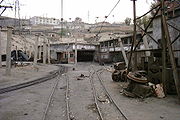
China's coal mining
Coal mining
The goal of coal mining is to obtain coal from the ground. Coal is valued for its energy content, and since the 1880s has been widely used to generate electricity. Steel and cement industries use coal as a fuel for extraction of iron from iron ore and for cement production. In the United States,...
industry is the largest and also deadliest in the world in terms of human safety where thousands of people die every year in the coal pits, compared to 30 per year for coal power in the United States
Coal power in the United States
Coal power in the United States accounts for 46% of the country's electricity production. Utilities buy more than 90 percent of the coal mined in the United States....
. Coal production rose 8.1% in 2006 over the previous year, reaching 2.38 billion tons, and the nation's largest coal enterprises saw their profits exceed 67 billion yuan, or $8.75 billion.
Coal reserves
As of the end of 2006, China had 62 billion tons of anthracite and 52 billion tons of lignite quality coal. This ranks China third in the world in terms of total coal reserves behind the United StatesUnited States
The United States of America is a federal constitutional republic comprising fifty states and a federal district...
and Russia
Russia
Russia or , officially known as both Russia and the Russian Federation , is a country in northern Eurasia. It is a federal semi-presidential republic, comprising 83 federal subjects...
. Most reserves are located in the north and north-west of the country, which poses a large logistical problem for supplying electricity to the more heavily populated coastal areas. At current levels of production, China has 48 years worth of reserves. However, others suggest that China has enough coal to sustain its economic growth
Economic growth
In economics, economic growth is defined as the increasing capacity of the economy to satisfy the wants of goods and services of the members of society. Economic growth is enabled by increases in productivity, which lowers the inputs for a given amount of output. Lowered costs increase demand...
for a century or more even though demand is currently outpacing production.
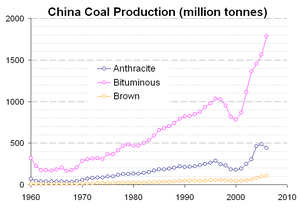
Coal production
Sulfur
Sulfur or sulphur is the chemical element with atomic number 16. In the periodic table it is represented by the symbol S. It is an abundant, multivalent non-metal. Under normal conditions, sulfur atoms form cyclic octatomic molecules with chemical formula S8. Elemental sulfur is a bright yellow...
and ash, and therefore unsuitable for many applications.
| Year | Coal Production (Billion short ton Short ton The short ton is a unit of mass equal to . In the United States it is often called simply ton without distinguishing it from the metric ton or the long ton ; rather, the other two are specifically noted. There are, however, some U.S... s) |
|---|---|
| 2000 | 1.00 |
| 2001 | 1.11 |
| 2002 | 1.42 |
| 2003 | 1.61 |
| 2004 | 2.00 |
| 2005 | 2.19 |
| 2006 | 2.38 |
| 2007 | 2.62 |
| 2008 | 2.72 |
| 2009 | 2.96 |
Demand for coal in China continues to increase, and it is estimated that it will be around 3.06 billion tons in 2010. Furthermore, it is expected that demand will soon exceed production due to factors such as a government crackdown on mines that are unsafe, polluting, or wasteful. Some were shut down for the 2008 Summer Olympics
2008 Summer Olympics
The 2008 Summer Olympics, officially known as the Games of the XXIX Olympiad, was a major international multi-sport event that took place in Beijing, China, from August 8 to August 24, 2008. A total of 11,028 athletes from 204 National Olympic Committees competed in 28 sports and 302 events...
.
On July 6, 2008 in central and northern China, 2.5% of the nation's coal plants (58 units or 14,020 MW of capacity) had to shut down due to coal shortages. This forced local governments to limit electricity consumption and issue blackout warnings. The shortage is somewhat attributed to the closing of small dangerous coal mines.
Inner Mongolia
China's largest open-pit coal mine is located in Haerwusu in the Inner MongoliaInner Mongolia
Inner Mongolia is an autonomous region of the People's Republic of China, located in the northern region of the country. Inner Mongolia shares an international border with the countries of Mongolia and the Russian Federation...
Autonomous Region. It started production on 20 October 2008, and is operated by Shenhua Group
Shenhua Group
Shenhua Group is a state-owned mining and energy company in China. It is the largest coal-producing company in the world. It was founded in October 1995 under the auspices of the State Council of the People's Republic of China.-Activities:...
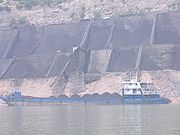
. Its estimated coal output was forecast at 7 million tonnes in the fourth quarter of 2008. With a designed annual capacity of 20 million tonnes of crude coal, it will operate for approximately 79 years. Its coal reserves total about 1.73 billion tonnes. It is rich in low-sulfur steam coal. Mines in Inner Mongolia are rapidly expanding production, with 637 million tons produced in 2009. Transport of coal from this region to seaports on China's coast has overloaded highways such as China National Highway 110
China National Highway 110
China National Highway 110 runs from Beijing to Yinchuan, via Hohhot and Baotou, in Inner Mongolia. It heads northwest from Beijing to Zhangjiakou then heads straight west, and runs to approximately 1,100 kilometres....
resulting in chronic traffic jams and delays.
Coal consumption
China's coal consumption in 2010 was 3.2 billion metric tonnes per annum. The National Development and Reform CommissionNational Development and Reform Commission
The National Development and Reform Commission , formerly State Planning Commission and State Development Planning Commission, is a macroeconomic management agency under the Chinese State Council, which has broad administrative and planning control over the Chinese economy...
, which determines the energy policy of China
Energy policy of China
The energy policy of the People's Republic of China is a policy decided on by the Central Government with regard to energy and energy resources. The country is currently the world's largest emitter of greenhouse gases according to a Dutch research agency. However, China's per capita emissions are...
, aims to keep China's coal consumption below 3.8 billion metric tonnes per annum.
With investment in the coal industry rising at an annual rate of 50 percent in recent years, China will retain its current position as the leading global consumer of coal, even as it endeavors to diversify.
During the first three quarters of 2009 China's coal consumption increased 9% from 2008 to 2.01 billion metric tons.
The consumption of coal is largely in power production, aside from this, there is a lot of industry and manufacturing use along with a comparatively very small amount of domestic use.
| Use | Anthracite | Coking Coal | Other Bituminous |
|---|---|---|---|
| Residential | 0 | 0 | 71.7 |
| Industry | 24.6 | 16.3 | 342.1 |
| Electricity Plants | 0 | 0.2 | 1305.2 |
| Heat Plants | 0 | 0.19 | 153.7 |
| Other Transformation | 0 | 359.2 | 84.0 |
Electricity generation
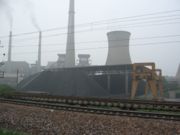
Coal power is distributed by the State Power Grid Corporation.China's installed coal-based electrical capacity was 484 GW, or 77% of the total electrical capacity, in 2006. The dominant technology in the country is coal pulverization in lieu of the more advanced and preferred coal gasification
Coal gasification
Coal gasification is the process of producing coal gas, a type of syngas–a mixture of carbon monoxide , hydrogen , carbon dioxide and water vapour –from coal...
. China's move to a more open economy in the 1990s is cited as a reason for this, where the more immediately lucrative pulverization technology was favored by businesses. There are plans in place for an Integrated Gasification Combined Cycle
Integrated Gasification Combined Cycle
An integrated gasification combined cycle is a technology that turns coal into gas—synthesis gas . It then removes impurities from the coal gas before it is combusted and attempts to turn any pollutants into re-usable byproducts. This results in lower emissions of sulfur dioxide, particulates, and...
(IGCC) type plant by 2010. Furthermore, less than 15% of plants have desulphurization systems.
Domestic use
Indoor air quality
Indoor air quality is a term referring to the air quality within and around buildings and structures, especially as it relates to the health and comfort of building occupants....
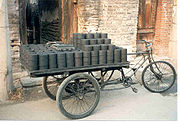
(IAQ). In addition, people eat food cooked over coal fires which contains toxic substances. Toxic substances from coal burning include arsenic
Arsenic
Arsenic is a chemical element with the symbol As, atomic number 33 and relative atomic mass 74.92. Arsenic occurs in many minerals, usually in conjunction with sulfur and metals, and also as a pure elemental crystal. It was first documented by Albertus Magnus in 1250.Arsenic is a metalloid...
, fluorine
Fluorine
Fluorine is the chemical element with atomic number 9, represented by the symbol F. It is the lightest element of the halogen column of the periodic table and has a single stable isotope, fluorine-19. At standard pressure and temperature, fluorine is a pale yellow gas composed of diatomic...
, polycyclic aromatic hydrocarbons, and mercury
Mercury (element)
Mercury is a chemical element with the symbol Hg and atomic number 80. It is also known as quicksilver or hydrargyrum...
. Health issues are caused which include severe arsenic poisoning, skeletal fluorosis
Skeletal fluorosis
Skeletal fluorosis is a bone disease caused by excessive consumption of fluoride. In advanced cases, skeletal fluorosis causes pain and damage to bones and joints.-Forms:...
(over 10 million people afflicted in China), esophageal and lung cancers, and selenium
Selenium
Selenium is a chemical element with atomic number 34, chemical symbol Se, and an atomic mass of 78.96. It is a nonmetal, whose properties are intermediate between those of adjacent chalcogen elements sulfur and tellurium...
poisoning.
In 2007 the use of coal and biomass
Biomass
Biomass, as a renewable energy source, is biological material from living, or recently living organisms. As an energy source, biomass can either be used directly, or converted into other energy products such as biofuel....
(collectively referred to as solid fuels) for domestic purposes was nearly ubiquitous in rural households but declining in urban homes. At that time, estimates put the number of premature deaths due to indoor air pollution at 420,000 per year, which is even higher than due to outdoor air pollution, estimated at around 300,000 deaths per year. The specific mechanisms for death cited have been respiratory illnesses, lung cancer
Lung cancer
Lung cancer is a disease characterized by uncontrolled cell growth in tissues of the lung. If left untreated, this growth can spread beyond the lung in a process called metastasis into nearby tissue and, eventually, into other parts of the body. Most cancers that start in lung, known as primary...
, Chronic Obstructive Pulmonary Disease
Chronic obstructive pulmonary disease
Chronic obstructive pulmonary disease , also known as chronic obstructive lung disease , chronic obstructive airway disease , chronic airflow limitation and chronic obstructive respiratory disease , is the co-occurrence of chronic bronchitis and emphysema, a pair of commonly co-existing diseases...
(COPD), weakening of the immune system, and reduction in lung function. Measured pollution levels in homes using solid fuels generally exceeded China's IAQ air quality standards. Technologies exist to improve indoor air quality, notably the instillation of a chimney and modernized bioenergy but need more support to make a larger difference.
International trade
China became a net importer of coal in 2008. In 2006, its exports exceeded imports by 25.1 million tons, but only by 2 million tons in 2007. This is significantly lower than the 90 million ton net exports in 2001.- Vietnam is the largest supplier of coal to China at 24.6 million tonnes for 2007.
- Australia exported 4.52 million tonnes in 2007.
Carbon footprint
In 2001 the carbon emissions from coal use in China made up about 10% of the world total CO2 emissions at the time. By 2004 this fraction rose to 14%. It is believed that a continued increase in coal power in China may undermine international initiatives to decrease carbon emissions such as the Kyoto ProtocolKyoto Protocol
The Kyoto Protocol is a protocol to the United Nations Framework Convention on Climate Change , aimed at fighting global warming...
, which called for a decrease of 483 million tons by 2012. In the same time frame, it is expected that coal plants in China will have increased CO2 emissions by 1,926 million tons — over 4 times the proposed reduction.
| 1998 | 1999 | 2000 | 2001 | 2002 | 2003 | 2004 | |
|---|---|---|---|---|---|---|---|
| CO2 from coal | 2,363 | 2,287 | 2,339 | 2,472 | 2,518 | 2,731 | 3,809 |
| CO2 from natural gas | 47 | 51 | 57 | 64 | 69 | 72 | 83 |
| CO2 from petroleum | 531 | 566 | 636 | 653 | 686 | 737 | 816 |
| Total CO2 from all fossil fuels | 2,940 | 2,905 | 3,033 | 3,190 | 3,273 | 3,541 | 4,707 |
| Source: DOE United States Department of Energy The United States Department of Energy is a Cabinet-level department of the United States government concerned with the United States' policies regarding energy and safety in handling nuclear material... /EIA Energy Information Administration The U.S. Energy Information Administration is the statistical and analytical agency within the U.S. Department of Energy. EIA collects, analyzes, and disseminates independent and impartial energy information to promote sound policymaking, efficient markets, and public understanding of energy and... |
|||||||
Efforts to reduce emissions
China's first coal-fired power station employing the integrated gasification combined cycleIntegrated Gasification Combined Cycle
An integrated gasification combined cycle is a technology that turns coal into gas—synthesis gas . It then removes impurities from the coal gas before it is combusted and attempts to turn any pollutants into re-usable byproducts. This results in lower emissions of sulfur dioxide, particulates, and...
(IGCC), which is a coal gasification
Coal gasification
Coal gasification is the process of producing coal gas, a type of syngas–a mixture of carbon monoxide , hydrogen , carbon dioxide and water vapour –from coal...
process that turns coal into a gas before burning it, is planned to begin operations in 2009 at Tianjin
Tianjin
' is a metropolis in northern China and one of the five national central cities of the People's Republic of China. It is governed as a direct-controlled municipality, one of four such designations, and is, thus, under direct administration of the central government...
near Beijing. Developed under a project called GreenGen
GreenGen
GreenGen is a project in Tianjin, China which aims to research and develop high-tech low-emissions coal-based power generation plant.- History :...
, this $5.7 bn 650 MW plant will be a joint venture between a group of state-owned enterprises and Peabody Energy
Peabody Energy
Peabody Energy Corporation , previously Peabody Coal Company, is the largest private-sector coal company in the world. The company is headquartered in Downtown St. Louis, Missouri....
. In September 2011, the Chinese government's Ministry of Environmental Protection announced a new emission standard for thermal power plants, for NOx and mercury, and a tightening of SO2 and soot standards. New coal power plants have a set date of the beginning of 2012 and for old power plants by mid-2014. They must also abide by a new limit on mercury by beginning of 2015. It is estimated such measures could bring about a 70% reduction in NOx emissions from power plants.
Beijing
China is considering moving the last four coal-fired power and heating plants out of Beijing's municipal area, replacing them with gas-fired stations, in an effort to improve air quality in the capital. The four plants, owned by Huaneng Power InternationalHuaneng Power International
Huaneng Power International Inc. , or Huaneng, was established in 1994 administrated by the State Council of the People's Republic of China. It is one of the five largest power producers in China. It engages in the development, construction and operation of large power plants...
, Datang International Power Generation Co Ltd, China Shenhua Energy and Beijing Jingneng Thermal Power
Beijing Jingneng Thermal Power
Beijing Jingneng Thermal Power Co., Ltd. is a Beijing coal power producer and district heating supplier listed on the Shanghai Stock Exchange.-Description:...
Co Ltd, have a total power generating capacity of about 2.7 gigawatts (GW).
Coal mine fires
It is estimated that coal mine fires in China burn about 200 million tons of coal each year. Small illegal fires are frequent in the northern region of XinjiangXinjiang
Xinjiang is an autonomous region of the People's Republic of China. It is the largest Chinese administrative division and spans over 1.6 million km2...
. Local miners may use abandoned mines for shelter and intentionally set such fires for heat. One study estimates that this translates into 360 million metric tons of carbon dioxide emissions per year, which is not included in the previous emissions figures.
North China's Inner Mongolia Autonomous Region has announced plans to extinguish fires in the region by 2012. Most of these fires were caused by bad mining practices combined with bad weather. 200 million yuan (29.3 million USD) has been budgeted to this effect.
Accidents and deaths
In 2003, the death rate per million tons of coal mined in China was 130 times higher than in the United States, 250 times higher than in Australia (open cast mines) and 10 times higher than the Russian Federation (underground mines). However the safety figures in the major state owned coal enterprises were significantly better. Even so in 2007 China produced one third of the world's coal but had four fifths of coal fatalities.Pulmonary disease
While not directly attributable, many more deaths are resultant from dangerous emissions from coal plants. Chronic obstructive pulmonary diseaseChronic obstructive pulmonary disease
Chronic obstructive pulmonary disease , also known as chronic obstructive lung disease , chronic obstructive airway disease , chronic airflow limitation and chronic obstructive respiratory disease , is the co-occurrence of chronic bronchitis and emphysema, a pair of commonly co-existing diseases...
(COPD), linked to exposure to fine particulates, SO2, and cigarette smoke among other factors, accounted for 26% of all deaths in China in 1988. A report by the World Bank
World Bank
The World Bank is an international financial institution that provides loans to developing countries for capital programmes.The World Bank's official goal is the reduction of poverty...
in cooperation with the Chinese government found that about 750,000 people die prematurely in China each year from air pollution. Later, the government asked the researchers to soften the conclusions.
Many direct deaths happen in coal mining and processing. In 2007, 1,084 out of the 3,770 workers who died were from gas blasts. Small mines (comprising 90% of all mines) are known to have far higher death rates, and the government of China has banned new coal mines with a high gas danger and a capacity below 300,000 tons in an effort to reduce deaths a further 20% by 2010. The government has also vowed to close 4,000 small mines to improve industry safety. A total of 2,657,230 people worked in state owned coal mines at the end of 2006.
2005
- On February 14, 2005 Over 214 miners were killed in the 2005 Sunjiawan mine disaster2005 Sunjiawan mine disasterThe Sunjiawan mine disaster was a mine disaster that occurred on February 14, 2005 in Fuxin city, Liaoning province, in the northeastern part of the People's Republic of China. Initial reports indicated that at least 214 coal miners were killed, making it the worst mining disaster in China in at...
- On March 19, 2005 an explosion at the Xishui Colliery and neighboring Kangjiayao coal mines killed 72.
- On July 11, 2005 an explosion at the Shenlong mine killed 83.
- On November 27, 2005 171 miners were killed by a blast in the Dongfeng Coal mine in Qitaihe city, HeilongjiangHeilongjiangFor the river known in Mandarin as Heilong Jiang, see Amur River' is a province of the People's Republic of China located in the northeastern part of the country. "Heilongjiang" literally means Black Dragon River, which is the Chinese name for the Amur. The one-character abbreviation is 黑...
province. The mine owner (plus 5 others) was later tried in court for negligence and sentenced to 6 years in prison.
- On December 8, 2005, a gas explosion kills 54 miners and traps 22 in the Liuguantun Mine, TangshanTangshan"唐山"redirects here. For an alternative name of China, see Names of China#TangTangshan is a largely industrial prefecture-level city in Hebei province, People's Republic of China. It has become known for the 1976 Tangshan earthquake which measured 7.8 on the Richter scale and killed at least...
Kaiping district.
2006
- On February 1, 2006 the Sihe coal mine in Shanxi killed 23 miners.
- On May 18, 2006 an Induation disaster at the Xinjing coal mine in the ShanxiShanxi' is a province in Northern China. Its one-character abbreviation is "晋" , after the state of Jin that existed here during the Spring and Autumn Period....
providence killed 56 miners. - On April 29, 2006, 27 miners were killed in an explosion in the privately owned Wayaobao mine in ShaanxiShaanxi' is a province in the central part of Mainland China, and it includes portions of the Loess Plateau on the middle reaches of the Yellow River in addition to the Qinling Mountains across the southern part of this province...
province. Fires, floods and explosions claim about 5,000 deaths every year in Chinese coal mines. - On July 15, 2006 at the Linjiazhuang coal mine in Shanxi an explosion killed 50 people with seven more missing.
- On November 5, 2006 at the Jiaojiazhai coal mine in Shanxi an explosion killed 40 with seven more missing.
2007
- In March 2007, over 100 were killed in 8 tragedies.
- In August 2007, 181 miners died when heavy rains flooded two mines in eastern Shandong province.
- A coal mine gas leak on November 11, 2007 had at least 35 confirmed deaths.
- On December 6, 2007, 105 workers died in a mine blast in Shanxi province's Hongtong county.
2008
- On April 11, 2008, a gas explosion resulted in 14 miners dead and two reported missing in the No. 3 Coal Mine in Huludao's Shaguotan village.
- On September 4, 2008, twenty-four miners were killed and six injured in FuxinFuxin-Economy:Fuxin is a mining center in an agricultural region.The city suffers from the over-mining of coal, which is low in supply while fundamental in Fuxin's economy. As the coal mines run dry, Fuxin is trying to find other industries to keep its economy going...
, LiaoningLiaoning' is a province of the People's Republic of China, located in the northeast of the country. Its one-character abbreviation is "辽" , a name taken from the Liao River that flows through the province. "Níng" means "peace"...
province. - On September 28, 2008, 31 miners were killed and nine were missing in DengfengDengfengDengfeng is a county-level city in Zhengzhou, Henan province. In ancient times, it was known as Yangcheng .Dengfeng has an area of 1220 square kilometers and a population of 630,000....
city, HenanHenanHenan , is a province of the People's Republic of China, located in the central part of the country. Its one-character abbreviation is "豫" , named after Yuzhou , a Han Dynasty state that included parts of Henan...
province. - On November 10, 2008, four were killed and thirteen injured Wannian Coal Mine of Jizhong Energy Group Co., Ltd. in HandanHandanHandan is a prefecture-level city located in the southwestern part of Hebei Province of China.- History :Handan was the capital of the State of Zhao during the Warring States period , after the capital moved from Zhongmu. The city was conquered by the State of Qin after the virtual annexation of...
City, HebeiHebei' is a province of the People's Republic of China in the North China region. Its one-character abbreviation is "" , named after Ji Province, a Han Dynasty province that included what is now southern Hebei...
Province.
3,000 workers were killed in Chinese coal mines during 2008.
2009
- On February 22, 77 miners died and over 100 were injured in an explosion at the Tunlan coal mine in ShanxiShanxi' is a province in Northern China. Its one-character abbreviation is "晋" , after the state of Jin that existed here during the Spring and Autumn Period....
. The blast was China's worst industrial accident in a year, until the November, 2009, Heilongjiang mine explosion. - On March 20, six miners were killed and four were missing at the Lianfa Coal Mine in Qinglong CountyQinglong County, GuizhouQinglong County is a county of Guizhou, China. It is under the administration of the Qianxinan Buyei and Miao Autonomous Prefecture....
, Qianxinan Buyei and Miao Autonomous PrefectureQianxinan Buyei and Miao Autonomous PrefectureQianxi'nan Buyei and Miao Autonomous Prefecture is an autonomous prefecture of Guizhou province in the People's Republic of China.-Subdivisions:The prefecture is subdivided into 8 county-level divisions: 1 county-level city and 7 counties...
, GuizhouGuizhou' is a province of the People's Republic of China located in the southwestern part of the country. Its provincial capital city is Guiyang.- History :...
province - On April 4, twelve miners died in the Jinli Coal Mine in Xingnong Township, Jidong CountyJidong CountyJidong County is a county of southeastern Heilongjiang Province in Northeast China. It is under the administration of Jixi City and is the location of Jixi Xingkaihu Airport....
, JixiJixiJixi is a city in eastern Heilongjiang Province in the People's Republic of China. At the 2010 census, 1,862,161 people resided within its administrative area of 22,351 square kilometers and 757,647 in its built up area made of 4 out of 6 urban districts...
City after water flowed in from an abandoned coal mine. - On April 17, eighteen miners die in a dynamite explosion in a dynamite warehouse of a coal mine in ChenzhouChenzhouChenzhou is a city located in the southern area of Hunan province, People's Republic of China. Its administrative area covers , 9.2% of the provincial area, and its total population reached 4,559,600 as of 2001, 26% of them living in urban areas, 74% of them live in rural areas.-History:Chenzhou...
city, YongxingYongxing CountyYongxing County is a county of Hunan, China. It is under the administration of Chenzhou city.Yongxing, a county in Hunan province, is the home town of the PRC’smarshal Huang Ke Cheng or PRC. It has a population of 630,000 and an area of 1,979 square kilometers that include 8 towns and 17...
. - On May 2, seven people died of gas poisoning at the Xinfeng Coal Mine, DengfengDengfengDengfeng is a county-level city in Zhengzhou, Henan province. In ancient times, it was known as Yangcheng .Dengfeng has an area of 1220 square kilometers and a population of 630,000....
city - On May 15, ten miners die in a mine blast in a licensed private Chashan Coal Mine in ZhaotongZhaotongZhaotong is a prefecture-level city located in the northeast corner of Yunnan province of Southwest China.-Demography:The prefecture, almost exclusively agricultural, is one of the poorest in China, which led the authorities to encourage young people to migrate to eastern and southern parts of...
city, in Zhenxiong county, YunnanYunnanYunnan is a province of the People's Republic of China, located in the far southwest of the country spanning approximately and with a population of 45.7 million . The capital of the province is Kunming. The province borders Burma, Laos, and Vietnam.Yunnan is situated in a mountainous area, with...
province. - On May 16, eleven miners die of asphyxiation in ShuozhouShuozhouShuozhou is a city in the north of Shanxi Province in North China, located on the upper reaches of the Fen River. As of 2004, its population is approximately 1.25 million, and the city has an area of approximately 5,737 square kilometres. Administratively, Shuozhou is a prefecture-level city, with...
, ShaanxiShaanxi' is a province in the central part of Mainland China, and it includes portions of the Loess Plateau on the middle reaches of the Yellow River in addition to the Qinling Mountains across the southern part of this province...
province.
- On May 29, a gas explosion at the Tonghua coal mine associated with the Songzao Mining Bureau of Chongqing in ChongqingChongqingChongqing is a major city in Southwest China and one of the five national central cities of China. Administratively, it is one of the PRC's four direct-controlled municipalities , and the only such municipality in inland China.The municipality was created on 14 March 1997, succeeding the...
kills 30 and injures 59. - On November 21, 104 people were reported dead and 4 others trapped underground at the Xinxing mine in HeilongjiangHeilongjiangFor the river known in Mandarin as Heilong Jiang, see Amur River' is a province of the People's Republic of China located in the northeastern part of the country. "Heilongjiang" literally means Black Dragon River, which is the Chinese name for the Amur. The one-character abbreviation is 黑...
province. China Central TelevisionChina Central TelevisionChina Central Television or Chinese Central Television, commonly abbreviated as CCTV, is the major state television broadcaster in mainland China. CCTV has a network of 19 channels broadcasting different programmes and is accessible to more than one billion viewers...
reported the news, and said that the cause was a gas explosion. The mine is run by one of China's top 520 state-owned enterprises, according to the Web site of its owner, the HegangHegang-Subdivisions:The prefecture-level city of Hegang is divided in 6 districts and 2 counties. The information here presented uses the metric system and data for 2010 Census.-Early History:...
branch of the Heilongjiang Longmei Holding Mining Group. It says the Hegang branch has more than 88,000 employees. The mine is located near the border with RussiaRussiaRussia or , officially known as both Russia and the Russian Federation , is a country in northern Eurasia. It is a federal semi-presidential republic, comprising 83 federal subjects...
, about 250 miles (400 kilometers) northeast of the provincial capital, HarbinHarbinHarbin ; Manchu language: , Harbin; Russian: Харби́н Kharbin ), is the capital and largest city of Heilongjiang Province in Northeast China, lying on the southern bank of the Songhua River...
. The reported death toll climbed near 90 by the next day.
2010
- In January, at least 25 people are killed and at least three others are trapped in a mine fire in Xiangtan CountyXiangtan CountyXiangtan County is a county of Hunan, China. It is under the administration of Xiangtan city.-References:*...
in HunanHunan' is a province of South-Central China, located to the south of the middle reaches of the Yangtze River and south of Lake Dongting...
. - On March 29, 153 people were trapped in a coal mine by a flood2010 Wangjialing coal mine floodThe Wangjialing coal mine flood is an incident that began on Sunday, March 28, 2010, when underground water flooded parts of the Wangjialing coal mine in Shanxi province, People's Republic of China. A total of 261 people were in the mine when workers first broke through an abandoned shaft that was...
that occurred by breaking into a water-filled shaft in the Wangjialing coal mine in ShanxiShanxi' is a province in Northern China. Its one-character abbreviation is "晋" , after the state of Jin that existed here during the Spring and Autumn Period....
.
- On May 13, at least 21 people were killed and at least five were wounded when an explosion occurred at the privately run Yuanyang colliery2010 Yuanyang colliery outburstThe Yuanyang colliery outburst occurred at the privately run Yuanyang colliery in Puding County, Anshun, Guizhou, People's Republic of China, at 9:40 p.m. on 13 May 2010. At least 21 people were killed and at least five were wounded....
in Puding CountyPuding CountyPuding County is a county of Guizhou, China. It is under the administration of Anshun city....
, AnshunAnshunAnshun is a prefecture-level city in China in the southwestern province of Guizhou where the famous Huangguoshu Waterfall is located. Within the borders of its prefecture one also finds attractions such as Long Gong Dragon Caves and the Getu River. As of 1999, it had a population of 217,215...
, GuizhouGuizhou' is a province of the People's Republic of China located in the southwestern part of the country. Its provincial capital city is Guiyang.- History :...
.
The government has been cracking down on unregulated mining operations, which account for almost 80 percent of the country's 16,000 mines. The closure of about 1,000 dangerous small mines last year helped to cut in half the average number of miners killed, to about six a day, in the first six months of this year, the government has said. Major gas explosions in coal mines remain a problem, though the number of accidents and deaths have gradually declined year by year, the chief of the State Administration of Work Safety
State Administration of Work Safety
The State Administration of Work Safety , reporting to the State Council, is the non-ministerial agency of the Government of the People's Republic of China responsible for the regulation of risks to occupational safety and health in China....
, Luo Lin
Luo Lin
Luo Lin is a female Chinese softball player who competed at the 2004 Summer Olympics.In the 2004 Olympic softball competition she finished fourth with the Chinese team. She played four matches as outfielder.-External links:*...
, told a national conference in September.
In the first nine months of 2009, China's coal mines had 11 major accidents with 303 deaths, with gas explosions the leading cause, according to the central government. Most accidents are blamed on failures to follow safety rules, including a lack of required ventilation or fire control equipment.
Unofficial estimates often estimate death tolls at twice the official number reported by the government. Since 1949 over 250,000 coal mining deaths have been recorded. However, since 2002, the death toll gradually decreases while the coal production nearly doubles in the same period.
By year
| Year | Number of accidents | Deaths | Death rate per million tons of coal |
|---|---|---|---|
| 2000 | 2,863 | 5,798 | 5.80 |
| 2001 | 3,082 | 5,670 | 5.11 |
| 2002 | 4,344 | 6,995 | 4.93 |
| 2003 | 4,143 | 6,434 | 4.00 |
| 2004 | 3,639 | 6,027 | 3.01 |
| 2005 | 3,341 | 5,986 | 2.73 |
| 2006 | 2,945 | 4,746 | 1.99 |
| 2007 | 3,770 | 1.44 | |
| 2008 | 3,210 | 1.18 | |
| 2009 | 1,616 | 2,631 | 0.89 |
Source: State Administration of Work Safety
State Administration of Work Safety
The State Administration of Work Safety , reporting to the State Council, is the non-ministerial agency of the Government of the People's Republic of China responsible for the regulation of risks to occupational safety and health in China....
International opinions
In October 2008, GreenpeaceGreenpeace
Greenpeace is a non-governmental environmental organization with offices in over forty countries and with an international coordinating body in Amsterdam, The Netherlands...
, World Wildlife Fund, and The Energy Foundation published The True Cost of Coal, a report that said that by-products of coal burning such as water pollution, air pollution and human costs such as mining deaths are costing China an additional 1.7 trillion yuan per year, or more than 7% of GDP. They recommended that China increase the price of coal by a tax of 23% to reflect the true costs of China's reliance on coal.
Other commentators have pointed out that China has been taking a role as a leader in making use of coal as an electricity source more clean and responsible. For instance, the country built new ultra-supercritical coal plants (~44% efficiency) before the United States. While the average efficiency of the coal fleet in China remains less than that of the US, the gap is quickly closing. China has required companies building new plants to retire an old plant for every new one built.
See also
- China National Coal Group CorporationChina National Coal Group CorporationChina National Coal Group Corporation, formerly China National Coal Industry Import and Export Corporation, is a coal mining enterprise controlled by State Council of the People's Republic of China. It is the second largest state-owned coal mining enterprise in Mainland China, and the third largest...
- Shenhua GroupShenhua GroupShenhua Group is a state-owned mining and energy company in China. It is the largest coal-producing company in the world. It was founded in October 1995 under the auspices of the State Council of the People's Republic of China.-Activities:...
- Asian brown cloudAsian brown cloudThe Asian brown cloud is a layer of air pollution that covers parts of South Asia, namely the northern Indian Ocean, India, and Pakistan. Viewed from satellite photos, the cloud appears as a giant brown stain hanging in the air over much of South Asia and the Indian Ocean every year between January...
- Other coal companies of China
- Clean coalClean coalHistorically used to refer to technologies for reducing emissions of ash, sulfur, and heavy metals from coal combustion; the term is now commonly used to refer to carbon capture and storage technology...
technologyClean coal technologyClean coal technology is a collection of technologies being developed to reduce the environmental impact of coal energy generation. When coal is used as a fuel source, the gaseous emmissions generated by the thermal decomposition of the coal, include sulphur dioxide, nitrogen dioxide, carbon...
Other countries
- Coal in the United States
External links
Organizations- China Coal Society
- Coalbed Methane Committee - China Coal Society
- China Coal Industry Development Research Center
- China Coal Industry Network - Chinese coal industry's information, policy, science and technology, statistics and other information.
- China Coal Industry Association
- Statecoal.com - National Coal Network
- General Administration of Coal Geology
- State Coal Mine Safety Supervision
- National Coal Mine Safety Supervision Bureau
- Coal Mining Production Safety Information Network
- China Coal Research Institute - Coalfield Geology and exploration, coal mining, coal mine safety, coal mining machinery, coal washing, coal mine environmental protection, pipeline transporting coal and other professional applied & basic research.
- Beijing Research Institute of Coal Chemistry
- List of coal research institutes in China
Articles
- Peter Fairley, Technology Review. Part I: China's Coal Future, January 5, 2007.
- Peter Fairley, Technology Review. Part II: China's Coal Future, January 5, 2007.
- China to enhance coal industry restructuring
- The True Cost of Coal: Greenpeace China Report on China's Coal Crisis